One hit wonders

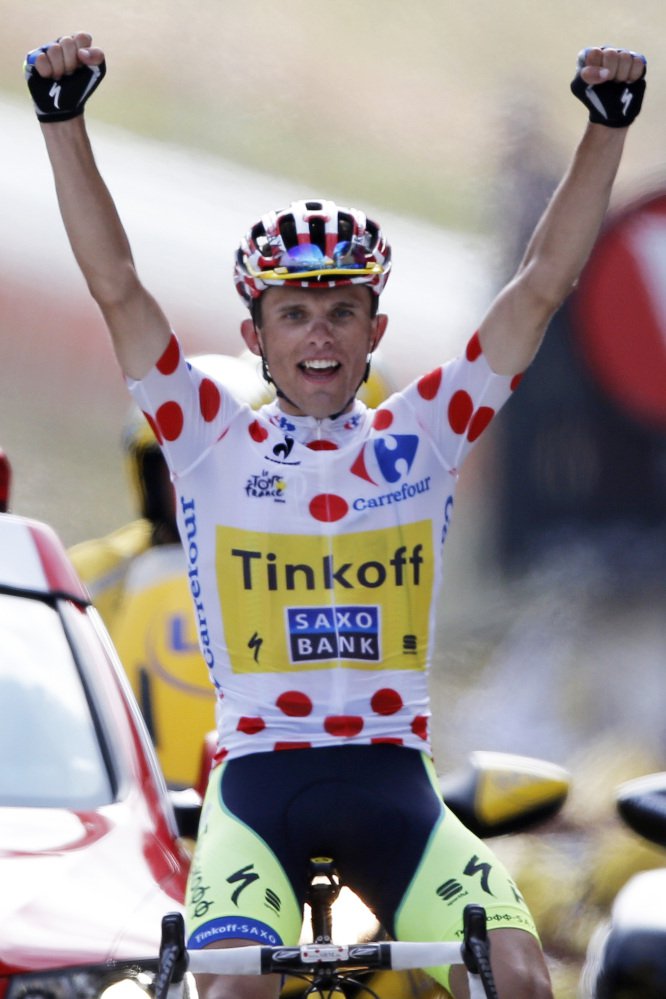
313113_Cycling-Tour-de-France.JP6_In the massive controlled chaos that is the Tour de France, it is accepted that getting a stage win in the race is considered a peak in a cyclist’s career. It takes so much work and so much talent to get to that point in a cyclists pro journey, the fact of crossing the line first in a Tour stage is a pinnacle seldom attained.

There are only 20-some chances for victory during each year’s Tour. Out of those twenty stages, there are only a few cyclists with a real chance for victory in each stage. These are the also usually the result of calculated attempts by team managers to set up one of the top team members for a shot at a stage win. It is very, very hard to win a stage of the Tour all on your own. You must be very talented. And very lucky.

Yet such victories are important because earning results for the team is vital to sponsors. No sponsor likes to pay millions to support a team and get zilch in terms of exposure. That’s also why there are solo breakaways, to gain exposure and camera time for team sponsors.

One Hit Wonders

The entire enterprise resembles the former setup of the music industry where record labels once vied for opportunities to get their artist a number one hit. When a hot little tune came along that people seemed to like, the hype machine would kick into gear. If you got lucky, the song would rise the charts in terms of sales and the group would gain popularity. If talent and timing held out, there might be a string of records that make it to hit status. When a mega-talent such as the Beatles comes along, the term One-Hit Wonder grows even more dramatic by comparison.

that-thing-you-do-1996-04-gOf course there are plenty of One Hit Wonders to testify to the fact that it is both a difficult and lucky thing to have a record climb the charts. The wonderful Tom Hanks movie “That Thing You Do” chronicles the rise and ultimate dissolution of a pop band from Erie, Pennsylvania. The song “That Thing You Do” is even an aberration of sorts. Written as a ballad, the song launched from first into fifth gear when the substitute drummer hammered into a faster beat and created a hit out of nothing.

Or, if you prefer your One Hit Wonders a bit grittier, you need to check out the movie or play called The Commitments. This movie makes you appreciate the grit and hard work it takes to make it, and how fast things can go wrong even when they’re going right.

Once hit, twice shy? No way. 

We can all relate, right? It’s the same with those who run and ride. You can be cruising along in your training only to pick up an injury at the last minute or crash into a tree. Just like me. Ha ha. Talk about a one-hit wonder. Wondering what hit me? One downed tree!

bike-wobble-1But you gotta get back on your bike and ride. That’s what I did after the bike wobble crash as well as the one-hit encounter with the tree.

Well, such is the case it seems with many a pro cyclist as well. That state of fitness allowing you to ride at the front of the peloton only comes along once in a while. Everything has to be right. The diet. Training. Even the weather can play havoc with well-made plans. Or you can crash out in spectacular style. God Bless Johnny Hoogerland. He got back on the bike and rode that very day the support vehicle drove him into a ditch and a barbed wire fence that did surgery on his butt cheek.

Johnny got back on the bike because that’s what one-hit wonders have to do. Keep on trying.

Singing a different tune

Those of us that engage in these sports of running, riding and swimming understand the ephemeral nature of real fitness. Yet that’s also why pro athletes are so amazing. They seem to have a different type of engine in them. Indeed, most of them amount to physiological geeks. They are born with certain traits that lend them the ability to train that hard and perform at a level most of us can only hold for a mile or two, if that.

120820055254-san-diego-rock-n-roll-marathon-story-top The comparison between athletics and music holds true in that respect as well. Most people with good voices have that natural ability. Yes, training helps tremendously. But if you can’t really sing in the first place, you’re not going to win American Idol or The Voice.

That’s what makes the early rounds of shows like American Idol so interestingly raw. Back when the show started, the early rounds were nothing short of cruel, taking advantage of hopeless dreams and crazed characters that actually thought they could sing. Let’s admit it: We all laughed at their efforts, especially the guy Simon called a Sugar Glider. Mean, yet funny. He looked weird and he could not sing. Yet deep down we know that when we sing in the car most of us sound just as bad, or worse.

So that whole American Idol thing was rather like taking an everyday bike path cyclist and throwing them into a Tour stage. What did we think would happen? Yet delusion and desire often go hand and hand. That’s the entire premise of reality TV.

Reality TV

Of course the Tour de France is also a form of reality TV. Pro cyclists such as Matthew Busche that chronicle their Tour experiences admit that while there are team plans and individual goals, it really comes down to being opportunistic and avoiding disaster. You either discover your strength at a critical moment or it fades away into obscurity.

The dramatic nature of such discoveries is still what makes cycling a compelling event to watch. Once in a Grand Tour while, whether it be the Giro de Italia, the Tour de France or the Vuelta a Espana, there are moments when riders break free into some sort of weird stratosphere where the legs are good and the lungs pull oxygen out of nowhere. It can be thrilling to watch. Like Thor Hushovd. 

Once in a while a rider gets into a breakaway and the brute strength of the peloton cannot catch them. Sometimes it comes down to a singular moment. Right down to the wire. That lone cyclist is pedaling for all they’re worth as the peloton like an uncaged animal thrusts and claws its way toward the finish line. But the rider stays away and raises their arms in victory.

europcars-thomas-voeckler-of-france-descends-the-col-du-galibier-during-the-ukeurosportyahoocom-1And once in a very great while a rider strings together a succession of one-hit wonders as did French cyclist Thomas Voeckler, riding on guts and pride to lead the Tour de France. Inspiring.

Who cares if they are a one-hit wonder? Riding 10,000 miles a year to represent a pro team in cycling requires total sacrifice. So does training at elite levels in distance running.

Equivalencies

It still makes me shake my head that a pro-golfer earns a million dollars for winning a tournament while a world class marathoner wins $100,000 for running a marathon, but there are a lot of things in this world that do not seem fair by comparison.

Cudworth Racing SycamoreI can only speak to competing at a sub-elite level, yet the commitment to race even at that level required everything I had to achieve results. Like a singer at the microphone, you pour your guts into every line with the hope that you will connect with that universal energy that carries you to your dream.

Those of us without rock star capability can still attain results that inspire. When we get out there and try our best it does not matter if we are leading a Tour stage or coming down the final 400 meters of the Boston Marathon ahead of everyone else. We can be our own One-Hit-Wonder and be proud in the reality of breaking out of our own expectations.

And if we’re really smart and really lucky, we even pull out a string of hits over time. So here’s to all of us One Hit Wonders.

werunandridelogo

Posted in cycling | Tagged , , , , , , , , , , , | Leave a comment

Who’s your biggest fan? I am!

Race StartThe start of the Sly Fox Half Marathon and 10k in St. Charles, Illinois was murky and a bit dark. Skies were threatening with 100% chance of rain predicted.

Yet here were the stalwart runners crowded into corrals waiting to embark on a race that would be full of surprises. For one thing, it did not rain much in the next two hours, so at least half the participants got home before the skies opened up.

But the real surprise to so many participants were the hills. And lots of them.

In the Fox Valley in Illinois there are two reasons for hills. The Fox River is one. Glacial deposits are another. Without those two natural phenomena there would be no hills because glaciers 10,000 years ago pretty much flattened the entire eastern half of northern Illinois.

The women's race leader at four miles. She went on to run 1:27.

The women’s race leader at four miles. Bronwen Douglas ran 1:26:32. 

But if you hug the river there are climbs up the valley hills as well as rolling hills on glacial kames west of the river.

These provided plenty of interest for runners in the Sly Fox Half Marathon. The race started out on an equal sea level to the river. Then it climbed. And climbed again. But that was not enough. It still climbed some more, all the way to one of the highest points in central Kane County.

I watched the start of the race and then pedaled my mountain bike out to a spot on the course where I could cheer on the runners and look for my gal pal Sue to come past. It was gloomy out, so I decided to sing. Loudly. “You’ve got to love these hills…” I sang to each new group of runners coming past.

“No, I don’t,” one guy laughed.

“Who put these here?” a woman runner said.

“Thanks for cheering,” a few said upon hearing me clap and holler encouragement.

That was at the three mile point. But this was all my old running territory from high school. So I knew all the short cuts and showed up at the five mile point too.

“All downhill for half a mile here,” I chortled.

“Thanks for telling us,” a group of women smiled. I kept up the banter and people smiled and waved. “Nice to see you again,” someone called out.

Runners (including my gal Sue in pink socks) cresting one of many hills on a gloomy day.

Runners (including my gal Sue in pink socks) cresting one of many hills on a gloomy day.

My gal Sue came running past, looking and feeling good. “Nice downhill from here,” I told her. “Thanks,” she laughed.

Then I pedaled on up to the seven mile point and waited for all my newfound friends to arrive again. The leader came whipping past with a 400 meter gap to second place. “Looking good!” I cheered. “Love the tempo.” He ran 1:17. Not bad on a hilly course. (Eric Viverito, 1:17:09)

That’s the life of a distance runner. You have to be your own best fan at times. Cheer yourself on despite your own stupidity. I recall a similar style course in La Crosse, Wisconsin that I raced. There was a half-mile long hill we had to climb. At the top I recall having absolutely no feeling or strength left in my buttocks. Fortunately there was a long downhill on the other side. But it’s a strange thing to be maxxed out completely during a race. I finished in 1:12 that day. That night we drank like crazy people with the college guys from La Crosse. One showed up at parties as Naked Man. He wore nothing but an apron, and somehow found a way to lose even that during the evening. The next morning we all got up and ran 10 miles hung over and laughing at the exhaustion we felt from the day before, but no one complained.

Which is why it’s so fun to get out and cheer on other runners. And at the eight mile point I parked my bike again and yelled crazily for the runners I now recognized, and they recognized me. “Dude, you’re everywhere!” one called out.

“For you! Run faster now! Only five miles left!”

The race leader at the eight mile point. He ran 1:17.

The race leader at the eight mile point. He ran 1:17.

It was the same at the 10 mile point too. By now people were expecting me to show up. It was fun seeing their smiling faces as they approached. “Way to work that hill!” I called out, because they were climbing a 300 meter stretch that was once part of my high school cross country course from four decades ago.

Sue came by looking relaxed and smooth. I rode with her for a bit and she was on pace for a good time.

So I rode ahead and caught up with two gals that could have been twins. Well, one of them might be having twins. At three months she already had a healthy baby bump. “I’m pregnant too,” her friend piped up.

“Then I’m cheering for all four of you,” I laughed.

At the finish it got colder and started to rain. I didn’t catch up with all my new friends but saw some of them in the beer garden. “Thanks for cheering us on!” several yelled over the crowd noise.

It’s all part of being a runner or a cyclist. Who’s your biggest fan? I am. Way to go all of you.

Posted in Uncategorized | Tagged , , , , | 1 Comment

Dropping a few pounds in London.

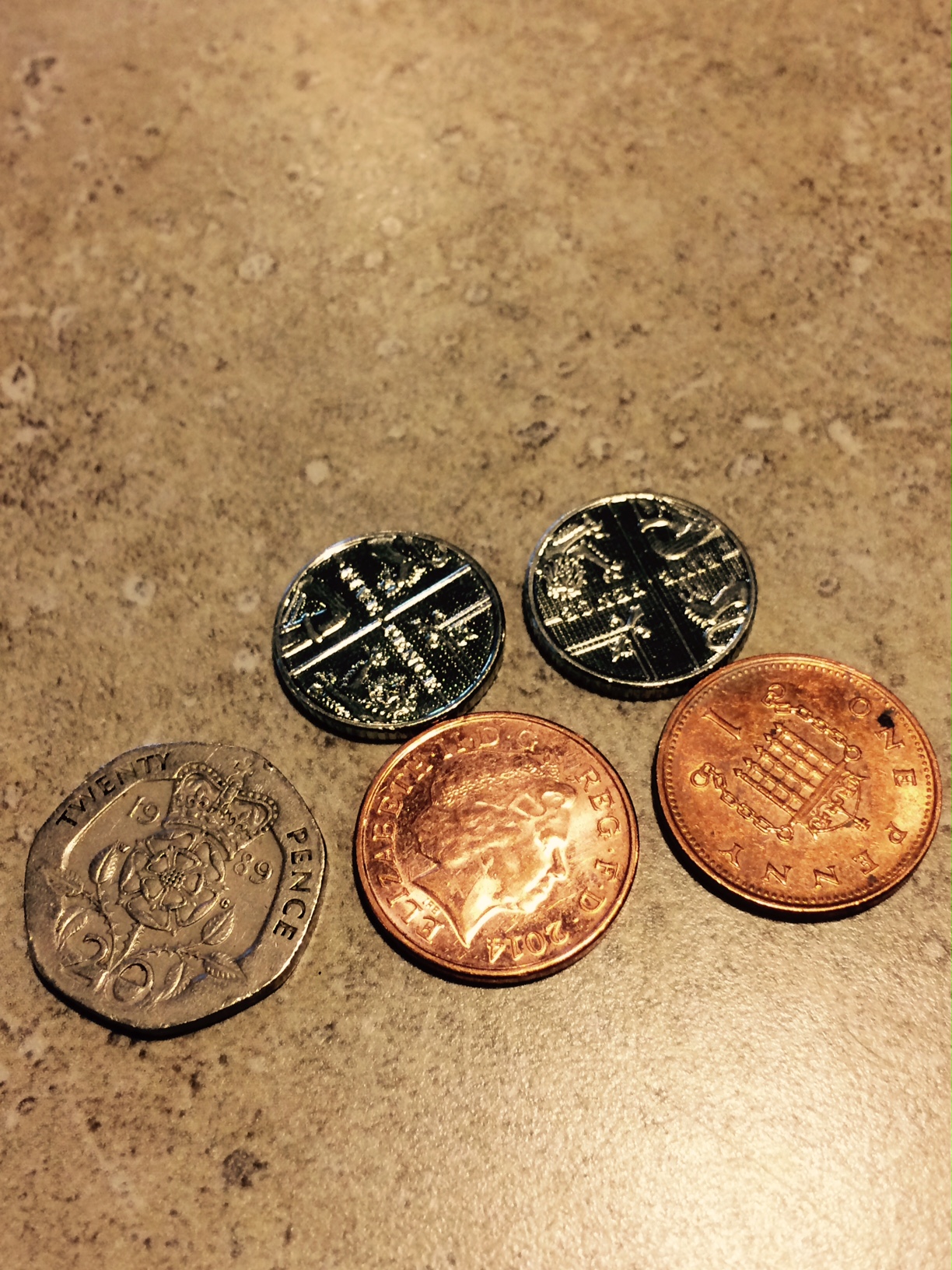
IMG_7127The exchange rate between the United States dollar and the English pound is a bit lopsided these days. You really don’t want to know what you’re spending in London. Not in dollars anyway. If there was a mile race between the pound and the dollar, the English pound would start out a lap and a half or more ahead. That’s really not fair.

Perhaps it would be a bit more fair if the English pound were actually forced to wear one of those sets of armor that knights once wore in medieval times. That’s right, I just wrote the words “medieval times” because there really is a fine line between legend and reality at play in Great Britain.

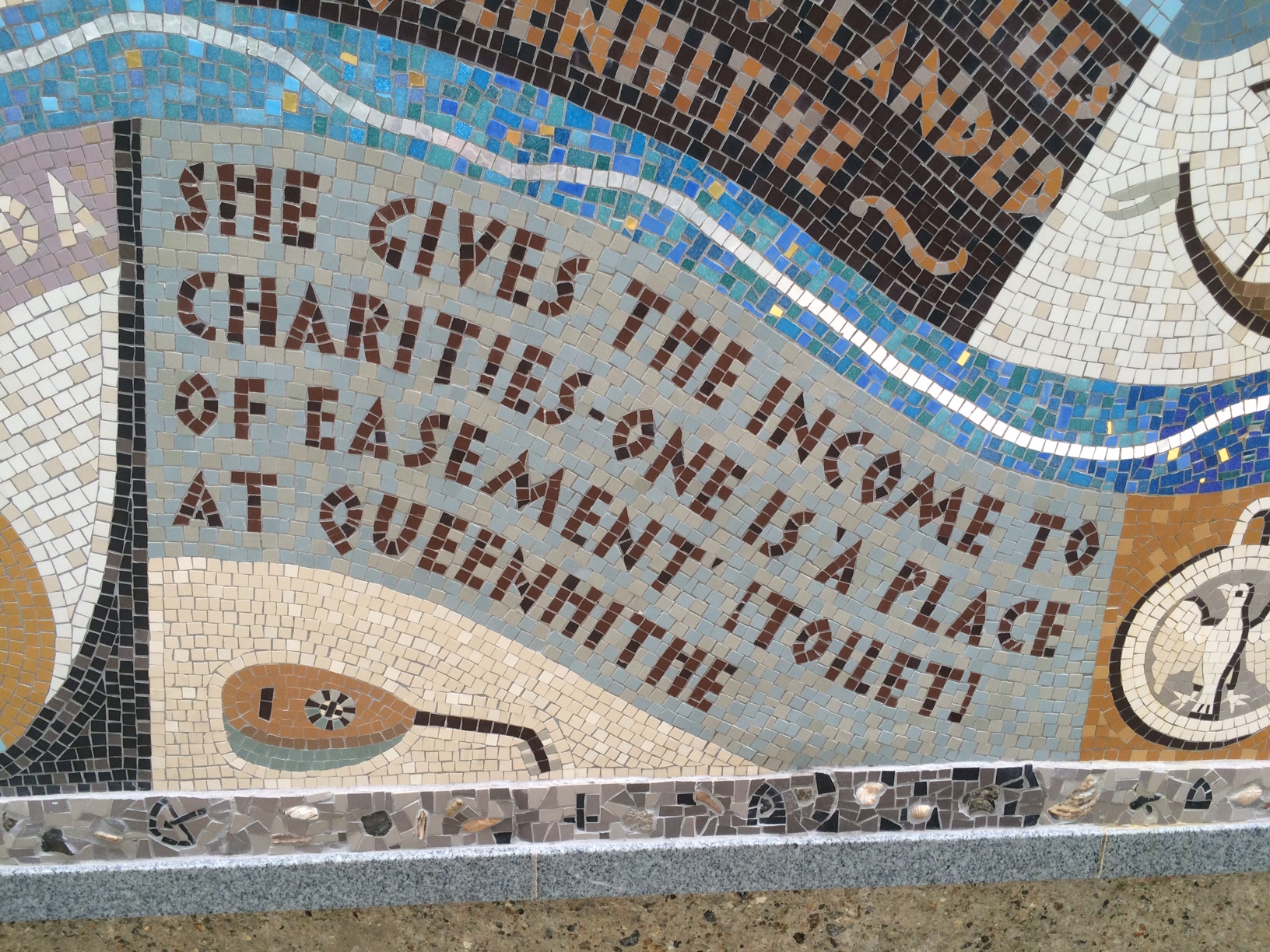
She GivesThat’s how the royals actually kept things in line. The illusion of control was actually just as important at times than the actual fact of having everything in good shape and good order.

Generally the peasants went along with kingly rule so long as the royals did not abuse the privilege of their stature.

Off With His Head! And Again. 

We know of a particular incident in which the Duke of Canterbury or some other official of the king’s court once levied one too many taxes on the good people of England and 10,000 peasants gathered from the countryside and stormed the Tower of London looking for the royal sot who was raping them for pence and pound.

Knights and UsIt happened that at the moment the peasant mob arrived at the castle, the gates were very much unlocked. Either someone forgot to lock the gate, or else the commoners held the sympathies of the guards, and the mob waltzed right in looking for the Duke and calling for his head.

They honestly left the king alone because he was only a kid of 14 at the time. They knew he was not responsible for the lying ways of the treasury demanding more money from the peasantry for the royal treasury. So they searched the castle until they found the money-grubbing Duke and hauled him off toward Tower Hill where they lined him up on the chopping block and gathered a crowd to watch justice be served. Off with his head! But unfortunately it took a full eight whacks of the axe to remove the Duke’s head. Apparently the peasants were not too practiced in such an endeavor.

And that, my friends, is where the Monty Python part of English Legend must step in to help us tell the rest of this story. Because we can imagine that after the first whack of the axe that did not remove the Duke’s head, he might have raised his voice in protest and shouted at the crowd. “And for that I will raise your taxes again!” Then the axe would fall yet again. And still the Duke’s head was attached. So he’d scream. “And AGAIN I SAY!”

With each successive (yet unsuccessful) whack of the axe the Duke would shout “And AGAIN!” until at last, having hung by a spouting thread of a bloody throat, the head of the Duke would roll down the hill and come to rest at the feet of a peasant child. Who, surprised to see a face with no body staring up at him from the ground, would mutter kindly, “Can I help you sir?”

And that’s how the Monty Python Version of British History typically plays out.

Not far from reality

See, stories like that really never are far removed from the real thing. That’s what makes English Legends and Monty Python’s movie The Holy Grail so darn funny. Because whether it’s hapless knights or obnoxious French palace guards rapping their helmets and shouting, “I fart in your general direction,” the humorous truth is never that far from the serious reality of what has gone on in history. We honestly can’t tell the two apart sometimes. 

Funny money

So we must consider the fact that currencies such as pounds or dollars are themselves quite funny things. The value of an American dollar against the English pound is supposedly how much you can buy with the “value” of each respective currency. Yet you can’t spend a dollar in England the way you spend a pound, or the other way around. So there’s no opportunity for direct comparison between the two.

So you face a choice when you get to Great Britain. You can exchange your dollars and get about 50% of that value in pounds at some skeezy booth where the attendant almost can’t help laughing at your pittance dollars against the pound, or you can use your credit card and pretend you’re actually spending dollars when in fact the people at your bank back home are watching your account shrink before their very eyes as if it were some horrid science experiment gone wrong.

Yet that is a much better strategy if you don’t want to get depressed.

It’s a sweet illusion that when you swipe your VISA through the credit card machines the conversion genie does the math for you. The magic of credit or debit works whether you’re buying a four-pack of Stella Artois or a pack of souvenir drawing utensils and art supplies from the Tate Modern Art Museum. Which is exactly what I did. And it cost me 58 lbs. Or about 90 dollars. Magic!

Stinky dealings

All this stench of money conversion comes out in the wash eventually. And that brings up the other smelly task you’re forced to do when you return from a vacation and have not had time to wash your running or cycling clothes while on “holiday,” which is what the British call vacation.

In fact a conversation very much like this occurred between Sue and before our last run around London yesterday morning

“Phew. I stink,” I said.

“Yes,” she replied. Then politely added. “I must stink too.”

On such pleasant exchanges are relationships formed and made. We put up with each other’s little stinks on occasion but mostly run around having fun and talking about cool shit and messing with robins in Hyde Park by using my UK birding app to make them think there was a new male singing on their territory. Mean, but fun to hear a merry little robin talking to us in person.

Running around London

Yesterday morning as we ran a merry little loop along the Thames, many other runners were traipsing about with serious expressions on their faces. That’s because Thursday was Vrigin Money logo with time clocktheir first day in town to go for a run and shake off the jet lag in advance of Sunday’s Virgin Money London Marathon. That’s the actual name of the race this year. The Virgin Money London Marathon.

See how all this money talk is converging now? Yet what a wonderfully, almost tragically ironic name for a business focused on money. Virgin Money. That Richard Branson sure knows how to titillate and tease every subject, doesn’t he? It never ends with him.

No such thing as virgin money

Actually Virgin Money is not so strange a concept as it might seem. Back when a long line of kings were in charge of the currency in England they often had to address problems with the condition and reality of their money. Coins wore out back then because originally they were little more than hammered bits of metal, silver and gold and copper. After 200 years of use these coins would lose some of their weight (because people clipped them and melted down the shavings) and the images would wear off.

Of course this pissed off the kings to no end. But the kings were no innocent party in money laundering either. We know that Henry VIII worked on the cheap by sneakily coating a large batch of copper coins with silver to fob them off as the real thing. Trouble began when the silver began wearing off because people could see the wear on the very image of King Henry’s visage. That’s why the citizens all called him Old Coppernose. It wasn’t a compliment.

Forgeries

MoneyThere was plenty of forgery to deal with back then as well. The Royal Mint was an important function of the stability of the state. Because if you could not control the quality and quantity of the money you issued, the entire economy could collapse. In fact the entire nation of England actually ran short on coin stock for a while and resorted to stamping money from other countries such as France to make it their own. “It spends the same,” seemed to be the reasoning. And doesn’t that sound familiar today? The illusion is more important than reality when it comes to money and currency. 

If Richard Branson himself were actually King of England these days, one wonders what he might do to revise the currency system. After all, Branson has a knack for turning stodgy precepts on their heads. Heathrow Airport was full of his sassy little Virgin Atlantic planes, and there is a Virgin line of health clubs in London. One can just hear the campaign if he were to be named king. “We’re all Virgins now.”  Or, “Keep Calm and Grab a Virgin.” That would work. 

Virgins here and there

Virgin this. Virgin That. When people step to the starting line of the Virgin Money London Marathon who knows what they’ll find? Will they be asked to bend over and receive Virgin Timing Chips up their Virgin Asses? That would be fun to watch. Thousands of runners bent over with their shiny little ass cheeks glowing under the London Sun. And those first few miles adapting to the feel of a chip up their ass? You talk about good television. Who wouldn’t pay to watch that? It all has a Pythonesque feel, you might say. 

End of the World

Or perhaps, as some tightass religious types would have us believe, that would be a sign of the End Times and the Second Coming. If you signed up for the London Marathon and your big number is 666, watch out. You could be the Anti-Christ.

Craig_VirginBut think about this. Wouldn’t it be great if America’s Craig Virgin were still racing and actually won the Virgin Money London Marathon? The headlines on the British rags would be fantastic! 

VIRGIN WINS THE VIRGIN!

VIRGIN IS VIRGIN WINNER!

DON’T STOP NOW, SAYS VIRGIN!

VIRGIN’S THE WORD!

Well, I’ll stop with the Virgin jokes now. Craig has probably heard them all. But on chance that he has not, perhaps you can submit a few more Virgin headlines in the comments below this blog. Because I know that Craig Virgin actually reads this blog and he’ll really enjoy all of us using his name to make naughty jokes. Trust me on that one. He’s no Virgin when it comes to a bit of randy humor.

A good dirty joke is worth its weight in pounds

What runner or cyclist doesn’t enjoy a good dirty joke to lighten up the run or ride? It helps pass the time when the training gets long or dull. I’ve known runners and cyclist to draw a good joke or story out for miles at a time before delivering the punchline.

None of us seems to be virginal in that respect. Although once in a while we find someone with a delicate set of ears in our midst, who blush at mention or commentary on sex or the particular attributes of the other athletes passing us by. There really are many kinds of virgins in this world, including some marathoners that will drop a few pounds to run the Virgin Money London Marathon.

They’re everywhere

They were all over Hyde Park and Kensington Gardens this week in their runner garb. Londoners know to watch out for those who run and ride. And this weekend, with so many foreigners flipping into town without a clue how to look for oncoming traffic, there likely will be a few close calls before the race gets going and takes over the streets of London for a day.

IMG_7618It’s all part of the thrill of competing in a strange place on streets that don’t look like yours. There may even be a few spots where runners skirt some cobbles laid down by kings 500 years ago. London’s like that. It’s rather like an exchange rate for time, this place. You go in thinking you’re going to be running in the year 2015 and find yourself next to a stolid stone wall holding graffiti from a peasant revolt.

Perhaps that what the London Marathon truly is, after all. The guidebook for the Tower of London has a section titled “THE PEASANTS ARE REVOLTING!” which says a lot about how the royals and much of British society must really think. The headline could have been said something like THE PEASANTS REVOLT but that would not have contained the same subliminal message, now would it? 

Which brings us full circle to the Virgin Money London Marathon. Because most marathons resemble some sort of peasant revolt. We take over the streets blocking traffic and throwing cups all over the place. We shit in porta-potties creating a stink to high heaven. The lead pack goes charging forth while the laggards and those thick of frame or lame with training bring up the rear.

IMG_7483It’s all apparent how and why this grand parade comes about. An excess of pounds and age slows down the mob so that by the time the fit and fast are through, there is nothing to do but sweep the streets and mop up the mess as the last of the peasants completes their bloody rounds. It goes to show you that some things never change. Pound for pound, we’re all the same in the end.

The the King or Queen walks to wave their hand at the crowd, then secretly shake their head in wonder and return to the castle for another year. “I’ve have to raise the price for this mess,” they mutter to themselves. Because that’s how it all works.

werunandridelogo

Posted in Christopher Cudworth, marathon, We Run and Ride Every Day | Tagged , , , | 1 Comment

Why it pays to travel with two smart women

We played a game of chess in the park.

We played a game of chess in the park.

From the moment we landed in Great Britain it was my benefit to be in the company of two very smart women. Sue is a great organizer and her daughter Sarah is a pragmatic person and now experienced in the ways of life in England given her four-month study in Oxford.

Between the two of them, there were very few stressful moments here. Occasionally we’d run up against a train schedule versus a show across town. Other than that, navigating the Tube was simple with both of them to figure out where we were and where we were headed.

It helps that the Tube or Underground is a clean, modern, well-maintained public transit system. Same goes for the National Railway, which we rode out to Bath through an English countryside that looked marvelous even at 110 mph. That speed doesn’t look that fast when you’re moving. But when you’re stopped and another train whooshes past and is gone in a flash, the effect is impressive.

IMG_7670Even at that pace it was possible for me to study birds like the red kite (a species of raptor) floating up thermals on the English hillside. And the nice thing about taking the train is that it allows time for personal and collaborative contemplation. All of us had reason for consideration. Sarah had reason to review an amazing four months in Oxford. Sue was musing over a well-earned break from project management.

I was thinking about all sorts of stuff, including the state of my body and mind and how finally getting away on vacation was a wonderful thing after many years.

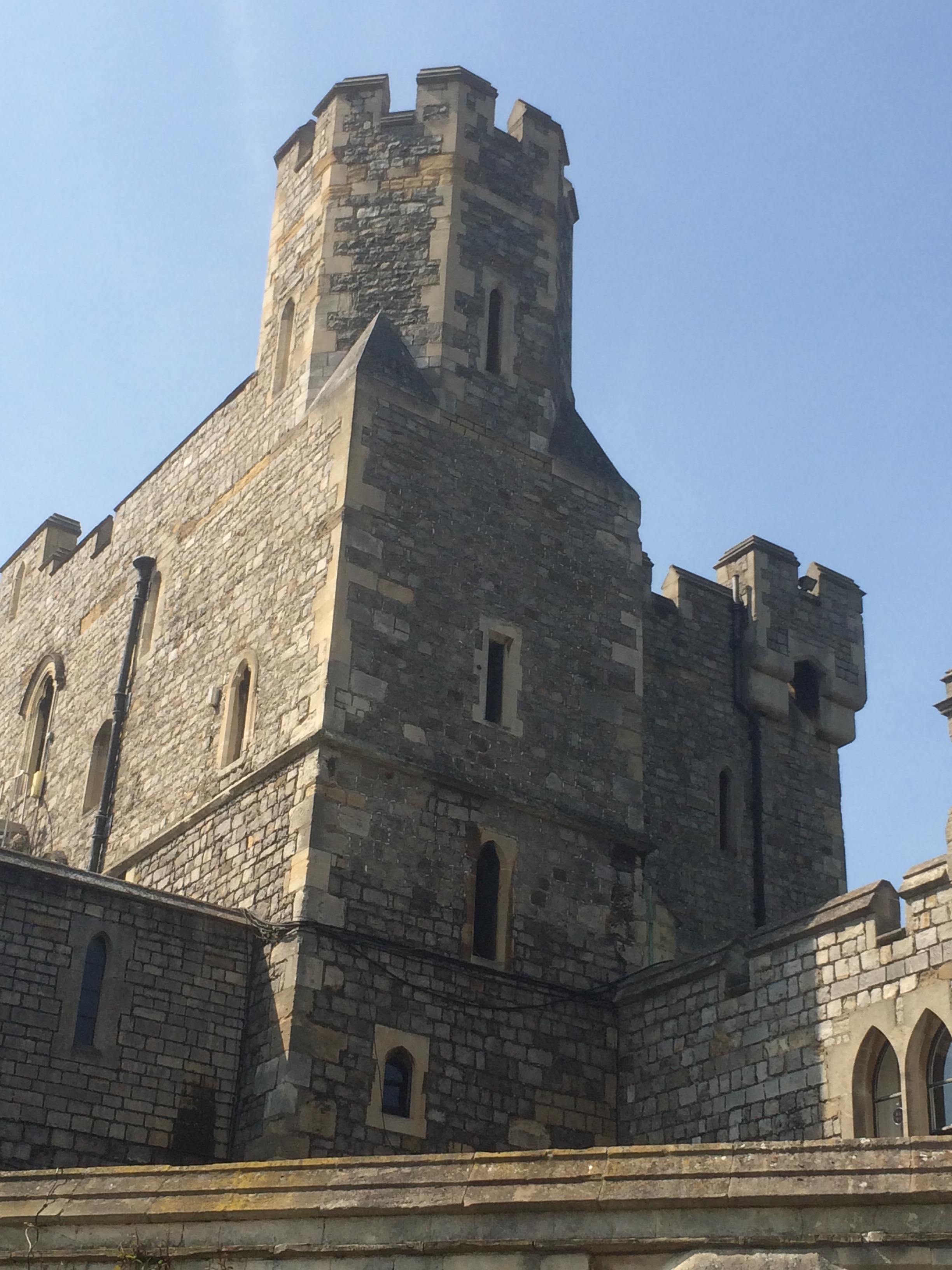
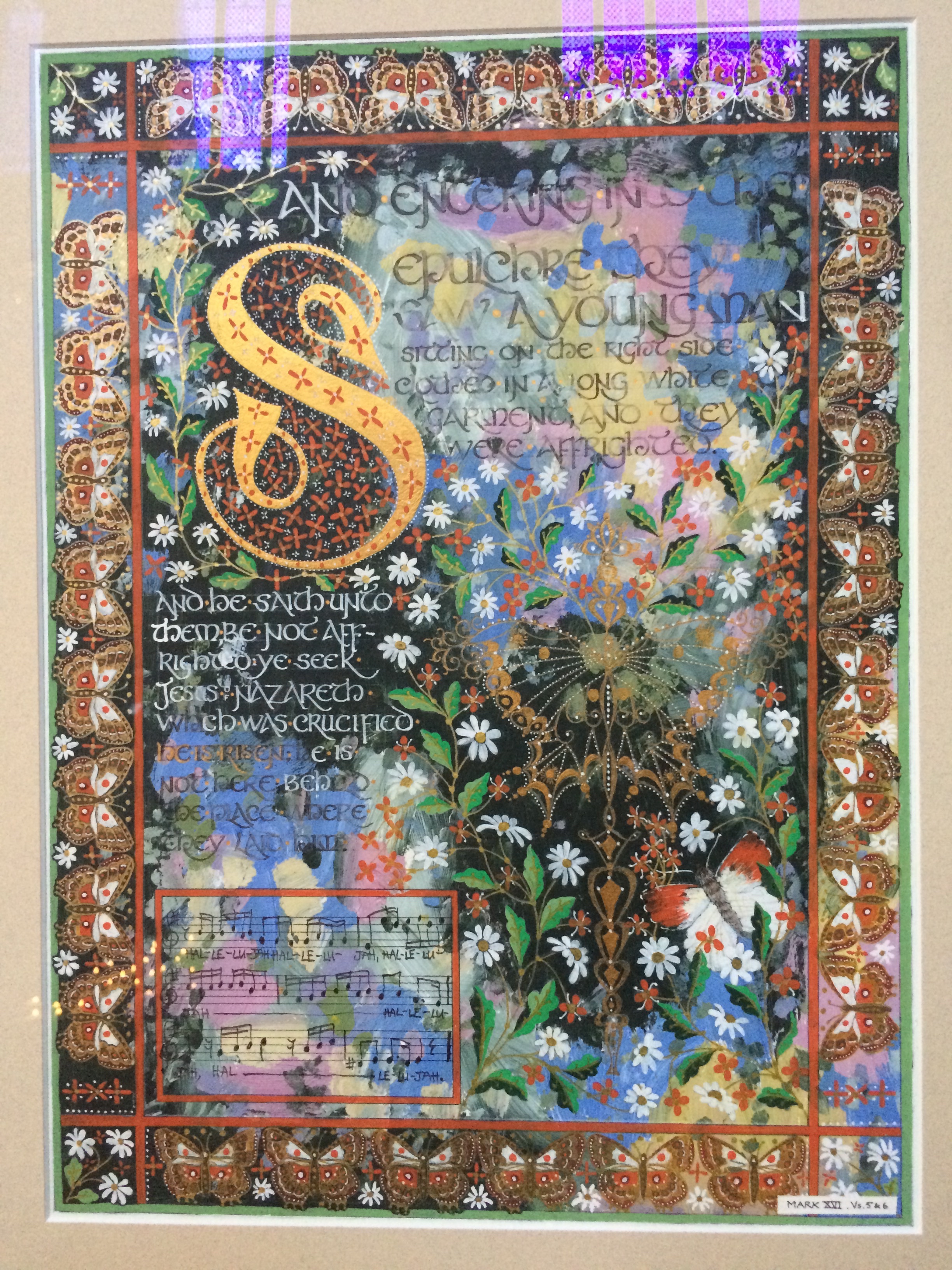
There were spiritual consideration as well. These met with a perfect expression at Bath Abbey, a towering chapel rebuilt many times over the last 1000 years. Alongside the main chapel there was a series of diptych paintings and weavings by Sue Symons. These were so wonderfully conceived and executed, and followed the entire life of Christ from start to finish. The creative, emotive work in each square inch of these portrayals was a miracle unto itself. By the time we reached the final pair my eyes were filled with tears.

You can tell when it’s time to go home. This morning Sue and I went for a short run along the Thames and she did a few quick one-minute repeats in advance of her half-marathon on Saturday. Sarah swung back across town from an overnight with some of her college buds who were still in town. Thus we wrapped up a smart trip made wonderful and easy by the companionship of these two smart women.

God Bless. And see you stateside.

werunandridelogo

Posted in Uncategorized | Leave a comment

England is a sometimes silly and often very pointy place

The most pointy building of all must be the House of Parliament, where hardly a point is made that can't be disputed. And that's pretty silly.

The most pointy buildings of all must be the House of Parliament, where hardly a point is made that can’t be disputed. And that’s pretty silly. Big Ben is pretty pointy too. Click to enlarge. 

After five days in England there are a few sound conclusions one can draw from the experience. England is silly about its affection for Pointy Things. Lots and lots of pointy things live here. The entire history of the English is about Pointy Things in commemoration of other Pointy Things used to kill or threaten people who miss the Point that the British are better and you’d better not forget it.

Except when they’re not. And then you had better forget that, or they’ll get you with other kinds of pointy things.

I know all this because I informally designated myself Chief Minister of Pointy Things while on holiday here in England. Or do you call it the UK? Or Britain? They really can’t make up their minds over here either. So they make up all sorts of names for you to remember so very friendly people (as most of the Brits are) can smile at you and say, “That’s okay, we know you’re from America.”

But here’s a funny thing. In many ways the Brits are very much like Americans, or perhaps it is the other way around.

After all, over the pond, as they say, we call ourselves the United States of America and also Just America. The third option of what to call ourselves has yet to be decided because our country is still so young in comparison to every other civilized nation on earth we are still going by our nicknames. Like Yankees. And they sell a bunch of New York Yankees caps over here. It seems to be some sort of ironic, or iconic, statement about America as a whole.

Here I am on a British Runabout in a search for more pointy and therefore important, old things to view.

Here I am on a British Runabout in a search for more pointy and therefore important, old things to view.

But I was more interested in why the Brits so loved their Pointy Heritage. So it was with much interest that I went on a British Runabout looking for the full range of Pointy Things that could be found. There must be a rule in England that when anything is deemed important to the culture or the crown, it must be designated by a full compliment of Pointiness. Otherwise the thing is Pointless and must be consigned to the rule of modern architecture. There’s plenty of that in London, for sure. There are so many new buildings in London they almost hide all the Pointy Buildings in some areas. That must really disappoint people who prefer Pointy over Glassy things.

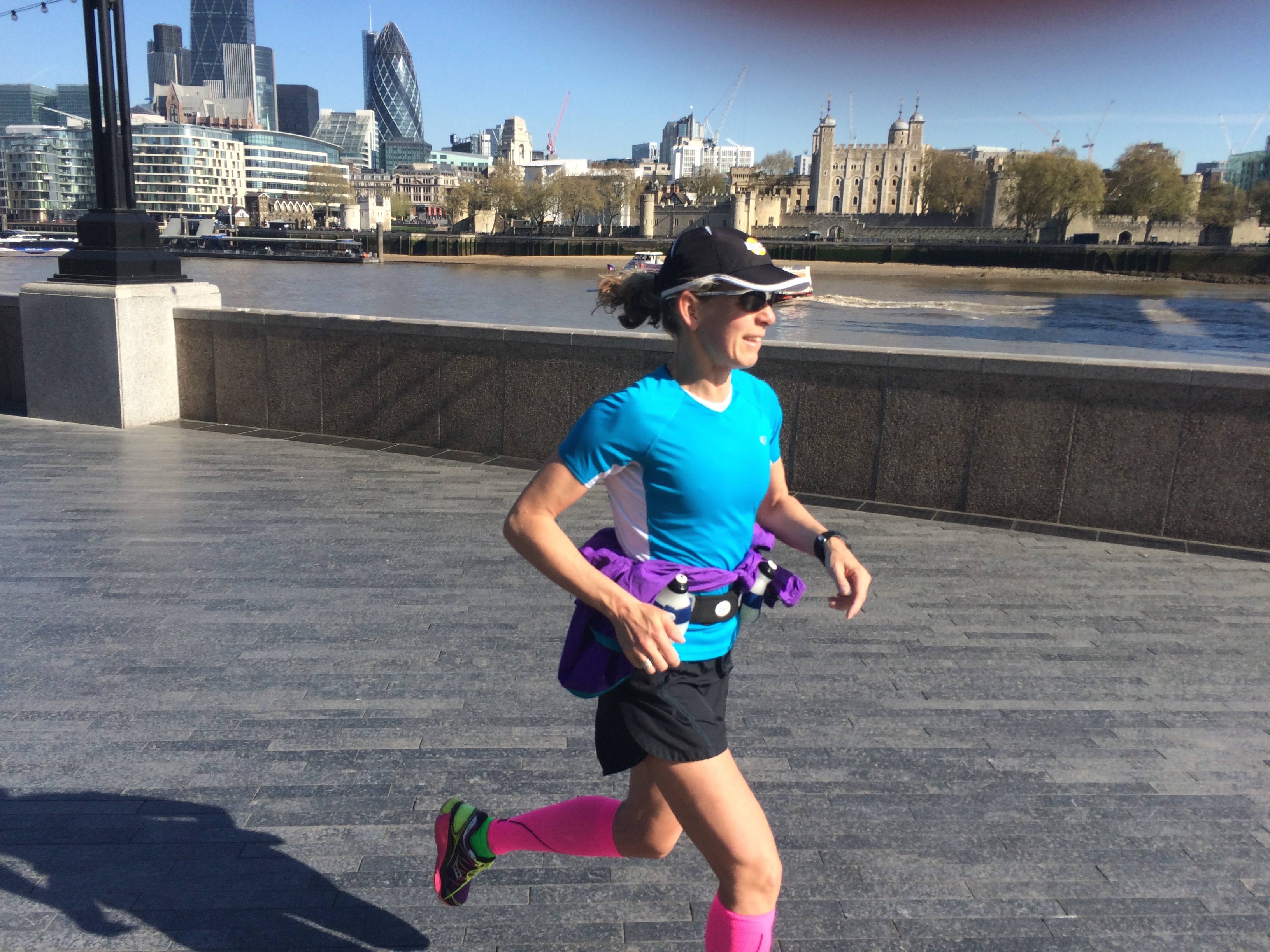
So we went running across the Tower of London Bridge on a Tuesday morning in April to experience even more Pointy things as part of our British experience.

Some history: back when there was not steel and glass and pointy metals to construct buildings, Britons actually had to rely on stone and mortar. So it was the height of elegance to refine this process to its absolute peak and create a Pointy thing (or a whole series of them) out of stone to show that you can afford to do just that.

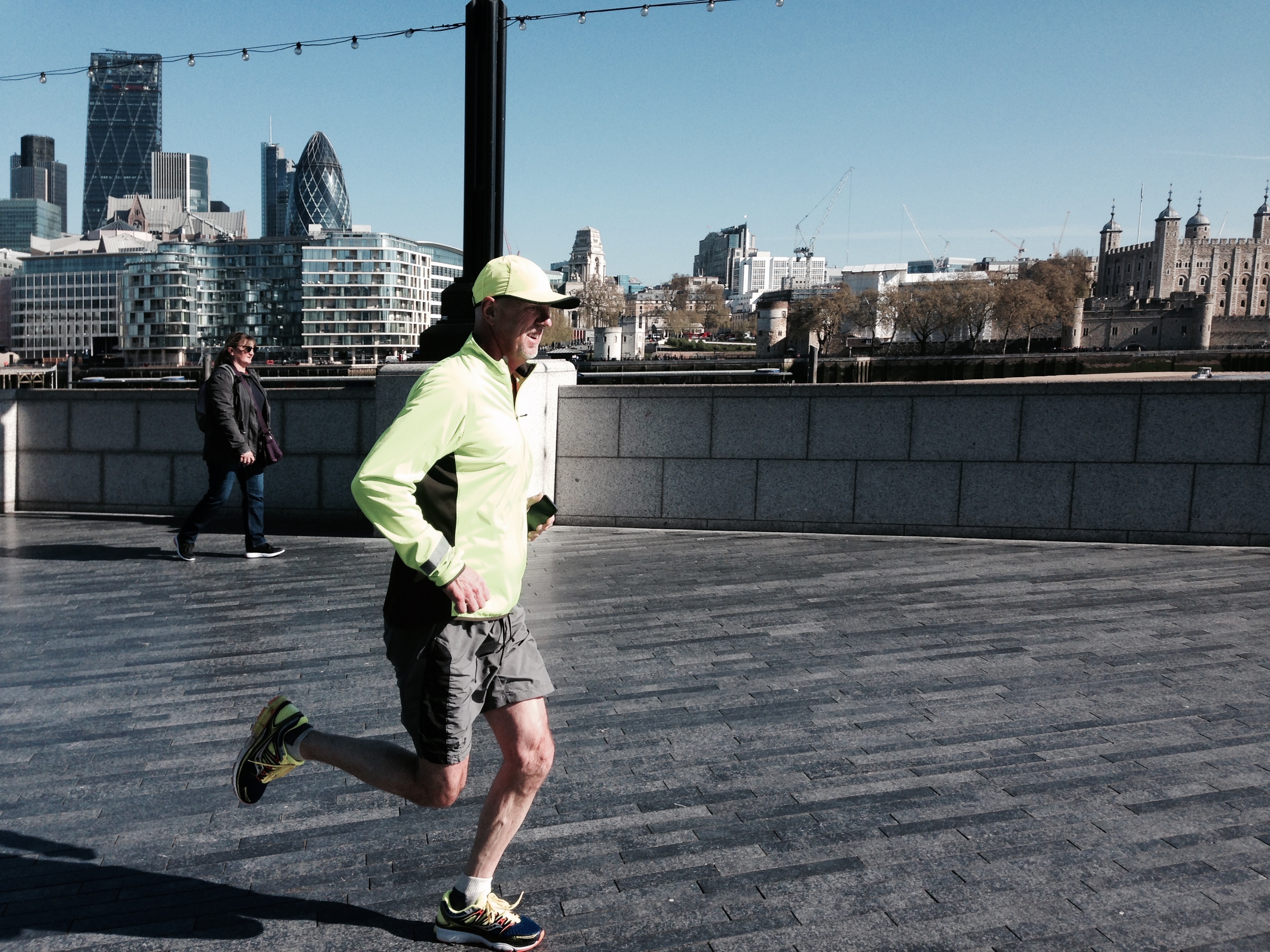
None of this basic stacking of blocks one on top of the other like some group of peasants. That would not do for some cathedral or castle. Oh no! One must make it all sing with pointy syllables and architectural statements that rise to the sky Sue Running Past Pointy Thingslike songs of the angels. But there are a still a few architects alive today that adhere to the Pointy Things Theory of building construction. You can see evidence of that fact in this photo of my girlfriend Sue, who happens to be an architect by training. She’s apparently running through a time warp because you can see the future behind her in a Pointy Modern building and the past ahead of her in the Pointy Promontories of the Tower of London across the Thames. Which is really old. The buildings and the river. Both are old.

And yes, that’s my fat finger f****** up this foto. 

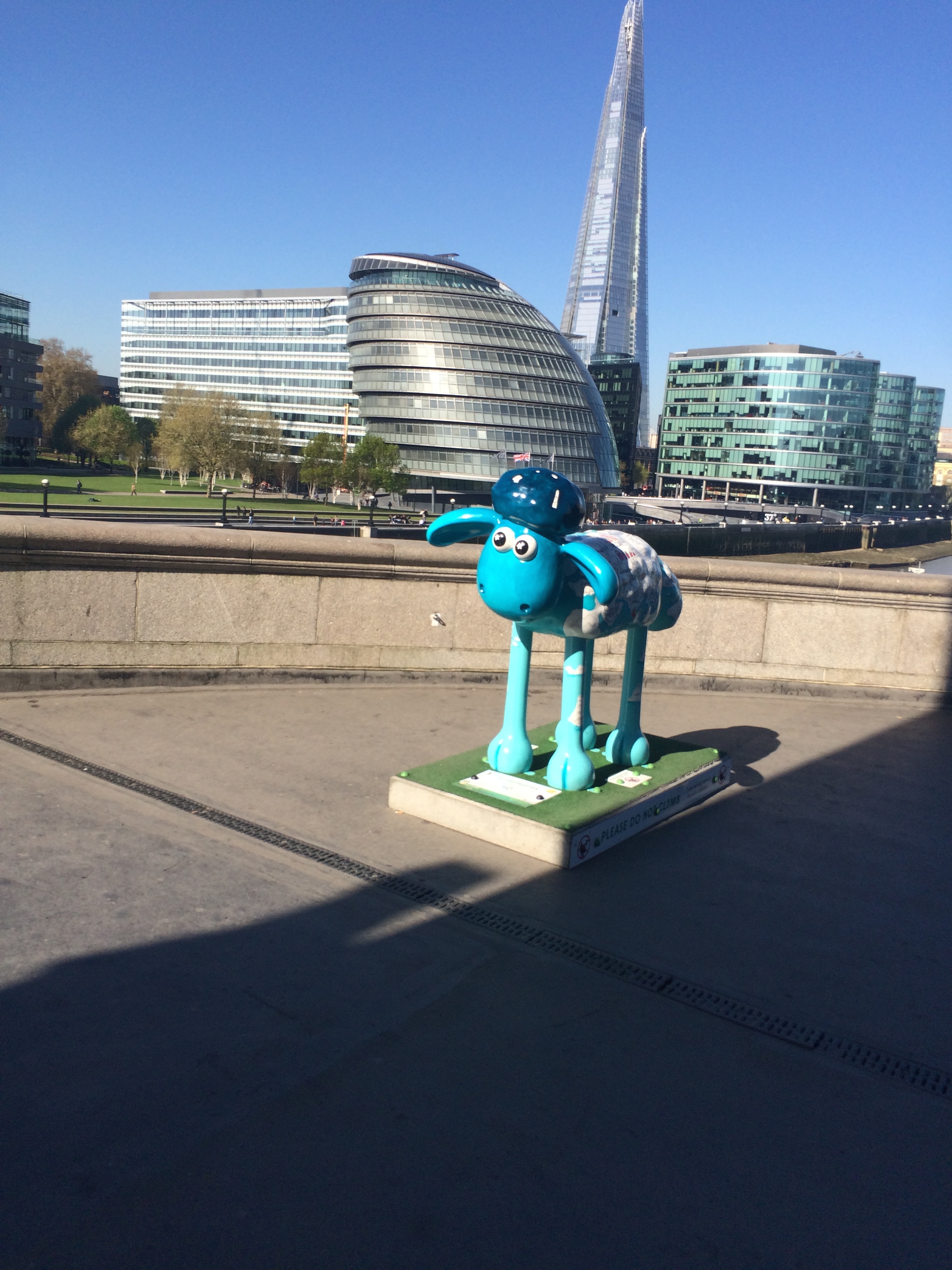
A Sheep from the Wallace and Gromit painted characters stands in front of another Pointy Thing, proving that the British really are a very silly people.

A Sheep from the Wallace and Gromit painted characters stands in front of another Pointy Thing, proving that the British really are a very silly people.

But back to my role of Minister of Pointy things. We’ve been traveling around England for days looking at delightfully pointy things. Blenheim. Windsor. Bath. And all Points In Between.

In time I may have my MBA in Pointy Things once I submit my thesis to the Booth School of Business, which is founded at the University of Chicago, one of the many Ivy League-like schools in America that also subscribe to the Pointy Things Theory of Everything. Just visit the campus. You’ll see.

Our research on Pointy Things was quite fulfilling during a 45-minute run across the Tower of London Bridge and back. There seemed to be quite a few other Ministers of Pointy Things otherwise known as tourists about doing the same sort of research. You can spot them by their squinty stares and Selfie Sticks.

In fact there was what appeared to be an entire convention of such Ministers when the Changing of the Guard took place at Buckingham Palace. A group of very stiff but dapper palace guards first appeared carrying serious military grade weapons with real bayonets. They were ushered into the palace grounds by a piping pack of pleasant pipers in similarly red uniforms. They they Marched Up and

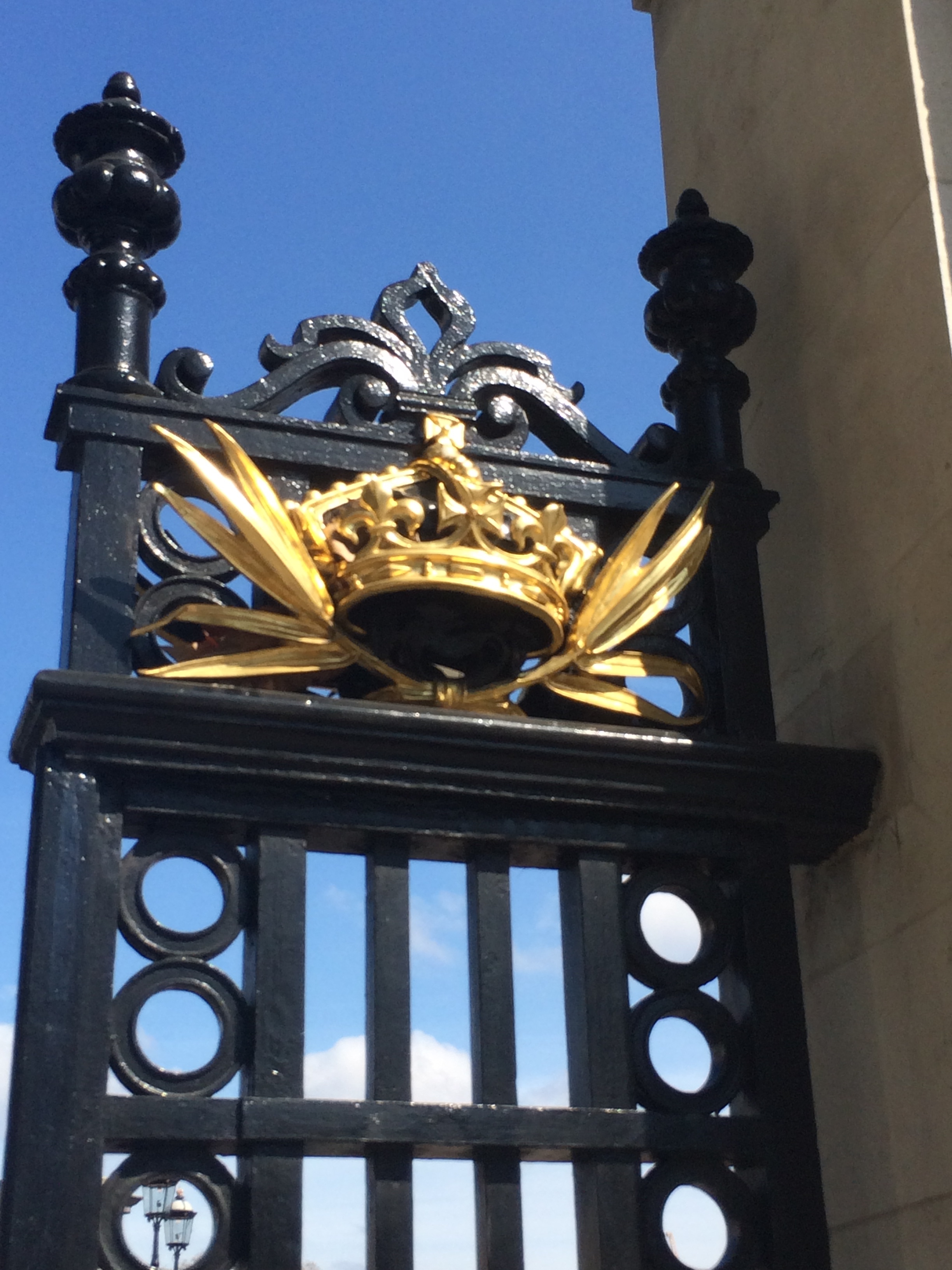
Need proof that the Royals love Pointy Things?  Look at these pointy decorations on the Royal Gates.

Need proof that the Royals love Pointy Things? Look at these pointy decorations on the Royal Gates.

Down the Square for a bit with their Pointy Weapons and Pointy Batons while thousands upon thousands of people pointed their cameras at them. So it must have been a very important occasion.

Personally I rather love Pointy Things so the silliness of England’s love for such pointed decorations is quite pleasing.

But we needed a break from pointiness today, so Sue and I strolled under a greening arch of sycamore trees to walk through Hyde Park on our way to the Natural History Museum.

There were Robins singing in the trees, and these were European Robins so we stopped to listen to their chortling little warbling sound in the trees. Then I pulled out my iPhone and the UK Birding app and played the Robin’s song right

Look! It's really pointy! It must be very, very much important.

Look! It’s really pointy! It must be very, very much important.

back to him in his little robin tree. And that really seemed to piss Mr. Robin off. So he sang even more and swooped over our heads to plant his little Robin Butt in a garden hedgerow where he could grump and croak with the rest of them.

But that was not the end of our birding adventures. Because after walking along the lake while watching dozens of runners pass us by because the London Marathon is this very weekend, we made friends with a Mandarin Duck, a few Tufted Ducks, a series of Swans and even some Egyptian Geese.

Then things got really serious when there was a bustle in the hedgerow next to the Princess Diana fountain. A magpie had raided the nest of a blackbird, and both blackbird parents were throwing a fit as the bully magpie thrashed, killed and began to eat the helpless baby blackbird.

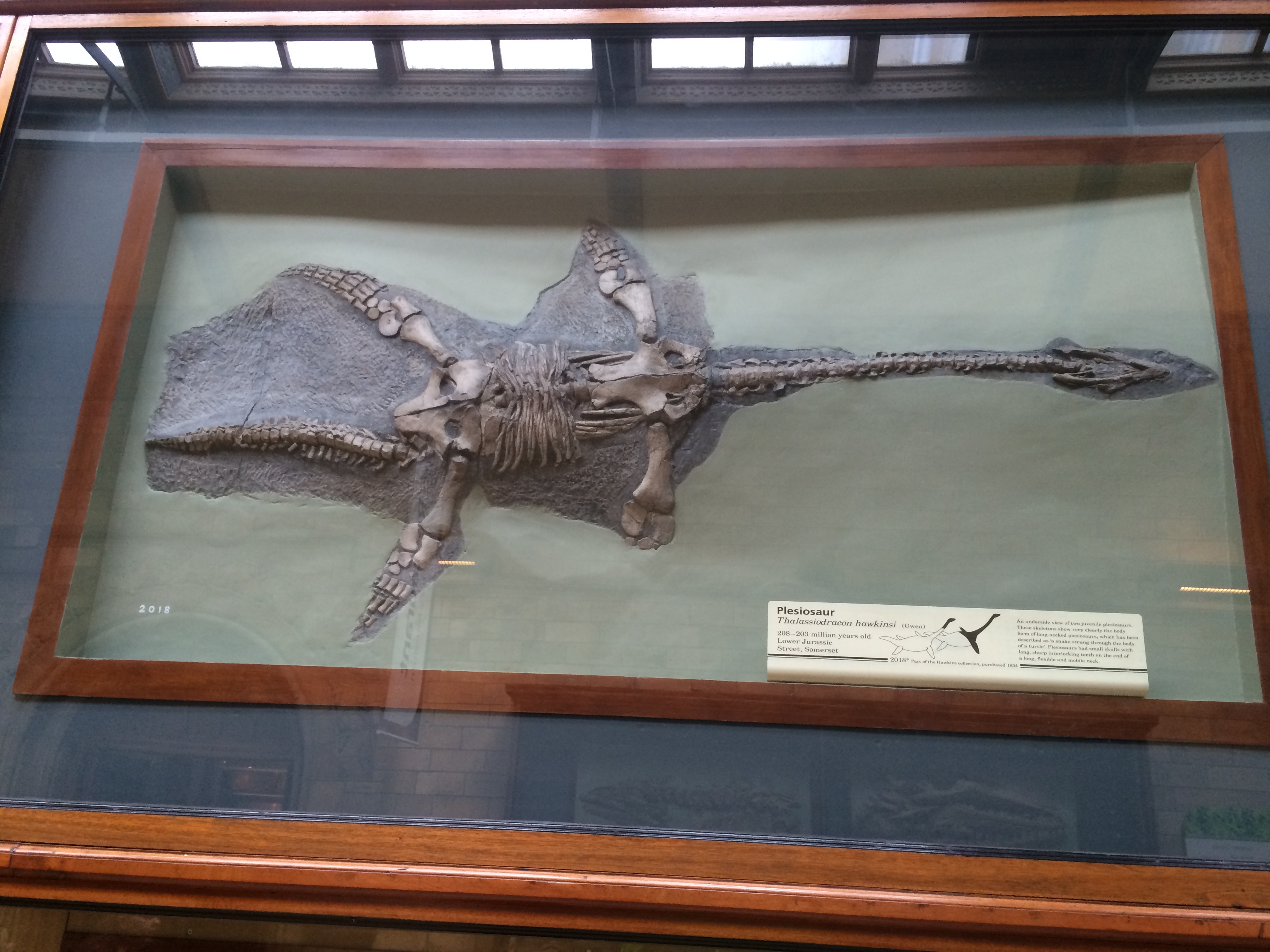
A fossil from a different, much less silly age.

A fossil from a different, much less silly age.

Ah yes, nature really is quite lovely. And that’s why we went to the Natural History Museum to look at the fossilized skeletons of ichthyosaurs and plesiosaurs with their massive pointy heads and incredibly swimmy bodies. Because long before any of us human types were present on this earth the seas were ruled by monstrously sized dino-dolphins with massive, pointy teeth. If you got in their way they would eat you, and it was an eat-or-be-eaten world.

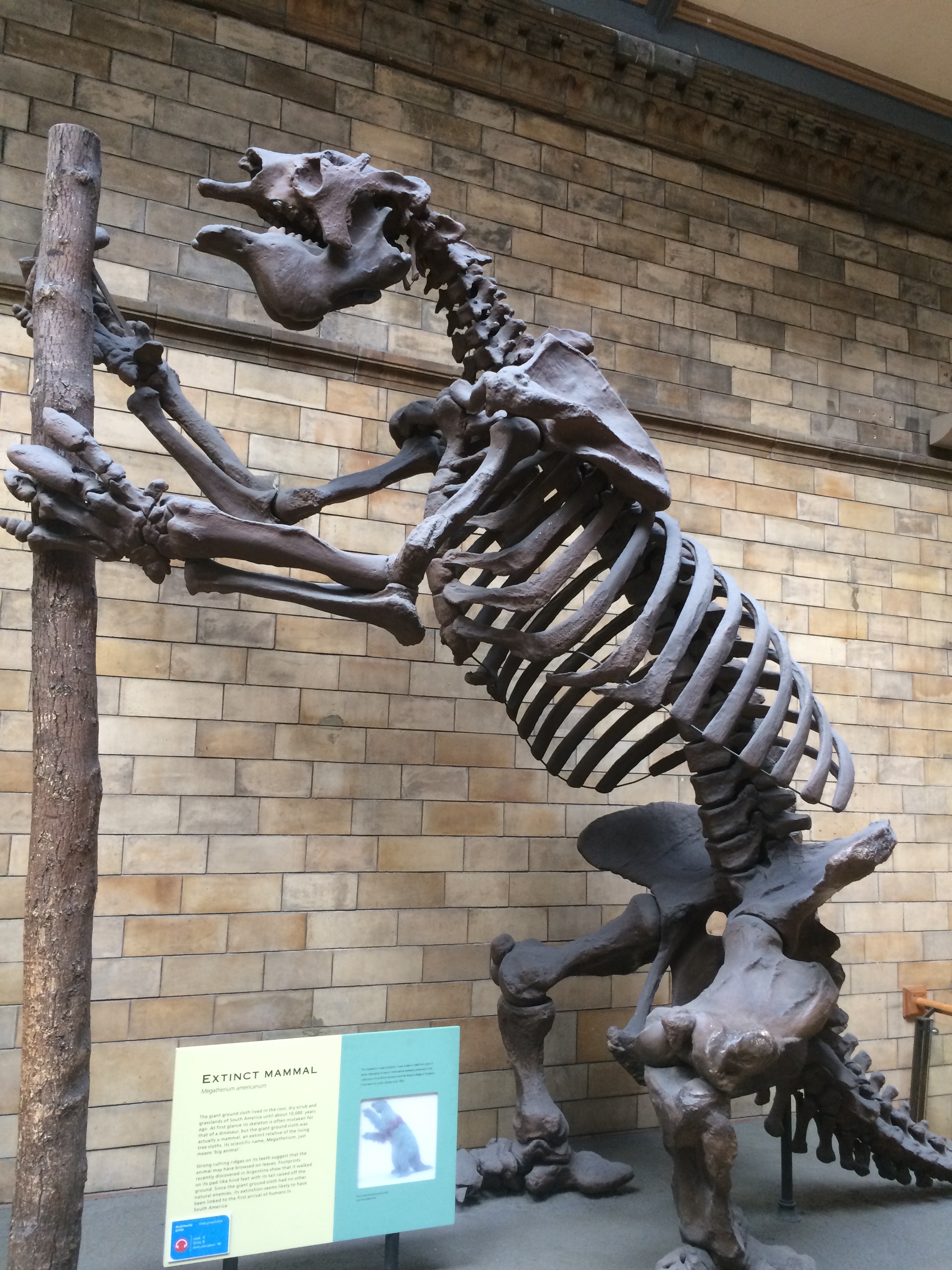
A fossilized giant sloth assumes the position to pray to yet another pointy thing in the British Museum of Natural History.

A fossilized giant sloth assumes the position to pray to yet another pointy thing in the British Museum of Natural History.

It was a very much more serious place than the one in which we live in today, where stiff looking marching guards in fuzzy black hats can march up and down the square and people take photos with selfie sticks because they really have no other place to go on a Wednesday in April except to a square in England where nothing can eat you except a taxi or an HGV. But that’s a story for another day. Another silly day, that is.

werunandridelogo

Posted in Uncategorized | Leave a comment

Discovering the great in Great Britain

IMG_7325

The Tower of London is a World Heritage Site, so designated for its incredible stretch of existence from 900 years ago.

Great Britain. United Kingdom. Whatever you call it, this is a fascinating place.

Perhaps it helps that my ancestors are from England (the Stewart side) and Scotland (the Cudworth side) but there has not been a minute in my visit where it did not feel somewhat like home.

Yet traveling out to Blenheim Castle on Saturday made me realize that Britain has a history borne much more from struggle than familiarity. Blenheim was the boyhood home of a certain Winston Churchill, savior of Britain from the aggressive attacks of Germany in World War II. This was not a man that lived a life of ease despite his upbringing on an estate that in scope, size and history plainly boggles the mind.

Winston was no star student, yet his imagination and love of dramatic narratives saw him setting up massive battles with highly detailed toy soldiers. It would turn out to be a prescient occupation of the young boy’s mind. Churchill’s fascination with war would turn out to be a critical contribution to a long British history of wars, conquered lands and being conquered.

IMG_7219

The toy soldiers of Winston Churchill occupied a mind eager for glory and conflict.

He also fought a sometimes desperate war with his own mental health. Plagued as he was with a predisposition to depression, which Winston called The Black Dog, he was perhaps better than anyone equipped to deal with the truly dark days of World War II. Yes a world war is nothing to sneeze at, but facing down your own propensity for dark thoughts can be just as terrifying.

You might even say that Winston Churchill perfectly symbolizes the national character of Britain. Finding that stiff upper lip and keeping up appearances in the face of incredible odds is the source of inspiring British drama and amazing comedy as well. How else can we explain the miracle of Monty Python’s Holy Grail, in which the holiest of quests turns into a running banter on the stuffy, sometimes witless pursuits of the British for glory.

article-1278687-0998843C000005DC-616_306x587It’s true of British athletes as well. One of my favorite all-time distance runners is a peripatetic soul named David Bedford. This man looked like a classic Brit in every way. The white uniform, loosely arrayed on a skinny frame. The dark hair flying. And his racing style? A front-runner no matter what. Bedford would take you to the limit of die trying. That was his schtick.

And Bedford was followed by other Great Brits. Men like Sebastian Coe, a miling great from the late 70s and early 80s who went on to Olympic Gold. But there was also Steve Ovett, an enigmatically speedy runner who seemed to race for the sake of racing. He’d set world records too at the mile. Yet he won the Olympic 800 when Coe was supposed to win. Go figure.

Finally we find a certain David Moorcroft, an English runner that was first under the 13:00 mark for 5000 meters. Track writer Kenny Moore once characterized that race as Moorcroft going “wonderfully mad.”

Click to enlarge

Click to enlarge. Inscription on wall of Tower of London by a man imprisoned, tortured and killed. 

There is a certain madness to the whole British character it seems. Churchill facing down the terrible Germans. Or men holed up in fortresses like the Tower of London, the many-walled castle once was surrounded by a moat filled by waters from the Thames River. There are hundreds of slits in cross-like shapes designed to allow archers to aim and shoot down attackers as they tried to take the fortress. Yet there were also massive parties inside the walls where life was communal if always a bit structured.

Those who went afoul of British rule were sometimes kept as prisoners inside the Tower of London. Some were tortured multiple times if they refused to give in. Some of these men carved their names in stone or drew incredible figures of the earth and sky to occupy their time.

But ultimately, if they failed to confess whatever the Brits wanted to know, they were then hung, drawn and quartered. That means they strung you by a rope to hang and die. Then they tied your limbs to a quadrant of horses and gave those horses a firm slap on the butt so that they would all run in opposite directions. If that force alone didn’t rip you apart, there was always the tap of an axe or some other sharp instrument start the ripping process and send you splintering in all directions.

No one said the British were always nice.

IMG_7224In fact, there are plenty of horrors to be told in both directions when it comes to British history. They document such things in tapestries and paintings, the better to remind both royalty and subjects that any notion of freedom comes with a cost.

Certainly Great Britain did its best for a while to rule the world. It worked for a while, but then overreaching always comes with a cost. Nowadays colonialism is working almost in reverse with Britain struggling in some ways to incorporate immigrants from all over the world. It’s almost as if nations like Great Britain and the United States have become a sort of earthly Black Hole. Our conquering ways come back to haunt us when immigrants flood back into the nation that once proudly swept its way over other cultures.

The Tube in London is filled with advertisements about the contributions of immigrants to British society. It’s as if the Brits forget that the Romans once pulled the same shit on them, conquering southern England and then pulling back from the desperate suck of their own internal contractions.

Roman baths

Stones next to the original Roman baths built in 74 AD in Bath, United Kingdom.

We visited the Roman baths out in Bath today to view the amazing constructions of ancient engineers from 2000 years ago. The Romans built a giant bathhouse and temple to the goddess Minerva in southwest England. For a while it was lost to posterity until Victorian archeologists dug it up and figured out that Bath once housed an incredible complex of heated pools, saunas and steam rooms.

It all points up that fact that people have not changed all that much in the last 2000 years. We’re still fascinated with the same physical comforts and emotional constructs that drove the Romans to construct what amounts to a health club out there on the west edge of the island.

One can readily imagine a Roman soldier going out for a three-mile run in the hills around Bath to get in shape for his soldierly duties. He could finish up with a hot bath and stare at the multitudes of hot babes wallowing in sundry states of undress at the bath. If so moved, he could wander over and say a prayer to Minerva. Or, if he was pissed at someone in the ranks or among civilians, he could etch an angry prayer into a sheet of lead and toss it into the bath where it was fully expected those prayers would result in vengeful or practical answers.

A bust of Winston Churchill.

A bust of Winston Churchill.

This was 2000 years ago. Long before Churchill was borne into near-royalty at Blenheim and grew old enough to defend his country, life in Britain was formed of both simple and royal aims. It remains the same. The glories of Great Britain are mixed with sophistication and folly. But what glorious history it is. And what glorious folly as well.

werunandridelogo

Posted in Uncategorized | Tagged , , , , , , , , , , , , , , , | Leave a comment

With an appreciation for the English countryside

After eight hours in the air half asleep and half awake, dawn peeked in the half-opened eye of the airplane window. Morning seemed a little early. We were flying ahead in time toward London, and the brain that has never done that before has a tough time grasping the concept.

Soaring above Ireland there was not a glimpse of the emerald land below. Clouds obscured the island, which by report of the digital map on the back of the airplane seat in front of me, was still officially down there. Somewhere.

The view of the English countryside from the airplane window.

The view of the English countryside from the airplane window.

Minutes later the clouds parted and there, for the first time in my life, was the sight of the English countryside.

I don’t know what I expected, but it was everything I hoped for and more. The first sweep of spring was evident in the patchwork landscape. As we sunk lower toward the earth, English rowhouses and hedgerows became evident. All the literature of youth came to play in my mind. A.A. Milne’s Winnie-The-Pooh and Christopher Robin for whom I was partially named.

The Wind in the Willows with those strangely stubborn and troublesome frogs and badgers.

The Chronicles of Narnia and C.S. Lewis were borne where we were headed, to Oxford, where my companion’s daughter had studied (English) for four months during the second half of junior year at Elmhurst College (IL.)

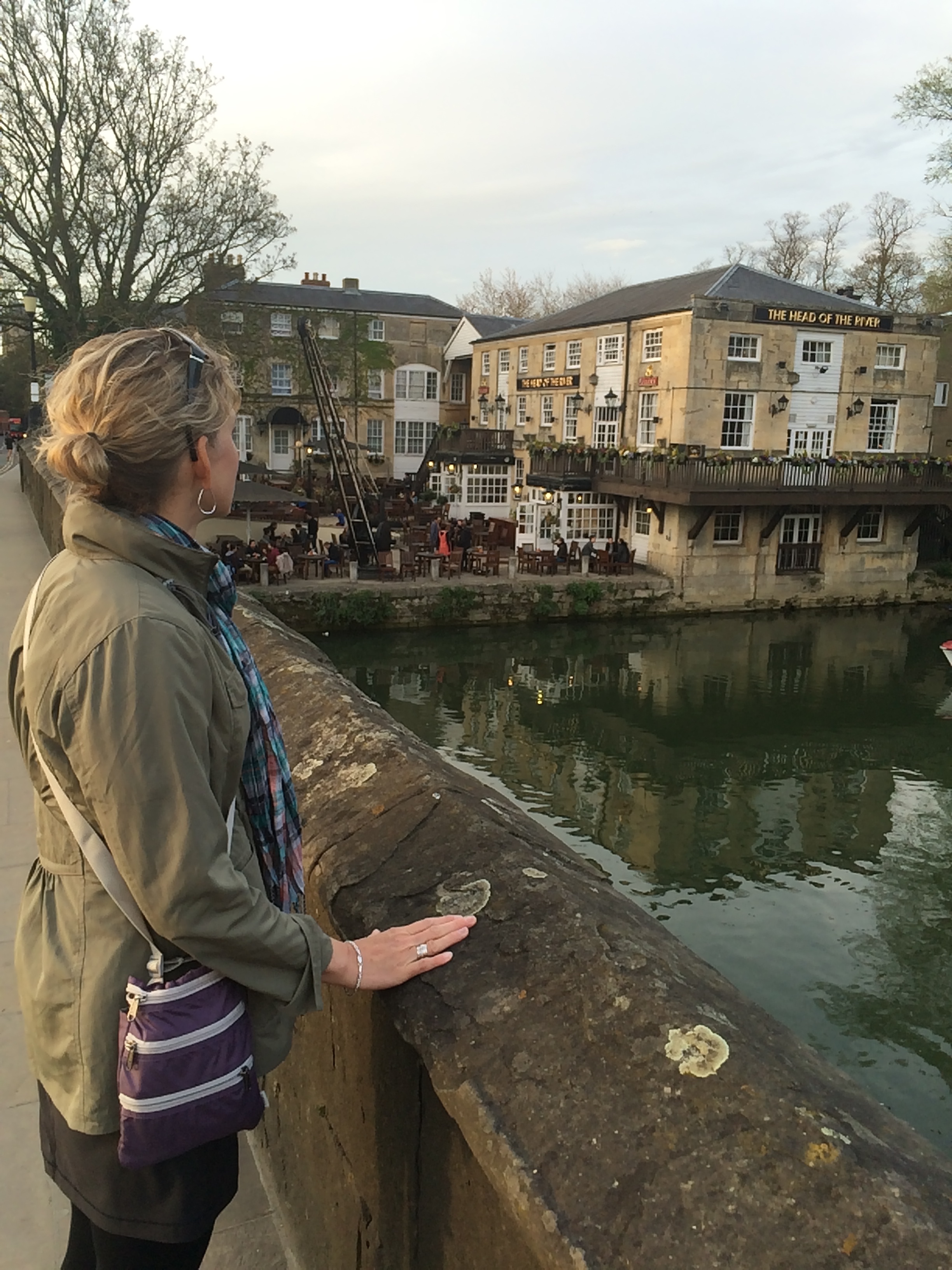
IMG_7129We’d soon dine at the Eagle and Child pub where C.S. Lewis and J.R.R. Tolkien once shared pints and foodstuffs. But first we checked into the Head of the River inn and pub, nestled tight on the Thames, with a bridge right next door to prove it.

That afternoon wandering round Oxford and several of the many college campuses the age and connection of the place began to sink in. But first there was a layer of modernity to paw through. “This is where they filmed a lot of the Harry Potter movies,” Sarah said, pointing to one of the many block stone buildings with archways and gargoyles and spires. That afternoon Sue would purchase a beautiful little print of the Oxford spires in a downtown store. “It’s like a synopsis of the place,” she mused.

And what a beautiful city it is. Crawling with pleasant people on a Friday in April. Rife with buses going to and from London and other destinations. Oxford fairly sang with delight in the sunshine.

IMG_7130That evening Sarah joined her friends for a last night saying goodbye as schoolmates at Oxford. What bittersweet glory youth can be. She had made friends, she said, but it took a while for them to find each other. Then they traveled to Venice together, sharing even more European light and youth, and finding their way onto a gondola at 40% off because river traffic was slow. “And he sang to us,” she said. Three American girls; one blonde, one redhead and one brunette. The picture was almost too perfect. Almost.

So Sue and I dined at a pub called Chequers named after the checkerboard pattern used by Roman auditors to tally bills.

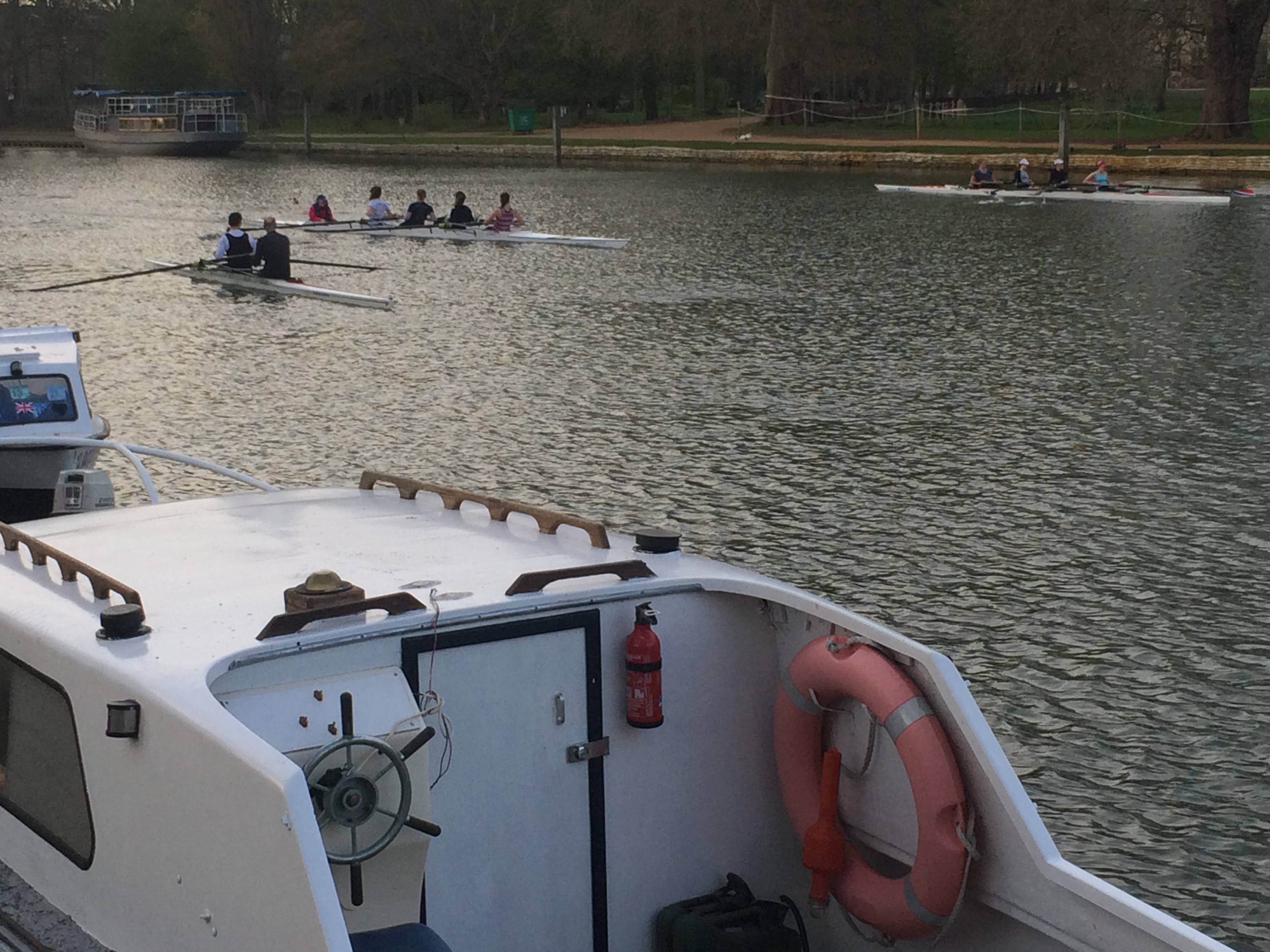
IMG_7156At dawn we rose from hard sleep to plough under the jet lag and put on our running shoes. The sun was bright and temps were in the low 40s. The Eastern breeze from the continent kept us honestly cool, and our pace was slow and forthright. We took the path up the Thames and past the boathouses where rowers of many ages, both men and women, had pulled out single, doubles, fours and eights to work the surface of the blustery Thames.

There aren’t all that many places in the world with this much tradition and picturesque charm. We ran on the gravelly path up around the Christ Church campus and circled back. IMG_7179Countless English birds were singing in the trees. My birder’s eye and ear were challenged to separate these songs and these species. But a Great Tit flitted in the lower branches and was unavoidably identifiable. Along the canal a Moorhen strutted, and Sue chirped, “It looks like a hen.”

Indeed. We continued our run through delightful shade and sun, the wind tapping a beat on our cold ears. Back to the Head of the River we trotted to head back up the tow path to add in the next 3.5 miles. “Joe gave me seven to do,” she said, for she’s following a program wonderfully prescribed by her capable coach Joe LoPresto of Experience Triathlon. So we ran together on the asphalt towpath. Every fifteen feet was another bird singing its tiny guts out as if they all wanted me to stop and learn what they were.

IMG_7141Later we paused to study a Robin (not the American kind) atop a small flowering tree. It sang sweetly and Sue and I stared intently at its quivering orange throat. We were both dizzy from stopping our run so fast. The world seemed to swirl for a moment as a spate of kayakers when churning past. This was England, for God’s sake.

My ancestors are English and Scottish. Around town in Oxford I saw dozens of people that could be my relatives. It made me wonder what it must be like for other people to return to the country of their origins. We are all one people, the human race, and yet these races and histories and flavors of human existence all do matter.

IMG_7160So whether it was the birds singing or the English countryside so familiar from the literature of my youth or my feet covering ground that looked and felt like home, there was magic in the air for me. It had been a long time since that feeling came home to roost. It’s almost as if the birds had sung the place into existence. We wake to dream and we dream to wake.

It might have just been jet lag. But I say whatever it takes to dig back in time or live in the moment. It’s worth the trip.

werunandridelogo

Posted in Uncategorized | Tagged , , , , , , , , , , , , , | 2 Comments

There’s something I’d like to stress. Or not.

IMG_5128For eight years during my late wife’s cancer treatment stress was a constant companion. If it wasn’t her direct health at risk, it was the side effects. Then there were insurance and financial issues as we tried to recover from the expense and byproducts of each round of treatment.

Dealing with the stress of that took a lot of fortitude, prayer and creativity. There were times when overcoming the stress on my own was just not possible. That meant anti-anxiety drugs in small doses to get me through the night. But when it came time to wean off that medicine, it took time. It was hard to separate the controllable stress from that which could not be controlled.

As a person pre-disposed to anxiety and its pursuant dark buddy depression, there were plenty of times when stress worked like the devil in a triangulating relationship. I was also caregiver to a father who is a stroke victim. There were relational issues afoot there too.

So I went and got counseling, because sorting all that stuff out on your own is not easy. The most interesting thing the counselor said to me was simple: “You seem to be good at forgiving others. How are you at forgiving yourself.”

And that, to me, was the key to unlocking the mystery of so much stress. If you’re constantly blaming yourself for the problems you face in life, there is no way out of the stress zone holding you in a locked battle with fear, anxiety and depression.

During all those years the running and riding were vital to keeping sane. I came to appreciate that from a very young age, physical activity was my savior. That’s true from grade school on up through college. I didn’t just crave sports. I needed them. It helped me process both emotional and mental perspectives. It helped me overcome attention difficulties brought on by a creative and active mind. It did not matter whether I was diagnosed with attention-deficit disorder or not. We all have to deal with our ability to focus in some way. It’s harder of course when you have anxiety or other challenges working on your mind. You have to struggle just to maintain what other people feel as normal.

The running and riding and a multitude of other sports have always helped me wick off stress and get back to a state of mind where I can write it all down and get things done. That’s the ticket to true stress relief. It’s not just relief you need to achieve. You also need to develop solutions.

The challenge during all those years dealing with my wife’s cancer is that between the stress and the drugs to treat uncontrolled stress there were definite difficulties attaining levels of basic athletic performance that once came so easily to me. Riding with the group on Saturday mornings became a struggle similar to post-traumatic stress disorder. I had no appetite for clinging to the back of a group of other cyclists flying down the road. The stress of that was too much some days.

DisneyBikeBehindsSo I dropped sometimes. And my buddies credited it to my general moodiness at times. But it was impossible to explain in any relatable terms. I recall one week where a new rider showed up though. 40 miles into the ride when I’d hung on for that long at a 20mph average I just needed to fade back and gather my wits. Ride my own pace. Not be pressured. He asked my buds what was up with me and when they explained my situation he turned to them and said, “What are you doing up here then?”

Recently I’ve had some interesting stress in my life to do with business. I’m thankful for the running and riding and swimming because it still helps me gain perspective and a fresh outlook. But I’ve also learned to forgive myself at some point if everything doesn’t go exactly as planned. I can handle stress with the best of them. That much I know. But whether that’s what we really should do at times in life is the real question we should be asking ourselves.

Because there’s always a message in stress. Figuring that message out is the most important thing you can do sometimes. Then move on down the road.

werunandridelogo

Posted in Christopher Cudworth, cycling, running, swimming | Tagged , , , , , | 4 Comments

Is anybody out there a runner or cyclist?

Fluorescent ChrisWhen I began this blog a couple years ago it was titled We Run and Ride because it would have been kind of dumb to call it I Run and Ride. Really? That’s just me. There’s a lot more out there in this world to write about. As well as me. Ha.

In the process of doing this blog I’ve met and profiled many interesting people including Jim Varga, producer of the white ovals now being used to market marathons and other races across the country. Also Kerri Hoskins Branson the former Playboy model turned Sonya Blade character turned superhero mother of four and now full time artist.

I also interviewed Cid Carver, the entrepreneurial Ironman triathlete training through missile attacks in Tel Aviv, Israel. And my former high school running competitor Tom Burridge, former distance running star at Kentucky and now a top level masters cyclist. Wish him well because he’s coming back from the harsh effects of a bicycle racing crash earlier this year.

10mil_trials84It was also my pleasure to get to know one of the world’s all-time leading distance runners Craig Virgin, two-time world cross country champion and perhaps one of America’s least-appreciated competitors on the track, the road and cross country. Rarely do distance runners excel across all three running disciplines. Getting to know Craig has made me appreciate the sacrifice that goes into being a world class athlete. His story is especially compelling given his battles through congenital kidney problems and other challenges in life.

I’ve also tried to capture the everyday adventures of runners and cyclists whose stories may not include world class performances, but have their amazing merits just the same. One of these stories was a chance encounter with Midge-Taylor Good in the wake of the cancellation of the New York City Marathon due to the devastating effects of Hurricane Sandy. Given all the training she’d done for New York, she came home and decided to turn her 26-miler into an adventure with its own character. I met her as she doffed her shoes to relax on the browning grass one November day. The well-known local runner works for Naperville Running Company and her story was shared to hundreds of people that knew her.

All these little encounters and twists of fate are evidence the world of running and cycling never sits still. People enjoy these pursuits because of the encounters they engender. That goes for the crazy soul who writes this blog. I don’t hide too many of my thoughts and some people might say that’s a risk to me personal brand in some way. But I’d rather be considered honest and a bit crazy than quiet and controlling. It’s better to be crazy than psychopathically obsessed over self-image.

Hopefully some of this writing has made you laugh, because it’s not exactly an advice column, but simply “original thoughts on running and riding.” Perhaps some of it inspires. We’ve long passed 1000 posts and 1000 followers. It is gratifying to know that this blog, written as it is from the American Midwest, is read throughout the world. Every day I can glance at the analytics and see a map of where readers live and read this blog. Australia. Africa. Asia and Europe. I wish there were 100,000 of you. But perhaps that will happen some day. Share if you will. That helps grow the audience.

ShoesMy only regret is that the convenience of receiving this blog by email as many people do, represents a lost opportunity in some ways to dialogue or reach our fellow readers. Some of the interviews resulting from this blog have come through comments and replies to the blog. I never feel short of material because this is an amazing world we live in, and just talking to people leads to sometimes surprising result. I mean, I even got a free pair of Saucony Triumph running shoes by talking up the rep as he carried a pair of pre-market shoes down the street in front of a Starbucks in Geneva, Illinois. “For me? You shouldn’t have,” I teased. And it turned out the shoes were actually my size. Now I’ve purchased a new pair because they are such good shoes.

It proves that what goes around, comes around in many ways. If you ever have the urge to have your story told, or to share some event or experience in your life, just hit REPLY and leave a comment on this blog. I’d love to make you part of this running story.

werunandridelogo

Posted in Uncategorized | Tagged , , , , , , , , , | 1 Comment

A solo cyclist’s survival guide to springtime winds

Cyclists in wind IMG_6971It’s not generally practical to ride your bike in a group every time you go out. That means there will be days when you’re going solo or with just one buddy on the road. That can be tough for everyone on days with high winds.

Often you’ll hear cyclists complain, “No matter which way I turned, the wind was in my face.”

It certainly feels like that. But in fact it’s always true. The wind IS always in your face. That’s how cycling works. If there were no resistance from air we could all sail along at 40mph or more unhindered.

Of course that’s not the case. So the solo cyclist must consider all the facts that make it tough to ride in the wind before they even get on the bike. The fit of your bike is the most important part of this formula. And here’s where theories of bike fit get tricky.

The aero factor

We all know that aero and tri-bikes allow riders to go faster because they help a cyclist cut down on wind resistance. The deeper and flatter your position on the bike, the less wind catches you in the chest and creates a negative pressure against which you must ride.

Any duathlete riding a road bike can testify to the frustration of competing against other du’s riding aero bikes. Unless the course is exceedingly hilly, the aero bike guys and gals will likely dust you. It’s simple physics. Unless you can get really low in the drops on your road bike and stay there, it isn’t much fun trying to keep up with bikes and cyclists engineered for speed.

Racing duathlons and triathlons is a good testament to the virtues of good bike position and wind resistance. There is no drafting allowed, so you must literally pull your own weight.

That’s why it’s good to get out on the roads and practice on your own how to deal with wind resistance and more specifically, wind as a condition in which you must perpetually ride.

Like Paris-Roubaix

Cyclists in the windHere in Illinois there are plenty of open roads and the countryside even looks a little like Belgium or Holland where cyclists regularly participate in spring sufferfests battered by wind and sometimes cobbles. The last few miles of this year’s Paris-Roubaix race saw long strings of riders trying to stay in the draft while bouncing on and off the cobble stretches.

With the flags sticking straight out from the poles, there was little doubt about wind direction and its effects. We all know crosswinds can be as deadly tiring as headwinds. In many ways they are more exhausting because they catch an even greater stretch of body surface. Plus there is the constant pressure from one side that can throw off your rhythm and cadence.

So there are a few practice tips that can help you prepare for such conditions as a solo rider when no one is there to help you.

1. When planning a route on a windy day, plan a course that zigs and zags.

Riding solo on a windy day is like engaging in an interval workout. Riding in a headwind or crosswind can quickly put you in an anaerobic state. That means it is vital to set up your workout the best you can to create breaks where you’re changing direction as you go along. Nothing wears down a solo cyclist like a 10-mile stretch straight into the wind or through a crosswind. Heck, the mere roar of the wind in one ear can drive you crazy. And using the same muscles repetitively results in imbalanced fatigue. So do the best you can to zig every two miles and zag another.

2. Plan a route that is a big circle with the hardest parts built for the beginning, and remember to zig and zag if needed. 

Listen, great cyclists like Eddie Merckx used the wind like a training device. He actually wanted to ride the hardest part of the road at the end, not the beginning of the ride. That way he could build endurance when he was tired. And if you’re already a strong cyclist, that’s a great way to proceed. Same with running into the wind. But if you’re not yet fit or not yet a great cyclist, it can really pay to look up the wind direction on your phone and plan a route that will finish with the wind at your back. That doesn’t mean you slack it in. It just means you’ve ridden in a sane way.

3. Never count on a tailwind. There are no guarantees. 

photo (50)Despite your best planning, there are no guarantees that your route will result in the pleasures of a tailwind. Even a wind blowing at a 45 degree angle from behind your shoulder can read like a headwind in many cases. It’s all about cutting through the air, and there’s no law of nature that says riding into a strong headwind for miles will produce an easier ride when you head back. Winds can shift. That often happens here in Illinois near twilight. A west wind at 5:00 in the afternoon can shift east to northeast by 6:30 p.m. because of lake effect winds off Lake Michigan. In spring these winds are often chilly and steady too. There are no guarantees of an easy ride home.

The wind will defeat you now and then. There will be times when you are reduced to an 8 mph crawl. I recall clearly a day where the southwest winds here in Illinois topped 30 mph. On the far western stretch of my ride, a 10 mile patch of road in very open country, the winds were so buffeting I finally pulled over and just stood there gathering my wits.

Going it alone is tough sometimes on a bike. But when you get home from a windy ride you know you’ve done something at least. It hurts. You’re exhausted. Your eyes are full of grit and dry as shells on a sandy beach. But damnit, you made it.

And that sets the tone for making it another day. When you’re that much fitter. That much stronger. That much able to wrestle with the wind and come out ahead.

werunandridelogo

Posted in cycling, duathlon, triathlon, We Run and Ride Every Day | Tagged , , , , , , , , , , , , , , , , | 2 Comments