It is fascinating to study public opinion through the lens of Facebook and other social media. In an effort to grasp and express opinions, people borrow and create memes that paint a black and white picture of a particular social issue and then beg agreement from friends.
Of course if you question the logic of a particular meme, you set yourself up to get savaged by all those readers who happen to agree with the meme. This happens daily on topics such as religion, politics, gender, sexual orientation and cycling.
Whoa, wait. Cycling? Who really cares that passionately about cycling?
Angry motorists
Well, some people do. In fact, it appears there is an entire population of people frustrated by the presence of cyclists on the roads.
All over the world cities are grappling with the benefits of cycling in terms of its economic and environmental benefits. Cycling in a city cuts down air pollution and traffic congestion, so why do so many people still seem to hate on cyclists? It’s one of those cultural questions in transition. But there are signs of change everywhere.
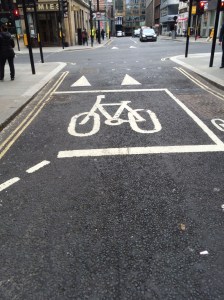
In London bikes have the right of way.
In London, England bike traffic mixes with motorized vehicles and buses every day. Cyclists shoot through the heart of the city in designated lanes. There are accidents, to be sure. But the priorities are clear that cyclists have a right of way in urban traffic, and it is to be respected.
Here in the states, and in urban areas such as Chicago where I live, there seems to be a bitter impatience with this entire concept of granting cyclists more time and space on the roads. The mayors of Chicago have been resolute in creating bike lanes, and cyclists do use them. But if someone breaks the law while riding, which does happen with some frequency because cyclists can be stupid or lazy just like motorists, it turns the issue of city cyclin into an indictment of the entire concept. Then the anger grows and cyclists become targets for very public ire.
Violent tendencies
It is interesting to note that in America where gun violence has taken more lives than all the soldiers killed in foreign wars, the issue of gun control is still a hot button in terms of human rights. Yet the facts don’t like. Even conservative websites acknowledge there are more than 32,000 gun-related deaths per year in America. That’s equivalent to killing the entire population of the City of St. Charles, Illinois, where I attended high school. Think about that. No more high school reunions for you, Buster.
America has grown numb to the fact that people are dying daily due to gun violence. It is therefore just as likely that people just don’t care if human lives are threatened by large vehicles on the road. It is so ironic. People fought and died for our freedoms and then we throw away human lives through selfishness, fear and carelessness as if it didn’t matter at all. But America is not alone in the hate game for cyclists. Skepchick.com analyzes the Science of Hatred for Cyclists in this quite interesting blog.
Main Street culprits
But for me, the face of hatred for cyclists has one form. Large pickups.
In the last 12 years of consistent cycling America’s roads, drivers of large pickup trucks have been main culprits in open aggression toward cyclists. Personally I’ve been buzzed, honked at, yelled at and even stopped and aggressively confronted by drivers of large pickup trucks. Usually these trucks are of the red or black variety, with driver’s eager and angry to make the point that I do not belong on the same road with them.
The facts are clear about large pickups; they are one of the most dangerous types of vehicles on the roads. This note from the Bicycle Almanac puts it into perspective:
“Big pickups kill even more than SUV’s. When the average large pickup truck collides with a second vehicle, people in the second vehicle die at a rate of 293 for every 100,000 crashes, according to federal crash statistics. By comparison, large sport utility vehicles kill people in the second vehicle at a rate of 205 per 100,000 crashes; minivans kill at a rate of 104 deaths; and large cars at a rate of 85 deaths. (NYT, July 31, 2003)”
But when vehicles hit cyclists, the injury and death rates are obviously much higher. A 4,000-6,000 lb. truck can easily crush or maim a cyclist.
The Safety Debate
The debate centers on safety and laws applying to cyclists. There is an angry undercurrent out there about the behavior of cyclists on the roads. Many motorists seem to believe that cyclists simply refuse to obey the law. Recently a meme showed up on Facebook that illustrates this view. When it appeared, I read it carefully and then responded to the post in kind. It was late, so my grammar sucks. But you get the point.
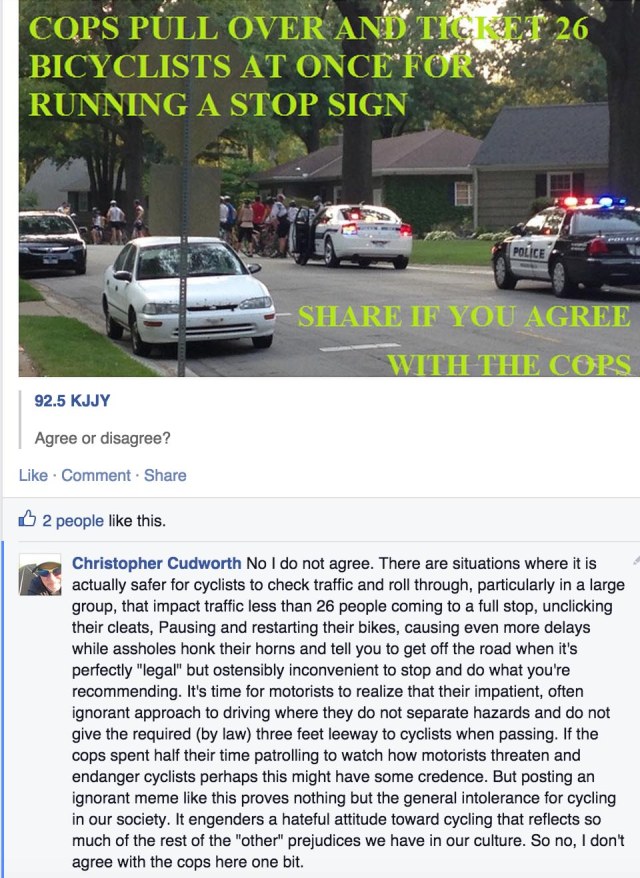
Motorists that hate cyclists likely seem to have little or no experience with actually riding a bike on the road. They cannot hope to comprehend that each and every cyclist is a legitimate entity on the road. In a group, they are also an entity.
So let’s start with the basics. For one thing, it is perfectly legal for cyclists to ride on the roads. Motorists are required to give cyclists fair sway in the road, with three feet being the required distance in many states. That’s the law.
Also, the taxes paid to build and maintain roads come from more than vehicle fees. So motorists need to stop rolling down their windows to complain loudly that they have more right to drive on the road than cyclists do. Plus, a huge number of adult cyclists also drive cars, and pay the same fees.
And there’s no way that a single cyclist on the roads impacts your right to drive on the same roads. You just have to pay attention to Driving 101.
Driving 101
Knowing how to legally and safely pass a group of cyclists is as simple as Driving 101. Whether you are passing a large farm vehicle or a group of cyclists, the rules are the same. Look ahead to discern approaching traffic. Allow ample space on the road to pass the hazard safely while accelerating, and pull in with ample time and distance to avoid cutting off the other moving vehicle or group.
This is known as “separating hazards.” It’s a basic part of driving. But America’s new Culture War mentality seems to have overridden basic courtesy with respect to separating hazards. The question seems to be “Why do I have to do this?” rather than “How do I have to do this?”
When drivers are frustrated by the “why” they can no longer make good decisions on the “how.” That’s when people honk their horns loudly, roar up from behind and then cut in aggressively on a group of cyclists. It’s dangerous, and it’s stupid. But from the frustrated driver’s point of view, it is practically necessary to demonstrate one’s prowess and ownership of the road.
Group dynamics
Groups of cyclists constitute a different dynamic. Riding two abreast in long rows is often the acceptable formation on a ride. It is a consistent shape so that motorists can see the number and width of cyclists they need to circumvent. Plus, on narrower roads, cyclists in groups generally call out to each other to go single file. These are discretionary calls in terms of cyclist laws and etiquette.
However, when large groups of cyclists are competing for space on the roads, especially on fast group rides, these rules of etiquette shift tremendously.A driver approaching a group of cyclists from behind is likely to view this dynamic as a sign of chaos, not order. The fact that the group is shifting and covering the entire lane of a road is no doubt frustrating. However this is where the Rules of the Road also apply to motorists.
As any cyclist in a competitive group ride can tell you, it is either hang tough in the group or be dropped. Driving behind a fast group ride can and will frustrate many a motorist. But again, the relative delay is often seconds or less than a minute before a motorist can get past and on their way.
Bigger issues
Never mind that much larger vehicles than pickups somehow find a way to get around cyclists whether they are in groups or riding alone. I’ve written previously about the gravel truck operation whose drivers excel in road safety. They separate hazards because their livelihoods depend upon it.
By contrast motorists whose schedules are slightly interrupted (perhaps a minute or so) by the need to get around a group of cyclists…well, it’s just selfishness that makes someone so angry. If the predominant viewpoint toward use of the world’s roads is always “Me Me Me” then there’s little hope for humanity in general.
 Yes, there’s a need for cyclists to show good behavior on the roads. This last meme illustrates the anger toward cyclists who want to Share the Road but flaunt the right.
But until motorists comprehend that some of the rules of the road are a grey area, such as getting through stop signs efficiently so that cars can get on their way, there will continue to be conflict on the roads. And memes to prove it.


 Not so fast
 We all get into circumstances where we think we see things and jump at the sight. If we’re lucky, we brake in time. If not, we hit a tree like I did last summer. Never a chance to hit the brakes on that one. Just 20 mph one minute and zero the next. Let me tell you folks, that hurts.












 We Run and Ride