
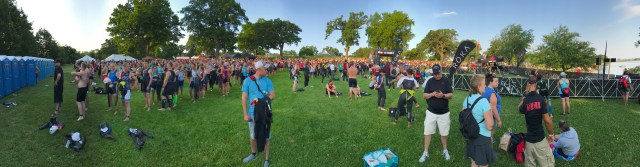
This weekend in Madison we arrived at the starting line for the Half Ironman at 5:30 am. As I stood around watching athletes get ready and waiting for my wife Sue to emerge from checking her stuff into transition, I took a look around at the way in which people almost seemed to be posing for a painting by Georges Seurat.
You may know his work. His most famous painting hangs in the Art Institute of Chicago. It’s titled A Sunday in La Grande Jatte. It looks like this:
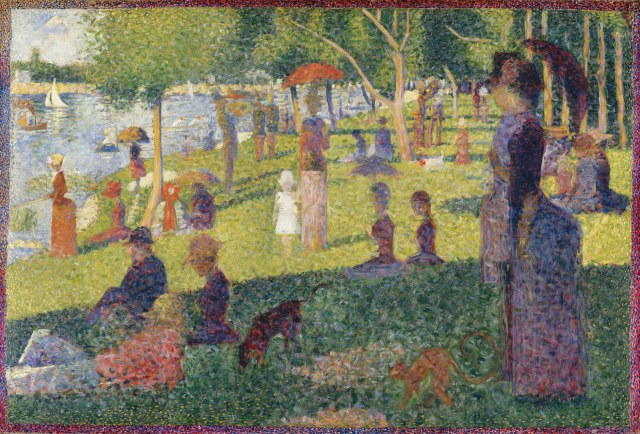
Working Title/Artist: Study for A Sunday on La Grande JatteDepartment: Nineteenth-Century, Modern, and Contemporary ArtCulture/Period/Location: HB/TOA Date Code: Working Date: 1884 photography by mma, Digital File DT1026.tif retouched by film and media (jnc) 9_29_11
Seurat was one of the painters known as Neo-Impressionists. The version of the painting shown here is actually a study piece he did before engaging in the far more finicky final version done in a style call pointillism. That is, he executed the massive work in a system of finely painted dots that when seen while standing back from the painting are no longer distinguishable.
Here’s an interesting kicker: This method anticipated the manner in which modern photography now works. When people use their camera phones, they snap an image that is captured in an increasingly dense set of digital color representations called pixels. What we’re actually seeing even in the finest grade of digital photography is a virtually seamless cloud of these pixels that make up each and every photo.
Of course we take this artistic miracle for granted. We’re so obsessed with the look of our bodies in the mirror or the angle of our face in that recent shot from a party we don’t stop to think that we’re the beneficiaries of an amazing brand of Neo-impressionism that just 15 years ago was unimaginable to the average person.
Amazing tasks
And to make things even more interesting, our smartphones can handle some amazing tasks as well. Which is why I stood facing the crowd (photo above) who were waiting to use the Porta Potties. Then I performed a panoramic scan of all those people. A few of them moved a bit while I was scanning. That results in a fascinating twist on the human form.
A few minutes later I turned to face the crowd gathering for the start of the race. This also produced an interesting study of the human condition. All those people served as an interesting statement on the human condition.

It got even more interesting when I moved closer to the starting line. There were hundreds of athletes wrapped in neoprene. Their forms were reduced to the simplest statement of shape and gender while swim caps wrapped heads and highlight faces.

Finally I moved close to the gates where athletes were funneling down to the water. Some of the fastest swimmers were perched here. Many of them sat on the grassy hill together. This formed a bit of a perceived performance roadblock. “If you’re going to  ease past this queue,” their quiet protest seemed to say. “You had better be a much better swimmer than all of us.”
Their stolid posture made me think of another Seurat painting in which bathers are perched on the banks of a river. The summer haze is visible and the skin of those sitting by the shore seems ripe for a sunburn. Everyone seems lost in their own space either daydreaming or half asleep in the sun.
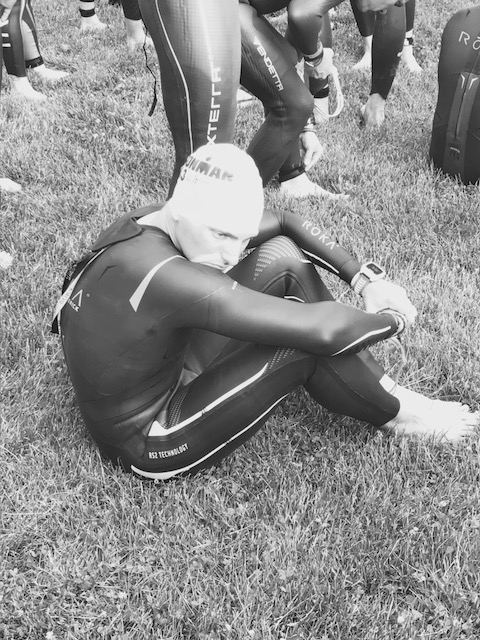
The same held true with all those swimmers lost in their own concentration. I reasoned this mood was best captured in the solemnity of black and white photography. In the photo below you can feel the pre-race focus of the athlete as he broods a bit. Race management had canceled the swim warmup for medical reasons when the ambulance failed to show up until 7:00 am. But look at this guy. He’s ready to go.
First out of the water
It can be intimidating to hang around in the company of the most elite swimmers in the race. Yet one 19-year-old kid had the genuine daring to walk to the front of the queue and stay there. His name was Billy Barth. By casual conversation at the check-in station the day before, I’d chanced to meet his father Ed who shared that Billy is a swimmer for the University of Notre Dame. His son’s broad shoulders explained the strength behind his confidence in winning the swim. He was first out of the water in just over 26 minutes for the mile distance. Then he ran up the hill to face the bike segment and then the long run in the heat.
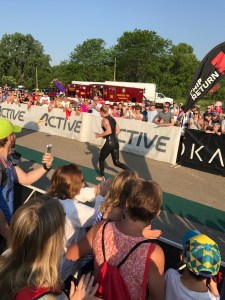
Billy Barth, as he predicted, is first out of the water at the Madison Half Ironman
That’s how the triathlon is for many people. They do the best they can in the event where they have the most experience and build on it from there. Some like Billy are excellent swimmers and count on that leg to give them a head start. Others hammer the bike leg while the best runners count on closing fast.
But the wonders of the sport are its confusing ups and downs, triumphs and failures. Even on the best of days, there can be things that go comically wrong. Testimony to that fact were the pile of water bottles gathered by volunteers just after the race course crossed a set of diagonal railroad tracks not 400 meters into the race. There was nutrition of every type that bounced out of carefully assembled packs and pockets. It seemed no one turned around to pick up their valuable stash. The world is chaos at times. Such is life so often that we go looking for solace in natural places.
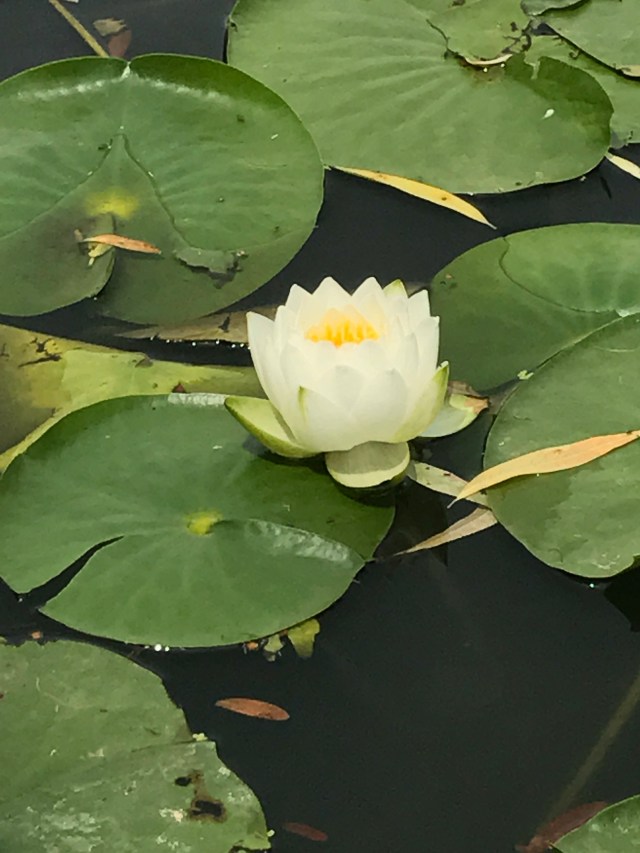 Which explains why I took the longer route back to the car during the day to walk. That afforded a closer view of the bright white and lily blossoms were in bloom. I stopped to take some photos of those too, thinking of course about the work of Claude Monet, one of the leading Impressionist painters.

I love sports like triathlon. But I also love the unstructured world in which the eye can do the lazy work of taking it all in. It’s a wonderful thing that so many people convene to participate and cheer at a triathlon. In some respects it is representative of the best of the human condition.
Yet we also know that our celebrations of life are almost always a ruse of sorts. As athletes were are the pixels in a grand pastiche that we call sports. Because beyond that realm, there is the broader world where the pixels of the human race all seem to be in chaos.
Indeed, some people seem to thrive on scrambling the order of things, and laugh out loud at their ability to muck things up like a hand in the mud of a deep clear pool. Their efforts raise clouds of silt and makes things harder to see, but this makes them feel bold and expressive like the bully in a grade school art class. “Look what I can do! Isn’t this genius!”
The untalented and deeply disturbed always seem to call their cloying, egotistical tendencies great art. Nero. Hitler. Mao. Trump. Then there are those that celebrate this dark-hearted ugliness through self-absorbed literature. Ayn Rand comes to mind.
But the so-called work of the self-absorbed ultimately leaves a void. People suffer as a result of their careless brush with responsibility and alternately sloppy and narrow visions of what constitutes great leadership.
When this brand of dispassionate rule is enabled by society, we are left not with people catching moments of clarity on a grassy hillside next to a river, but with broken, abandoned souls reduced to lying on the ground with no explanation for their presence except that they can go no farther.
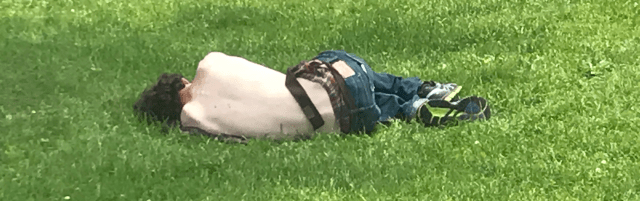
This is also what I found during a day in Madison under a hot sun. The man shown in the photo above lay on the grass near the Alliant Center for the entire afternoon. He had found some shade and laid his shirt on the ground to protect his face from the grass. There could not have been a stronger contrast between that man and the steady stream of athletes returning to their vehicles from park where the race was staged a half mile away.
The world is dichotomous. It always has been, and always will be. But now I am kicking myself for not stopping to check on that man. He left a strong impression on me, and raised the question about where true reality lies. All of life is a series of impressions. It’s what they ultimately make of you, and you of them, that truly matters.
 Every summer something comes along to make life more interesting on the bike, the run or in the pool. I even had a sense yesterday things were not quite right in the universe with me. There are days when the bike feels like a blunt instrument in my hands.
 When I looked up, the truck was right there in the parking lane with the guy sitting in the driver’s seat. I avoided colliding with the rear bumper and gave the wheel a shunt to the side of the truck. That sent me skidding across the handlebars a bit, which are wrapped in grippy tape. That explains the stripedy rash on my arm. And not much else was hurt. No dinged knees. No bang of the head. Nothing much happened.
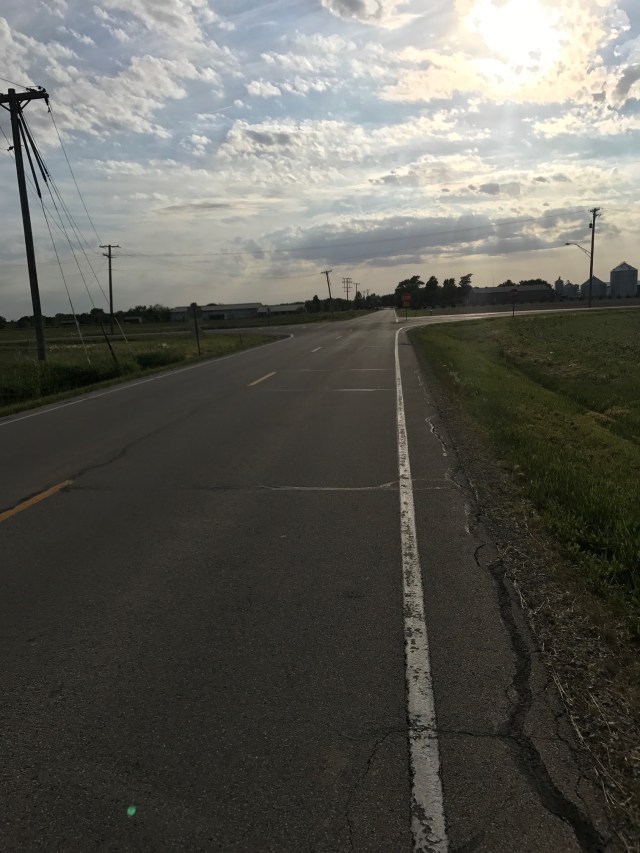 The rest of the ride was mercifully uneventful. In fact it was downright lovely. I took a turn up a section of road called the Burr Road Rollers and recorded my second best time on Strava for the segment. Then I turned west all the way to a road called Meredith, The sun was hidden by some popcorn clouds, but its late afternoon rays could not be contained. As I approached the intersection of Beith and Meredith, I was reminded of that scene in the movie Castaway in which the character played by Tom Hanks comes to a lonely junction of roads somewhere out in the fields of Texas. He stands there and looks both ways. After what he’d been through as a castaway on an ocean island and living through the jolt of returning to modern life, life felt strange. He’d reconciled to his lost wife and realized that the life she’d found was right and proper given the circumstance of his supposed death. It was a new life he had to consider. And in that moment, there was a feeling of both loss and liberation.
 It’s funny how we human beings, though highly evolved in areas of intelligence and self-awareness in comparison with other living things, still resort to comparisons with animals to generate ideas about the merit of individuals or teams. We name our organizations after LIONS and TIGERS and BEARS to symbolize some set of virtues with which are supposed to be inspiring.
 That reminded me of that
 So my simple plan is this. I need something manageable to accomplish change. It comes down to replacing about 30% of the foods I eat that are carbo or sugar heavy. The few sodas I drink? They have to go. I lived 20 years without them, and let them back in the door a few years back. Big Mistake. They are fat bombs, those sugary drinks.
 The bloom of fitness is a near miraculous feeling. After waking countless mornings fatigued from training, a dawn arrives where one rises rested even after a hard workout. The brain comes alive. The body feels ready to do that next thing. Whatever that is.
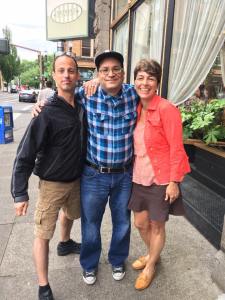 The next day Sue and I rode in an event called the Udder Century. Our entries were gifted to us by friends that had signed up months ago only to move to Beaverton, Oregon where our friend Anne de Traglia has started a new job for the Nike corporation.
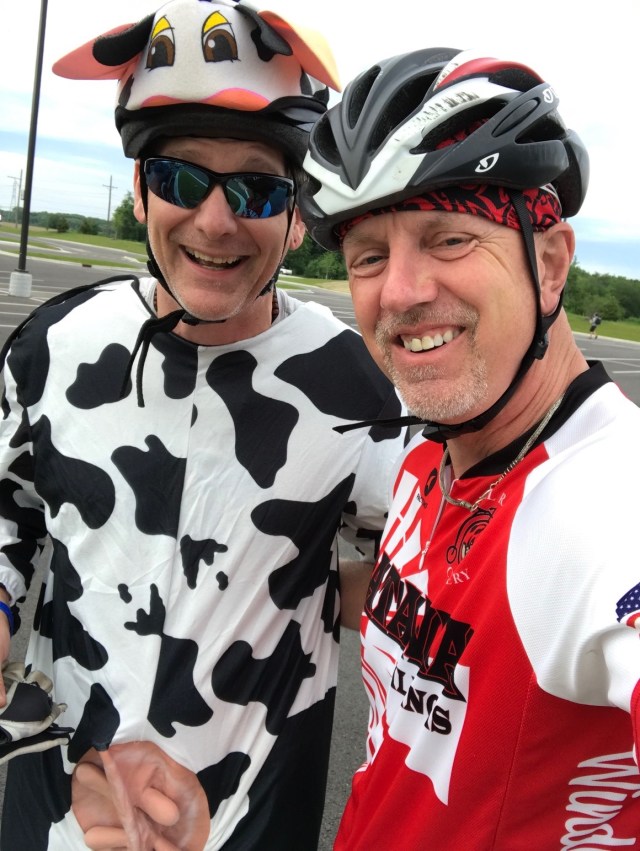 But there are times when I’m at an aerodynamic disadvantage because Sue typically rides in full Aero Tuck position and I’m left to slum it on her back wheel. I reason that’s the tradeoff in riding with her. She doesn’t want me to pull anyway. That doesn’t help her become a stronger rider for Ironman. So I slum it in the draft. And even then it’s hard to keep up sometimes.
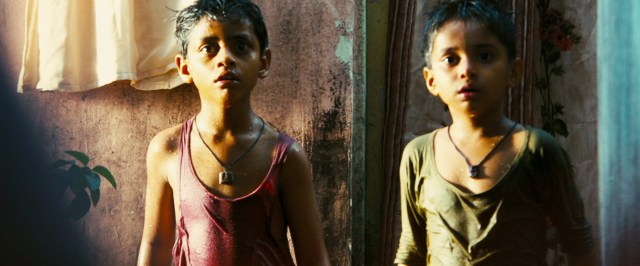 Then came Monday Morning after the previous evening’s encounter with the movie Slumdog Millionaire. I’d seen it before, but forgotten how it worked. You likely know the plot. Two low-caste Indian kids with a terrifically tough childhoods wend their way through a long series of experiences bordering on death. These prepare the one kid to answer questions that lead him to win a million dollars.
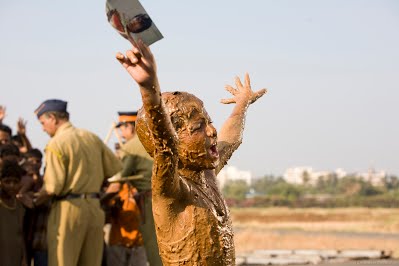 There so much ignorance and denial. We’re almost drowning in it. Up to our necks in it even when it isn’t our shit we’re dealing with. And sometimes, out of sheer desperation or motivation, we must dive all the way and hold the picture of our desires aloft. That may be Jesus or our favorite Hollywood star. Whatever keeps you from sinking all the way into the shit, keep your arm up and your fingers pinched tightly together. And raise yourself above that shit however you can.
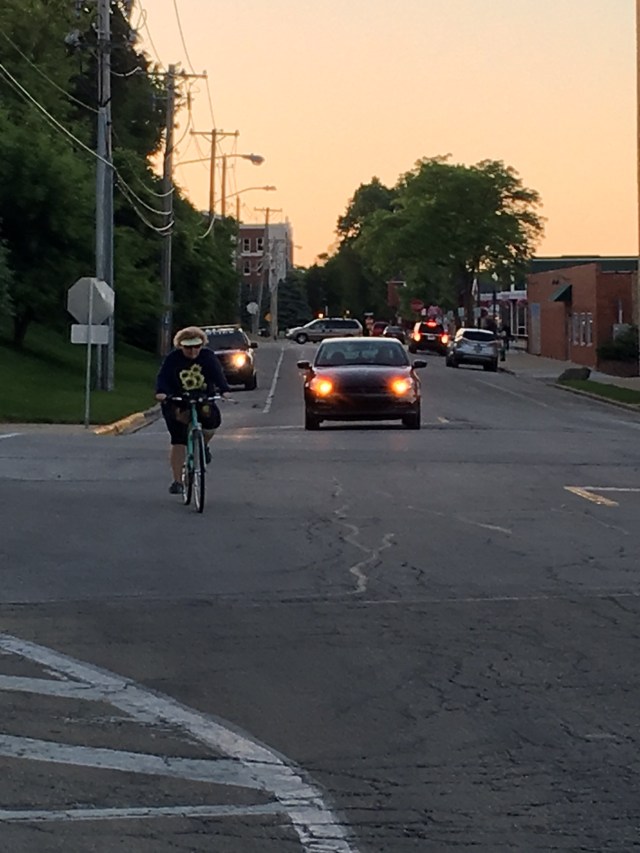 I started this blog in the fall of 2012. Within a week or two of posting the first piece, I noticed a woman riding up the block where I lived in Batavia at the time. She wore a visor, no helmet, a sweatshirt and some 3/4 length pants. Her bike was a simple mint green affair. She wore no clips on her shoes and pedaled at a steady, even rate.
 She told me later that spring that it was a tough winter for riding. You think? “I cut it down to ten miles some days,” she admitted.
 As fans of the Austin Powers series well know, the character Dr. Evil was very fond of his Mini-Me dressed in a little gray matching outfit. Perhaps it had something to do with his controverted ego and his creepily suppressed sexual desires, whatever those were. It was hard to tell given his association with characters such as Goldmember, whose apparently shiny tool and propensity for eating flakes of his own skin were so distracting it made Dr. Evil seem normal.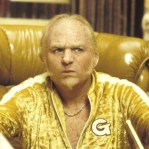
 Which could be the game plan for a certain golden-haired politician, if you think about it. We haven’t yet seen him eating his own skin, but perhaps that is what got in the way of his fingers while typing ‘coverage’ so that it came out ‘cofveve.’ You have to admit there’s a striking similarity between The Donald and Goldmember. Think about it.
 But it’s a fact that every character in the Austin Powers series seems to be grappling with some sort of deep inner conflict, usually sexual. Even Austin Powers lost his Mojo and couldn’t shag anymore. And those Fembots with the machine gun nipples? The NRA would love them. So would Fox News.
 And if all that fails, you can simply follow the model of Dr. Evil himself, who sums up his life history and philosophy in this highly compelling quote:
 The last morning in May 2017 delivered a sunny day with a fresh northerly breeze. A four-mile run sounded good to me. Just enough time to think things through about the summer.
 For those of us with a 30-year gap in our swimming resume, the process of building up to a strong, reliable swim stroke is a step-by-step exercise in humility. From those first manic learning laps in the 25-meter pool to the daunting task, the venture into open water swimming would be epic if it weren’t so common and mundane to the entire sport of triathlon.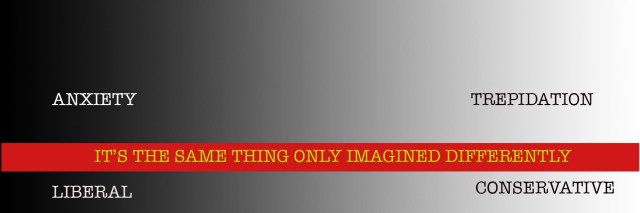
 Genetically, all living things are evolved to respond in either fight or flight mode. But when we try to run away from something we bring upon ourselves, such as choosing to swim in open water, real internal conflicts can arise.


 We Run and Ride