

Melvin Mues, at center in plaid shirt, was a family patriarch.
Yesterday I wore a pair of dress shoes to work that were previously owned and worn by my late father-in-law, Melvin Mues. He loved practical, comfortable clothing and shoes, and when Mel passed away six years ago, the family passed along some of his shoes and coats and clothes. The Ecco shoes I wore yesterday morning were part of that litany.
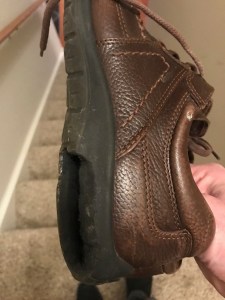 But something funny happened yesterday that meant the end of the Eccos. They had a blowout on both sides of both shoes. During the day I actually noticed some chunks of rubber below my desk chair. It was brittle, granular rubber, the type that typically flakes off the arm of a desk chair arm. But there was no new evidence of that on my new chair, which did lose a chunk a couple weeks ago. That sucked. But yesterday was a busy day at work, so I did not dwell on what might be going on with my chair. Things to do, you know.
Yet this morning when I went to retrieve the Eccos from the living room where I’d shed them the night before, I picked them up and noticed a hole in the side of the shoe near the heel. Obviously, the rubber that made up the bulk of the shoe had suddenly decided to give up the ghost.
I took the shoes straight out to the garbage because there’s nothing that can be done for shoes in that condition. No sane shoe repairman will touch them. You can’t fix aged, crumbling, rubber. It will decompose at will.
They lived a full life, those Eccos. As did their previous owner. My father-in-law was a gracious, kind and intellectual man. He was a graduate in biology from the University of Colorado were he spent his undergraduate years chasing insects to identify up in the hills above Boulder. At one point while talking about his love for the outdoors but his disdain for the formalities of the sport of golf, he smiled at me and said, “Nature is my country club.”
Now that is the title of a book I’m working on and expect to have completed by late this year.
Glacier trips
 Mel and his wife Joan made an annual trip during the summer to Glacier National Park. They always took the same route, driving up from Illinois through Wisconsin and Minnesota to link up with Route 2 in North Dakota. Then they drove straight across the top of the lower 48 states and straight on through the long stretch of Montana to reach Glacier. They visited the park for more than 20 years, then announced they’d had enough. Their hiking days were through.
Yet the nature of that trip explained how the man lived his whole life. He was one to focus on the present and appreciated the little things as much as the big things in this world. He was brilliantly informed about the structure and makings of the universe from his studies as an amateur astronomer. He owned a big Celestron telescope through which you could see the rings of Saturn and moons of Jupiter as clear as day. In 1996, we all made a family trip out to Cortez, Colorado in league with the Adler Planetarium to study the archaeoastronomy of the Anasizi Indians one summer. It was the best summer vacation we ever took together as families, filled as it was with pre-dawn trips to view solar and solstice events in Four Corners region of the United States.
Despite his chill dude attitude, Mel had his share of tensions, for sure. At his funeral it was revealed that he kept a half dollar in his pocket that was rubbed smooth from years of him fingering it in his pocket. That was his stress relief. No drugs. No drama. Just a half dollar in the pocket, rubbed daily.
Running on
Mel only saw me run races a couple times. Fortunately, I won a couple of those races, which might have gone some distance in him trusting that I had initiative and believing in my character. But one can never be sure. He was not a person who was big on frivolous exercise, preferring to walk more than run.
His true favorite hobby was sawing up wood in the form of tree branches that fell from the oak and hickory forest in his large backyard. That’s what he was doing the day he collapsed from some sort of heart issue, falling face first into the sawdust. His wife shook him back alive, but the next year was spent trying to cure the side effects of surgery and other problems, and he never fully recovered. As a guy who generally avoided doctors most of his life, he once spent a couple weeks leaning on a portico near the front door because his back hurt too much to sit or lie down. His philosophy was stoically German and rather inane, if you ask me. “Most things go away in a couple days if you wait them out.” Well, it didn’t always work.
Hard worker
Mel was simply one of the hardest workers you could meet, and applied that ethic in everything he did. Some of that “work” was organic to his occupation. During multiple decades of managing Northern Hydraulics, the machine manufacturing company he owned more than forty years, he made thousands trips up and down the steep stairs from the second-floor office down to the plant floor. “That kept me in shape,” he once told me. And he was likely right about that.
But his formative years helped explain his real-life ethic. Part of his persona was that he also loved to tell stories about living on the family farm out in Nebraska where he was raised. He was one of eleven kids, if I recall, and had to fend for himself on a lot of fronts. That included living in a farmhouse where there was no heat in the attic where he slept. The outhouse also was unheated. So the choice to visit the bathroom late at night during subzero weather toughened the child as well as the adult. And at some point in his elementary school years, he contracted some sort of congestive condition and the doctors performed a tracheotomy to keep him alive. The scar was still visible on his neck.
He loved telling country-living stories such as shooting squirrels out in the big cottonwood forest down the lane. “Sometimes they’d get stuck up there in the crotch of a tree after we shot them,” he’d chuckle. “That always made me mad.”
 The emerging ethos
That was his way of telling us that life does not always go the way we’d planned. Generally, he was patient and virtuous in all respects. But there was an anger that sometimes boiled beneath the surface. Mel was a deeply conservative man in the traditional sense. He read the National Review religiously and believed enormously in self-sufficiency. It angered him to watch spoiled professional athletes mumble about their problems on TV. He’d sometimes mutter and curse at the TV during post-game interviews.
As Fox News emerged as a conservative news force, he fell into a pattern of aligning his views with their talking points, and that sometimes vexed our family. His kids would roll their eyes and this son-in-law frequently bit his tongue rather than attempt to contradict the patriarch.
Yet no one really blamed him for a bit of frustration in life. He’d earned his right to complain about the world, having been sued for ridiculous reasons having to do with companies that removed the safety arms from the hydraulic machines his company manufactured. A worker somewhere would get their fingers or limb chopped off and turn around to sue the maker of the press. It was an unjust outcome, and Mel had to put up with that and other absurd vexations that afflict business owners.
The American Way
Ultimate the company floundered not from lawsuits but because the American manufacturing sector was fading from existence as American capital and manufacturing operations migrated overseas. That left men like Mel holding onto thin shreds of the machining and repair market for existing products still in operation. Then for a while, he hired a Korean salesperson who was ordering machines for the Asian market. But soon enough, that market dried up and blew away too. Those companies could get cheaper products made on Asian soils.
I deeply admired how he handled himself through all that. One can only imagine the pressures and nightly worries as he strove to keep the company afloat and took no income himself for years. There were eight or ten machinists on the payroll. Every Christmas the company would host a wonderful little Christmas party for everyone who worked there. Bonus checks were handed out even in lean years. The staff was largely loyal and intensely devoted to doing a good job.
We all wish that world could have been sustained here in America. It was built on the backs of World War II vets and the GI Bill that educated so many and fostered growth and prosperity in America following the war. At one point, manufacturing was more than 40% of the American Gross Domestic Product. But not any more. It’s closer to 9% these days.

4th of July, watercolor painting by Christopher Cudworth
Keep on keeping on
Yes, there are still great companies making things here in America. Perhaps some of that ingenuity and manufacturing business really can be brought back onto our shores. That’s the promise that’s been made to Americans voting for Trump. But it may be unrealistic in a global economy where emerging countries have labor forces ten times the size of the American population and willing to work for wages that are perhaps less than half what an American worker needs to make to survive.
I think about Mel frequently when I read the promises being made these days. I genuinely wonder what he’d have thought of Donald Trump. I do know that Mel despised the shallow instincts of contemporary society. Perhaps that explains it well enough.
All I know is that the legacy of the man I knew, who taught himself how to engineer and design hydraulic presses all on his own volition. I’ll repeat: He taught himself how to do the drawings used to design those machines. That is real genius.
Born on the 4th of July
Mel was also born on the 4th of July. That was another big day of the year for all of us. We’d gather in the backyard and in some years, Mel made hand-churned ice cream in a wooden bucket. We’d all take turns churning it until we could churn no more. Then we’d slather that tasty stuff on the apple pies he’d make in autumn and store in the freezer until he hauled them out in the heat of summer. He’d sport bright 4th of July clothing in red, white and blue and one year even wore star-spangled boxer shorts, a rare concession to his wild side. It was epic, I’ll tell you. We all just shook our heads, lit a bunch of illegal fireworks and sat out in their dark front yard with the fireflies and mosquitos watching the Addison fireworks show over the park a mile away.
So it prided me to wear Mel’s Ecco shoes. The man was a testimony to honest beliefs and earnest living. They were the echo of a man who was kind and loving and endured my pontifical dreams and plans even when they were stupid or didn’t work out. He knew that I loved and cared for his daughter and his other children. And in the end, that’s what matters most to a father or a mother. He was a doting grandfather to my own children and taught them many life lessons they’ll never forget. I loved the man, and still have another pair of shoes, a solid pair of Timberlands that are wearing out these days, but should last another couple years.
This is the type of dedication love that drives this world. It echoes through all of us, if only we’ll listen.
 Perhaps we’ve become so accustomed as a society to seeing things hyped beyond reason it is normal to feel jaded when something really special comes along. Here in northern Illinois, last summer’s total eclipse of the sun was indeed dramatic if you had time to get outside with the proper eyewear to look up at the sun being blocked out by the moon.
 The sun still reached the lower 4/5 of the moon as I watched it glow through the 150-600mm lens I use for photography. Slowly the crescent moon shrank and then dimmed. When the earth’s shadow completely covered the moon, it did not show completely orange as predicted. It vanished completely. I stared through the camera and waited and looked for some sign of the moon. But it was gone. It did not come back.
 Even then, some people prefer to deny what they’re truly seeing. Don’t laugh, because members of the Flat Earth Society are very seriously in denial about the fact that the earth is indeed a round sphere moving through space. The website LiveScience.com has gone to the trouble of assembling a summary of these beliefs and the credulity that drives them. Here is a quick take:
 To believe these things so earnestly people have to base their entire worldview on denial of facts staring them right in the eyes. Their grasp of reality, you might say, is eclipsed by their religious and/or political worldview. And they like it that way.
 This is what the AnswersInGenesis website, an apologetics source for those insistent on a literal interpretation of the bible, says about the craters of the moon. Notice that there are no quotations of scripture to support these suppositions. They are basically all “made up” from the whole cloth of the imagination.
 Thus it is no coincidence that 30% of America’s voters remain staunchly in support of a certain orange politician who also has a loose relationship with the facts, tells them he’s a Christian just like them, and denies global warming to boot. But because he says he doesn’t like abortions and maybe black people, they vote for him. And his two sons? They’re little more than sonspots, “regions of reduced surface temperature caused by concentrations of
 There were guys and gals of all shapes and sizes on the track team. Compact little sprinter girls no taller than 5’3″ but with thick thighs and the sprinter’s butt to match. Long lean high school boys whose shirts collapsed into their skinny guts as they ran. Thin as heck. Knees still stretching with growth. Loping their way down the track. They hardly looked thick enough to allow blood flow to occur.
 It’s a fact sometimes that our life choices get made for us by circumstance. There is little we can do to change them. They become habits, a calling, then a way of life. Running around a track has been a part of my life for so long now that I feel like a corpuscle swooping through a curving artery until I get back to the heart and start it all over again. I’m like a science experiment with no results but a sense of satisfaction. But is that bad?
 This weekend a band of twenty-something children moved out from our house into their own apartment 15 miles away. The move was a delightful mix of chaos and organization. I’ve packed moving vans so many times over the years the process is almost like an art to me. The mixture of furniture and boxes and plastic bins is performance art in the making.
 Even my expensive and prized tall
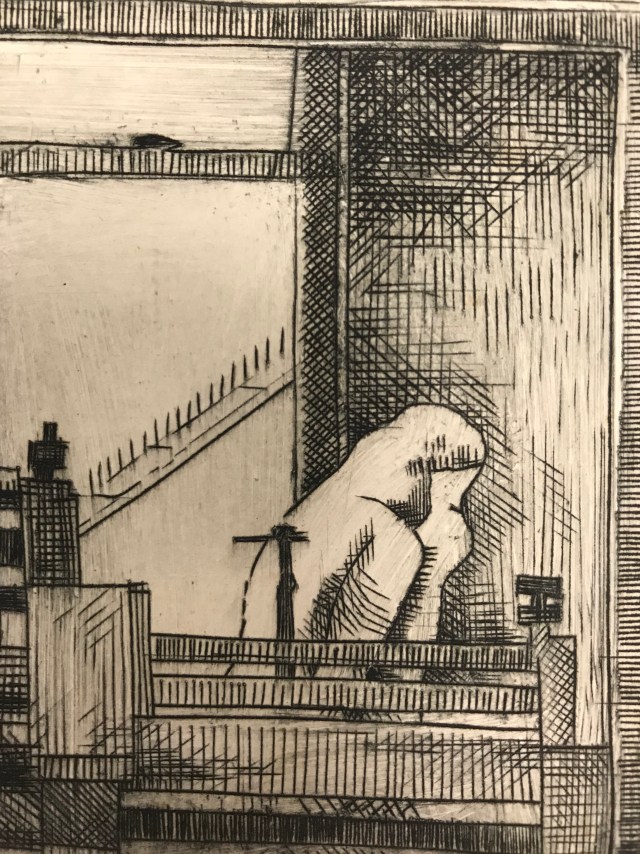

 Like so many people, there are periods when the dreams I have at night are so vivid they almost make my head spin when I wake up in the morning. Some of the dreams are clear and direct. You can tell the brain is processing some life event or challenge in abstract fashion.
 I’ve always been a person who wants to please others. Call it the Middle Child syndrome. At the point in life when I had that dream, I was likely in some position with family or work where I felt like I wasn’t meeting the self-imposed obligations rattling around my brain. That dream was my way of working through the nighttime angst.
 Early morning freezing rain made the roads slick for running today. I got out the door by 6:30 a.m. and immediately found my daughter scraping away the thick crust of ice on her Honda windshield. She’d gotten through the top layer of ice but the visibility was still zero through her windshield. I stopped to take the scraper for her and ground away as the ice turned to powder and fell like little bits of snowstorm on the now-bare window. It turned from black to white ice before our eyes.
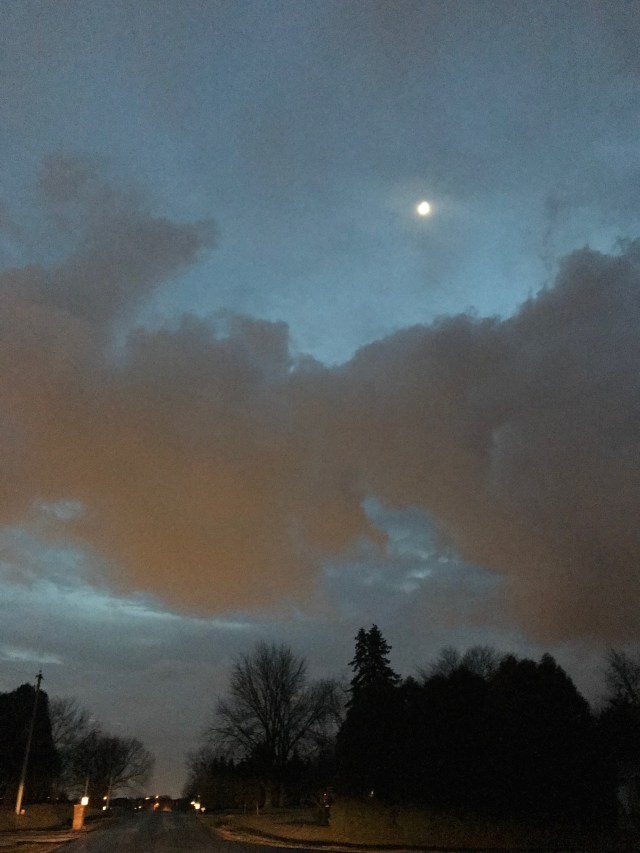 A near silent hiss of granular snow had fallen overnight. This was a surprise to see as I opened the blinds to peek into the pre-morning gloom. “Huh, snow,” I muttered to myself.
 It turned out to be the perfect solution on a brisk morning with a north wind pushing icy crystals of snow southward. The street was covered. Only one set of tire tracks circled round the cul de sac. That was the newspaper delivery truck. The track of the skidding paper slid up the driveway. Later I’d come back to find the thin tracks of mourning doves around our bird feeder, and the clean lines of the primary feathers of a bird that lifted off the ground when I approached.
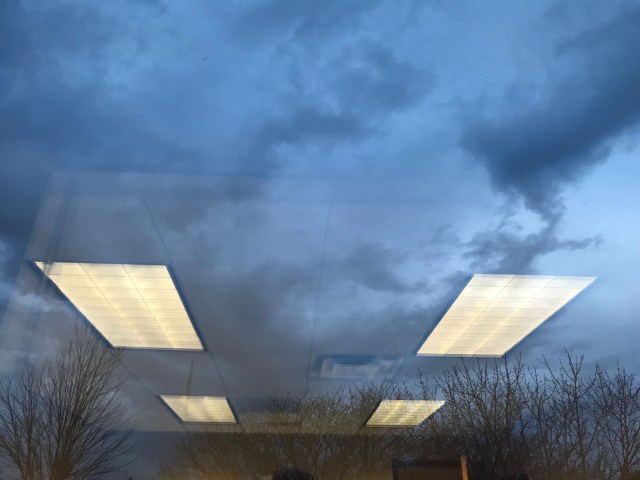 Behind me, as I stepped up to our porch and the front door, the lights of the car dealerships blared behind into the morning sky. They were diffuse, so different than the illusory images of fluorescent lights reflected on the glass of my office window as I turned to leave work last night. Those were crisp and defiant against the darkening sky. This light thing is all a game. An illusion of self and perception.
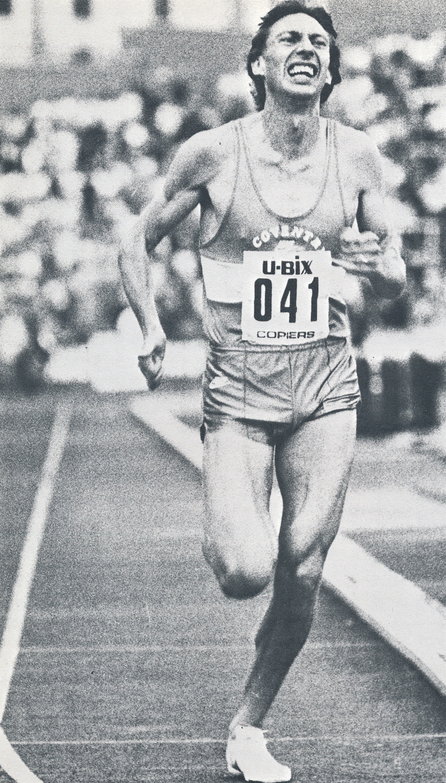 Thirty years ago sportswriter Kenny Moore published a compilation of his best writing about runners for Sports Illustrated.
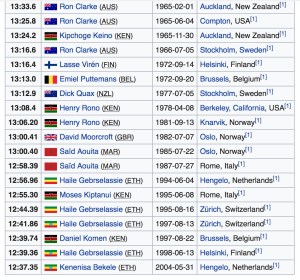 My personal best 5000 is essentially two minutes slower than the world record. I ran 14:45 in the year 1984. That race was an all-comers meet at North Central college. The gun did not go off until midnight, but we all raced as hard as we could. The personal triumph of my PR was essentially my own to share except for a female friend that had come back to watch me race. I thanked her for that. It always meant a lot.
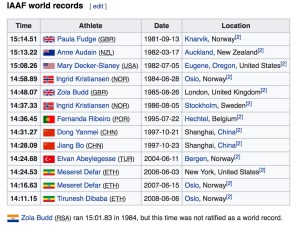 There’s a chance I could have run a bit faster with other opportunities to race. But likely not by much. We all have limits to our natural abilities. I honestly feel that I ran as fast as I could that evening, and every other race in which I competed. If I ever dogged it on purpose, I cannot recall.
 I grew up in a four-square house south of Lancaster, Pennsylvania. I loved that home for a million reasons, but mostly because our family was all together when I was 5-12 years old. Flawed as we were, there were many joyous days.
 The period of my elementary to junior high school days was a time of great change in children’s toys.
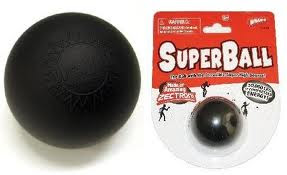 New kinds of rubber were being developed from space research and material experimentation. These included the first amazing Super Balls that bounced so high and far it was easy to lose them in the weeds if you couldn’t catch up.
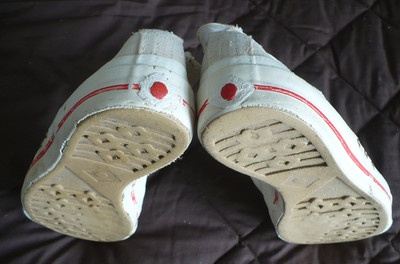 To go out and play, we all wore tennis shoes or “sneakers,” as we called them.


 We Run and Ride