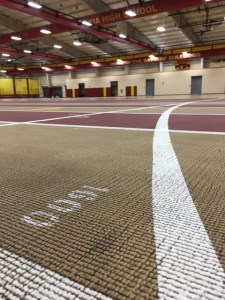
 Walking into the indoor track this morning, I witnessed one of the gals being trained for running form pull over in a series of halting steps and lean down either to catch her breath or deal with whatever pain was vexing her. But it wasn’t clear whether that pain was physical or emotional.
The class puts a lot of demands on the women who participate. They do drills to learn to run on their midfoot, carry their arms correctly and sustain pace and tempo over time. It’s a lot to think about. They are literally changing who they are as runners. That takes some doing, and it can make you a little crazy.
To runners that grew up in the sport, it always looks a little crazy to see people starting out. Add in a rehearsed method of training like form drills, and it all seems overcomplicated.
Sure, many of us have done drill training, and recently while watching a focus piece about Galen Rupp broadcast during the Olympic Trials, it showed how much strength work he did to build his running form. Rupp credits that strength training for being able to avoid fatigue late in a race. And it clearly works.
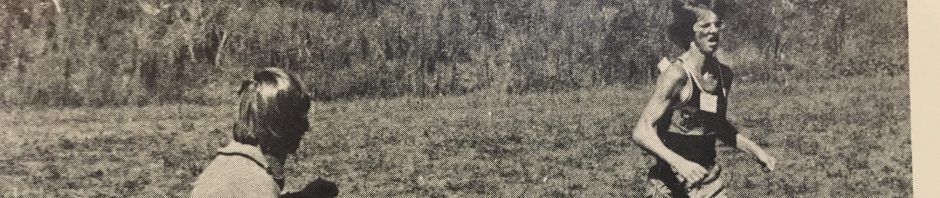
But getting there takes a little bit of crazy. I recall doing weeks of indoor training during high school track. We ran through bone-chilling cold to an elementary school gym for an hour’s worth of plyometric drills. We bounded and jumped and built our foundations from the ground up. And it worked.
That’s one kind of crazy. A good kind. The kind that fits part of the definition of crazy in fact. Crazy: extremely enthusiastic. synonyms: passionate about · (very) keen on · enamored of ·
The other kind of crazy, the kind not deemed so positive, is defined as: mentally deranged, especially as manifested in a wild or aggressive way.
We all claim to know some crazy people in life. That’s half of what people talk about all the time. Crazy politicians. Crazy YouTube videos. Crazy memes and themes and Krispy Kremes. It’s crazy to eat that stuff. Yet we’re all tempted. We’re all crazy in some way. It takes a little crazy to get through life.
And we all know there’s a mix of all kinds of crazy in our daily schedules as we run, ride and swim. That’s in part why I started this blog. To consider the craziness of what we do.
 It’s all so easy to get carried away. Yet to “get crazy” is often perceived as a good thing. The craziness of doing event like a 100 mile run or an Ironman consumes us wholly. Yet we do it and share these experiences because it’s a way to react to life. The fight against the mundane is perpetual. We dive in and we back off. We engulf ourselves in the miracle and hope of craziness. We learn things about ourselves. Some of that is good. Some not so much.
And we hope other people understand. Sometimes they do. Sometimes they don’t. It depends on what angle you are using to consider the situation.
That calls up the third definition of crazy, defined as: (an angle) appearing absurdly out of place or in an unlikely position.
That last definition carries some crazy weight in this discussion. Because you often can’t tell the difference between a person that is crazy about what they’re doing and someone who is doing something because they’re already a little crazy, or trying somehow to cope.
I knew a guy named Larry in Chicago years ago that ran around with heavy weights strapped to his arms and legs. He swore this was going to make him a better runner. His theory was that his strength would be such once he removed the weights that he could glide across the ground at a much faster pace. It was a crazy theory. And it didn’t really work. Larry never really got any faster as a result of his routine.
It’s simply impossible to tell these things apart at times. Emotional conditions like depression can make people want to do crazy things or act out. Either that, or it forces them to withdraw. People do these things to break out of thought patterns that are not constructive. Runners and endurance athletes are no exception to this behavior. In fact, there are many among us who are drawn to the craziness of endurance sports for those very reasons. It’s considered a healthy way to work off the stress, anxiety and depression.
More than one fellow athlete has told me that either they took up running or they’d have smoked and drank their whole life. A few former teammates have gone that route after they ceased running. Some survived to become sober and cease the craziness. A few did not make it. The drugs took them down.
 We now know that endurance sports contribute important chemical support from within the body to combat depression. There are cognitive benefits as well. Combined, and with common sense, these benefits are healthy indeed.
But we still need to remove the stigmas of what it’s like to deal with depression.
This morning my son shared an amazing treatise on depression written by a friend of his named Matt Muze. People struggle to grasp what it’s like to work through depression. The starting points are inconceivable to those not afflicted by it. This essay shows some of the outcomes that might even be deemed positives.
The world knows great benefit from those who live with depression. Men like Winston Churchill, who called depression the Black Dog, knew how to contribute to society despite their condition. There are simply rough days now and then. It’s important that people not take it personally when a person with depression wades through the murk. It’s not a “mood” or a “choice” they are making. And they can’t always admit it in the moment. Be patient.
People who deal with depression are not crazy. In fact no sort of mental challenge is truly a “crazy” thing. Supposedly “normal” people do far crazier things through arrogance, intellect or just plain being an asshole. The fact of the matter is that all people act that way at times.
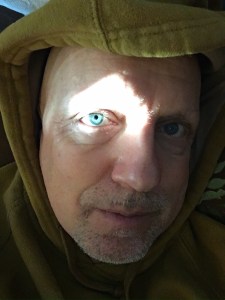
 All this craziness is like a three-way mirror, or more. People aren’t so much crazy as they are trying to look at themselves from several angles at the same time. When someone catches you doing it, the situation can be a little embarrassing. But why else do so many millions of people shoot selfies? And why do they so often choose to use mirrors to do so, rather than the self timer?
It’s the patent objectivity of the selfie that is so appealing. People really want to know themselves better. It’s the prurient curiosity of this process that makes it so appealing to look at other selfies and wonder what that person was thinking. About themselves. About the world. Which in sum is a little bit of crazy every day.
BE ORIGINAL.

 The idea that “all things are possible through God” is inviting, however. Yet it has been my experience that the things possible through God often have nothing to do with our own expectations or desires. They have everything to do with comprehending our ultimate place in the universe. I’ve seen people close to me die. Parents and a spouse. I know what it means for life to come to an end. I know what it means to have mercy extended before that happens, and why it is so important to show mercy however you can to others. It is our true role as human beings to do so.
 That’s what I take to the starting line, and everything I do these days. The will to try is balanced by the acceptance of forgiveness. Many times in my career I’ve been fortunate to find that sweet spot in time, the place where the joy of competing is rewarded with the relaxation of knowing I’m doing my best. But not always.
 On every team, there is always one or two people who love the dynamic but actually seem bent on messing it up. They might be noisy or obnoxious. They lead intervals too hard or too often, but can’t actually race. Or they might lack social awareness in some strange way.
 I watched the Olympic Trials marathon on DVR, so I already knew who would win. And I fell asleep watching it. And so missed the
 As a kid, I could not swallow pills. My mother had to pack them into food to get them down. I distinctly remember the acid taste of aspirin exploding on my tongue. And crying.
 I also graduated to Ibuprofen as my pain reliever of choice. When headaches came on and I took Tylenol, literally nothing happened. Decades later I had this conversation with a nurse at a hospital:
 With all the debate over government spending and what constitutes socialism raging across the land, perhaps it’s a good time to shed some perspective on how government really works. And it all centers around running.
 children. Some do a great job. More often they’re frustrated or disappointed with what public schools (and even private) have to offer. All it takes is one bad teacher and some folks want to toss the whole system down the drain.
 Well, all of them went to public schools. And many went to public universities. Even private colleges depend on national infrastructure, government loan programs and other methods of sustenance to run their operations. No organization exists in a void.
 And it was even discussed working collaborative with the park district. But that might have bloated the referendum and caused some genuine needs to blacked out. That’s both the problem and power of compromise, a principled manner of discourse that is sorely lacking in America.
 Yet we’ve allowed the nation’s infrastructure like roads and bridges fall into disrepair because a collection of strident assholes in Congress don’t want to fund bills to pay for basics like that. They took a pledge to some nutjob to never raise taxes, and that’s how they run our government. And our nation is getting run down as a result. It’s becoming one giant tarsnake.

 Remember those numbers quoted at the start of this article? They may not reflect the half of it when it comes to real reporting about rape. That’s because women feel threatened to come forward and report a rape if they feel their circumstances will not be taken seriously, or worse yet, to be judged as the instigator rather than the victim. We all know how that goes. “Well, it’s how she dresses. She was asking for it.”


 And truly, swim competitions (like most races in any sport) are a shock to the system of anyone that has not been racing. Whether it’s an FTP test on the bike or a time trial on the track, jacking your heart rate up to race status for the first time is always a bit unnerving.
 That doesn’t stop Chris Colburn, the enthusiastic coach of the Bullet’s Masters Swim Team from cheering his protege’s on with urgent calls and gesticulations. He works the pool deck waving and counting time so that his swimmers will not grow complacent. Colburn simply loves success of any type, and his swimmers accept that they need some pushing at times.
 early morning hours at Master’s Swim practices to be great prep for a day of being a parent to the curious, active minds all around her. Her children played and amused themselves making cheer signs for mom as the meet morning wore on. Good kids. Great mom.
 Bullets swimmer Lida Bond Keuhn emerges from the competition with several age group blue ribbons. This past summer she completed her first Ironman. She got a tiny Ironman tattoo on her ankle in testimony to her achievement. Now her daughter Stephanie plans to follow in her mother’s shoes. Even father John Keuhn was a top-flight athlete in college, playing basketball at North Park in a program that won a national championship. Their son Scott just finished a career as a top receiver for the highly successful Illinois State football team. One of his former teammates now plays for the Kansas City Chiefs.
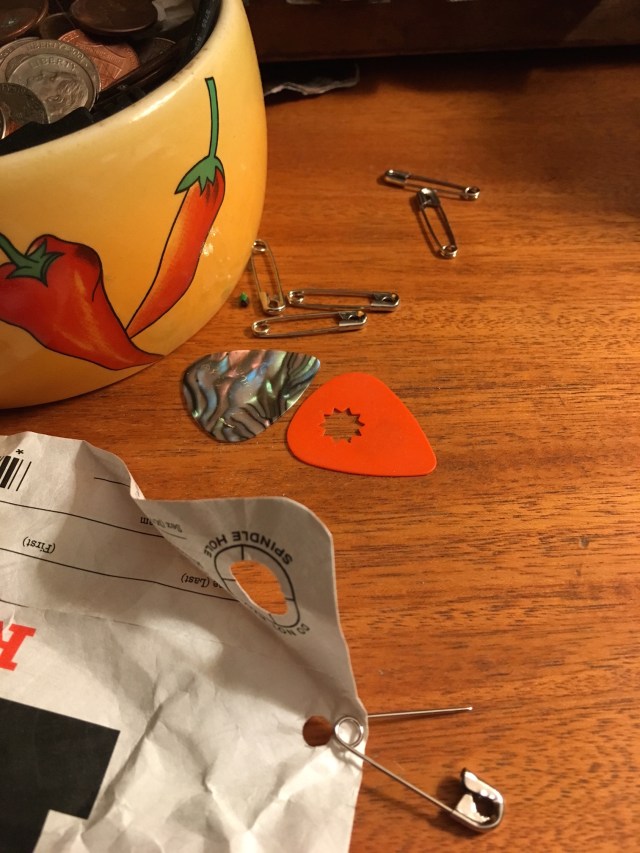 Cleaning off the top of my dresser is always an exercise in personal topography. The year tends to pile up in patches if you don’t get around to shoveling change into the jar and sorting through the many things that are so easy to toss on the dresser.


 We Run and Ride