50 Years of Running: Race after race

On June 27, a day or two after the big win at the Geneva Community Classic, I dropped by to visit my former coach and business buddy Trent Richards. His partner Marietta was a lovely Jewish woman with hair that just amazed me. She was smart, and somewhat snarky, and quick to observe all that she encountered. “Look at you,” she remarked when I arrived. “Lean and mean.”
I was having some trust issues with Trent because I was doing plenty of work for him but not earning much money for the collaboration. That was a major stressor in my life at the time.

The fact is we were definitely different types of people. “He’s a sincere guy but he lacks a sense of folly,” I wrote in my journal. “Even his jokes are meant to be serious. I’m not that way. I want to function in this world but I want to retain a link to the mystique of what I’m about. I will. Remember what Gary (my brother) said so long ago––”Do you really think your personality’s that weak?”

Certainly, it was not weakness that enabled me to drive through the pain to win or hold the pace race after race. But anxiety, that native sense of dread inherent in my family’s genes, was my Kryptonite. On some occasions that fear of something bad happening crept into the running. Yet at the same time, running was the primary cure for anxiety. That was the tarsnake of my existence, a strip of black dread threatening to trip me up at any moment. My goal was running over the tarsnakes.

Coping mechanisms

Beyond running, my coping mechanisms weren’t altogether healthy. The daily desire for sex was so strong that I’d edge along at times, wasting an hour here, or several hours there thinking about it or allowing absolute lust to take over. Surely that was not healthy. At one point I even developed a sore groin muscle that I checked with the doctor. I’d stretched it too far during a wild night with the downtown girlfriend and then had not the sense to leave it alone. “I’ve been feeling this muscle pull or groin problem for about two weeks now. I hope it’s not a hernia, or something worse. I have no health insurance. I should get a job for a while. Get healthy. Run well. Be myself. Yo. Who’s that?…I’m a working man in my prime…cleaning windows.”
That last line was a quote from a Van Morrison song, comparing myself to men working hand-to-mouth, just getting along. But it wasn’t even that practical. I was living race-to-race, actually. That was my salvation. There was nothing practical about it. But I was driven, because I knew it was the lone chance I’d have in life to fulfill that realm of potential. So fuck it. I was going to see this thing through to the best of my ability, whatever that meant.

Firecracker 4-Mile

A few days after the Geneva race I signed up for a four-mile race in Glen Ellyn. I knew the competition would be tough because that city was the source of many great runners in Illinois, including a world-class athlete named Ken Popejoy. In college, I’d showed up to race in one of the Glen Ellyn summer cross country races and lasted about a mile before the lack of fitness took me down. As the lone “strange runner” in that race, I was targeted for a bit to see what I was made of. But it turned out to be not much that day.

This time around I was fit as heck, however, and prepared to race whoever showed up. I was going to be the firecracker that day.

As it happened, the main competitor was a guy named Geoff Hill, and we were evenly matched. The course was hilly as heck, up and down and around the rolling terrain of that city. We traded leads back and forth on the Fourth of July. In the end, he beat me with a superb effort with a quarter-mile to go.

I ran 20:06 on a warm summer morning, taking second place and was proud to do so. Out on the course, whenever I took the lead, his friends and all the Glen Ellyn guys screamed at him to take the lead back. But I made it hard for him, racing quickly up the hills even when it hurt like hell. He raced right back. We were tearing along at 5:00 pace the whole way. He was bolstered by all the yelling and I could feel that local pride surging within him. He was protecting the Home Turf. So while I wanted to win, it was also everything I could do to keep from falling behind. I finished the race with utmost respect for him.

My girlfriend Linda watched it all go down. Following the race, she said, “That was a tough one, huh.” “It was fun,” I told her. “I’m not disappointed at all. We both ran really hard.”

What a cool feeling that was. Nothing holding me back. Young and fit and raring to race. There’s no feeling like it in the world.

Juggernaut

Three days later I showed up for a race in the Northwest Suburbs with ten other Running Unlimited teammates. The race was right in the vicinity of the shop, so we wanted to make a good showing. Well, we overdid it. The squad blew away the field and took the top eleven places. We ran together like a pack of blue and white dolphins. The splits were fast: 4:55, 9:55, 14:55, 25:00 and 31:10. Exactly 5:00 per mile. I finally did it. Ran a 10K at 5:00 pace the whole way. I finally set a respectable 10K PR.

Unfortunately, I got outkicked by a teammate, Jim MacNider for the win. “Lacked boldness,” I wrote in my journal. Well, that was how critical I could be about my own running. I topped off the week at 52 miles with two races in less than seven days.

But the backlash from the crowd attending the awards ceremony was upsetting as our Running Unlimited team swept up all the top awards in age groups and the overall race. We generated a bit of bad PR, and the shop’s owners were almost ready to apologize but enough people came by to congratulate them that they decided to let it go.

A summer of success

Already the summer had been a success. In mid-June, I’d also set a 10-mile PR at the Melrose Park Run for the Roses race in mid-June. That day, my future mother-in-law Joan Mues came to watch me race because her daughter Linda had just had foot surgery done by Dr. John Durkin. He chopped up the bunions in both her feet and shoved the bones back in place. That meant it was recovery time for Linda. She had metal pins sticking out the tips of her toes and could only wear slippers to walk around, and hobbled around on crutches. So Joan Mues joined us to help out that day.

It was hot as hell that morning. I jogged lightly to warm up and the sun was wicked hot. But I felt superb, without any soreness in my legs from training. The race was also special to the Mues clan because the family business, a manufacturing plant called Northern Hydraulics, was situated in Melrose Park.

Downtown Melrose Park

So the race was largely an urban affair with a route that crossed a couple major highways via arched bridges. The rest of the time we hustled past rowhouses or large factory plats and railroad yards. Hardly the most scenic race I’d ever run. But I didn’t care.

Jogging back to the starting line, I took note that several of the area’s top runners were in attendance. I did the math on what I knew about the competitors and figured a Top Ten finish would be a good effort that day. I vowed not to go out too hard because the temperatures were surely going to rise as the sun got higher in the sky.

Early on, a large pack cruised along while being towed by Kevin Higdon, the son of the famed running writer Hal Higdon. I’d trained the two of them a few months before and knew Kevin to be a smooth and strong runner. I hung at the back end of the pack and waited for the moves to begin.

That didn’t happen until well past five miles. Suddenly, as if someone set off a firecracker in the middle, of the bunch, the pack broke up and guys took to the curbs on a narrow street to get past a batch of slowing runners. I swung past on the side of the road and found myself perched in eighth place, about where I wanted to be among the group.

We twisted and turned and ran over the railroad tracks yet again. I was feeling incredible. One by one some of the guys I considered unbeatable slipped behind me. Now I was in sixth with just two miles to go. Through a welcome section of shade, I took measure of the runners ahead. “I think I can beat some of those guys,” I reasoned. My mind was clear. My legs felt good. There was not a trace of sidestitch or even and threat of nausea holding me back. I was on a hot streak, you might say.

Old beliefs

Part of me worried that I’d flounder in the heat at some point. I still believed at that point in life that I’d been the victim of heatstroke after a national meet steeplechase race my junior in college. I’d thrown up all night after the race and for years had told myself that it was due to running in 85-degree heat and high humidity. The conditions were similar in Melrose Park that day. But my affect was completely different this time around. I was sweating but clear-headed and eager to put in a finishing kick… and see what came of it.

To whit: Later in life, I figured out that the illness the night after nationals was caused by food poisoning, not heatstroke. I’d gotten sick from a bad meal at Pizza Hut. In fact, the success in that hot ten-mile race in Melrose Park was the reason I looked back and figured out that I was not heat-susceptible after all. In fact, I rather thrived in it.

With 1.5 miles to go, I was sitting in sixth and had a runner fifty yards ahead in my sights. Remarkably, the more I pressed the pace, the faster I was able to go. Just after the nine-mile point, I was within ten yards of the runner ahead and still felt strong. I decided to not get greedy because the next guy was another fifty yards ahead. I’d save my kick until the right time because I could still see the other three guys up the road.

I unleashed a strong kick when the finish line came into view. Blowing past the runner in fifth felt tremendous. My future mother-in-law had walked up the avenue a bit and I could hear her cheering at the top of her lungs. “Come on, Chris!” she yelled, waving her arms. I’d never heard that tone of voice from her. That meant quite a lot.

When you train all those miles hoping for a strong finish at a race, it is such an exceptional feeling to have the work pay off. It felt like I was flying across the ground the last 50 yards. I’d not only finished in the Top 10 that day. I’d placed in the Top 5, exceeding all pre-race expectations. My time of 53:30 was a PR as well.

Just past the finish chute, I was greeted by none other than Kevin Higdon. He walked up with a big smile and offered congratulations. “Good race today,” he offered. “You beat some good people.” That meant a ton to me too. It always feels good to be recognized by quality people like him.

To that end, I’m thankful for all the experience gained from years of running. The summer of 1984 was truly a peak period of performance for me, and the year was only half over. Despite my reticence at times, I did savor the racing and the accomplishments that came from the dedication. I think my mother was right about that aspect of my being at the time. I was burning brightly.

Yet with that said, every flame is subject to the winds around it. The next goal on my schedule was competing in the Prairie State Games 5000 meters in Champaign. I bought a new pair of Nike spikes from Running Unlimited, and set a goal of running 4:40-4:40-4:40 with a 30-second kick at the end. “14:30 is very respectable,” I wrote. “And you can do even better.”

That’s what I was certainly trying to do, race after race.
Posted in 10K, 5K, anxiety, Christopher Cudworth, competition, healthy aging, running, sex, steeplechase, training | Tagged , , , , | Leave a comment

50 Years of Running: Desires and distractions

By mid-summer of 1984, I’d gotten quite used to life in the City of Chicago. Essentially I was leading a double life, with a girlfriend in the suburbs and one in the city. But that wasn’t the whole story either. The manic energy of a 26-year-old (young) man knows no bounds. Along with the late-night dance sessions with the downtown date that I’d branded Miss McBuns in my running journal, the city seemed to beckon in other ways.

My roommate would often come home singing the song Paint It Black by the Rolling Stones, particularly the line:

“I see those girls walk by dressed in their summer clothes…I have to turn my head until my darkness goes…”

Because yes: women in summer dresses in the city can kill a young man. All it takes is a shaft of sunlight flashing from the front of a woman and her silhouette shows up through gauzy fabric. Then there are the summer breezes that playfully lift summer skirts, revealing either panties or none at all. That kept happening to my friend and roommate, and it was driving him crazy. “I saw another one today…” he’d half lament. “She was unbelievable.”

But the killer moment of that summer was a morning at Nookies, the breakfast restaurant one block away from our apartment. We’d both been out late with our dates and decided to grab some pancakes in the brunch hour. Sitting together at a small table in the center of the restaurant, my friend leaned forward and whispered, “Don’t look right away. But when you get a chance, the scenery to our right is quite striking.”

I waited ten or fifteen seconds, then dared a glance to my right. And there, illuminated by a long shaft of sunlight coming through the front windows was the lightly furred crotch of a woman wearing an extremely short skirt. We played it cool and did not stare. But he mouthed the words, “My. God.” to me. I quietly shook my head in agreement. “You have to appreciate that,” he told me once they’d left.

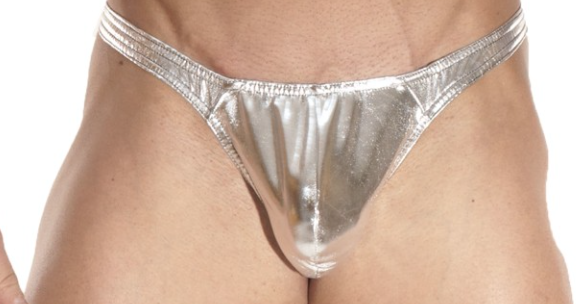
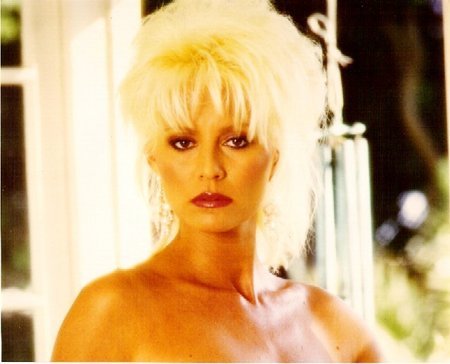
Indeed, the signs of sex seemed to be everywhere in the city. Earlier in the year, I was invited to attend a large party that was rumored to feature a live appearance by the porn star Seka. The night of the event, the friend that invited me handed over a silver thong and said, “Put this on underneath your clothes. You may need it later.”

“Okaaayyyy…” I said, half laughing. “Is this gonna get wild?”

“You never know,” he said with a bit of mystery in his voice. “But it’s best to be prepared.”

The admission fee was $35, and ostensibly the night was supposed to feature some avant-garde visual artists, wild music and dancing, and food if you were hungry. We showed up at the address to find a large warehouse with music thumping inside. It felt strange to have that thong creeping up my tiny runner’s ass, but I was used to small garments. My racing shorts for running weren’t all that much bigger. Yet knowing there was a silver lame crotch pouch underneath my loose-fitting sweatpants was admittedly thrilling.

I loved dancing and figured the night could get goofy and wild. How many other times in life were opportunities to get truly wild going to come along? We met a couple friends on the big open floor, but the atmosphere was not looking crazy or interesting at all. The lights were up and a large part of the crowd in attendance was suburban men in their late 30s or 40s. Most were dressed in jeans and poorly tucked-in dress shirts. Many of them had the flushed complexions of unfit and slightly flustered men.

“What…the…fuckkk…” my buddy laughed. Then we realized we’d been had. The whole party was basically a fundraiser for the porn star Seka. The crowd was a pack of chronic jerkoffs there to see their fantasy come to life. Some of them probably even dreamed they’d get a shot at Seka, who finally made an appearance of sorts, just enough to tease the crowd into submission before traipsing backstage while the emcee promised a “real performance” later on.

The 80s porn star Seka

Dance off

At that point, my friend and I had both downed several drinks. When the lights went down, the main dance floor cleared of suburban wankers and some of the more serious partiers swarmed a dance floor that was suddenly bathed in lights. My buddy asked some woman a few paces away to dance, but I froze in place. Watching him roll out onto the dance floor made me jealous.

I was instantly a bit nervous and feeling foolish in my grey sweatpants with a silver thong beneath them. So I stood there moving in place and glanced right and left to see if anyone might be up for dancing. The lights pulsed and swung around the crowd. I noticed a pretty face right next to me. “Huh!” I thought.

I turned and asked, “Do you wanna dance?” The young man faced me and said, “Sure!”

Honestly, I freaked. At that age, I had neither the confidence, desire, or awareness to know how to respond when a man accepted an advance, however unintentional it was. So I turned on a heel and booked out the door. That party was held in early spring, and the weather had shifted while we were inside. The cold Chicago winds took over the night and temps had dropped into the 20s. I ran half-frozen all the way home wearing just my sweatpants, a tee-shirt, a light jacket, and the silver thong, which rattled around my crotch. Halfway home, I couldn’t help laughing at myself.

Had I stayed around that night, things might have gotten interesting. One of my friends wound up going home with both a gal and her guy friend. It was the afterparty that turned out to be the real party for him.

Side attractions

A happy but naive young man

As for my own dalliances, there would be other encounters with interested gay men while I lived in the city. One of them followed me on the 151 bus one morning. He pressed against me in the crowd and I gave him a stern glance and moved to the door to get off at the next stop. He followed me off the bus. When I got back on the next bus, he followed me back on, again with a physical advance. “Look,” I told him. “I get what you’re after, but I’m not interested.”

But he persisted. I got off the bus and he followed. I got back on the bus and he joined me again. “I’m getting off this bus one more time,” I warned him. “And if you follow me, I’ll punch you.”

Perhaps that wasn’t the right way to handle the situation. But I knew so little about gay culture and was frankly fearful of what I didn’t know. But the warning worked.

The inner workings of a brain

There was definitely something still driving me to explore the inner workings of my brain. Even with all the running and working and writing and painting I was doing, I was still restless, sometimes anxious, and wracked by desires outside the norm. Such is the brain of a writer and artist on a diet of sunshine and darkness.

If no one else was around and I didn’t have a date of some kind, I’d sometimes wander over to a punk bar called NEO a few blocks away from our place. I didn’t have much to wear that matched the atmosphere of that bar, but that’s why I went now and then. Above all, I wanted to hang out near people that weren’t at all like me. The courage they had to buzz half the hair off their heads, or pierce their faces, or wear makeup that looked like it was painted on with an acrylic brush…all felt like an escape from the sucky normalcy of daily life with bills and money and business relationships that seemed to be going nowhere. It all appealed to my inner David Bowie, the Ziggy Stardust side of my personality. I’d finally had the courage to try a bit of glam that night in the silver thong, but it all came to naught.

But even NEO turned out to be a rue. One night, I ran out of cash and found only a folded-up, worn-out Traveler’s Cheque inside my wallet. I tried to pay for drinks with the thing, and the glammed-up bartender told me, “You’ll need to go in back with that thing.” So I walked past the bar and down a long hallway to a door that said MANAGER. I knocked and heard a voice inside say, “Yeah, come in.”

Pushing open the door, I was surprised to find a classically frumpy businessman sitting behind a desk. “How can I help you?” he asked in an accent that I took to be Jewish, or New York, or something.

“I have a $50 Traveler’s Cheque I need to cash,” I replied.

“Drinking, huh?” he grinned, reaching in a drawer to pull out some cash. “Here,” he handed me two twenties and a ten. “Sign it off,” he said, punching the Traveler’s Cheque with a finger. “Have fun.”

That exchange took all the exoticism out of the NEO club for me. I bought one more drink that night but never went back. I guess the fact that the club was nothing but an artifice or moneymaking enterprise gutted its allure. It wasn’t a punk bar at all. It was a business catering to people living out a fantasy of their own making.

In some ways, that experience made me think differently about the whole City of Chicago thing. Was everything just an excuse to sell everything from sex to alcohol to whatever else people had to sell? I could sit in my second-floor window and watch the high-priced escorts loading into limos every night. And I thought I was living a double life?

All that felt real most days was walking out into the sunshine every morning to go for a run. That cleansing act cleared my head and helped me to make it through another day. The rest was desires and distractions wrapped around me like the helix of DNA. It takes time and experience to unravel all that.

Posted in alcohol, mental health, sex | Tagged , , , , , , , | Leave a comment

50 Years of Running: A record that stands forever

In 1982 I’d won the inaugural Geneva Community Classic 10K in 32:36. That was the first race ever held on the Fox River Bike Trail. At that time, the path was so new that the last chunk of asphalt was laid down just days before the race was to be held.

I was living in my coach house in Geneva that year, and was dating my new girlfriend Linda. It was hard to tell where that relationship would go, because I’d just learned that I’d be transferred to Philadelphia for work in August of 1982. So the win that day was joyous, yet bittersweet.

By May of ’83 I was back in Geneva after a nine-month sojourn living in Paoli, and moved back to live with a best friend in Chicago. Looking to defend my title from the previous year, I signed up for the Community Classic only to get thumped by another former St. Charles High School graduate, Jeff Wheaton. That meant I was coming into the 1984 race determined to win.

I drove out from our city apartment on a Friday night, but traffic was heavy and I arrived too late to register. The pre-race registration booth was closing up as I approached, and frustrated from the long drive in the heat and traffic, I got a little testy when they refused to let me pay for my entry and get a number. “Listen,” I barked, “I’ve won this thing before and I’m going to win it again. Just take my money.” And I shoved it out like I was closing a drug deal.

That was a prick move, for sure. But I was serious. The race director was familiar to me, having watched me either win or take second the two previous years, so she stared at me for a moment. “Alright,” she instructed one member of her team. “Go ahead and sign him up.”

Racing conditions

The morning of the race broke clear and mild. I was relieved that it wasn’t as hot for racing as it had been n 1982 and ’83. That’s always the risk with a late June race. Often that’s when the first real waves of humidity strike. If you go out fast on those days, it catches up with you eventually.

There was a large field gathered on race morning, just over 1000 runners. The race grew so fast in popularity it would be named one of the best 10ks in the Chicago area, and for good reason. The course started on the scenic avenue of Third Street in downtown Geneva and went down to Batavia and back on the Fox River Trail with views of the river almost the entire course.

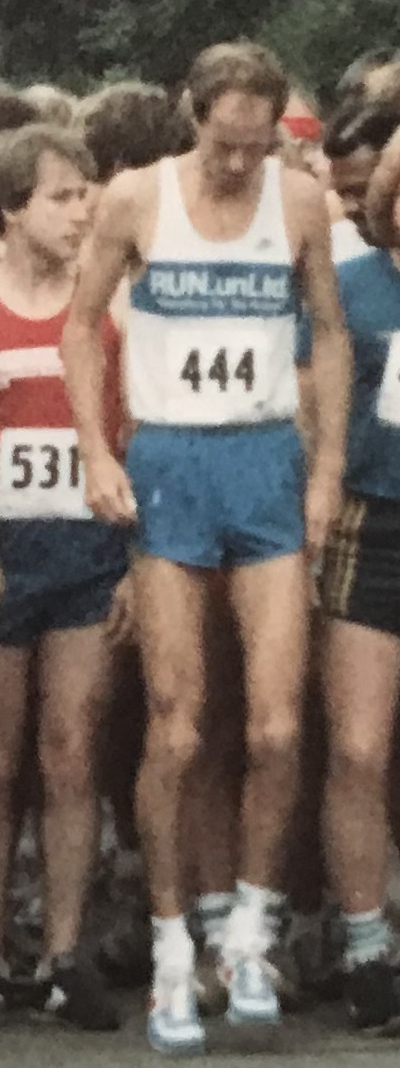
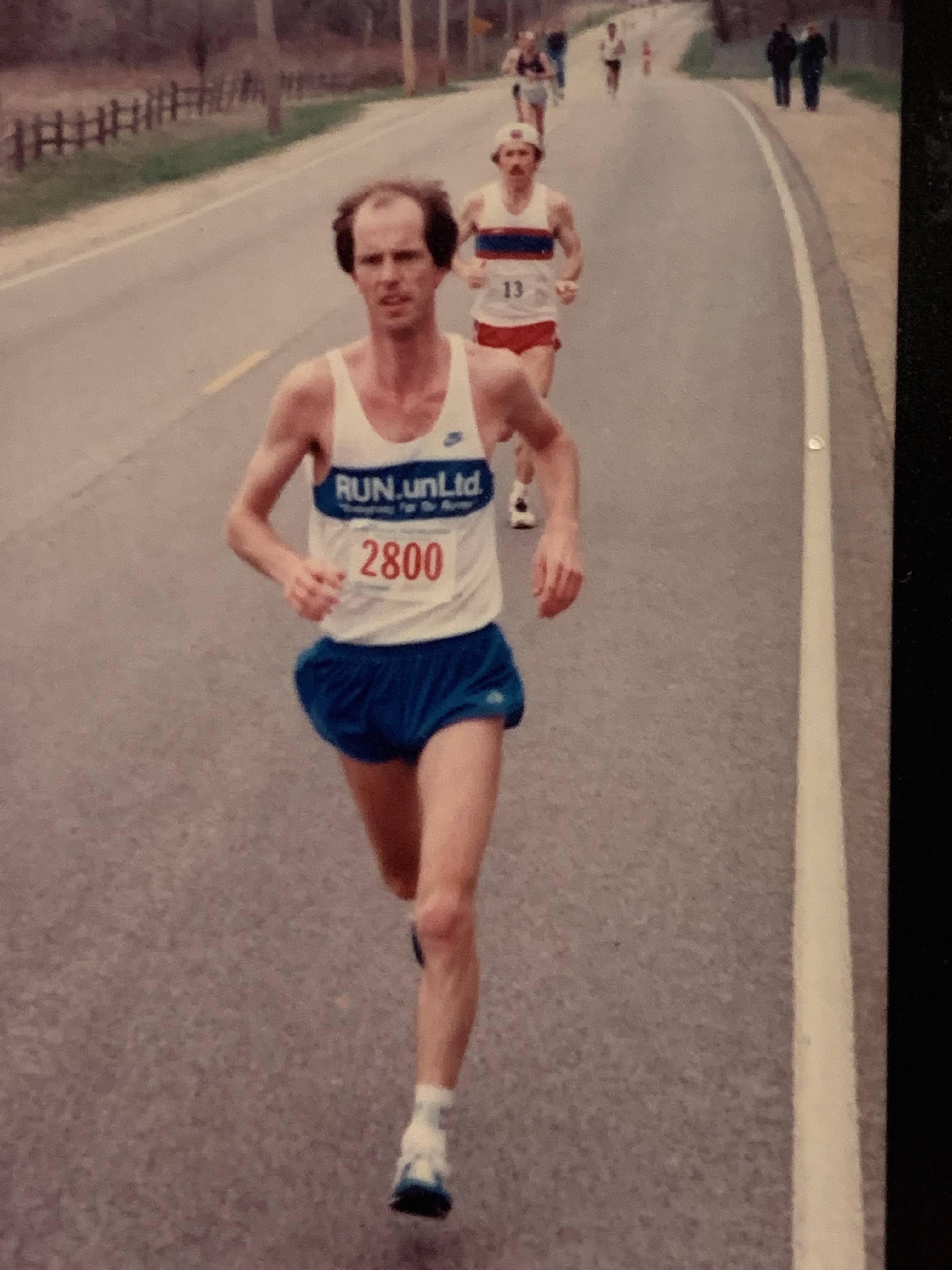
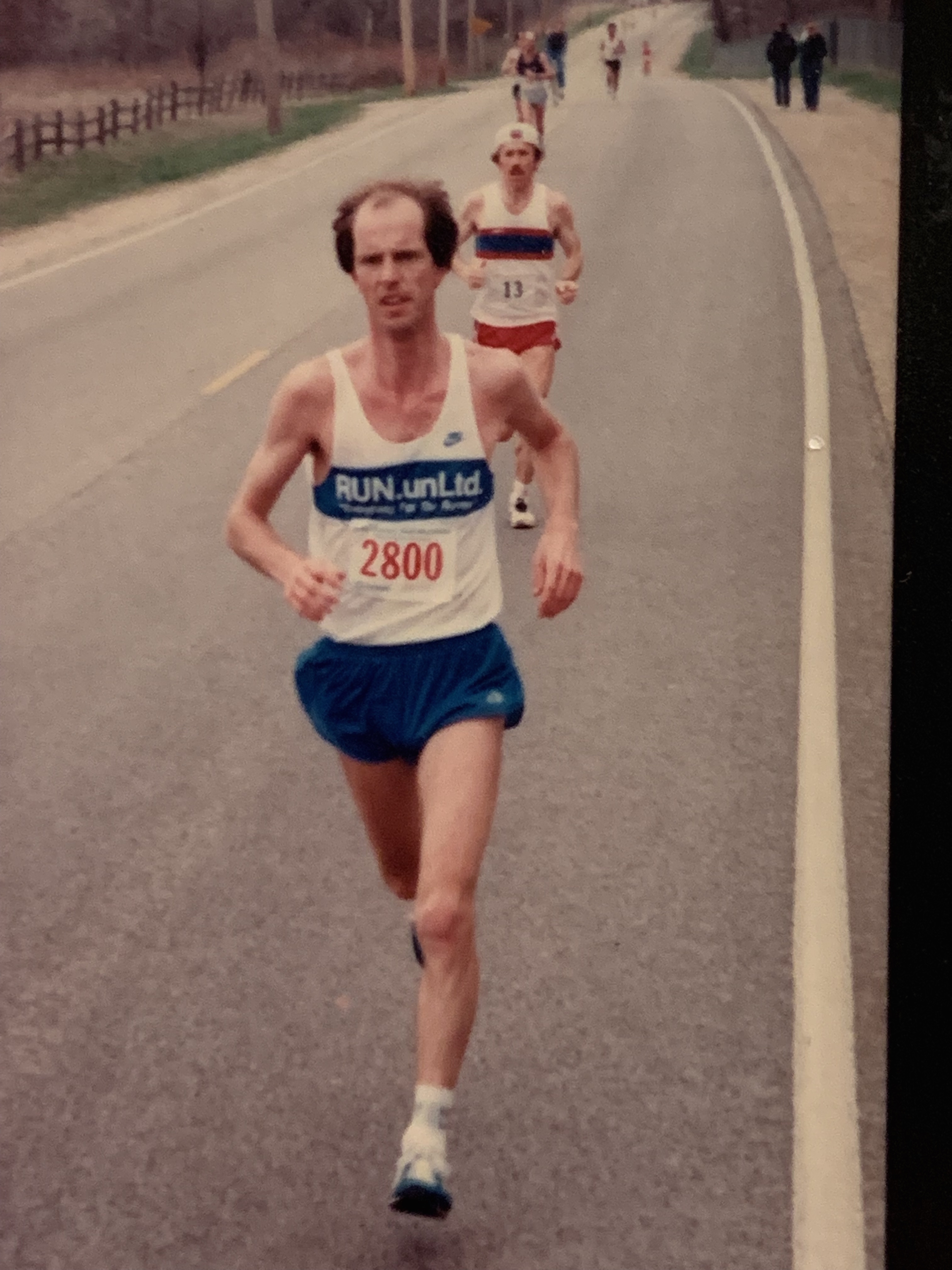
I warmed up with a solid jog to make sure my legs were revved up and ready to go. I felt fast and lean at 140 lbs. My Running Unlimited top and shorts felt like they were barely there. That’s how I liked my racing uniforms.

I wore a pair of Nike American Eagle racing flats that day. They weren’t quite as fast-feeling as the Nike Air Edges that I loved, but those were almost worn out from two years of racing. I laced the Eagles twice to make sure there wasn’t a chance of them coming untied. My ADHD had on occasion allowed such things to happen.

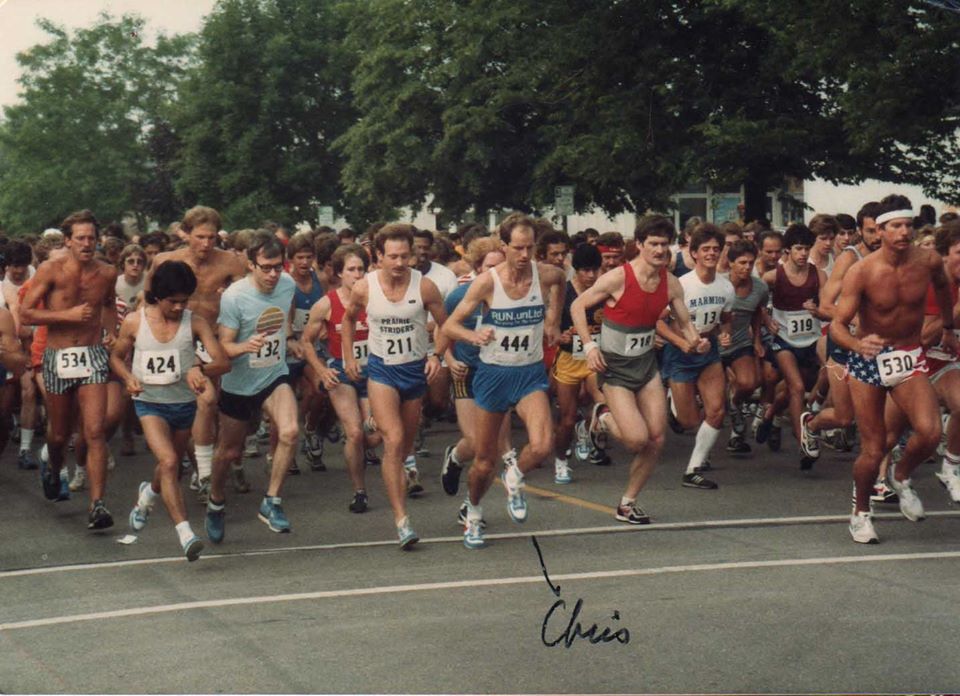
After warmups, I did a couple hard stride-outs at race pace to test the legs. Everything felt good. Then I trotted back to survey the front line and see who showed up. And there, bouncing up and down in place was a guy wearing Prairie Striders singlet. “Hmmmm,” I thought. “There’s my competition.”  I thought I recalled that the Prairie Striders club was the same team from which Phil Coppess or Dick Beardsley emerged to become some of the nation’s top marathoners, winning races such as Chicago, Grandma’s and the Twin Cities Marathon. In any case, I figured the guy to be tough. He looked solid and fast type, and I later learned that in college he was a steeplechaser like me, only much faster, with a sub 9:00 time to his credit.

The race started and I made sure to stand next to my key rival so that he could not get away.

Who knows what he was doing in town? The early 80s were like that. Road racing was growing quickly, and regional or national gunslingers like this guy often showed up to challenge the locals. “Well, here I am,” I said to myself during the last jog into place at the starting line.

The gun sounded and we took off at a super-quick pace. The course went straight north for five blocks to State Street, also known as Route 38 or the Lincoln Highway. We turned into the sun and faced two full lanes of open asphalt. That’s where he accelerated again.

I decided to track behind him rather than take an early lead. We soared downhill toward the Fox River bridge and caught the swooping turn beneath it to join up with the Fox River Trail.

It helped that I knew every inch of the park and trail by then. That speedster and I were running so fast it was all I could do just to stay on the path. We separated ourselves from the rest of the race and hit the mile mark in 4:37. That didn’t rattle me. I’d run a 4:30 practice mile the week before with plenty left in the tank, and figured my real mile speed at the time was around 4:15. So I let the guy lead as we crossed under the railroad bridge and sped toward the woods of Fabyan just ahead.

We passed two miles in 9:42. Again, a healthy pace but not one that rattled me. We’d settled into a one-on-one battle and I decided to wait my turn to lead.

At three miles we hit 14:42. At that point, I kind of chuckled because I still felt so damn good. It was one of those rare days when everything seemed smooth and well-oiled. I savored the soft sound of every footstrike and pulled up next to him as we turned west on Wilson Street through downtown Batavia. As we crossed the bridge I swung to his left and prepared to pass him when we turned north again.

Taking measure of the man

He was sweating and breathing hard, but so was I by then. About then, I thought about my folks and their friends waiting for me back at the finish line with my girlfriend Linda. My parents loved the festive nature of summer races. They’d seen me race all through high school and college, but the open-faced sandwich of road racing was different. My mother loved the intensity of it. Years later, when I’d retired from competitive racing, I mentioned to her that perhaps I was a bit self-indulgent during those years when I was half-working and running full time. “I don’t think so,” she corrected me. “You burned brightly.”

Such were the thoughts of my mother, ever the poet. My father seldom said much at road races. He enjoyed the spectacle and figured that if I’d made the choice to run, it was my job to make it work. Yet here was his skinny son, the same bratty kid that used to cry for mercy whenever his older brothers refused to let him on the basketball court when the big kids were playing. But I was also a tricky little fuck. I’d save my tears until just a few feet before entering the house, then erupt in a big display of drama, crying and whining that my older brothers were being mean. My parents bought the act the first time, because my brothers were mean, but the next time around, they called my bluff.

“Stop blubbering,” my father said after I entered the house in tears. “We saw you coming across the yard. You weren’t crying until you came in the back door.”

From that episode, I learned that crying to get my way wasn’t going to do me any good in life.

Tests of character

There would be many tests of character like on the way to adulthood. Yet there I was, twenty-six years old, putting my guts on the line with no one to get the job done but myself. If I lost the race, it would surely do no good to cry about it. The type of drama I’d face was all mine to choose. Either take the lead and own it or let the guy in the Prairie Striders shirt run away from me. And cry about it later?

I pulled around his shoulder and took the lead. We turned left on Batavia’s Houston Street for one block and ran past the Depot Pond wher ethe west side of the bike trail began. Now we were on the return trip north toward Fabyan Forest Preserve. The trees provided plenty of shade, but the humidity was higher underneath the canopy. I gave a big exhale and leaned forward a bit more. I was chugging toward home.

The trail follows a former railroad bed once used for industrial purposes as well as a trolley line coursing from Aurora to Elgin. The auto industry put the trolley line out of business in the early 1900s, but sections of track could still be found sticking out of the streets in Geneva, especially on Anderson Boulevard, the street where I’d come to live two years later, in 1986.

The watercolor rendering I produced of my training route past the home where I’d later live at 421 Anderson Boulevard.

I’d grown up running through Geneva all through high school and college. This was my home turf, and I felt obligated to defend it.

We covered the next mile fast as well, a feat because the grade went slightly uphill all the way to Fabyan Forest Preserve. I kept the pace quick by shortening my stride slightly and we passed through four miles in 19:50. Geez, what I would have given to run a time that fast in college cross country! But we still had at least two miles to go. Gotta stick to business…

At the entrance to Fabyan park, we swung left and started an abrupt and then prolonged climb to the five-mile point at the crest of a hill on a four-lane state road, Route 31. The police had closed one lane of traffic. A long line of orange cones marked the way ahead but disappeared from sight over the top of the hill. We climbed past five miles and hit that mile marker at 25:00 flat. “We’re sure not pissing around,” I thought to myself.

Just after the five-mile point, my stomach started to get flighty. The pressure of racing that fast often gave me the dry heaves. Perhaps it was stomach acid having its way with me, or maybe I should have eaten more before races, but barfing was not out of the question by that point. Still, I rolled over the last bit of climb and turned full attention to the closing mile. We raced past the stone walls and weird animal cages erected by a wealthy magnate named Colonel Fabyan back in the early 1900s and headed toward the finish.

One of the former animal cages of Col. Fabyan

The road starts to drop again toward Geneva, including a long downhill section where a creek runs beneath the road. It bottoms out quickly, then it climbs back up again on Route 31 to slip beneath the railroad bridge.

From there, it was about half a block until we turned up an even sharper hill to the finish line. I held a lead of just a few yards on my competitor, who had not given up. But I could feel that he’d given his all by then, so I kept the tempo high even as I could feel my legs starting to tire. It was a damned hard hill to run after six miles of stern racing. Then we turned and could see the finish chute with all the crowd milling around. I unleashed what I had left and felt the first taste of barf sneaking up my throat. By then I did not care. I was going to win this fucking thing after all. I’d passed the test. There would be no crying that day.

The finish clock read 31:52 as I passed underneath it. “What?” I thought to myself? “There’s no way we ran a 5:52 last mile…” Then I threw up.

“Hey,” the race director churled at me. “Don’t do that here.”

“I got no choice,” I blurted, and stumbled away.

Linda met me there with a big hug. “Are you okay?” she asked.

“I won,” I replied. “I’m great.”

Locked in battle for 6.2+ miles.

The Prairie Striders guy and I shook hands. We’d been locked in a battle for six full miles. We actually cooled down a bit together. I had the chance to tell him how much I respected his racing that day. He was also complimentary, a good sport. Following the cooldown, I accepted the congratulatory backslaps and handshakes from local friends. Then a familiar face showed up beside me. It was Jeff Leavey, the track and cross country coach from my alma mater, St. Charles High School.

“What was your time?” he inquired.

“31:52,” I told him. “Which is weird,” I observed. “We raced sub-5:00 most of the race and I know we didn’t slow down that much in the last two miles. Even with the hill, I hit 5 miles in 25:00. And we kicked at the finish.”

“That’s because the course is long,” Leavey informed me. “We walked it with the wheel a week ago. It’s at least 200 meters long by my measurement.”

I trusted Jeff because he cares about such things. He was also the race director of a really good five-mile event held each fall, and he always walked the course and covered the tangents to make sure things were accurate.

Doing the math, it made sense that the course was a bit long. Running an extra 200 yards would chew up 37 seconds or so at 5:00 pace. That would take the final time down to 31:15, a more accurate reflection of the racing we’d just done. In fact, I’d race even faster than that in the coming weeks.

But in terms of competitive racing, I don’t think that I ever ran better than the Geneva Community Classic 10K in 1984. I recall that crazy feeling when my ears kept tensing up in a fight or flight response knowing there was a runner right behind me the last three miles. But I kept the pressure on and didn’t flinch, even when nausea almost took me out of contention.

ranrA post-race photo with my late wife Linda, myself, best friend Greg Andrews, his wife Francie, and my mother Emily.

Indeed, two decades later the record of 31:52 still stood; a fact noted by the race director in a letter to the editor marking the 20th Anniversary of the event. The course eventually changed when a parking garage was constructed on the former finish line, so any subsequent fast times didn’t count. I’m sure that some of the elite runners from the Chicago area could have broken that course record, but nothing makes you feel better as a runner than an effort that stands the test of time over many years.

Posted in 10K, 5K, Christopher Cudworth, college, competition, cross country, race pace, racing peak, running, running shoes, training, We Run and Ride Every Day | Tagged , , , , , , , | 1 Comment

50 Years of Running: Qualifying time

Coming off a less-than-stellar race like the one I had in Elgin, where a side stitch slowed me down, is tough on the short-term confidence. But while I was second-guessing the ten-mile race in Elgin, I heard that there was going to be an Olympics-style event called the Prairie State Games held in Illinois. The qualifying meet for the region I’d chosen to represent (the western suburbs, not the city) was at York High School on June 9th.

I still felt ready because I’d run a PR 5K the week before. My workouts with the UIC boys were going great. Week after week, those workouts built confidence in both my base fitness and increasing speed.

Bumping into legends

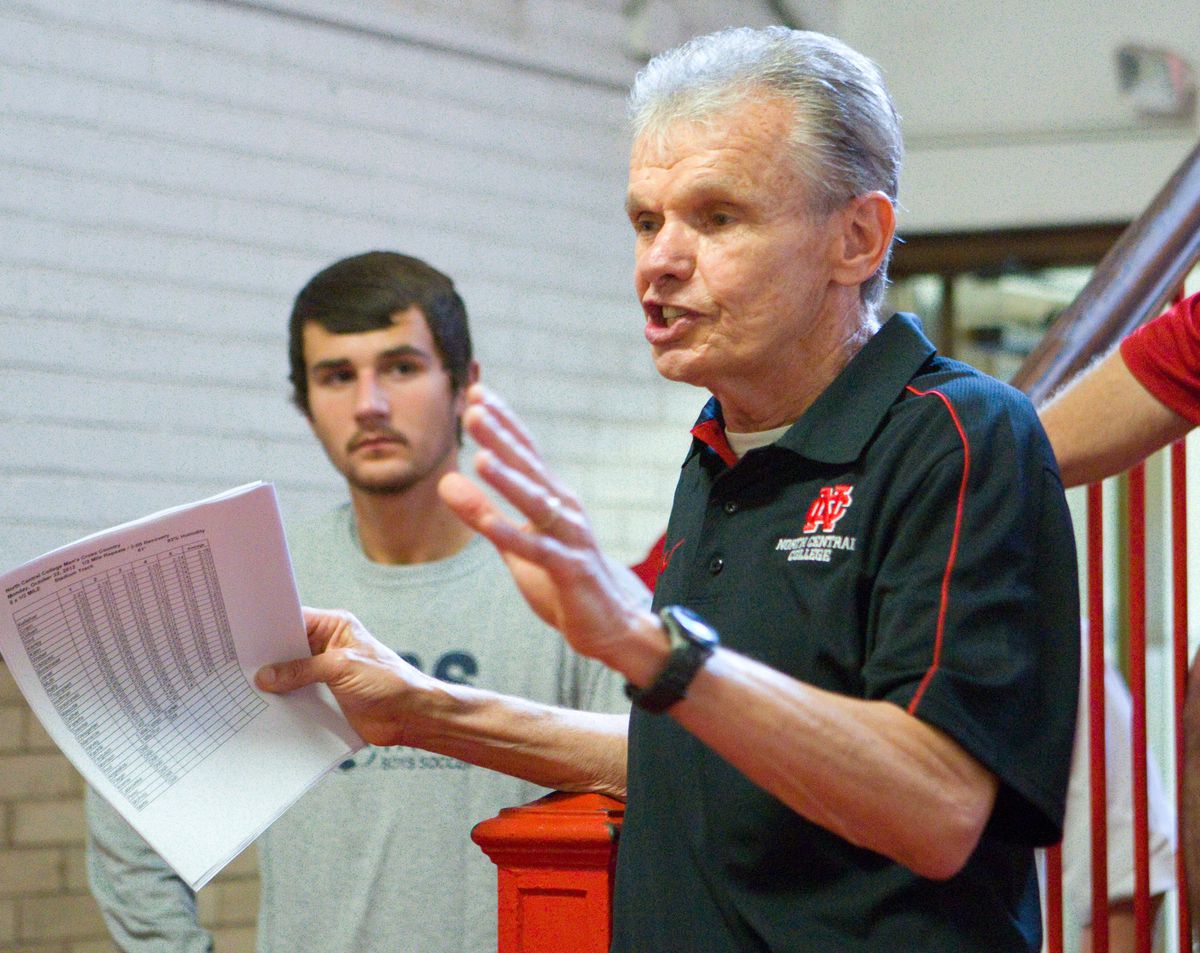
Coach Al Carius of North Central is known as one of the most motivational running coaches of all.

I signed up to run the 5000 meters and showed up at the York track for the noon race and met up with two men I knew and respected, both of whom happened to be some of the greatest coaches ever in Illinois. They were Al Carius and Joe Newton. Each had committed to coach the west suburban track team. Of course, I wanted to impress them somehow, but that only made me nervous. Some of that was situational anxiety, but some of it was native to my persona and brain chemistry. So I had to calm myself before the race. Rather than shoot for a fast time on a hot day, I needed to focus on the main goal, which was qualifying for the team. To do that, you had to win.

Not knowing who would show up to run, I poked around the registration asking to see the competition slate. Al gave me a funny look and smiled that big smile of his. “Just get out there and run,” he grinned, and glanced over at Newton, who was too busy to worry about a Nervous Nellie runner like me. Thinking about their respective coaching styles, I knew that Coach Al built confidence by meeting runners “where they were” and helping them understand what it meant to achieve their full potential.

Most importantly, Al was famous for taking mildly talented kids and turning them into national-level competitors. That happened again and again over the years. He’d coach kids with 10:20 high school two-mile PRs that would run near 9:00 before they graduated from college.

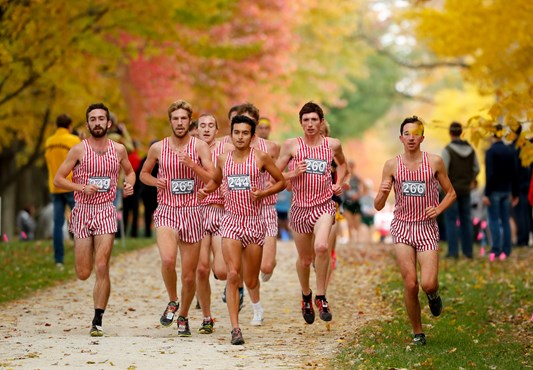
North Central in their famous striped uniforms.

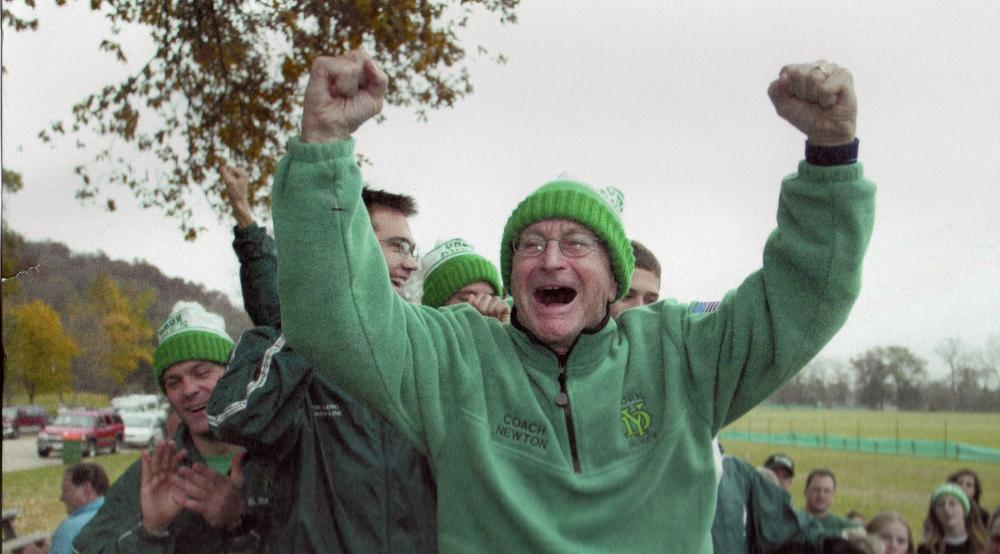
By contrast, Newton turned out team after team with five runners breaking 15:00 for three miles. That’s how they won state championships, and that how Joe built confidence among his runners: by involving them in a larger-than-life program. That tradition alone was a form of self-empowerment.

The Long Green Line was famous nationwide for winning state championships year after year. In the 1970s, you couldn’t miss the York Dukes team. The military-style crewcuts worn by York runners at one point defied the moptop hairstyles of most cross-country runners in the 1970s. Newton ultimately relaxed that rule, but it didn’t change the fact that you knew York’s runners were fully committed. By reputation, we heard that many of them ran a thousand miles or more during summer months. Honestly, I was lucky if I ran 100 miles over the summer between track and cross country seasons. Sure, I’d play basketball for five hours at a time, but that was probably not the same as putting in long mileage.

Burning desire

Joe Newton’s teams won plenty of state titles, but at what cost to the long-term interests of his runners?

The only rap on York kids among the running community at large was that seemingly few of them went on to do much in college or beyond. There were a few notable exceptions, but the belief (true or not…) among most Illinois runners was that due to the high mileage they put in, and the strong disciplinary environment in which they ran, York kids were either used up by the time they left high school or found the college environment undisciplined compared to their formative experiences under Coach Newton.

A year or two before I arrived at Luther College, a quality York runner paid a visit to our cross-country program. He trained with the team and that went fine. But then he encountered the antics of the team leadership at a party to which he was invited. Apparently, the drunken team captain from that year wore danced around like a madman wearing the lace-fringed Pussycat Lounge cap he sometimes wore while racing. At least, that’s how I heard the story. And perhaps that made the wrong impression on the York boy, who did not sign up to run at Luther. Nor did any York runners ever visit again, to my knowledge. Ironically, that Pussycat Lounge runner was one of the toughest runners ever to compete for Luther, and earned the distinction of being a conference champion as well as a Division III cross country All-American. There was a vast difference between the team culture at Luther and the regimented running program back at York High School.

Alternative history

I’ve wondered what it would have been like to run for Coach Newton in high school. I probably would have done fine with the training, but the haircuts seemed extreme in that era. I fought my father many times over the length of my hair. Fortunately, none of my coaches ever said a word about any aspect of our appearance either in high school or college. The entire running world was a ragamuffin-looking bunch in the 70s and early 80s. We didn’t envy those York kids for their closely buzzed haircuts, but did respect their work ethic and abilities.  

I loved my Pete Maravich moptop hairstyle in 1972.

When it comes to haircuts and appearances, most coaches care about one thing: Are you willing to put in the work to improve? And secondly, do you know how to get ready to compete?

That is why Al Carius glanced at me oddly when I showed up that day at York all anxious and wondering who else was in the race. Worrying about the other competitors never helped anyone! You still have to go out and run the race no matter what! So dude, line up and run! Stop ruminating about whether you’ll fail or not! That’s the surest path to failure.

Race time

I warmed up for the 5K and it didn’t take long to work up a full sweat under the early summer sun. We lined up at the starting line and I glanced down at the mix of athletes and didn’t see anyone familiar or even fast-looking. That helped me relax.

From there, I wisely started off with the bunch and moved into the lead after two laps. Admittedly I was grateful that I wasn’t being pressed by anyone in that race. Two miles in with the lead in hand, I felt foolish for acting like such a scaredy-cat hovering around the registration table. Here were two of the greatest coaches around, and I came off with zero confidence and even less self-awareness.

At any rate, I ran hard enough once the race got going, and qualified for the Prairie State Games. I was grateful to finish in first that day at 15:49. It was one of those days when I felt like it would be tough to run any faster than I did. It was hot out. In some respects, earning a place on the team was like “going downstate” at last. And lookee there, I’d done it on the track at York, the host of the cross country sectional the made it through thanks to all that high-level competition.

Sometimes, as a runner, you just take what you can get.

Posted in 5K, anxiety, Christopher Cudworth, college, competition, cross country, PEAK EXPERIENCES, race pace, racing peak, running, track and field | Tagged , , , , , , , , | Leave a comment

50 Years of Running: Poetry about (e)motion

From the time that I started officially competing in athletics at the age of ten, when I tried out and made the Local 285 baseball roster, my mother and father supported my sports career in many ways. My father ultimately nudged me into running (quite wisely) when I was a freshman in high school. He didn’t want any of his sons mangled on the football field, so none of us played that sport despite our high degree of speed and agility.

From there, my running career progressed and I led teams at Kaneland and St. Charles High School and went on to captain the Luther College team that took second in the nation. During all those years and through so many meets, my parents were often there on the sidelines. I’m grateful for that.

My mother Emily Nichols Cudworth and my father Stewart Kirby Cudworth at an October race in 1983.

Even after I graduated from college and took to road racing, my folks often showed up at races near their home to cheer me on. My father typically urged me to relax before the race while my mom stood there observing my state of mind. She always wanted a little hug before the gun went off. And I can still hear her voice to this day calling out, “Go, Chrissy, Go!”

Yes, she called me Chrissy. I once took grief from some competitors upon hearing her call out that pet name for me. It was embarrassing, but I knew that it meant love, so it always inspired me as well.

At some point in my mid-20s, while watching me win a race in Geneva (that I’ll document in the next installment,) she composed a poem titled RUNNER. The verse shows how observant she was about running and racing. I love this poem for many reasons, but also the emotional outcome of a race.

Here it is:

RUNNER

I watched you as you stretched and started

moving slowly, eyes inward, thoughts on self.

Sensing the morning’s chill

noting the wind, a muscle twitching here and there

(“Will it last?” he wonders, “Will it last?”)

Adjusting the suit, talking briefly

(Breakfast wasn’t much, you know–

too important, too important a race you see.)

A milling crowd arrived, some garrulous and greedy

for the prize, half-formed decisions, in their eyes.

Some there for fun, pure fun, no more

like children looking through a door.

But you were not these people (“Muscles are trained,” you told me)

there were these days and days of running

in the cold mornings––beard frosty, stocking cap pulled down

(“You can’t freeze your butt,”) you said

both humorously and morosely, a Captain of the sleet and snow.

In the Mid-Summer, smell of sweetness, grasses, ferns, upon the air.

Joyous birds alight at dawn and calling (“Saw a line of swallows on a wire”)

Heat of the sun, tempestuous burning

on the road, tar bubbles going SMACK SMACK

hot feet, sweat, burning lungs.

Now, cotton-mouthed you wait.

Lined up first, (“It’s by your times, you know,

five-minute milers are the first to go.”)

Crack of a gun startling the silence

and you’re off.

I did not see you for awhile

I sweated out that first slow mile

you finally breathed by me, easy

I didn’t feel so scared, so queasy.

(“Up the slope, a lot will die,”

you said, with twinkle in your eye.)

They did by droves with dirges

played inside the head

“We’re dead, we’re dead.”

I saw them panting up the hill

the untrained heart will not be still.

You were smoothing out when next you passed

you heard the timer and you gasped,

slowed down a little, evened out,

the crowd a-watching gave a shout.

“Look out behind you!

Someone’s coming

Someone’s coming

Someone’s passing you a runnin’!”

You let him go for you’d already

calculated, taken his measure, breath abated.

Down came a smaller torrent pouring

down to the finish, all adoring––

finish banners, crackling, flying

arms held high, but body sighing.

Then, THERE YOU WERE!

Your strong legs pumping

Eyes alight! my heart was thumping

“He’s got it still,” I heard one say,

“He’s got his win at last today.”

You did, You passed the man ahead

you stalked about, less said than anytime before.

Thumping of backs and hugs all sweaty

friends and drinks and world all ready.

But still you looked a little sad

you were back in the world

but were you glad?

You did not say,

silently, you jogged away.

And I, who did not run the race

cried softly

it was something to watch

now in its place, dead paper cups

and empty space.

Posted in race pace, racing peak, running | Tagged , , , , , | Leave a comment

50 Years of Running: Tears for Fears

All around me are familiar faces
Worn out places, worn out faces
Bright and early for the daily races
Going nowhere, going nowhere

Lyrics to Mad World by Tears for Fears, later recorded by Gary Jules

As I continued working hopefully for Trent Richards, we came to the conclusion that we were both essentially disorganized. I’d composed and illustrated a massive document with forty pages of running and fitness theory used in his counsel of One On One Fitness clients. He was paying me fitfully, and not enough for the time involved. But every dollar helped, so I kept on with that work and picked up other freelance jobs along the way, including a design project for Homer Furniture, a longtime Chicago business run by a sweet and kind owner that wanted new sale tags designed.

My pencil drawing of Trent Richards

I’d known Trent since I was thirteen years old when he coached me in Elburn baseball. I got into running at Kaneland, then my dad moved our family to St. Charles where Trent was the combative head coach and I had considerable success as the lead runner. Yet even during my peak as a junior in high school, Trent accurately assessed my abilities after a reporter branded me a “junior sensation” in an article about our season. “Cudworth’s a good runner, but not a sensational one,” Trent said.

He was absolutely right about that, and every time our paths crossed, our longtime association as coach and kid dynamic fell back into place. He was always taking the measure of me, even when I didn’t want him to, or wasn’t seeking his advice. He’d give it. Trent was a force of nature himself. At 5’7″, he’d high jumped 6’5″ in college. That takes determination.

But our tug and pull was not a healthy dynamic in some ways. I needed to grow into my own person and Trent needed to stop twisting my arm to get what he wanted from me. Those were the worn-out faces of our past in conflict, and we both needed to move past them. It would happen eventually because life strained it out of us. We argued some, but not so much that we cut off the relationship. I was still training his clients and had learned a ton of biomechanical analysis techniques from Dr. John Durkin.

Other characters

At the same time, I’d begun working with another Trent-like coach/character by the name of John Hudetz. He somehow got the gig of coaching one of America’s top marathoners and I met with him one day to discuss a business proposition he wanted me to hear about. We talked a bit about my own training, and he was mildly impressed with the racing I’d done so far that year, but his other running protege was so much better that I don’t think he was keen on taking on another client.

I drove out to his house in the country and we shot some basketball and played a game of HORSE in his yard, and he beat me. I was pissed because he was sort of pedantic about the game. That rankled me but I was curious about what he wanted, so I swallowed my pride and hung in there. But man, I hated losing in HORSE.

It turned out that he’d contrived a points-ranking system for assessing workout values. He wanted someone to collaborate with him in designing what he called an Aerobic Journal. Given my work with Trent and One On One Fitness, I was already in that mode. so I set about designing the pages and it took several weeks to complete. When I was nearly completed with the job, he called me up and said, “Hey, I want to settle up with you on this project. We’re probably not going to go forward with it.”

Disappointed at the news––because I thought it felt like a moneymaker––I told him that he owed me at least $500 for the work. So he cut me a check. I thought that was that. But a year or so later, I learned that he’d indeed gone ahead and published the journal using my designs. His partner or brother or someone else in the business told him that he’d owe me too much money for the design if he didn’t cut me out of the deal. I decided to visit his office to discuss it, and there on the lounge table sat the journal. I stared at it for a moment, and hissed, “Damnit.” I felt so betrayed and naive at the same time.

I confronted him about it, and he told me that he’d gladly pay me 80% on all copies sold. What else could I do? He’d carefully had me sign a document that said the work I’d done was finished, so there was no real recourse. Chalk that one up to “dumb and eager.” Such are the workings of the business world.

In stitches

As May ’84 came to a close I was excited to race the Elgin Fox Trot, a tough ten-mile race with a rolling course and a killer hill at eight miles. Unfortunately, I did a couple dumb things in advance of the event. I ran a ten-miler two days before the race, “felt fair,” I wrote. Then I ate some fried food the night before, and what, an orange for breakfast? WTF was I thinking? “Side stitch during race,” I wrote. “Out of it before mile 2! Must do pushups and situps again!”

Those side stitches likely had nothing to do with pushups and situps. I’d had an acidic stomach all week, and that was yet another product of the cumulative effect of hard miles, professional and personal stress, and other factors as well. The point here is that runners do not exist in a void. We’re the product of everything going on in our lives, not just the focus on training and racing. That was not the first time I got a sidestitch from the stress of running, and it would not be the last.

Mental games

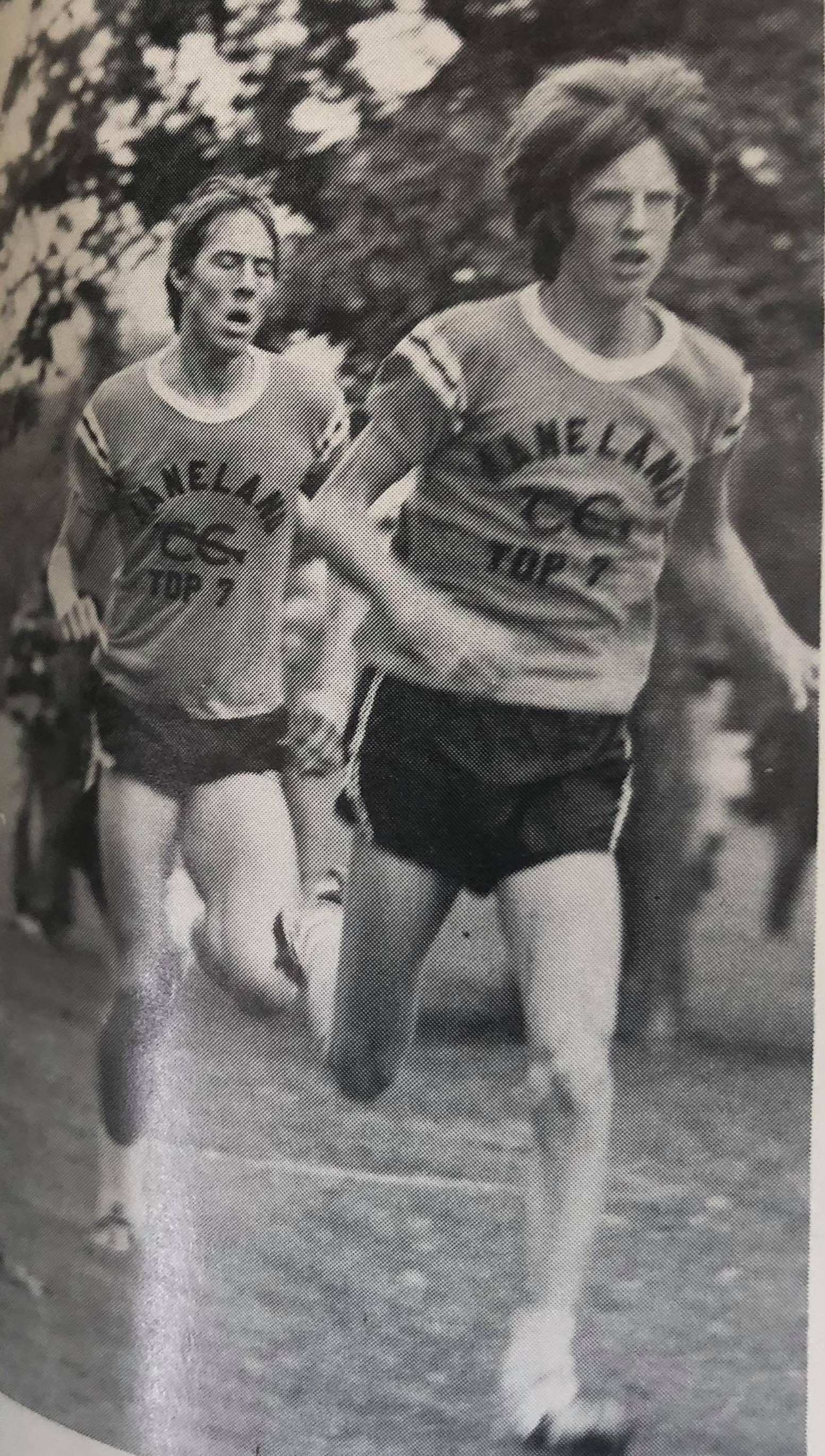
As a junior in HS

In recent years, especially during the 2020 Olympic Games in Japan, and the Winter Games in China, we’ve seen athletes like Simone Biles coming to terms with their own mental state, even stepping out of competition to regroup and rethink the processes going on in the mind. Some shed tears to overcome their fears and trepidation. It’s the right thing to do.

I think it’s important these days for athletes of all ages to assess their relationship with competition as a whole. After all, we maintain relationships with competition just like the rest of the influences in our lives. That holds true with the work we do for a living. We also need to keep personal relationships spinning as well. Then there are relationships with our avocations. In my case, that included writing and painting, and my love of nature too. All these placed demands on my time and occupied portions of my mind. And then, as we move from youth to adulthood, this complex matrix of relationships shifts and changes.

Warming up as a senior in HS

Life tectonics II

When those relationships pile up it can all be difficult to manage. They can even collide, as I wrote in my novel Admission, in what I call life tectonics. Opposing pressures push up barriers to our peace and progress. They can even cause relational earthquakes, eruptions in character and personality, and subduction of whole parts of ourselves if we’re not careful.

Watching time fly

In any case, I managed to fun 54:50 in the ten-mile Elgin Fox Trot race. I got a side stitch early on and never recovered. To rub salt in that wound, part of the course went out a two-lane road for a mile or so and came back again. I could see how far ahead my teammates from Running Unlimited were, one after the other, and watched in envy as the lead runner zoomed past on the way to finishing in the 49:00 range. That illustrated the vast difference between my sub-elite pursuits and the really talented guys at the front.

That’s the crazy thing about distant events and training. When you choose to embark on a running career, you enter a perpetually Mad World where the rules of life and engagement are entirely different from other human beings on this planet. I recall many conversations in which people would ask about my training. Upon hearing about the time and effort invested, they’d shake their heads and say, “That’s crazy.” Part of me agreed. Yet another part of me––that inner dialogue that you share with no one else––would say, “It’s also the only thing keeping me sane.”

A play within a play

Perhaps you’ve seen a drama production in which there’s a “play within a play,” with a main character playing a fictional role. But when you’re the character playing that kind of role––and distance running is like that––it’s hard to determine where the “you” begins and the character you’re playing ends.

This is true because running until your mind and body can go no faster or further is a mad sort of dream, a dance between life and death itself, with heart racing and the mind and body trying to keep up, if not in pace, then at least in appearances.

And I find it kind of funny
I find it kind of sad
The dreams in which I’m dying
Are the best I’ve ever had
I find it hard to tell you
I find it hard to take
When people run in circles it’s a very, very
Mad world, mad world

––Lyrics from Mad World, By Tears for Fears

Posted in aging, Christopher Cudworth, competition, healthy aging, life and death, mental health, mental illness, nature, race pace, racing peak, running, track and field | Tagged , , , , , , | Leave a comment

50 Years of Running: Under a Mad Moon

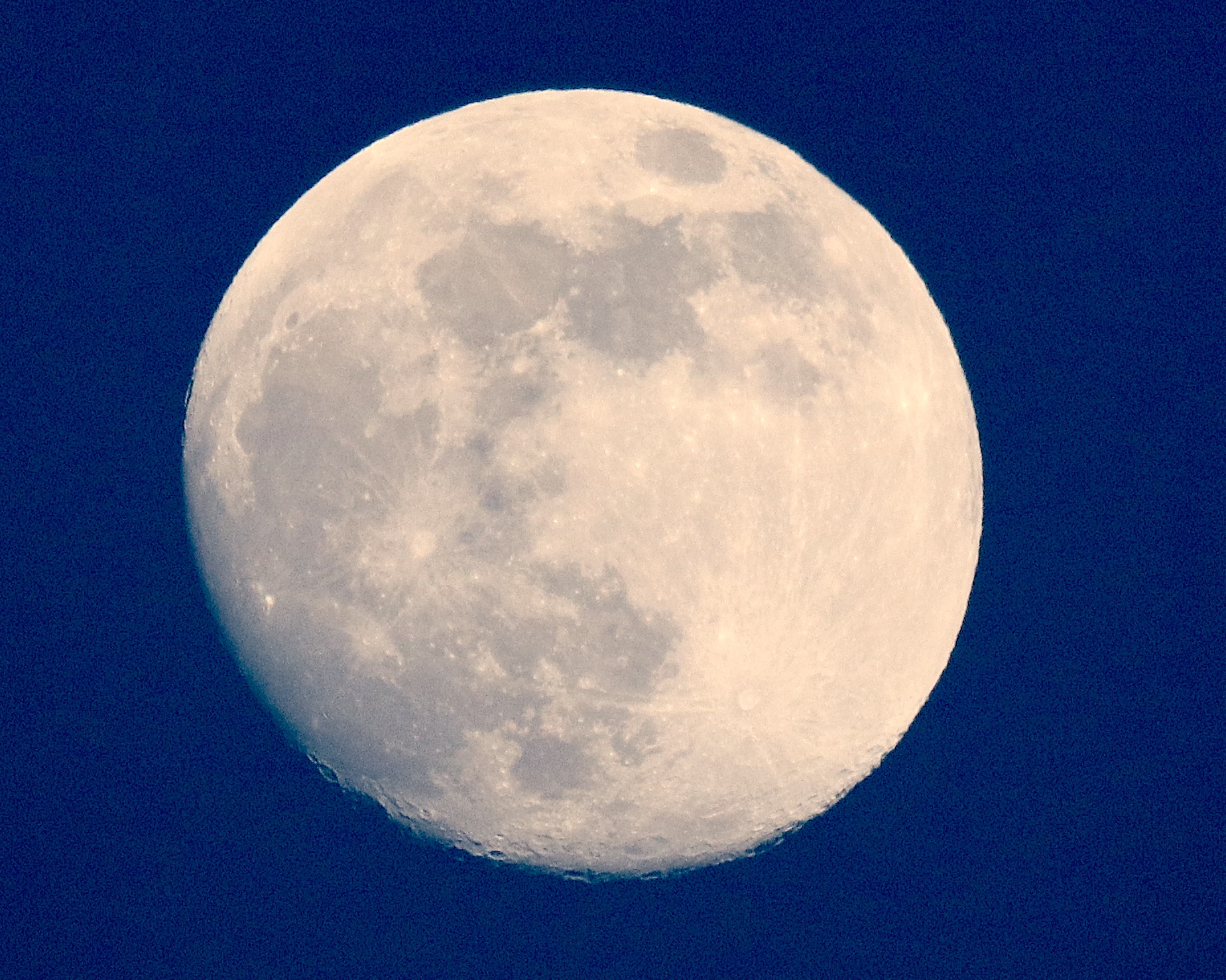
Moon photo by Christopher Cudworth, 2021

Whether from the wet and 40-degree April weather or from the impacts of overtraining, I picked up a nasty cold at the end of April, 1984. “Sore throat. Sore thighs. Tired. Dry air in room. Window open tonight,” I wrote on the 24th. I rested like crazy for a couple days and the weather turned hot, hitting 80 degrees on the 26th. I took a day off the next day, and biked easy on the 28th to rest my legs for a half-marathon the next day.

It was a long haul up to Lake Forest or some other North Shore town where the Lake County Marathon and Half Marathon started. The morning of the race, the symptoms of the cold were still fairly profound. I was coughing some, and snot still ran from the nose. But I’d committed to run the race because it was a relatively high-profile event for the running community. So I toed the line with my Running Unlimited kit and ran a 1:11:55 in cool temps of fifty degrees. That wasn’t a bad effort considering how sick I’d been leading up to the race.

Competing with symptoms of a cold is never fun. I plowed through the race the best I could.

Earlier that week, I’d revealed to my downtown lover that there was another woman in my life. “Had a long talk with (MM) about Linda,” I wrote in my journal. “I love her.” Looking at that note these many years later, I’m not sure to whom that confession of love was directed. In any case, I was trying to be honest with somebody, perhaps everybody, about our prospects together.

There is no doubt I had strong feelings for the woman downtown. We ran together in the park and made love rightr in the doorway when she came to visit one afternoon. Talk about hunger. She had it. I had it. And whenever we went out dancing the rest of the world seemed to fall away. One night we attended a concert and dancefest by the group Heavy Manners, a reggae-based group based in Chicago with an infectious hit song titled: “Under a Bad Moon.” The lyrics certainly nailed my equivocation to the wall.

“She thought love would be soft and tender

He thought love would mean sweet surrender

In her mind he was a romantic notion

In his mind she needed to prove her devotion

Then under a bad moon…he took her

Love is blind, I need to touch you

Love is invisible, c’mon let me hear you

He said ‘but you know how I feel baby….

She said, “Say it…”

I covered 60 miles the week following the half marathon. That included a 4 X 1 mile workout at the University of Illinois Chicago track with the “boys” who all gathered to work out under the guidance of coach Tom Brunick. That week we ran a 4:50, 4:45, 4:58 and 5:00 set. Brunick knew that we were running too fast and called upon all of us to slow our asses down. “Don’t leave your race on the track,” he yelled after that fast first mile.

The pace was likely my fault. I came there ready to run hard every week, and we were all competitive. The “boys” weren’t about to take a back seat. Over the weeks, I’d gotten to know Dave Casillas and Jim Whitnah, Larry Gnapp and a few others. They all ran at a tier just above me. Not the super-elite in the Chicago area, but slightly better runners than I.

We all seemed to swirl around in the racing and training circuit around Chicago. I’d even stumbled into doing a training session earlier that year with Hal Higdon and his son Kevin. They seemed like private people, so I kept my mouth shut for the most part. It was fun running with such a well-known figure as Hal, and I liked Kevin’s straightforward demeanor. And he was a better runner than I, as well.

Raising the race profile

But I was eager to raise my racing profile up a notch. By mid-May that year, I was aching to get to a track and test myself at 5K to see where my fitness really stood. After the fast five-miler in Arlington Heights, and the quick workouts in practice, I felt like a sub-15:00 5K was definitely within my reach.

So I showed up at North Central College on May 18th to run in one of the All-Comers meets. The track meet started in late afternoon, and there were dozens if not hundreds of athletes on hand. Many were either prepping for their national meets or trying to hit qualifying standards of one kind or another.

The meet dragged well into the evening. One of my female friends from the Van Kampen days showed up to root me one. She stayed a few hours but I told her that my race was not going to happen for some time. I don’t recall where Linda was that night, but she apparently couldn’t attend, perhaps because of a teaching obligation.

Finally, my female friend told me she was hungry and decided to go home for a while. She lived just a few miles down the road and told me that she’d be back. I couldn’t believe what dedication she was showing as a friend. But after all, we’d shared a bed together a year before, and we both loved each other in spirit, so I didn’t object to her support.

When the 800-meter race came around, I watched as one of the former North Central athletes was goaded into running by his former teammates. He’d shown up the meet in blue jean shorts, obviously not planning to run. But true to the North Central tradition, his teammates teased and pushed him to borrow a set of spikes and jump into a heat of the 800. He won it, blue jeans and all, tearing through a sub-1:55 as I recall, with barely any warmup.

We sat through multiple rounds of sprint races and the night wore on. I warmed up once or twice thinking the 5000 would come along soon, but no such luck. Hungry at last, I nibbled on some sort of crusty granola bar that I had in my bag. And waited, sitting in stands for the most part, wondering what the hell my life was really about. I mean, this was insane, right?

Racing Under a Mad Moon

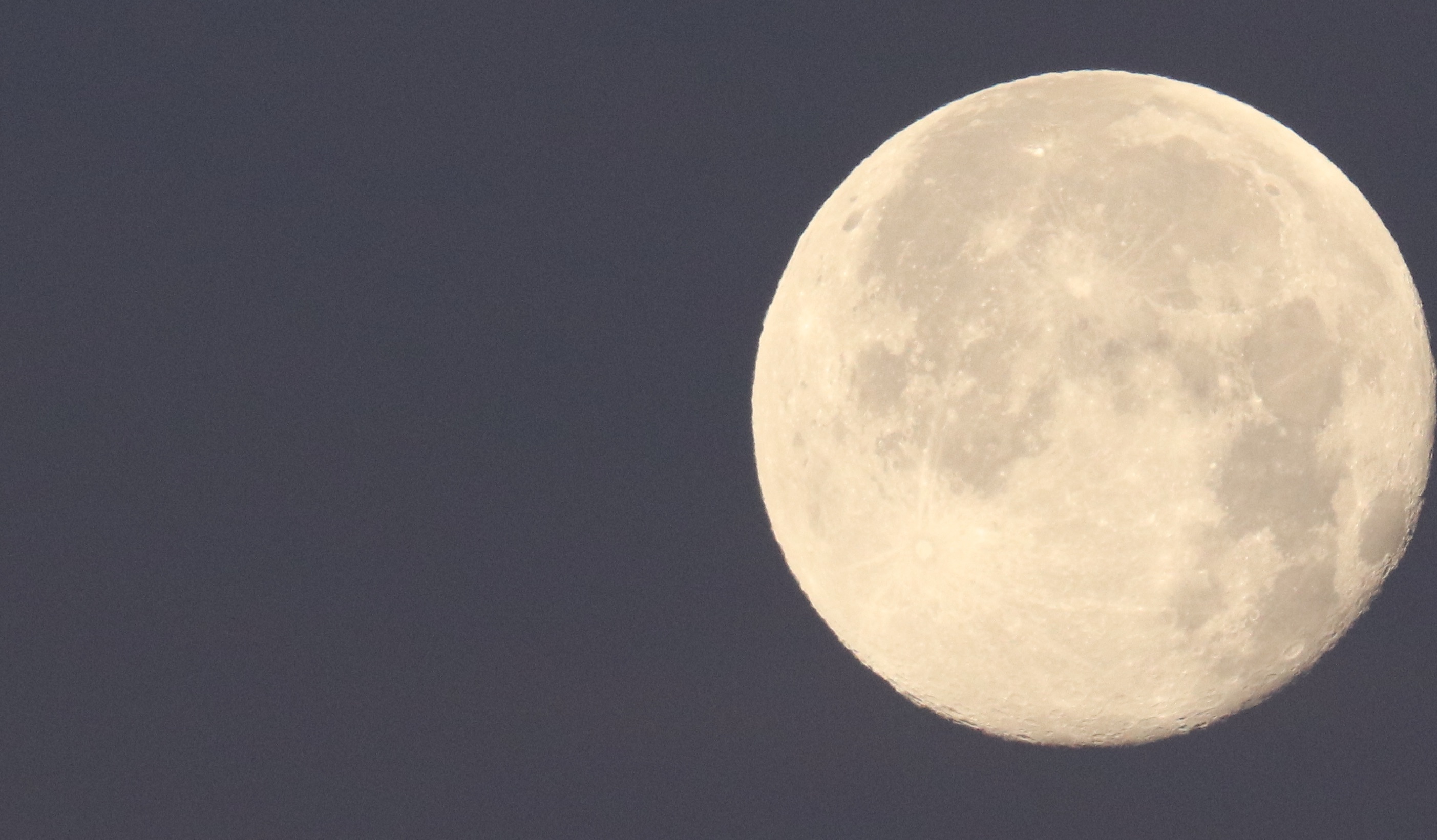
Another moon photo by CLC

Finally, at nearly midnight, the call was made for the 5000 meters. I looked up the track while warming up to spy none other than Jim Spivey pulling off his sweatpants. “Oh boy,” I thought to myself. “This is going to be fast.”

I laced up the pure white Nike Zoom spikes with blue swooshes that I’d purchased a week before at Running Unlimited. They perfectly matched my blue and white racing kit. The runners were called to the line and I took a deep breath and exhaled. “Pop!” went the starting gun.

We raced through the first mile and I hit a split of 4:36. Right on target, I thought. I was fifteen runners back from the leaders, and probably 20+ yards behind, but running well. The weather was perfect, about sixty degrees and no wind. The rack of lights above the track were like bright moons casting alternately long and short shadows as we passed under each set of them. Running track races really is a form of controlled madness, I’ve long thought. But that night I was into it. “This is fun,” I thought to myself.

The other runners around me were just as excited. “C’mon,” one of them gushed as he elbowed past a slowing runner and moved into the second lane next to me. “We’re running fast!”

We passed through the two-mile mark at 9:17. To date, that was my fastest ever time at that split. Now I was really excited. The pace stayed quick and I ran through three miles in 14:14. That was definitely the fastest I’d ever covered three miles. The leaders were well ahead of me, by a half a lap. The winner was Spivey in about 14:00. But I did not care. I was raising my game on my own terms.

With half a lap to go, I did start to struggle a bit. But I came home in 14:47, a PR by almost fifteen seconds. Already in 1984, I’d run my fastest half marathon, quickest five-mile, and fastest track 5K. And it was only May.

I think going through three miles in 14:14 was my proudest accomplishment that night. My best 3-mile to that point in time was back in college when I ran a 14:37 for a solo win in a dual meet on a cinder track.

What a friend

Cooling down after the midnight 5K race, I came jogging around the track to find my blue-eyed woman friend waiting for me near the finish. She wore a big baggy sweater because it was cool outside. I came trotting ver and she threw her arms around my neck in a big hug. “Nice, jobbbb…” she whispered. “You ran great.” She’d indeed come back that Friday night and waited in the wings for my race to start and finish. At midnight. What a friend. What a woman.

We exchanged a friendly kiss and she held my hand kindly as I bent down to gather my sweats from the ground. We said goodnight and I thanked her earnestly for coming. Then I walked to my Plymouth Arrow to make the drive back to Linda’s place in Geneva, where I’d stay the night. It was hard to get to sleep that night after all the excitement of racing around that track at the fastest speeds I’d ever run. She was sound asleep when I got back to her place and she rolled over to ask, “How’d it go?”

“I set a PR,” I told her, and flopped my head on the pillow. I lay in bed with my heart still pounding in my chest. My life might have been confusing in many ways, but at that moment, the focus on running had paid off. I’d put in the work and produced the results. There’s no better feeling on earth.

It had good to have a friend witness the race. I was lucky perhaps to have all those women in my life. Despite how it might seem, I did not take any of them for granted. Still, the second half of the lyrics from the song Under a Mad Moon felt like a soundtrack for that time of my life.

“Mom told son that girls are a tangle

Dad tells daughters boys try an angle

Boys and girls collide in romantic notions

in her mind she needs to hear the word devotion

Then Under a Mad Moon, he took her

With invisible hands he took from her invisible nest

She said I’ll die before I hear a many say he loves me

He said “But you know how I feel baby,”

She said, “Say it.”

Posted in 10K, 13.1, 400 workouts, 5K, Christopher Cudworth, college, competition, race pace, racing peak, running, running shoes | Tagged , , , , , | Leave a comment

50 Years of Running: “Faster than you”

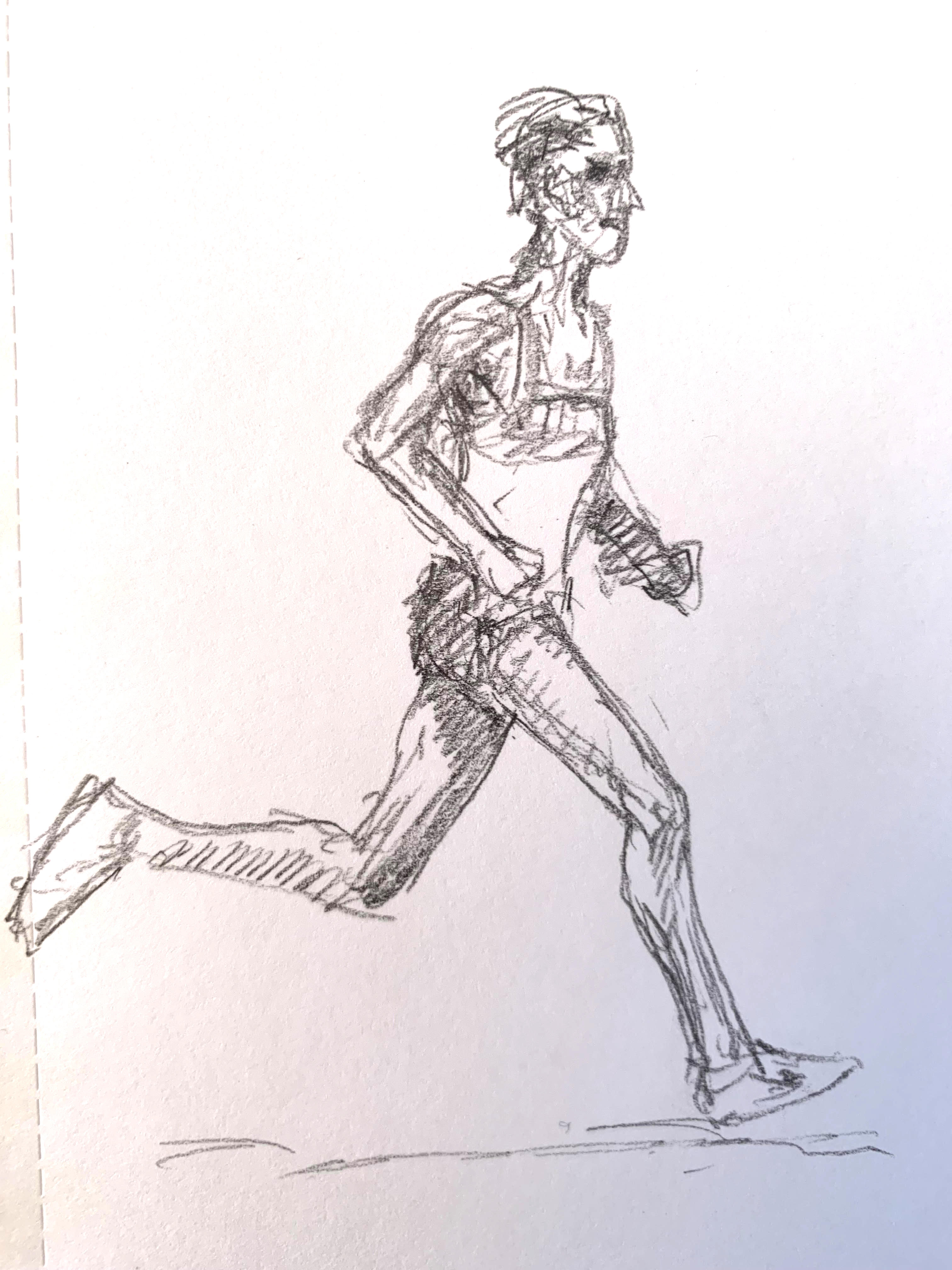
My pencil sketch of the 1984 me racing in Arlington Heights.

On April 15 of 1984, I raced on home turf for the Running Unlimited store in Arlingtonn Heights. Though it had rained overnight, and dawn arrived with 43-degree temps, I was eager as hell to run a five-mile race after the half marathon PR a few weeks before.

The race started and finished at the Arlington Heights library, for whom the event served as a fundraiser. Years later, I would collaborate with that library and 175 others in the Chicago area while building a literacy support program I conceived and developed called the Big Ticket Reading Project. Knowing that summer reading was a big part of every library’s initiatives for school kids, I fanned out and recruited free admission passes from 27 different leading institutions and organizations; the Art Institute of Chicago, Shedd Aquarium, Brookfields Zoo, Chicago Children’s Museum, and many others. Each of these provided a free admission pass with no restrictions to every child that finished their summer reading program at their local library.

The program proved an immense success and raised overall summer reading completion rates to 75% across the board. Those numbers made every library program a success according to their metrics, and the program served to raise awareness of the Daily Herald, the newspaper where I worked. Pulling together a program of that scale––and it grew to serve 375,000 families––took planning, persistence and sometimes raw determination. I learned much of that from running.

But all that was seventeen years into the future. The matter at hand the morning of April 15 was kicking ass in real-time. We lined up at the start and I glanced up and down the line to check out the competition. That morning I didn’t care who was running. I felt like I was going to win. In fact, I knew it.

We moved out at 5:00 pace while a few of the pretenders struggled along trying to keep pace. One-by-one the fakers fell away until there were just three guys left at the mile mark. The runner next to me turned and said, “How fast are you running today?”

My eyes were focused straight ahead and I said, “Faster than you…” then took off running at an even quicker pace. He was left behind.

From there, I ran all alone for the remaining miles. I raced hard into every turn––and there were quite a few of them––because we wound through suburban neighborhoods surrounding the library. There were a few kids from the local high school out the course cheering me on. They’d holler like heck and then jump back on their bikes to catch me on another point of the course. We’d all met me through the running store because I’d started working there a few days a week. So yes, I was super dedicated to making the store look good.

The finishing kick

I remember turning the corner with 400 yards to go, feeling fantastic still, and kicked it up to a faster gear to end the race. It was one of those days where I felt invincible. Had there been other runners there to match my pace, I’m sure it would have been one helluva race.

In the last 100 yards, the high school kids lined up screaming and hollering as I passed by. I gave a short wave to them, and a big smile to Linda, who wore a beaming smile on her face too. And why not? To be frank, I’d put on a racing clinic that morning. I was fit, young, and proud of that effort.

Payoffs

It always feels good to win, and my sponsors from Running Unlimited were happy to see their singlet coming across the line in first. The whole reason they invested in a running team was to promote their store in the northwest suburbs and beyond. I felt like I’d repaid their confidence in me and the other guys on the team. I wore the Running Unlimited blue suit on the awards stand, and collected a nice, tall trophy with a smile on my face as the sun beamed down on us during a chilly morning. My time of 24:49 was the fastest five miles I’d ever run.

I always knew I could find success in some forms if I stayed focused. It wasn’t always easy with all my interests. Prioritizing in the face of multiple desires to produce or experience life; to paint, to write, to go birding…I’d often wake up in a dither over which activity should take precedence. Combine that with the pressures of social life, and the ins and out of family relationships with sibling rivalries and the main thing I realized is that I was Competition’s Son. I was the product of competing interests and a battle for approval. That is why I was driven in my mid-twenties to bring some of these competitive urges to a head, to explore and discover what made me what I was and what I could (or should) become. It was just the start of the journey, but going fast.

Despite that voice in my head like the Rain King chanting “I want, I want…” I found ways to channel those energies, and the payoffs would come along sooner and later. The morning I tore through that five-mile race in record time, I felt the surge of full potential realized.

And there’s nothing wrong with that.

Posted in 5K, adhd, Christopher Cudworth, competition, healthy aging, mental health, nature, race pace, racing peak | Tagged , , | Leave a comment

50 Years of Running: The Rain King gets no satisfaction

On March 20, 1984, the vernal equinox arrived with typically chilly March weather. But like a maple tree with its sap starting to run, I was eager to start using the fitness I’d built over the winter. After the freezing cold Shamrock Shuffle race on March 16, I turned attention to a half-marathon on March 24.

To my pleasant surprise, I ran a PR of 1:10:58. The splits told a story of solid fitness going into the spring racing season. 5:10 at the mile, 26:33 at the five-mile, 53:58 at ten miles and a finish under 1:11, but just barely. My stated goal at the start of the year was 1:10:15, so I was closing in. My other goals were mapped out in my running journal.

While my objective there were concrete, I’d grown frustrated with the back and forth business dealings of my former track and cross country coach. “Tired of Trent’s ongoing, pulling, tugging self. I’m tired of going against the odds. I want at least a few odds on my side. I’m going to find a job.”

He’d counseled me to stick with freelancing because it served his own objectives in part. My availability to train his One On One clients, and producing his marketing and education materials provided me some income, but not enough to call it a living.

I felt the strain. On March 15, I felt like the king of rain staring out the window at Clark Street and Lincoln Park beyond: “First sad rainy morning, spring on the verge. Rings of wetness joining together on the street. Whole lakes of vision out in the park. Naked tree branches must shine up close. Envisionment is my own salvation. Unmarried to any thought, however, I move into this day with a void in my head like a patch of snow on the beach. Oh, sand and snow, sand and snow. Will the others ever know?”

Later that day, I attended an artwork and illustration fair held by Scott Foresman, but it proved a total waste of time. “Stupid showing,” I wrote. “Stupid game. Numbers.”

Midwestern girls

Like a bolt from the blue, my downtown girlfriend sent me a nice note from her travels to New York, home office for the massive publisher where she was employed. In retrospect I wonder: Why didn’t I just ask her to help me find a job? I don’t know. I was blinded by other aspects of our relationship, the sex mainly, and possibly some stumbling block of pride. But I did visit her one day in the tall office building where she worked. “Like that girl, like that….girrrrrlll…” I wrote, quoting a popular song at the time. She was rejuvenating in her runner girl persona. I liked being around her in any circumstance.

“Every twenty years or so the earth renews itself in young maidens. You know what I mean? Her cheeks had the perfect form that belongs to the young; her hair was kinky gold. Her teeth were white and posted on every approach. She was all sweet corn and milk. Blessings on her hips. Blessings on her thighs. Blessings on her soft little fingers which were somewhat covered by the cuffs of her uniform. Blessings on that rough gold. A wonderful little thing; her attitude was that of a pal or playmate, as is common with Midwestern young women”
― Saul Bellow, Henderson the Rain King

And then, as if to crush the remaining work pleasure I maintained in my artwork, my roommate and I received a visit from a couple we’d known from Luther College. She was in art classes with me, and always had a manneristic way of drawing that I did not particularly like. But since college she’d gone into painting, and her work still bore a sculptural feel that spread across the canvas like a piece of flattened cake. “She of the abstract expressionist bent,” I wrote about her.

During our afternoon visit, she lambasted my parochial interests in painting wildlife. I didn’t take the criticism kindly, and slapped back at her high-minded claims to a better mode of working. She’d been taking classes at a school in Minneapolis, and felt like she needed to demonstrate that she was producing work of a higher order. Of course, I knew that she was likely taking critical hits about her own work, so she had some redirected aggression to release, much like a blackbird wiping its beak on a branch when you stare at the creature too long. At first, I made an easy target for her frustrations and enabling boyfriend sort of went along with the whole spiel. Of him I wrote: “The verdant Renaissance supportive photographer.” But ultimately I told her to fuck off.

My own best critic

What they did not know is that I was my own best critic at the time. “And me, out to stud,” I wrote. “and lonely still, the insufferable, incurable gigolo part-time artist who wished only to make the whole damn mess look real to himself. I want to paint. I want to write. I want to love. I want to understand. I want to compete. I want to learn. I want to enjoy. I want to know.”

Little did I know that years later a literate friend of mine would recommend reading the Saul Bellow book “Henderson, the Rain King.” The main character had a perpetual voice in his head saying “I want, I want…” and so he ventured into the interior of Africa guided by a local. He won the leadership of a tribe only to realize he was now obligated to satisfy a hierarchy of women, and he found himself conflicted. And then, when a plague of frogs infested the only water source in the community, he used his ballistics experience from the British army to set up a massive dynamite charge to kill all the frogs. Only the veritable bomb blew up the dam that held the water back and that proved a greater tragedy than he could imagine.

At least, that’s what I remember about the book. And years after that, I heard a song by the group Counting Crows with lyrics that also echoed my life:

Hey I only want the same as anyone
Henderson is waiting for the sun
Oh, it seems night endlessly begins and ends
After all the dreaming I come home again

ON March 27 I continued writing in my journal…the ongoing rant of wonderment about life and circumstance. “If anyone ever reads this, you must think I’m crazy…

I recalled a slice of writing from Henderson the Rain King that applied well.

“I wish my dead days would quit bothering me and leave me alone. The bad stuff keeps coming back, and it’s the worst rhythm there is. The repetition of a man’s bad self, that’s the worst suffering that’s ever been known.”
― Saul Bellow, Henderson the Rain King

On March 27 I observed

“I am like a crab in this city. Penniless, flawless, constrained to a nook in a red brick wall like a crustacean in coral. Anyway. Has anything changed? Wearing the shirt given me by a city woman I can probably never satisfy. I have been close to Linda but I can’t break through to that shining platter of comfort and love that she offers. I keep throwing up arms and reasons. I was a rail child yesterday, aimless, throwing rocks at birds, haggard and angry and thoughtless. Except for running, the consummate youthful escape, and running with international presidents, and my old high school coach, feeling strong tonight, and fearless, and driven, hard into the wet darkness. I can’t get no satisfaction. No satisfaction.

“Of course, in an age of madness, to expect to be untouched by madness is a form of madness. But the pursuit of sanity can be a form of madness, too.”
― Saul Bellow, Henderson the Rain King

Posted in Christopher Cudworth, college, competition, fear, God, love, mental health, mental illness, sex, training | Tagged , , , , , , , , , , | Leave a comment

50 Years of Running: And pocketfuls of money

While my quasi-job search continued, and freelance work kept trickling in, I mused whether to continue the solo journey or go to grad school. I’d made one inquiry years before about getting a Master’s Degree in Art from Northern Illinois University. The depressing response was that I’d have to start over as a freshman in order to qualify for their program. I wasn’t about to do that after four years of college at Luther, so I kept on painting the wildlife that I loved, and left the avant-garde art world to itself.

My painting Urban Light, circa 2019.

My brother attended Northern as an undergrad during seven years of fitful enrollment. His senior art show was an astoundingly brilliant collection of sculptures made from paper. Their texture and shape made them look like metal. They were works of genius.

By comparison, my artwork was considerably more prosaic. I’d gotten my watercolor technique down to the point where a balance of detail and subtlety was possible. Over the late stages of 1983 and early 1984, I built a collection of thirty-plus paintings. Many were medium to smaller sized works, fine little watercolors of ducks and songbirds and hawks.

Along the line, my roommate’s girlfriend invited me to hold an art show at her parent’s house in the quaint little town of Wayne. Her father was a bon vivant type and grand socialite, and her mother was tied in with the horsey set because the Village of Wayne was the regional equestrian host with trails in the woods and a training center at the edge of town. On weekends, the Wayne hunt would spread out to chase down fake foxes, with horses and mounted riders and herds of hound rustling through the woods. I was running in Pratt’s Wayne Woods one day when the hounds came rolling through the preserve in pursuit of the unseen prey. I stood there watching the dogs following their noses and admired their focus. Oh, to live a life so simple.

The Hunt was a common activity in the Village of Wayne back in the early 1980s.

Of course, within the dog pack, there were likely rivals and pecking orders akin to human relationships. Every social group has Alpha Males and Omega Females, and all points in between. So the world is never so simple as it appears on the surface. Even among dogs, there is competition and a social order. The fact that they establish their rank by sniffing each other’s butts is not so different from human societies.

So I gratefully accepted the invitation to host an art show at a home in Wayne. I needed the money, for sure. I also wanted to see how well my art would be received.

The answer was both profound and dizzying. There was a dinner and the wine flowed freely among those in attendance. I quickly found myself selling one artwork after another. Some of the buyers took the time to talk with me, while others snatched up work, a cardinal here, a set of mallards there, and went back to drinking.

Mini-mogul

One of the men in attendance was the son of a corporate mogul for whose company I’d one day work. The father was a hard-driving man whose government contracts fueled a firm employing hundreds of people. The work was so secret, and the personality of its head operative so controlling, that when people within the firm argued over whether they’d get a corner office with a window, he ordered the facility to be built with no windows at all. Oh sure, there were windows on the outside to give the appearance of normal functionality, but in truth, the dark panes covered only concrete walls.

So the son lived in the shadow of that control, and unfortunately, he fell into drinking and drugs. The Rich Kid Syndrome. But on the night that I held my art show in Wayne, he was feeling good and speaking in affectionate, grandiose terms about my work. So he bought a few pieces, and we had our connection. “This is going great,” I told myself.

Buyers were snatching pencil sketches like this out of my sketchbook to buy that night.

Linda was working the crowd, talking with people about my work, and now and then another person would sidle by and ask questions about the artwork perched throughout the house. As the evening wore on, and the drinks kept flowing, I encountered a few women who disembarked from their husbands or lovers to wander by and catch up with me. One of these pulled out her purse, snatched a hundred dollar bill from her wallet, and shoved it into my pants pocket. She held her hand there a moment, slid it over to give my crotch a squeeze, and whispered, “I’ll take that one,” pointing at an elegant painting of a pintail duck.

I’d had a few glasses of wine myself by that point. And when Linda came by minutes later to ask how it was going, I could only mutter, “Pretty fucking good.”

She laughed, not knowing what I’d just experienced, but I think she understood. By evening’s end, there were people tearing pages out of the sketchbook I’d brought along to show the process of how the paintings came out. “There’s nothing left to buy,” one woman crowed merrily. “But these are pretty,” she laughed, holding up a page covered with pencil drawings. “How much?”

“$50,” I replied. Her husband pulled out a checkbook and wrote it out. “Thanks,” he chuckled, giving me a wink.

The Renaissance Man

By evening’s end, I’d sold $2000 worth of artwork. The host cruised by as the night wore down and handed me one last check, “an appearance fee,” he told me, for $150. “Now don’t spend all that money in one place,” he advised. “Put some of it away.”

I thought to myself, “I wish. The rent is late.” The very next day I deposited all that money, checks, and cash, and tried to catch up on bills. I wondered at that moment if I’d ever really catch up.

Well, some people do. People with common sense and a lack of artistic ADHD, anxiety, and pursuant depression. Those people seem to save and handle money just fine. The artist in me was admittedly not practical. It’s not that I thought the world owed me a living. Not exactly. But how does one recreate the social scene in which people are throwing money at you and stuffing it in your pockets? That’s the world where I wanted to live. It was out there. But it’s all about connections. In the meantime, I felt a bit like my own sacrificial lamb.

After the big art show, I went back to training in February and March of ’84 and cranked off fifty-mile weeks one after the other. The first race of the season was the Shamrock Shuffle five-mile, a race scheduled to begin at Montrose Harbor. Linda came downtown and stayed the night. The next morning broke fiercely cold with a stiff northeast wind off Lake Michigan. The temperature was sixteen degrees, with traces of snow still lining the streets.

Despite the freezing conditions, I raced well to start off the season, cranking through the first mile in 4:46, the three-mile mark in 15:03, four miles in 20:46, and a final mile into the wind. By then I was so cold it was hard to care about anything but getting the race over. The bright March sunshine provided zero warmth as the wind tore at my thighs. I finished at 26:10 for sixteenth place overall.

That result felt good given the freezing cold day and the damned cold wind. The winner was a guy from Wisconsin in the mid-24:00 range. I wore my Running Unlimited kit for the first time in a race with black and silver Nike tights that barely kept my thighs from freezing up.

We headed back to my apartment to warm up. We had some hot tea and lunch and took a bus down to the Art Institute of Chicago later on. Linda particularly loved the work of Renaissance artists, and did not seem to see any irony in dating an artist and writer who was trying to be a Renaissance Man on his own terms.

Fulfilling that promise was my job in life. In that light, I viewed everything I did in the framework of “transfer of excellence.” That is, use the quality of one experience to set the standard for another. It would take time, but that would become my life’s work, and running helped fuel those standards.

Posted in alcohol, Christopher Cudworth, college, competition, love, mental health, race pace, running, training | Tagged , , , , , , , , , , , , , , | Leave a comment