What’s on your Laundry List?

Bright Kind of GuyOn the way to drop my wife off at the train, we were conversing about some domestic topic and I blurted out, “Well, I’ll have to put that on the Laundry List.”

And Sue said. “What is a Laundry List? What does that even mean?”

Which is why I love her. Because she asks the questions that may not need to be answered, but they sure are interesting to consider.

So I looked up the term Laundry List and this is how it is defined: “a long or exhaustive list of people or things.”

In the process I learned there’s a company called laundrylist.com that bills itself as is “The #1 seller of used industrial laundry machinery in North America. We specialize in the sale of used industrial equipment from Tunnel Washing Systems, Flatwork Feeders and Folders, Material Handling to Power Plants.”

That’s quite a laundry list, and rather specific and literal when you think about it.

Our laundry lists

On a more practical level, we all walk around with laundry lists of one kind or another in our heads. For example, today is my birthday, and that always makes me think back on the experiences of the past. I particularly recall my ninth birthday when my mother bought me three of the best things I’d put on my birthday list. I spent an entire peaceful day gluing together a model of some military plane that I admired. From my brother’s room down the hall, a Beatles album was playing Nowhere Man. All was right with the world. That goes on my Laundry List of Good Days in Life.

That proves our laundry lists don’t have to “exhaustive” as in “dire” or on a list of things we’d rather not remember. To do, especially.

Dirty laundry

Of course, there are actual literal laundry lists for endurance athletes. Nothing is more frustrating than going to the closet or dresser and learning all your cycling or running shorts are still down in the laundry bin. Finding socks can be a particular pain. So can all the gloves and other gear vital to healthy, active training. All must be laundered at some point, or else you have to fudge it.

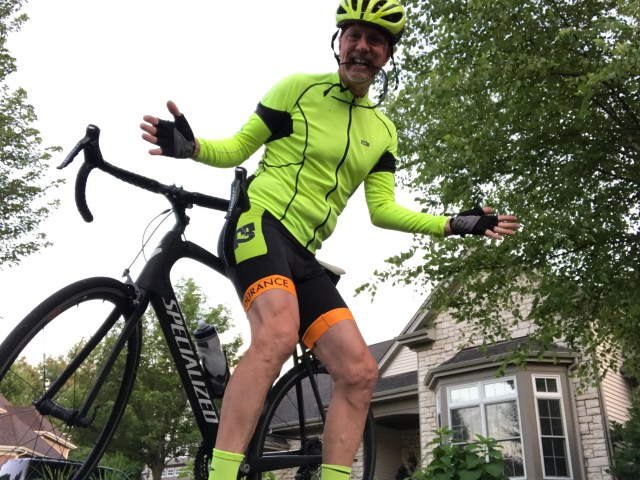
It only gets worse the colder the weather gets. Here in Illinois, it is summertime now and the living is easier. A set of cycling shorts and a kit top are all it takes to get out on the bike. But don’t forget the helmet, gloves, shoes, Headsweat, Garmin, water bottles, nutrition, cell phone and sunglasses. It never gets easiers, you just buy more stuff.

There’s always a laundry list of things to track it seems. That’s the fact of human existence. Even if we could swim, ride and run naked we probably wouldn’t. Not on a daily basis anyway. Which means laundry remains a big part of our lives, and that means a laundry list to keep.

What’s on your laundry list? 


Posted in Christopher Cudworth | Tagged , | Leave a comment

Putting the hammer down

IMG_6278Standing on the starting line of a five-mile race a few years back, I could feel the energy pouring through my body. Training had been going well. I’d done a track workout of 12 X 400 at 60-63 and was feeling sharp.

Glancing down the line of runners, I saw a few that might be a threat of some sort. That didn’t shake my confidence. I knew that I was ready to run 5:00 pace for the entire race, and probably faster.

The gun went off and a group of five runners formed at the front of the race. I sat on the side of this group looking them over.

How many were already breathing hard? Who were the pretenders? 

At the mile mark, passed in 4:58, it was down to three of us. By the mile-and-a-half it was just me and another guy. “How fast are you gonna go today?” he asked.

“Faster than you,” I replied. Then I took off. I won that race in a time under 24:50 and finished with a celebratory sprint up the final stretch. I’d put the hammer down and won.

Nothing like it

There’s nothing quite like being fit and knowing it. When you’ve done the training and have seen the empiric results on your stopwatch or Garmin or power meter, it gives you confidence knowing you can handle the pace you want to run, ride or swim. And if things go really well, you can truly put the hammer down.

I’m not the same level of cyclist that I was as a runner. I took the sport up too late in life to know whether I could have been truly competitive or climbed a few categories along the way. While my aerobic fitness was great and there was plenty of will to push myself, cycling is a completely different animal than running.

Thus when I did try to put the hammer down during a criterium or two, I found my limits pretty quickly. Far more than the sport of running, cycling strategy and drafting are much more important to success. You can be super fit and waste it all by riding stupidly or chasing back onto the peloton in a hairpin turn, for example. I did that once or twice. Or, if you get gapped because a bunch of guys blow up between you and the main group, you had better put the hammer down just to keep contact, or you’ll be dropped. So there’s more than one reason to put the hammer down in cycling.

The triathlon hammer

IMG_6279.JPGUnless you are so fit that your skinsuit looks like a coat of paint on your sculpted body, competing in triathlon typically requires a series of tradeoffs during each event. Swimming or cycling too hard in the first two stages can have a big cost when it comes time to run. More than one great cyclist in triathlon has busted a hard ride only to have jelly for legs in the run phase.

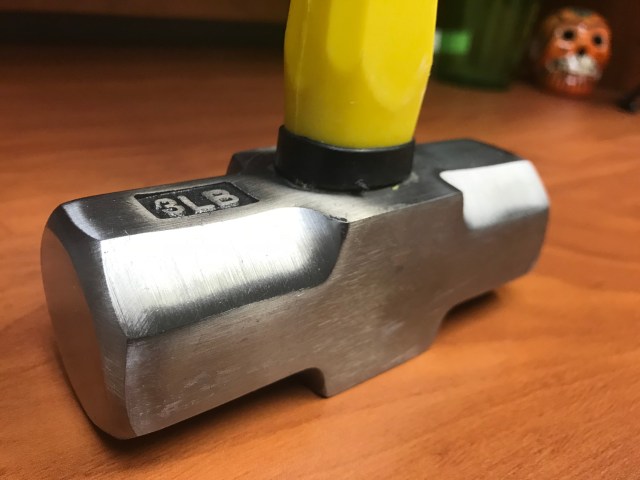
So the triathlon hammer must be applied with strength, but also finesse. It’s almost a counterintuitive thing to hold back a little when you feel great. There is more than one way to drive a nail into wood, after all. You can whack it with all your might four or five times, but if you miss the nail gets bent and the game is over.

But if you hammer consistently and accurately, the nail will get in there soon enough. That’s the art of the hammer in triathlon. Hitting the nail on the head counts more than whaling away hoping you hit it big.

Hammer on

Those of us that compete in endurance sports know there’s great value in the things we learn along the way. Putting the hammer down can apply in business or during life in general.

dBcAx_MNqdtlA few years back when I started dating after the loss of my wife to cancer, I met up with a gal through eHarmony.  She was a little older than me and seemed straightforward enough in our online chats. So we agreed to meet at a restaurant for drinks.

Two minutes into the conversation, she had something to say: “Look,” she told me. “I’m looking for a man willing to move to Arizona with me so that I can be closer to my son.”

I sat back, took that statement at face value and said, “Well, I think this date is through.”

Sometimes it’s best just to put the hammer down right away. That’s what she did. That’s what I did. We both moved on in life.

Practice makes perfect

So let’s wrap up with a hint about how to hammer best. If you want to put the hammer down in your favorite sport, you have to practice at it. Remember that 12 X 400 workout mentioned at the start of this story. I did that speed work to teach my body how to sustain a pace even faster than the prescribed race pace in a five-mile or a 10K. When you put the hammer down in practice, be serious about it. Run or ride or swim much faster than you plan to race, and apply that principle in volume. That’s the only way to turn your body and mind into a hammer that works together.

Some things in life truly are simple. Putting the hammer down is one of them.


Posted in 10K, 13.1, 400 meter intervals, 400 workouts, running, swimming, tri-bikes, triathlete, triathlon, triathlons | Tagged , , | 3 Comments

Was Jesus a triathlete?

IMG_6238The Bible is a remarkable book both in what it reveals and also what it leaves to our collective spiritual imagination. For example, the creation story and the rescue of species from the worldwide floods lists a few “kinds” of animals that God created and preserved, but the record of nature’s salvation is far from complete. There only broad mention of the zillions of kinds of insects in this world, for example. Information about how Noah and the ark were able to provide food for creatures like tropical hummingbirds  that specifically depend on flowering plants evolved by length of blossom to the length of the hummingbird’s beak is somehow missing.

Tough journeys

And talk about your tough journeys. We all know doing a full Ironman is a tough task, but imagine how hard it was for a pair of blind cave salamanders from the caves of Kentucky, USA to get to the ark perched on dry land in the Middle East. That would mean the salamander would have to have crawled across the eastern seaboard, swum the Atlantic Ocean, scuttled across the deserts of Northern Africa, climbed on board the ark, lived for a year or in a wooden aquarium supplied with fresh water, crawled back out when the deluge was over, swam back across a tumultuous ocean likely filled with rotting corpses of human and sub-human detritus, and crawled back home into that Kentucky or Tennessee cave to breed.

But it’s funny. There’s not a word about all that in the Bible! Remarkable, isn’t it? it would have been an inspiring tale to include, indeed.

About The Life of Jesus

But here’s a real biblical mystery: We do not seem to know squat about what took place in the life of Jesus between the ages of 12 and 30. So we are about to fill in the gaps…

Jesus in India

There are many academic and conspiratorial theories about what Jesus did during those important “lost” years of self-development. Because after amazing the folks at the temple with his early grasp of scripture and holy writ, Jesus disappeared from biblical view for some eighteen years. Some speculate he traveled to India, engaged in spiritual enlightenment training and came back with a brain full of insight to share with the world.

I personally don’t find the notion out of context at all. Those “three Wise Men from the East” who  came to visit Jesus in his early youth brought “gifts” of some sort. They are listed as gold, frankincense and myrrh, but like many things in the Bible, those might not be meant to be taken literally. The “gifts” could well have been invitations to learn about aspects of the world that humdrum existence does not offer. Otherwise, why did Jesus teach so many lessons in parables using everyday objects to teach spiritual lessons?

Jesus the Carpenter

The more “traditional” take on the youth of Jesus is that he served as an apprentice “carpenter” under his father Joseph. That’s a pretty quaint take idea, just like the depiction of the Nativity where Mary and Joseph are surrounding with critters and the Three Wise Men. It’s all based more on romantic notions and people filling in the gaps with conventional thinking than an expression of any real knowledge about what really happened in the life Jesus. We also see plenty of nativity scenes with Santa Claus or Frosty the Snowman keeping the Baby Jesus company. Are we also supposed to take that as a literal communication of fact?

But poor use of symbolism hasn’t stopped Bible-lovers from extrapolating certain aspects of scripture to “prove” what Jesus did all those years between the age of 12-30 years old. Here’s a great little synopsis from GotQuestions.org. Notice how fluidly the rationalizations flow from the tongue of this conventional thinker:

Question: “Was Jesus a carpenter?”

Answer: There is every evidence from Scripture that, before He began His ministry, Jesus was employed as a carpenter. His earthly father, Joseph, was also a carpenter, which means that Jesus was likely His father’s apprentice. It is bizarre to think that God Incarnate was taught to build things by a human man, but it seems that in this, as in all other aspects of His earthly life (e.g. he cavorted with prostitutes) Jesus submitted Himself to the humility of being fully human (Philippians 2:6–8).

People called Jesus a carpenter (Mark 6:3), and He was known as a carpenter’s son (Matthew 13:55). There is some evidence that the Greek word used for “carpenter” (tekton) could also be translated more broadly as “artisan,” “contractor,” or “handyman.” It is possible, therefore, (editor’s note: everything’s possible) that Jesus and Joseph were the sort of men you call when something needs to be fixed—be it made of wood, stone, or something else. (Jesus was a ‘fixer?’ What is this, the Holy Mafia?)

It is also possible that they acted as civil engineers, (which weren’t invented yet) even designing bridges or other structures that were needed by the people of the town. (Did Jesus also run for Mayor?) This throws an interesting light on Jesus’ later comments about the temple. As they were going past the temple, His disciples, perhaps knowing of His interests and past profession, pointed out the grandeur of the great buildings. Jesus told His disciples that those structures would all be thrown down (Mark 13:2). In addition to being a prophecy, Jesus’ words were perhaps a reminder of the importance of the spiritual over the physical. (It never gets easier, you just go faster…)

Practical truths

All this practical application and “working for dad” stuff is great if you buy that Jesus arrived at his deep level of symbolic wisdom by working for his spiritually cuckolded dad by sawing and hammering pieces of wood together. We all know there is much to be learned from our fathers, but when it’s so hot outside that you can’t think and your own dad is barking at you to hurry up and get that lumber over to the job site, there is also the possibility that you will tell your father to “go fuck off” under your breath and swear that you’re going to leave town at the first light of dawn.

Which explains why Jesus probably did take off to India. He needed some “me” time and India was just right up the Silk Road. Besides, those of us who worked summer jobs in carpentry or slaved away in cheap-ass factories earning pitiful money to pay for college know better. The only thing those jobs like those actually get you is pissed off and tired. Even Jesus wouldn’t humble himself to that nonsense. He was smarter than that.

40 days in the wilderness

So Jesus probably took off a few “gap years” and got his proverbial shit together studying with people who were smart and capable in the ways of the world. When that mind work was all done, he came back to his roots in the Middle East and got serious.

But there was still one more venture to undertake. When Jesus came of age, he retreated to the wilderness to engage in a 40-day period of deprivation. And like clockwork, the likes of Satan showed up to tempt Jesus with literalistic promises of power and glory. Jesus saw straight through these supposed shortcuts to godlike status and declined Satan’s legalistic offers.

Oh, that Adam and Eve been wise enough to figure out Satan’s game.  He was playing them fully with the same sort of literal promises disguised as the actual word of God in order to trick his prey into sin.

Genesis 3: Now the serpent was more crafty than any of the wild animals the Lord God had made. He said to the woman, “Did God really say, ‘You must not eat from any tree in the garden’?”

2 The woman said to the serpent, “We may eat fruit from the trees in the garden,3 but God did say, ‘You must not eat fruit from the tree that is in the middle of the garden, and you must not touch it, or you will die.’”

4 “You will not certainly die,” the serpent said to the woman. 5 “For God knows that when you eat from it your eyes will be opened, and you will be like God, knowing good and evil.”

What a snot rocket of a philosopher, that Satan. Turning the literal Word of God into false promises is not nice. But isn’t it interesting that a long history of religious zealots from leaders of the Catholic Church to televangelists have used the very same legalistic language to gain power for themselves. That’s actually why Jesus fought so hard against the religious authorities of his day. John the Baptist called them “hypocrites” and a “brood of vipers.” But the zealots and the political harlots they favored had them both killed anyway. That’s the real lesson of the Bible and the Gospels. Beware all those of claim to be on the side of God.

Jesus the Triathete (Get it?)

So lacking any better explanations for the Lost Years of Jesus, the table is open to explain what transpired for the Lord and Savior between the ages of 12 to 30.

There is something tantalizing about the idea that Jesus took off those 40 days of deprivation in the wilderness. Doesn’t that sound a lot like a training camp of sorts? It was actually preparation to prepare for his ministry, but like a coach with a hidden training agenda, Satan had a set of spiritual workouts in mind.

After his psychological prep in the wilderness, Jesus showed up at the River Jordan to be immersed by John the Baptist. As we’ve learned, the Bible keeps things short for a reason. So we’ll never know for sure if Jesus just took a dip or swam a full two miles as the first leg of a full Ironman. And if Jesus walked on water at an Ironman event, would he be disqualified?

The First Cyclist

We do know that Jesus covered a lot of miles on foot. But who is to say that he wasn’t the beneficiary of some sort of early version of the bicycle? If he was an able carpenter it would have been easy enough for Jesus to create a self-propelled cart to pedal from town to town. The need existed. The towns back then were often pretty far apart with dangerous desert roads between and bandits looking to steal everything you’ve got. So having a bike and being able to pedal it faster than a man could run would have been a handy deal. The Son of God was surely capable of that. He was likely the First Cyclist.

Running on

And running in those Huarache-style sandals with the straps up the ankles would have been pretty cool too.

So what I’m saying here is that I think we know what Jesus did during all those “lost” years. He was in physical as well as spiritual training for the trials to come. And how do we know that Jesus started it all?  Well, the evidence is clear in that the “trinity” of swimming, riding and running to this day remains a tradition on par with a religion.The The will to suffer is a big part of endurance sports and most religions. The Son of God was also known to endure suffering better than most. Perhaps we actually have Jesus to thank for that.

And the final bit of evidence that Jesus might have been a triathlete is documented in the sign that Pontius Pilate put on the top of the cross where Jesus hung to die. It said “King of the Jews.” Pilate was simply giving props to the Strava segment Jesus earned while carrying his own cross to Calvary.

So you can go on out there and suffer with the best of them. Jesus was a great example for us all. And who knows what enlightenment you might find along the way. Even St. Paul saw the light on the Road to Damascus.


Posted in Christopher Cudworth, cycling, evangelical Christianity, it never gets easier you just go faster, riding, running, swimming, Uncategorized | Tagged , , , , , , , | Leave a comment

Tour de France rider for a day

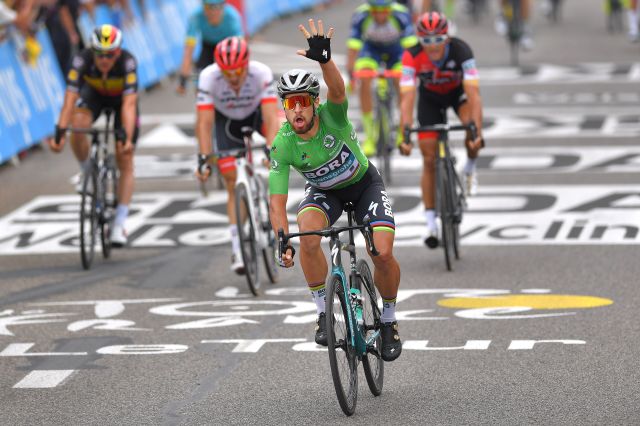
arrival-peter-sagan-of-slovakia-and-team-bora-hansgrohe-news-photo-1002642690-1532101540The weather in Illinois was cool, rainy and windy this past Saturday. We rode west and north into the wind for 25 miles. At several points our speed dropped to 13 mph as we ground into the gray gale coming from the northwest.
Then we refueled at the Casey’s General Store in Maple Park and turned around. That’s when the fun began.

With a tailwind strong at our backs, it was easy to ride in the mid-20s and faster. For long stretches we whirred along at speeds above 30 mph. Had we tried, it would have been easy to reach 40 mph on the slight downhills leading southward.

Pretend Le Tour

As we rode, I thought about all those Tour de France riders and how they sustain these speeds under their own power. They don’t need a strong tailwind to keep the pace at 30 mph. They’re that strong and talented. But it was fun to experience the sustained sensation of traveling at those speeds. We could pretend for a long while that we were that fast.

One quickly realizes how much more dangerous it is to ride at 30 mph than it is at 20. Reaction times to everything around you are reduced by 1/3. Imagine riding in a pack of 160+ riders traveling at 30 mph! One touch of the wheels and people go down.

So I kept my distance off the wheel of my companion. Our wheels were genuinely wet from the rain falling off and on. Braking would most certainly have taken longer.

10 miles on

For ten miles we whirred and flew down the road. Our speed never dropped below 23 mph. Even on the uphill over the I-88 bridge the Garmin showed 25 mph. That was cool. 25 mph going uphill!

Finally the road turned east again. The crosswinds had us now. It would be tough going the last fifteen miles home. We had to fight and flail just like the Tour riders on the coast of France. So I guess it’s all the same in the end. We all go as fast as we can. We all fight the winds. But it sure as hell is fun to roll fast when you can.


Posted in cycling, cycling the midwest, tour de france | Tagged , , , | Leave a comment

Run and ride doodles keep me sane

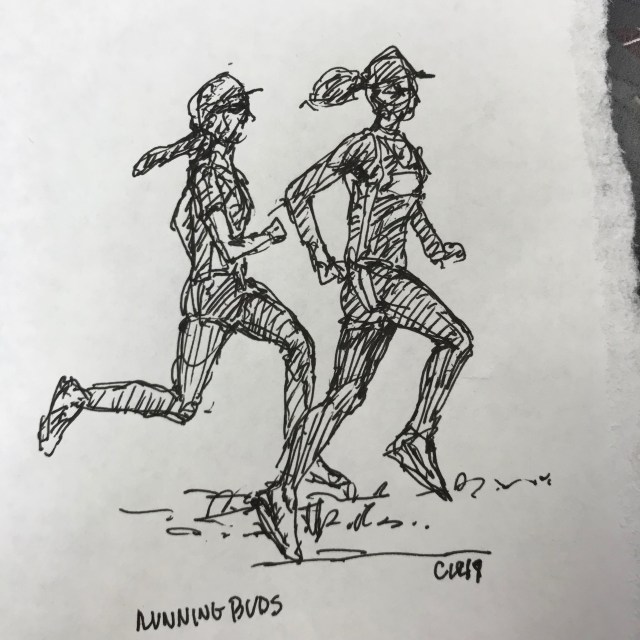
Sometimes meetings drag on. That’s when I let the pen do the side thinking for me. The result is plenty of run and ride doodles. These were all pinned to a cork board in my office but I got to move into new digs. These are fun but I don’t need to keep them. There are always more where they came from.

Still, I’ll share:

IMG_6114 2

It had been really windy out when I drew this one.

IMG_6121

This is my wife Sue and her friend. Oops. I said it was me in the first descript!

IMG_6123

Fat pen means thick lines and a solid feeling drawing.

IMG_6115 2

Always thinking about good running form.

IMG_6099 2.JPG

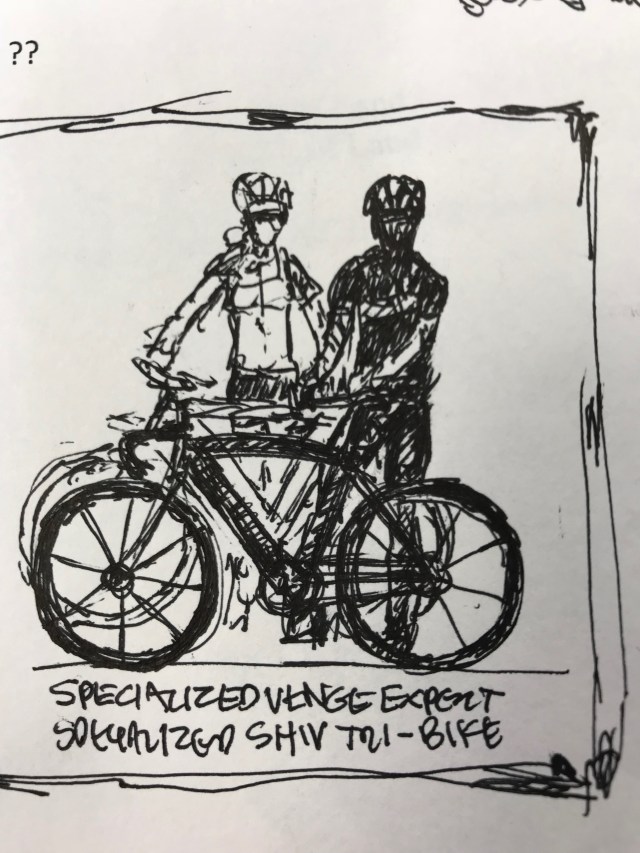
That’s what we ride. Two Specialized. Expert and Shiv.

IMG_6104

Angular thinking.

IMG_6108

I miss racing at the front of the pack like this. Getting old sucks.

IMG_6103

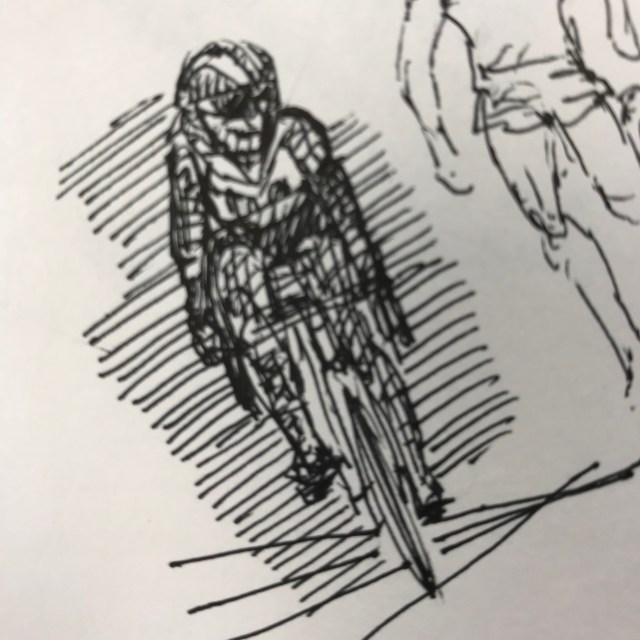
Sometimes riding is just a blur.

IMG_6112

Probably some inner psyche thing I was working out.

IMG_6100.JPG

My fave of this set. Imagining climbing some remote rode.

I’ve always drawn and it’s fun to pull these from memory and work out all the little details. And keep my sanity.

Hope you do too.


Posted in cycling, riding, running, trail running, training, tri-bikes, triathlete, triathlon, We Run and Ride Every Day, werunandride | Tagged , , , , | Leave a comment

Summer lovin’ 1972

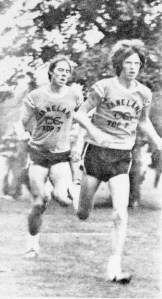
cudworthkanelandThose formative years of distance running remain special to me because everything was still so new. The sensations wrought from running farther than I ever imagined possible were both stimulating and daunting.

Coming off a freshman year cross country season in which I’d run varsity most of the meets and helped lead the team to a first-ever frosh-soph conference victory was quite motivating. That spring in track I’d set the freshman school record in the mile at 4:57, but had to beg for the opportunity to go “up in distance” from the half to the mile. Despite having competed over three miles in cross country the previous fall, I never ran a two-mile on the track. That was for the “distance guys.”

Summer training

How times and perceptions have changed over the years. The notion of training over the summer months was just coming into fashion. I was also a baseball player and early in the season, when urged by a third base coach to take a chance and steal home, I slid into the plate where a big catcher from the farming community of Huntley fell on me in a crushing heap. That ended the inning and it was time to go back out and pitch.

As I raised my glove arm to start the pitching motion a sharp pain shot from my elbow to the shoulder. It hurt so badly I almost fainted on the mound.  The coaches came out to see what was wrong but it was clear that something had gotten broken in the home plate play.

It turned out to be a bone chip in my elbow. That meant a half-cast on the arm and no more baseball. It also severely limited any ability to put in training miles.

I think I wrote or called the cross country coach Rich Born that summer to let him know about the accident. He was encouraging. “Heal up and we’ll see you in the fall,” he told me. I stored the running log sheets we’d all been given to record or daily mileage. Mine were sparse and sporadic. Secretly I might have been a little relieved. Running miles in those thin gum-rubber track flats was no fun. And in the sun? Forget it.

That all happened late in the month of June. I ceased going to baseball games that summer and perhaps I was a bad teammate. But I saw no purpose in torturing myself sitting on the bench while others played.

Tennis player

As an active kid, I still tried to do something to keep from going crazy. I learned it was possible to toss a tennis ball up in the air with my ‘bad arm’ and that meant I could play the game. So we’d head down to a local community college where a massive spread of courts was available. That was my training all summer. Playing half-assed tennis in the heat of the day.

I also had a morning paper route that involved cycling about three or four miles around town. Then at night, I’d join my friends Eeker and Roy (nicknames) to ride our bikes all over Elburn, Illinois. I still recall the sensation of swinging around those curved streets of on a Huffy three-speed, clicking gears as we went. We all lived for the quiet smack of tires on tar and cool air rushing through our long hair. It made us feel alive.

All Things Must Pass

Thus the summer months whiled away. I’d spend time trying to get attention from the girls who lived around town. That summer I turned fifteen years old and somehow that turn of years made me feel much older. Fifteen.

Without sports to keep me busy I spent more than a few afternoons lying on the living room floor with my head wedged between two giant stereo speakers. George Harrison’s All Things Must Pass was one of 10-15 albums I’d play from beginning to end. There was Elton John’s Tumbleweed Connection, Traffic’s John Barleycorn Must Die and David Bowie’s Ziggy Stardust and the Spiders from Mars. Neil Young’s After the Gold Rush was my alternative rock and The Beatles were never far from my playlist either.

But I also liked an album my brothers gave me called Midnight On the Water. It was a blues-folk album so different from the music of my friends it made me feel weird. And I was a little weird. I liked birdwatching, art and poetry. Those weren’t big topics of discussion among my friends out there in cornland.

So I was still something of a tortured soul that summer. Blame the hormones and the general angst of girl-hungry fever. Blame the competitive small-town culture and angst over social friends and foes. Blame something, anything. That’s what teenagers do. I was angry at the world and wanted to take it out on something.

Cross country season

Then August arrived, and the cast came off after six weeks. It stunk. We threw it into a trash bin and that was that. My already scrawny left arm looked wasted and frail when it finally emerged from the cast. The arm had a weird tan stripe on the top where the sun could reach it. I’d taken multiple showers holding that arm aloft to keep the cast from soaking. Now I was free. Fortunately, I still had my right arm all summer to jerk off. I was fifteen, after all.

Somewhere in the middle of the month of August, cross country practice began again.  As always, it was hot and those first few runs around the high school campus were a struggle to get enough oxygen in the humidity. Yet all that bike riding and tennis had kept my legs in some kind of shape.

Within two weeks it felt like I’d never missed a beat. I had no real summer training to count on, yet that fall I tied for most team points with our best runner Bill Creamean. He’d logged a thousand miles in training and that was beyond my imagination. I’ve always admired that dedication. He was an excellent competitor who continued to run even through back pain late in the season. His legs were probably too strong for his midsection. I had a teammate in college built the same way. He had the same problems with lower back pain.

That team won the Varsity conference cross country meet that fall, and I largely served as second man. I even won a meet that our lead runner missed. So the question that has run around through my head over the years is whether doing a bunch of summer miles really would have helped much in those high school years. These days kids run together, but in those days, in a district where the towns were far apart and getting together to run was almost impossible, we either did it on our own or not at all.

Summer lovin’

I tried my best that first summer and every summer after that. But truth be told, I pretty much showed up in the fall and ran myself into shape with two-a-day workouts. By the time the first meet rolled around in September, things were coming together. Then we ran 18-20 meets with competitions Tuesday-Thursday-Saturday. Every week was a round of intense competition and hard racing.

Usually, by the end of that schedule, we were getting pretty close to past peak. It was probably too much racing.

Or was it? Back then it was what you did. Certainly, we all felt like we had a “real season” by the time cross country was done. And to my way of thinking, we also had a “real summer” in the sense that we didn’t burn ourselves out running too much, too often. Nothing wrong with summer lovin’.

But it took a busted elbow to make it happen in the summer of 1972. Such is life.


Posted in competition, cross country, cycling, Uncategorized | Tagged , , , , , | Leave a comment

A black belt in fatherhood

IMG_5988Twenty-five or so years ago, our family went camping in the Upper Peninsula of Michigan. It was a busy season, so campsites were scarce and the more remote campground in Hiawatha National Forest where we wanted to say was closed due to sanitary problems with the water and toilet systems.

So we sat on a waiting list for a spot at another campground and jumped on it when a campsite opened up. That’s where we gratefully set up our tents and hurried to make supper for our kids.

The week went generally well with occasional fishing trips and hikes in the forest. We did get chased out of the wilderness park at Sylvania by massive hordes of mosquitoes. I went for hourlong runs in the woods and tried to keep the deer flies at bay.

Perhaps I’m even mixing together a few different camping trips because we went on quite a few when our kids were little. It was easier when the wonders of the world were not so hard to show.

Receiving a black belt

black-belt.jpgAs the week was about to wrap up, one of the campers in the site next door walked over holding out a long black object. I thought for a moment that it might be a snake, and my late wife HATED snakes. Feared them. We’d even seen a long dark water snake lying on a strip of sand earlier that week. We left that lake immediately.
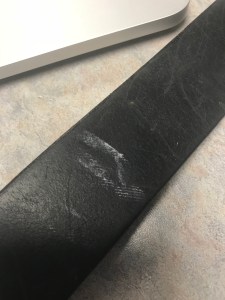
But it wasn’t a snake he was holding. It was size 34 black belt. “I found this on the road,” he told me. “Must have fallen off someone’s car. It doesn’t fit me but it looks brand new, so if you want it, it’s yours.”

I took the belt and tested it around my waist. At the time I was a size 32. Weighed 150 lbs. But the black belt fit well enough to keep. Who knows, I might need a size 34 someday?

Still fits

The belt still fits. It still looks good. The inside coating is a bit fragmented. In fact it looks like snakeskin. So that part of the tale came true.

That belt has been worn with business suits and blue jeans. It has held up Bermuda shorts and survived dozens of painting sessions with only the merest trace of white paint on its surface. I could remove that with some Goof Off but something in me wants to keep it that way.

IMG_5989I have a new black belt that I purchased recently. It’s a size 34 as well. My waist has remained the same through years of adulthood. The last couple winters my pants got a little tight at times. All my running and riding and swimming can’t quite combat the appetite of a formerly competitive athlete now in his 60s. So I’m trying to get a headstart on winter this summer. I’ve dropped ten pounds since January and want to go another seven pounds down. Whether that will remove the belly fat accumulated around my waist I have no idea.

Strong family ties

My son is an inspiration of sorts at this stage in life. He’s supremely fit right now through CrossFit and running and riding his bike to work. He’s got his reasons to want to rock the fitness thing and sometimes we learn as much from our children as they learn from us.

That’s where the symbolic black belt thing comes in. In many forms of martial arts, it is considered as wise to redirect the energy of an opponent’s blows as it is to strike them with a force of your own. That is the yin and yang of life as well.

Life has thrown me some considerable blows. It has been my goal to try to redirect some of that energy to the positive side of things. In many ways, that has worked out.

Yet sometimes I fail at re-channeling or redirecting that energy. Like a Black Belt who whacks a board but fails to break it, my aim and purpose have sometimes been “off.” I’ve offended or hurt my own children through lack of communication at times. I’ve neglected friends or insulted business associates. My black belt has also been my Dark Side at times.

All one can ask for those transgressions is forgiveness. And try to make it up to those you’ve hurt.

Good and bad belts

Man from GladSo in many respects the black belt that I where around my waist is a chronicle of both the good and bad that I’ve accomplished over the years. Have you ever put a belt on inside out and had to pull it back out of your pants, reverse it and pull it through the belts loops again. Life itself is like that sometimes.

There has been one steady factor in all this of which I’m quietly proud. Over the last twenty five years my waist has held pretty much steady. That is an accomplishment of sorts.

But that belt has also held together the years. The young man who accepted that black belt from a fellow camper that day in July could never have dreamed that belt would carry him through all these adventures in life.

White belts and that 70s look

All I can say in looking back is that it is probably best that it was not a white belt I was given to wear. That’s not a good look for any father, including my own. My dad once showed up at one of my baseball games wearing a white shirt, white pants, white belt, white socks, white shoes and a set of dark shades. One of my teammates shouted out, “Look! It’s the Man From Glad!”

Mr. clean.jpgThey might have been confusing my dad with Mr. Clean, who had no hair and wore all white as well. But you get the picture.
I’ll stick with my black belt, thank you.

Posted in Christopher Cudworth, healthy aging, healthy senior, Uncategorized | Tagged , , , | Leave a comment

Things I learned today on a morning ride

IMG_5930

The road through Johnson’s Mound, a preserve mounted on a prairie kame

At 5:30 this morning the air was cool and clear. A light north wind had broken the humid grip of mid-summer on our part of Illinois. It was a fine time for a bike ride.

I’d planned the morning ride coming off a rest day that involved mowing the lawn, an hour’s exercise that also led to a garage cleanup. But no official workouts. No runs, rides or swims. Just a Monday to recuperate a bit.

That was a good idea after a Friday morning repeat workout of 16 X 400, a Saturday morning bike ride of 50 miles, Saturday afternoon track workout of 6 X 800 in extremely humid conditions, and a Sunday morning run of 8 miles in 85 degree weather with 90% humidity. Guys my age need a recovery day.

Changing course

I pedaled east at the start of the morning ride, but decided against a route that takes me through downtown Aurora. Who needs stoplights at that time of day anyway? Turning south and west again, I rode past a large swath of wetlands that has been there my whole life. In fact I’m a little embarrassed to say that for all the birding I’ve done in the area, never have I walked those wetlands to see what might be found.

As I pedaled next to a bed of cattails I saw a sign that read, “Federally Protected Wetlands.” That made me both happy and sad. Glad that someone had seen fit to protect them. Sad and mad at myself for never really checking them out. Will do that soon, because as I came near a roadside section of open water the song of a marsh wren with its sewing-machine-like rhythm reached my ears. I love that bird. A true sign of quality habitat.

Then I crossed back over the curving line of Orchard Road that leads back to my house and turned south and west again.

Open country

The forest preserves in our county have a penchant for mowing fields in June and July. Some mowing is done to control clover, but the fields I passed were cut through in some places leaving rows and patches of tall grass between. It looked all ragged and torn.

Earlier this summer a field rife with breeding birds near my home was mowed flat. Birders protested, but the county wants to get rid of the clover. They own the mowers and the land. It may take a few years to reach a common consensus.

But nature adapts, and this morning I heard meadowlarks and kingbirds, yellowthroat and sedge wrens out in the open country. I learned that summer is not over. That’s the entire reason I went for the ride. We live and long for these days all winter long. This morning’s ride provided plenty of reason to return to those fields with camera in hand. Capture some of this glory.

Summer’s namesake

IMG_5922.JPGI was tooling along at 15-17 miles an hour most of the way. Then I threw in some harder riding after ten miles when my legs were warmed up. At the park known as Johnson’s Mound I turned to ride a loop up and over the prairie kame on which the woods has grown tall and thick.

There were both summer and scarlet tanagers singing high up in the tree canopy. That first species is the only bird I know named for the season we all seem to love. It is strawberry red from head to toe. Those birds sing a song like a robin too lazy to hit the high or low notes. It is still lovely to hear.

Heading home

Turning home from the country I felt a tailwind and torqued the bike up to 30 mph on a stretch of road that has a Strava segment. At home I learned that I’d missed a PR on the segment called Bunker Blitz 2.0,  a stretch that I’ve covered in 2:15. Today I rode 2:22. But my PR was set with a massive tailwind at my back. Today was the superior ride. Sometimes numbers lie.

Back at home from the ride I met Sue on her return from a hard run after an indoor bike session. Sweat streamed from her body and she was like, “Woahhh, that was hard.”

I hadn’t worked nearly as hard. But I’d learned and seen some nice things along the way. Sometimes that’s just as good.


Posted in 400 meter intervals, 400 workouts, cycling the midwest, Uncategorized | Tagged , , , , , | Leave a comment

Sibling rivalry

Sibling clouds.jpgOur family consisted of four boys and our mom and dad. We apparently had a sister that died very early in life. She was born between my next oldest brother and I. Still hoping for a girl, my parents had the name Christine Annette lined up in the event that I arrived as a female. Alas, I was a boy. I was christened Christopher Lynn Cudworth.

I didn’t know about that sister until very late in life. She came up in conversation at some point with my mother and I went, “What? Wait…” and asked to be told about this sibling that I never knew. Growing up in the 60s, there were many family “secrets” that never got talked about.

Thus my brothers and I were left to fight it out in sibling rivalries. We competed at everything we did. From fighting for food at the table to games of basketball, soccer, baseball and side yard football games, we played and we played hard.

Fights

Sometimes the competition turned into fights. Mostly it was one punch and over when it was my brothers pounding me. But that one punch sent a message to me that I had better not take it further with them.  We were like chimpanzees.

The much more biting form of competition was the verbal repartee amongst us. Teasing was a ritualized form of brotherly torment. My brothers, being full of creative and dark energy, excelled at it. As a sensitive kid, it was the taunts and ridicule at times that hurt the most.

I once read an article in the Utne Reader that suggested our siblings raise us much more than our parents. If that is the case, my siblings raised me to be feisty and possess a strong sense of social justice. All that teasing made me eager to fight back. So I did.

Parental influence

IMG_5347But you can’t grow up without adding in the influence of your parents. My father’s fierce temper and occasional bouts of physical punishment impacted us all. Some of the sibling rivalry stuff was echoes from our father’s wrath and rage. There is more than one way to pass it along.

Yet my father also guided us wisely on many fronts when it came to sports. He refused to let us engage in either wrestling or football. He considered the first a graceless dirge of physical competition and the latter just a stupid way to mess up your body.

I still wrestled my way to a 7th grade championship at the behest of our gym teacher Mr. Davis. He arranged a wrestling tournament because he was a wrestling coach and a gymnastics teacher, so our gym classes involved a healthy dose of both. Being the competitive kid that I was, there was no way I was not going to wrestle given the challenge put forth by Mr. Davis.

So he called us out of class to wrestle our classmates. I remember trying to pin a wriggling friend named Greg to the mat. I felt pretty bad about it, but business was business in my competitive world. No mercy. Beyond that, I know there were other matches, but I don’t recall them so well. They were all against friends. Maybe I’ve blocked those victories out. Perhaps I even wrestled my best friend David. In any event, I beat everyone and earned my way to the final match against a guy named Tim.

Tim had jet black hair and a naturally tan complexion. His muscles also bulged. So while we were in the same weight class, the match seemed unfair to me. He was handsome and the girls loved him. I was a bit homely (by my own estimation) and had barely latched onto a Tier 2 girlfriend who at least wore short skirts. Thus I never thought I could beat him.

Yet Mr. Davis looked me in the eye before the match and something registered in my soul. All that competition between my brothers and I had taught me that much of competition is about mental assertion and momentum, and Mr. Davis somehow knew that. So I wrestled Tim and if memory actually serves correctly, I won.

Exceeding expectations

IMG_5417Life is a series of experiences like that. Sometimes we exceed our own expectations. To some degree, the control group for that experiment is our sibling rivalries. They test us from the moment we’re born. By the time we go out in the world, there is an entire catalogue of successes and failures already filed in our memory.

For example, the biggest achievement I could imagine in my elementary years was coming up with a joke funny enough to make my older brothers genuinely laugh. This was not an easy goal to hit. One had to be alert to the entire conversation and understand most of its context in order to enter with a witty comment. Then, would it be a mature enough comment to register as funny? Would it be quick enough to enter the joke stream at just the right time? The ultimate compliment would be, “Hey Chrissy, that was really funny.” They called me Chrissy. As did my mom. Perhaps they got their sister and daughter after all?

Brothers and sisters

Later in life, we relate to our teammates as we once did our siblings. All those miles of running done between the ages of 13 and 28 years old were spent in the company of a long series of teammates and rivals. And still, it was a prized ability to be able to make your teammates laugh. To entertain. To compete for witty approval.

Certainly soldiers in battle become brothers or sisters in arms. The same goes for athletes who enter the realm of competition together. We bond with them and sometimes that bond lasts forever. We also have sibling rivalries with those teammates as well. Two of my college running teammates roomed together freshman year and one refused to talk to the other within the confines of their own room.

That’s a little messed up, but that’s how rivalries sometimes play out until all the issues can be worked out. It’s a power struggle. That’s why those early sibling rivalries with our familial brothers and sisters are so formative. They teach us how to survive in the face of close competition.

Shared experiences

IMG_3726My next oldest brother actually got royally screwed in sports when our family moved from Pennsylvania to Illinois. He was going into his senior year in high school when we moved. That is possibly the worst time of all to change schools. Moving out to the cornfields of Illinois, he lost the two sports at which he had earned starting positions in soccer and baseball. He was also aligned to be on the varsity basketball team.
So lacking a soccer team, he went out for cross country. While he was not a natural runner, he got into the high 17:00 range for three miles on a hilly home course. Not bad for a guy who did not train for running the first three years of high school. He’d been a star goalie back east. He also went out for track that spring and did high jump and long jump. What a gamer.

At that time, I was busy trying to make my own way in the world of 8th grade at the new school. Thus most of my brother’s sibling suffering was appreciated in retrospect. I never saw him compete in a single cross country meet or track event. But the very next year I went out for cross country as well, and made the varsity as a freshman.

My brother could have been vicious or jealous about that. But I recall nothing but encouragement and admiration for my efforts. Because along with sibling rivalry in this world, there’s also thing thing called sibling pride. For all the testing and teasing and torment that can go on between brothers and sisters, there is still love to be found.

And that is all.

Posted in Christopher Cudworth, competition, Uncategorized | Tagged , , | Leave a comment

Workouts don’t need to be insane to be good

Sue Running

Last night the weather was windy and hot. Hardly the ideal environment to do a running workout of 16 X 400 meters on an outdoor track.

Oh sure, I’ve done workouts far more insane than that in terms of weather and difficulty. As college idiots, we once ran 28 quarters (400 yards) on a single stretch of snowy road. It was dark on a cold winter’s night in Decorah, Iowa and we averaged 80 seconds per 440, about 5:20 per mile pace, with a minute’s rest between. Insane, right?

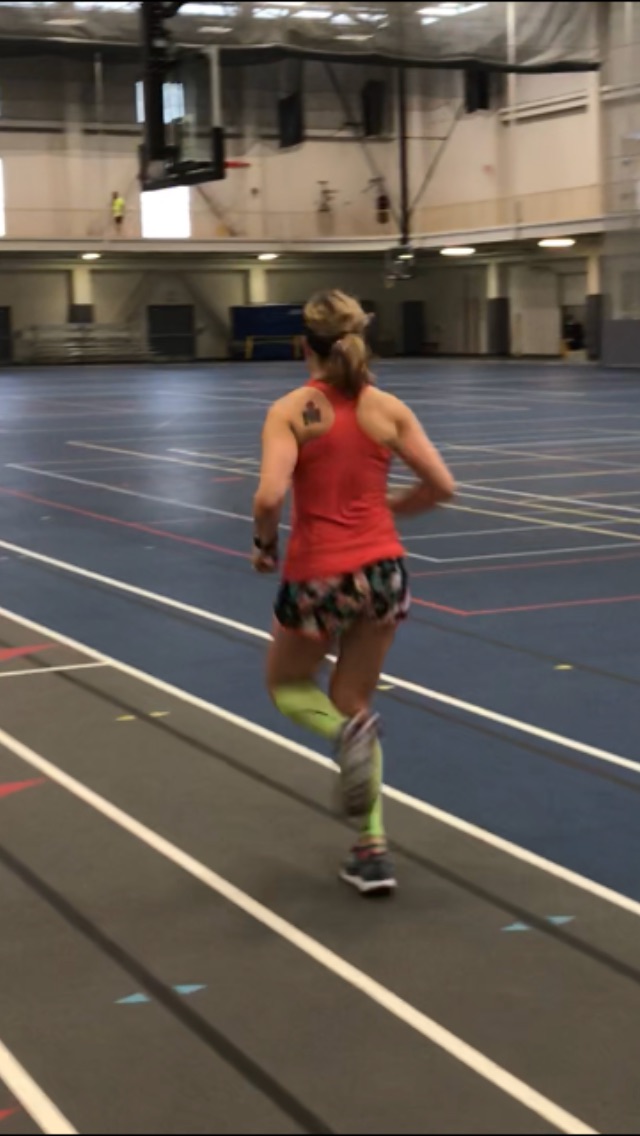
But Sue and I aren’t into insanity. We’re into running well. So we opted out of suffering needlessly in the heat and wind last night to run an indoor workout on the 200 meter track at the Vaughn Center this morning.

Besides, they have toilets at the Vaughn Center. And when running in the morning, we need toilets.

So we warmed up and ran the 400s at her prescribed pace. My calves were a bit tweaky and my repaired knee was temporarily creaky, but the workout went really well together. There were moments when I felt ageless.

See, workouts don’t have to be insane, to be good. Remember that when you’re wondering whether to suffer needlessly. You’ll thank yourself down the road.


Posted in 400 meter intervals, 400 workouts, Uncategorized | Tagged , , , | Leave a comment