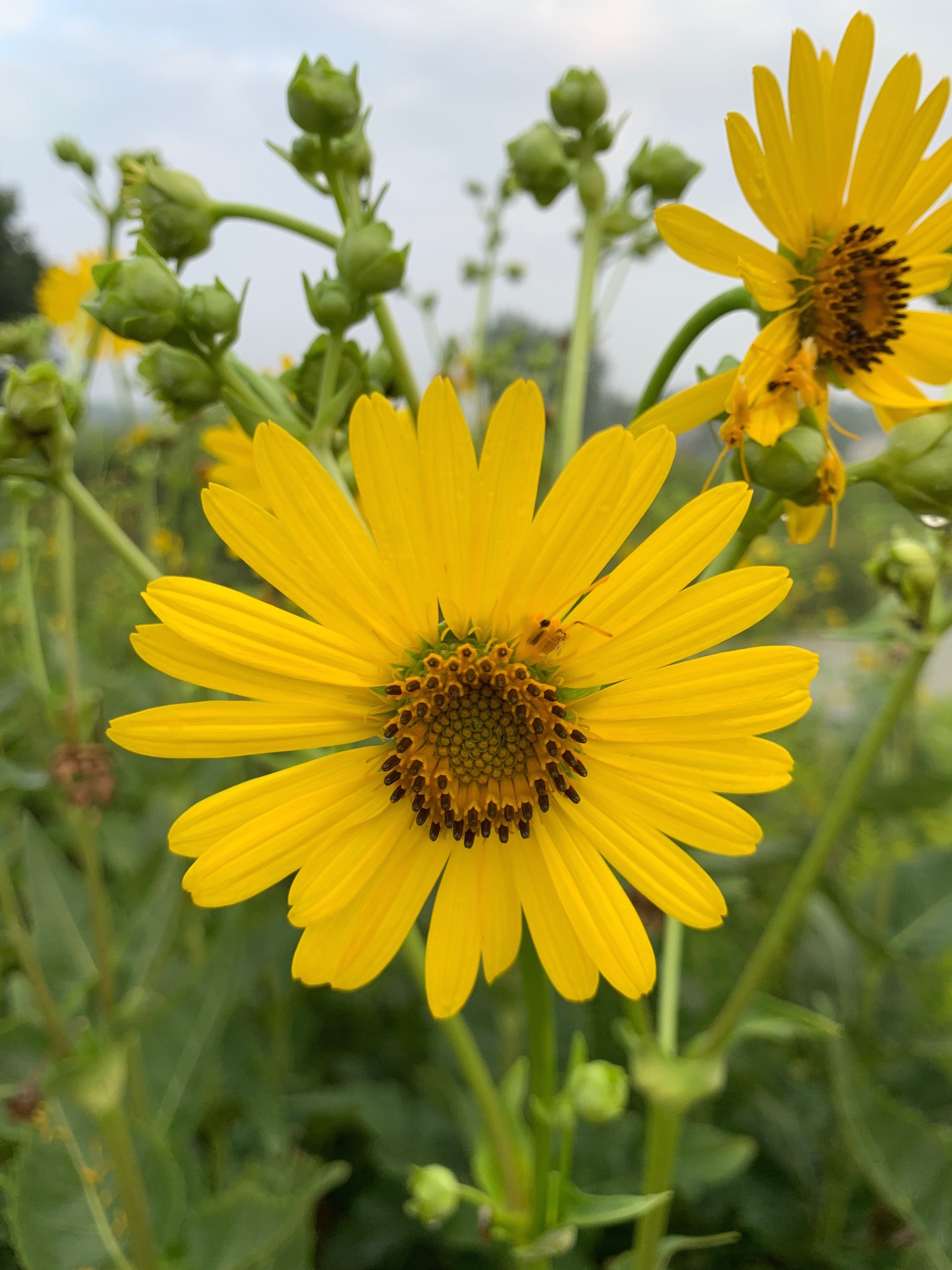
This is the time of year that the color yellow begins to take over. From coneflowers and sunflowers to sprays of goldenrod burgeoning in the open fields, yellow demands its time before the chill of fall takes over.
I love the yellow of daffodils in the spring, of course. That burst of warm color after a winter of bland landscape is a thrill. And the smell. Daffodils smell like heaven to me.
But the yellows of summer are always a bit richer and more profuse. A little wilder and uncontrolled. A little sadder perhaps because they signify the end, not the beginning of a sweet season.
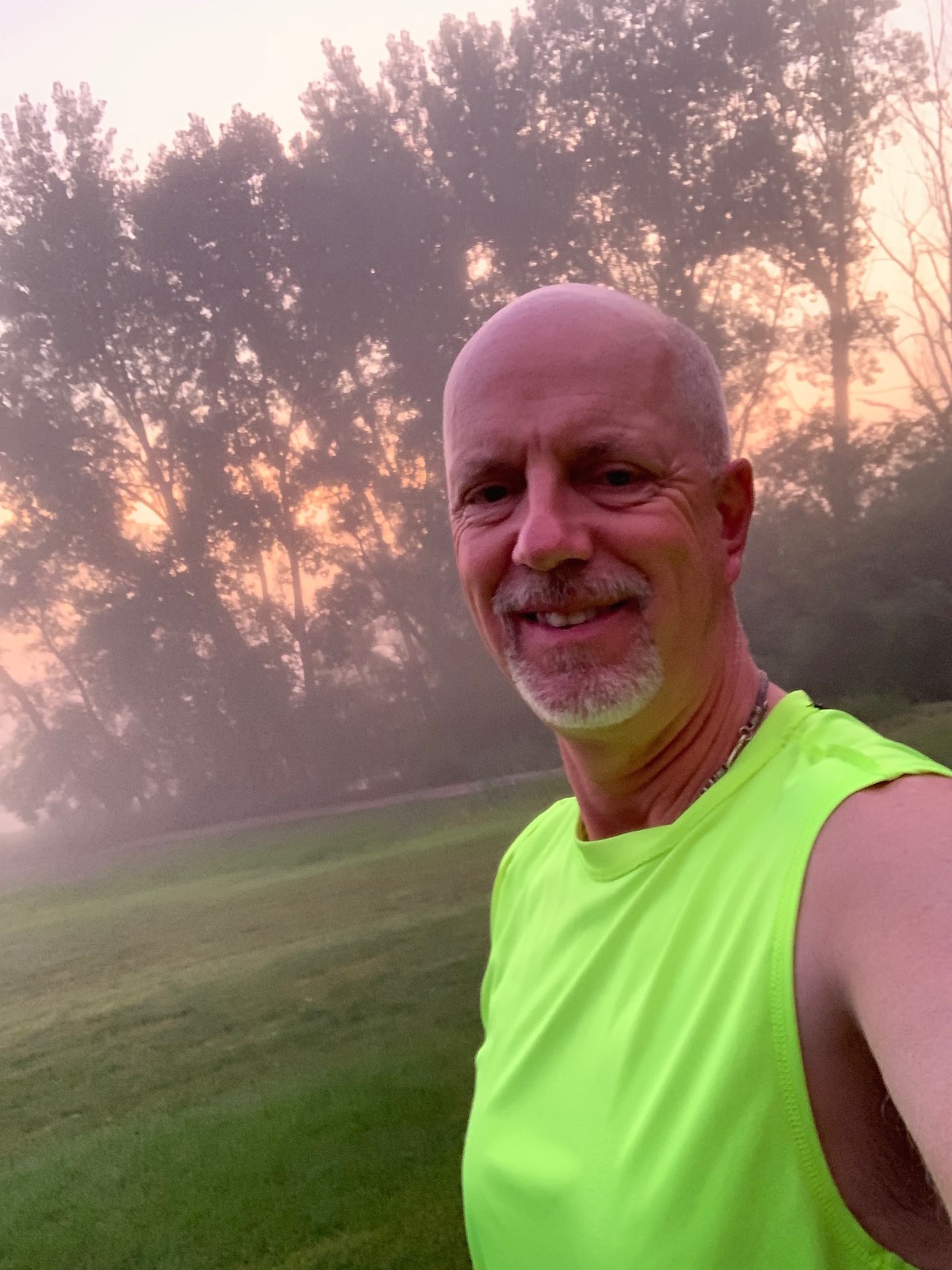
When I go out for runs in the early morning light of August, the yellows of late summer often stand silent in the mist. Some are laced with dewy spider webs. Others lean over from the same dew, baptized by the night.
Sooner or late the yellow petals of the tall flowers fall while goldenrod waves its thick fists of color in the blue sky. Then one morning the first September leaves land on the ground, tinged with red. Another season has indeed begun.
Yellow may yet arrive in round shape of glorious maples, but it looks different than the yellow glow of summer. For now we can only stare and try to absorb these moments as we move along in our lives, by foot or otherwise.
Medinah Country Club is an exclusive, private course where members must invite you to play.
A few years back I had a friend who belonged to the Medinah Country Club, the posh set of courses perched in the west suburbs of Chicago. This past weekend the BMW Championships were held on the course I once played.
During one round the rain began to pour from the skies and the course became flooded within minutes. There were ponds on the fairways and water running in rivers down the hilly terrain.
As a child, it was on rainy days that I’d go out and play golf. We lived fifty yards from one of the fairways of Meadia Heights Golf Club south of Lancaster, Pennsylvania. When rain kept the country club members off the course, I’d take a three wood, a seven iron and a putter and couple golf balls and run the course in bare feet.
Of course I’d be careful to avoid the holes near the country club. Or occasionally I’d see a greenskeeper out driving the course in a cart and have to make a run for it. But I took it as a challenge that they’d never catch me. Perhaps that fueled my ultimate life as a distance runner.
They never chased me down. I was either too fast or they simply did not care that a local kid had the nerve to run around whacking golf balls while soaked to the skin and in bare feet. Admittedly, I once stepped on a honeybee during one of those rounds and got stung on the tender arch of my foot. It quickly swelled but I was not going to be deterred from my free round of golf. So I wound up hobbling around the course in pain. Again, that experience probably prepared me for life as a distance runner too.
Competing on the golf course
Years later I’d run cross country meets on golf courses in high school and college. That was an environment I knew well. Between races we’d sometimes do workouts on the smooth fairways of local golf course. But those days are long gone. These days that will most likely get you chased off the course. The game of golf is protective of its turf in both literal and metaphorical ways. Liability is one of the main reasons golf pros frown on anyone but golfers taking to the links. They don’t want the legal risk of someone being struck by a golf ball while out running on a golf course.
Rainy days and grownups
All those memories of golf in the rain and other half-approved activities on the golf course ran through my head that day at Medinah when our round of golf got rained out. In that moment the liabilities and risks were real. There was lightning and thunder rolling over the course so we jumped into our golf carts and humped our way back to the clubhouse to take part in the rest of the Camelback event to which we’d been invited. We shed our golf shoes and were ushered into a big banquet room where they shoved sandwiches at us and told us to get ready for the strippers to arrive.
That’s right. The entertainment during lunch at Medina was a phalanx of half-naked women wandering between tables with legs hanging out and boobs barely covered. They were dancing and distracting the crowd of men from their sack lunches. After twenty minutes of that manner of entertainment, an announcer stepped to the microphone and told us the girls would begin offering lap dances in five minutes.
I looked around the table at my fellow companions and said, “I don’t know about you guys. But I’m married.” I gathered up my ham sandwich, potato chips and a Coke and headed out the door.
In that departure I was not alone. There were a number of men in the room who felt the same way. We all exited by the same door and went to find a place to consume our lunches in peace.
We all make decisions during the course of life.
What happened back in the room was really not in my best interests as a person. And it did illustrate the difference between men committed to the ideals of respect for women––especially wives––and those willing to stretch those boundaries for their own entertainment.
I’m not a prude about the world. People can do what they want. Take off their clothes if they choose. Like many a manic twenty-something craving freedom, I used to like to run around golf courses naked at night. Run between the sprinklers and howl at the moon. We all need a release now and then.
I just think there are certain situations where you make choices that reflect your present values and character. I found the lunch entertainment at Medinah that day out of bounds relative to the reason I showed up. I was there to play golf. Mixing it up with other stuff just wasn’t that interesting to me.
Honor code
They say golf is a game that depends on a code of honor. You govern your own penalties out there on the course. Count your own strokes and mark them with honesty or it becomes something else. That’s an allegory for life itself. I’ve always preferred to land on the side of honesty when I can. In looking at the headlines these days (and always) it is obvious there are plenty of folks playing fast and loose in the game of life. It’s hardly even necessary to name names. You can tell who keeps an honest scorecard by the company people choose to keep.
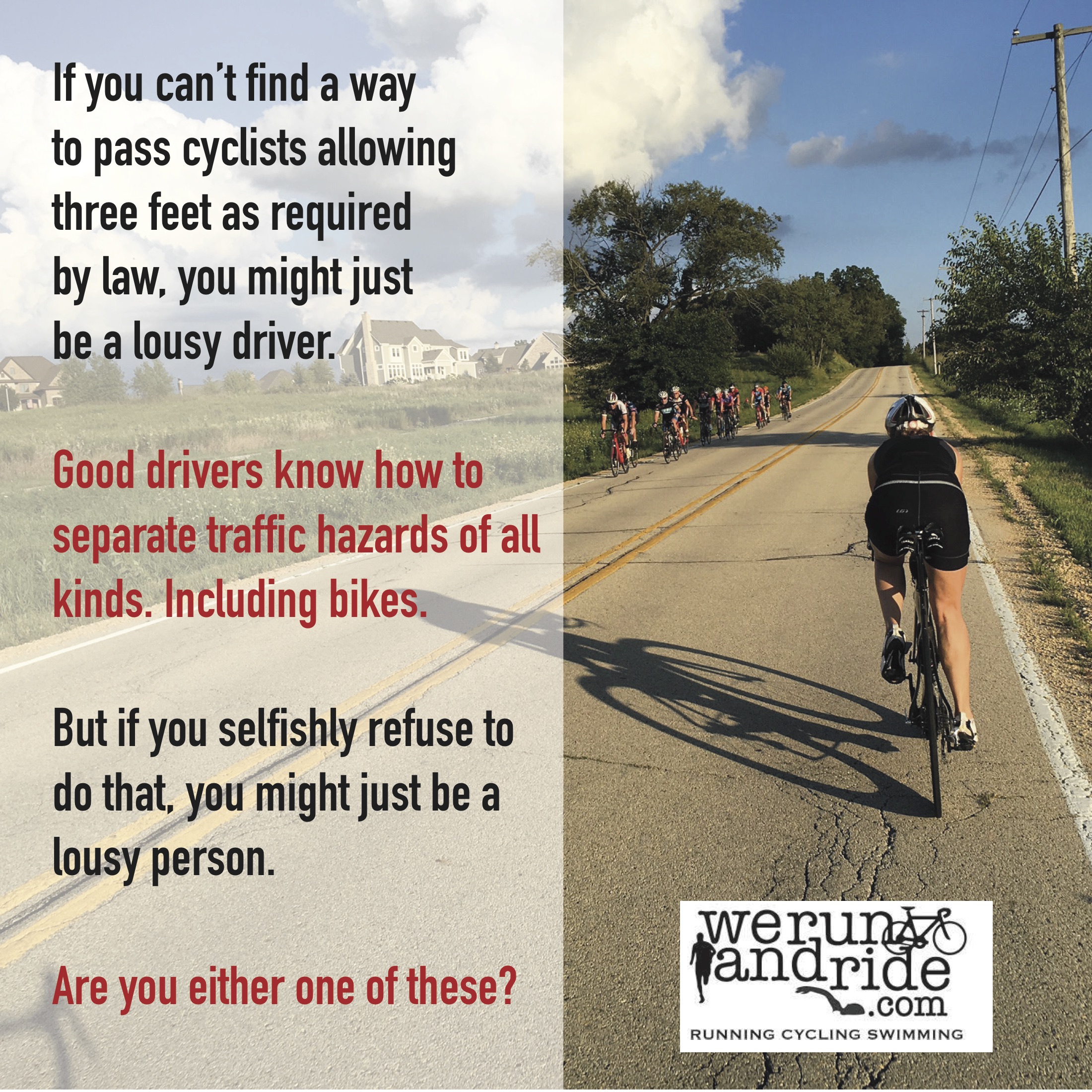
I composed this meme this morning because I spent a couple hours studying the roads while on a 30 miles ride. I was noticing how many types of road shoulders cyclists need to navigate while riding. It also occurred to me as I used a short length of bike path along a busy street that most are typically rutted, bumpy, covered with glass or end abruptly with no warning.
This is one of the basic facts of cycling in America. The style of bicycle we call road bikes are not suited for most bike paths. This is especially true on heavily trafficked rails-to-trails bike paths where runners, pedestrians, dog-walkers, children and many other slower types of “traffic” try to use the same 12-foot-wide swath. It’s not safe for fast-moving bicycles to enter those busy zones. That same is true along the big lakefront paths in Chicago. But now efforts are being made to separate the various kinds of trail travelers into lanes. And in the busy parts of the city, designated bike lanes are playing important roles in overall bike safety.
Photo from an article in TimeOut! Chicago (link above)
The safest place for a road bike is generally on more open roads, where the faster pace of “skinny tire” bikes is complimentary with traffic moving in the same direction.
Traffic laws in the United States grant cyclists of all types the right to travel on most public roads. The exceptions are Interstate highways, and for good reason. The rate and volume of motorized vehicular traffic on those roads is not at all conducive to cyclists moving 15-25 mph. Even cars that are moving slower than 45 mph in the left lane can be ticketed for going too slowly and creating a traffic hazard in many states.
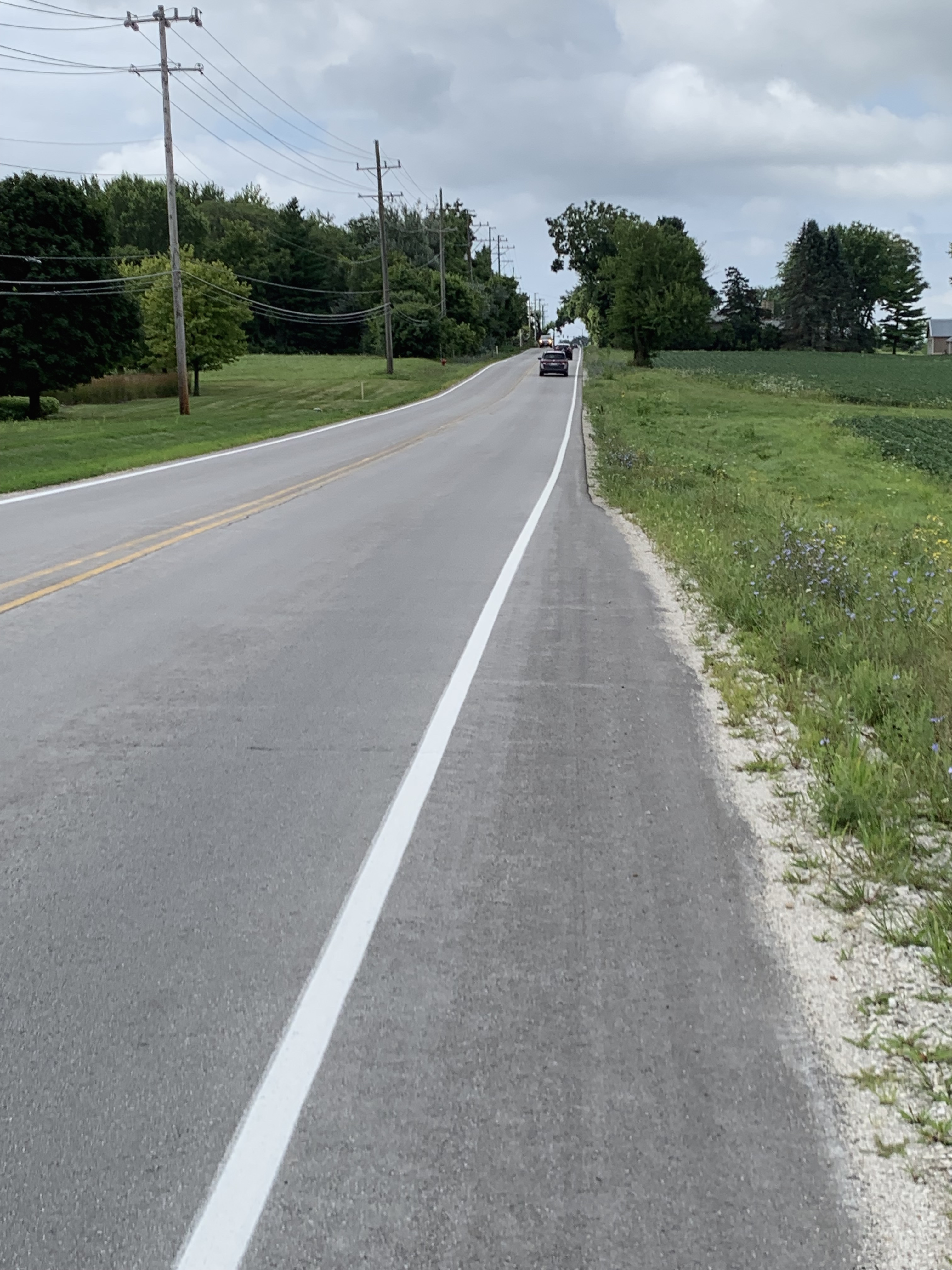
The typical margin on the side of a two lane road is less than a foot of additional asphalt.
On standard two-lane roads, bicyclists typically ride within a foot or two of the white line on the side of the road. In some circumstances where the asphalt ends within a few inches of the white line, there is no room for cyclists to ride outside the white line. That means cyclists are allowed to ride in the regular lane of traffic, and passing cars are required to allow three feet minimum as they seek to pass any bike or riders.
The reason for this law is simple. Most people are not adept at judging the span of their vehicle or its width while driving. By requiring three feet of passage on the right side of a vehicle when steering around a bicyclist, the law allows for a margin of error that still protects a degree of protection for both the cyclist and driver.
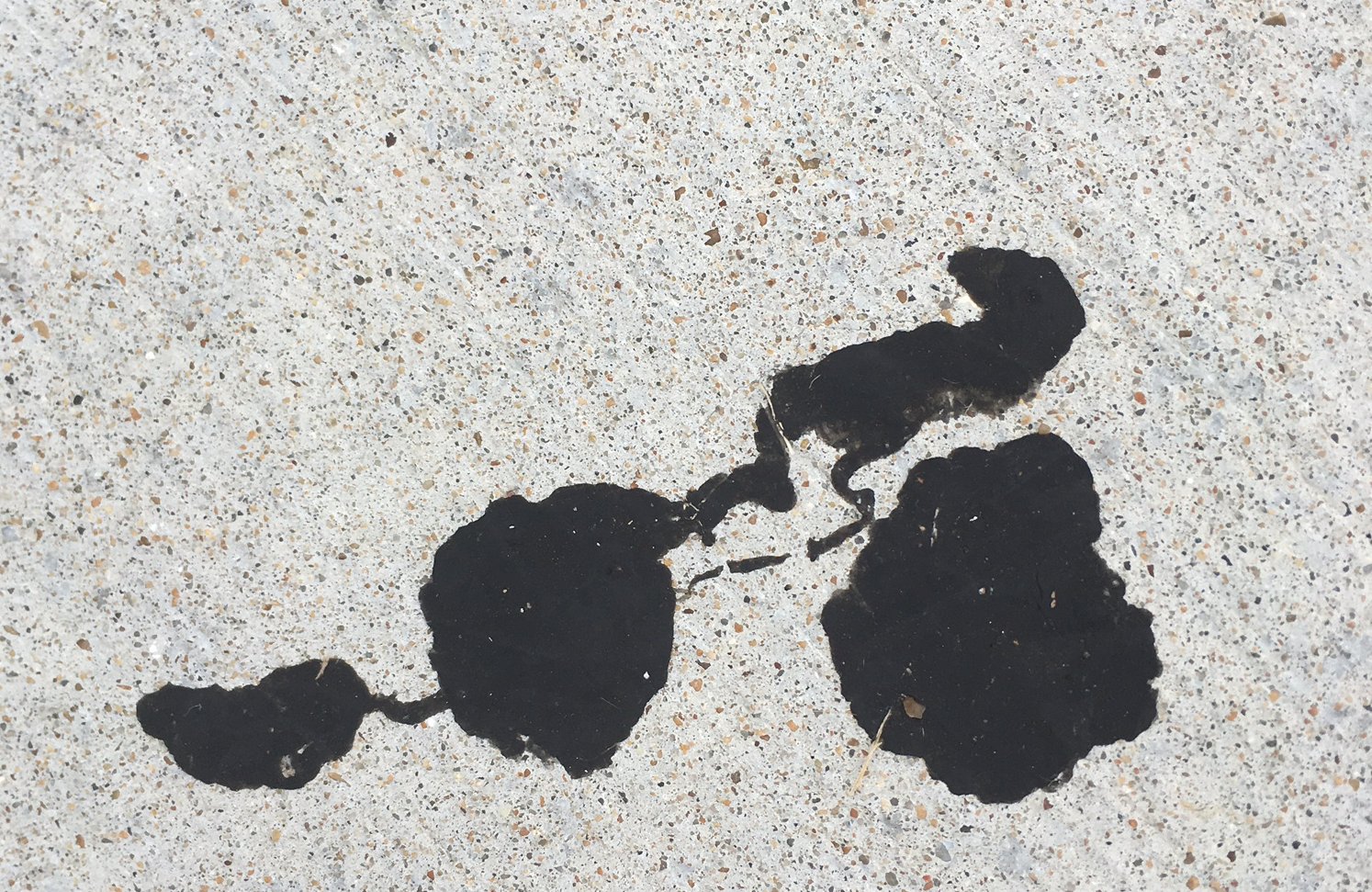
None of is perfect after all. Add in the factor that cyclists are much more at risk from poor road conditions. The Three Feet law allows for the need of cyclists to swerve around ruts, pavement cracks, tarsnakes or road debris. Unless you’ve ridden a bike on a public road, you may not be familiar with how common these conditions occur. Cyclists are always grateful for “good road,” and most of them drive cars and pay taxes like the general population.
Road conditions and shoulder widths can change suddenly, forcing cyclists out into the lane of traffic.
But the infrastructure of America being what it is these days, underfunded and oft-neglected, the condition of roads in this nation is not always good. It is common in an open country ride to find massive variations in road conditions as one travels through several townships during a typical thirty-mile ride. One learns quite a bit about how tax dollars are applied when rubber literally meets the road. And when it meets the fateful “chip and seal” solution to road repair, cyclists curse and mumble as they rumble down the road with teeth chattering inside their heads. It may be cheaper to use, but chip and seal is a disaster to ride upon.
Traversing a chip and seal roadway is risky when loose gravel suddenly shows up under the wheels.
One also learns quite a bit about public attitude and awareness of cyclist during every ride in every circumstance. Be it urban streets or lonely country roads, cyclists must be aware of automobiles and protect themselves by obeying traffic laws in every way possible. Some riders are better at this than others. But all riders are protected by the Three Feet law where it is required by state jurisdiction.
And where it is not a law, it is still a courteous gesture to give cyclists plenty of room while passing. The same holds true for motorcycles, farm machinery, Amish buggies or plain old Aunt Matilda guiding her supercruiser 1966 Buick on the way to the local supermarket. Public roads are thoroughfares that bear all types of traffic. Some of it is predictable. But much of it is not.
Bike traffic is often considered dangerous even on designated trails. But those Heavy Pedestrians…
Which is why the basic lessons of Driver’s Education need to come into play during every trip by automobile. We all have limited attention spans, but you’ve made it this far in this blog about bike and driver safety, so here’s a link to a set of flash cards that cover terms related to “separating hazards while driving.”
The point here is that separating hazards is a good basic practice in which to engage while driving. But forty years of running on the side of public roads, and close to 20 years of active cycling on those same roads has taught me that a fair number of people don’t know much about either the importance or methods of separating hazards. They either speed up in an attempt to beat the approaching traffic or simply squeeze next to any cyclist on the road and give a roar of the engine to get away from the situation as quickly as possible. Neither of these is a good idea.
But people do these things because they are either incapable of judging traffic situations or too impatient and selfish to care. The former is excusable at some level. But people need to wise up. Cycling deaths are on the rise, and habits like texting while driving are only making things more deadly.
Roads with this much shoulder for cyclists to use are rare indeed.
But the latter habit of aggressively refusing to make room for cyclists is truly deplorable behavior by any driver. People that are so selfish they are eager to threaten cyclists by buzzing close to them on the roads are the true losers in society. Their road rage and dismissive attitude toward people riding bikes is inexcusable. The patterns of behavior are so familiar to cyclists it is often taken for granted there will be a close call or scary incident every ride. First comes the gun of the engine, then the rush of air closes in as a truck or car surges past. Then comes another roar of the engine and a blast of engine smoke as they tear off.
But sometimes, we catch up to these aggressive types at the stoplight. Then one of two things typically happens. If they see you riding up from behind, they’ll either refuse to make eye contact or else bark something out the window. “Get on the bike path!” is a familiar refrain. When there are no bike paths around for miles, this makes absolutely no sense. But then again, neither does the way they were driving.
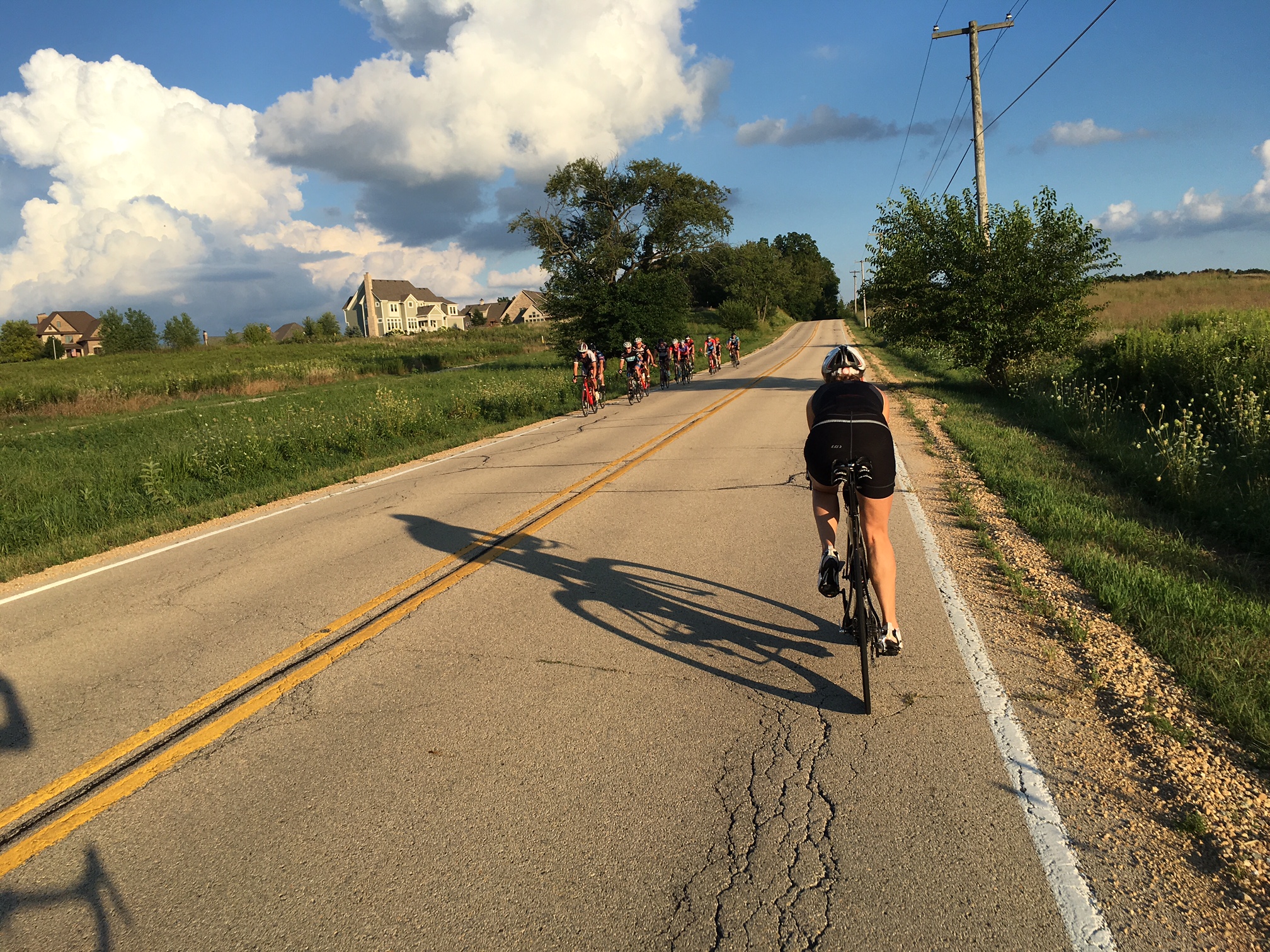
How would most drivers react in this situation when there are cyclists moving in both directions?
It’s not always pickup trucks. There are sedans and minivans that shove riders off the road. But even when traveling in groups, it is rarely a motorcyclist who intimidates or threatens a group of cyclists. That’s because motorized bikers have enough trouble being seen on the highway. They understand what it’s like to be put into situations that threaten their lives. Their love for the open road and lifestyle may be entirely different than bicyclists, but the one thing these seemingly disparate groups of people have in common is an appreciation for respect shown and given between the two white lines.
We’re all souls traveling the roads of time together. Why can’t we get along?
I’ve written about the fleet of massive trucks that daily floods out of a gravel mine in tiny Kaneville, Illinois. Those drivers encounter loads of cyclists on Main Street, the country road that leads east toward Chicago. That’s where the trucks are headed, and they’re on a schedule for sure. But every truck that I’ve ever encountered coming or going out of that gravel mine has been courteous and safe, often waiting patiently to steer around a single rider or an entire group of cyclists, and there are many out that way.
And I say that if a 20-ton truck can manage to give a minimum three feet of leeway, and often more, then it is also possible for everyday drivers to spend a few moments looking for the safest avenue around a cyclist or a group of riders.
If people are impatient or grow angry because they have to wait a few moments to steer their vehicle around cyclists in order to pass, then those are selfish instincts that need to be addressed at both a personal and societal level. Because while separating hazards on the road while driving is not a cure-all for what ails America roads, it is a starting point for showing greater respect between differing factions of culture. Rather than driving Americans farther apart, that space between the two white lines actually represents an opportunity to find and share common ground. It could be the start of true American civility.
That’s the kind of populism that actually makes America great.
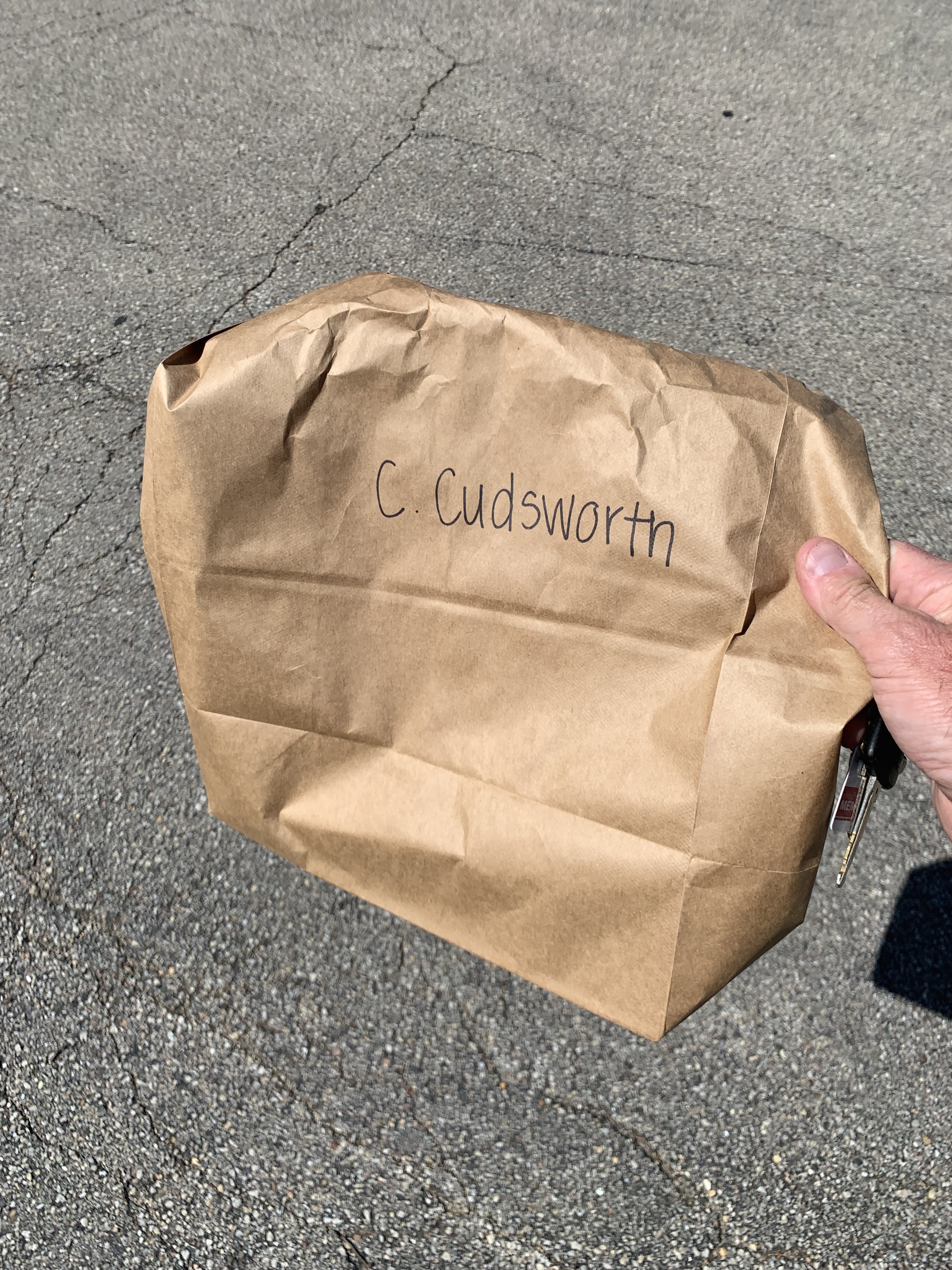
Last week’s project was filling this brown paper bag with shiit
Coming off a week of taking powerful antibiotics to combat sub-lingual infection from a compromised tooth, I knew there was a risk that the balance of my good gut bacteria might be equally compromised. And sure enough, about six days after I completed the prescription regimen, a familiar rumbling started up in my gut.
Three years back I had to take power antibiotics to knock out a case of cellulitis in my had that stemmed from a friendly cat nip that turned into a not-so-friendly red rash under the skin of my had. And six years ago I had a sliver in my finger that started in infection that could have cost me my middle digit on the left had. And that would not do. I need that finger to flip off asshole drivers during my cycling adventures. So I had to self-infuse liquid antibiotics for three weeks to fight that infection.
So I don’t mess around anymore when it comes to dealing with infections.
That is why I went to the doctor pronto to conduct a test for CDiff, Clostridioides difficile (Formally known as Clostridium difficile)
CDiff is a disease of the gut that can kill you if you’re not careful. This is how the website linked above describes how it all comes about: How do Antibiotics cause C diff.? The antibiotics cause a disruption in the normal intestinal flora which leads to an over growth of C difficile bacteria in the colon. The leading antibiotics known to disrupt the normal intestinal flora, yet not limited to, are Ampicillin, Amoxicillin, Cephalosporins, Clindamycin, and the broad spectrum antibiotics.
So I stopped at the doc’s office and they gave me a big brown plastic bag with my name on it. That was my test kit for CDiff. Granted, my name was spelled with an ‘s’ in the middle of it. But given that my college cross country coach called me Cudsworth all four years, I wasn’t that insulted.
Yet I stood there and wondered. “How the hell am I gonna fill this whole bag with shit?” And that illustrates the problem with literalism in this world. And we’ll digress along those lines. Because when you’re fighting CDiff, the volume of crap coming out of you is quite prodigious. So in the fashion of a good literalist (and this is how biblical literalism “works” as well) I texted my wife and said, “Look at what I have to fill!”
She texted me back a Poop Emoji. And I told her, “I might need your help to fill this too. Maybe we can toss in some shit from our new dog Lucy. Or perhaps Chuck the dog and Bennie the Cat can help too. We can even collect some goose crap from out by the bird feeders to top it all off.” And that’s how the tradition of literalism actually works. One piles shit on top of shit until no one can tell the difference between reality and bullshit. Then you wrap it all in a brown paper bag and label it ‘ABSOLUTE TRUTH’ and dare anyone to question you because no one really wants to look inside.
Present for Donald
The same methods of bullshit work for constitutional originalism and political bullshit as well. So we filled up the whole bag with shit and mailed it off to the White House because I’m sure they need another cabinet member in the Trump administration because so many have resigned or been indicted. And sure enough, Donald Trump took one sniff and named that bag of shit the Ambassador to Shithole Countries Around the World. Because you know, it takes a real shithead to know one.
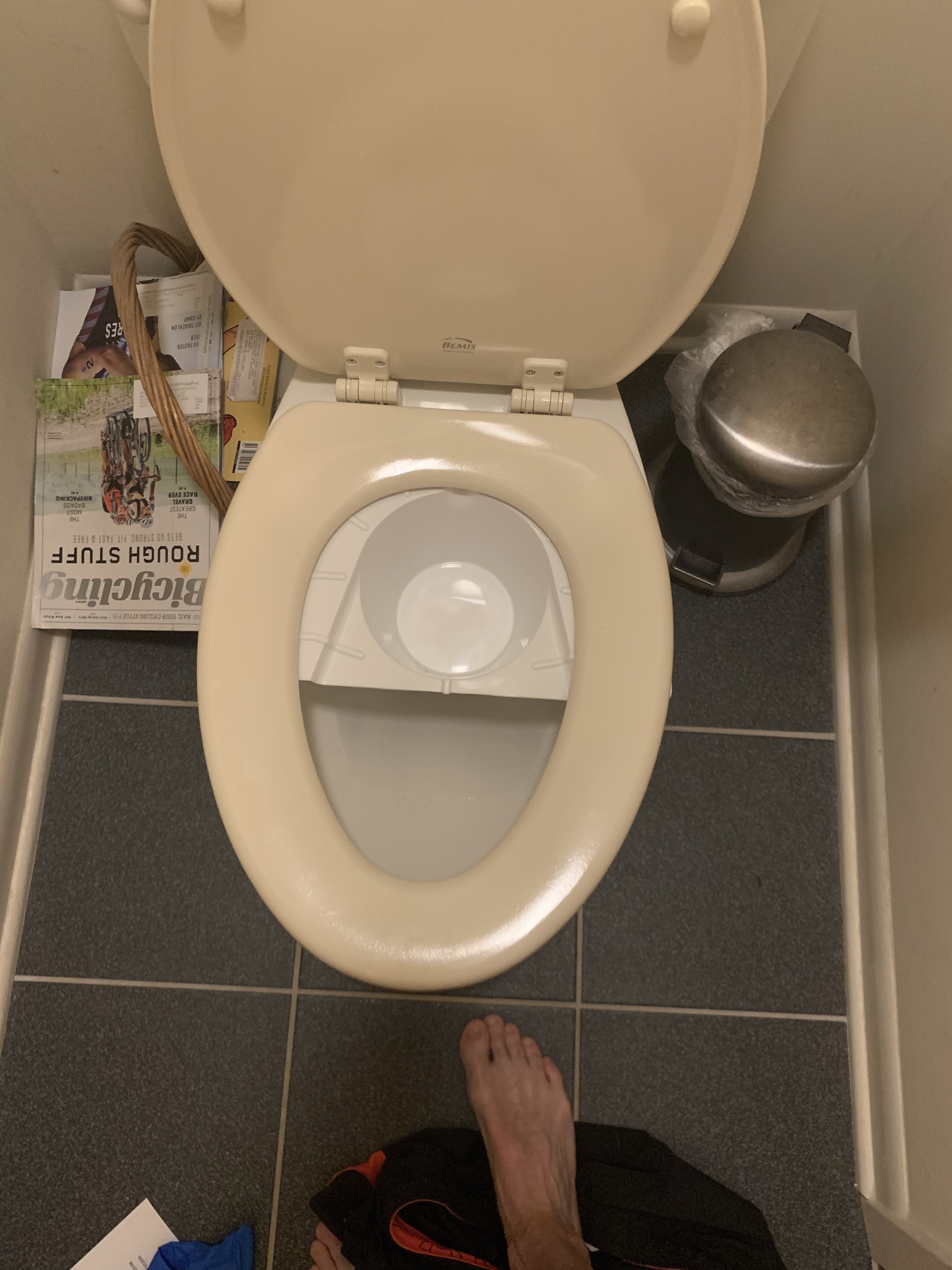
Actually, I didn’t do any of that. Because once I opened the brown paper bag given to me by the doctor’s office I found the plastic poop portal that you stick under the toilet bowl seat. Then you have to crap in the plastic bowl and transfer a portion to the plastic cup with an orange cap on it.
The value of liquidity
There was an instruction sheet in the bag that said, “Samples must be watery stool or they will be rejected.” So I sat down to do the business and out came a solid turd. I used the tongue depressor they provided (eww, I will not use that on my tongue again for sure) to transfer a bit of good old solid shit from the plastic bowl to the plastic cup and said out loud: “Shit. This will be rejected.”
It’s not that I wanted the stool sample to indicate that I had CDiff. It was the embarrassment of bothering the doctor over what turned out to be a false alarm that bugged me. I have a conscience, you see. But the doctor said no worries. “It looks like you had a solid stool. So, no CDiff.”
Okay, that’s good news I told myself. But earlier in the week my gut had really hurt and my stools were loose. So I was taking no chances. Perhaps the probiotics I’d been taking had made up the difference. I was back on the route to good health.
Illustration by Christopher Cudworth
But I take pleasure in knowing that the rhetorical bag of shit I sent to the Trump administration was a solid commentary on the state of the nation. That POS racist/fascist/narcissist jerk is making the whole world miserable with his shitty take on reality. He’s the equivalent of CDiff in the American gut, a disease that may require a massive cleansing to rid the world of his infectious bullshit. We’ve got to hope for a cure, because this shit can’t go on forever.
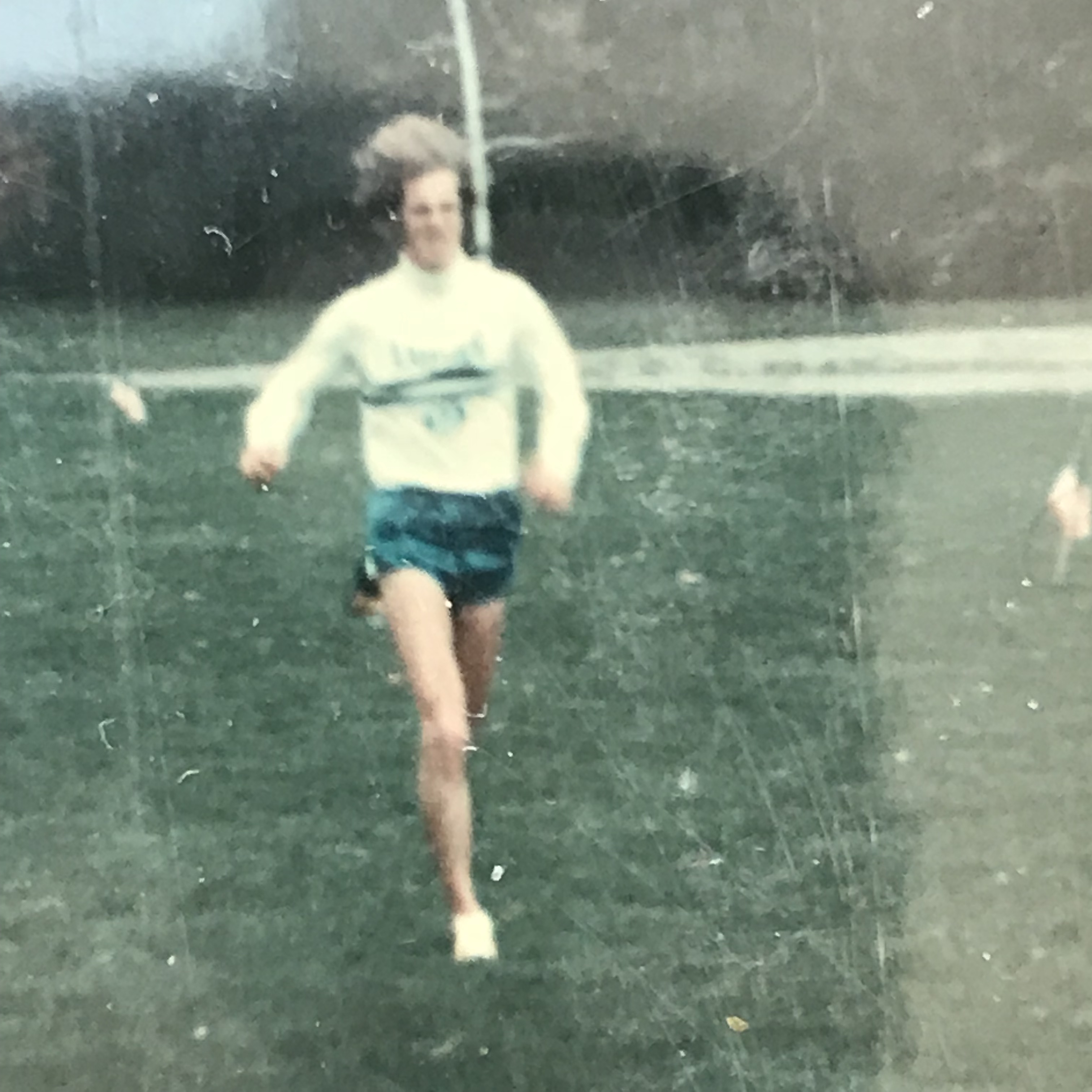
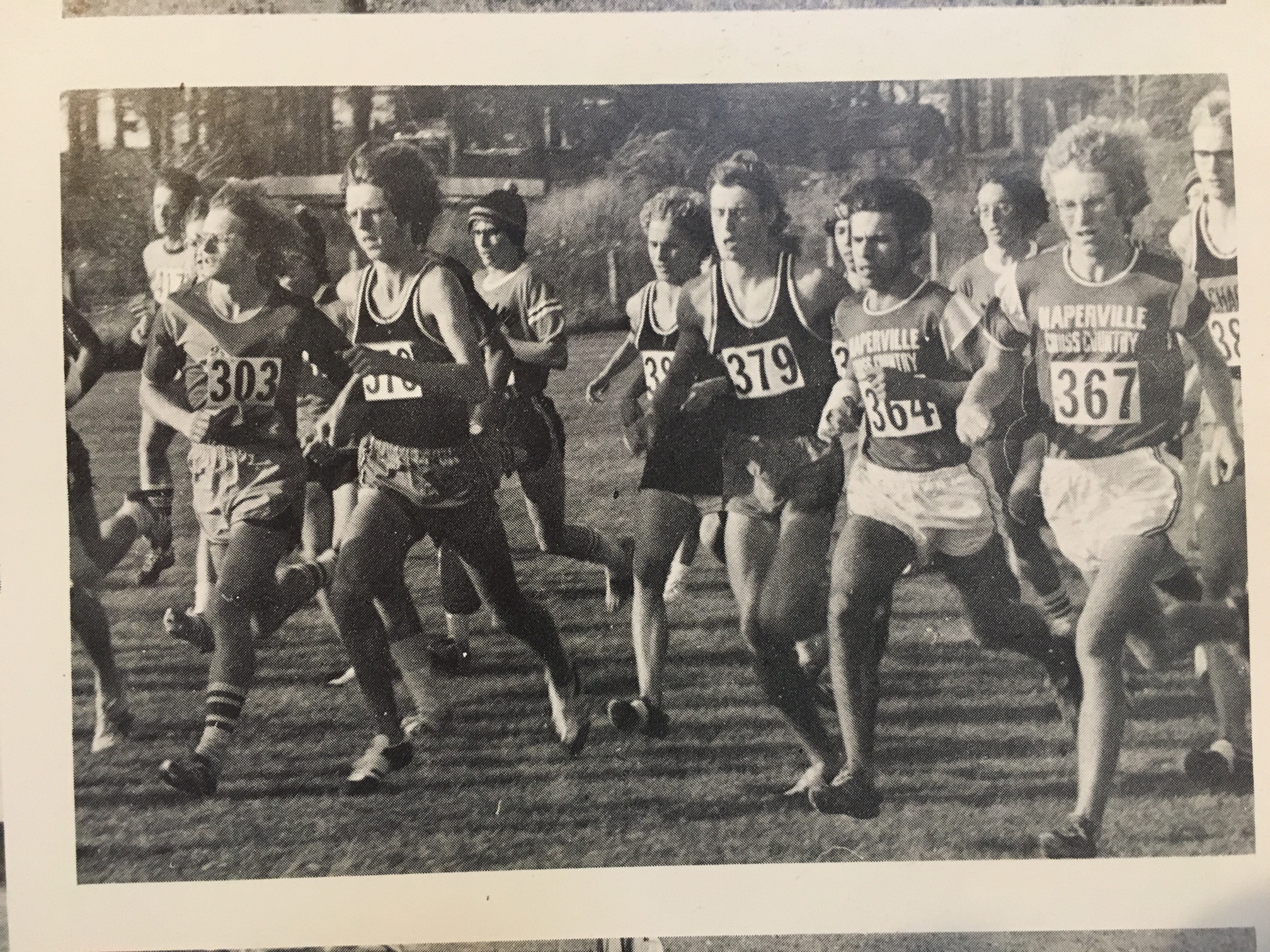
The photo above is as old as it looks. It is a snapshot taken by my father with one of his jury-rigged cameras in the late 1970s. My folks had come up to Kenosha, Wisconsin from our home back in Illinois to watch our Luther College team compete in the Carthage Invitational at Petrifying Springs Park.
They also came to meet my girlfriend, the woman walking toward me in the photo. I’d fallen quite in love with her. She’d also come up from Illinois after having visited her folks for a few days back home.
The other guys in the photo are people with whom I’ve kept in touch all these years. The runner at left was my roommate that year, a talented runner named Dani Fjelstad. The gent in sweats to my left is Bradley Stene, a former Luther runner who came up from Illinois to watch us as well.
Watersheds
Up to that point in the cross country season, things had gone along even better for me personally than the script I’d laid out in my head. I was consistently racing as second man on our team while my roommate Dani was our #1 guy, ranking highly on the national charts in having won several key invitationals.
But Dani had suffered a calf pull that slowed him the previous week. In fact the entire team had run into Achilles tendon problems after a speed workout we’d done on the roads. Most of us recovered within a week or so, but not everyone was up to par. Thus I ran as our first man in the Tuesday dual meet against University of Wisconsin-LaCrosse the same week as Carthage. I’d barely missing out winning the race when a LaCrosse runner named Steve Oestwinkle outkicked me in the last 400 meters.
A Polaroid photo from a previous year at the Carthage Invitational, circa 1976.
We’d already faced down a number of challenges that season. One of our top senior runners, Keith Ellingson, was forced out of action by back problems. Another of our best guys Paul Mullen had been hampered all season with a sore big toe. But thanks to some talented freshman and runners stepping up each week, we still saw an opportunity to take a win at the Carthage Invite.
Dashed hopes
From the opening gun I knew that I wasn’t feeling my best that day. Up to that point I’d been beyond solid in every race, but within a mile my body wasn’t responding with the same verve. Perhaps it was the mileage buildup we’d been doing with 100-mile weeks. Or perhaps it was racing every week. In any case I faded from second man to sixth that day. Along the way, my teammates offered encouragement and I kept on running, but it was a struggle.
Per usual, one of our teammates Steve Corson stepped up as top man that day and barely missed placing in the Top 10. That would have earned him a coveted Carthage Invite watch against competition that featured featured Northwestern University and other big time teams.
Photo finish
That’s why there is a strain of disappointment in that old black and white photo. After what had been a dreamlike season, it was a disappointing day for us. Of course, most of the crowd in attendance and even my parents didn’t really realize that we had not run our best. The excitement of cross country on a bright fall day is a blessing to the fans. The sweaty young men who walked out of the chute still looked glorious and brave in the autumn sunshine. Quite often the expectations of the athletes are far different from the impressions of the fans.
Nor did I ever marry that girl. It was simply a great college relationship that lasted another year or so. So when I look at that photo, I see a slice of time that was a blessing even though the results that day and the feelings in that moment were not perfect. If that’s not life in a nutshell, I don’t know what is. Sometimes we all need a snapshot to remind us how important all these moments really are.
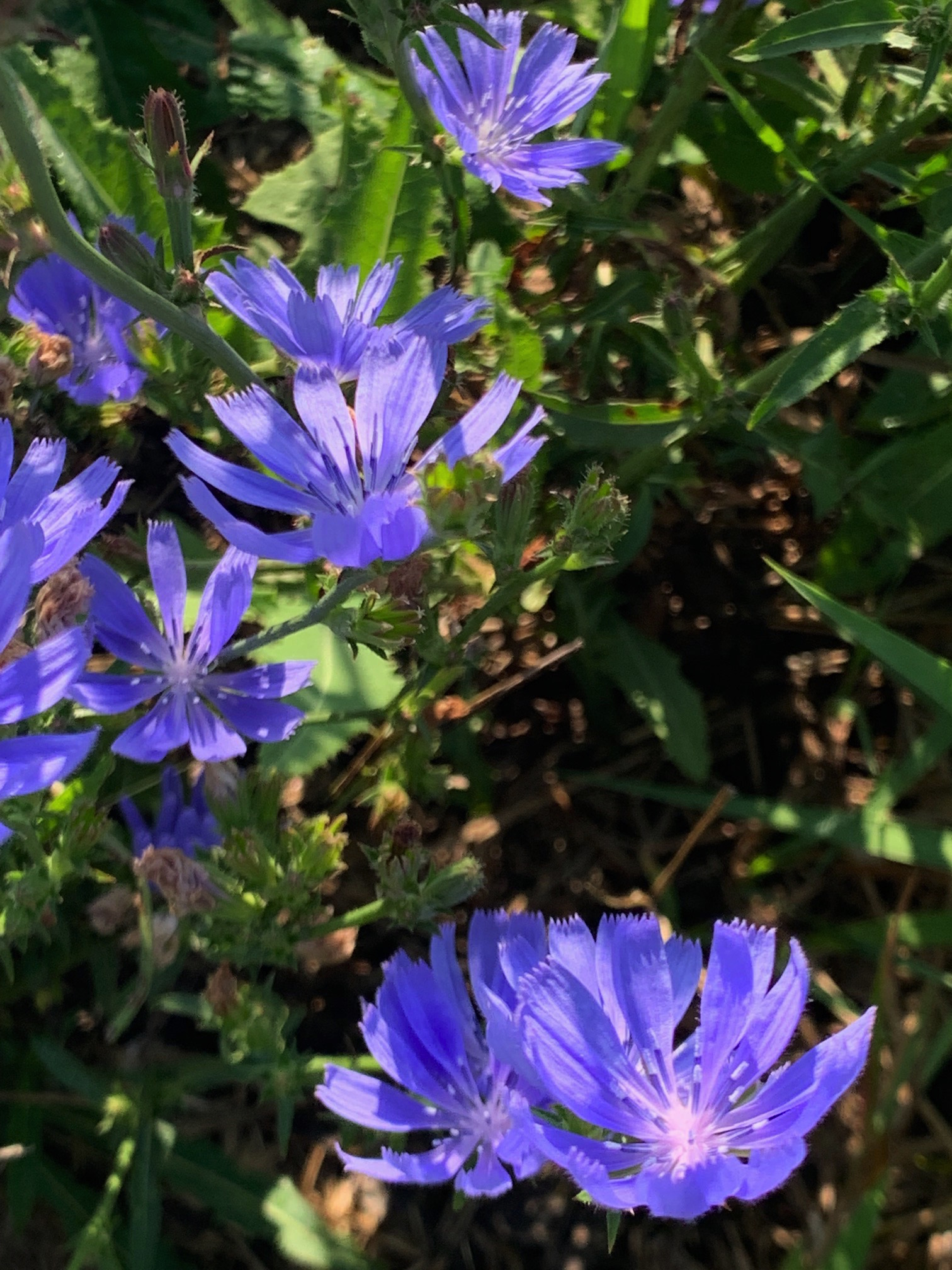
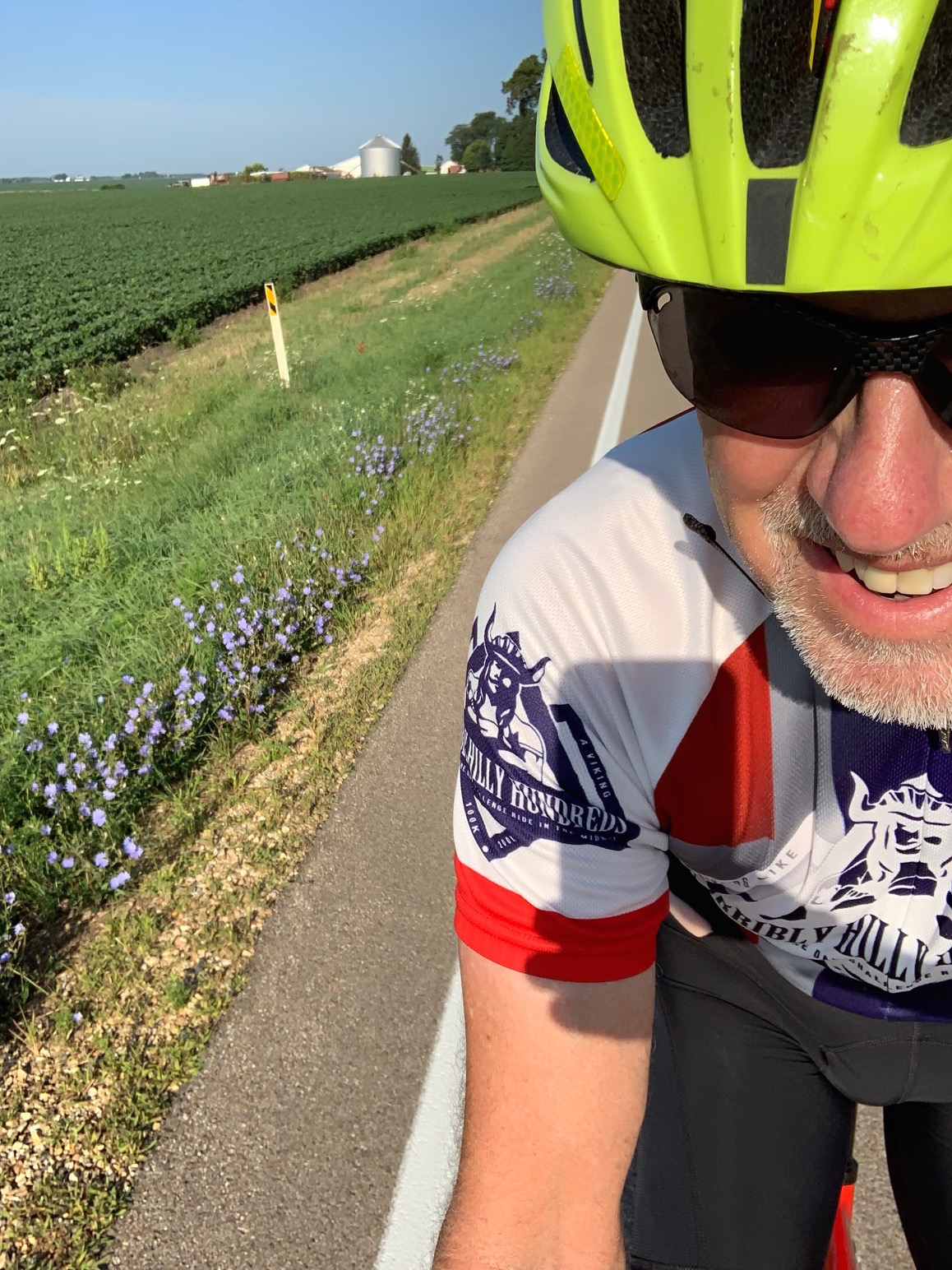
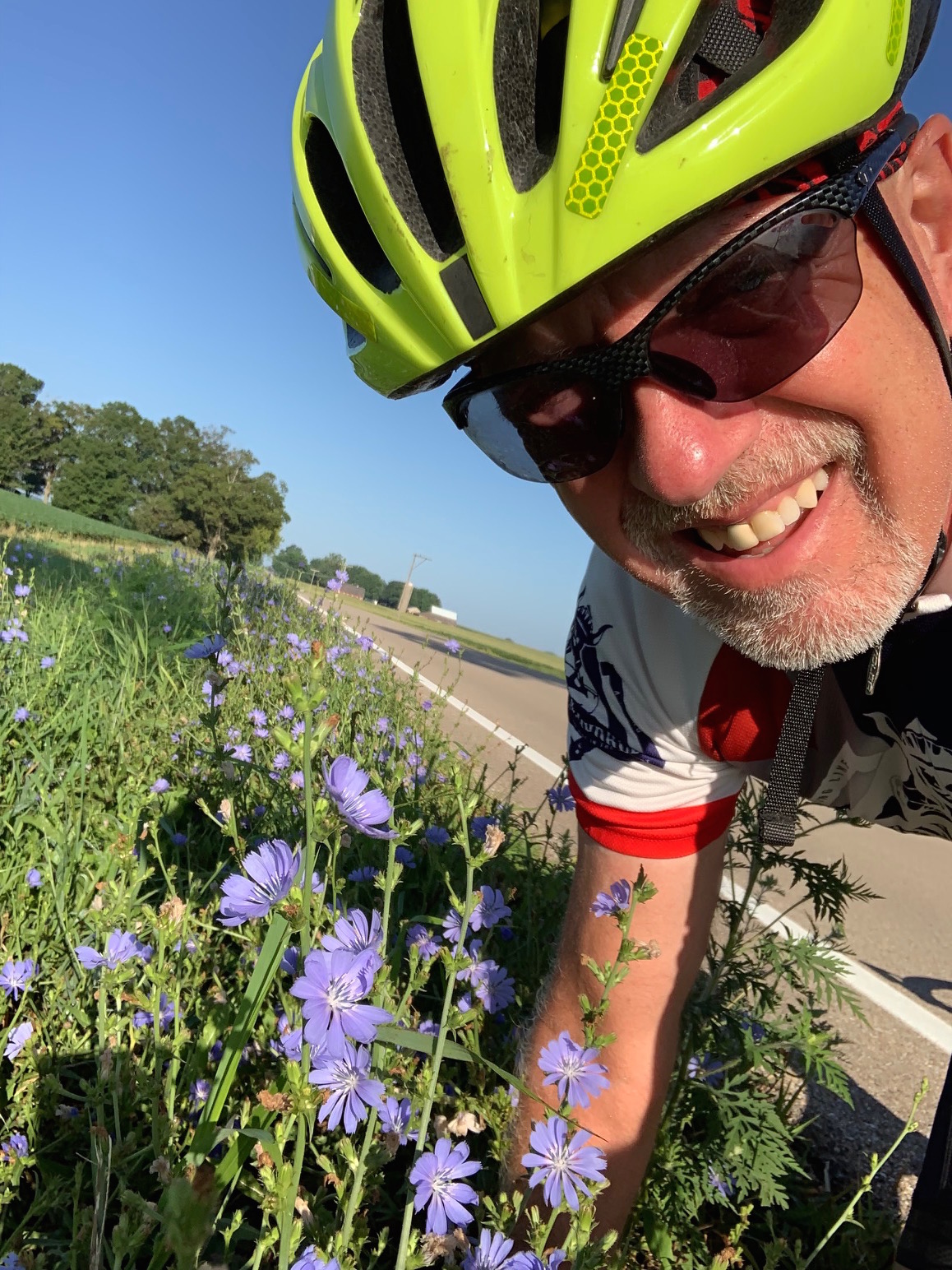
America’s roadsides in July and August typically bear a ribbon of bright blue flowers known as chicory. They are tough plants that grow in disturbed soil, often popping up through gravel and grit to unleash their starlike blue blossoms in the summer sun.
As tough as they are alive, they fade quickly when plucked. The bright blue flowers turn sour and dark. Even a stem in a glass of water is sometimes not enough to spare the blossoms. So I stop to savor them in their place at least once each summer.
I cherish their ephemeral glory. Long rows of chicory stand like fans alongside the road during summer cycling trips. They pop up like crowds cheering cyclists in the Tour de France. All that is missing as I ride past is the noise.
Yet I don’t really miss that either. The whirr of bike tires on the summer tarmac is enough reward for me. My days of leading races may be gone, but the bright blue flicker of chicory in the periphery marks my pace no matter how fast I’m going. That’s a winning effort no matter how you look at it.
Winning the Plainfield invitational in fall of 1974
From the moment I first walked in the door of a cross country locker room and joined the company of largely skinny misfits that would become my teammates, I was hooked. My coach that first year was an organized fellow with a crystal clear voice and a will to help us get better at this thing we called running.
During that first season––as it was to follow the next eight years of my life–– early season training was done in mid-August. We’d show up at school a week or two early to run laps around the campus in the early morning sun. We’d all be sweating like crazy, exhausted in some moments and exhilarated in others. Trying to improve our times. All with the clack and slap and crunch of football practice taking place within earshot. We never envied those guys.
During those early years we’d train on the high school campus or travel to a forest preserve to run mile repeats in the early morning air while the sun rose and burned off the dew. Then the grasshoppers would start to hiss. Cicadas would call from the trees. Occasionally we’d run long enough in the evening to hear the katydids ticking like syncopated stopwatches in the tree canopy over suburban streets.
Without August miles, cool fall days would be disappointing.
Those precious weeks of August were supposed to push us over the edge from lazy and slow summer days to the cool and urgent rush of fall afternoons. But some of us relented, not wanting summer to end. I well recall the day my best friend and I ran eight miles out to visit the house of his cousin in the country. I’d dated her a couple times at my former high school and loved her thick mane of long blonde hair and athletic build. That day we arrived to find that she had female company as well, a friend whose figure that summer had come into full bloom. We were set for the afternoon.
We drank lemonade and watched each other perspire while playing innocent card games under the August sun. When the sun got too hot, we’d slide into the pool and come back out with our suits clinging to tan young bodies. We were eighteen years old, full of life and naive to the future other than the playing cards we held.
That afternoon’s training session was the mellowest workout either of us had ever experienced. We were so relaxed from our day by the pool with the girls that the 800 repeats we ran fell off us like summer sweat. I recall walking into the locker room to look over at his blue eyes gleaming with joy. “That was great!” he told me. I didn’t know whether he meant the day at the pool or the workout we’d just done. It didn’t matter. It all fit together perfectly.
High school teammates and I taking off in an October district meet.
Our college cross country team would trek to points west for August training. ONe year we camped at Yellowstone, then drove down to Jackson Hole and the Grand Tetons. We ran eighteen miles round-trip from Jenny Lake up to Lake Solitude and back. The entire run was horse trails and rocks and we didn’t carry a drop of water with us. We did know better than to drink from the streams. That run was a j test of both legs and spirit. We all made it back alive, but barely. One of the freshman got pinned on the trail behind a massive bull moose. We were young and stupid, to say the least.
By late August the nighthawks would come charging through the Midwestern skies in massive flocks, winging their way south to another continent while covering far more miles than we mere humans could ever hope to achieve. Then would come the first cool nights of September. Our August running was behind us now. Time to turn those miles into performances. You can’t have one without the other. August will always mean cross country to me.
One of our hosts slaloming along on one ski under a beautiful summer sky.
We were invited to spend a day on the river with friends yesterday. They are wonderful people who own a boat and love to tool up and down their favorite body of water in the summertime.
The proposed activities including water skiing, a sport that I’ve done a few times over the years. But probably not in the last 15 years now that I think about it. That meant I had not been on water skis since tearing my ACL not once, but twice. And with no ACL to stabilize my left knee, I have not played soccer or basketball or done any real ballistic sports for quite a long time. It’s not worth the risk.
But I did do something stupid a few years back and hurdled a traffic cone during a race on a snowy January day in southern Wisconsin. The knee hurt for months from the hyperextension and required a meniscus repair another year after that. Since then all I’ve done is go swimming, cycling or running. All pretty much straight-line activities.
So the opportunity to water ski actually made me anxious. I told my wife that I probably would not try it. But we drove out to the river and climbed in the boat and my eagerness to respond to the hospitality of our guests overcame my reticence and I plunged into the water and pulled on the skis.
I know how to get up in the water, but when you haven’t done it lately it usually takes a practice pull or two to rise up on the skis. So I sat back and steeled my arms for the pull and tried to keep the two skis aligned in the water. Then the boat pulled away as I rose about two feet and plopped forward like a stalled Asian carp into the river.
A better, much safer idea: tubing.
Instantly I knew that what I’d just done was a bad idea. The tendon running down the inside of my hamstring to the knee was tweaked. It already hurt. Yet I swam around to get the rope and get into position again, then thought better of it. I waved them off and said, “Nope, not gonna go!”
Which was a wise and mature decision. Today my leg’s a bit sore but nothing major is wrong with it. That tendon has given me problems from speed work and other activities. I should have known it would not hold up to the torque of water skiiing.
Actually I did know that something would be a problem. Trying to be a good sport about something as radically different as water skiing when you haven’t done it in ages is a really good way to get good and hurt. I’m fortunate, because a friend of mine actually did tear his hamstring while waterskiing. It furled up like a slap of curly bacon inside his leg and left a black and blue wake on the back of his leg.
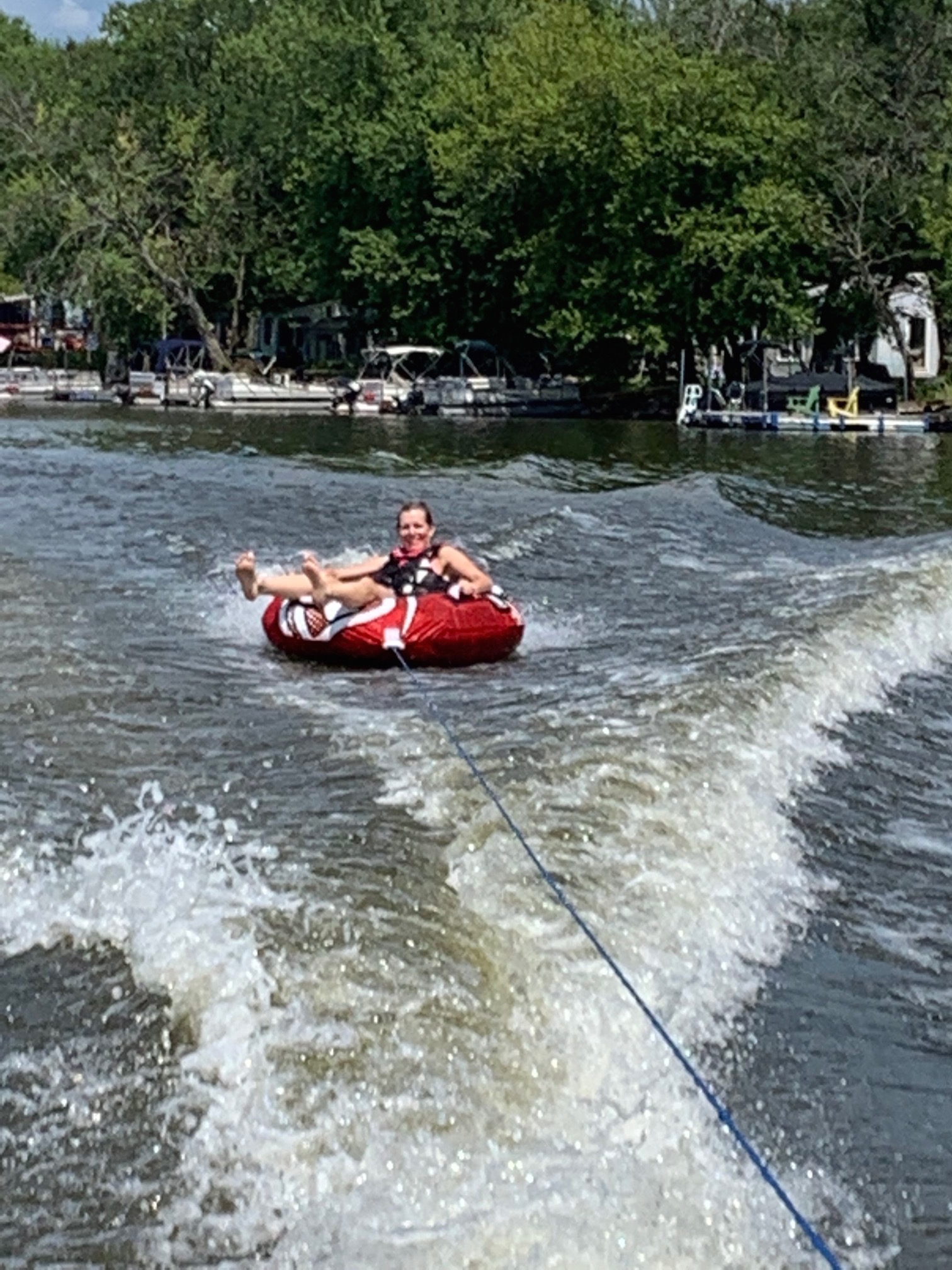
So I clambered back in the boat and agreed only to sit on an inner tube and be pulled around the water like a chunk of pale ham on top of a bagel. It was fun. Nothing else got hurt. The clouds were pretty in the blue sky and my wife had a laugh watching me hang on for dear life.
What I learned from the experience is that I’m still a good sport, just a little older and ultimately a little smarter than I used to be. And I’ve lived to tell the story without another six weeks off for injury. I hope.
We got up to swim this morning. It was the first time in two weeks I’ve been to the pool. Now that the tooth and face infection is over, I can get back in the pool to prepare for a couple September triathlons.
I’m much more enthusiastic about the pool than I once was. You might not know it by looking at the photo below, but I was actually looking forward to sliding into the pool for a workout. I was concentrating on de-fogging my swim goggles. But perhaps really is my resting pool face. I’ve got to learn to smile and pretend I have 30,000 Instagram followers who adore my body and seemingly permanent grin.
My resting pool face.
The funny thing about a really great pool face is that even if you’re smiling the entire time you’re in the pool, no one will ever really know it if you’re swimming the right way. The amount of time your face is actually out of the water is pretty limited if you’re breathing right.
About that breathing thing. We all know it’s important to breath while swimming. Otherwise you wind up flailing on the surface like one of those doomed sunfish critically gutted by some young fisherman who yanked out their guts to remove a swallowed hook.
Of course, just as I’m getting going with the swim workouts again, the pool is scheduled to close a week or two for cleaning. I’ll miss the opportunity to swim but do have alternatives. They just involve getting up earlier in the morning. In which case my resting pool face will probably look pretty much the same as it does in the photo above. A little sleepy and slack. Perhaps not entirely enthusiastic. But turning my mind on to the challenge ahead.
Sometimes that’s all it takes to improve. Showing up is 90% of achievement. Or so I tell myself every time I toe the line at the pool.
Outside of the gates the trucks were unloadin’ The weather was hot, a-nearly ninety degrees The man standin’ next to me, his head was exploding Well, I was prayin’ the pieces wouldn’t fall on me
––Bob Dylan, Day of the Locusts
The after effects of the tooth infection that nearly made my head explode are slowly going away. The memory of the pain and swelling sits like a band of angry storm clouds on the horizon after a wild summer storm.
Pain is the humbling influence in all living things. While out running, I once happened on a large raccoon that had been struck by a car and crawled into the bushes to die. I wanted to put the animal out of its misery but had no means to do so. And to realize that the scene was likely playing out on a thousand streets across America with a thousand raccoons bleeding and dying gave me a guilty conscience the rest of the run.
So much pain
Realizations like these can lead to some emphatically existential questions, such as: “Why so much pain in this world?” The Judeo-Christian answer to that question is that pain is the curse and the cost of sin. That’s what religious tradition tells us anyway.
I don’t entirely trust religious tradition to all its supposed truths. In fact I’m nearly finished writing a book titled Rescuing Christianity… from Drowning in Tradition. I’ve changed the title just this week as the edits are being completed. I wrote a friend who I greatly trust to excoriate literary frailty and he let me know the previous title was a washed out and cloying attempt at appealing to readers.
“Don’t bury the fucking lead,” he’s been known to say. And I have that habit. We’re all called to be more forthright in this world. It is ours to say what we mean with clarity and conciseness. But most of all, be honest. That is authenticity.
That brings us back to the many reasons why there is so much pain in this world. It is not, as tradition tells us, the result of a single curse caused long ago by two mythical people and a talking Serpent. We know this for certain because pain is divided into several specific categories. There is physical pain, which is manifested in the body. There is emotional pain, which is manifested in the mind. There is ancillary pain, which we feel in empathy of others. And there is existential pain, which we feel about the world.
To claim that all conveniently fits under the Fall of Man seems rather cynical. And besides, that terminology leaves out women, who by nature of their gender experience types of pain that men never do. So religious tradition leaves out quite a bit in its patriarchal notion that only men own and understand the concept of pain.
There is another whole dimension to all this. Certainly one type of pain has been known to overwhelm the other. When we’re in steep physical pain, as I recently experienced, from something like the inflammation of an infected tooth that leaked into the sublingual space and threatens our very lives, emotional pain is certainly there, but gets pushed to the side. And when a dental surgeon stands in front of you and says, “We need to fix this, or you could die,” that is the moment when you realize there is such as thing as spiritual pain.As in, what if I cease to exist?
Living with pain
Some believe that we carry our souls around with us as we got through this life, and this world. Perhaps that is why we choose to pursue soul-searching activities that test us through all types of pain. Pushing pain to the side is an art we human beings need to learn through repetition. Those of us who swim, run and ride for “fun” learn that pain is a regular companion. Some great distance runner once said, and I paraphrase “If you try to run through the pain, you will never succeed. But if you learn to run with the pain, you can achieve great things.”
That’s right. Pain is a companion that we actually need to learn to welcome in our lives. Far from being the curse wrought by Adam and Eve, pain is the greatest instructor in our universe. You’ll find that when you read past the renditions of scripture wrought by biblical literalists, an entire other world of thought and insight awaits you. And when it comes to pain, we find that God uses it as a teaching tool. He even allows Satan to vex Job with painful sores to test the man’s faith, which I think rather cruel, but in my opinion, God is not so perfect. The Lord even challenges a father to sacrifice a son under the knife as a test of commitment. And he finally sacrifices his own Son through a passage of bloody torture and crucifixion. From those lessons we might draw the conclusion that God is a concept by which we measure our pain. And I didn’t think that up. John Lennon wrote that.
Pain is not easy to accommodate when it enters our life with such force that it renders us helpless but for the next set of pain pills or a visit to the dentist. But if we’re smart, we’ll learn a few things from the experience. We all live with pain of one kind or another in our lives. I invite you to think back on painful moments in your life, even a race that really hurt, and think about how much it taught you about your personal character and what you actually believe in. Pain is both the great instructor and the great revealer. Think hard and long on what it tells you about yourself. That is where the meaning of life is revealed.

















 We Run and Ride