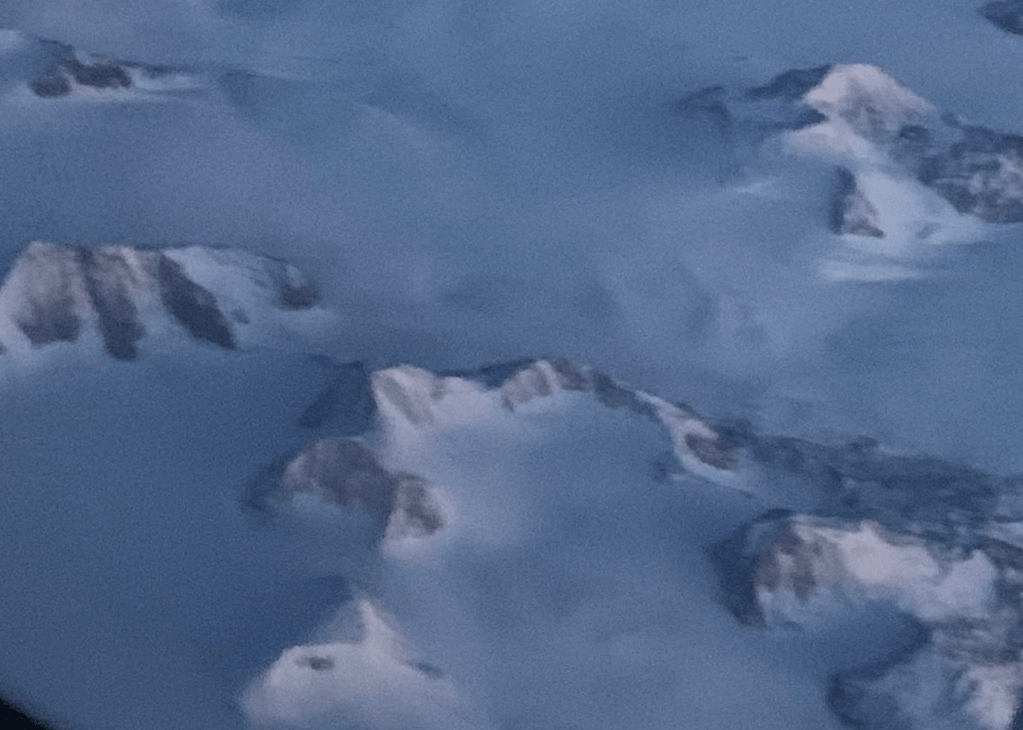
Mountains peek and peak up through the snow covered surface of Greenland.
Billions of years ago, a massive single land mass contained all the continents we know today. Through force of internal pressures such as volcanism, the shove and pull of plate tectonics and the mechanism of sea floor spreading, all the continents we in the world were distributed around the globe.
One of those chunks of land wound up sitting in the northern hemisphere far above the more habitable climates of the earth. That giant spit of land is still mostly covered in ice. But somewhere along the way the human race titled it Greenland in a strange little word game that seems ironic to many.
Thanks to the impact of human-induced global warming through climate change, that sub-continent northeast of North America may one day become the most habitable place on earth. Greenland may one day live up to its literal name while desertification takes over the much hotter beltline of the planet.
Glaciers collide somewhere in central Greenland.
Scientists warn that when the icepack currently covering Greenland someday melts, the seas will rise by feet, not inches. That will inundate entire nations and submerge valuable coastline property under less-than-forgiving saltwater. The profiles of our supposedly immutable continental outlines will be radically changed.
It is hard to imagine such events until you actually fly over the land mass of Greenland and see how covered in ice it truly is. This past Sunday our flight back from Munich, Germany took us straight across the snowy guts of Greenland. We were chasing the sunset for six to eight hours, so there was ample time to study the peaks of mountains jutting up from the surface of Greenland. We could see glaciers too, rivers of ice with terminal walls where sediments were dumped.
This is how the Great Lakes were formed in North America. Billions of tons of water was left in the wake of glaciers that once stood a mile high and scoured the earth flat where there had once been hills.
I grew up running on the flatlands of Illinois. But I also attended college in northeast Iowa, a geography known as the Driftless Region. The glaciers left that part of southwest Wisconsin and Iowa alone.
The haunting landscape of Greenland in what seemed like eternal twilight.
So I have an intimate sense for what ice can do to the surface of the earth. I’ve run thousands of miles across flat Illinois topography and have climbed hills and cross country skied in the Kettle Moraine where terminal glaciers dumped gravel and emptied water down the gullet of the earth. These are evidence of how massive the force of the earth and nature can be.
And human beings tend to forget all that. It is far more convenient and often necessary to live entirely in the present. But that outlook has a price.
We all have a carbon footprint of one kind or another. Yet as I stared down at the surface of Greenland covered in ice and snow, it was hard to imagine it looking like anything else. Yet below that skim of ice and snow are fossils locked in stone that can be traced far back into earth’s history, long before the human race ever existed. That is the Greenland we need to imagine in order to understand the brevity of the human predicament in terms of consumption and sustainability.
The world we live on is both a patient son-of-a-bitch and a chronicle of the discipline dished out by Mother Nature over the ages. Whatever we know of God is a combination of these two things. We had better respect that. Both science and religion tell us that life on this earth is frail.
I took a break from blogging the last couple weeks due to a combination of trips, including one abroad to Spain, France and Italy.
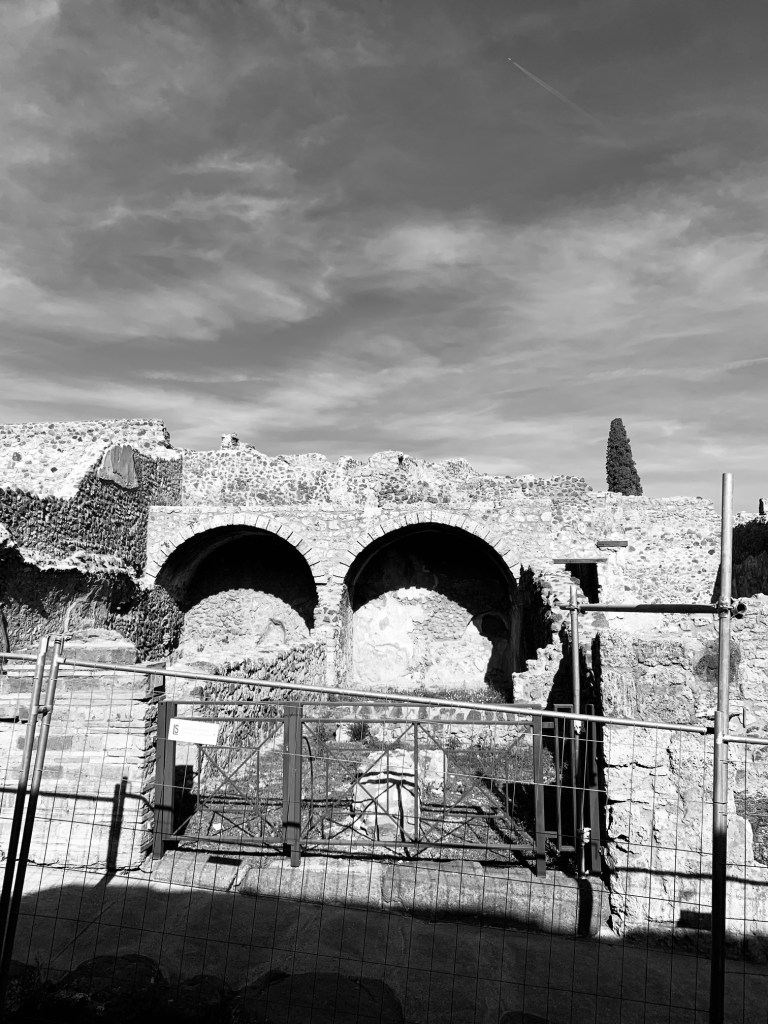
The eastern walls of Pompeii, Italy
We docked near the former city of Pompeii, the Roman settlement buried by volcanic ash from Mount Vesuvius in the early part of the first century. As we walked into the large park where old stone walls have long since been excavated to reveal the borders of the city, my mind turned back to those images published in National Geographic fifty or sixty years ago.
A woman figure identified as likely a slave due to the garment she wore on her waist
As a child I stared at those images and wondered that someone could be frozen in time, solidified in a tomb of their own shape and size. Having heard the biblical term “ashes to ashes, dust to dust” as part of an upbringing in the Christian church, I wondered back then what it meant to be turned into a twisted relic of one’s self. What did that mean?
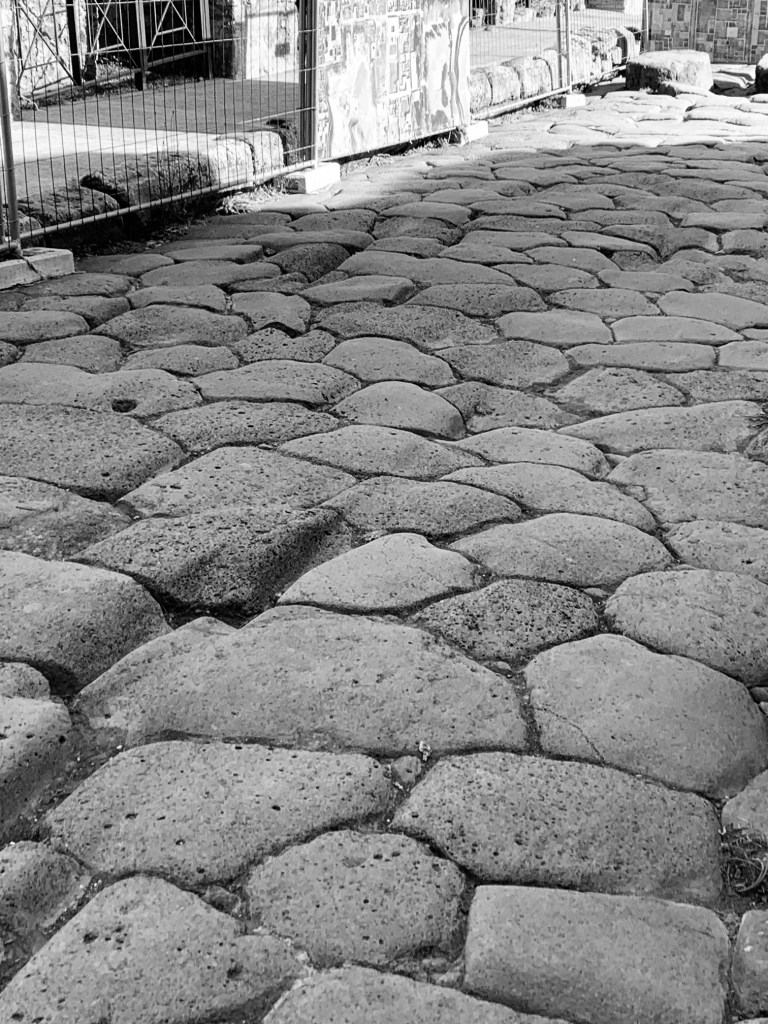
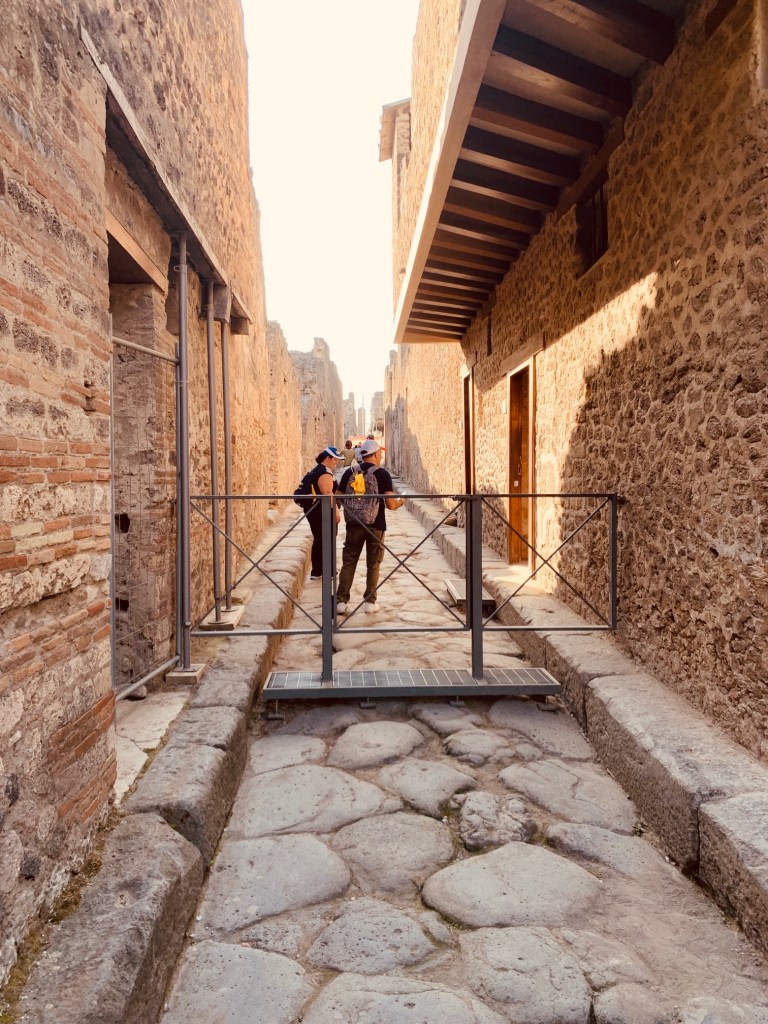
We climbed the steps up to the City of Pompeii and were met with a network of old Roman streets. There were ruts in the stone made by chariot wheels. Suddenly all of time shrank to an aural recollection of how that must have sounded to hear horse hooves and chariots clattering down those streets.
The streets of Pompeii
You certainly could not have run very far on them. Every step required a full attention span. The space between inlaid boulders was in some places three to four inches across.
Yet those roads have lasted forever. These days cyclists negotiate the former Roman roads made of rough pave in the north of France. They bounce along trying to avoid flats in the Paris-Roubaix spring classic. A modern competition on the roads of antiquity.
The sport of choice in Pompeii was something far more earthy. The sexual imagery discovered during excavation of the city was scandalizing to many who viewed it. Even the most casual demarcations above doorways were depictions of erect phalluses, a sign of good luck and fertility.
The local brothel did a brisk business with the seaman and merchants that arriving in port eager for food, drink and a romp with one of the enslaved whores in a district of town. Men were guided by to the whorehouses by pale white stones embedded in streets. These helped led them to their pleasures even in the dark of night, and when moonlight shone, their eyes must have glinted with the promise of sex soon to be had.
Not to leave anything to chance, the sex workers howled at night like wolves to attract their many customers. Talk about having difficult neighbors…
It is reported that following the burial of Pompeii under volcanic ash, even Rome’s leadership was not inclined to exhume it. Some believed the place was so cursed by its lusts that it was a condemnation of fate similar to the famed story of Sodom and Gomorrah in Judeo-Christian scripture. Could the allegorical reference be more similar?
Tourists stand outside the doorway that once led to the brothel.
Pompeii had things pretty well figured out on a number of fronts, but modesty and chastity were not one of them. Even the sanitation of the town was more pragmatic than considerate. The streets themselves were gutters down which flows of water and human excrement could wash to the low ground. The city could not have smelled good at all on hot days.
Yet the people who lived there also knew how to celebrate life in fine ways as well. The frescos on walls depict lively hunts in realistic fashion. The layout in many houses allowed people to recline on their beds while gazing upon large paintings such as these, often featuring gardens and wild creatures. Virtual reality is not a new concept to humanity.
A stray pup lies in the back alley dirt with the volcano Vesuvius in the background.
The entire experience of visiting Pompeii made time disappear. As we rounded a corner I looked up to see Mount Vesuvius against a blue sky in the distance. I could easily imagine the 14km pillar of ash and gas billowing up in the sky. Then its weight grew so great it tipped and collapsed upon the city with great force and peril for all who lived there.
As we now know, the entire population was dramatically covered and entombed while going about their daily business. All of life within the city came to a sudden stop. Men and women and children were turned to hot ash in an instant. Streets and houses were consumed. Perhaps a few small pups like the dog in the photo were lying in the dust when the pumice and gas fixed them forever in time.
There were many styles of residences and businesses in Pompeii.
It’s not that hard to imagine. It’s certainly not hard to believe. Not with all this evidence of history still standing in testament to what life was like back then. We all like to assume that we’re immune to peril in our daily lives, that nature would never attack us, or our culture.
Yet we’re always wrong. But we keep on running ahead in hopes of avoiding the next towering plume of fate or the next round of dangerous gases sent by God or bad luck to whatever end awaits us.
I decided to take the back roads on the return trip from my college reunion in Decorah, Iowa. A simple tap of Directions on Google Maps set up a route through Lancaster and Platteville in southwest Wisconsin.
My childhood was actually spent in the city and county of Lancaster, Pennsylvania. Those were delightfully formative years. I even attended school with children from Mennonite and Amish families. They’d sometimes come to school smelling like cow manure or some other earthy odor, but we didn’t mind. Well, we said we didn’t anyway.
The Amish children all seemed to disappear from school by the time they hit the seventh grade. Perhaps they stopped going to public schools and got the rest of their education at home.
In a tradition called Rumspringa, the Amish send their teenagers out into the world for a year or so to live it up before making a choice about whether they want to stay in the tradition. Trusty old Wikipedia describes it this way. “Rumspringa normally begins around the ages of 14–16 and ends when a youth either chooses to be baptized within the Amish church or to leave the community. For Wenger Mennonites, Rumspringa occurs between ages of 17 and 21.”
Rumspringa
The Amish call it Rumspringa. The secular world calls it a college, or a Gap Year. Whatever the case, it is an acknowledgement that not everyone is ready to begin adulting at the same prescribed time.
I was thinking about all that growing up stuff while driving through southwest Wisconsin. I’ve been driving through the region for forty-plus years since I started at Luther College as a freshman. Along the way I’ve had my share of Rumspringas. Those college years of running 100 miles a week and drinking until I felt like a zombie were an intense way to experience the world.
As I drove through southwest Wisconsin where a number of Amish families now settled, I observed that the Driftless Region looks quite a bit like the land around Lancaster County, Pennsylvania where I grew up. As I crested a hill just after dawn I spied an Amish buggy on the road ahead. It’s a courtesy to slow down when passing the Amish, so I slowed my Subaru to a crawl in the dawn’s early light and waited for an opportunity to pass.
Into the murky gloom
But I got a creepy sensation as I wheeled up behind the gray Amish cart. The spot on the back of the buggy where there’s normally an orange triangle to indicate a slow-moving vehicle was missing. That made me slow down even more. I waited to clear the hill and began to pull my Subaru around the buggy to move past. Rolling along at only ten miles an hour in the murky gloom of early day, I blinked at what appeared to be a foggy wall in the steep little valley below.
I’m quite used to the fogs and mists of southwestern Wisconsin in early autumn. But this fog was something else. It seemed to be composed of an impenetrably thick substance beyond the range of any fog I’d seen. I pressed my foot on the brakes and fell even in pace with the buggy as I passed. Then I looked over at the family and realized they were a band of living dead Amish.
Not a fan of zombies
Not being a fan of zombie shows, as I find them insufferable and fake, it seemed at first that the carriage full of zombie Amish was some elaborate Halloween prank being played by some Wisconsin locals. I laughed aloud as the fog around my car grew thicker and the windshield misted over. “Did I just see that?” I asked.
The road was hardly visible ahead. I had not even made it back into the lane of traffic for fear of cutting off the Amish buggy behind me. Then I heard a whip crack the back of my car. The massive black horse reared up and smashed the side windows with its hooves. At that moment I jerked the car to a halt and lurched out of the vehicle to protest that the prank had just gone too far.
Carried away
The moment I got out of the vehicle a group of bony hands grabbed me on all parts of my body. I was lifted in the air and carried through a thick cornfield with the sharp edges of unharvested shocks tearing away shreds of my clothing. I let out a scream of sorts but my voice clung near to my face in the thickening fog. The noise of my captors stumbling through the fields was deafening, haunting and surreal.
Finally I got a glimpse at the creatures carrying me. I could see the flapping chins of two zombie Amish. Shards of thin beard were flapping about. They chattered away in a broken German tongue that was slivered by time itself. One of them glanced up at me and gave a sharp flex of its stinking hand into my shoulder. That forced a wince of pain. From then on I resigned myself to wherever they were carrying me, hoping to escape and outrun them if I could.
Soon we burst into an open field where they tossed me on the ground. I popped my head up to find an entire congregation of Amish zombies standing stolid and severe in the dew-covered grass. An area of pale light opened above us on the field. I could see a flock of crows that had risen from the trees. They were flapping silently overhead. It made me sad to think how many times I’d seen crows in the sky and taken them for granted. I wondered if these were the last crows I’d ever see alive.
Unceremonious ceremony
The next moment a circle of Amish zombies was closing in on me. “Well, if this is how it ends,” I told myself. “I’m going to go down fighting.”
Then the Amish zombies stopped. One of them raised a ragged hand above his head. The entire mass of haggard souls began muttering one word… “Rumspringa,” they howled in wild German unison. They repeated it again. “Rumspringa!” Then louder, more insistently. “Rumspringa!!”
It all held a demanding tone. I reasoned I should do or say something. So I answered them in English. The words came out in a strange yet familiar tongue. I was speaking the same broken German I’d learned along with other kids in that little elementary school south of Lancaster, Pennsylvania.
Taken aback
That made the Amish zombies all jump back and begin talking to one another in soe form of the same broken language I had just used. The only difference was that their language was an equally broken version of English that they’d likely learned at the same age.
It appeared to be an Amish zombie standoff. Then one of them quietly stepped forward and extended a terribly mangled hand. With a questioning voice it repeated the same word again. “Rumspringa?”
Familiar face. Sort of.
Something in me recognized the tone and nature of that voice. I’d made one actual Amish friend in all my childhood days. He’d actually invited me out to play at their farm south of Lancaster one sunny Sunday afternoon. He was a bright kid, filled with curiosity and with such bright blue eyes it made me uncomfortable at times even to look at him.
The dim glow of those bright blue eyes was now shaded in cloudy grey tones that looked like cataracts had covered them over. He chuckled a low, throaty growl and said in a mocking tone, “Rum-springa.”
Was this a choice to become one of the living dead?
I stood up tall and tried to look very much alive. Then I chuckled back. “This… is Rumspringa? To you?”
“To you…,” the Amish zombie muttered back. “Kehre jetzt zurück… oder nicht…”
Which meant, “Now return, or not…”
“I’m sorry,” I told my long lost mostly dead zombie Amish friend. “I’ve actually got places to go. A life to live,” I shrugged. “Plus I’m entered in a half-ironman triathlon next spring and I’ve already paid the $600 entry fee.”
Zombies are not stupid. Even Amish ones.
“That sounds steep,” one of the zombies responded in broken German-English. “ Was ist triathlon??”
“It’s this sport where you swim and then you bike and then…” I heard myself saying those words and realized how amazingly stupid they must have sounded to a band of half-dead Luddites stuck between worlds. “It’s an English thing, you know. We do a lot of stupid stuff.”
At those words all the zombies nodded their heads in approval. “Yes,” one of the bearded old zombies retorted. “Sie Englisch tun…” one of the elder zombies intoned. You English do.” one of them translated.
Off they go
And in that moment the zombie Amish tribe dispersed into the cornfields. A harsh silence fell. Then a hissing noise accompanied the rising of the fog from the bottomlands. I was standing in a completely normal lawn with a fence leading back toward the barn. An Amish family was boarding its buggy wearing clothes and in a manner that looked like they were headed for Sunday services. One of the little boys looked up and waved, but the mother ushered him quickly into the carriage.
I walked back toward a road that looked like it headed in a direction that might lead me to my car. My senses were right. I’d found my Subaru with one wheel slightly down in the ditch. But the windows were intact. Everything else seemed fine.
Climbing into my car, I found the iPhone asleep on the seat. Taking it in my hands, I tapped the screen and entered the code to access Google Maps. Instead I heard the voice of Siri blurting out a question I did not want to hear.
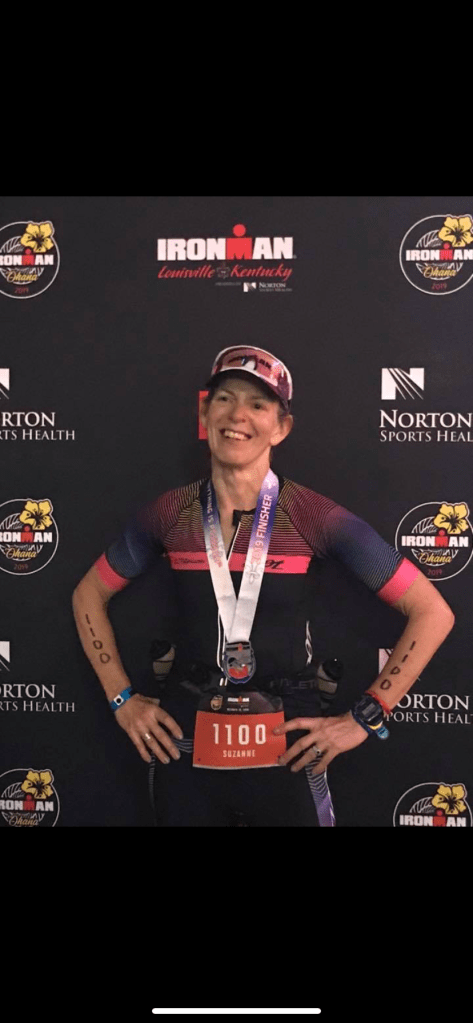
My wife set a PR in the Ironman Louisville race. It wasn’t a perfect or “complete” race given cancellation of the swim due to toxic algae. But she’s a strong swimmer that has raced well in that component of triathlons all summer. So it’s possible to add on the logical time for a 2.4 mile swim and know that she still busted her PR by more than half an hour.
That means quite a bit, because her running is what improved the most over the last two years since she last competed at Louisville. She’s worked diligently to improve her form, strength and overall stability in terms of consistency and pace. I’ve watched that transformation first hand.
Yet she had a setback six weeks out from her Louisville effort. Her running shoes got a little too worn and when she traded them in for new ones a stress fracture popped up in her right foot. The orthopedist confirmed the problem and she was forced to abandon all the run buildup that she and her coach had planned.
Rested and ready
That may actually have helped her in the long run. She did a few Half Ironman races this summer with a PR at that distance as well. There’s always a risk of overtraining for the longer distance. The stress fracture actually forced her to back off and rely on the biking and swimming to keep fitness up.
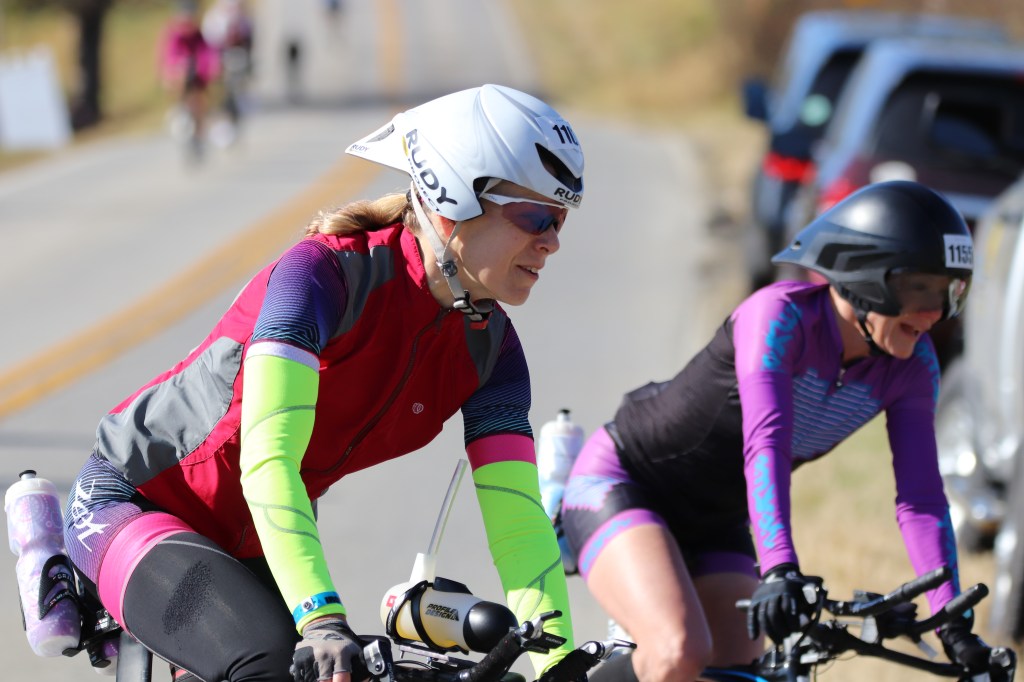
At the 33 mile mark in the hills east of Louisville, Kentucky.
To her credit she got out there on the bike on the worst of days and did multiple century rides in the wind and rain, heat and vagaries of late summer. Nothing fazed my strong woman. “I feel good,” she kept telling me. “I feel strong.”
To that I can also testify. I’d ride 40-60 miles with her and be happy to tail off after having averaged 19-20 mph on our rides. She’d go on another 30-40 miles with regular stops at the Casey’s in Maple Park. Our trusty food station.
Slightly off tracked
She even dealt with a double flat up in the hills west of Madison pretty well. She was 75 miles into a planned 100-miler when some railroad tracks waylaid her on the Ironman Madison course. A kind couple that was up scouting the course for his Ironman drove her back to Rocket Bicycle Studio and got a download from Sue on the course topography. That’s about a fair trade, I’d say.
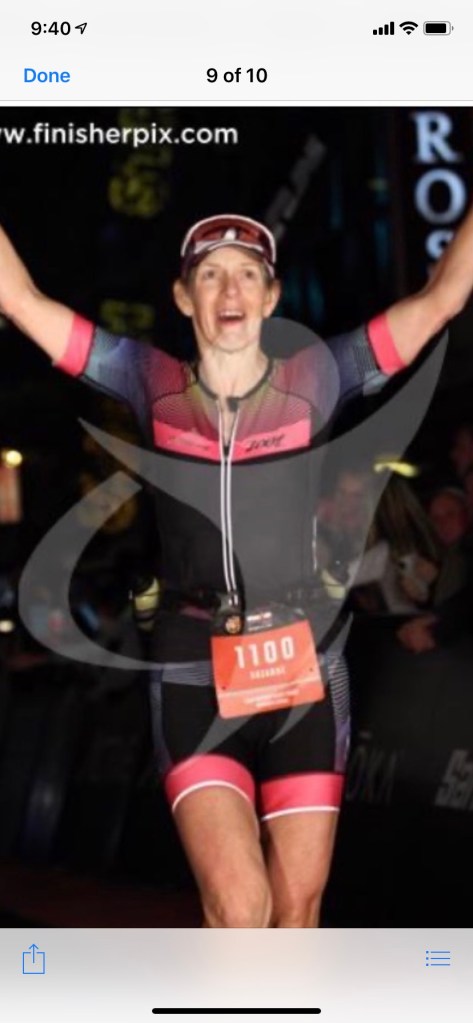
The happy face of an Ironman finisher
It’s so seldom that anyone’s Ironman training goes perfectly smooth. Yet in recalling her prep for the first Ironman in Madison several years ago, there was an incident with an Escalade SUV that the driver literally parked in the middle of the lane on a country road as Sue and others were coming off a long descent on Campton Hills Road. She had to ditch the bike and it cracked the frame. We had to buy a new bike, get that fitted and off she went, but it was stressful to say the least.
So we’re grateful for the great day in Louisville with temps that were cool but manageable. The wind was not something about which Sue was worried. “I’m good in the wind,” she told me. To that I can testify as well. I’ve spent many miles trying to keep up in headwinds, crosswinds, cross-crosswinds and tricky tailwinds that feel like headwinds. We live in Illinois. It’s often windy here.
“You’re an Ironman!”
Watching her head into the chute after her steady marathon effort was rewarding for me too. As a partner to an Ironman racer there’s always a bit of anxiety going on. At one point her tracking icon disappeared off the Ironman app. I panicked for a few minutes and then realized she may have just been riding through some forested areas.
At the long day’s end I’d had two tall drinks of Buffalo Trace and Coke at Whisky Dry on Fourth Street in Louisville. I sat there watching her icon slipping along the course map on my phone and looked up at her daughter Sara and grinned. “She’s doing great,” I smiled. A little tipsy I’ll admit.
She even made it past Siren and Bullhorn Man in his bulging Speedo.
There will be other races, God willing. But it always pays to be thankful for the one just completed. Our puppy Lucy was a pretty good girl all day with everyone taking turns holding the leash. It was a great day to be in Louisville, for sure.
What I keep taking away from these races is the pageantry combined with the transcendent humility of doing something that requires perseverance to complete. But I particularly notice the strong women in these events, who defy the formerly stifling limitations of male expectations and sweat with the best of them. You gotta love it when Ironman meets strong women. And my wife is one of those.
“You been tellin’ me you’re a genius Since you were seventeen In all the time I’ve known you I still don’t know what you mean The weekend at the college Didn’t turn out like you planned The things that pass for knowledge I can’t understand…”
Steely Dan–Reeling in the Years
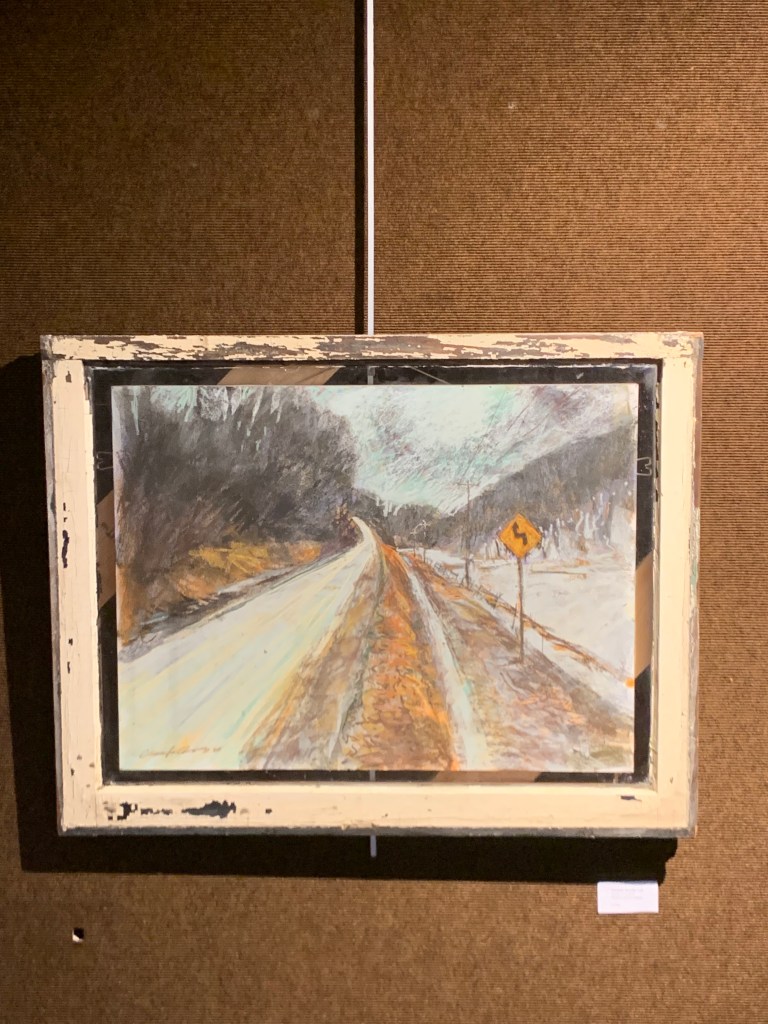
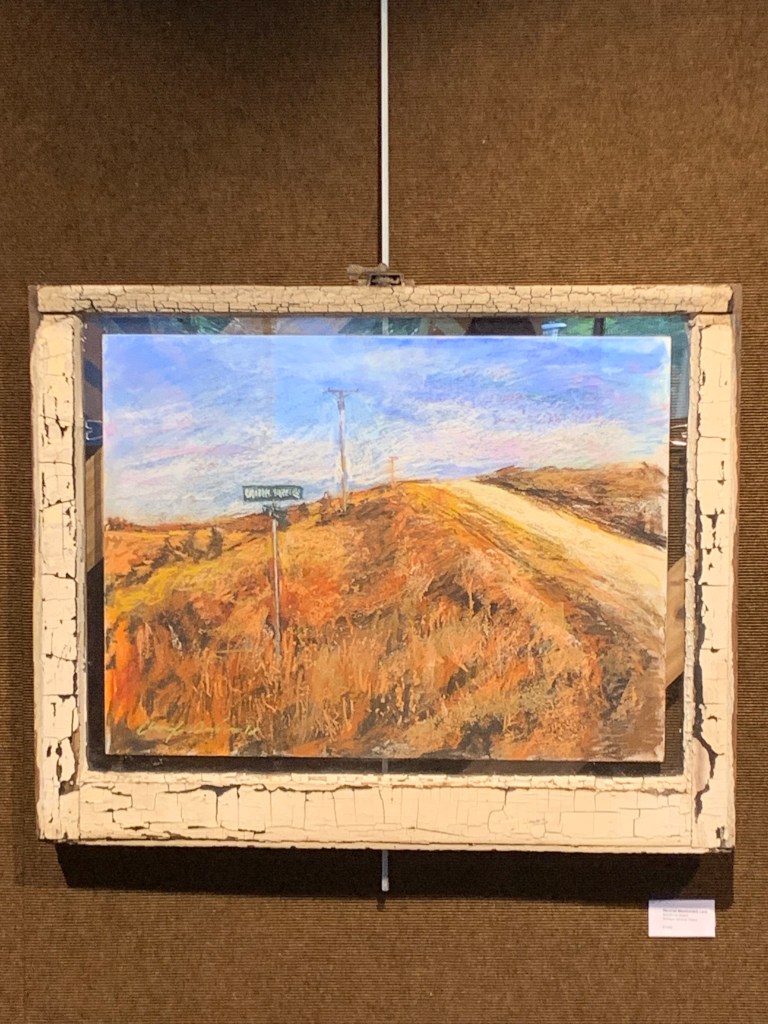
A pastel of a section of road on which we used to train during our time at Luther College.
There’s nothing like a high school or college reunion to set off a round of self-examination. But as the years have gone by, these occasions have become less of a Come to Jesus moment for me and more of a God Loves You Anyway assessment of conscience and consciousness.
I drove up to Decorah, Iowa to visit Luther College for the third time this year. The first occasion was a reunion of track and field athletes from the years 1966-1986. It was fun to meet legacy athletes and hear stories about how their achievements took place.
Every reunion is a crossroads of sorts. From the show Road Trip: Passage Through Collective Memory.
Then in September I hauled my artwork up to Luther and installed a show called Road Trip: Passage Through Collective Memory. But then I turned right around again and came back home the next day. I took the backroads to get more material for future paintings.
This past weekend marked our official 40th-year class reunion. I so well recall watching our aged alumni trod quietly through campus when I was 18 years old and just a freshman at Luther. We were so caught up in cross country that fall it was hard to imagine events in the weeks to come, much less forty years down the road.
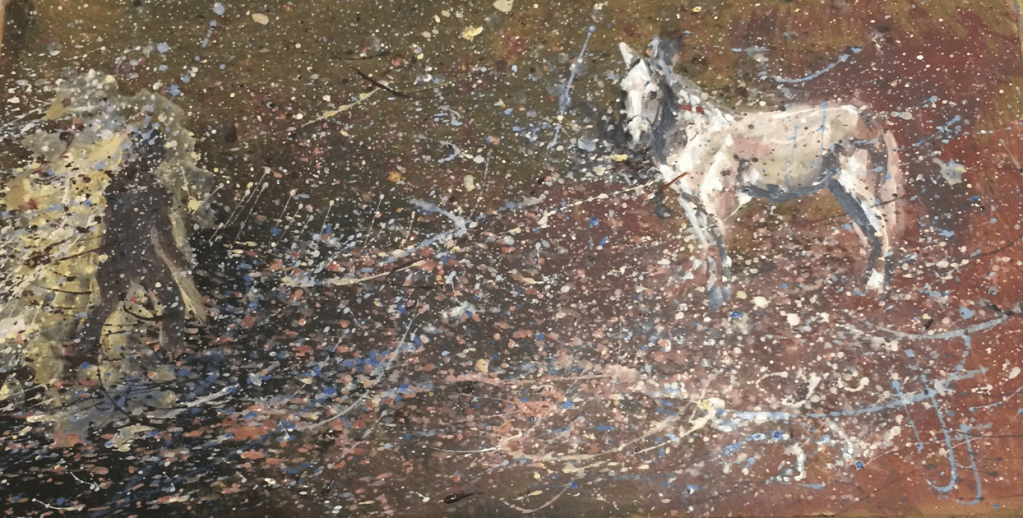
A painting done for a friend about equine treatments for PTSD
Eventually I’d study the concept of the ‘irreversibility of time’ in the Philosophy of Existentialism class I took from Professor Richard Ylvisaker. That harsh notion informed both the state of a distance runner on the roads and all of life to come. You can’t turn back.
But you can reminisce, and that’s what reunions are all about. That, and discovering new friends among classmates with whom you shared a time period.
My art show was all about the fact that we have many experiences in life that reside in our minds as a collective. We may not dwell on them specifically, yet those places we pass when we’re going somewhere important in our lives build up and actually become part of our mental processes. The same thing happens with groups of people whom you “pass” along the way in life.
Those four years of college are considered formative years. We give them high significance and we give money to the colleges we attended because we feel loyalty to those places for giving us those opportunities. The faces we see at reunions are like icons for the era. So are the conversations about events past and present.
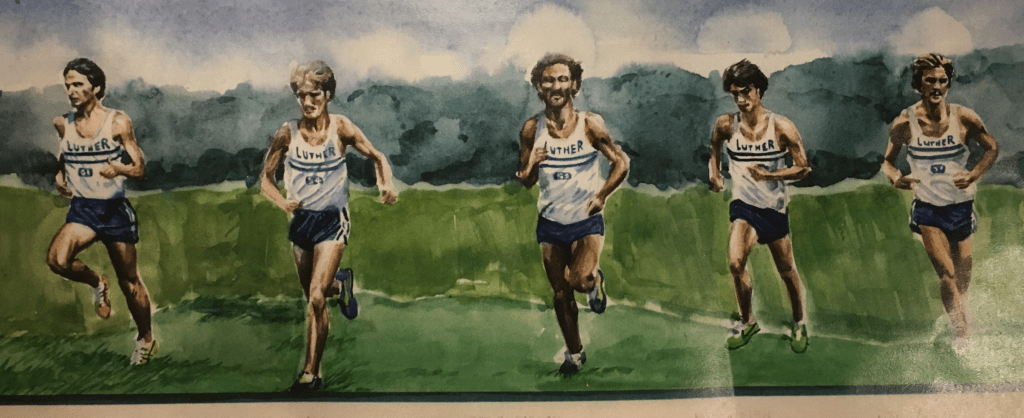
The painting I did years ago for our coach Kent Finanger.
And for those of us that ran so many miles together, there is a unique level of shared experience wrought from both the pain and pleasure of trying to achieve things that are not easy. For those experiences we share hugs, say thanks and laugh at all the stupid thoughts and funny conversations that occupied our minds all those years ago.
Yes, sometimes the things that pass for knowledge we never truly understand. And I’m more than okay with that. That’s the most common experience we all share.
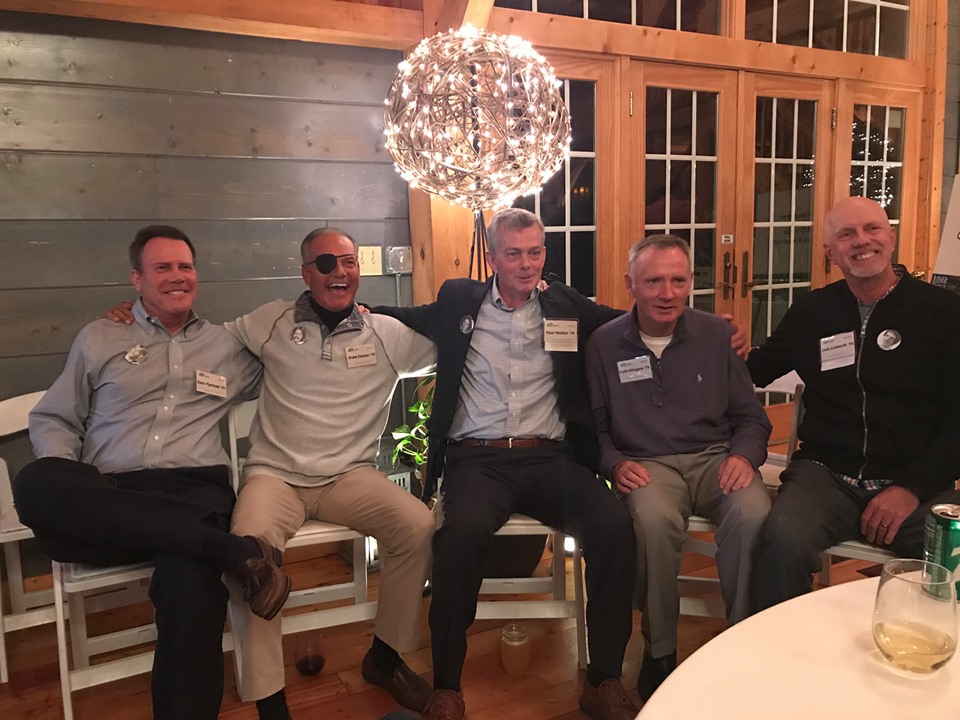
Team captains and Class of ’79 members Dani Fjelstad, Steve Corson, Paul Mullen, Keith Ellingson and Christopher Cudworth. 2nd place NCAA Division III nationals 1978.
I first accepted a job in the City of Chicago when I was twenty-one years old. I’d already worked a year as an admissions counselor traveling all over the state of Illinois, and that was rough.
So when a man named Robert Van Kampen offered me to join his newly formed investment banking firm with offices at 208 S. LaSalle Street, it was both hard to resist and an adventure in the making.
I’d hardly spent any time in the really big city growing up. The town of Lancaster, Pennsylvania where I lived from age five through twelve was not tiny, but it was no Chicago. When we moved to Illinois our family lived in a far-flung rural community named Elburn. It was surrounded by cornfields and a train line ran right through town. But back then the commuter line ended in the City of Geneva twelve miles east.
The view from the rail bridge over the Fox River heading west toward Geneva
So I was a rookie that first day taking the train downtown to Chicago. I don’t know why it felt so new to me to be spending time in the city. After all, I’d worked the previous year visiting urban schools recruiting students. Nothing bad ever happened to me then.
But just in case, I tucked my wallet in the front of my pants and walked the three blocks from the train station to the office. That would be the first of many morning commutes to follow.
The part of me that loved to run and also hated the idea of having to spend two hours a day on a train. But the part of me that loved to read and write made good use of all those mornings and evenings riding the West line in and out of the city.
I worked on a book titled Admissions, a work of fiction that predicted a ton of things correctly about the world. It sagely predicted the rise of Right-wing media on AM Radio. I predicted the rise of a Right Wing political movement that I called The Mandate. It later came true in the work of Newt Gingrich, the Contract for America and the Tea Party. Years later I’m going to finally publish that book. It anticipated everything going on in America today.
That book was written longhand on yellow legal pads. I’d write entire chapters that way, and rewrite them to make edits. It would be another three years before I owned my own IBM Selectric Typewriter. But writing that book longhand taught me to be economic in my writing. That’s a lesson I haven’t always abided.
These days I’m commuting again. I’ve ridden in and out of the city so many times over the years the landmarks are part of my sub-conscious mind. So are the names of the cities announced along the way. And the dulcet tone: “Caution, the doors are about to close.”
Only once here in Illinois have I missed a stop and gone too far. But when that happened on my early commuting experience out of the City of Philadelphia, the conductor would not let me get off at the nearest stop north of the city. “You won’t come back,” he warned me.
These days I can write using my laptop and even plug it into the wall socket if I’m lucky enough to board a newer car. I still haven’t learned to recognize them from outside the train. I’m not sure anyone can.
But I kind of like it that way. If there are no sockets available in an older Metra car, I use my cell phone as a personal hotspot and write away just like I did all those years ago on legal pads. That means the commute is put to good use. It’s still a rat race some days trying to make the train going into the city. And coming back out there is always the tension of which train to catch. Many’s the time I’ve trotted across the loop at eight-minute-per-mile pace or faster trying to make the 5:27 or the 6:10. It’s all relative in the end.
Oak Park, where I won the Frank Lloyd Wright 10K two years in a row.
I once covered the miles between the Hancock Center and Ogilvie Transportation Center in a heavy rain storm. There were also a few late nights walking from the bars to the train. Only once did I worry about being mugged. Some guy followed me all the way down Wacker, scoping me out to see if I was a legitimate target.
Obviously I kept an eye on him. Even with a few drinks in me I was ready to run as fast as I could if he approached too closely. Perhaps a few people in this world would have preferred to have a gun on them at the time. I’ve always been happy to have my feet and legs as a weapon of escape.
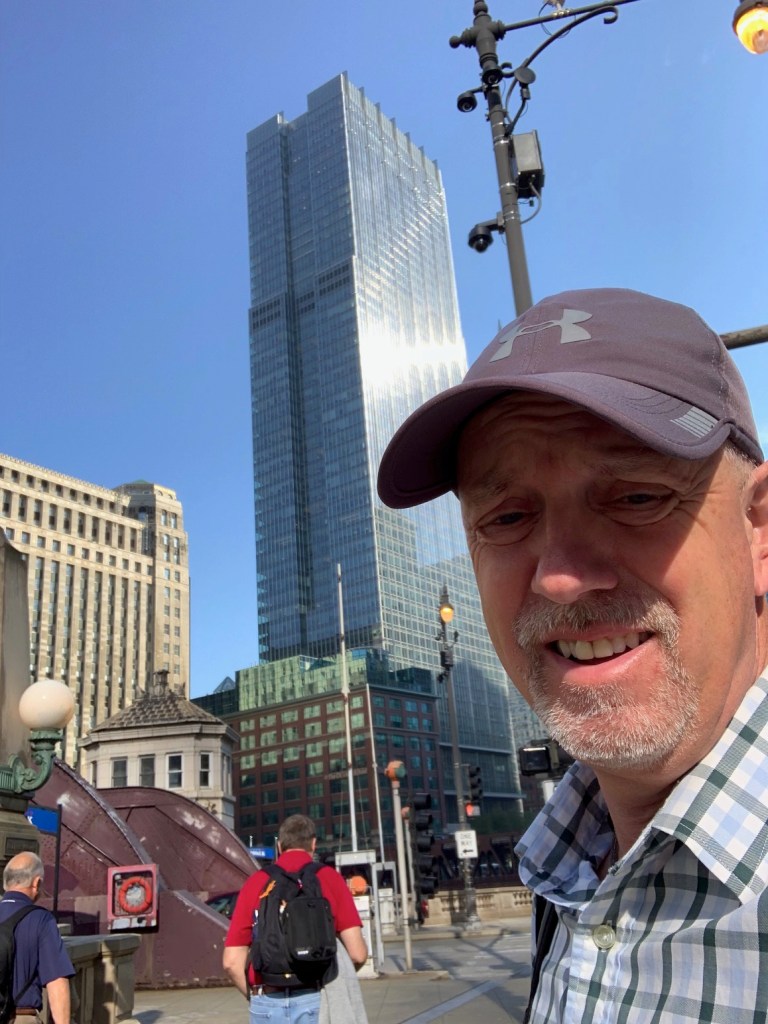
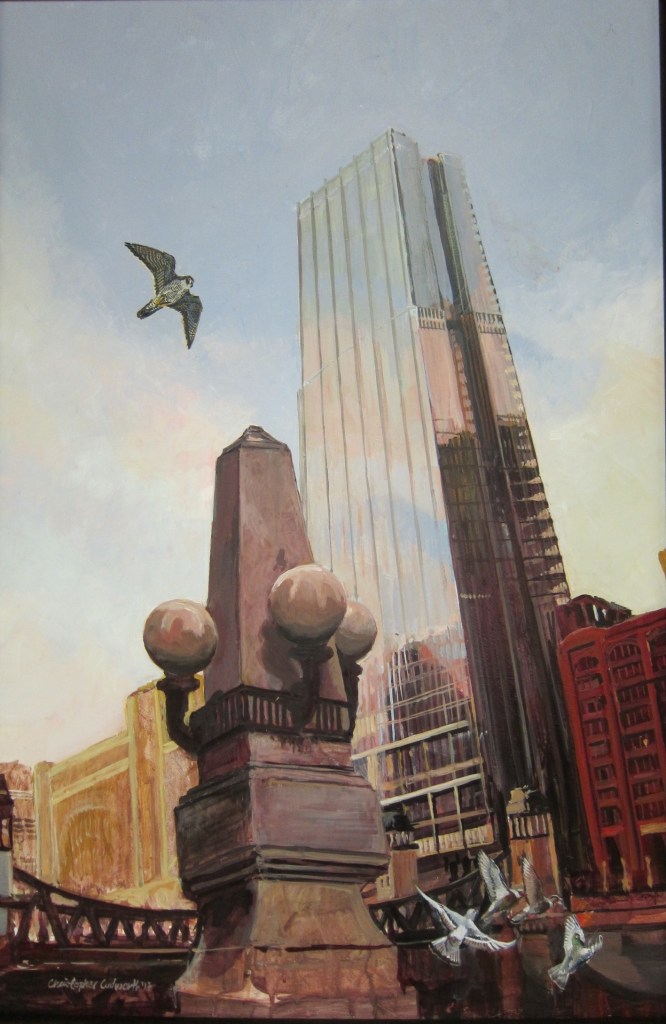
This building is featured in a painting I did from photos taken while commuting. (see below)
Taking the train in and out of the city is to be involved in a core sample of the present and past. All that urgent energy of youth and desiring to be anyplace else but on a train was perhaps not the most constructive outlook. At least with time I can appreciate the fact that not every opportunity in life means freedom.
I was in Cub Scouts as a kid. Made it all the way to Webelos earning badges along the way. But then I got shamed out of the pack for protesting too loudly when one of the pack members cheated in a game of kickball organized by the den mother. The kid moved to second base after one of his own players struck out at the plate. Stealing bases was not allowed in kickball.
So I pointed out that fact, and the kid who stole second refused to admit it. So I raised a fuss and refused to pitch the kickball to the next player. The den mother yanked me out of the game and told me to go home. I never went back.
Sense of social justice
Even at a young age, I had well-developed sense of social justice. One of the values I learned early on was that playing fairly was important. Cheating was something I refused to tolerate. The other personal quality you learn from those values is how to establish those parameters with everyone you meet. And how to lead.
So getting kicked out of Cub Scouts for “fighting” (as the den mother branded it) was a cogent lesson in the fact not all adults could or should be trusted to uphold moral values. But it also provided motivation to prevent dishonesty from ruling the day.
I recognized these things early in life but am also not a perfect human being. Through many years of athletic competition I was largely honorable in my conduct. But anger sometimes entered the picture, especially when losing––the other thing I deeply hated in life. Occasionally I lost my cool or resorted to ugly gamesmanship. But that’s still different than outright cheating. But perhaps not much more honorable.
Not a perfect person
So I’ll never claim to be the perfect sportsman, much less a perfect person. But the sport of distance running that I chose as a primary pursuit through college was not a discipline at which it was easy to cheat. You either ran faster than the other competitors, or you didn’t. Oh sure, some real scoundrels have found ways to cheat, and still do. They take shortcuts. Use drugs. Catch a train or bus to the finish line.
I never really wanted to actually cheat to win. I too much enjoyed the world of distance running precisely because it was “hard, clean and severe”––to quote writer Kenny Moore. Along the way I was blessed to win my share of races. And by the time I was in my mid-twenties had earned a reputation as a good journeyman distance runner on the local road race circuit. But by 1985 I was feeling like it was time to hang up the racing flats, get married and start a family.
Rush job
That summer, on the advice from some friends, I accepted a job as a District Executive with a local council of the Boy Scouts of America. “You’ll love it,” they told me. “The winter months are pretty busy but the summer’s are relaxed.”
That sounded like a good deal. So I signed on and was sent to a three-week intensive training program called NEI (National Executives’ Institute) down in Irving, Texas. There they talked plenty about the importance of virtue, values and hard work.
But when I got back to the local council and studied the membership records for the council and district, I noticed there was something amiss in the fact that some of the packs and troops essentially consisted of “ghost” memberships. That meant entry fees had been paid for kids who weren’t truly enrolled in the program. In other words, some District Executives were cheating.
Hush job
I raised that issue with the Field Director and was immediately told never to mention it again. Not long after that I learned that funding from the local United Way was dependent on serving a certain number of youth. If numbers dropped, that funding would go away.
So I was told that the numbers in my district definitely had to be met or there would be consequences to pay. I raised that issue with some fellow DEs that I thought were friends and no one was willing to discuss the subject. It was all hush-hush.
In other words, the council was cheating in many respects and everyone was playing along. But rather than cheat and falsify membership numbers, I took the initiative to start an Explorer troop and get high school kids signed up. I found a friend in the district to help and even attended their activities. It took tons more time on top of the school visits, evening meetings and weekend events I was already required to attend, but I was determined not to start out my work life by cheating.
Shush job
It ultimately didn’t matter. My inquiries with the field director and staff had made me a target of suspicion about being too honest. They didn’t want me to blow the lid off the scam. So they conspired to trump up some volunteer complaints about me and then threatened punishment. After two years of trying to make things work in an honest fashion, I finally left the Boy Scouts when I land a job in newspaper advertising sales.
But the realization that an organization that was supposed to be a pillar of conservative values and tradition could be so corrupt truly sickened me. Yet I’ve seen the pattern repeat itself time and again over the decades. People present a righteous front while scheming and scamming behind the scenes to get money or power or position in life.
Honest efforts
It’s all so different than the raw honesty of running. But through those experiences, you really do develop an ability to spot the phonies and liars from miles away. Perhaps it’s a matter of participating in the cut-and-dried reality of distance running. It’s a perspective you develop through uncompromising effort and making no excuses for the outcomes.
In any case, the distaste for cheaters lives on. You can imagine right now how I feel about so much that is going on in this world. How do you feel about it?
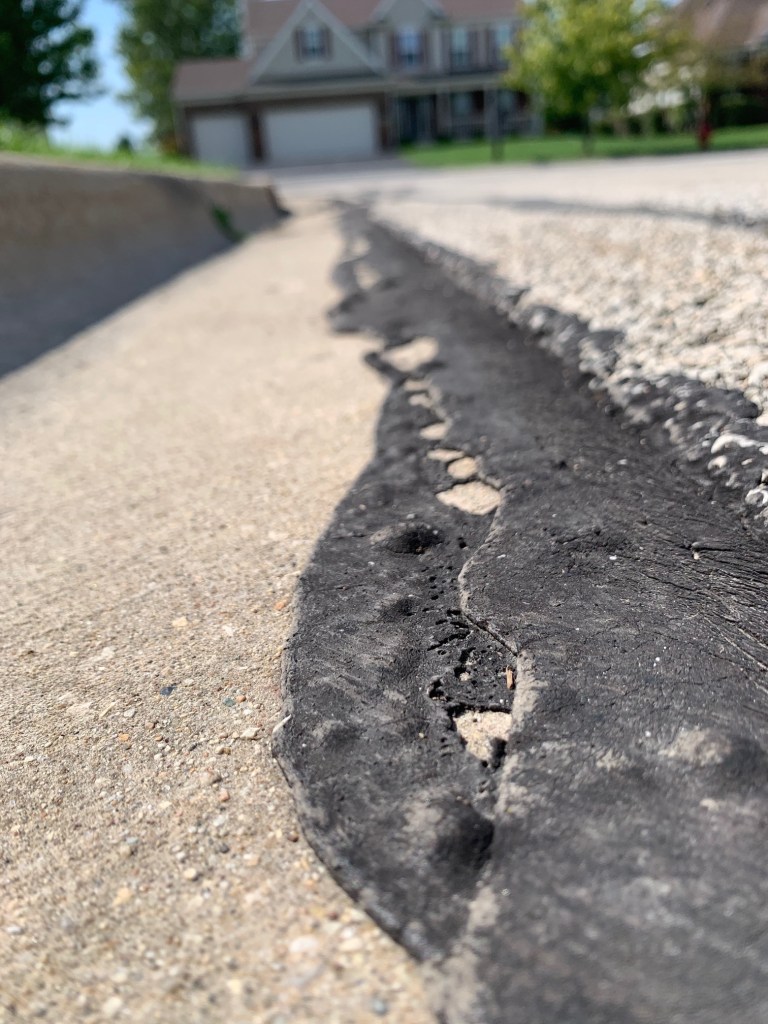
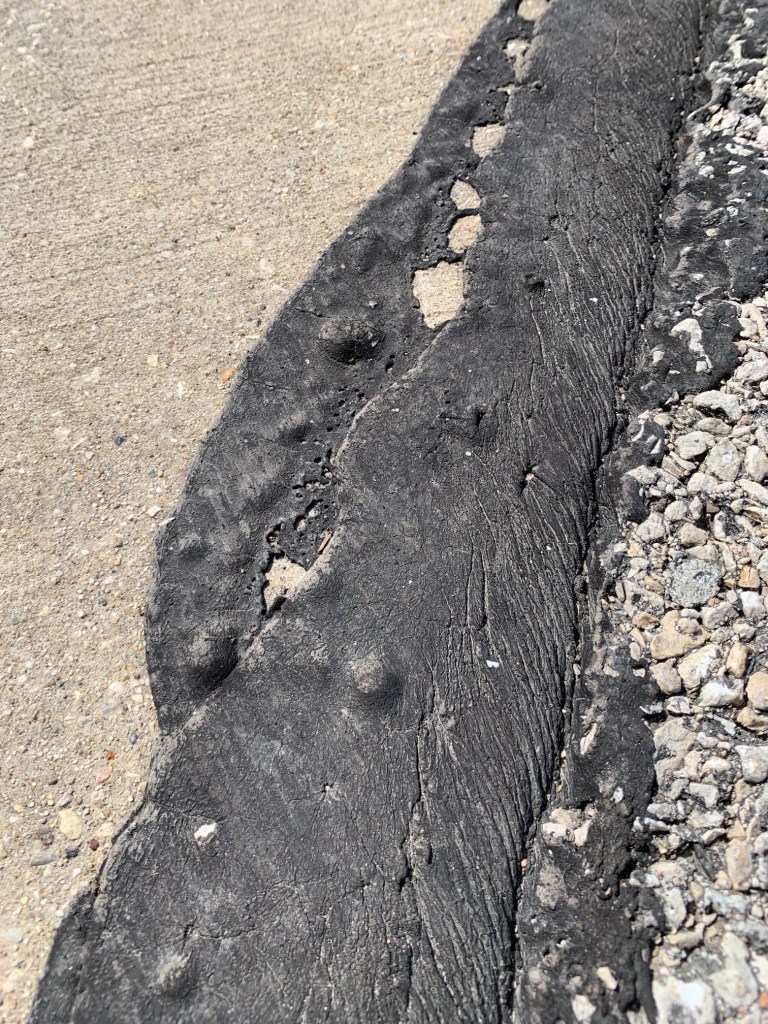
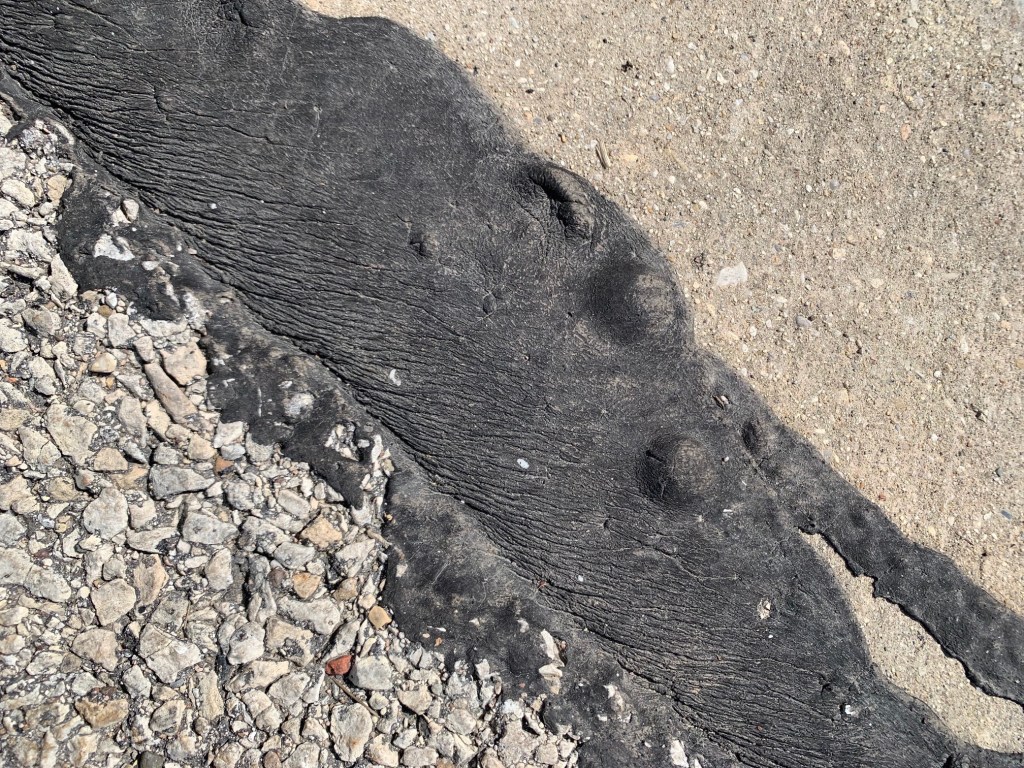
During my run today I looked down and saw a few small bubbles poking up from the surface of the tar at the edge of the road. I stopped and bent down to use the tip of my pointer finger to pop one of the bubbles. It didn’t exactly pop, but it did give a satisfying collapse in going from convex to concave.
Tar bubbles were a childhood fixation for me. I loved to pop them. So satisfying.
Pushing that tar bubble made me think back to those slow days as a kid when I’d wander back from the swimming pool with no real pressure to get home or do anything else that I didn’t want to do. The neighborhood that stood between the pool and home was safe enough for a kid of eight or nine years old to walk along with no worries. So I’d wrap a towel from swimming all day over my shoulders and walk back home on streets named after golf course terms. There was Niblick Avenue and Divot Court. We lived near a private country club you see. some developer must have thought it would be cute to use golf terms to name the asphalt streets lined with modest homes.
Our family wasn’t actually members of that country club. We just had an “associate” membership that allowed us to swim at the Meadia Heights pool. These days its just a crumbling old relic. But in those days it was a bright blue pool with low and high diving boards and a snack shop that had everything a kid could need to make it through the day.
But as afternoon waned and it was time to head home, I’d say goodbye to friends or walk with them until they turned off to head down their own street. Along the way we’d hunt for “Fool’s Gold” as we called it. All the local kids had collections of the stuff. It would show up with a bright golden glint in the gravel next to the asphalt. Usually it was in cubic form. Sometimes it would be embedded in the tar. If a chunk of pyrite was big enough we’d dig it out with our fingers or a stick and take it home to add to our collection. I also had a collection of golf balls from wandering the fairways of the country club, a butterfly collection carefully preserved in a set of cigar boxes and a baseball card collection that included many of the New York Yankees, then my favorite team. I had cards for Mickey Mantle, Roger Maris, Rocky Calavito, Joe Pepitone, Whitey Ford along with a host of other baseball players from the Orioles, Giants, Pirates (Roberto Clemente!) Red Sox and Cardinals. But even though we lived near Philadelphia, I never liked the Phillies.
The texture of the tar is like my aging skin in places. Was it a premonition of years to come?
Those were the small pleasures of youth, all those collections. It felt like I owned something precious. Yet I also recall a deep sense of peace walking those streets on the way home from the pool and feeling a sense of freedom in having so few obligations. My body would be relaxed from swimming all day. The sun kept me warm all the way home. I could walk along with my own thoughts, dreaming about this thing or that. The only thing missing (I suppose) was a group of imaginary friends the likes of Winnie-the-Pooh, Eeyore and Piglet. But I was never much into the imaginary friend thing. I studied the birds instead. That’s a hobby I still carry with me to this day. a
A band of bank swallows. Photo by Christopher Cudworth.
As for the journey home, my imagination was rich enough to fill in the gaps. In fact it has always been a little too rich for my own good. I struggled in classes at school that bored me. I abhorred boredom. So I’d draw instead.
Abiding those habits is probably why I’m not rich in the material sense of having lots of money. I find joy in creating things instead, especially writing and painting. Yes, I have made money at those things over time. But I don’t obsess over money perhaps the way I should. A few artists do. But most of us don’t.
Some tar bubbles would make an audible “pop” when the pressure was released from their heated core.
I’ve written extensively about those couple years I spent running and painting and writing for all that I was worth. Something in me knew that taking time to do those things at that point in life was a precious investment in my long term self. And learning to survive on little has at times come in handy over the years.
Yet during one of those summers in which I was training so much and writing all day, a friend at time once stood over me and said, “You know, self-indulgence is not the way to self-fulfillment.” He was basically accusing me of doing nothing more than popping tar bubbles on the road to life.
Perhaps he was right. But I say you have to pause to pop the tar bubbles along the road of life or you’ll find yourself looking back and realize it’s been one long tarsnake from one end to the other.
3942611: Smoke pours from the World Trade Center after it was hit by two hijacjked passenger planes September 11, 2001 in New York City in an alleged terrorist attack. (Photo by Robert Giroux/Getty Images) Time Magazine.
Thinking back to 9/11/2011, I well recall coming into the house after a run to find the television tuned to an image of a World Trade Center tower smoking and burning against a clear blue sky. At that time, America did not know that our President and Vice President had been briefed by the outgoing administration of Clinton and Gore that terrorists threats were real and imminent. All we knew in the moment is that bad things were happening and the skies above us had gone silent.
I was no fan of the Bush administration well before they swept into office on the backs of a legal decision by a conservative-led Supreme Court. I wasn’t a fan of the electoral shenanigans down in Florida that led to the need for that decision. I considered the entire Bush-Cheney debacle an example of an ideological coup on America.
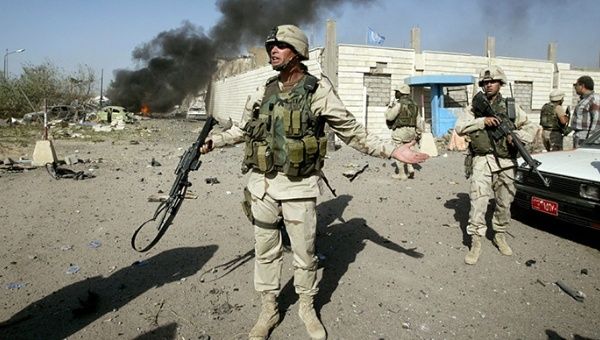
And I wasn’t wrong about those instincts. Because after 9/11 the Bush administration trumped up arguments to not only attack Afghanistan but to use the 9/11 attacks as an excuse to invade and devastate Iraq. The supposed weapons of mass destruction waiting to be used against the United States by Saddam Hussein were phantoms of political imagination. And after Osama bin Laden slipped away into Pakistan, the Bush administration sort of lost interest in the man. They had their hands full messing things up in Iraq with no plan and no exit strategy. Meanwhile Donald Rumsfeld offered up the lamest example of military tomfoolery in American history: ““You go to war with the army you have, not the army you might want or wish to have at a later time.”
That made me wonder out loud what in the ever-living-fuck America was doing with all the money American taxpayers pumped into the world’s largest, supposedly most powerful military? How could we not be competitively prepared to engage in war if we were spending more than the seven next nations combined?
What? No WMDs?
So Rumsfeld and Co. sent our soldiers into harms’ way with Humvees that lacked armor, vests that were insubstantial and even earplugs that were insufficient to protect the hearing of military personnel. If you don’t believe me on that last part, listen for the advertisements on Sirius radio now offering legal compensation for military personnel whose hearing was damaged in the Iraq debacle.
Mercenaries unleashed
Meanwhile the mercenary instincts of the Republican guard ––American style––were unleashed through military contractors turned loose in Iraq to run the show and make money hand over fist. This was war profiteering, plain and simple. And Vice President Dick Cheney could sit back and wait for the money to flow his way because his longterm interests in companies such as Halliburton would guarantee him a good return on investment. In the first Gulf War and the second, companies like that likely jumped for joy when the oil wells caught fire. Just an opportunity to make more money.
Oily interests
The Bush-family interests in oil were not neglected either. We had two massive conflicts of interest going on in Iraq and yet the political Right and Fox News cheerleaded our efforts even after they led to the heinous practice of torture and death of people in captivity. It was too ironic that we shipped those captives to a prison camp on the shore of Cuba, a country with whom our country had no formal political ties at the time. The ugliness of the entire enterprise was a disgusting stain on the character of our nation.
Restoration of sanity
The nation temporarily corrected with the election of Barack Obama, whose calm presidential guidance through the aftermath of a Republican-led recession restored America’s economy to global competitiveness. The Trump administration now in power owes its initial success to the momentum established by the Obama years. But rather than thank President Obama for the great job he did on the first three legs of that economic relay, Trump took that baton and waved it in Obama’s face while claiming he did all the work to get there.
Return to inanity
All these competitive issues are hampering America’s ability to sustain its economy and find its place in the peloton of world politics. With naively assumptive rubes like Bush, Cheney and Trump as captains of America’s team, we always squander the lead we’ve built up in any category of governance. Republicans always act like rookie track runners who want to burn up the first part of the race without concern for what comes after. Then the bear jumps on their back and they start to point fingers. “They made me run too fast! There’s no way we could see this coming!”
As a longtime competitive athlete, I have zero pity for people who keep making the same stupid mistakes over and over again. And when people additionally lie about their exploits and/or engage in “woulda-coulda-shoulda” claims about what might have happened “if only” people had supported them, it makes me want to barf on their shoes. I would so gladly do so on the shoes of Donald Trump. He is a sickening man at every level. He can’t compete on legitimate playing field, so he cheats and lies and commits fraud. Colludes and conspires, and hires those incompetent only to try to make himself look smart by firing them. He’s an overblown idiot and it’s only too bad Chris Farley is not alive to play him on SNL.
Here are the simple facts: The 9/11 attacks could well have been prevented if Americans had not been misled, deceived and possibly even purposely manipulated by an administration all too eager to capitalize on tragedy to execute its dark comedy on the world.
Back in 1982, I was transferred by my employer from Chicago out to Philadelphia, Pennsylvania in a consolidation of the marketing department. That situation lasted about eight months before the EVP in charge of the division decided the VP of Marketing was not contributing much in the way of actionable return on investment. So they canned the whole bunch of us.
They gave me a severance check in April and I moved back to Chicago in May. The economy was not exactly booming three years into the reign of Reagan in 1983, so I used that summer to focus on getting better as a runner.
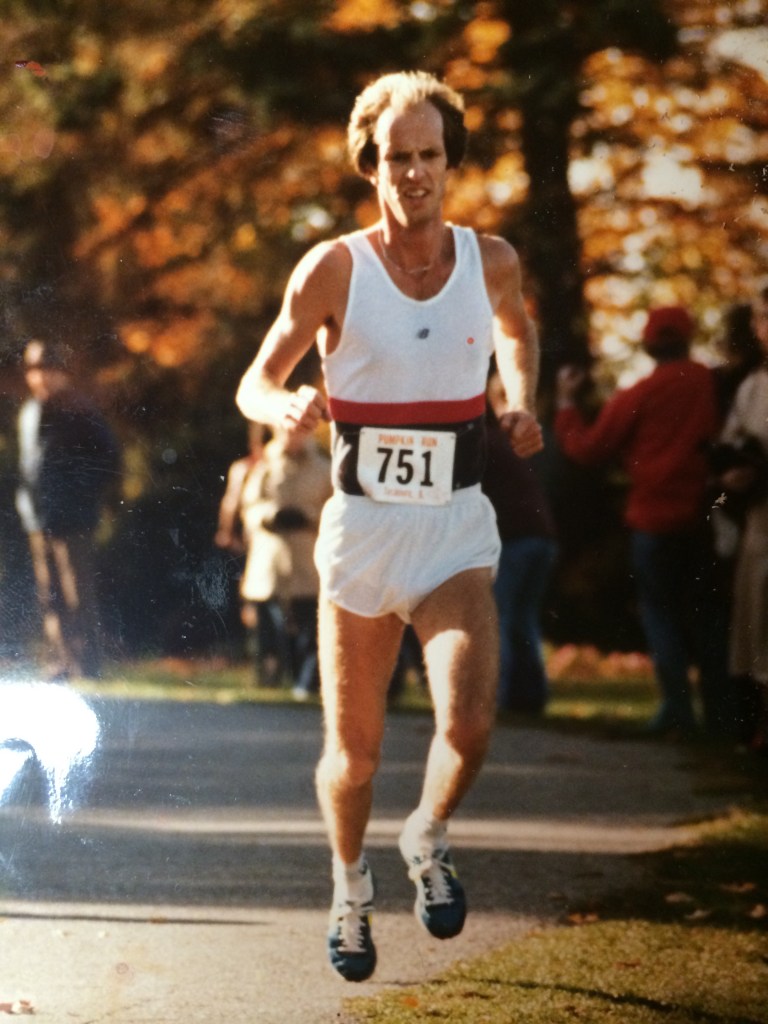
Circa 1983. Sycamore Pumpkin Run. Right before I earned sponsorship. Loved that NB kit.
That fall I won a race called Run for the Money. It earned me attention from a running store that was forming a sponsored team. They gave me racing and training shoes and equipment, and I started working part-time at the store. But otherwise I ran morning noon and night.
It was an admittedly self-indulgent period of life. Beyond the running, I chased girls in the city even while I was dating the woman that I would later marry. She lived out in the suburbs. I was also selfish about my interests and habits, spending entire days writing or painting in our two-flat Chicago apartment overlooking Lincoln Park. But I completed my first book and sold quite a few paintings. So it wasn’t wasted time. Mostly my hormones were the big distraction.
Winning ways
In 1984 I won a bunch of road races and that would turn out to be the peak of my career. By 1985 I was still running well but the obligations of life were staring me in the face, including the birth of our first child. I made a conscious decision that next October in 1986, the month he was born, to cease racing seriously and focus my energies on becoming a good father and provider.
I did not necessarily achieve those two goals in a perfect sense. There were times when I was distant emotionally. Mostly that was a product of my first awareness of anxiety and depression. Despite those vexing emotional hurdles, I did push into marketing and promotions. By the time I was 32 years old, along came a second child, a daughter this time. And from there life became a series of commitments to support their activities and education.
My daughter Emily and son Evan Cudworth
Both our children popped out of high school and into college only to have their mother get sick with cancer. She achieved remission multiple times but eight years later she could not hold out any longer and passed away in 2013.
During those eight years I tried my best to be a selfless caregiver. Her illness often required absolute attention. We’d spend long hours sitting in chemo treatment centers, me writing while she either read or watched TV as the chemo dripped through one vein or another. They even pumped huge doses of controlled poison straight into her abdomen. Then it was like they said, “Go ahead, walk it off.” And we’d come back a few weeks later for another round.
It was stressful. I took Lorazepam to help me through the nights. Then I’d wean off it when she got well again.
Linda with our daughter Emily on the banks of the Mississippi River in the Quad Cities.
But it was the side effects that hurt us the most. That required more attention than anything else. I tried my best to be a selfless husband to her then as well. At one point I was trying to help her down some awful liquid she had to drink for a barium test and she hissed at me and said, “Fuck you!” I deserved that.
That first year of her cancer my mother passed away from a combination of cancer and stroke as well. That meant I took over as caregiver for my father as well. That was my other duty all the way through 2015, just over ten years after my mother had died. His needs were many and he could be a demanding patient at times. Fortunately with the help of caregivers he lived a mostly fruitful life all the way through his passing.
Perspective
These days with the duties of caregiving behind me, I look back and wonder if life would have turned out any differently if all that had not happened. But honestly, I view much of those experiences as a benefit to my soul. I learned better patience, for one thing. And I learned to be less selfish about a ton of things.
But I’ll not say that all that caregiving did not have an emotional price. I’ve coped with the grief in a pretty healthy way. Going on long runs and rides to think it all through always helped. Yet there are moments when I feel the fatigue of caregiving (all those years) catch up with me. And I can’t help wonder what life might have been like without it.
Thinking back to all that supposed freedom in my early 20s doesn’t really help. The severance check they gave me ran out by autumn and I was living hand-to-mouth most of the next year, my big year in running. That’s actually a familiar story to many of us from back in those days. We were willing to sacrifice almost anything to run a little faster or a little longer. Running was an obsession.
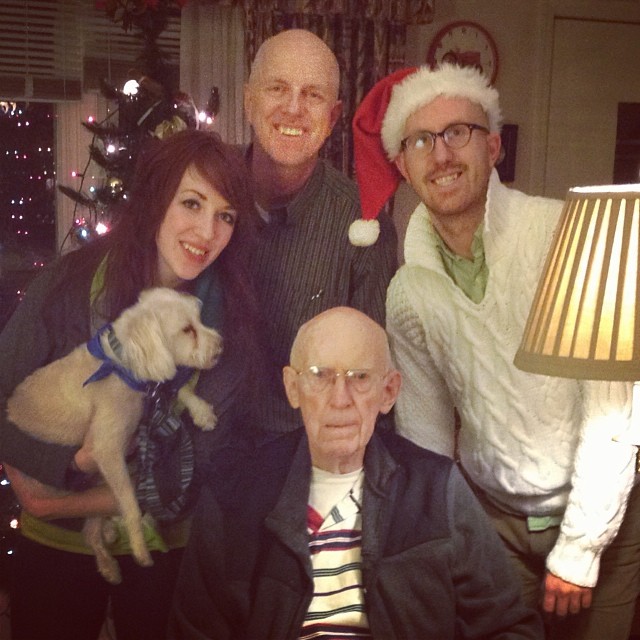
My kids and I with my father Stewart Cudworth. And Chuck the Dog.
I once said to my mother while she was alive that I felt a little regret at being so self-indulgent during those years. Without hesitation she said, “I don’t think so. You burned brightly.” She’d seen me win races with that fiery look on my face and the early signs of balding creeping back my forehead. She knew that you have to take some selfish chances in life when the time is right. The drive to be so obsessed is no longer there.
The writer John Irving was one of my favorite reads back in those days. One of the lead characters in his book Hotel New Hampshire said, “You’ve got to get obsessed and stay obsessed.” He was talking about wrestling, in that context. But we all knew it was a statement about life as well.
It’s hard not to feel a little selfish about my time going forward. I’m sixty-two years old and trying to save my ass off to plan for retirement, but life is rocky sometimes and the ups and downs can trip you up. That said, I’m writing books because there are things I want to say, and I believe the world needs to hear them. Perhaps that is a selfish thing to assume, but that is the core mission of every writer and artist on this earth. Produce or die. Say what you have to say. Show your goddamned cards or shut the fuck up. No one ever said life as an artist or writer is easy. But it’s much harder for those of us with these penchants to not do anything at all. That is anathema.
Power to the pup
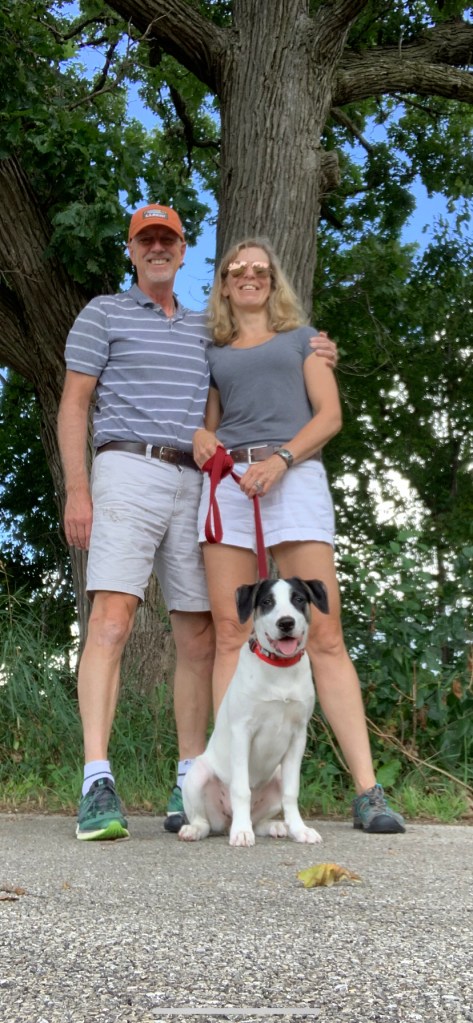
Sue and I with our new pup Lucy.
It’s even hard for me some days to not be resentful in my new duties as a dog owner. So much of the scheduled routine reminds me of all those caregiving years. Waking up every morning (and sometimes at night) to think, “What do they need today?” has been part of my psyche so long that it feels like a native anxiety. So part of me rebels at the thought of new obligations. I want to feel selfish and not feel guilty about it.
But that’s not really me. It never really has been. Not since I retired from competitive racing anyway. My selfish brain still has selfish thoughts, but then I see the light in the eyes of those I love and that all melts away. After all, it’s time to face another day. I always try to do it the right way. By putting others first.