With thanks to dad in the long run

Cudworth Racing SycamoreI’ve often related a story of how my running career actually got started in high school. As an eighth grader that previous fall, I’d won the local Punt, Pass & Kick competition in the town of Elburn, Illinois, advancing to the regionals where I did well but not enough to win.

Still, the idea that I would someday be a football player was stuck in my head. My father did not like the idea. Not for me, or for any of my brothers. He viewed the game as a knee-wrecker, which at that time was fairly true. But there was more to it than that.

He also did not want us to become wrestlers. My dad liked a certain amount of grace to the sports he helped choose for his sons. Baseball and basketball were terrific. So was soccer, so back home in Pennsylvania my brothers had both played soccer, one as a defender, and the other as a goalie.

When we moved to Illinois the high school had no soccer or baseball. Only football and track & field. So my brother who was a junior when we left Pennsylvania had no other choice but to go out for cross country the fall of his senior year at a new school. He did pretty well for having had no previous experience in the sport. Then he ran track & field in the spring in lieu of baseball. The athletic director was the track coach and wanted no competition for athletes from the sport of baseball.

FamilyThat was an unfair gig for my brother in several ways, but my father was not exactly sympathetic as I recall. That was not his style. His philosophy was “grow and adapt.” He thought it built character.

And so the same choice was made for me that freshman year in high school. We drove out to the campus and my father walked with me to the door of the locker rooms. “You’re going out for cross country,” he advised me sternly. “And if you come back out of that locker room, I’ll break your neck.”

As it turned out, that decision was the right one for me. I weighed about 126 lbs. on a 5’11” frame at the time. I might have survived playing football, but maybe not.

New BalanceBut after that first cross country practice, I knew the sport of running was for me. I loved the feeling of it. And with that drive came a modest degree of success. I made the varsity team as a freshman, led the varsity in points as a sophomore and then moved to another school my junior year to lead the team to a district title.

Beyond high school my running continued at Luther College, a school my father insisted I visit even after I had signed up at Augustana. My dad liked the sound of the wild country around Decorah. We drove through the hills of Wisconsin to northeast Iowa together and I recall a deep feeling of welcome sitting in the hippy cafe in downtown Decorah that day.

“You can cook wild game in the dorm around here,” my father counseled, and something in his message clicked. It also helped that Decorah with its hills and trees looked much like my birthplace in Upstate New York.

My father was more often right than wrong in his judgments and advice, but we had our differences for sure. The sometimes exasperating approach of challenging my perceptions caused some distance between us in the years of college and beyond. There were also anxieties stemming from a stern and sometimes physical upbringing that included thrashings if my father did not approve of the actions of his boys.

BrothersSome people sentimentally celebrate those corporal punishments as necessary to the upbringing of a generation. But I am not one of them. In raising my own children, I never felt the need to strike them. A couple attention-getting swats to their diapered or young bottoms, maybe, but perhaps three or four times in their entire lives was all that was necessary. They turned out wonderfully without having to beat the tar out of their bottoms or anything like it.

There was a certain level of anger that fueled our sporting endeavors as a result of the physical upbringing. We knew how to pass a licking on from one to the other within the brotherly hierarchy. We knew how to fight. There was also some cruel teasing involved.

All these are honest assessments of the period and time. They do not fault my father, whose own upbringing was absent both a mother and a father. His mother died from complications of cancer when he was just seven years old. His father struggled with financial and emotional problems through the Depression. Losing both a wife and a farm did not help the man.

So my father may have struggled for a role model by which to raise his own sons. Combined with the enormous financial ups and downs of the 1970s and 80s, there was plenty of insecurity to add to the mix.

CudworthEnglertBut there was no lack of love. Even through my father’s family and work challenges he was fiercely committed to supporting each of his boys in their athletic endeavors. Like all good parents, he attended our meets and games, often yelling to us “Stay Loose!” as a way to connect with us on the field. He could detect the anxious minds at work in his boys, and wanted us each to realize that the best way to perform was to lose that nervousness and gain the strength of relaxation. But sometimes his chortling calls worked to the opposite effect. My brothers and I will still tease each other with the call to “Stay Loose!”

Yet my father really did care how we did. And that’s what counted most. He also loved a good game of catch with a baseball. We’d take turns throwing knuckleballs to each other. All his boys turned into good pitchers in the sport of baseball. But none of us ever topped the knuckleball my father threw to one of my brothers. It fluttered through the air and then sank from shoulder height to drop near his feet at the last minute. My father loved a good knuckleball. It was like fly-fishing in the side yard, more of an art than an act of sport.

My father was pretty swift of foot in his day. As a kid I recall challenging him to a footrace in our Pennsylvania yard and he took off with that weirdly smooth stride of his. There was no chance I could catch him. Perhaps my father might have made a pretty good runner had he been given the chance growing up.

Instead, he watched us all race at some point in our careers. All my brothers and I participated in track and field. Jim ran a 4:40 mile as a freshman. Gary long-jumped nearly 20 feet. Greg high-jumped 6’6″ and made it downstate.

I was a little too eager about the whole thing, high-jumping 6’1″ and triple jumping 40’4″ in an attempt to win points for the team in high school. All that as a distance runner? But my father never made me quit trying field events. Anything for the team, he agreed.

Most fondly, I recall the day our cross country team at Luther earned second place in the NCAA National Meet. My father and mother were both in attendance that day in Rock Island, Illinois, where the flat course circled around Arsenal Island. When it was all said and done, and our team pictures were taken, I walked over to my father and gave him a long hug. It was the first hug in a long while, as I recall, because kids in the 70s often ignored or resisted their father’s attentions.

And yet, the feel of your father’s arms around you when you return to those graces with a hug can be liberating indeed. I simply said, “Thanks, dad.” And he hugged me hard.

There were tears in his eyes, for he knew that there were struggles through those long miles of training. But this was something we could both share, an accomplishment.

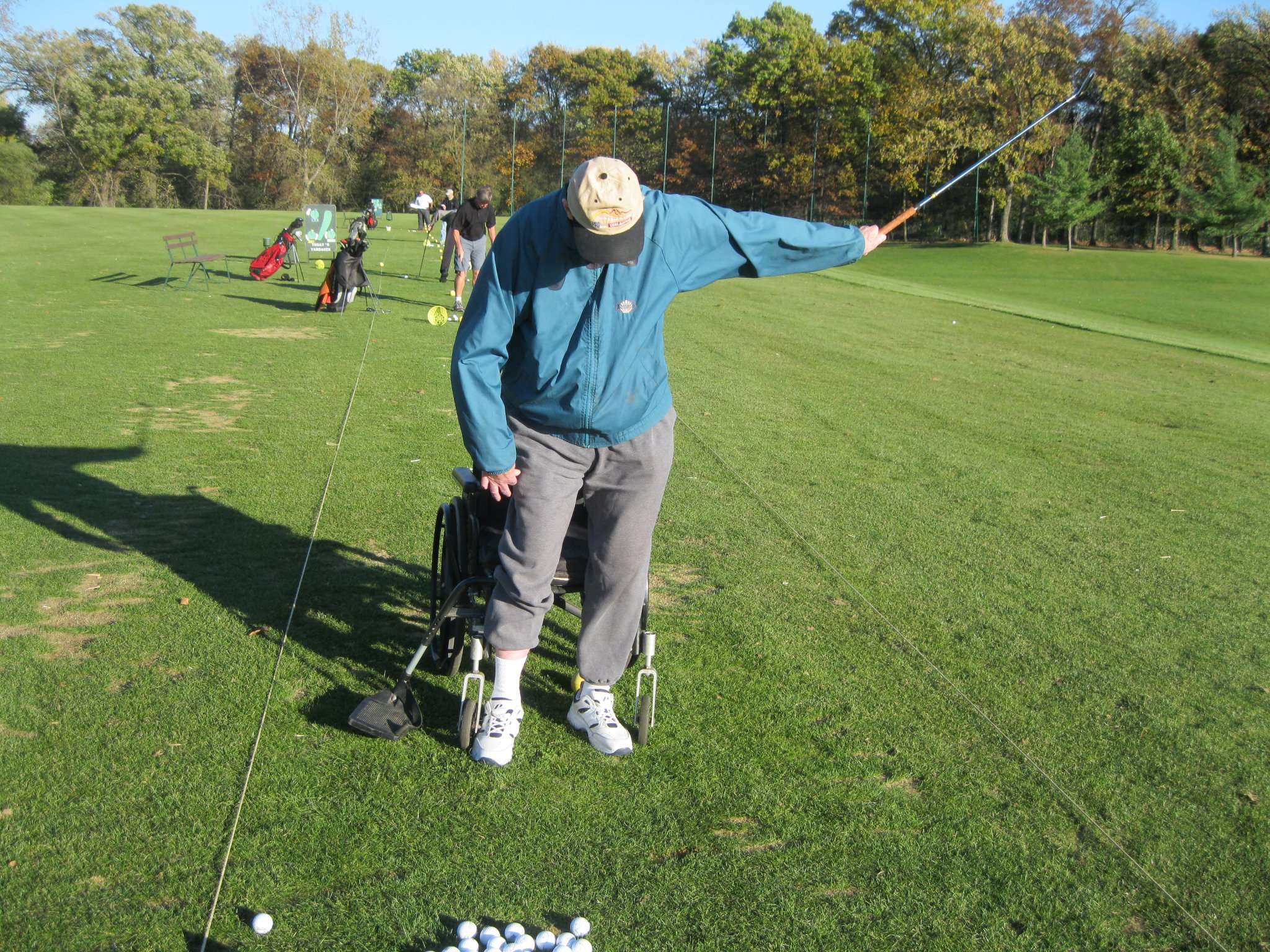
330060_111606775635235_2063240478_oMy father passed away this weekend after twelve very long years of living with the effects of a stroke. He was eighty-nine years old, and had dealt with his circumstance of not being able to talk or walk very well for all those years. He still got up and swung his beloved golf clubs, and with one hand repaired and refurbished clubs which he lovingly gave to friends or family. My dad loved the game of golf and won his flight one year in the city tournament in St. Charles, Illinois. It was my job to take care of him in many ways once my mother died twenty years ago. I always felt like it was returning a favor.

I still think about the manner in which he addressed a problem with my track spikes in high school. The long miles and hard intervals on the track were causing a tightness in my left Achilles tendon, so my father set to work making a heel lift out of leather to glue into my shoe. It was just enough to take pressure off my heel for the remainder of the season. I recall looking into the heel of those adidas blue suede spikes and marveling at how he’d managed to make the pad smooth enough not to rub my heel.

That was my father, a man who made real wooden frames out of rescued barn wood to help me sell my paintings at a local restaurant willing to hang them on the wall. Of course one morning the nails gave out and a frame came crashing to the table, flipping pancakes in several directions. “Nothing’s perfect,” he told me.

He also gave me advice about my artwork that has never been forgotten, and yet not implemented enough in some ways, “Paint squirrels,” he told me. “People like stuff they recognize.”

Brothers In Kitchen

Christopher Lynn Cudworth, Gregory Lawrence Cudworth, James Stewart Cudworth, Gary Douglas Cudworth, Our mother Emily Nichols Cudworth passed away in November, 2005. 

He was right about many things in this life. We had our challenges but through thirteen years of caregiving to the man who raised me and my three brothers, it was an honor to provide that care back. Sometimes it was done impatiently I will admit, for the fatigue of caring for a parent can be exhausting. For me it never occurred in any sort of a void. While taking care of my dad, I also ushered my late wife through eight years of ovarian cancer survivorship. Being pulled in two or more directions was stressful.

But when I really needed to get away, I went out and ran or rode some miles to help put things in perspective. That was a gift that my father gave to me. He somehow knew that my mind would need that in life. So it is that I’m giving thanks in the long run. We love you dad, and we’ll miss you.

Stewart Kirby Cudworth was born in Upstate New York in January, 1926 and lived to 89 years old. He was a World War II Navy Veteran, avid golfer, visitor to garage sales and socializer who loved to sing with a beautiful tenor voice. He earned his engineering degree from Cornell University and worked for RCA, Sylvania, Belden and Anixter in his career. 

werunandridelogo

Posted in Christopher Cudworth | Tagged , , , , , , | 4 Comments

Running it up the old flagpole

IMG_2250Yesterday I walked past the flag display at our local hospital. The flags were standing straight out from the pole. “Bad cycling weather,” I thought to myself.

Recently some friends participated in the Louisville Ironman. The swim is conducted in a river. We must presume they swim downstream, and not with the current.

Back in college our cross country team was hosting a few runners from a junior college. They came to visit the campus and joined us for a 10-mile run. Unfortunately, there were winds blowing more than 50 miles an hour. “This sucks,” one of the visiting runners said. “I’m never coming here to run.”

Tough times

None of us likes to do our activities when the conditions make it even tougher than normal to swim, ride or run. If we had it our way all the time, the wind would always be at our backs.

That seems to be the way some people like to view the world. If they see an opinion that does not agree with their ideology, they would rather walk away than engage in a genuine discussion about the subject, or better yet, learn something from the experience.

Some people accuse me of being intolerant of conservative opinion on this blog. But there’s a difference between publishing your opinion and refusing to read anything by anyone that might contradict your own. I listen all the time to conservative radio, for example. And I read The Blaze and other conservative websites to see what they’re saying. And I can’t avoid the Fox News television blaring away at the health club I use.

Footprint TwoDespite the claims of a so-called “liberal media” and bias against conservative causes, the facts point out something entirely different. The number of radio stations carrying liberal programming has dwindled thanks to station owners that don’t want that information getting out to the public. Television station ownership is similarly conservative, as are newspapers such as the Wall Street Journal. These are not liberal outfits. They are in the long run, conservative mouthpieces for policies in business, industry and the media that favor the interests of corporate conglomerates, monopolies and an oligarchic political system in America.

Odd bedfellows 

Today one of my blogs about sociopathic socialism was shared on a Tea Party site. I cannot presume to know whether they shared the piece on their site because they liked it or hated it. One can never tell. I’ll have to go see if there are comments. The wind of politics blows in many directions these days.

This much I can say. I did not arrive at my political views by accident, or without experience. Just as I did not become a runner or a cyclist and now a swimmer overnight, I have tested my opinions and digested a lot of information that runs counter to my principles. Yet I still read it, examine its merit and corroborate its fact or falsehoods.

And I have to tell you, there are a lot of obvious falsehoods, and opinion disguised as news.

Blog traffic

One wonders how people make decisions on what to read. The number of people who follow this blog rises up and down every week. I’ve noticed a quick drop of 5-10 followers every time I post a criticism of some conservative policy. I also sometimes mock the sports I cover, and perhaps that pisses people off as well. Yet sometimes I write things and 20-30 new followers join the site in a week’s time. It’s hard to predict.

But it’s not hard to determine what I think.

I believe in the merits of an examined faith and political life. From an early age, my instincts for social justice have gravitated toward liberal policies because those are the values advocated not only by the Bible, but by the United States Constitution as well.

IMG_8603There are several definition of Liberalism. The first is that it is a political philosophy or worldview founded on ideas of liberty and equality. The second is that it is a belief in the value of social and political change in order to achieve progress. The third, and equally valid definition of Liberalism is theology. “A movement in modern Protestantism emphasizing intellectual liberty and the spiritual and ethical content of Christianity.”

So those have been the foundations of my life, and none of these has been contravened by my participation in athletics. From a very young age, I learned there is a balance between individual achievement and sacrificing for the good of the team. These are both, according to the definitions of liberalism, good qualities for life and leadership.

Dropouts

It may just be my imagination, but not my fear, that some people drop off from reading this blog because I’ve offended them somehow. The winner-take-all atmosphere of politics in America has encouraged a watershed approach to how people engage in the information wars. People obviously tend to subscribe to websites that support their views and avoid those they find contentious or politically, religiously or economically offensive.

That’s not how I operate. I visit sites and articles that challenge my ideas. I’ll continue to profess what I believe and expect feedback from those who don’t share those views, and from those who do because I also believe in healthy debate.

I welcome both criticism and compliments. If you can make a case against what I say that makes rational sense, I’ll change my mind. But you’re going to have to work hard to do that, and argue with clarity and proof, because there’s frankly nothing in this world harder to be than a liberal.

Prime example

Just ask Jesus, who taught us a few things about love and convictions of spiritual liberty in the face of aggressive authority and material law. He ran his liberalism up the old flagpole and got hung there by nails as a result. I buy that example because I’ve made a life’s study of the Bible and its symbolic virtues, all of which contribute to its greater understanding.

You can argue all you want that conservatism is somehow the better foundation for society, or that progress in moral and social equality is somehow bad for our culture. You can whine about missing the Good Old Days, but they were only good for a select part of the population. Liberals helped change that by advocating equal rights for people of color, for women and for people across the spectrum of sexual orientation. We’re not going to quit, you see. It’s the race that never ends. We may be dreamers of a sort, but we liberals have stamina, and are willing to use it.

werunandridelogo

Posted in Christopher Cudworth, we run and ride | Tagged , , , , , | Leave a comment

The Truman Show is still running when it comes to climate change

The news came in 2-4″ of snow is predicted this weekend for Wisconsin. In case you’re geographically challenged, or live in a country far away (and there are many who read this blog who do) that’s the state just north of Illinois, where I live.

I like Wisconsin because it’s a great place to run and ride. There are hills, for one thing. Lots of beautiful hills from Madison west to Prairie du Chien. We’ve been riding our bikes up and down those hills a lot these past ten years. Running too.

But I swear that part of Wisconsin has its own weather system. For that matter, the whole state seems to be run by a band of angry Weather Witches who stir up local brews to unleash on the populace. Perhaps it is some sort of karmic vexation for vanquishing the native Americans who once owned and loved the state. But for whatever reason, one has to respect Wisconsin weather, because it will not respect you.

I have huddled inside tents at Necedah National Wildlife refuge while the rains pummeled the earth. I have run the first 10K of a half marathon with a mild wind at our backs only to turn around into a gathering gale that threatens to strip the clothes right off your body.

Of course, these personalized weather events are only my active imagination at work. The weather is unpredictable everywhere in the world. It just seems personal when it interferes with your favorite activities.

You might recall the scene in the movie The Truman Show in which Truman (played by Jim Carrey) is mulling his life on a beach when rain starts falling on his head. Sometimes weather feels like that.

But the whole point of the Truman Show is that reality is often not what it seems. This is especially true with a created reality. But as Truman grows to realize something is amiss in his world, he also becomes suspicious about its source. While he revels in his seeming control of the rain from above, it also starts his mind to working. His innocence begins to evaporate. He develops a cynical view of the world around him. If even the weather is cranked by some greater hand, what else in the world is not right?

Those of us who run and ride should know better than to think of the weather as some personal affront to our efforts. The randomness of weather is one of the complexities we all face in training and races. Earlier this year during the Batavia duathlon, the skies opened up and all of us competitors were forced to race our bikes through rainy conditions that were dangerous if you did not pay attention to your turns and your wheels in deep furrows of water washing down hills.

Everyone in the race was forced to deal with bad weather. Some of us got back to the transition to find our shoes filled with puddles. But it made it all interesting. And fun, to be sure. Our best stories often come from weathering adversity.

Yet all these localized weather events pale in comparison to what’s really going on in the world. We’re all just basically Truman characters in a play with rules and controls much bigger than the weather in Illinois or Wisconsin. See, the entire climate of the earth is impacted by human activities. It’s almost like the Truman show in reverse. Because you really can imagine the atmosphere on earth as a dome of sorts. It captures and holds all sorts of gasses, and these in turn capture heat and light and radiant energy. For a century the human race has been hyper-driving this process in a grand experiment. It’s like we’re challenging the world’s climate to dare to smack us down.

snowman6_1554874iAnd sure enough, it’s happening. Climate scientists have tried to explain this in a variety of ways, but there are quite a few pseudo-Truman-like characters in this world who would prefer to go back to that little world where everything is predictable and controllable.

And yet 97% of the world’s climate scientists have looked at the data a hundred different ways and come to the same conclusion. The earth’s climate is changing as a direct result of human activity. It’s called anthropogenic warming. We’ve turned the world upside down and inside out.

Yes, we’ve all heard claims that global warming is a giant hoax designed to fund the salaries of scientists and coerce nations to operate under a one-world government. We’ve also heard the oil-or-coal-industry-funded “science” that conveniently says what they want it to say, that greenhouse gasses could not possibly alter the earth’s warming and cooling systems. But if you’re looking for people trying to control the narrative, always follow the money to the source of the identified problem, because that’s where the most powerful interests lie. Pun intended.

Still, some people do still view climate only in terms of localized events. They see snow on the ground in their particular vicinity and boldly claim, “Look, the world is getting colder, not warmer!” One nitwit, Sen. Jim Inhofe, balled up a snowball and preached in a bald-faced manner that a handful of snow was proof the earth’s climate was not changing.

A friend of mine recently sent me an email about this phenomenon of un-Truman-like forceful stupidity.

“We — Americans — have the attention spans of gnats. Short memories are both our greatest national advantage and curse. On one hand, we can shake off previous setbacks and plow forward, while on the other, we keep reliving history because we so quickly forget it. How the micro and macro of a condition is at odds with itself.

Road signsBut the thing that drives me mostest nuts is the lack of scientific knowledge most Americans possess. For instance, many mouth-breathers are now climate-change deniers because of this:

http://www.businessinsider.com/polar-vortex-week-of-nov-10-2014-11

The polar vortex will visit the midwest again early this year, plunge into the south, race to the east coast.

It’s cold, say the scientifically challenged. Therefore, how can this be global warming?

Because nature abhors a vacuum, idiots.

The Pacific is superheated. Much warmer than usual (and full of radiation, but that’s not part of this argument). The Pacific current races from the equator past Mexico, California, the Pacific Northwest, hits the arctic and the warm water is cooled, plunges to the bottom of the seabed. It’s a heat pump and cooling station all at once. 

swimming_poolBut because the Pacific is so warm, by the time it reaches Canadian and Alaskan borders, it’s pushing much warmer than normal air along. The warm high pressure pushes the cold low pressure in the middle of the continent out of its way. The only place for the dense, cold air to go is south, ergo, polar vortex. 

It’s because of increased heat we’re cold. 

Try explaining it to any climate denier. They stick their head outside and call it a personal scientific study. “Nope, it’s cold. Global warming is a lie.”

The issue of global warming is a tremendous symbol for human arrogance in the fact of facts. We tend to do the same thing with economic patterns as well. Economists keep predicting another economic crash because the factors that contribute to a balanced economy such as middle-class wealth keep draining away. The Economic Vortex keeps building and building. We can see the signs, but the biggest banks keep growing, and that heats up the risk factors that too much money is concentrated in one sector of the markets. We’re told those banks are “too big to fail.” Yet they can, and they likely will again.

Wall IceThese are cause and effect issues we’re talking about here. It’s not about rain falling on the head of Truman or you and me. It’s not about whether it’s cold in your part of the country when it’s winter. It’s about whether temperatures all around the world keep surging. They may ebb now and then, but when the trend is consistently upward, we should at least pay attention to factors that may be causing that to happen.

The world is supposedly a big place. The earth’s climate is supposedly too big to fail just because human beings drive cars and cows fart. It’s easy to be cynical toward such illustrations of risk. It makes some people feel smart and sophisticated to brag that because they’re not scientists, they know better than scientists what we should do politically about global climate change.

But if you had a coach who told you, “You don’t need to train for that next event. The training you did last time will hold you over,” would you listen? Or do you comprehend that while the training we did forms a baseline, it does not last forever. But the things we did yesterday can teach us about tomorrow, but they are not necessarily sufficient guarantees of future performance. That means we must all be prepared to learn from the past yet make preparations for the future, if we expect to have one.

It’s like that with our changing climate, and with our perpetually changing economy. The parallels are spooky, and earnest. Here’s hoping those of you who read this are not just mouth-breathers about these issues. Take a deep breath, and take a long look at how the world really works. You should know intuitively from being an athlete that what you put into the world is what you get out of it. Think about that long and hard during your next workout. And vote accordingly for those who do not deny reality, or expect you to do so for their personal benefit in terms of the power, authority and wealth it affords them in the short term.

They are the bad coaches in this world. And there are plenty of them.

werunandridelogo

Posted in cycling, running, triathlon | Tagged , , , , , , , , | Leave a comment

The view from the hospital

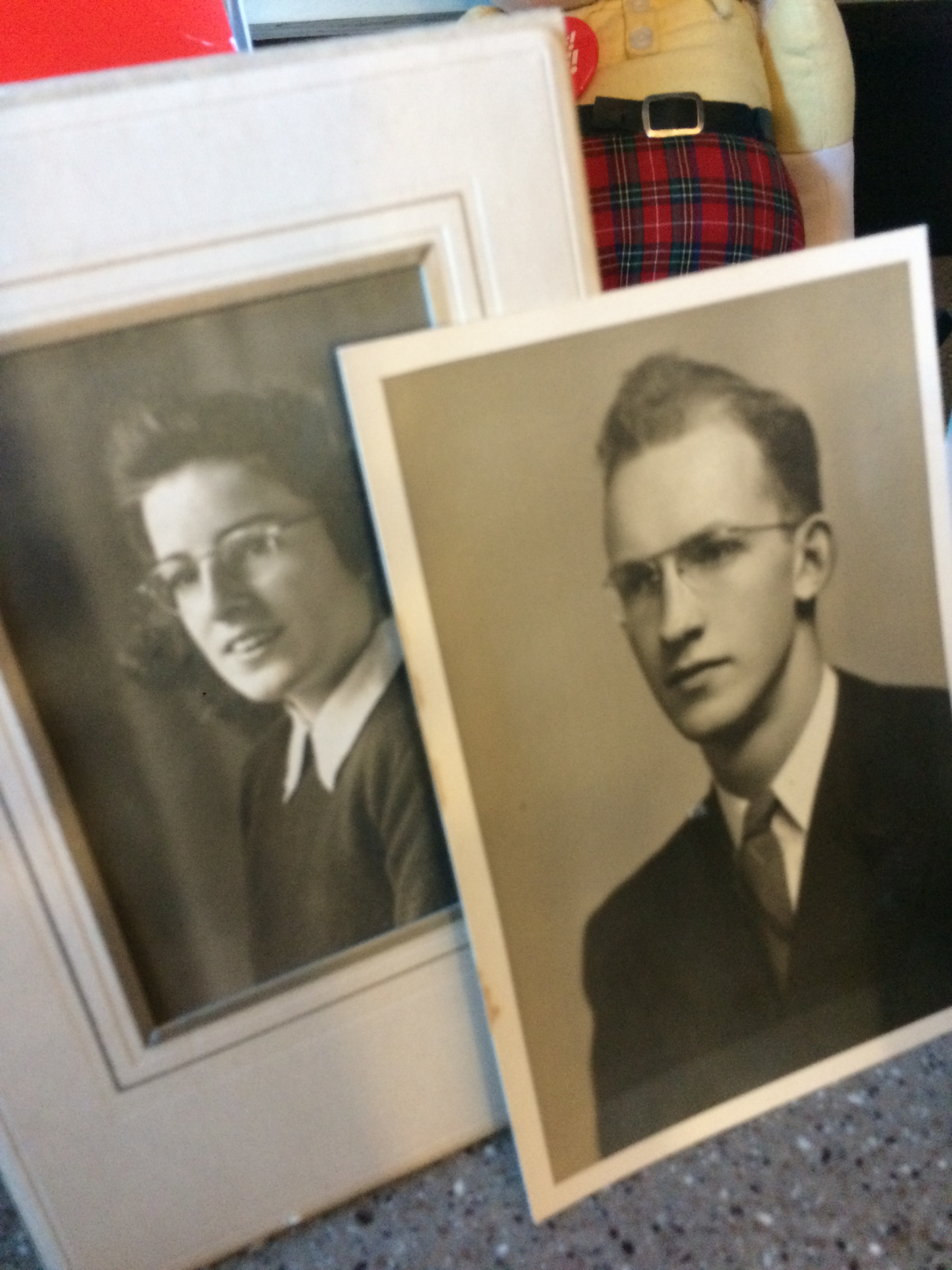
My mother Emily Cudworth and father Stewart.

My mother Emily Cudworth and father Stewart.

Ever since 2000, the year my father had his quintuple bypass surgery, followed by his stroke two years later, and the death of my mother in 2005, my life’s journey has involved visits to quite a few hospital beds.

That’s not even factoring in the eight years my late wife dealt with ovarian cancer. She endured multiple chemotherapy treatments, surgeries and side effects that drove us to the hospital, it seemed, on every possible major holiday. We visited the hospital on Easter, the day after Christmas, Memorial Day, Labor Day and all points in between.

It was tough for this formerly hyper distance runner with boundless energy to learn to sit still in the hospital and wait. Because that’s what caregivers do. You stand by your patient and you wait. For doctors. For nurses. For news on surgery, or chemo, or test results.

You sit, and you wait. Patiently.

It’s an endurance test of a different type from going out and running 15 or 20 miles, cycling a century or swimming until your arms ache. Caregiving is the ultimate test of character.

My father is lying upstairs in a hospital bed right now. A month ago he fell while trying to get up to go to the bathroom in the middle of the night. He’s 89 years old and weakened on one side from the effects of his stroke. He’s not supposed to do things on his own, but he’s a determined fellow and not always willing to listen to instructions.

So he fell on his shoulder and broke his arm. But that was just the first incident.

We treated the arm and the doctors decided it was best to let it heal naturally. My dad of course still has heart issues and putting a person with issues like that through anesthesia is not always the best idea.

So he went home and hung out for another couple weeks. And then he decided again at 2:00 in the morning it would be a good idea to get up and go to the bathroom on his own. His live-in caregiver does a wonderful job with my dad normally. But again, my dad is a determined fellow.

This time he fell and broke his hip. That’s never a good thing for elderly patients.

There was no avoiding surgery if my father wanted to live beyond a few months. He is lucid and understood that. So he had the surgery.

But it’s no easy road. There are no guarantees he’ll recover well from all this. My family understands this. My dad has gotten through tons of stuff over the years. Frankly there were people who never thought he’d survive beyond the first year after his massive stroke in 2002. He was weak and frail and hardly recognized us. But he’s a tough man and even after my mother passed away ten years ago in November, my father grieved her and kept on living.

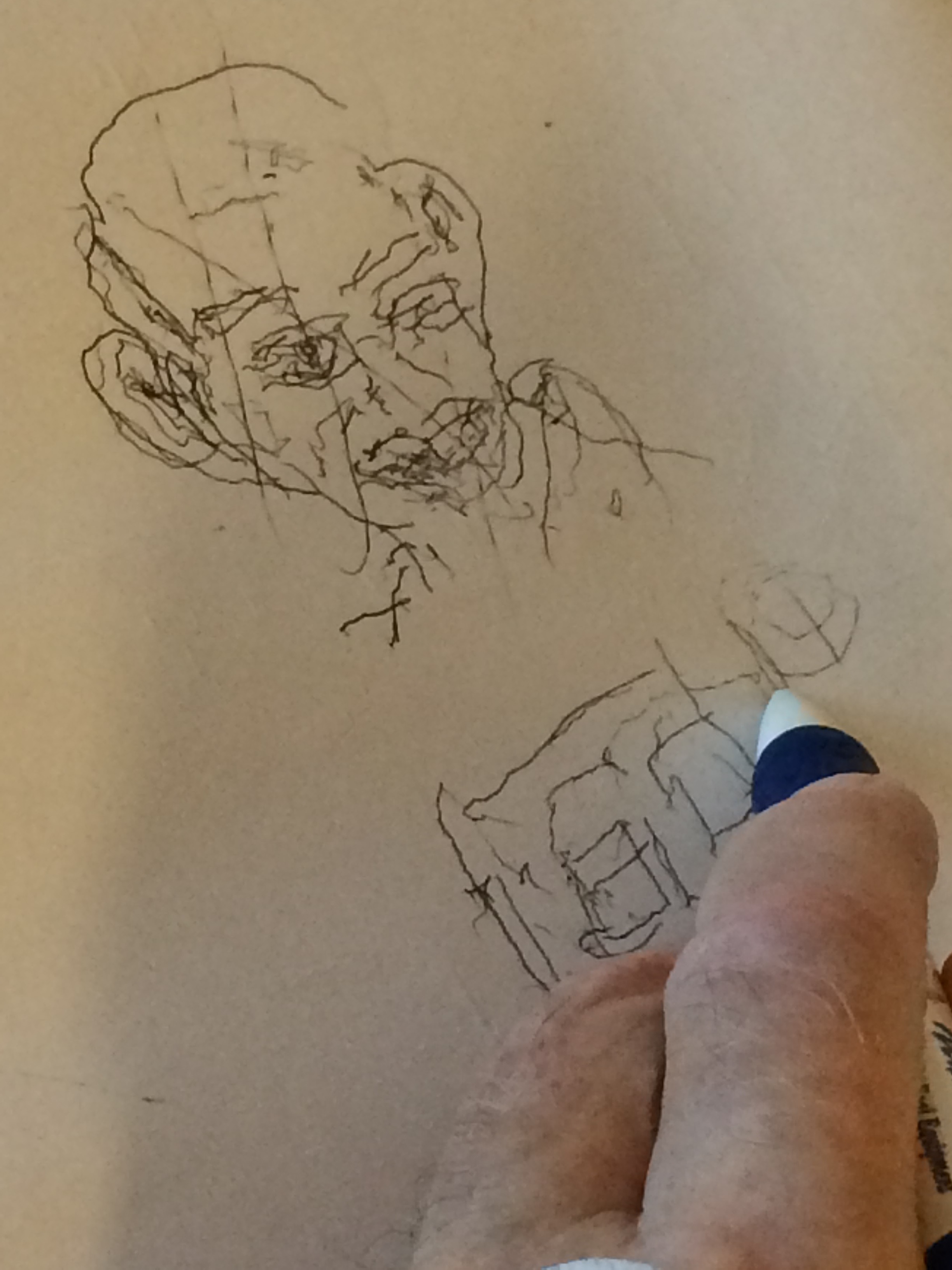
IMG_3684He’s been bombing around visiting garage sales and buying all sorts of weird crap ever since. There are ten full sets of golf clubs in his garage. He still uses his one good hand to repair and restore clubs. He can also draw quite well using his left hand. That has been useful in his communication because he lost the ability to speak after his stroke. For thirteen years my father has not been able to say much more than the word “Poo,” if he doesn’t like something, and “Yeah…” if he does.

It’s been up to me to lead the conversation all these years. I’ve learned to ask questions that get to the core of what he wants. For a long time it was difficult and he’d get so angry he almost got physical. But over time we’ve both learned patience. Sort of.

He still gets that stern look on his face when he’s displeased. As his caregiver says, “Stew the Boss.” Well, that pretty much means he demands things be done his way, and right away.

That’s not always possible, as you can imagine. He was in pain earlier this week and it took a few minutes for the nurses to arrive. Dad fussed and scowled. I’ve always wished he could be more grateful for the care he receives. Perhaps it’s not in his nature. Everyone has their own character with which they sail through life. Sometimes people feel like a pirate flag is better than any other form of signal.

In between caregiving visits I’ve squeezed in a few runs and rides this week. And yesterday I went to the pool and saw genuine improvement in my ability to swim longer intervals. That was encouraging.

It all helps make it possible to tolerate the view from the hospital where my father struggles to breathe and life is confined to a bed full of floating sand. Seriously, that’s how hospitals deal with patients who might otherwise suffer bedsores.

It’s all part of the deal. Life is always a balance of freedoms and obligations. That’s how we all have to roll at times. The view from the hospital is no different than any other.

werunandridelogo

Posted in cycling, running, swimming | Tagged , , , | 4 Comments

Eight days a week, and eight weeks a year

Really intense periods of training can make you feel as if time does not exist, or exists in duplicate.

Recently my companion Sue was involved in Ironman training and there were about eight weeks in her training schedule that very nearly wore her out. She was quite literally training eight days a week because the extra workouts needed to build endurance added up to an entire extra day spent on the road or in the water.

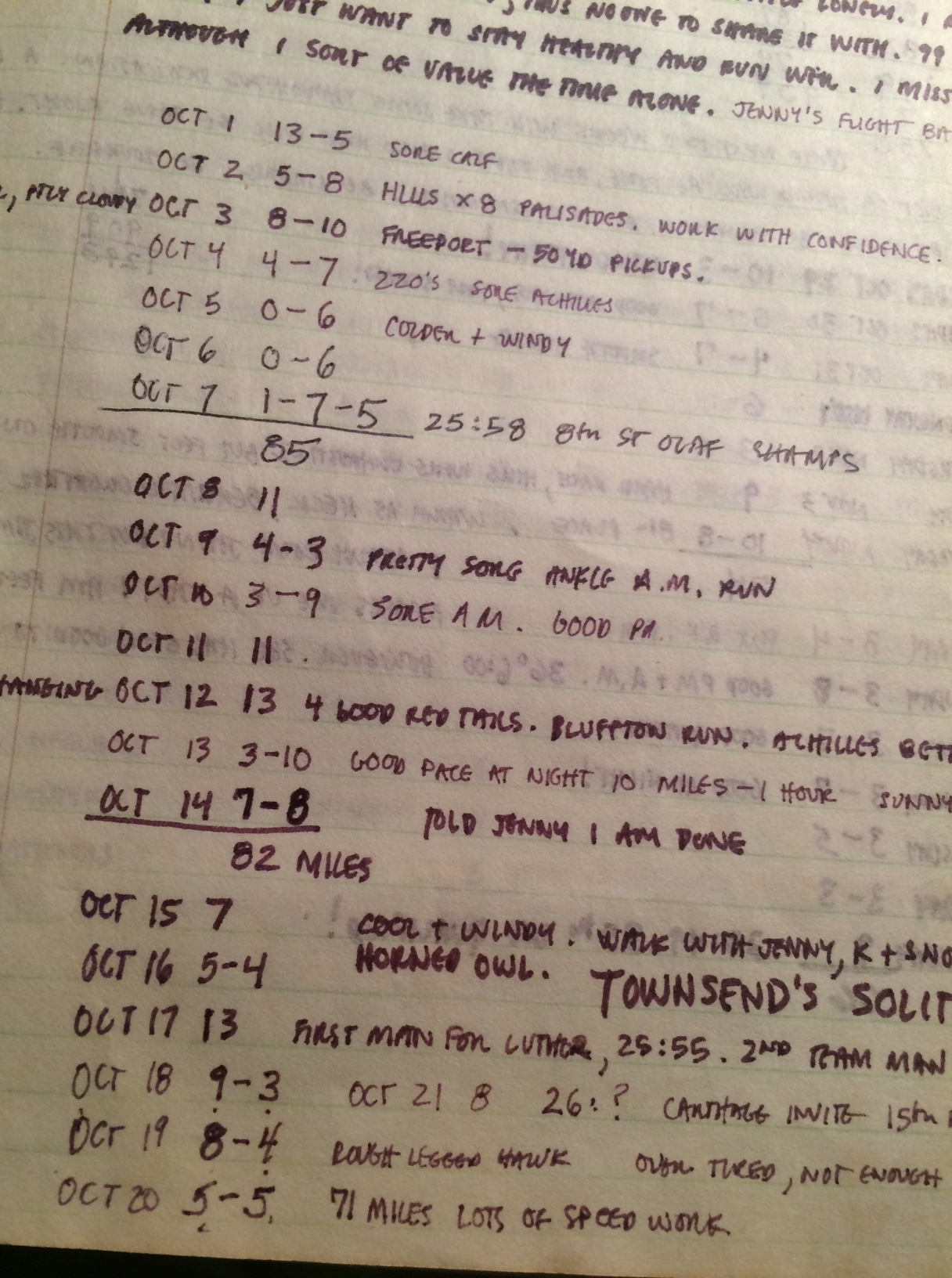
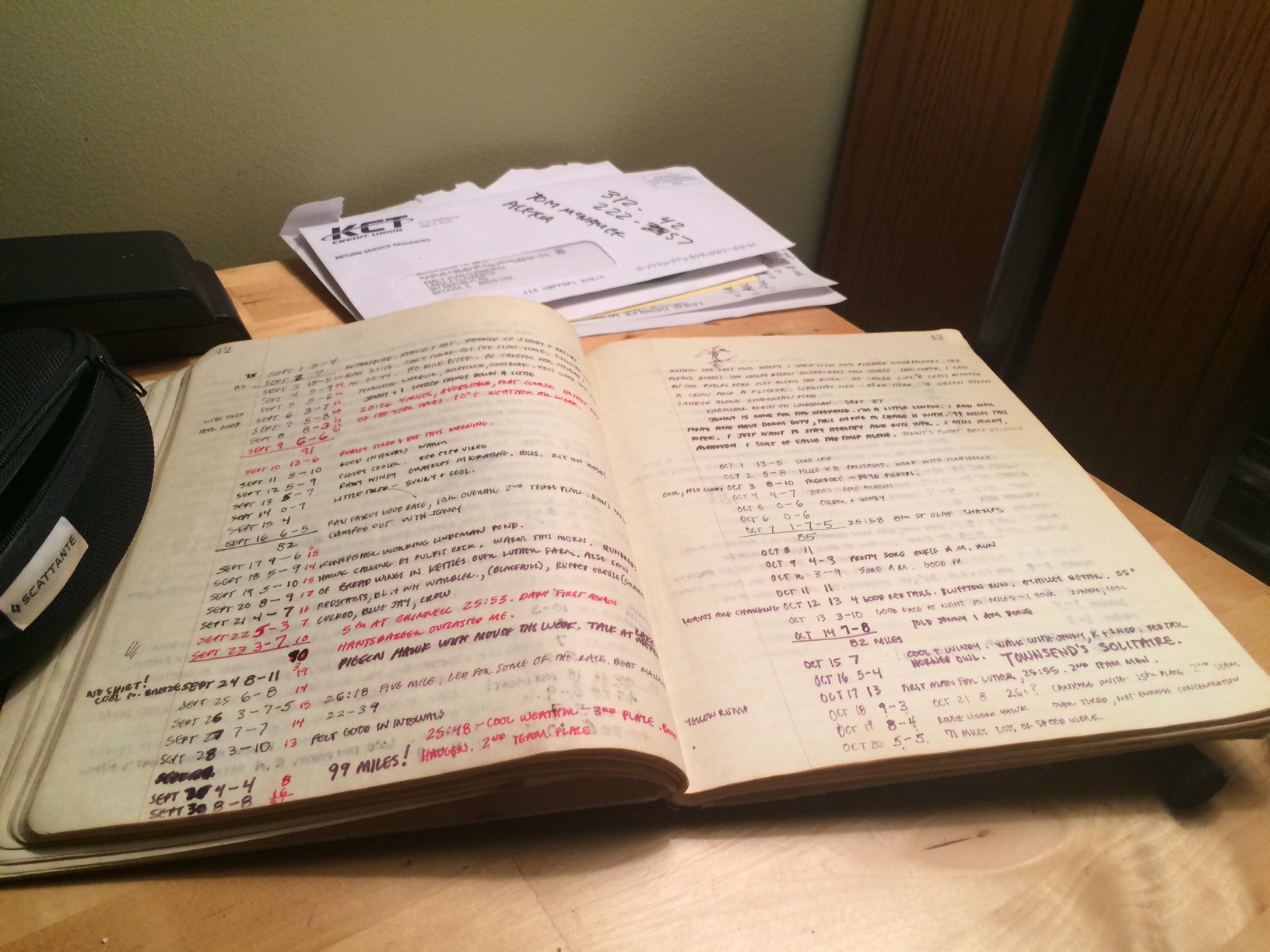
When you’re shooting for an important goal, that’s what it takes. Thinking about the amount of work necessary to improve and succeed made me take out one of my running journals to look through the double workouts we did during college cross country.

IMG_3694Looking through this journal from October, 1978 has always been interesting to me. Sometimes it feels like it was written by an entirely different person from the one I am today. But in other ways, it does not feel like I changed at all. My interests and concerns have not shifted. There are still birding notes among the workouts recorded on those pages. There are comments about the woman I was dating at the time, and how I felt in her presence and her absence.

In particular, there were concerns about how tired I felt, and trying to balance rest with other obligations. At one point, all that pressure added up. And as noted in the journal, I was not willing to compromise or suffer distraction on the goal of a good competitive season for which I’d worked four full years. This was, I knew, the one time in life that all should be given to attaining that goal.

IMG_3695We went on to finish second in the nation that fall.

The point here is that none of this takes place in a void. We can try to isolate our efforts and reduce our obligations while training hard, but life and love and challenges still intervene.

Perhaps you keep a record of your efforts somehow. It’s a fascinating thing to look back a week, a month or many years to consider how you did what you set out to do.

Often these efforts come down to a critical eight week period when your training either goes well, or it doesn’t. It doesn’t matter what event you’re trying to do, it still comes down to eight weeks. That’s when you either nail it in training or you don’t. Then you taper for a week or two and have a go at whatever you’re trying to achieve.

It can give you confidence to know that you’ve done the training. And in the greater scope of life, knowing that you did those eight weeks right can make you believe in yourself in other ways. Eight days a week. Eight weeks a year. It all comes down to the eights.

werunandridelogo

Posted in Christopher Cudworth | Tagged , , , , | Leave a comment

Confusing times and tarsnakes afoot

IMG_2250Last Friday afternoon, eager to get in a good workout, I headed out the Great Western Trail in St. Charles. The trail is a former railroad bed that was one of the first lines in Illinois to be converted to a running and cycling path.

The trail is popular for many reasons. It starts at the former entrance to Leroy Oakes Forest Preserve where many high school cross country meets are held in fall. During the summer months, large groups of runners and cyclists gather to go on training runs in preparation for summer and fall races. Serious cyclists don’t really ride the trail for very far. Instead, they head northwest or west on the open roads of Kane County. That’s where road cyclists belong. On the road. Not on the trail. But try to tell that to motorists who can’t stand our confusing presence. They refuse in some ways to ever get that.

Serious runners do use the trail. Way back in the early 80s it was the hub of many runs with training partners whose times for 10K were in the low 30s. We’d hammer five miles out of town and come racing back.

The great thing about the trail in summer was the shade. Long stretches were shrouded by trees. Years ago I recall the trains barreling through these same trees on the way out of Chicago to points west.

So the effect still remained. The long tunnel of trees from St. Charles out to Wasco filtered light and kept you cool on otherwise hot days.

The miles are marked by small green markers fixed to bridges or posts. We must assume they are reasonable accurate. It’s not that hard to measure out a mile and put a marker in place. Still, there are days when you sweat those mile markers are a little long. The older I get the more that seems to be the case. A speed that feels fast now used to be my warmup pace.

IMG_2251So last Friday I ran the first mile at 9:00 pace and popped up on the trail near the first bridge over Peck Road. Right behind me there appeared another runner dressed in a strange combination of running and soccer clothes. Looking ahead, I saw a guy dressed in orange ahead on the trail. I decided to try to catch the Orange Guy and leave Soccer Guy behind.

Dialing it up to a quicker pace, I passed the mile marker and tuned into the tempo. The miles clicked away fairly smooth at this pace. But I wasn’t catching Orange Guy. He was moving slightly faster than me ahead on the trail. It bugged me that he was pulling away ever so slightly.

Soccer guy fell back, but not completely. At the turnaround point I waved as Orange Guy passed me on the way back toward town. Then I turned around and waved to Soccer Guy. It was a linear dance of pace. None of us was catching or really losing the other.

In some ways this was confusing to me. For most of my running career there were very few people I could not catch on the trail. Training in Chicago’s Lincoln Park in my early 20s, I took pride in mowing down one runner after another. Once in a great while there would be another quality runner on the trail that I could not catch, or who tried to catch me. Sometimes we’d run together, taking measure of each other and talking about our respective times for 5K, 10K, 10M, Half Marathon and beyond.

Headed back on the trail toward town, I kept the pace in the low 7:00 range. It felt faster though, but the watch and the Strava don’t lie.

Finishing in 46:27, I tried to calculate what the overall finish might have been without the 9:00 first mile. Taking off 2:00 left me with a 44:27. That’s about the pace I ran for the first six miles of my best 10K last fall.

Perhaps I’ll run a bit faster in real racing mode. I wasn’t exhausted at the end of the training run. And thinking ahead, that pace felt good and manageable for a possible half marathon in November.

We’ll see. These are confusing times for a guy who once used to run these times in practice, and faster. It makes you wonder if it’s truly possible to run much faster even with tons more training.

Life rolls on either way. If it comes through the fun I’m having in training, then so be it. If not, that’s fine too. I’m motivated because the act of running still feels good and does good things for my head. It’s one of the tarsnakes of aging that you cannot improve your times forever. Sometimes you’re getting better just through the act of staying the same. Go figure.

Confusing times or not, the effort is still worth it.

werunandridelogo

Posted in Christopher Cudworth, Tarsnakes | Tagged , , , | 2 Comments

Unbroken and Whiplashed

Louis_Zamperini_1aLast night I did the movie thing. Watched the Angelina Jolie feature Unbroken about Louis Zamperini, the World War II bombardier and Olympic distance runner who survived captivity in a Japanese prisoner of war camp.

Then I watched the tail end of the movie Whiplash, which is the story of a drummer under the tutelage of a demanding, uncompromising professor.

Both stories are about perseverance. One is about surviving brutal treatment at the hands of someone who considers you the enemy. The other is about a teacher who believes that you can only become better if you are not coddled or told “good job.”

Seen back to back, the movies certainly make you think about the importance of character. The fact that Zamperini was a distance runner before he became a soldier, survivor of 40+ days at sea and a prisoner of war, makes the statement that knowing your body and mind can certainly help in facing life’s difficulties.

Yet there were hundreds of other survivors of those war camps, and not all of those people were athletes at all.

Which means there was something else at work. The movie Unbroken strongly suggests and conveys that something else is personal faith.

Faith in God is one thing. Having faith in yourself is another. That’s the message of Whiplash. The young drummer puts himself through merciless practice sessions where his fingers bleed and his entire body is coated in sweat. Still he cannot please his merciless instructor, who vets and cajoles and tortures the kid into submission.

The professor’s goal is to bring out the best in his musicians no matter what. Without that pressure, he contends, there is no way the work and talent can pay off. Mediocrity is not something to celebrate, he contends.

The difference between survival as a prisoner of war and surpassing mediocrity as a top flight musician is a fascinating difference to consider. Perhaps only by coming close to being killed, or by killing ourselves with effort, do we ever now what spirit lies within.

The abiding message is to never give up. Despite what Nike tells you, don’t Just Do It. When it comes to giving up, Just Don’t.

werunandridelogo

Posted in Uncategorized | Tagged , , , , , , , , | 1 Comment

Is it better to stand your ground, charge the shooter or run away?

IMG_3546The strange campaign of Republican Presidential candidate Ben Carson continues to entertain but seldom inspires much more than a scratch on the head at his oversimplification of every issue he encounters. As quoted in a recent New York Times story, he spoke about the most recent mass shooting in Oregon.

“I would not just stand there and let him shoot me,” Mr. Carson, who has been surging in recent polls, said on Fox News. “I would say: ‘Hey, guys, everybody attack him! He may shoot me, but he can’t get us all.’ ”

That assumes, of course, that everyone in a room of panicked people will stop long enough to listen to the calm voice of Dr. Carson. It also assumes the shooter will specifically target Mr. Carson, as requested, and not have time to mow them all down with an AK-47 or other military-grade weapon.

One wonders whether most of us would not follow the example of those frightened knights in the Monty Python movie the Holy Grail and shout, “Run away! Run away!”

Choosing heroics

Granted, the narrative chosen by Mr. Carson seems more heroic. It is simply not considered courageous to turn around and run like hell when confronted by violence.

And I can actually speak from experience about it’s like to be chased by a knife-wielding maniac. Way back in 1976 while running through the City of Geneva,  an overgrown punk that did not like me running through downtown chased me for a block yelling insults. Then he climbed into his car, pulled up on the street ahead and got out to throw a very large knife at me, which I dodged. To this day, I’m glad he did not have a handgun. I might well be dead. Running away was a good strategy in either case.

Mass shootings

I’m not sure what I’d do in a circumstance where other people’s lives are in danger as well. I do know that I’m still faster than perhaps 99% of the population, so I’d have an advantage over others by running away. But I can’t imagine the idea of leaving people to die in a room behind me, either. So I’d like to think that I might behave as Mr. Carson suggests. Run right at the shooter and try to take them down. I’d have an advantage there too.

I’ve actually imagined what I’d do in such emergency situations. While I value my life, I also recognize there are higher purposes than saving your own skin. So I get Dr. Carson’s sentiments. But I do think he’s making a cloyingly political argument by suggesting that most of us would have the presence of mind to charge a shooter when faced with a hail of bullets. If that’s the logic for supporting gun rights, his argument is really weird, don’t you think? His point seems to be that we should never infringe on the rights of the heavily armed shooter before he goes out to kill. Instead, it’s our obligation to accept that such shootings are bound to occur. They are a naturally-occuring expression of a democratic society. It’s not our obligation to prevent mass shootings, Dr. Carson argues, but it’s our obligation to stop them once they begin taking place.

Armed and dangerous 

As for arming myself and standing ground against another shooter, that’s a fantasy that I’ve addressed in this blog on other occasions. I’ve wanted to shoot out the tires of some aggressive drivers that have driven me off the road. Others have gotten out of their vehicles to accost me on the street for the simple act of riding my bike. So yes, the idea of having a gun on my person has seemed inviting at times.

So I get that people who find themselves in threatening situations want to own guns and protect themselves. I really do. Not everyone has the ability to run away, or run at a shooter, especially in America, where the overall obesity rate makes it pretty tough for many people to run ten feet, much less escape from a hail of bullets or rush them like a running back aiming for a hole in the defensive line.

Given America’s love with football, that’s an interesting analogy. Because while 30,000+ people are dying annually from murders or suicides due to guns, millions more are dying from the effects of heart disease, diabetes and other illnesses caused by obesity. It actually seems the worst thing you could possibly be in terms of life expectancy is an overweight gun owner.

But I agree that people should never have to run away from your own home either. So the right to keep and bear arms makes total sense in that context. What we ultimately need to seek is the balance between the right to bear arms and the right to slaughter people at will. Because we don’t have any good solutions right now, but we’ll get to that.

Military thinking

Our society is becoming militarized as a direct result of liberal gun laws. You heard that right. Our gun laws are in fact “too liberal.” Because conservative gun laws (by definition) would first assure that said gun laws “do no harm.” That is clearly not the case right now. There are almost as many guns in America as there are people.

Not all of us want to live in a militarized society. Likewise, there is the long-standing problem that our military personnel feel disgusted by the lax attitude of a society with little apparent respect for tradition or sacrifice. We’re a culture that increasingly acts like it is a wing of the military without expressing any of the discipline or rules it takes to survive or manage that approach to living. We don’t seem to want to respect ourselves, or respect others.

No soldier boy 

It so happened… that my slice of the American generation fell into a gap where draft registration was not required. As a result, I never received weapons training as part of military service. Neither did I get yelled at in boot camp, or broken down and built back up to automatically respect authority. As a result, perhaps I retained a habit of questioning authority, demanding explanations and reasons for the actions of others. This is especially true when confronted by “rules” imposed by force of will, much less bullying, hazing and collective agreement on social policy without sound basis in reason, not ideology.

And yet, my participation in the sport of distance running delivered experiences in physical, psychological and emotional discipline. We trained like soldiers in boot camp, running hard through the early dawn hours and sweating through August heat in preparation for the season. Then when competition began, we learned the virtues of personal sacrifice for the betterment of the team.

Take one for the team

IMG_3541So I appreciate there are traces of that mentality in Dr. Carson’s call to “take one for the team.” And yes, there have been recent instances in the news where people did not just run away from attackers. Those three fellows on the train in France, for example, may have prevented some genuine terrorism.

Again, military and police training does come in handy in those situations. Those guys were also in their mid-20s, appeared to be in good physical condition, and took a chance and succeeded.

Not all potential heroes are so strong, or so lucky. Significantly, none of the three men that took down the shooter was armed. They did not whip out their own guns and shoot the guy on the spot. They did what Dr. Ben Carson suggested and charged the shooter. One got a severed thumb and injured arm and neck out of the deal. Being a hero takes some doing.

Carrying a piece versus peace

But I’m still not sold on the idea that everyone carrying weapons around in public is a good idea. Wherever that happens, there tends to be mayhem. The streets and neighborhoods of major cities across the country are murderous danger zones because guns are still far too easy to get by people who refuse to respect the rights of others. In fact they specifically get their hands on guns to demand respect that they might not really deserve. That’s a deadly combination.

Arguments that it is people that kill people and not guns that kill people are absurd. There is no such thing as a drive-by knifing, for example, or a mass knifing at a public school or movie theater. Those things just don’t happen. A mass of people can indeed run away from a knife-wielding murder. But when a murderer armed with automatic or semi-automatic weapons opens fire, there is no such thing as running away.

I’m happily part of the 1% in terms of total foot speed in America, but I cannot outrun a bullet no matter how hard I try. That’s never going to be my idea of “taking one for the team.”

American and friendly fire

It comes down to this: there is a logic to the constitutional call for a well-regulated militia that we seem to be ignoring in the public space. Even military personnel keep their guns locked up when not in use, and that’s on their own bases. If even the military recognizes that carrying weapons around all the time is not a good an idea, why does the rest of America not get that? It’s because men like Dr. Carson invoke the fantasy that heroic gun-toting and charging a gunman in the face of murderous intent is both a practical necessity and a badge of honor.

No, Dr. Carson. It’s insane to suggest such a thing. It’s also unconstitutional.

See, the military abides by the Constitutional demand for a “well-regulated militia.” Soldiers often don’t carry guns until they need them in their line of duty.

And still they sometimes shoot their own comrades. Ironically, that is called dying in “friendly fire.” So even the military can’t speak honestly about the ill caused by guns. They are forced to use a euphemism to disguise the fact that people die from gunfire by mistake. Somehow being shot and killed by your own army does not seem friendly in any significant way.

And when we apply this “friendly-fire” standard to America as a whole, we find out that more Americans have died from gun violence here on our own soil than all the soldiers that have died in foreign wars. America is literally a nation killing its citizens on a daily basis through friendly fire. Our unenforceable guns laws are responsible for those statistics. But we’ll get to the solution to that problem in a minute.

Militarizing ourselves

IMG_3522Even the military standard of regulating and using weapons only when necessary is not good enough for the 50 states that have passed Concealed Carry laws. These plainly flaunt the notion of a “well-regulated militia.” There is no central commander to issue orders to carry or not carry. It is left to the vigilante discretion of any American gun owner to decide whether every new day is going to be a battle on the streets or not. As a result, all it takes is a pissed-off citizen with enough guns and ammunition to turn an elementary school or a movie theater or a college campus into a war zone. That’s how easy it is.

These are quite specifically acts of domestic terrorism, yet we treat them like mere aberrations in human behavior (often invoking “mental illness as an excuse) rather than identifying them as a byproduct of a society that refuses to accept the dangers of its own militaristic liberalities. The loopholes in our gun laws that allow easy access to powerful weapons should be closed for the public, just as it is closed for the military. If we’re going to be consistent with our regulation of firearms, let’s consider military standards as the baseline. Here is what I’d propose:

To keep citizen management of gun access at the forefront, and the right to bear arms intact, we should set up civilian-managed armories where people regular check in with their guns. That way public safety is localized or privatized, and can be monitored close to home. We need to place accountability for the right to bear arms on the very people who demand it most. 

Our police will thank us for it. Their lives are in daily jeopardy because the right to bear arms is unregulated and prolifically abused. As a result, they have been forced to militarize their personnel because they are literally going into war every day of their lives. By charter, our police are charged with standing their ground.

As for the general public, if you are trained in the arts of war and military response to attacks, it makes total sense to charge a shooter. You might know a few things about how to avoid the aim and range of a shooter, and also how to effectively disarm them. You might also better understand the nature of the weapons you are encountering.

But the rest of us are not so-equipped. We should not be required to do so unless through prescribed military service every American must serve in the military in some way. That’s a completely different issue.

Hold the NRA to account

According to its public statements, the NRA seems to want everyone to become citizens soldiers as a baseline for American citizenship. But just like the separation of church and guaranteed by freedom from religion as well as freedom of religion, there is no Constitutional statute that demands we should all become gun owners. That is truly unconstitutional.

IMG_1299But given the citizen soldier goals of the NRA, we should at least examine their motives, because this is an organization in close alliance with the gun-manufacturing and ammunitions industry. When it comes to the public good and gun laws, that should be considered in context with a genuine conflict of interest.

In its calculated attempts to push through gun laws such as Concealed Carry, the NRA has helped force a citizen soldier dynamic on all fifty states in the Union. It has done so by linking it’s selective interpretation of the Second Amendment to the business interests of the gun manufacturing industry, and tied this all to a brand of aggressive patriotism that flatly ignores the rights of people who don’t want to own guns. Many millions of people want to live in peace without guns. Their rights are impinged by suggestion that owning and carrying a firearm is a necessary act of public safety. 

But according to some gun proponents, that why the mass shootings continue. Every time a shooter goes on a mass murder spree, gun proponents suggest that the only way to stop them is to arm everyone to the teeth. That brings us to the point where we are faced with three options out there in the world. 

1. Stand your ground and fire back.

This is the violent fantasy that an armed citizenry is an ideal solution to gun violence. This would be a grand experiment in sociology and practice of vigilante law.

2: Charge the shooter if you don’t have a weapon.

The second option is the notion that on a consistent basis we can expect citizens to confront armed shooters with their bare hands.

3. Run away. 

This option reflects the practical truth that when faced with a gunman engaged in mass shooting, the first instinct most people will have is to run away.

Yet here’s an interesting fact. All three of these options are imposed on the citizenry by the mere fact of the massive proliferation of guns in America.

“According to the Geneva-based Small Arms Survey – the leading source of international public information about firearms – the U.S. has the best-armed civilian population in the world, with an estimated 270 million total guns.” (The Blaze.com). 

Conservative arguments suggest that the mere existence of millions of regulated and unregulated weapons can’t have any effect on the populace–– if people don’t use them.

But that denies the fact that people spend considerable money on those weapons and the ammunition that fills them. Yes, an unloaded gun is not the cause of any shooting. But a loaded gun requires human action and obvious intent to fire that weapon. That is the missing component in the argument that guns by definition are benign. Guns are by themselves harmless. But ammunition loaded into a gun expresses intent to harm, kill, commit suicide or threaten all those within range of a loaded weapon. 

Guns don’t kill people. Bullets do. 

Yes, the laws we have in place are considerable, and firearms training teaches people responsible use of their weapons. All good. A law-abiding citizen is no threat to society. No one has to run away from a gun owner who keeps his or her weapon safely secured in its holster and concealed while out in public.

But people like Dr. Carson insist that everyone should become a citizen soldier, even kindergarten teachers.

The New York Times had this to say about Dr. Carson’s contentions along these lines: “Offering a prescription that echoed the National Rifle Association’s view that arming “good guys” is the answer, Mr. Carson also suggested to USA Today that kindergarten instructors should have weapons training. “If the teacher was trained in the use of that weapon and had access to it, I would be much more comfortable if they had one than if they didn’t,” Mr. Carson said.
Footprint TwoSo you see, the options we’re given amount to being herded into a pen where personal liberty and the right to safety is defined by how willing we are to defend ourselves. This is not freedom. This is slavery to the notion that guns are the solution to all social problems.  There’s no safety in that at all. There’s no democracy either. But rather than close with this depressing bit of truth, let’s focus for a moment on what Mark Twain had to say about the danger of weapons.

Don’t meddle with old unloaded firearms. They are the most deadly and unerring things that have ever been created by man. You don’t have to take any pains at all with them; you don’t have to have a rest, you don’t have to have any sights on the gun, you don’t have to take aim, even. No, you just pick out a relative and bang away, and you are sure to get him. A youth who can’t hit a cathedral at thirty yards with a Gatling gun in three-quarters of an hour, can take up an old empty musket and bag his mother every time at a hundred. Think what Waterloo would have been if one of the armies had been boys armed with old rusty muskets supposed not to be loaded, and the other army had been composed of their female relations. The very thought of it makes me shudder.
– Advice to Youth speech, 4/15/1882

In other words, guns are not by themselves evil. But they are an expression of the hapless nature of human beings who, when armed with anything, are likely to miss what they shoot at and hit everything and anything they don’t want to hit. How convenient, because mass shootings are often conducted uncritically. The more they kill, the better the shooter feels about him or herself. This is their chosen date with destiny, and guns enable their violent fantasies to become reality.

In my direction

I’ve had my share of encounters with angry, misinformed and aggressive people in life. I have actually had guns pointed at me on several occasions. While walking on public property, landowners and hunters have pointed their guns in my direction from positions on private property and issued threats of harm. Still, I never begrudged them the right to protect their property or hunt legally. But they seemed to find my presence on public property an affront to their very existence. This was always disturbing.

It also illustrates the confrontation between private rights and public spaces, and shows why I do not take threats to my existence from guns lightly. Until you’ve actually seen someone point a gun at you and hear them issuing words of threat or anger, you cannot know the strange fear and recognition of your mortality that brings about.

Frankly, I see it almost every day while out riding and running. People are dangerously engaged or disengaged while driving their cars and trucks, messing with their cell phones and wrangling with screaming kids. Cars are weapons just as sure as guns or knives. When a pickup truck with a gun rack tries to run me off the road, I’m two full counts down on the safety docket. These are cultural dynamics that need to be explored. Why are some people so disenchanted with society they feel threatened by the mere existence of others? It’s not just a black problem, as some dog-whistle racist rants against gun control try to suggest. There are plenty of angry, disillusioned people of all colors and races with weapons more powerful than their self-control out there.

Lynyrd Skynrd wrote some keen lyrics about that dynamic:

I was there to buy a pistol. She was there to hock her ring.
The broker in that pawnshop deals in almost anything.
He’ll pay you for your misery
or he’ll sell you someone’s pain,
And that twinkle in his greedy eyes says your loss will be his gain.

A safer dynamic

IMG_0913I just happen to think we need a little more consideration of the gun dynamic we’ve created in America. I think my idea of citizen-managed armories is a good idea. It keeps the authority away from the hands of the government of which so many militiamen seem suspicious, and places it in the hands of local people with a vested interest in the safe management of guns and ammunition in their part of America.

I have not heard anyone else with a better idea that bridges the gap between private rights and public authority. So I’m proposing that structure as a solution rather than endless arguments. It would abide by the original tradition of a ‘well-regulated militia’ where Americans were issued arms for protection of the state or national interest. These would remain in local control with technology to allow communication between these hubs.

Perhaps I’ll run this idea past a politician or two. It’s better than sitting back and getting shot at, or vacuous nutballs like Dr. Ben Carson from promulgating phony tests of courage as the litmus test for national character.

werunandridelogo

Posted in Christopher Cudworth, werunandride | Tagged , , , , , , , , , , , , , , , , , , | Leave a comment

Caregiving is not a race, but it is a form of training

IMG_1343At seven in the morning on a July morning in the year 2002, the phone rang as I lay on our big couch in the living room. Our family had just returned from a trip to Glacier National Park and I was stretched out on the couch to loosen my legs after the long drive back from South Dakota the day before.

There are times when the phone rings that it sounds different. This was one of those times. Within seconds of picking up the call that prophetic feeling became evident. “Your father had a massive stroke,” my mother told me.

When I hung up the phone after consulting with my mother on next steps, I turned to my wife and said, “Well, my life just changed.” Somehow I knew that it would be my role to care for my mother and father. Some of it was simple logistics. My parents lived just five miles away. My brothers did not live so close.

From there the story unfolded in waves. I made the flight to Syracuse a few weeks later to bring my father back home. That first sight of him was a shock. He was highly compromised by the stroke.

The trip home was not easy. Managing all the details of transporting a stroke victim in a wheelchair from ambulance to plane to another ambulance was like flipping one anxiety after another.

The trip left me hollowed out and exhausted. To make matters worse, the Security people at the Syracuse airport had pulled my nearly 80-year-old mother aside to be “wanded” in a random test. She burst into tears and I’ll never forget the sight of those two security guards escorting my 5’3″, white-haired mother behind a curtain. So unnecessary. So stupid. And that was even before 9/11 happened…

Over the next few years, I would have to tend her in many ways. Then in 2005 she died of complications from treatment of lymphoma and an underlying pancreatic cancer. I was there by her side when she died.

IMG_1352My father grieved her loss and then went about the business of his “new” life. He had lost his ability to speak and also lost use of his right side.

We hired series of live-in caregivers that spent 24 hours a day at his home tending to his daily needs. During the early phases of his recovery from stroke, he had migrated through a set of healthcare facilities. Our goal once his health was stabilized was to bring him home. That has worked for the last ten years since my mother died in 2005.

The same year mother died my wife had been diagnosed with ovarian cancer. It was a bit tough, I will admit, to be caregiving director for a dying mother, a father recovering from a stroke and a spouse with cancer. But we made it work through thick and thin. The thick was working through my father’s more-than-occasional fits of anger and frustration at not being able to talk at all, or walk very well. The thin was not always knowing if I was doing a good job or making the right decisions.

You learn to change your perceptions through time and tests of patience, and will. Sometimes it is best to simply walk away from a particularly tense moment. The patient can lose patience, and so can you. Whenever that happened, I went for a long run or a long ride to get my wits back. Then I went back to leading the family in my father’s care and my wife’s long journey through cancer.

There is tough love needed at times when caring for your loved one gets difficult. It is often a test of personal character to measure your energies and dispense them against the challenges of time, demands and expectations (for better or worse) that come with the job. All those things that happen along the way in caregiving––the late night calls, medical tests that don’t deliver answers you’d like to hear, or accidents, falls or failures in hope that can wear down the spirit.

IMG_1882Yet the goal was always clear to me, and our family. Give my father the best quality of life we could manage to give, and that he could logically afford.

At times when I’d see him in his wheelchair hunched over or asleep in front of the television, a pang of guilt would shoot through me. There was always the feeling that I should be spending more time in his presence. How long would he live, after all? Well, he has lived 13 years after his original stroke. He’s almost 90 years old. that question has in many ways been answered. I can tell you that the ultimate rewards of having given yourself to a cause are an affirmation much like winning a race that was never a race to begin with. Caregiving is, in fact, the direct opposite of a race.

It is a victory of sorts to have persevered even when the net result, if someone dies or grows ill again, does not appear to be a victory. We all pass from this life sooner or later. To have given yourself to the life of another is the highest compliment you can pay to this life.

That is why it is interesting to see so many athletes using their sports to raise money for the benefit of others. Any chance to do good when you are not directly giving care to another is a good instinct. God Bless all of you who race on behalf of the health and well-being of others. You’re training for a good cause: caring enough to give. That’s the best kind of training of all.

werunandridelogo

Posted in Christopher Cudworth | Tagged , , , | 2 Comments

My slice of the pie

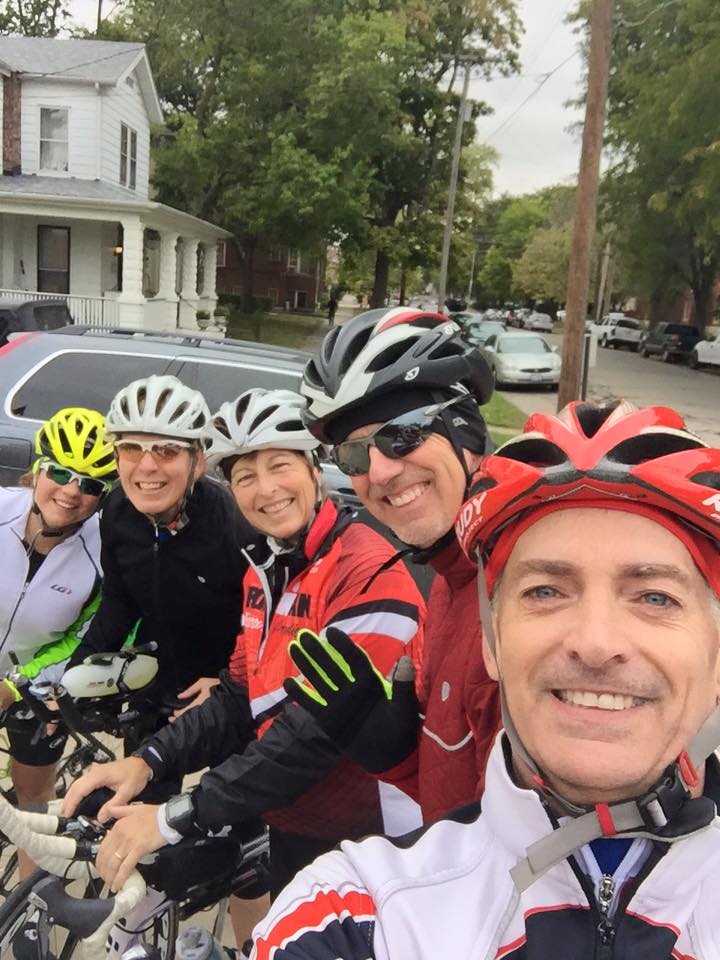
Amanda Marek, Suzanne Astra, Lida Bond-Keuhn, Pumpkin Pie Head Cudworth and Todd Walters post-ride.

Amanda Marek, Suzanne Astra, Lida Bond-Keuhn, Pumpkin Pie Head Cudworth and Todd Walters post-ride.

At the start of the Ottawa Pumpkin Pie ride we gathered outside the YMCA for a last minute discussion about distance. We had choices of 20, 26, 66 and 100+. “We’ll go to 40 and see how we feel,” it was agreed.

The skies were grey and the wind was low and insistent. As we stood there I felt that strange little bit of headache you get when there’s a trace of flu or cold still in your system. I had a craving for a cold Coke, or something. Despite some nice oatmeal and a rich banana on the ride down, there was a strange hunger in the pit of my stomach.

Emphasis on the word pit. For that would be the theme for the day. I know, pumpkins don’t have pits, they have seeds. But from the get-go my stomach felt as if all that stuff from the insides of a pumpkin was roiling around down there. Not a fun feeling. And you probably know the feeling too, like there’s a combination of goo that might or might not come up, our out.

But you know, sometimes you gotta suck it up and just go. So we did. And I did. And for 23 miles we sliced through the wind and enjoyed some tailwinds for about 12 miles to arrive at the first aid station.

There was food, including a Sloppy Joe sandwich, some grapes, cookies and a bit of blue Powerade. Yet we all got chilled standing around, and when the ride started again it was hard to warm the body up.

As the pace picked back up to 19mph my legs still felt okay. That part of it was not a strain. But like I told Sue back at the aid station when she asked how I was doing, “My stomach is giving me fits.”

It had been that way all week. Every run this week was an awkward balance between feeling okay and feeling less than okay. Nothing better. It had started with a zinc battle against a tingling ‘cold coming on’ feeling in my nose on Monday night, and lasted all week. Nothing came of it except this half-tired all the time feeling. It was as if whatever bug did not set in also refused to go away. So I slept a little extra, or tried.

By Friday I skipped a run to try to recharge my battery. By Saturday’s 30-minute run with Sue I thought it was getting better.

But not really.

So the bike trip across the flat landscape got a little more difficult as we rolled along. Every increase in pace against the wind set my stomach churning. The legs were okay for the a while, but the tension took its toll. Sue hung back a couple times, but I told them all to go ahead. I know my body well enough to know that I’d make it back fine.

With a group ride like that I hate, hate, hate to impact the pace and the mood of the day. Everyone was pedaling along fine but me. Ugh. I’m the middle child, and I hate to cause anyone inconvenience.

It was hard to keep my mood up on the surface where it should be. I got angry with myself. Then I was angry with Sue for asking if I could stay on her wheel. It always occurs to me that life and cycling are much the same. Sometimes you don’t want to have to hold anyone’s wheel. But you know, it becomes a test of personal character to do so in the best way you now how.

So I drank and ate a little, hoping to feel better. But the Accelerade in my bottles, while ideal for energy, makes me burp. That was no fun. The idea of barfing that Sloppy Joe was no fun at all, and seemed imminent. So I pedaled along in this flux state, sometimes alone, sometimes with Sue patiently pulling me through the wind.

Well, we’re even in some ways. We’ve pulled each other a few times and through a few things this year. Life is indeed like cycling. Her bike was wrecked before her Ironman and that was a stressful deal, to say the least. During her Ironman, her stomach was pretty upset after getting thoroughly dunked during the swim,  which by all accounts was insanely aggressive in Madison. Don’t people have any consideration for the hard work put in by others in preparation for that race? Is it really necessary, and does anyone really gain anything but a few seconds by clobbering other swimmers? Questions for the ages.

There’s little you can do but make the best of such situations. Her stomach was upset by all the water she’d take in, and the ride was compromised along with it, and her ability to take in nutrition too perhaps. All that preparation and it often comes down to stupid stuff out of your control.

And yet, I was so admiring of her response while coming in from the run on the last mile of the Ironman. “Well, it wasn’t the day I wanted,” she called to me with a smile. “But I’m going to be an Ironman!”

If only we all had iron guts when we need them.

But it’s part of the deal when you’re an endurance athlete. You have to dine on the slice of pie you’re given on any given day. Sometimes you feel great, and ride or run the whole way without a problem. Other times you’re the one left gnawing on a gnarly piece of crusty dreams.

So I was grateful that the last five miles of the Pumpkin Pie Ride turned into a tailwind stretch. By then I’d forced down some nutrition and was feeling better. Probably on top of feeling lousy in the stomach I was missing nutrition the last half of the ride. It’s pretty easy to lose that balance.If it was the flu of some sort, I’d fought it off in large part.

Sue classily rode in the last few miles with me and all was good. We gathered together as a group and snapped a selfie showing our smiling faces. No one told me that I suck as a rider. Not that anyone would. Because we’ve all been there. We all must dine on our slice of the pie, for better or for worse, on any given day.

It reminds me of what my brother told me before a 20-year high school reunion. “You’ll like this one a lot better,” he chuckled. “By now everyone’s had their ass kicked in one way or another.”

So enjoy your slice of the pie when it tastes good and goes down easy. And when you’re forced to dine on humble pie of any flavor, know that tomorrow is another day. And what a slice it will be.

werunandridelogo

Posted in Uncategorized | Tagged , , , | 1 Comment