Dan Johnson is in it for the long run

Dan Johnson is a runner from Minnesota who attended Luther College, in Decorah, Iowa, where he ran cross country and track. As with many former teammates, I’ve kept up with Dan in a variety of ways, and became aware of how well he’s been running all the way through his late 50s. This past week, he messaged me through Facebook to follow up on a series of questions I’d sent him to publish a profile of his running. His running journey is an inspiration to runners of all ages. And most recently, this is what he accomplished:

“Hey there Chris, FYI, just ran a half marathon yesterday.My official time was 1:24:01, a pace of 6:24 per mile. I finished 63rd out of 1012 overall and 1st out of the 44 Men 55 – 59. My net time was 1:23:58, my 10 mile time was 1:03:47, and my age grade was 83.33%.”
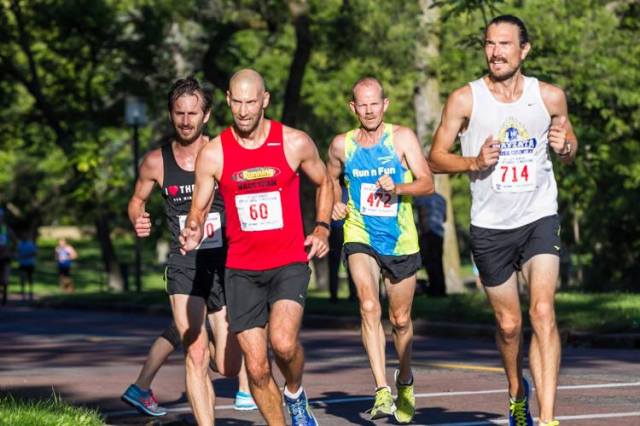
 

danjohnson

Dan Johnson (green and teal jersey) competing in the Twin Cities Half Marathon.


Before his recent half marathon, I’d sent him a set of questions and was going to publish this story in advance of his race. But he had an old email address on record for me and that’s part of the problem with long-time associations. Yet in many ways, the answers he provided now have even more value with the real results of his training and racing well-proven.

What are your current races plans? Upcoming races?

I’m currently training for the Twin Cities Half Marathon on September 11th. This race is part of Minnesota’s US Track and Field (USTF) team circuit.

What training have you been doing this summer? 

I have been running between 30-45 miles a week. Every other week or so put in a longer run of 13 miles.  This summer’s long run is currently at 16 miles. 

I live in an area with a lot of hills, so almost every workout includes a few hills. Occasionally I do some speed work, with series of 8-10 intervals of approximately 100 meters. Sometimes I also incorporate fartlek into my runs.

In addition to running I usually go for a morning walk of a mile or two with a friend and then bike 5 miles each way, to and from work. 

Who do you train with? 

I run almost entirely on my own, with the exception of Monday nights, when I run with a dozen or so other guys who are team mates with me on the Road Warriors.  Guys have their choice of running around one, two or three of Minneapolis’ chain of lakes.  I typically run three lakes, which equates to 9 ½ miles.

After our Monday runs we gather for beer and then go out for pizza or hamburgers, and occasionally tell a tall tale or two about past running exploits.

What are your objectives typically in most races (age group, overall?)

I used to have a goal of finishing in the top 1% of a race, now that has changed to the top 10%. With age graded results I usually hope to run between 82-85% in my age grouping; 55-59.

How has your running changed over the years? 

I eased off considerably after a pulled hamstring during Grandma’s Marathon back in the 80s, when I was hoping to qualify for the Olympic trials.  I was on pace through the half, at 1:10, but then could sense my hamstring beginning to fail.  I pretty much quit racing after that for the next twenty years or so.  I still ran on and off, but usually shorter distances of between 3-5 miles.

I quit wearing a chronograph watch many years ago.  I like to simply run according to how I’m feeling.  I also don’t track my distances.  Part of the rationale is that I don’t want running to run my life, rather I want it as a complementary fitness component that won’t overtake focus on family and community involvement.

I got back into racing on a more regular basis when in during the fall of 2014, when I reconnected with some of the guys I used to train and race with in the 1980s.  We ran around the city lakes every Wednesday evening. One of the guys, Perry Bach, later opened a series of running stores “Run n Fun”. In visiting with Perry a couple of years back at his recently opened Minneapolis store he let me know about a reconvening of the Road Warriors racing team, now also known as the Old Road Warriors, since most of us are in our 50’s and 60’s.  I joined up with the guys and have slowly been regaining a touch of my speed and stamina. We commit to running a minimum of four races in the Minnesota USTF summer road racing circuit.

What types of injuries have you experienced? 

In addition to my hamstring injury in the 80’s I’ve experienced a lower back injury, totally unrelated to running back about 12 years ago.  I was improperly lifting a bag of mortar.  Not too long after that I picked up a book with stretches for the lower back.  I’ve since been doing a series of 8 different core strengthening and stretching exercises.  Though I never really enjoy doing these exercises, I do them pretty religiously, usually about three times a week.  Since I’ve been doing them I credit them with keeping me injury free. 

What events did you do in college? Times? 

I ran cross country, and mostly the 5K in track at Luther College in Decorah, IA.  My best mile time, 4:18, came during a four-mile relay at Drake Relays.  My best four-mile cross-country time was 20:08, and a 25:28 five-mile time.  I was second in the IIAC (Iowa Small College Conference) 5K in 1980, but unfortunately, don’t have a record of the time. 

Favorite races you’ve run over the years? 

Probably my all time favorite race was in 1979, running a leg of a relay at Louvain-la-Neuve, in Belgium.  I ran with a fun and fast group of guys on the cross-country club while I was a student at the University of Nottingham.  We placed second overall, with dozens of university teams competing from all around Europe. 

I thought it was interesting to be a part of a running relay with legs of varying lengths.  Our top runner, Graeme Fell, ran the longest length.  Graeme later went on to become a world-class steeplechaser.

Another favorite race was the 1983 Twin Cities marathon. I ran the entire 26 miles behind Barney Klecker, world record holder at 50-mile ultra marathon.  All throughout the race, I heard people cheering “Barney, Barney, Barney”. I tried to imagine that was my name to. I nipped Barney at the finish for a time of 2:24:36.    

Another highlight was the Boston Marathon in 1985. With a fast qualifying time, I was able to join the top echelon of runners at the starting line.  Looking around me I saw runners from all around the world.  I ended up finishing as the top Minnesota runner, 166th overall, with a time of 2:29. 

Ever have a time or race that really surprised you? breakthroughs? 

I don’t think that I’ve had any really great surprises. I’ve come to appreciate that without putting in the work over time, I’m not going to reap the rewards of a fast time.  That said, I was surprised a couple of years ago, when at age 56 I was able to place ahead of a bronze medalist from the 2015 World Cup Nordic Skiing championship, Caitlin Gregg.  We ran an extremely hilly 5K Trail Loppet, one of my current favorite races, held at Minneapolis’ Theodore Wirth Park. 

What have you learned most from your training partners? 

I’m learning to run slower. In college. almost every workout was a full out race, so I got in the habit of running hard.  One of the Masters runners I train with, who is setting state records for his age group, has a habit of running very slowly much of the time. I’m a big believer that sometimes one of the best things a person can do for their conditioning is to take a day off.

Are you coached or self-coached? 

I am self-coached, but enjoy the fellowship and wisdom of a group of seasoned runners… the Old Road Warriors.

Race Times from this current year (2016)

1 mile:  5:26

5K: 18:36

8K:  31:15

10K: 39:20

½ marathon: 1:24:00

Those stats tell a great story on their own, don’t they? Dan is still competing in the Top 10% overall in most races. He recognizes that age does have its affects, but that intelligent training can keep a runner in contention for whatever goals they set out to achieve.

Enjoy this story? You’re nvited to follow WeRunandRide, original thoughts on running, cycling and swimming. 
Posted in 10K, 13.1, Uncategorized | Tagged , , , , , | Leave a comment

How to run a marathon without really trying

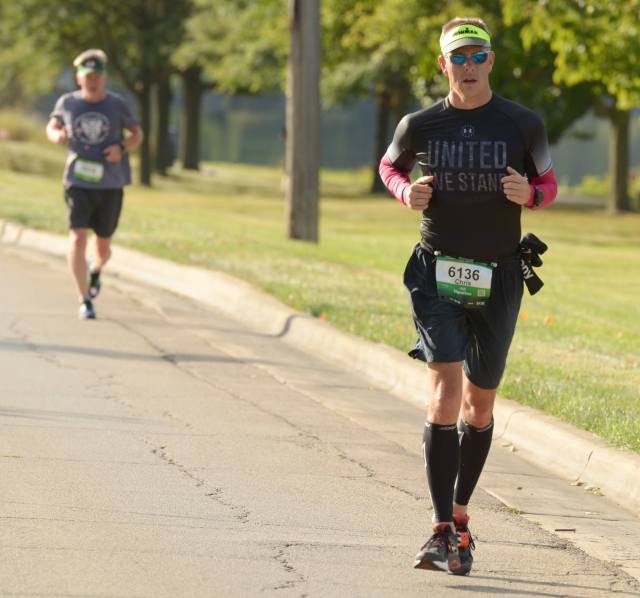
A photographer friend sent me a photo after yesterday’s Fox Valley Marathon. There was some guy named Chris that looked like me who was running the race. Perhaps I ran 26.2 miles yesterday and did not even know it. That’s how easy it can be folks, if you have friends in the right places.

Doppelganger.jpg

But actually, a friend of ours named Jamie Meyer actually ran the distance and won the women’s race in 3:19. Jamie is an avid running competitor and superb mother who juggles training with raising her children and all the other events of life. She is not tall in stature but she is quick on her feet.  Here’s a pic of Jamie with some of her friends that completed the race.

jamie-mayer

It’s a tremendous accomplishment for anyone to run a marathon. 26.2 miles is not an easy distance to cover. And while the lead runners make it look easy, they feel the same sensations that most mid-packers feel. It typically hurts.

But with the right amount of training, and on the right day, it might not hurt as much as it typically does. Your running can come together in fascinating ways if you put in the effort. Basically, the trick is to spread your suffering out over a period of weeks and months in hopes that your fitness will make race day feel tolerable.


Jamie Mayer marathon.jpg

Jamie in the last mile of her victorious marathon in 3:19

As has been noted many times in this blog, too many runners and triathletes forget to fun faster than their actual race pace in training. The principles are simple. Do time trials and intervals at a faster rate than your goal pace so that your body is trained to sustain that tempo. Then the actual pace of racing is not such a strain.


If you plan to run 7:30 pace as Jamie did, that means doing interval training at 7:00 or even below that at times. The body needs to be stressed beyond race pace, and so does the mind. Then come race day much of the race can feel tolerable. That’s how you run a marathon without really trying.

Granted, at some point the pace will catch up with you. There will be discomfort. But it is much wiser to be able to get through 15 miles in a perceived state of comfort than to be feeling like you’re suffering to keep up with your goal pace from the start. Right?

Jamie trophy.jpg

There are some ironies in all this. One of the best ways to prepare for the “second half” of the race, when you do begin to feel it a bit (15, 20 or 23 miles, it all depends…) is to run very long, slow runs at well above race pace. Then the trick is to throw in some hard miles at the end. This is the concept of creating a “brick” at the end of your runs. Triathletes do that by getting off the bike and running. Marathoners need to do it by adding speed at the end of their long runs.

A group with whom I once trained would do 17 miles at 7:30-8:00 pace and close with three miles in 15 minutes. They were all talented runners, for sure, capable of 10K times under 30:00 in some cases. But some ran marathons as well, and that’s how they prepared for the miles that hurt, and that really count.


So congratulations to Jamie Mayer for a fantastic Fox Valley Marathon race. She’s been an inspiration to her many friends for years. Now she’s an inspiration to all who shared those race miles with her as well.

Posted in running, Uncategorized | Tagged , , , , , | 2 Comments

Separate ways

I had the best friend ever growing up in Pennsylvania. Our family moved to Lancaster when I was five years old. Within days, my mother somehow met up with a woman whose son was the same age as me. We were introduced and left to play together in the back yard. We were taking turns swinging a golf club when his nine iron whacked me clean in the skull.

That raised a big lump and I was dizzy for an hour. But two days later we were back playing again. We wandered the smooth fairways of the golf course where he lived on the seventeenth hole. One afternoon when we were both twelve years old, a giant rainstorm swept up from the Atlantic and dumped inches of water all over Lancaster County. Undergrounds springs bubbled up through the fairways and we stripped ourselves bare of clothing and engaged in the world’s largest Slip and Slide. His sisters came out to watch and laughed at our bare little asses shining wet and unashamed.

That day symbolized the earthy manner in which we engaged in everything we did together. Heartfelt confessions of love and fear in the giant apple tree out front of his yard. We learned about girls together, and I trusted his instincts because he had sisters and was unafraid of how girls thought and acted.

He was there for me the evening that we were supposed to attend a school dance in middle school. I’d gotten a huge bump on my head from baseball that day and was terribly self-conscious about it. Frankly, I was terribly self-conscious about everything in my life, much less showing up at a school dance with an inch-long bump on my forehead.

Assuring me that it would not matter, he lent me one of his favorite shirts or some other favor to boost my confidence, and away we went. The dance went great.

All those sexual awakenings and confidences that are part of going into puberty we shared together. Some guy on the playground told us how to masturbate and that evening, we each gave it a try. Of course, it was fantastic, and from that point on it became part of a regular routine that many young males seem to adopt.

But we still knew little about the female body, and it was not until we were wandering about the yard one summer evening that we passed by the window and saw his older sister masturbating in her room. That was a complete mystery to both of us. But we didn’t stay too long out of a combination of fear and respect.

Girls and sports occupied most of our time. We shared gym classes together and participated in the fitness tests administered by our disciplinarian physical education teacher. My friend had stronger arms than me, and excelled in pullups whereas my skinny legs covered two miles in the 12:00 time trial on the track. As close as we were as friends and athletes, our destinies began to separate through these realizations.

Yet we both shared the triumph of playing for a baseball team that won the Lancaster New Era Tournament. That was the pinnacle of achievement in youth baseball in those parts. I came in to pitch in the second game, a tight contest that we won 8-6 after stomping the competition 26-0 in the first game of the tournament. I remember the murmurings on the bench when the other players worried that I might not be able to hold my own in that important game. But I was one determined kid who knew how not to lose. And so we won, then took the championship a few days later.

But by the time I was twelve my father decided it was time to move to Illinois. That meant my relationship with a best friend was going to be broken off. We sat together on a golf tee overlooking a drop hole, and he mused, “Why does everything I love have to leave me?”

His parents were divorced and his father was a hard, hard man. One year he’d gone to live with his father down in Florida. When my friend came back he was a hardened child for sure. It took a while for the cynicism to wear off. I like to think I had a role in that. We rode our bikes everywhere we went, or trotted the half mile across the golf course to reach our homes. That activity was a healing force in both our lives. I remember wanted to spend time with him so much that I’d sprint from my bus stop through the parking lot of the golf club to get to his house before the bus made its loop out of our neighborhood and over to his place on Golf Course Road. The bus driver knew that I did this, and never once told on me. He could appreciate the bonds of childhood, and his liberal attitude about that was not lost on me.

When our family moved to Illinois, I vowed to come back to visit my friend back in Pennsylvania. That first year we did make it back. But it hurt to come home to the place that had formed so much of what I believed, and what I had become. There was an entirely new life to explain out in Illinois, and the competitive nature we both shared… forced us into angry comparisons over whose baseball team was now better.

Then he asked me a difficult question that I did not know how to answer: “Do you still beat off?”

I admitted that I did. He told me, “I quit that.”

It was four or five years later that I got to return to visit again. By then we were both in high school. Our lives had diverged in even new ways. I became a cross country runner because there was no soccer team our in Illinois. My friend became a solid defender in soccer, and played baseball in the spring. Our school had no baseball team either, so I competed in track and field. Again, we had gone our separate ways.

Through college years, we completely lost touch. There was no Internet, only long distance phone calls. And letter-writing just didn’t cut it.

So it wasn’t until twenty years later that I heard he had moved to a city near my home in Illinois. I called him up and asked to pay a visit. He quietly agreed that we could come over.

Yet once again, I had a lump on my forehead, this time from some strange microbe that I’d picked up while camping in the Upper Peninsula. The doctor would ultimately treat it with both antibiotics and a minor surgery. It was gross, and I felt self-conscious coming to see my old friend with that nodule above my eyebrow.

So it was an uncomfortable visit from the get-go. His new wife was his second marriage. The first marriage had somehow dissolved after three children were born. He had gotten married early, and something did not work out. That’s all I could get out of him. He did not want to talk about it.

Nor did he want to discuss our childhood adventures all that much. He was disinterested and disengaged from the past in general. His new life was his foundation. The old life was gone. Perhaps he had been born again?

But I was not satisfied. With my writer’s mind, the past was interesting at both a subjective and objective level. I treasured the liberalities of our adventures together. We’d shared tears and joys. That seemed important. I tried sharing that with him, but the past was a closed book. What he appeared to take away from those experiences was resolve not to repeat what he might have considered weakness or lack of resolve.

And we did not talk again for another ten or twenty years. Then he showed up on my Facebook feed as a possible friend and for a while, we were connected. But he clearly did not share my politics or my interests. He is conservative. I’m a liberal. So by his choice, we went our separate ways again. I recall a press clipping my brother sent to me when I was in high school. There was a picture of friend with a quote about some issue with high school politics. I remember being surprised at his viewpoint even then. How could this guy with whom I grow up, with whom we shared so much in common, suddenly demonstrate such rigid thinking? I realized at that moment that had we stayed in Pennsylvania, it is very likely that my close friend and I would likely have grown apart. It happens. And has happened with other friends in life.

So those are his choices, and I respect them. I’ve come to realize that the reason many people go separate ways in life is chemical. One of my blog readers and a close friend keeps reminding me of this. You can’t change people. It’s hard-wired. No amount of logic or argument will make them think any differently. You might as well try to convert a pig into a raccoon. It’s not going to work.

***

What I do know is that something is truly lost when people go their separate ways on grounds of arch reasoning or denial. All I ever wanted from my childhood friend was to talk about playing baseball and hanging out in the apple tree. But for reasons that I cannot comprehend, that was no longer possible with my childhood friend. What were the reasons? Was it pride in the present that made looking back seem silly? Or was it a source of shame of the past and deep personal pain that drove away the will to recollect? What about that harsh treatment by his father, and his belief that everything that he loved would someday go away?

I learned through caregiving for my own father that some misunderstandings are the product of the very personal pain faced in his life. My father lost his own mother to cancer at age seven. His father then had a mental breakdown as a result of losing his farm and livelihood during the height of the Depression. All those reactions are forgivable if you know about them. Then it’s possible to move forward in life and reconcile the past to the present. But it takes work, and the will to accept that you might not be perfect. Ever. Then you can grow in your perspective and build tolerance for the flaws of others, and in yourself.

But much of the world seems to fix on rigid ideals and nothing is allowed to interfere with that carefully constructed view of life. It is both a coat of armor and a house of cards. Some people go separate ways within themselves and make the decision to leave the other person behind. Create a “new person” and don’t look back. Conserve those beleifs that support your present. Don’t put up with anyone that tries to call up the past, or question the logic of your worldview.

The Bible shows Jesus trying to call people out of these traps of selfhood. But instead of listening to that call of love and the freedom that comes with it, people adopt rules by which they run their lives, and try to impose on others. To these folks Jesus issued stern warnings, calling them a “brood of vipers” and “hypocrites” for creating a world dependent on such rigidity, or laws based on literal interpretations of scripture. This was the real prison on earth, not the Kingdom of God.

That form of rigidity has its price. I don’t expect to ever have contact with my childhood friend again. And again, all I wanted to do was discuss those days playing catch, swimming in the pool and doing jacknife dives of the low board to splash the lifeguards. Those were good times. The Good Old Days. Childhood. And there’s nothing wrong with talking about that. Sure, there were some earthier aspects as well. But those things were just as real. Deal with it.

So, sometimes while I’m out running past a golf course on a rainy day and that familiar smell of wet fairways wafts through the air, it takes me back to that day in Lancaster when my friend and I tore off our clothes and ran naked to slide on the perfect grass bubbling with clear water from an undergrounds. And we were connected to the earh, and truly alive.


Posted in running, track and field, Uncategorized | Leave a comment

Rehumanize yourself

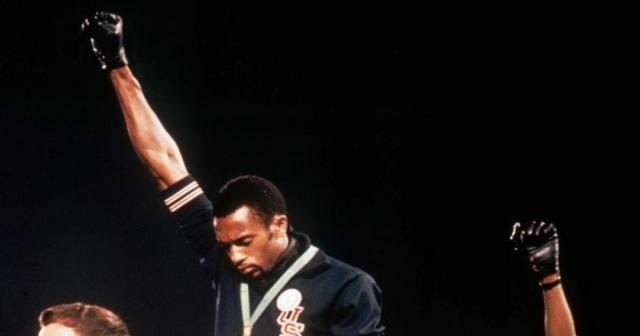
tommiesmithweb7s-1-web.jpgNow that football players have come to the realization that they are not robots run by the NFL, the nation has been grappling with what it means not to stand during the National Anthem or recite the Pledge of Allegiance by rote habit.

I empathize with Colin Kaepernick, just as I empathized all those years ago when John Carlos and Tommie Smith stood on the Olympic podium with fists raised in black gloves. They had a reason then to be disgusted with how black citizens are treated in the United States. Those reasons are still alive today.

As a track and field athlete in college, I often roomed with black teammates. It would seem we had little in common on the surface. One runner named Ron lived in Chicago’s housing projects. He was a quiet young man who had the courage to come west and attend a principally white liberal arts college in Northeast Iowa. He’s gone on to good things in life, but it was not a comfortable journey being yanked from home into the lily white world of the Iowa cornfields.

The year after I graduated from college, I worked admissions and visited dozens of inner city schools. Explaining to those kids where the college was located was difficult at times. Their lives were largely confined to the city of Chicago. What good reason could there be to leave and attend college where you would be a painfully obvious minority.

I remember well the initially cool treatment we received when a black assistant track coach and I visited the family of a young black woman on Chicago’s far South Side. The discussion went well, and when we made ready to leave, handshakes and smiles were exchanged. As my friend and associate Aubrey Taylor and I walked down the sidewalk, I paused to ask him how it went. “Keep walking,” he instructed me. “Follow me to the car and get in,” he insisted.

We drove away and he explained himself. “It went very well. But you don’t stop to discuss things where that family can see you. They need to trust that you were happy enough with our meeting. If you stop and talk it’s like keeping secrets from them.”

That was a life lesson that has never been lost on me. I do recall noticing the mother and father at the door as we left. Aubrey astutely knew that their trust was a major factor in the preceding exchange of ideas and the recruitment going on. That young woman later attended Luther College. But the credit all goes to Aubrey.

So we must ask: how is that level of trust at work in the rest of America? Can black citizens truly trust white people to their word and their promises? Are there still people who view blacks or Latinos as less than equal?

The question itself seems absurd on its own, and that’s the problem. That’s why Colin Kaepernick is kneeling before games while the National Anthem is being played or sung. The continual presence of racism in this country defies the very symbolism of the flag and the National Anthem.

So perhaps instead of the National Anthem we should all stand and sing along to a song titled Rehumanize Yourself by the Police.

Read these lyrics and consider what they say about the current state of our nation.

He goes out at night with his big boots on
None of his friends know right from wrong
They kick a boy to death ’cause he don’t belong
You’ve got to humanize yourself

A policeman put on his uniform
He’d like to have a gun just to keep him warm
Because violence here is a social norm
You’ve got to humanize yourself

Re-humanize yourself

I work all day at the factory
I’m building a machine that’s not for me
There must be a reason that I can’t see
You’ve got to humanize yourself

Billy’s joined the National Front
He always was a little runt
He’s got his hand in the air with the other cunts
You’ve got to humanize yourself

Re-humanize yourself

That’s what all the protest is about. America is in a massive process of dehumanizing other people.

The fact that the protest against that dehumanization got its start in one of the most dehumanizing sports known to the human race, pro football, is no coincidence. We don’t see the faces of those athletes much in those NFL broadcasts. Players are traded like meat from team to team and Fantasy Football leagues reduce those same men to mere statistics. It’s all dehumanizing.

Appearances often deceive. With black athletes dominating many pro sports and earning millions of dollars, it would seem that racism in America has all but disappeared. Yet hundreds of those athletes lose their millions within a couple years of playing in a pro sport. Their lives are invested heavily in that pursuit of fame and glory, and when it is done, they are either falsely celebrated as national heroes or discarded like deflated footballs. Some even come away from the games they play with brains addled by forcible contact, or wracked by chronic injuries so severe they live on painkillers the rest of their lives.

But it’s not even pro athletes that are the issue in the recent National Anthem protests. It is how people are being treated on the streets of America, and in business, our schools and cities or small towns. Anywhere you go, the wicked face of racism maintained its foothold despite general gains in social progress the last 40 years. Racism has risen up yet again as a national movement in 2016, driven by a candidate whose supporters claim that the very act of calling them out on that is political correctness. They cherish instead the dehumanizing approach of treating people of color as “the other” on claims that America is a white nation by destiny, and by tradition.

And that’s why some people are kneeling during the tradition of playing the National Anthem before football games. America’s game, the NFL, actually gets paid money from the military to host patriotic displays. The red meat tradition of pro football aligns well with the militaristic jingoism that feeds the military-industrial complex. That same military was all too willing to send black soldiers into combat during World War II, but America essentially ignored those honorable men and women when they came back home. Instead they were met with a society that still rudely discriminated against them.

Some changes

Some aspects of civil rights in America have changed since the 1940s, but not all of them. The liberties our nation defended in the last World War are not consistently supported across the face of the nation. Our first black president has been accused of not solving all that racial tension. He’s even been blamed for causing it. Such cynicism is nowhere near even laughable. It is perhaps the most serious issue of our times that racists can turn their attacks on a black president for eight years and then blame him for being the divisive one.

crsmitht1These are the aspects of American citizenship that men such as Colin Kaepernick find so disgusting. There’s a lot of faux patriotic shaming going on now, mostly by people throwing patriotism around as it were a weapon unto itself. But that defies the nature of true patriotism, which is a commitment to the idea that the equality guaranteed in our Constitution is not real until it is provided to all citizens. That includes minorities, women, gays and everyone who lives under this nation’s flag.

Bitter farce

And until that is the case, standing during the National Anthem is a bitter farce, as is reciting the Pledge of Allegiance. To what? A country where hate is not just tolerated, but promoted as a political party platform? Where fear of immigrants is a recruitment tool, and religious discrimination grounds for violence?

What we’re actually witnessing in the backlash against Colin Kaepernick and others is a forcible attempt at conformity. “Make them get in line, stand up, salute the flag…they’re disrespecting our nation.”

But oh how wrong you have it if that’s what you believe. What they are actually doing by kneeling during the National Anthem is respecting the very roots of democracy that led to the American Revolution. It was tyranny then that led people to protest. And racial tyranny has a very real history in America. Slavery was real. Jim Crow laws were real. Police with attack dogs and fire hoses and batons were real. Today, police violence against black citizens is documented nearly every single day. The rates of incarceration for black men is multiple times higher than that for whites committing virtually the same crimes, or no crimes at all. Hundreds of black men have been falsely accused of crimes and thrown into jail for the bulk of their lives, only to be released when evidence is shown that they had nothing to do with the crime for which they served time.

These are injustices that continue to go on in this country. Yet our nation is only too happy to wave the flag and watch our black men and women trot around the track as they win Olympic medals, or carry the football across the goal line. That’s because too many people don’t even see these athletes as human beings. They are black athletes. Nothing more need be said. They are tolerated by some Americans only because they are winners.

But the rest of black America has been treated as losers for too long. So it’s time to take a knee and call America to account for its hypocritical traditions and celebrations. That’s what this is all about. Rehumanize yourself. Consider what’s being said in all this. That’s the only real solution.

Posted in running, Uncategorized | Tagged , , , , | Leave a comment

Keep this heart in mind

Lily FullWe saw Bonnie Raitt in concert a few weeks ago. She’s a truly amazing musician. I’d seen her once before, many years ago, in a double bill with Jimmy Buffett. She deferred to his raging fame at the time. But truly, she’s always been a great talent on her own.

I still adore an early album she recorded titled Green Light. There are many beautiful and fun songs on that album. One is titled Keep This Heart In Mind. She writes of loves found and lost so well. But think about that song title on its own. Heart… and mind. They represent the two things we all depend upon for motivation in life.

During periods of peak fitness, I have touched a finger to my neck and counted heartbeats. At one point in life my resting pulse dipped below 40 beats per minute. Lying there still with such a slow heartbeat is a strange sensation. It takes its time because it is pumping enough blood to do the job of supplying oxygen to your body. That’s fitness.

It’s an intimate thing as well to place your ear to the chest of another human being to listen to their heartbeat. It is the pulse of life itself. That is why the heart is considered the symbol of things such as love, virtue, and cherished beliefs.

In times of stress, we speak of having a troubled heart. Pile on the stress and a heart can start to skip beats, behave erratically. The pulse shifts in response to chemicals within the body that affect those electrical impulses. In a book titled “Match to the Heart,” writer Gretel Ehrlich documents the difficulties of living with a heart disturbed after she was struck by lightning while tending sheep in the mountains. There is a medicine used to restart the heart when it forgets its duties thanks to electrical interruptions. Think about that: living within death every minute of your life.

Of course, that’s a massive allegory. Because that is how we all live. Life is precious. Yet we take these heartbeats for granted because we’re so busy training and living and creating stress in our lives that makes us feel useful.

At sixty beats per minute, our hearts beat 86,400 times each day. That’s 2,592,000 beats per month. 31,104,000 beats per year. 2,177,280,000 times in seventy years of life. And we take our hearts for granted.

And that’s if we simply live without exercising. Most of us who run and ride and swim raise our heartbeats daily. And it responds. 150 bpm? No problem. Get up around 200? Things get interesting.

Some people do worse things to their hearts, smoking or drinking or abusing their bodies in ways that destroy or damage heart tissue. I once sat in a surgery lounge while my father had bypass surgery. Another woman sat there waiting for her husband’s surgery to be completed. It took five hours and when the surgeon emerged she berated him for the time she had to wait. He stood there mutely, the picture of self-control. Later, in the recovery room, I heard that patient ask when it was possible to have a cigarette.

Don Henley is another brilliant songwriter that has mentioned the heart in significant ways. His song Forgiveness may well be some of the most brilliant lyrics ever written.

These times are so uncertain
There’s a yearning undefined and people filled with rage
We all need a little tenderness
How can love survive in such a graceless age?
And the trust and self-assurance that lead to happiness
Are the very things we kill, I guess
Pride and competition cannot fill these empty arms
And the world they put between us – you know it doesn’t keep us warm…

Perhaps you can relate to those lyrics a bit, especially in these times when political insanity is running amok. Just yesterday a man accosted me through Facebook, a man that I had Unfollowed simply to avoid temptation to engage with him. Yet he went on the offensive posting to my timeline. I tried to reason with him. Get him to understand the notion of context when discussing politics. He would have none of it. He wanted to dominate the discussion, to win the argument. And here’s the scary part. He’s a family counselor. I tried to avoid him. Disengaged. He would have none of it.

It’s a strange world out there. Always has been. Always will be. What we’re seeing is the shallow urgency of ideology shoved to the front of public dialogue. People proceed on the shallowest of beliefs and will fight to the death over them. Literally. It’s not enough to wear their heart on their sleeves. They want to sling blood. Shed it if they can. They travel in league with racists and deny their association. They harm with words and claim it has no effect.

But there is still that issue of our own heartbeats to consider, and how to protect our souls as well. There is only one answer, and I’ll let Don Henley speak to that.

I will live happily ever after and my heart is so shattered
But I know it’s about forgiveness, forgiveness
Even if, even if you don’t love me
I’ve been tryin’ to get down to the heart of the matter
Because the flesh gets weak and the ashes will scatter
So I’m thinkin’ about forgiveness, forgiveness
Even if you don’t love me anymore

The world is a divisive place. But the only thing that has worked for me in healing from my own heartfelt pain is forgiveness. I’ve asked it from others. I’ve given it in my own quiet heart space, and been released from angst and sorrow, anger and passion.

A wise counselor once observed, “You seem to be good at forgiving others, but how are you at forgiving yourself?” That means turning attention to your own heart. Listening to the heartbeat of your life. Accepting that despite it all, mistakes and regrets, the heart continues on with its work.

Keep this heart in mind.

Posted in cycling, swimming, triathlon, Uncategorized | Tagged , , , , , , | 2 Comments

Before (and after) the frost

img_4342During a cross country season my sophomore year in high school, a friend and I were paired up to do an outdoor field biology project. His name was Doug Benson, I believe, who was a teammate and friend.

The instructor of the biology class was a man named Frank Kaminski. He was one of the few adults at that time who encouraged me in the activity of birding. He’d quietly (and carefully) call me aside before class to ask what birds I’d seen,. He knew that to discuss it openly might open me to ridicule from classmates who thought it silly to go out birding.

Mr. Kaminski assigned us to team up and engage in a bug collecting project. Doug and I considered our schedules and realized the only time we’d have to collect was on a Saturday afternoon after a morning cross country invitational. So my mother drove me to his house and we wandered out in the fields together with nets and cages in hand.

The day was bright and sunny, perfect for fall insects. Our job was to collect a certain number of species and display them for class by that Monday, the deadline for the project. This was the early 1970s when things such as butterfly collecting were still engaged. But Doug and I found far more than butterflies. We caught and identified more than two dozen species of insects, as I recall. Then we carefully mounted them for class.

It was fortunate that we went out that Saturday afternoon, because the very next morning a hard frost hit, wiping out most of the types of insects we’d collected just the day before.

But we had our bug collection and our teacher Frank Kaminski smiled at the returns on our efforts. “You did well!” he told us in looking over the collection.

The other sensation I recall during this process was walking around those fields on a set of very tired legs and likely dehydrated to boot. The race that morning had been hard. It was a strain on fifteen-year-old legs to hike about the fields after a race. Doug and I sat down in the warm sun several times, laughing at our fatigue.

IMG_4340.jpgThe sad aspect of this story is that Frank Kaminski later took his own life. He was a hugely overweight man. Perhaps that contributed to his decision to end is days here on earth. Or perhaps like so many, he suffered from a clinical form of depression as do so many millions of people. Back then the stigmas to mental illness were much greater and medications were not so refined. His immense weight often caused him to sweat and he breathed heavily while lecturing. Physically, life had to be difficult for him. And mentally as well. For whatever reason, he checked out for good.

Belted_Kingfisher.jpgI was quite sad on hearing that news. I can still see the twinkle in his dark eyes as he would ask me to cite my favorite bird. I told him it was the kingfisher, and he smiled. “A lovely bird,” he replied.

In some respects that man and I were opposites. Yet his weight issues did not obscure his kind nature or his love of nature in general. At a time when I struggled in some other classes due to boredom and an overly creative mind, I excelled in his biology class because he made everything he taught seem so important.

There is no better virtue in life.

As for Doug Benson and I, there was a lesson to be learned in going out to do our work even when our legs begged us to stay home. The hard frost that hit the next morning was profound, like a wave of the Almighty’s hand to cast a plague on the efforts of all those who put off bug collecting to the last day. “Do your work even when it tires you,” that frost seemed to say.

And the next morning as I walked through the whitened grass to go for a run on Sunday morning, I smiled that we’d had the guts to go through with our hunt the previous day.

Posted in running, Uncategorized | Tagged , , , , | Leave a comment

When the autumn light leads to inner light

light-chrisThe last few days have been so pristine and beautiful here in Illinois it almost takes your breath away. The skies have been clear. Hardly any breeze. That led me to take a run in the forest preserve where the local teams run cross country. The preserve is named Leroy Oakes after an early conservationist in our county. Like most forest preserves, the property was once a farm. There is even an old one-room schoolhouse next to a restored prairie. The entire scene can take you back in time.

That wasn’t my cause in going to Leroy. But it happens nonetheless. Our St. Charles cross country team was the first to conduct a meet on that property. The preserve was much smaller then. The county has added tracks. The big red barn at the center has not changed, however, and large invitationals often center around that parking lot where teams queue up and generation after generation of scrawny high school kids compete in the sport.

light-pathThe new course is a true cross country course just as all the other iterations have been since my teammate Kevin Webster first designed a three-mile track. Now the start is held on a wide field that can accommodate 20 or more teams at the start. The beginning of the race crosses a half-mile field to converge on a fire trail. Then it crosses the former entrance to the preserve, climbs a steep hill and goes flying down the back. Then the fun begins, as the course swings east through a mature oak forest and emerges on the grass where a series of undulations show that the streambed once created oxbows out of the same ground. Ferson Creek is still tearing away at the banks to change its course, as streams always do.
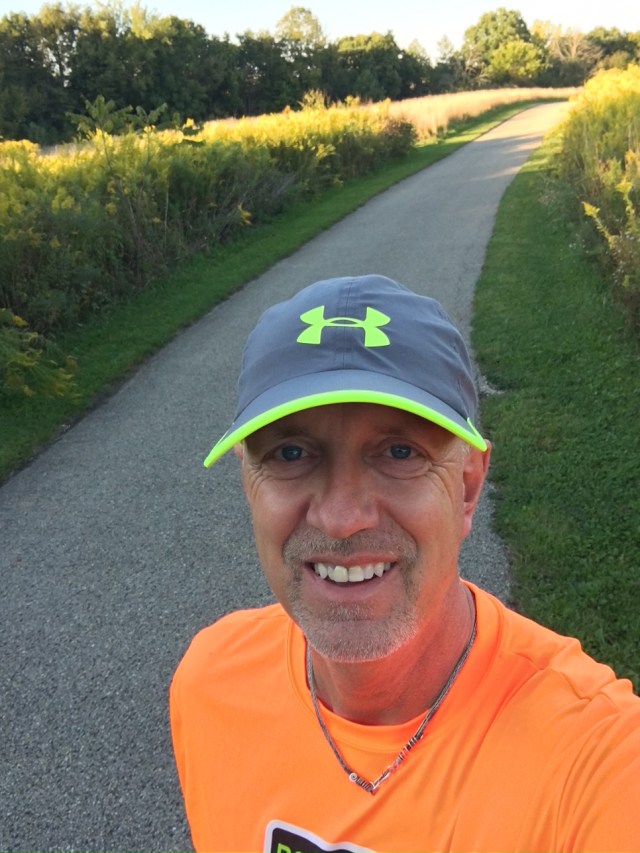
That symbolizes the cross country course itself, which has functioned like an oxbow over these many years. I return to watch kids run every year, and have seen some great runners fly over those paths. Former Jacobs high school star and Olympic Silver Medalist in the steeplechase Evan Jagr won a few times and everyone knew that they were witnessing a special athlete indeed.

Light Leroy.jpgI was ambling along at 9:20 pace for the most part, taking in the shower of goldenrod and bluestem, sometimes finding it hitting me in the face. They’ve not mowed the former fire trail that climbs the long hill. That’s where we used to do a ton of hill training. Even after college in my racing days, that quarter mile stretch up the east hill was a dependable way to build strength in hill training.
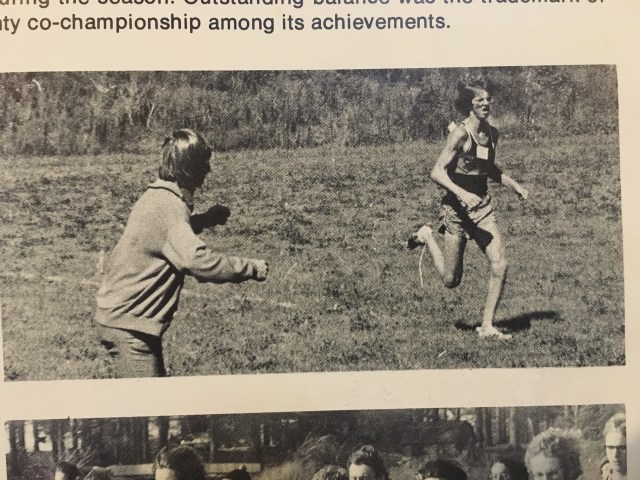
I wound around the course and found myself climbing a section that appeared to be a passage into the sun itself. Light streamed down the short hill and everything around me was illuminated. It was a joyous patch of running.

As the sun began to set the light crossing the grounds turned golden. My final half mile was run along that opening stretch of the cross-country course. I hope to get out there and see the start of a race because it’s always thrilling. Still thrilling. Knowing the excitement of those opening minutes so well, it is still possible for tears to well up at the joy of the pain and the pain of the joy ahead and behind you.

Autumn has a way of doing that to you. The tenor of light can lead to that inner light so precious to us all.

Posted in cross country, running, Uncategorized | Tagged , | 2 Comments

Moving on


running-past-house

Self-portrait watercolor by Christopher Cudworth.

In 1973 my father made the decision to move our family from Elburn, a town in the cornfields of Illinois, to a city in the far west reaches of Chicago’s suburbia. The move hurt because I was sixteen going on seventeen at the time. My brothers and I had finally, in some ways, adjusted to the move from Pennsylvania to Illinois three years before, in 1970. In that move, we’d all given up the friendships we’d built back east. My oldest brother was in transition to go to college that year. My next eldest brother was headed into his senior year in high school.


But my father only found work out in Illinois. So we yanked up everything we loved and toured together in a 1967 Buick Wildcat across Ohio and Indiana and arrived at the tall house in Elburn. It was a grand place, for sure, with three full stories and stained glass windows above the spiraling wood stairs that led to the second floor. Above that was an A-framed attic that we used for our table tennis playing. It was a passion for all of us, among many other sports.

Split affinities

We left that behind to move into a small split-level house in St. Charles. It was never admitted to us, but the motives behind that move were primarily financial. My father had gotten involved in a network marketing scheme and pumped a bunch of money into it. Surely he had our family interests in mind, trying to make more dough than he could as a sales engineer. But it failed, and we all jammed into the split-level to make the best of it.

The running route

From there, I developed a series of running routes that circled through St. Charles and Geneva. One of theme circled through the cities and caught a two-mile stretch that converted from 3rd Street in St. Charles to Anderson Boulevard in Geneva. The road was wider than most, and actually held remnants in its surface from the trolley car system that once coursed through the Tri-Cities along the Fox River. As a result, the road was paved and repaved over the years, and held many tarsnakes in its surface as a result.

At seventeen years old you have little idea what the future will hold. It was enough each day just to gather the focus to run seven miles, much less think about the homes you were passing or the lives of the people inside. Yet a home on that loop would one day become a residence where I moved my own family in 1985. My son was born while we lived in that home. My daughter too. Those were precious years.

Halfway house

But just out of college and living as a bachelor in 1981, I’d moved into a Coach House at 741 1/2 Illinois Street, also along that same running route. I’d run that seven-mile loop at least once a week and used the wide-open Boulevard as a good place to do what I called Unlimited Surges, long sections of hard running that exceeded the exertion even of fartlek training. That was a key method in building race-level fitness.

Refuge from danger

The Geneva house at 421 Anderson Boulevard also served as a refuge one day. At least the garage in back did. While training on that 7-mile loop one Saturday afternoon, I ran through downtown Geneva. There were a group of sluggard kids hanging out in front of the movie theater and one of them stuck out his leg in a half-hearted attempt to trip my. I turned around while running and flipped them all the bird. A big guy jumped up and came after me, but I easily outran him.

Then I heard a car start up, and a yellow Datsun came roaring after me. They were yelling threats and hanging out the window claiming they were going to kill me. So I cut across the Jewel parking lot and ran along the half-buried railroad tracks that led to a back street. But the Datsun caught up with me and a guy jumped out and threw a knife in my direction. I could hear it skitter across the asphalt and lodge in some grass near my feet. So I ran.

When I found an alley I ran through it to avoid being seen. Halfway down the alley a garage door was open. I ducked inside and closed the door. The Datsun pulled past and I waited a while to make sure they were gone. Then I opened the garage door and came out. The owner of the house was standing there. I explained what had happened and he just nodded. Then I closed the door and left.

Years later when we moved into the home on Anderson Boulevard, I realized that our garage was the same one I’d used to escape from those crazed kids in the Datsun.

Moving on

We lived in that home for eleven years. I watched them pave over the street several times and finally take out the trolley rails entirely. Yet the two manhole covers out front of the house remained, and they were often surrounded by tarsnakes in a pattern that made them look like nipples on two large breasts. It all seemed to fit together with the mystery of youth and sex and change and life.

That house was where I truly grew into manhood, but ultimately it became too small for our family. Twenty years ago in 1996 our family moved to a home in Batavia that I still own. However, the time has come again to be moving on. A new phase of life is coming on fast and like all those other times I’ve moved (and lost count, actually) there are both fears and joys mixed together. It’s a fact of life in general. We’re all just moving on.


Posted in running, Uncategorized | Tagged , , , , | Leave a comment

The Biggest Loser


chris-at-plainfield

Photo taken during the Plainfield Invitational in 1974 by Kurt Mutchler, who later went on to become a photographer for National Geographic magazine. The coach is Trent Richards.

Through the third week of the high school cross country season during my senior year in high school, I had not lost in a series of dual meets and triangulars. Then came the first invitational of the season, a fifteen-team affair in Plainfield.

Two years before as a sophomore, I’d raced on the Plainfield course for a different school. We’d won our first ever conference championship for Kaneland High School that season. Then my father moved our family east to St. Charles ten miles away. That meant starting all over again at a new school. It was a test. But it went well that junior year as we went 9-1 in duals, won a district championship and had a helluva a lot of fun.

So I was excited to be racing again as a senior. We traveled to Plainfield with the expectation of doing well as a team, but I was eager to try to win my first invitational.

Only the course on which we were about to race did not turn out to be the traditional Plainfield layout. That year the school moved their invitational to a newly re-opened quarry. The grass was barely in place. The bus arrived a bit late and there was no time for a course tour. So we lined up for the start and the gun went off.

As was my practice early that season, I took off in the lead from the gun. With an early margin, I rounded a corner and saw two flags ahead indicating the direction of the course. Between the two flags ahead sat a shallow cattail marsh. I paused for two strides and looked around for other flags. There were none. We were supposed to go straight through the marsh. So I charged ahead and went thrashing through the water and weeds. For a moment it felt like I was cheating. But that was how the course was indeed laid out.

Emerging on the other side of the water, I glanced down at my track spikes, all wet and soggy. Little did I know that a year later I’d be competing in the steeplechase event in college. That’s where your shoes get wet every race. It’s funny how some strange experiences quickly become the “new normal.”

The wet shoes that first time through the cross country course did not much daunt me. After all, I’d grown up thrashing through muck and fishing in streams almost every day growing up in Pennsylvania. So I saw the wet conditions as a clear advantage. I could hear the city slickers behind me complaining about it. I just raced on ahead.

The course climbed proceeded to climb steep gravel pit hills and cut through a maze of scrubby weeds. We came trundling down pebbly skree and by that point, I knew that no one would catch me that day. All that rough and tumble upbringing, unsophisticated as it was, made me a hayseed victorious.

There was history to that moniker. I’d once been called a hayseed by a track teammate back at Kaneland High School. He walked up to me with a sense of purpose like he had something important to say, and blurted out: “You know what Cudworth? You’re nothing but a hayseed.” He obviously thought my ways unrefined to his manner of thinking. Perhaps I didn’t dress as well as some of the other kids. I also had a habit of going birding in the weeds and thrashing around in the woods catching frogs and living the country life. To his way of thinking, that made me a hayseed.

Compensatory reactions

chris-in-pre-race-planning

I’m at the top of the group getting advice from coach about race tactics. I went on to place fourth in Districts and advance to sectionals. But never made it downstate.

It’s a plain fact that many people struggle with issues of self-image and self-esteem all their lives. I’ll freely admit that while growing up I was not a confident kid in many ways. Yet through running and other sports, I learned to face challenges with more courage than many others. Athletics was one of the tools in that process.

Yet at some point, I also came to realize that sports had become a sort of crutch as well, a source of compensatory self-esteem rather than dealing with real personal growth. At that point, I backed away from a competitive career because it was important to actualize my whole self, and in other ways.

Actualization

To actualize in life, we either learn to reconcile the less sophisticated aspects of our personalities or, as I did, develop compensatory strategies to hide them. Some very successful people adopt that compensatory approach of bald aggression and turn it into their greatest weapon and expression of success. As Mark Twain once said, “All it takes is ignorance and confidence, and success is sure.”

And for current affirmation of that sage statement, we’re all witnesses to its verity in the current presidential election.

You know who we’re talking about. The vain hairstyle. Braggadocio about wealth. Anger and threats. Ridiculing others. Verbalizing barely concealed prejudices. Xenophobia disguised as patriotism. These compensatory behaviors all mask a deep-seated lack of esteem and self-worth.

Fortunately, wiser people see through that bluster. Here’s what Michael Bloomberg had to say about Donald Trump:

“Throughout his career, Trump has left behind a well-documented record of bankruptcies, and thousands of lawsuits, and angry shareholders and contractors who feel cheated, and disillusioned customers who feel they’ve been ripped off,” said Bloomberg, himself a billionaire whose net worth is believed to be several times that of the GOP nominee. “Trump says he wants to run the nation like he’s run his business? God help us.”

“I’m a New Yorker, and New Yorkers know a con when we see one,” Bloomberg went on, before listing off some trademark business practices of the Trump empire and pitting them against the nominee’s promises.”

Trumpster divers

Yet millions of people still support Trump. The most likely reason is that he sets a pretty low bar for personal accountability, and is an accessible personality for those more concerned with winning than doing the work it takes to justify it.

Donald Trump is nothing more than a wealthy hayseed who never felt the need to change or adapt his behavior in any way. On many occasions, he’s been awarded for his aggressive behavior by those too afraid or sycophantic to stand up to his bullying ways.

Significantly, some factions of the Christian coalition have even been quick to forgive the man’s flaws. They do this as a means to gain favor with the man who is now a politician. If Jesus Christ had done the same and performed a few miracles at the demand of King Herod, the Messiah could have served out his years in the court of the King changing water into wine. So let’s be honest: it truly is a flawed brand of religion that is so willing to subvert its values just for the sake of approval and access to power.

Corrupted values versus straight ahead truth

chris-leading-out-districts

Second from left charging out during the District Meetin 1974.

So you see, real values get corrupted by those eager to get on the winning side all the time. That’s how this bumbling, babbling hayseed of a man named Donald Trump has been able to win so many people over. His political ploy has been obvious. Rather than run through the difficult marshes on which the course of a presidential campaign must rod, he simply took a short cut across the American terrain to claim victory without any conventional regard for accountability. He’s done this all his life. Trump’s idea of sacrifice is the perverse notion that giving up the businesses he created to bankruptcy is equivalent to teh sacrifice of a soldier fighting for his or her country. Trump prides himself instead on dumping his failures on others and letting the devil take the hindmost. His creditors suffered, and so have the people who did work for him. There is nothing to be admired in the man at all. And yet people think his claim to Make America Great Again has substance. He’s a bullshitter. A cheater. A brute. And a liar.

Yet millions of people continue cheering him on in his crooked road to success. That proves America itself is deadset on taking the shortcut to solutions for its problems. The impatient rabble have criticized how long it took for President Obama to fix the mess that was created by the first round of neoconservative cheaters led by the bumbling George W. Bush and draft dodger Dick Cheney. Those dolts tried to take over the world while expecting the American economy to run on fumes.

Humble ascertainments

I am not a wealthy or powerful man, but life is still good in many respects. That satisfaction comes from the fact that I learned what it takes to win rather than taking material or philosophical shortcuts. I’ve failed on many occasions, so I don’t claim to be perfect in mind or spirit. But our job in life is to learn from our failures, and grow from them. Now I’m proud of my hayseed roots and embrace them in many ways. If you want to call that a liberal disposition, so be it. I call it salt of the earth.

That baseline value has been my measure of character in other people for years. What is the nature of their real character? Do they thrive on taking shortcuts and placing wealth above all else? Are they the couldawouldashoulda type or willing to accept the results of their efforts by admitting, in both victory and lost, “I did the best I could do.”

The other candidate

Critics of Hillary Clinton, have gone to great lengths to portray her as the cheater and dishonest person in this election. And to be sure, in true hayseed fashion, she has roots in Arkansas and was perhaps unsophisticated in some of her efforts along the way. Perhaps she was even at one time naive. But she was also prescient in claiming there is a vast right-wing conspiracy at work in America. The fact that it produced Donald Trump as its candidate is simply a hilarious byproduct of the stupidity at the heart of that belief system.

Hillary Clinton has correspondingly been portrayed as evil and calculating. But at least she has attempted to answer for her flaws, including testimony before a Congressional panel and enduring countless investigations into a set of basically harmless emails that led to no ill effect. Even her Benghazi “lapse” if you want to call it that, was a relatively minor international incident compared to many embassy tragedies in the past. And during the Commander in Chief Forum the other night, she gave direct answers rather than bumbling excuses for her lack of experience.

At least during the Commander in Chief Forum the other night, she gave direct answers to questions rather than the bumbling excuses for thought emitted by Donald Trump.

Who made no sense at all, because he’s still a bumbling hayseed of a rich sot who prefers shortcuts in conversation to cogent discussion. He’s an arrogant idiot, in other words. And if you support him, so are you.

Some of us can see the straight lines in all of this. We know the course ahead for America is difficult in some ways, but not insurmountable with the right kind of leadership.

Others seem to believe that cutting across the course to the finish line is the better way to go about things. Those people will likely line up in droves to vote for Donald Trump. He makes all sorts of promises. But America will be the loser if that happens. And people know it, but they keep telling themselves they’re voting for the Underdog, not the Biggest Loser.


Posted in cross country, running, Uncategorized | Tagged | 8 Comments

It’s Ironman weekend I’m afraid

IMG_0713Last summer at this time, my significant other was in the final stages of taper for the Ironman in Madison, Wisconsin. She had trained through heat and rain and cold going all the way back through spring. I did a fair amount of that training with her. We did a Century (my first) in June. Rode the Horribly Hilly course too, a relative monster of a ride with a 2000 foot climb at the finish and 18% grades along the way.
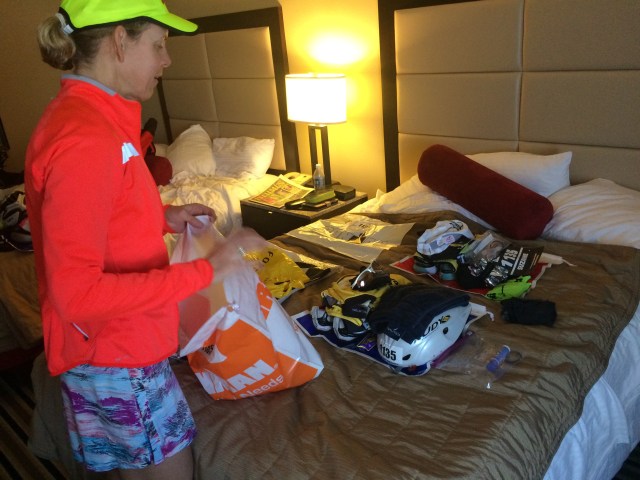
Yet for all that training, I only did half of what she did. My job on Ironman weekend was to act as Sherpa for Sue and her sister Julie. They both finished. That was the goal.

Several friends are doing the race this weekend. It seems like yesterday (but it was early this summer) that we first rode the hills with a smart young woman named Emily who is doing her first full Ironman. We did a loop on the course west of Madison. She was frankly shocked at the inclines on the set of hills called the Three Bitches. But her response was one of respect and acceptance that the challenge was hard. There was no falseness in her honesty. No bluster or braggadocio such as, “I’m going to kill this.” It was more like, “I’m not going to let this kill me.”

Which is probably not a popular meme on Ironman chat sites. The more popular mode is to cheerlead and encourage people with statements such as, “You got this.”

And generally, that proves true for most people. But along with that investment in time and preparation is the realization that things can go wrong, and often do. An ugly reality like a flat on the bike can steal minutes from your time. While riding with Emily on the course early this summer, we encountered a woman by the side of the road with a flat rear tire. She confessed, publicly, that she had never learned to change a flat.That’s not good preparation for anything having to do with a bike, much less an Ironman.

In an Ironman, most triathletes are so glad to get off the bike after 112 miles of riding, that they veritably smile at the chance to do something other than perch on a bike seat. Any way that you look at it, 112 miles on a bike is a long, long way to ride.

The running part? Most people get through it. That’s the goal. Because 26 miles is also a long, long way to run. What, no one told you that? These are things we all learn the hard way.

By doing it.

IMG_2802The full Ironman distance is simply no trifle. Some of us recognize that without engaging in the Grand Experiment. Personally, I feel no compunction to do the dastardly deed of the full distance. I’m quite happy to be working toward an Olympic. And while I did not quite get the swimming up to snuff this year to take that on, I’m in the pool and making exciting progress going into the winter. By next spring I expect to transform from a dragonfly nymph into a winged dragonfly. But I still won’t do the butterfly stroke. That might have to wait a bit.
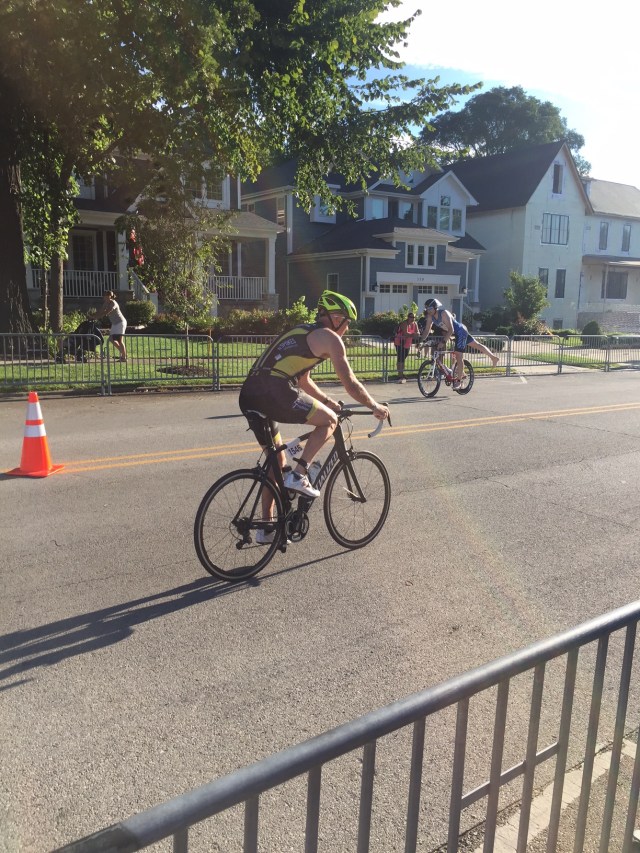
Someone last year swam the Madison Open Water Swim (MOWS) the entire way doing butterfly. People admitted grudging admiration. It seems some folks naturally like to make things harder for themselves than the rest of us. We also witnessed a guy riding the Horribly Hilly ride on a single-speed (fixie) bike. He suffered on the hills, to say the least. But he made it.

All the relative risks that go into Ironman training and the careful preparation for the race makes some people a little paranoid toward the end. The joke is that Ironman athletes want to case themselves in bubble wrap to avoid injury in the last days before the race.

Unfortunately, the best-laid plans still go awry. Last year during Ironman training one of our friends was involved in a bike crash with an aggressive driver who cut off an entire pack of cyclists. The accident caused him nauseating headaches from a concussion. It has taken months to recover. Suffice to say that was an unexpected hurdle along the way, and one that he continues to have to jump.

Last August, my fiance Sue got cut off by a driver who turned into her lane on a country road and just stopped her SUV right in the path of a group of riders . Sue had to dump her bike to avoid striking the Escalade. That incident ruined her bike frame, and she had to scramble to find a new bike before the race. It was far from ideal.

That’s why I titled this blog “It’s Ironman weekend I’m afraid.” Because fear is a natural part of human response, experience and existence. Yet it is the process of overcoming or moving past our fears that makes life a richer experience. Sometimes that ability comes through a boatload of sacrifice, and not by choice. At other times it means choosing to swim through open water with a thousand other competitors. All to earn the chance to ride 112 miles and run 26.2 after the 2.4 mile swim. Hello.  

The important thing to remember here is that fear on principle should never be used as a marketing tool. There are people who market the idea that you always should be afraid of something. It seeps into our mindsets and creates public anxiety on a scale that drives domestic and international policy. The people who do this to society are the real enemy. It shocks me that people so willing to confront their fears in some aspects of life so unwittingly subject themselves to a fear-driven worldview that says you have to guard yourself with a gun in public places and worry about terrorists around every corner. It’s insane. And it’s driven by fear.

It’s the people willing to help you overcome fears that are the ones you should trust.  They are the key to your well-conceived hopes or your ultimate future. A good leader or coach actually seeks to anticipate the potential impacts of fear to provide you with a good mental foundation going into any situation. Sports psychologists encourage mental rehearsal to help athletes overcome anxiety and fear about training and competition. Some people have fear of failure. Others have fear of success.

Of course, no one likes to admit they might be afraid. We’re somehow taught that being afraid shows a lack of courage. Instead, courage is the simply the antidote to fear. But it is not iAnd the best way to deny that fear is to take it on firsthand.

Yet we have this image of courage being this irrational ability to ignore danger and to take risks that no other human being would dare. Yet soldiers are taught how to keep calm, not rush about madly in the thick of war. It does not mean they won’t piss themselves in the heat of battle. The trick is to deal with fear, assemble your thoughts and carry on with your duties.

At the peak of my racing career there were many occasions where I stood a good chance to come in first place. Many years later I’ve come to appreciate what a unique perspective that really provided. Because even when your primary concern is fear of losing, there is still fear to contend with.

NCyclingNow that I’m a hard-working senior athlete who still finishes in the top 25% of most races, my fears revolve around the fact that triathlon is still a relatively new sport to me. Getting over fears associated with open water swimming has taken place in increments. And with experience, confidence has grown.

I also “fear” spending too much time in transition, or riding so hard on the bike that the run segment suffers. These types of fears are management issues. Practiced. Rehearsed. Made better through trial and error.

Which brings us again to the Ironman distance, and all those athletes about to embark on Indian Summer journeys through water, hills and darkness up in Madison and other cities around the country. Surely a few are afraid of not doing as well as they’d like, or not finishing. But as one great President once said, “The only thing to fear is fear itself.”

When you’ve done the work (or not…and have to deal with it) to prepare the best way you can, and sought to eliminate potential for mistakes, the starting line is simply a place to begin testing yourself. Take courage from the fact that you’re there. The rest comes together once you’re moving, and the mind goes to work replacing fears with the familiar sensations of swimming, riding and running.

Good luck to all this weekend in Madison, and many more.


Posted in IRONMAN, triathlete, Uncategorized | Tagged , , , , | Leave a comment