Cause and effect

Here in Chicago, the sports pages have begun to fill with stories of spring training. Cubs fans are still misty with flush from the baseball orgasm delivered late last fall by their favorite team. Meanwhile, Sox fans lurk in hopes their team can rise from its lowly status of black and white ashes.

It’s all part of the seasonal cycles people love to follow. And speaking of cycles, that’s exactly what we did in 69-degree temperatures yesterday. It was fun. But it was also freaky.

As a nearly lifelong resident of Illinois, I’ve seen my share of ups and downs when it comes to weather. But for most of my life, the month of February meant freezing your ass off. We ran cold, hard intervals around Kaneland High School during weather so raw the backs of your hands would be scalded from the cold even when you wore gloves.

Crocus in Spring LightThat was forty years ago. In recent years we’ve had several February warm spells that popped the crocus and snowdrops right out of the soil. For most of my life, that typically did not happen until well into March, or even early April.

In terms of running weather, I specifically recall a bitterly cold Shamrock Shuffle held in Chicago when the March temps were fifteen degrees. Racing that last mile into a stiff wind off Lake Michigan was some of the colder conditions in which I’ve ever raced. My thin Nike tights barely kept my thighs from frostbite, and my lips were blue at the finish.

March is still a dicey month no matter what year you choose. But February was almost always a lock for big snows and freezing cold. Things are changing in our climate. And it’s having effects.

Last week while doing research for a book I’m writing, I downloaded an Audubon Society whitepaper that models the anticipated changes in bird habitat due to climate change over the next eighty years. It also outlines the known changes due to climate warming that have already occurred in bird migration, winter and summer breeding ranges.

That information has been gathered over the last fifty years by birders conducting annual surveys in spring and winter. It also chronicles millions of bits of data from breeding atlas surveys conducted by citizen scientists. I know about these census efforts and bird studies because I’ve done them. The Audubon Society has gathered information of this sort for more than eighty years actually.
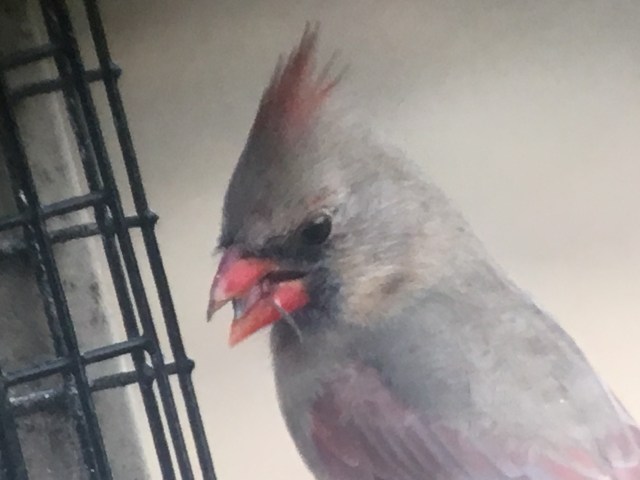
Cardinal.jpgSo we know actually know with great accuracy what’s happening to bird populations. That’s how science works. You study the patterns of cause and effect.

Every athlete should know how this works as well. You put in training in order to stress your body in positive ways. This produces a relative state of fitness, which you put to the test in races. Cause. And Effect.

But we all know how things can go wrong. A sudden cold or injury brought on by too much training can turn your workouts into a struggle. That’s a product of cause and effect too. Poor diet or other factors such as cold or hot weather can affect your results. The athlete that does not learn how to adapt to changing conditions will suffer poor performance as a result.

And if you don’t choose a coach wisely, all this madness can become the status quo. More than one coach has burned out athletes by trying to squeeze the maximum out of their protege in the short-term. All living things have limits.

That’s true of living systems, too. If you’re not making the connection here, here’s some help. The very earth on which we live is much like an athlete. It lives. It breathes. It chills. It overheats. All these factors amount to cause and effect.

And right now the whole earth is effectively suffering the effects of overtraining. Industrialization has turned out to be a stress on the climate. The planet can’t breathe fast enough to process all the CO2 being released by human activity, and we’re heating up as a result. It’s like the earth is being asked to run a mile while holding its breath, or encased in one of those plastic weight-loss jackets on an increasingly hot day. We know this for a fact.

February warmth is a symptom of climactic changes. But so are heavy snows in other regions of the country. The warming of the oceans is occurring with rapidity, leading to chemical changes that are killing off some coral reefs. This is the lactic acid buildup in our environment.

Some argue that human activity could never be the “cause” that produces these “effects.” They even pay for studies in an attempt to disprove the science that has shown climate change to be a real phenomenon.

Personally, I’ve watched the effects of climate change, and it is quite profound. The arrival time of spring songbirds has crept up by nearly a month in my own lifetime. This is based on empiric data, not some ideological perception. There are real and present changes happening all around us. Thousands of robins that once migrated south during winter no longer do so.
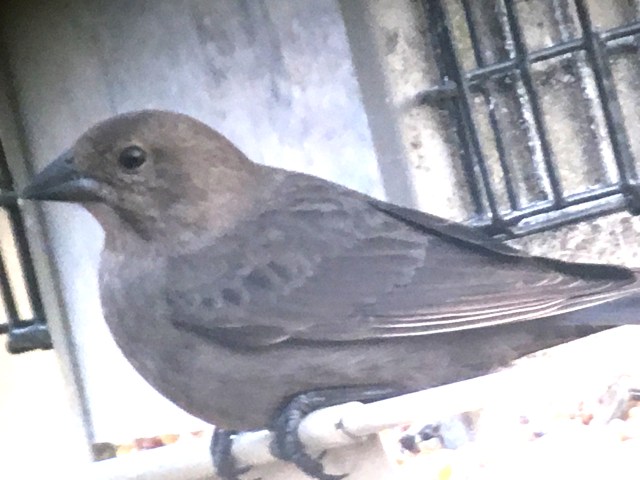
Cowbird.jpgThis is how evolution works, by the way. All living things are subject to the cause and effect of environmental and climatic conditions. If the weather gets too harsh or food supplies dwindle, populations either adapt or die off. We see that same phenomenon in winters when snowy owls populations fly south from Canada into the United States. If lemmings (their main food supply) suffer some disturbance that leads to a population crash, the owls are forced to find food elsewhere or they perish.

The same thing happens with human populations during times of drought or famine. Major migrations have occurred throughout human history. The potato famine sent many Irish across the sea to the United States. All it takes in some source of cause and effect to eclipse the status quo and human populations can be thrown into chaos.

If you’ve ever been in a race where there is not enough water at the aid stations, the cause and effect of such situations is dire indeed. A few years ago the weather for the Chicago Marathon turned out hot and stifling. Thousands of runners suffered heat stress and many could not get enough water to continue. Race organizers had to stop the race or risk having people die in the intense heat.

That race essentially served as a case study for the planet as a whole. Granted, race organizers could not control the temps that day. But when it comes to manmade climate change and the effects it is causing around the globe, we do have some degree of control how excessive that cause and effect cycle needs to get.

The changes are relatively simple. The solutions are progressing fast. Solar and wind power are turning out to be viable sources of energy. The conversion of vehicles from gasoline to electric can proceed apace as these energy sources grow in practicality.

Just a few years ago LED lightbulbs were far too expensive for most households to purchase. Yet the technology has advanced to the point where LED bulbs are now competitively priced. The market is embracing these bulbs as a result. They use less energy and last far longer than traditional light bulbs.

Yet technologies such as these are typically mocked by people who hate change. And yes, there are failures along the path to invention and conversion. That’s the nature of the free market. It is sometimes a case of failing faster in order to bring about true innovation.
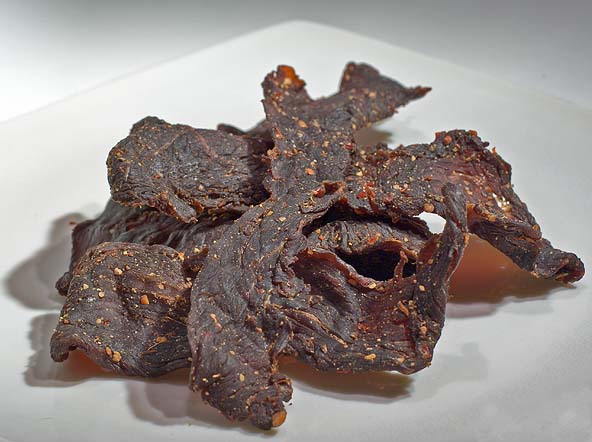
beef-jerky-tooSomehow we’ve come to a point where the opportunity to moderate human influence on the planet is being arrogantly opposed by people opposed to change. They happen to be the same group that mocks efforts to improve the American diet, and refuses to recognize the fact that the beef industry consumes 50% of the water used in America to produce a product known to cause health problems. The same goes for the sugar industry and cigarette manufacturers. Oil and coal producers as well. All these products have known negative health effects on human beings that can be mitigated through simple lifestyle changes.

Cause and effect often runs into stubborn belief systems. We’ve all known athletes who refuse to listen to coaches or trainers who warn that their habits might be harming them. Pride is the vicious enemy of purpose in many circumstances. But so is ignorance and the strange brand of confidence that comes with it. The priests who gathered up Jesus Christ and threw him to the Romans thought they were doing the righteous thing. On the surface, their cause seemed just.

That’s the exact same position we find ourselves in today. The cause of short-term economic preservation favored by today’s conservatives seems just. But the long-term effects of this are far more costly than this faction of society dares admit.


And those are the people currently in control of the political narrative. They’re concerned only with the short-term cause of wringing profit from the populace and the earth that supports it. That is their cause.

Some of us have been carefully watching the effects build up for years. We see it in the empiric changes in the birds and living things around us. We know that too many people are ignorant of the significance of these changes. Because blinded by their religion or their ideology or their politics or their economics, they are disconnected from these realities.

But cause and effect is an unforgiving reality. And the race we’re running is not a healthy proposition for any of us.
Posted in Uncategorized | Leave a comment

The just cause for being a head case

head-caseThere are plenty of points in my life where I was proud of some aspect of performance or character. Taking care of my wife during cancer and my father during his stroke come to mind. That took a lot of focus and dedication.

There are other aspects of life where my head was not truly in the game. Coaches would sometimes yell that at me or other athletes. “Get your head in the game!” they’d say.

Pro athletes who can’t seem to focus despite considerable physical talents are sometimes branded “head cases.” I looked up the definition of “head case” on Urban Dictionary and found this little gem: head case Someone who hogs the ball in basketball.Yo man you are a true head case.

I played basketball through high school and admittedly was alternately a star player and sometimes a head case. Having modeled my playing style after Pistol Pete Maravich, there were times when I did unnecessary behind-the-back passes or between the legs dribbles. Coaches would bark “Make the simple play.” Largely I’d listen. But the game was a lot more fun with a bit of flair to it.

At the same time, I competed in track and cross country. And again, at times I was a star and at others, a head case. With a mild case of ADD going on, I missed a couple turns in some races. That cost me a major dual meet win against a key rival.

Yet for all the excessive creativity and spacey disengagement, there were many times when my leadership was critical to team achievement.

Through the first three years of college cross country, I ran in 5th to 7th man position. But there were some ugly moments tossed into those years, including a junior year when I was clearly, but for the first time, aware of my propensity for depression. Mixed in were the financial challenges my family was facing with a father out of work. Then I’d worked a summer job in a paint factory. The work was at times brutal and the social environment so critical and abusive I emerged from six weeks on the job with a variety of concussive self- esteem issues.

These cropped up a few times during that season. Had someone pulled me aside and asked, “What’s wrong?” I’m not sure I could have told them. The inner spaces of my head just seemed dark. I’d run well a couple races and then go soft or slow. At the conference meet however, the darkness of anxiety and depression essentially took over my head. I was not ready to run in any sense of the world. Where I’d been completing five-mile races in 26:00 or so, I staggered home in 28:30. Those last two miles were some of the most difficult steps of my life.

Yet I recovered well enough and ran nationals respectably enough. I had survived the first real bout of depression in my adult life.

cyclingFollowing college, I kept training and racing to the point where my roommate at the time saw it as self-indulgent. Again life had tossed me a situation or two that I handled by blasting through with my head down and eyes focused only on the road ahead. Running was both a symptom and a cure for everything going on in my head.

Perhaps you know the feeling too. It’s not a cliche to state that running is cheaper than therapy. But the truth of the matter is that we’re all head cases of one kind or another. Even people that seem to have their entire lives sewn together with fine stitchery tend to have a few loose ends. They hide them well, or much better than others.

A few get so good at hiding their flaws they come to believe they are perfect. Or, they excel at convincing others of their exceptionalism that no one dares question their appearance or convictions. That was the case in the story of the Emperor’s New Clothes. It took a child to proclaim the truth that the Emperor, who was a royal head case if there ever was one, in fact, was walking naked down the street.

It is thus important to realize that really important and often wealthy people are sometimes the worst head cases of all. Those of us who labor in relative obscurity, or who don’t have 10,000 Twitter followers, might tend to think that our relative (or personal) failures in mental health and acuity are more damaging than those of the rich and powerful.

But I recall a specific instance where a certain feeling of release and relief came to mind through running. I was training with a group of runners at the University of Illinois-Chicago track each week. For some reason, the darkness in my head at the time convinced me that keeping quiet was the best way to focus during those sessions.

It was actually a bit of passive-aggressive behavior. But I didn’t know what that was at the time. In case you’ve never actually understood that term either, this simple definition helps: In psychology, passive-aggressive behavior is characterized by a habitual pattern of passive resistance to expected work requirements, opposition, stubbornness, and negative attitudes in response to requirements for normal performance levels expected of others.

In other words, being passive-aggressive is a tendency to try to control the situation by a false or calculated passivity. And I ran with the group for several weeks while talking very little between intervals. It could be said that in those moments, I was acting like a true head case.

runners-togetherBut one day we all lined up for a mile interval, and I’d been opening up a little as I’d gotten to know the other runners. There were one or two guys faster than me, but not by much. So we took off for the mile and ran a 4:30, in practice.

Then coach Tom Brunick was a bit upset with us. “You’re going to leave your race on the track doing that,” he warned. But as we jogged around the backstretch the five or six guys that had finished together all started laughing. “That was fucking great,” one of them chortled. “A 4:30! In practice!”

We came around for the next interval and ran the prescribed 4:45 mile. And the group moved in concert. Something in me relaxed during those laps. We were well within ourselves now. The 4:45 felt easy. We joked and talked in athletic whispers during those laps.

It felt wonderful to be a part of that workout. There were many like that over the years. So many that I can’t summarize them here. That is the predominant impression of all those years of running. Joyfulness and engagement.

Yet it is important to recognize one’s propensity for depression or anxiety in order to address it as life goes along. Over the years I’ve come to understand my own head a lot better. Early in my 30s I approached some of those feelings with therapists, but didn’t have much luck finding one that understood my relative needs. “You seem really well adjusted,” one of them told me.

And that was true. I’d learned to adjust. The deep and intense mood swing of youth were under control. But the habit of letting anger flare lay rooted in my conscience. There were wrongs that held on in from my upbringing that had not been solved. They vexed me in those school years, manifested in a deep desire for approval from anyone. And lacking that, the cycle was prone to repeating itself.

These are difficult admissions to make in life. Yet they are important to personal growth and actualization. Good mental health is serious business. It takes effort to understand your own mind, and where its weaknesses or propensities lie. You can’t expect everyone around you to just adapt to whatever potentially fucked up notions or behaviors vex you. That’s not fair to them, or to yourself.

hills-full-driveWe’re all head cases in some respect. But that doesn’t mean you need to go through life letting mental health challenges such as depression, anxiety or anger rule your existence. In my case, it has taken a combination of personal forgiveness, self-examination, recognition of mental health patterns, changing thought processes and practical engagement in faith to find a better path to quell the head case issues that once dogged me in life.

I’m proud of that work. And while there is always more work to do, it has also provided me the ability to better enjoy my running, riding and swimming as well. It means a lot to arrive at a point where depression triggers don’t drag me backwards or down. And it helps to be able to cure anxiety where it doesn’t need to exist.

I still have a passion for social justice that gets carried away sometimes. I’ve studied religion and politics for so long, and come to understand some of the lies that are told on behalf of God, and why they happen. So I can’t claim to be completely free of being a progressive head case. But at least I admit that. My passions run high because it makes me crazy to see people being mistreated. That may hearken to a single instance in my life, a violent moment that disturbed my sense of safety and reason to the point where all reactions to such abuse, be it verbal, religious or political, are focused into protest and action.

But that’s where I’m a bit proud of being a head case. Because it is head cases who have the guts to speak out sometimes. The Founding Fathers of America were in many ways profound head cases, driven by injustice to create a nation based on merit and equality, not royalty and Emperors with no clothes on.

Here’s to the head cases of this world. May you find both understanding and peace in your own way. And may you work to make the world a more just and rational place.

And barring that, may you hit your interval splits with panache.


Posted in Uncategorized | Tagged , , , | Leave a comment

The republican qualities of cycling

NBike OutEveryone that has ever served on a committee knows the frustrations of trying to establish a legitimate, healthy compromise to the most difficult items on an agenda. People typically weigh in with all sorts of opinions. In the end, the committee members vote and something gets decided. But it can be a painful process.
Cycling by committee

Some cycling rides are just like a committee. They start out with what seems like a clear idea, but the group is undermined with hidden agendas.

Riders express their opinions through their pedals. Other riders answer back, giving their opinions as well. Sometimes there are a couple “committee leaders” who stay up front for long pulls. Other riders linger in back trying to hang on. Others save themselves for late committee heroics. Almost everyone hates those people.

Peloton politics

Even the peloton in large professional races has its committees. Typically a rider or a group of riders will press their agenda that day by going “off the front” to see if they can “stay away” the entire stage. Rarely does this work, but people still try it because the benefits of riding ahead or in a small group include exposure for the team sponsor.

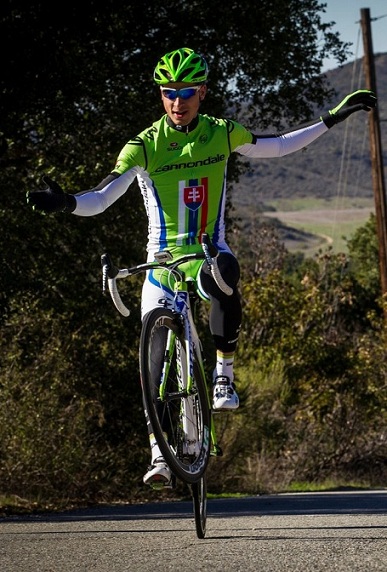
peter-sagan-2013-no-hands-wheelie-resized.jpgA very few riders might ride for the right to say “I led a stage of the Tour de France for 110 km.” There is always some room for individualism in cycling. That’s why people have long loved the likes of Jens Voigt, and why people root for Peter Sagan to freelance his way to winning sprints by jumping on the trains of other teams. It takes amazing cycling talent and fantastic bike handling to do what he does. Sagan is like a middle finger shoved in the face of the peloton. “Fuck you!” he seems to say.

Committee killer

And who else on this earth can say that? There are committees within the committees of every race. Each team in a stage race has its strategy. They each protect their General Category rider or work to position their sprinter for a win in the last 3Km. The bickering and competition between teams can get quite intense out there on the roads. There is only so much room on the road in major races.

In recent years Tour de France riders have complained the pressure and craziness is so great that it’s not safe to ride certain stages at all. There are moments in every Tour or Giro or Vuelta where it is a matter of survival to simply hold your place on the road. The mere structure of the race in these cases is a committee killer. Tour architects seem to like it that way. But sometimes individual cyclists suffer, get knocked out of contention or even risk their lives as a result. There is a fine balance between sanity and insanity.

The Dictator

A few years back I rode out with a group of cyclists led by a triathlete known for his 26mph average on the bike. Sure enough, he got down in an aero tuck position and blasted away. The rest of us on the “ride committee” that day looked around rather desperately for a wheel to grab. But the lead rider swung to the right of the road even when the wind was coming hard from the left front of the pack.

He was, in other words, “guttering” the bunch of us. Only first one or two riders could manage any sort of draft. The ugliness that followed was like throwing a bunch of Lutherans into a Catholic Mass. No one knew where to hide. The pack shed riders off the back one by one. Devil take the hindmost. It was a cold and lonesome ride home that day.

State your case

That’s all fair if you know that going. There are “drop rides” and “no drop” rides. But nothing was announced before that particular ride. I suppose if you show up and nothing is said, the assumption you can make is that no one is going to wait up for you. Every ride is a drop ride until someone says it’s not.

For these reasons, riding is democratic only in the sense that everyone has essentially the same chance to excel. Beyond that, anything goes. Cycling is an egalitarian yet often merciless sport. Only in club rides where communication is held before the ride do committees of riders have any sway. A really good ride operates more like a republic than a raw democracy or the mob rule of populism. Take a look at the definition of republic and you’ll see what we mean:

re·pub·lic [rəˈpəblik] NOUN
a state in which supreme power is held by the people and their elected representatives, and which has an elected or nominated president rather than a monarch.
A cycling group ride can still be a great thing even when it is run by committee or conducted in the fashion of a republic. If riders agree on a goal pace and allow other riders within the group to take pulls and share in the work, everyone knows the expectations and can contribute in their fashion.
Certainly no one expects every cyclist on a ride to be equal in talent or fitness. Some riders will be stronger and do more than their “fair share” of pulls. Most frankly love to do this work. It can give great satisfaction to be fit and “rule the roost” for long stretches with other cyclists in your tow.
But consider the actions of that “dictator” who loved to gutter the group just to prove how strong he was. That has nothing to do with the real qualities of leadership. He satisfied his own ego, for sure. But he sure didn’t build genuine respect from all those he lured into his draft and then punished for trying to stay close.
There are tons of lessons for the rest of life in that example.


Posted in Christopher Cudworth, competition, cycling, cycling the midwest, cycling threats, Uncategorized | Tagged , , | Leave a comment

It’s AFFECT versus EFFECT in the pool

The water in the pool at 5:30 in the morning can seem like a shock to the skin. Three lanes down one of my fellow swimmers sat at pool’s edge taking deep breaths. She was trying to work up the gumption for that first plunge. “I didn’t used to mind that part,” she told me with a wan smile.

Such are the differences between being a gumptious teenager and a 20-something getting herself in shape for a late-summer Ironman Triathlon. Yet she aptly illustrates the early morning plight of so many different people in the pool. It’s often cold getting in, but once you’re in, the effect of the cool water on your skin is hardly noticable.

Better late than never

About 15 minutes into our workout, another gal swimmer walked with her swim bag slung over her shoulder. She stood by pool’s edge and announced, “It takes soooo  long to get here.” She lives on the same block where I used to live, so I get that loud and clear. It was hard cutting through town to reach the pool. If there is frost on your window in the morning the going goes even slower the first mile or so until the defrost kicks in.

But every workout counts, so it’s better late than never.

So late or not, you hop in the pool. But then your goggles fog up if you left the swim gear in the car overnight because they’re still freezing cold. That’s the other effect of morning temperature changes.

The contradiction of the Blue Glove

Blue Glove.jpg

I recently read an interesting article on the proper way to hold one’s hands during the swim stroke. It recommended not holding the fingers tightly together. This seems counterintuitive. Yet so many things about swimming are like that. Who would think the best way to effect progress would be to rotate your body in the water?

While swimming this morning I felt a few moments where the sensation of moving my hands through the water indeed felt magical. Then between intervals, I waved my hand through the water just letting the feel of the liquid flowing around my fingers. I imagined the result looked like the blue swirls behind the Dreadful Blue Glove in the movie Yellow Submarine. We all know the Blue Glove started out as an evil tool of the Blue Meanies. But by the end of the movie, the glove learned the value of LOVE.

All you need is love. And to breathe. 

So while I’m still not quite at the point where I can claim that I love to swim, it’s getting there. I can’t yet let my thoughts roam. I still have to concentrate on the entry angle of my hands into the water. Then comes the catch and pull and that roll of the body with each stroke.

My breathing technique has also improved immensely. It seems so simple. Breathe Co2 out the nose. Breathe oxygen back in the mouth. Let it happen. Don’t force it. Once in the while I still catch a mouthful of water. It happens.

Sore subjects

This morning the ridges of muscles along the side of my body were sore from weightlifting two days ago. I’d isolated the ‘lats” with pulley pull-downs and could feel the lats and core straining to hoist 90 lbs. for 10 repeats each, times four. “I’ll be sore in a couple days,” I told Sue during the ride home after the workout.

No sport is more incremental by nature than swimming. Every tiny angle of the hands or arms or body either effects or affects forward motion. To effect forward motion means using your arms, legs and body to create propulsion and flow. These things help you swim more efficiently. Hopefully faster.


Affect versus Effect.jpg

A quick illustration of how poor swim form can AFFECT swimming efficiency and how good form can EFFECT better progress through the water.


To affect forward motion means allowing any part of your body to create drag. This occurs when hips and legs drop or the head is raised out of the water. These things cause a swimmer’s progress through the water to slow.

Truth and time

Swimming involves such simple physics and yet is so goddamned complicated it is like trying to sort truth from a Sean Spicer press conference. Getting to know the feel of an efficient swim stroke requires time in the pool. It’s the same thing with riding the bike. Efficient cycling only comes from TITS. Time In The Saddle.

Thirty years ago I read a book by John Jerome called A Sweet Spot in Time.  The book posited that it is possible for athletes to find a “sweet spot” in performance through a combination of practice and mental rehearsal that leads to a place where engagement is effortless.

What a sweet dream that would be in the pool! A few of my fellow swimmers have obviously learned how to swim with enough efficiency to casually enjoy their time in the pool. They can swim well enough to let the mind wander. That means one can ‘let it happen’ rather than constantly focusing on the next thing necessary to keep forward progress going.

Let it roll

That’s the goal for anyone that swims. To effect progress through the pool rather than letting the water affect how you move. Learning to effect a good stroke is critical because sooner or later, those of us in triathlon find ourselves in open water with no walls to reach or places to stop in order to catch our breath.

Yet last summer I walked down to the water at Pleasant Prairie and started a 750 meter swim in a large lake. Right away, a new kind of freedom in the water came to me. My arms cramped a little at 400 meters, but that didn’t stop me from enjoying the swim. I walked out of the water elated to have some so far in a year’s time.

This morning the speed portion of the workout called for ten 75-yard intervals on the 1:40. I did all ten in 1:26 show me, and that means progress is occurring.

It has taken a long time to reach the point where I can effect a good workout rather than letting the workout affect me. That’s called a turning point. Hope you’re finding your way to those moments in all you do. Run. Ride. Swim.

If you have any challenges in your progress, send me a note at cudworthfix@gmail.com. I’ll either try to answer them myself or find out the answers from the other experts in my life.


Posted in swimming, Uncategorized | Tagged , , , , , , , | Leave a comment

Jamie Block Mayer a dynamo you should know

Mayer smiling.jpgJamie Block Mayer is not much more than five feet tall. Her legs are thus in perpetual motion as she speeds along at just over 6:00 pace in a 5k. Those legs keep her going for much longer than that as well. Last fall she won the women’s division of the Fox Valley Marathon in St. Charles, Illinois in a time of 3:19.

“I was running along and after about ten miles people started shouting that I was third woman,” she recalls. “And they said I wasn’t far behind second. So I decided I’d try to catch her. Then I was going through fifteen or so and people kept telling me I wasn’t far behind the first girl. So I thought, ‘I’ll try to catch her too.’ But then I was in first, and it wasn’t as fun trying to hold the lead as it was to catch people.”

mayer-fox-valley-finishYet she did hold the lead, and the joy on her face coming across the finish line expresses the relief and thrill of accomplishing a win in a marathon with more than 1000 competitors. “I try not to make things too complicated,” she says of her training leading up to the race. “It’s pretty much 40 miles a week with a tempo run and some intervals every week. A friend named Mike Behr told me how to train a few years back and I’ve tried to follow the same program. Maybe I’ll go online and find something that sort of matches. Then I just do it.”

Some tease her about the regimen she uses in training. Her Strava feed shows a series of out and back or loop courses leading from her home. They don’t vary much. “I have my 5K, 10K, 10-mile and 12-mile runs,” she relates. “Even when I run with other people like Mike, he’ll say, ‘Let’s turn here’ and I’ll go, ‘No, that’s not on my loop.”

mayer-famllyHer schedule and obligations demand that kind of focus. She is a professor at Northern Illinois University in DeKalb, Illinois. She has her Ph.D. in Communications Disorders and Neuroscience and instructs her students in Speech Pathology. Her husband Steve, an orthopedic physician with Northwestern Medicine, threw her a nice little party when she received tenure a few years back.

And while Steve is also an endurance athlete and an Ironman triathlete, the two seldom (if ever) train together. Their paces and priorities typically don’t match up given her penchant for speed and his focus on longer races.

mayer-finish“I won a 5K a few years ago,” Jamie notes. “I was just over 6:00 pace. And I’m pretty competitive in every race I enter. A couple years back at the Sycamore Pumpkinfest 10K I was standing next to this 20-something girl at the starting line and she was going on about how she was up late partying and didn’t feel that great. But then she beat me. And I was pissed,” she laughs.

Thus it isn’t age that defines Jamie Block Mayer, but the purity of effort and the joy of participation. She encourages the same love of sports in her children Tara, age 12, Max, age 9 and Ellie, age 6. The eldest is involved in gymnastics. The middle child has earned national championships in the sports of tumbling and trampoline. Her youngest seems headed for considerable achievements in gymnastics as well.

That schedule of getting kids to practices is shared by the couple, and that’s another reason why Jamie and Steve don’t often train together. “We have to get the kids where they need to go,” she observes.

With a running career that began in her early 20s, Jamie has achieved some notable accomplishments herself, qualifying for Boston a few years back. She ran the race in 2013 when the bombings hit near the finish line. “I heard a noise but I was down by the buses getting my gear,” she recalls. “Then Steve called me and said “Run!” and I answered, “I just got done running! Then he said, ‘Something really bad just happened. Get somewhere safe.”

Thus her experience in one of the world’s most famous marathons was colored by terror and tragedy. Thankfully such events have been rare in the world of road racing.

mayersPerhaps that contrast was more in evidence as she raced the bike trails in the Fox Valley Marathon last fall. The race follows the Fox River south to Aurora and back to St. Charles. Typically the weather has been fair and clear for the race, with leaves starting to change and the river surface reflecting the glory of the valley. The predominant noise is often the honking of geese and the cheers of happy fans staged along the course.
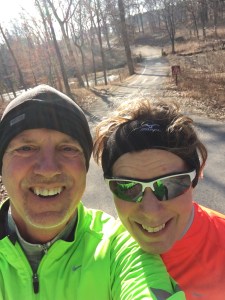
It’s almost hard to imagine those short Jamie Mayer legs carrying her the entire marathon distance. But anyone that has seen her run dispenses with those concerns immediately. And as she rounded the final corner into the finish of the Fox Valley Marathon with that huge smile on her face, the crowd cheered her every step. Jamie Block Mayer was very much in her element because while she may be small in stature, she believes in doing big things.


Posted in Uncategorized | Tagged , , , , , , , , , , , , , | Leave a comment

Learning to smile on the hills

hillsYesterday we ran 10 miles in the Morton Arboretum, a hilly landscape in suburban Chicago. There aren’t than many places in northeastern Illinois where you get a set of hills so close together. The Arb cover a series of glacial kames in DuPage County. That means it is an attractive place to train for dozens of runners who descend on the place every Saturday and Sunday morning.

Our planned 10-miler took a tour of the east loop first. The road climbs gradually through a pine woods and winds toward the far east side. That’s where a semi-native forest of maple trees covers terrain that drains to the wetlands below. On summer days the humidity in these woods can prevent the pavement from drying. That means dangerous footing where moss lurks on the road edges. Cyclists must be careful in sections where the asphalt stays slick with morning dew.

For runners, the same holds true in winter months when melting snow can create wide patches of black ice. Fortunately for us, the roads were dry due to a prolonged warm spell that wiped out the snow several weeks ago. The temps were in the low 30s when we started out. That meant there were few other obstacles to address. It was just us, the hills, and ten miles to cover.

Hill running form

Sue has been working on hills over the winter months. Her coach has her doing treadmill work on inclines, and we’ve gone to several sweet hills to do repeats. So her technique in hill running has improved.

It’s a fine line for many people to figure out the optimal hill running form.

hills-leaning-backYou can’t just run up a hill using the same running form you use on the flats and expect the same efficiency and results. The simple physics of hill running demand a change in strategy and technique. Runners who employ a fairly erect body position while running on the flat would actually find themselves leaning somewhat backwards if they tried to maintain the same relative position to the ground.
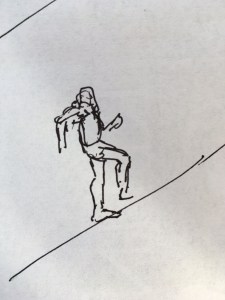
That means leaning into the hill is important. But you also don’t want to get your head so far forward that you’re actually falling uphill. That’s not efficient either. So the extremes are something to avoid.

The ideal running position will vary depending on the degree of uphill you are climbing. Some of this takes practice to make perfect. Sue’s coach has been having her do hill repeats and it took several sessions for her to get a feel in combining her midfoot strike with proper arm carriage.

Don’t lose drive!

hills-leaning-forwardIt seems so simple, and yet there are plenty of people who make the mistake of carrying their arms a bit too high. You actually lose the companion drive necessary to run hills well when carrying the arms too high. But you also don’t want to straighten the arms completely when running hills. By definition that forces you to lengthen your stride in sync with the arms. That’s not the most efficient way to climb either long or short hills.
The ideal “structure” to arm carriage is having the forearms at about ninety degrees from the upper arm. This provides optimal swing capability and prevents you from “shrugging” your way up the hill by tucking your arms against your chest like a T Rex.

Watch your knee lift!

The optimal amount of knee lift is going to vary from runner to runner. So much depends on body structure, flexibility and the normal amount of knee lift engaged in the running stride. But this isn’t what you want to change anyway.

It is the ability to run off the midfoot that will produce the most drive in any type of running style. That is what you need to practice on hills before doing long, hilly runs in hopes of developing better efficiency.

Learning to drive uphill using a forefoot stride is far better than trying to “heel” your way up the same hill. Think about it: landing on your heels while going uphill actually requires you to lift your leg higher off the ground in order to place your heel in the next stride. That’s a bit of repeatedly wasted motion that gains you zero forward impetus. You’re actually putting the brakes on the entire way up the hill.

Paw your way up

The better way to hill run is to the “paw” your way up the hill using a “sweeping” motion with your forefoot as the principle point of contact. You’ll still have sufficient opportunity to push off with the foot. The degree of hill you are climbing simply demands that. But the propulsion of “toeing off” in combination with a ninety-degree arm swing is what produces the most drive up a hill.

This can all seem impossible when you’re in the middle of a steep hill in the middle of a long run such as ten miles. But that’s when you shorten your stride a bit and increase the cadence. It sounds counterintuitive, but you have to “let the running happen” in those moments. Sure, fatigue may be sinking into your thighs, but keeping that slight forward lean and driving with the arms and toe push off will get you up and over far better than sitting back on your heels and laboring along.

Build confidence!

Running hills in training can do plenty to build confidence in this respect. Run 100-meter intervals as a starting point. Focus on the feel of proper arm swing and consistent forward progress. Then increase your interval to 200 meters or about 1:30-2:00 sessions going uphill.

When you’ve built some confidence you’ll also have built some strength in hill running. This you can begin to employ in longer sessions where you run up a 400-meter hill if you can find one, and jog back down for recovery. Work your way up to ten of these intervals.

Then when you head out for a ten-mile run with hills, you will no longer face each one with such trepidation or concern that you can finish the job.

Steeping the muscles

hills-full-driveIn situations where truly steep, short hills stand in your path, the entire process gets compressed even further. Increase the forward lean, get serious with the toe push off and concentrate on an even, measured running stride. It’s common to start off too hard by charging into the hill. Better to use your forward progress as a relative measure of speed. Power your way up the hill rather than sprint it. Most of all, understand that you’re calling on some energy reserves in the process. These tend to be your sprinting muscles, which exhaust themselves more quickly. You may find that burning sensation uncomfortable, but it does not mean you are finished for the day. Often the other muscles take over when you’re up the hill and moving on the flats. Trust your body. It can carry you through.

More than anecdotes

I well recall a hill at the three-mile mark of a six-mile loop in a half-marathon in La Crosse, Wisconsin. The hill went up the side of a bluff and was nearly a half mile long. We ran and ran up that hill and toward the top, my butt literally started to lock up. That meant I’d fully engaged the driving muscles on the hill. A part of me worried that I’d burnt all the matches in the box. Yet after the crest came a long downhill and within 100 meters I was flying down the other side. I finished the race just over 1:11 that day. Not a bad effort on a tough course.

But the worst road race for hills was a 10-miler near Lancaster, Pennsylvania. There was hardly a flat mile in the entire race. I went out with the leaders that day, who seemed to ignore the hills and took us through the first two miles in just over 5:00-mile pace. I hung with them through five when the ultimate leader pulled away. A pack of us fought up hills and down, at times flying on the downhills faster than 5:00 pace, then climbing another steep hill at over 6:00 pace. A topographic map of that race would have looked like the fibrillation of a dying heart patient. And at times, it felt that way inside my own body.

I still finished in 54:00, possibly one of the best running efforts I’d ever accomplished. There have been other hilly races including a four-miler in Glen Ellyn, Illinois where my time of 20:00 flat was exceptional given the massively hilly terrain on which the race was held.

Small proofs equal big progress

These are small proofs that it pays to take pride in your hill running, and work at it. There is no sense trying to fake it or avoid the fact that there are hills in this world. The pride and confidence you gain in climbing tough hills during training has direct applications in racing.

The same holds true for cyclists. Training on hills is a crucial source of strength-building. The techniques for successful climbing include consistent pedal strokes using both quads and hamstrings, and utilising core strength to support these two muscle groups. Clipped into a bike, it is yours to funnel strength all the way down to the pedals. It is a very different transfer of power from running. You almost want to pull your way up most hills rather than push exclusively with the thighs.

Yet there is beneficial transfer of strength from hill training in running and cycling. The psychology is much the same as well. There is no place to hide, but then again, that’s the point. It’s the hidden strength you build by practing on hills that exposes your true abilities. So go for it. Seek out those hills and do the work that builds strength and confidence. Then you’ll learn to smile as you head on up. “I can do this! I can run (or ride) this hill!”

And that’s where you want to be.

WRARNewLogo.jpg

Posted in running, Uncategorized | Tagged , , | Leave a comment

The curse of the snack attack

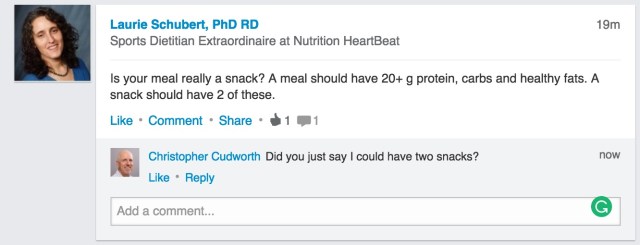
A dietitian friend and multisport associate on Linkedin posted a description of how to manage snacking. I read the recommendation and something in my brain did not quite process it the way it should be. So I joked with her, because I’ve consulted with her previously about nutrition for athletes.

Laurie Snack Attacks.jpg

I was playing the part of the athletic fool, of course. But like most athletes, I’ll dig up any kind of excuse for a snack. Just writing the word snack makes me feel snackier.

So you have to set up some rules for yourself. Or else snacks will take over your life.

The key thing with snacking (as any fool can tell you…) is to cut down sugar and carbs. These are the foods that make us fat. They make me fat anyway.

But cutting them out can be tough because sugar is everywhere. It’s hiding in everything. Sometimes it’s even hiding in plain sight. That’s the case with the muffins and other goodies at Starbucks. They just plop those fat and sugar bombs right in the line of sight while you’re standing in line.

It’s so hard to resist. A good muffin is like a hot mess of carbohydratey goodness. “Eat me!” it hisses through the glass. “C’mon, eat meeeeee…”

It’s like that at just about every other coffee shop in this universe. And we’re at our weakest point when we’re starving from having just completed a run, ride or swim early in the morning.

Last weekend after an eight-mile run we happened to be parked by a popular Sunday morning breakfast place called Harner’s. It’s a classic local restaurant in all the good, right ways. The place is jammed with breakfast eaters and brunchers. But the real temptation zone is the donut and pastry case. It’s a glass structure thirty feet long and it is jammed with shiny rows of disgustingly good treats.

I ordered a yogurt parfait and a chocolate milk. Those sound like good choices, right? Well, half the yogurts we eat are chock full of sugar. And so is chocolate milk. My After, My Ass.

Powdered sugar donut.JPGAnyway, I walked over to pay for my good choices when I looked down to see the clean round shape of a powdered sugar donut. “I’ll have one of those too,” I told the young lady.

Now in a just and righteous world, that young lady would have looked me in the eye and said, “Sir, do you really need that donut?”

But instead, she asked, “Will that be all.”

Now that’s just evil. But I resisted further temptation and walked out the place clutching a brown paper bag full of sugar infested post-run diet busters.

Then I sat in the car and ate my parfait. It had fruit in it, but the fruit felt fake because it was a little rubbery from swimming around in that parfait. But I downed the lot and took a good swig of the chocolate milk.

Next came the donut, which I broke into bits because eating a powdered sugar donut by holding the whole thing up to your face is flirting with disaster. All it takes is one sniff of that fine powder and a sneeze will erupt that can kill a bird in mid-air. So I took little nibbles of that donut while licking my fingers after each bite. I look like a cocaine abuser anyway, because my nose and already silver goatee was rife with powdered sugar.

I was just about finished with my evil treat when Sue came trotting back from the extra two miles she logged beyond the eight that I had run. I hid the rest of the donut in the brown bag. It made me feel like a druggie hiding a stash of pot from the cops. She’s pretty damn disciplined about what she eats except when she’s not. Which isn’t all that frequently but it still happens. Sometimes she gets hungry for anything that is edible within fifteen feet of her. Because we’re athletes.

So I wasn’t kidding when I asked my friend Laurie if I could have two snacks instead of just one. Because I always share the extras with my sweetheart. Except when I don’t. Because a powdered sugar donut is just not meant to be shared if it’s going to ruin someone else’s discipline and diet.

Is it?


Posted in running, Uncategorized | Tagged , , , , , , | 2 Comments

Watching out for the Home Team

Home Selling.jpgThis morning while running I noticed yet another Real Estate sign featuring yet another “team” dedicated to selling a home. This trend to assemble “teams” rather than operating as lone wolf Real Estate agents has been building for years. There are reasons why it is so necessary.

When I sold my home this past October, the market for ranch houses was hot. My place sold in a day because we priced it right and there was a buyer salivating for the exact dimensions and location of that house.

Of course, that did not stop the potential buyer from bitching about things anyway. When I let them into the house for some planning and measurements, someone in her enclave started complaining that the living room measurements in the listing information were off by half a foot.

That’s how absurd and stupid people can get about their home-buying. Beyond that, the buyer also complained that I’d “torn up” the yard by removing some stones from the garden. I had specifically stated that would be the case, but people conveniently forget what they don’t want to believe.

By the time I’d completely cleaned out the house, I was so ready to be done with the place, there was hardly any sentiment left for the home where my kids grew up and we’d lived for 20 years. I simply could not afford the emotion at that point. I’d gone through some serious shit trying to separate family keepsakes from the stuff that no one would ever need. In the process, I discovered some family photos and shared those with my kids and in-laws. But there was a ton of stuff that simply had to go. It was a physically, emotionally and economically exhausting process.

Running from insanity

Between those house-cleaning sessions, I’d go for runs on routes that were so familiar to me after 2o years. Those loops have gotten me through some truly vicious shit during my time on earth. All those years of dealing with my late wife’s cancer. The ensuing job stress and financial challenges that came with it. Caregiving for my stroke-ridden father. Some of those periods were almost too tough to take. But not quite. I’d go out for a run or a ride and arrive back home at least temporarily freed from the heavy weight that rested on my shoulders.

Occasionally I’ll drive the street in front of my former home to check out what they’re doing with the place. Right now there is an installation of a new heater going on. The boiler and radiant heat in that home had served us well, but there was admittedly no central air conditioning. We relied on window units when necessary. But honestly, the prairie style overhang of the roof kept the place cool.

The Realtor who sold my home explained that the lack of air conditioning depressed the value of the home by $10,000 or so. When a Realtor comes through the house and finds out you don’t have air conditioning, or notices that your bathroom countertops are retro holdovers from the 1950s, they try not to wince. They know people can be total assholes about every niggling thing. Somehow the lack of full AC just never bothered us when we lived there. I was always kind of proud of the simplicity of it all.  But now the buyer is installing vents throughout the house to “improve” the place. Have at it.

Home-selling teams

All these challenges in home-selling are why the concept of home-selling “teams” has likely emerged. Dealing with the public means putting up with a whole lot of horseshit from the buyers and a shitpile of fear from the sellers. People can turn into greedy, selfish bastards on both ends of the deal. so here’s the truth: It takes an entire team of people to deal with this shit.  

Over the last 20 years, the Real Estate world has also gone through some serious shit. That mortgage crisis that contributed to the economic crash and recession of 2007 acted like a bitch slap to the temple for anyone in the housing industry that wasn’t already supremely capitalized. Only the strongest survived because houses simply weren’t selling for a few years in a row. The market rebounded a bit starting three years ago. Last spring there was an absolute home-selling rush for a few months.

If anything, selling homes is like being on a track team. No one is doing the same event, but everyone on the team is important. In track and field, you have your fat folks to throw the shot and discus around. The skinny people do the distance running. It also takes humans with hops to win the jumping events or fly over the bar in the pole vault.

It’s the same with a home-selling team. In the Real Estate business you’ve got your mortgage brokers to qualify people for the loans they need to buy property. Then you’ve got your home inspectors to check the place over, and lawyers to file all the paperwork. Before it’s all said and done every real estate transaction is like a mini-track-meet of things to do and hoops to jump through.

Competition

To make it all the tougher, the Real Estate market is really competitive. That is why it doesn’t take just a “team” to sell residential or commercial property. Sometimes it takes a whose Platoon, a Goddamned Battalion or a Freakin’ Army sometimes.

I’ve worked in the Real Estate industry marketing homes and pushing commercial properties. In many respects Real Estate is a shallow business dependent on the merest whims of potential buyers. While taking people through tours of commercial property the dynamic is strange at best. All the cliquish conversation can make you feel as if you don’t even physically exist. Then they turn to you and ask, as a collective, “Can we get this for $12 a foot?”

A voice in your head goes, “No, you fucking dimwits. This space is $20 a foot.” But you ask the company owner to take a look at the proposal they submit. Then the company owner meets with the prospective buyer and two days later a contract is signed for the property for $10 a foot. Then the company owner calls you into the office and says, “Sorry, we can’t pay you commission on that one. You didn’t negotiate well enough.”

You wonder to yourself, “What the fuck?”

But that’s how so much of the business world operates. Shareholders get their return on investment even when employees bleed out their ears trying to create it.

It’s all about back room deals and taking cuts up front and letting the devil reign over those in the hapless middle ground where unions try to keep their clutches on a few dollars of pay and middle managers sit in cubicles wondering when the fucking axe might fall.

It’s a simple rule: If you’re not in the decision process, you get cut out of the deal. And that, in a nutshell, is why the American Middle Class is struggling. There are vast swaths of America that have been cut out of the deal. That includes family farms swept under the rug of corporate agribusiness and dunned by Monsanto for wanting to keep a little corn or soybean seed from year to year. Yet they’re told to hate the city folks who refuse to buy GMO or hormone-infused products because the science is not clear on where all this is taking us.

It’s an ownership game, you see, and there are assholes on both ends of the deal. People in the middle have gotten screwed.

It all helps explain why that Real Estate sign in your neighborhood says “So-and-So Home Selling Team.” These are people banding together to keep their cut of the deal. I say more power to them. They’re simply watching out for the Home Team.


Posted in running | Tagged , | Leave a comment

Life in the Faust lane

Devil over shoulder.jpgAs I swam in the outside lane of the Marmion pool, I glanced across the surface to measure my pace against the better swimmers in the middle lanes. They did not seem to be going much faster me, but I knew too well they were.

I’ve never been scared to compare myself to others. But I am competitive, and it sucks at my soul to be the slowest swimmer in the pool.

So I was growing a little empty as I swam along, wondering if I would ever improve enough to keep up with the morning crew at Marmion.

At that moment, I felt a strange little presence over my left ear. Take note: that’s not my breathing side. I pretty much breathe on my right. But for curiosity’s sake, I breathed on the left for a moment and was shocked to see what appeared to be a small goatlike creature wearing a bright red Speedo perched over my left shoulder.

He seemed to flutter above the water. When droplets hit him, small sparks flew off his body. I recalled an experiment in high school chemistry where we threw chunks of magnesium in water. They hissed and kicked out bright light while bouncing around the surface.

That’s what the little creature over my shoulder looked like. He was grinning at me with eyes narrow as slits. He looked like a cat that had way too much catnip. Then he said, “Hello there Mr. Chris. Would you like to swim faster than the rest of those buggers?”

At that moment I came to the end of a lap and purposely did a long underwater surge coming away from the wall. I thought that perhaps I did not get enough sleep last night. We got up this morning at 4:30 a.m. Sue’s alarm went off four or five times before we finally rose of out bed. So it wasn’t beyond imagination that I might still be dreaming. Perhaps the little creature above me in the pool was just the remnant of some strange dream from the night before.

But no, he was still there. “I can make you as fast as Michael Phelps,” the creature muttered as I emerged above the surface to get a gulp of air. I tried swinging my left arm a little higher to see if I could hit the little red devil, but he dodged it easily.

“That’s better!” called coach Chris Colburn from the sideline. “Higher elbows! Bring your hand into the water at an angle!” So I did that, and suddenly felt a surge of speed. “I don’t need you,” I muttered to the devil hovering over my ear. “Can’t you see? I have a coach…”

“He can’t coach you like I can,” the devil hissed in a voice that smelled of chlorine. “What you want is real speed. Let’s leave these people in the dussssst….”

“Go. Away.” I sputtered.

“Not so fasssst,” the little red creature teased. “You just did your last 100 in over 2:00. How would like to do a 1:20 without even feeling it?”

“That’s impossible,” I blurbled. “That’s a forty second improvement.”

“Nothing’s impossible with me,” he sneered. “You want to be best in the pool? Win Masters races all over the Midwest? Be first out of the water in the Pleasant Prairie Olympic Triathlon this summer. Let’ssss talllllkkk…” he pleaded.

I did another turn and came up for air again. “Think of it this way,” he continued, sparks dropping into the water from his body like fireworks over a bucket on the Fourth of July. “No one needs to know! We’ll take it gradual-like. Just improve a few seconds every week. At first, they’ll all just be happy just to see you keeping up. We won’t let them know how you got so good. No one needs to know! Look at that woman and her daugther over there in lanes three and four. Do you think they got that good just by working out all the time?”

“I can just imagine what you’re asking,” I sputtered. “What will this cost me. My soul?”

“In a manner of speaking, yes,” he admitted. “But you can have it back when I’m through with it.”

oil2“And how long will that be?” I wanted to know. “Do I get my soul back before I die?”

“More like when you die,” the little devil told me. “But you don’t really need a soul if you’re getting what you want in life, do you?”

“Now that’s an interesting question,” I replied. “I know a few people that have sold their soul lately…”

By then I’d completed four out of five 200s. My average was just under 4:10. So the temptation to accept his offer was definitely there. I stood there breathing. The pool water felt extra warm. I could taste the salt coming off my own face.

He hovered over my shoulder offering his Faustian bargain after every lap I swam. “C’mon, slowpoke!” he’d tease.” You want to keep going like this the rest of your life? A freakin duck could keep up with you at this pace.”

“Okay, that’s enough,” I scolded him. “I happen to like ducks.”

“That’s good, because you swim like one. Piddle paddle piddle paddle. You’re pathetic,” the devil said.

Finally he got impatient. “Now how about it, Michael Un-Phelps. Are you going to take me up on my offer, or let this offer of swimming glory just pass you by?”

But having completed the last of the prescribed 200s, I stood by the shallow end of the pool while the rest of the gang was getting instructions from Coach Colburn at the other side. “Okay,” he barked out. “We’re doing 8 X 25s on the 30. Ready, go!”

I watched the other swimmers tear into the first 25. Then they paused in a neat row on the same end of the pool as me. So I waited, wondering if anyone else could see the little red devil perched above my left shoulder. He whispered: “Don’t even try to keep up with them. You can’t do it.”

But when they took off,  I dove into line with them and swam as hard as I could for 25 meters. Lord knows, I actually kept up with them. But I’d finished in 25 seconds, so there was only 5 seconds recovery before we went again. This time I faded toward the finish.

But when I popped up for air on the other end of the pool, that little devil was gone. I looked all around me, and even dipped below the surface of the water to pop back up with rivulets dripping off my goggles. And at that moment, the rest of the swimming crew had arrived back at my side of the pool. So I gathered myself and took off swimming again the 30. And kept up for yet another lap. “Hey!” I told myself. “I did it!”

By then I admit I was exhausted. So I finished the last two 25s on my own. I can in at 28 on one, and 29 on th eother. But in that moment, I realized I did not need to make a deal with the devil to become a better swimmer. Working hard and getting as good as I can on my own power is good enough.

Yet I’ll admit it. For a moment there, I was tempted by life in the Faust lane.

‘

Posted in swimming, triathlete, triathlon | Tagged , , , | Leave a comment

Bumping along on the mountain bike

mountain-bikingYesterday turned warm and I was all set to go out on the Venge when I realized something had snapped a spoke in my rear wheel. Probably the wheel got knocked or caught on a bike pump, but whatever the cause, it was not fit for a ride.

That meant grabbing the Specialized Rockhopper to get out for a ride. The temps were in the mid-50s, so it was perfect weather for bumping along the mountain bike.

The problem with that statement is that it is literally true. Once I reached a small forest preserve along a country road, I pitched onto the grass trails and the bumpy ride began. The ground is a combination of frost-hardened soil and mushy, muddy furrows. So you alternately slide and bounce over the terrain.

Switching from high to low gears doesn’t help that much. Neither do the shocks on my front fork. My bike is a ‘hard-tail’ with my butt perched on a solid seat. So you absorb those shocks, and when your butt bones are just getting toughened up for the season, it hurts.

Riding a mountain bike on smooth roads isn’t what the sport is really all about. Yet I’ll admit relief when I climbed the last little hill leading from the forest preserve to the road and took off at fifteen miles an hour headed for the next turn.

hard-tailIt felt good to be riding at any rate. Today is also supposed to be a balmy day here in Illinois, with temps in the mid-50s. For February, that’s a heat wave. I might go out again on the bike.

Turning south yesterday, a small weather shift was coming in. The wind turned raw, but somehow it didn’t matter that much. Where I once hated the wind for its resistance, I’ve changed my mind to appreciate the training effect it has. Work hard into the wind, raise your heart rate. Get stronger.

Even the cold cutting through my jacket wasn’t that bad. I wore cycling shorts and my knees and calves were a bit chilled, but not in the shiver zone. It was late afternoon and a mist was starting to blow in. That would lead to rain by midnight and produce deep roars of thunder in the night.

Something in those sounds made me feel calm and complete. There is virtue in bumping along on your mountain bike, making contact with the land, that makes that cozy bed seem a little more honest.

werunandridelogo


Posted in Uncategorized | Tagged , , | Leave a comment