It happened again this weekend. After months of running without my knee acting weird, the “knob” came back. It happens when I hit a section of downhill ground at the wrong angle. The knee buckles a little and a knob of bone or ligament… or something yet unidentified… pops out just below the inside left kneecap.
I know why it happens. There is no anterior cruciate ligament in that leg. But when I keep up with strength work, the knee does not pop like that, or wobble around.
Yet there are times when I forget how important it is to strengthen that wambly knee. Then the knob pops back out. It hurts a bit until it works its way back into place. Then I can keep running with absolute proper running form. It pays to pay attention to that at all times, but ranks as super-important when your knees need protection.
Strength work
It could have been so different for me. Way back in the early 2000s, I sensed that my aging body needed strength work. I’d torn something under my pelvis playing basketball and went to an orthopedic institute to get it checked out. The doctor gave me a cursory, disinterested inspection and told me to rest it until I felt better. Apparently it wasn’t an area on which they could operate, so they sent me home without so much as a piece of medical advice.
But the next time I saw my family doctor, I told him, “I think I need some physical therapy. I keep pulling things.”
He pooh-poohed the idea. “That’s all a bunch of fluff,” he advised.
A few months later, I tore my ACL while playing soccer. That meant surgery and rehab, which taught me tons about the value of physical therapy. I’ve used the same exercises ever since.
Torn ACL
And for the most part, that has worked. But when I missed a couple weeks of strength work back in 2005, my leg got weak and I re-tore my ACL. So there’s nothing holding my leg bones in place. I’m a floater, you might say.
The ortho that did my original surgery took a look at my knee after the second tearing of the ACL and told me that I could function decently in life without another surgery. “About 30% of the athletes that get a torn ACL tear it again,” he said.
“Do I get a refund then?” I jested.
“No, it doesn’t work that way,” he laughed.
No ballistics
So it’s up to me to keep the leg strong. I can run and ride and swim fine. Just can’t do ballistic sports like basketball, soccer or tennis. Trying to cut hard might result in a complete discombobulation of the left knee joint.
That’s why I go to the gym to do leg lifts. It helps both my knee and my hips. When I do that work, everything’s fine.
Until it’s not. So it’s back to basics right now to keep the knee from chronically displacing. There is no grinding sensation or other bad signs like the slicing feel of a torn or fragmented meniscus. There’s just this aching oppositional imbalance that I can feel while doing yoga and running. Doing strength work is the only cure.
All you kneed is strength. It’s the first law of athletics, and the last word in knee health.
Algunas pautas para el éxito en un paseo en grupo No Drop
Joining up with a new No Drop ride is an exercise in Self-Confidence that can quickly into a bout of No Confidence. There is no sport quite like cycling in that respect. When you don’t know a thing about the riders in a new group, there are tons of question marks waiting you out on the road. Such as:
Is this a smooth-riding group, or herky jerky?
The reason this matters: Riders accustomed to keeping a nice rhythm on the ride, holding their line and picking up on the draft of riders ahead of them can be thrown for a loop when a group ride is full of Yo-Yo riders who either can’t keep pace, don’t know how or don’t care. The bother of constantly having to ride back onto the group, or pulling past riders that have slowed suddenly is irksome to say the least. If the trend goes week after week, it’s best to find a completely different group. There is no cure for Herky-Jerky if people don’t learn from their mistakes.
Are people there to race?
Some No Drop rides are, in essence, a race minus the entry fees and referees. There are two local group rides in our area to which only the best riders are welcome. These rides go fast every week. People race each other in a hundred different ways. The competition to hold a wheel can be fierce, and sometimes the group spreads out over the entire road. But if you want to get good, and go fast, that’s the ride you want to join. You’re there to ride and race if necessary.
Are there Ride Marshalls?
With every group ride, there are generally some unofficially designated ride marshalls that have the authority to put things back into order when Ride Chaos breaks out. Typically these are riders with so much experience and built-up strength they can stick with any pace in any condition on any day. They may not be the outright fastest riders but they are the best conditioned, experienced, and if you chalked their wheels, could draw a straight line for well over a mile. The reason Ride Marshalls are important? There are days when competitive riders literally lose their shit out there. The group slides across both lanes of the road, or refuses to pause at stop lights. Things get crazy and unsafe when group rides don’t have a Ride Marshall or two to pull things back into shape.
Are their regulars?
No-Drop rides depend on regulars who know the course and even know the wind and road conditions. They also provide a form of consistency to the ride. Most importantly, they are an indicator that the ride is well-respected in the cycling community, not just a twice-weekly gathering where only the crazies show up. Regulars can usually be identified by club kits. If there are a couple groups of two or three riders from different clubs, that’s a sign that the ride is designed to provide real opportunities for building speed and fitness. The presence of more than one teams is a general indicator the ride is about getting better at cycling, not just stroking egos.
What to do when you get dropped
When you join up with a new No Drop ride, you may indeed get dropped at first. Take no offense. The nature of a No Drop ride is to provide the challenge you’re seeking in improving your cycling. Hang on for as long as you can each week. No one will be pissed at you for showing up so long as you don’t drop from the middle of the pack and cause everyone behind you to lose the wheel and wind up getting dropped as well. Breaks in the peloton are never welcome, so don’t cause them. Ride at the far back if you must, along with the other hangers-on.
Be smart in finding a wheel
Or be smart and tuck onto the wheel of a Ride Marshall and then concentrate. You might have trouble actually getting one of their wheels, because everyone in the group will know who they are and when desperate, will fight for that wheel as well. If you are fortunate enough to find the wheel of a Ride Marshall, they will know you are there, trust me. They know where everyone is on a group ride. So be cool. Don’t do something stupid like crossing or touching wheels, or something desperately stupid such as riding into their finely tuned machine when you roll up to a stoplight.
Be respectful
You will only be welcome at a fast No Drop ride if you first show respect. Only then can you earn it. Cyclists don’t always judge you on your raw ability. There are many factors that contribute to your position in the group. As you progress in form and hang on longer each week, people will notice. But it’s just as important that you get there on solid ethical ground. Hold your line mostly, and if you can’t hold a wheel, swing off and grab what you can. Don’t cost others the opportunity to stick with the group by committing to a pace you cannot logically hold. But if you do pop, swing clear and try to get in the total wake rather than falling back slowly.
Be focused
Focus your attention completely on the rhythm of the ride and make absolute use of the draft at all times. Just because you feel good in the draft, you should never get cocky. Someone up ahead is doing the REAL WORK. You are just the beneficiary. Because if someone up ahead is pulling hard, there is always someone ready and able to pull even harder. That can leave you heaving where once you were just breathing. Be grateful for the pulls of others and pay attention to how long they stay on the front in case it becomes your turn to pull. Then do half what the others are doing if you’re new.
Hope you appreciate these No Drop guidelines. Many of them apply as much to experienced riders as someone new to a group. Road cyclists depend on each other to make each ride a great experience. Where triathletes pump away solo, roadies live in a community that rolls down the road. Respect it. Grow into it. Become part of it.
The Tour de France broadcast has become a creature entirely devoted to advertising and commercials. Consider the various definitions of the word ‘commercial’ and see if you agree:
None of those things is bad by nature. Money drives all professional sports. Cycling at the international level is professional in every sense of the word. In fact it behaves rather whorishly as a whole.
The Tour de France is itself is almost a prostitution enterprise, with riders pimped to the world by sponsors that plaster logos all over their kits. This is what pays the salaries of the athletes, who ride to earn precious positions on a squad that competes in an annual race calendar.
Time for our first commercial break.
Some riders are paid quite well while the domestiques earn their living carting food and beverages back and forth to the lead riders by stuffing them down their shirts. In this condition, a rider resembles a beast with nine tits. But it’s how they earn their pay in the Tour de Commercial that is the Tou de France.
The peak of commercial activity in cycling is the Tour de France, which became even further commodified during the Lance Armstrong era. Oh sure, Lance might be accused of being a cheat for using performance-enhancing drugs, but now comes word that the drugs used by cyclists in those days weren’t even effective. In an expose published in the medical journal the Lancet (no pun intended) medical professionals stated,
“The scientists behind the trial, which is published in the Lancet, say athletes are “naive” about the benefits of illicit substances such as EPO, but that myths about their effectiveness go unchallenged in the murky world of doping.
“It’s just tragic to lose your career for something that doesn’t work, to lose seven yellow jerseys for a drug that has no effect,” said Jules Heuberger, who led the research at the Centre for Human Drug Research in The Netherlands.
The ‘drugs’ that Armstrong actually injected into the system of cycling consisted of money, money and more money. The Tour grew immensely in popularity thanks to Armstrong’s compelling story of comeback from cancer. His life was saved by drugs that were so poison they could kill a person if applied incorrectly. Yet his career was apparently ended by revelations that he’d used drugs that were supposedly ‘performance-enhancing.’ But they may have had no effect at all. Except, perhaps, as a placebo. How interesting is that?
But first, let’s break for a commercial.
It’s hard to write off the effects of drugs in sports such as cycling and running when it is clear there have been times when PEDs were used to set world records. The world of track and field is considering writing off all records set before 2005. That happens to be the last year that Lance Armstrong won a Tour de France. So there is a weird convergence in all this drug talk. A Washington Post feature shares insight about this potential decision to erase records:
“What we are proposing is revolutionary, not just because most world and European records will have to be replaced but because we want to change the concept of a record and raise the standards for recognition (to) a point where everyone can be confident that everything is fair and above board,” European Athletics Council President Svein Arne Hansen said in a recent meeting.”
We’ll be back after this commercial.
There are some people that claim drugs are really not the problem in sports. People clearly enjoy seeing transcendent performances and don’t really care what drugs or substances athletes use to get there. Certainly the home run derby between Mark McGwire and Sammy Sosa pumped a lot of interest into Major League baseball. Both were hopped up on steroids, but no one was counting pills while baseballs were flying out of the park. The sound of money clinking into the coffers of MLB was audible no matter where you stood.
The Tour de France relies on similar dramas to attract viewers. If some guy takes off on a climbing stage with a superhuman surge, the announcers leap on the moment because otherwise cycling can be as boring watching paint dry on a remote French country road.
Oooph. Wait. One more commercial.
One wonders how much remorse the Tour directors are experiencing now that the commercially interesting Peter Sagan has been given a Red Card for throwing an elbow at Mark Cavendish. The penalty was harsh given the fact that all sprinters behave like angry children in the last 500 meters of a Tour stage. There is so much riding on victory, even one stage win can keep sponsors hanging on for another year, the drive toward the finish is every bit as raw and manic as it looks.
But that’s not where the ugly efforts to be commercially successful end. Now the Tour de France broadcast is spliced so heavily with commercials it is like watching an NFL game. The formula is likely the same. A certain percentage of commercials drives profitability. So the Tour shows some bike riders, a bunch of view of French Chateaus and insane fans, then cuts to the 97th commercial about an unconventional belt with ratchets that let users tighten their bellies up to a size 48″ waist.
Now that was a commercial.
A few years back there was an amazing commercial for Bacardi Mojitos that was so sweet with its tit-showing and ass-shaking I literally waited for the commercial breaks to see it once again. Sexist as hell, I know. It’s not that I wish all commercials were that misogynistic, but when they’re really good, it’s almost an art form. But alas, most commercials are mundane, predictable and highly repetitive.
Perhaps fans of the Tour should be allowed to cast their votes for their favorite commercials. Then the bad ones could be ‘voted off the show’ just like a Survivor or other Reality Show. There should in fact be some measure or judgement on what we’re forced to watch (or tolerate) while getting our annual dose of French cathedrals and bloody road rash. The French countryside and alpine mountains deserve better than to be spliced together with those awful commercials featuring Shaquille O’Neal for that insurance company The General.
Seriously, the Tour de Commercial deserves much better. Home viewers live through 2100 miles of travel and time to get a glimpse of the Champs Elysees between manic attempts to give viewers one more shot with the ratchet belt and the 48″ waist that goes with it.
We had a bang-up 4th of July party with 20+ guests in our backyard and kitchen. We all know that’s where most of the socializing tends to occur. It’s a law of nature.
One couple brought their small children, Sophi and Samantha. We learned that Sophi knows what cats look like, but the rest of the animal world from dogs to camels is considered the same creature. You have to love such a simple worldview.
Samantha discovered the company my stepdaughters late in the day. They carefully played with sparklers out on the lawn. Then the trio of them held hands and danced without music. Such is the imaginary life of women young and old. They can dance without music and be happy.
Grandpa Balls
I watched Sue playing Ladder Ball with some of our triathlon friends. It’s a game involving two sets of plastic ladders that are set up about ten yards apart. There are sets of plastic balls fixed together with rope. You try to throw them toward the ladder in a fashion that makes them catch and twirl around one of the rungs. It’s simple backyard fun. Sue calls them Grandpa Balls because of their resemblance to the late stages of the male anatomy and a sagging nutsack.
Sitting in the Adirondack chairs with a trio of women, I could not help making a few untoward jokes about the ribald name of the game. Making nutjokes after having put a few beers in you is what males do when temporarily unleashed from reality by the calm of a July afternoon under a fading sun.
Plans made
Back in the kitchen there were plans being made for upcoming events in the triathlon world. Then I noticed a post on Facebook from the daughter of an Ironman triathlete in our group named Lida Kuehn. Her daughter took up the sport just a year ago and this weekend rode 100 miles in 5:09. Just under 20 mph. I sat there in awe for a moment staring at the post on Facebook. Then I stood up to compliment her mother. “That’s a really good ride,” I told her by way of compliment.
“Well, I rode 5:02,” she chirped. This is a woman who in her early 50s took up the sport and went from never having run or ride to finishing Ironman Wisconsin on one of the toughest courses in the Midwest. That’s what comes of having a fine internal engine from years of endurance swimming.
In fact the entire Kuehn family is composed of athletes. Her son Scottie played Division 1 football for Illinois State University. Her husband John played for a national championship Division III basketball program at North Park University, which was North Park College back then.
Other ventures
But John was equally interested in talking about the accomplishments of their daughter Stephanie when she wasn’t an athlete in high school. Possessed with a great voice, their daughter competed with a Show Choir team that performed well all the way up the national level. “When you hear 40 voices, thirty of which are really, really good, it’s quite an experience. ” Add in the choreography and dancing, and it’s almost like an athletic competition.
They are really great parents, which provided such an interesting bookend to the presence of the little girls who were finding their way around from group to group at the party. You try to share with young parents that it all goes too fast and there’s obviously a realization there. The young parents know it. But the demands of immediate parenting are so great one is forced to live in the moment no matter what.
As if to illustrate that point, little two-year-old Sophi wandered out of the garage when I was talking with her mom about choosing a bike. Sophi had spotted the inviting spray of the watering system next door. She traipsed across the lawn in little steps and parked herself in the horizontal spray of the water, soaking her dress in the process.
Her mother Emily wandered over and scooped up the now sopping wet child. She wrung out the dress and set the girl back down. “She loves water.” Enough said.
The same could be said of my wife, who slips in an out of water like the two-legged mermaid that she is. She also wrings herself dry in moments and moves on to the next thing in life. We grow up, but some of us never grow old.
Fireflies and fireworks
Which became evident as the fireflies came out and with them, the fireworks. First came the sparklers as always. Then one of our triathlon friends hauled out the Big Stuff. Our yard is perfectly suited for setting off fireworks even though they are perfectly illegal in Illinois. Our yard backs up to a section of unincorporated Batavia Township and our extended back yard is technically Park District property. Just a big grassy field where we tossed lighted aero disks and hit wiffleballs as the sun went down.
As true dusk fell, our friend set up shop with a large box of fireworks garnered from trips to Wisconsin and Indiana. He lit up the sky in syncopated fashion along with other pyromaniacs in the neighborhood. A group next door did not seem to get the concept of how fireworks operate. The aimed their Roman displays right into the trees, and debris came flopping down.
As Sue and I gathered papery debris from our back lawn in the morning, it seemed odd that such magnified explosions could come from such frail articles. There were little paper parachutes attached by string to cardboard gunpowder holders. Somewhere east of this Eden we call America those little bombs were assembled and shipped back for us to celebrate our supposed freedoms. There could perhaps be no better symbol for the challenges that face America than that.
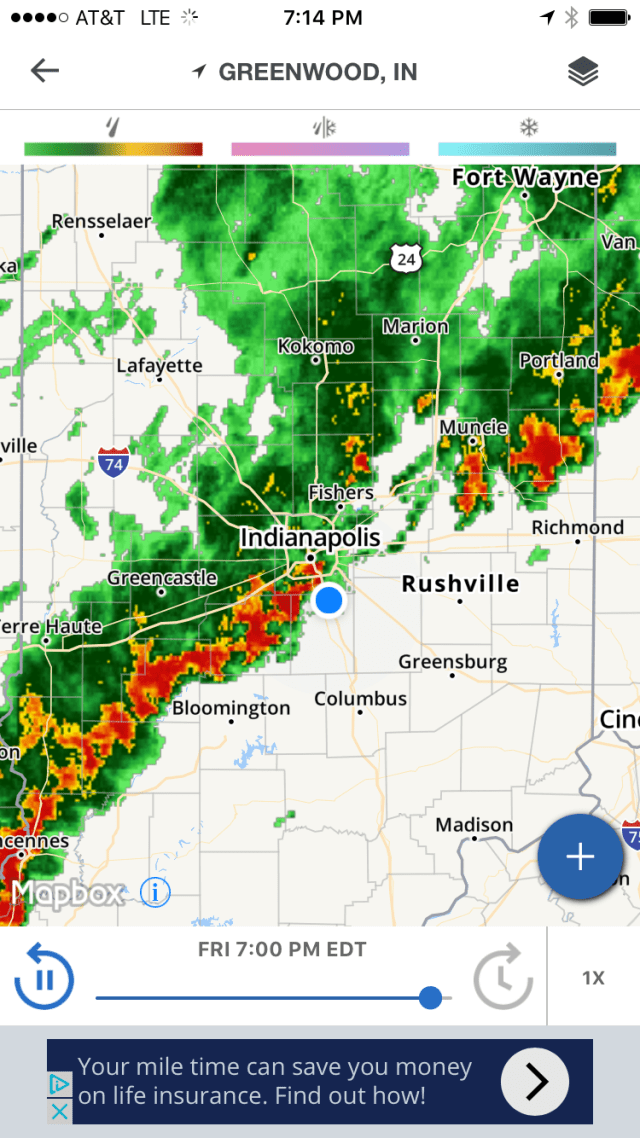
On the way to Louisville last Friday evening, a storm conspired to rain on us the entire length of the state of Indiana. It happened because the storm was formed an a 45-degree angle from Northeast to Southwest. As we proceeded south toward Kentucky, the long front edge of the storm kept tracking east at the very same rate we were traveling down I-65.
We saw the warning of what was to come as we rolled through Merrillville to get on the Interstate. A deep gray angular cloud sank into the horizon up north. Lightning flashed in the depths of that dark wall and I commented to Sue, “That’s where Satan lives.” Because it looked that ominous.
So we turned onto the Interstate as she cheered me on to drive faster. “Go! Go!” she laughed. For fifteen minutes we seemed to have outrun the front edge of the storm. Then all hell broke loose as the bending storm caught us out in the fields of northern Indiana. “Oh boy,” she intoned. It was pouring.
It rained like mad for the next four hours on the road. Massive amounts of concentration were required to keep a driving interval and not do anything sudden or dumb that could put us in jeopardy. It went like that for hour after hour.
Fortunately, the other drivers in Indiana kept their distance. No one did anything stupid. Many put their rear blinker lights on so that people following behind could see them. That truly helped. We all moved through the murk and the mayhem to the best of our ability. Sometimes a few cars would pull over when they’d had enough. They perched like beached shipwrecks on the road shoulder.
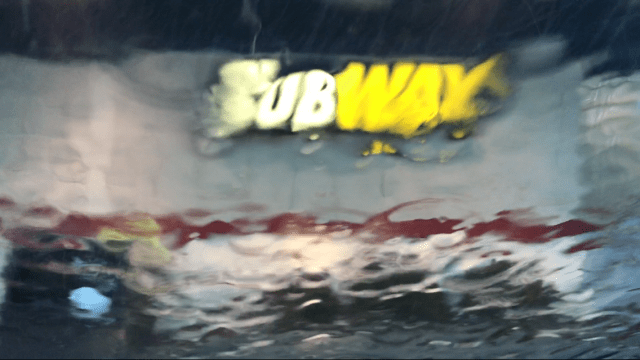
Finally the rain became so strong that Sue and I both thought it was time to take a break. Even with the windshield wipers on high speed, the whap-whapping could not keep the rain off the glass. Fortunately an exit popped up and we got off to get fuel for the car and find something for us both to eat. In the parking lot we sat looking through the washed out windshield as the Subway sign twisted in the pouring roil of the falling rain, which didn’t let up, so we hopped out in our raincoats and piled into the restaurant.
By the time we came out the storm had relented. It was still raining but not in such a downpour. The hours that had just passed seemed like minutes because when you’re concentrating that hard on anything, there is no time to get bored or distracted.
As we headed south again the rain let up. On the Weather Channel app it looked like the lower edge of the storm would swing behind us. It was nice to travel on clear roads once again. But of course we found a construction zone and traffic slowed again. As we crept along with the semi trucks, the storm rose again in the west.
We finally reached Louisville and it looked like we were going to beat the storm completely. But that was hoping for too much. The southern edge of the 200-mile long storm front had picked up its pace and was coming fast from the west. As we made our exit into Louisville the clouds poured over top of our vehicle. Lightning flashed and the winds swirled. Everything was dark and furious. The rain started in again, coming down in sheets, driven by a low breeze. Illuminated by our headlights, the rain appeared to be engaged in some sort of mad, weather-driven Shakespearean play about the tempest versus the vespers.
We got off the big roads and were headed onto the two-laners with the help of the Waze Lady giving instructions to turn right and turn left. We pulled into the condo lot and dragged our bikes into the house from the car. Sue’s wheels were filled with water and my handlebars were wet as a salamander’s back. But we’d made it after eight long hours of driving. I gave her a hug and a kiss on her wet face. Her blue eyes flashed and I was grateful we had arrived safely.
The reason I share all this is to shed light on what it was like to ride the next morning. Eight hours in a car with your legs under the steering wheel is not ideal preparation for cycling. I’d had to massage my quads several times during the long drive to keep them from cramping.
Which meant there was still considerable tension and fatigue left in my legs the next morning as we got up to ride. And wouldn’t you know it, the first five miles of the ride were damned hilly. My quads burned even as I tried to focus on keeping the pedal stroke even between quad and hamstrings. Still, I got dropped by the other three riders. Nothing I could do at that point. That’s no way to warm up legs that fast after you’ve just driven eight tense hours the night before.
I kept up fine riding on the flats and rollers that we took at well over 20 mph. But a few climbs later I’d made up my mind to cut the cord and let them tarry on without me. The goal for those three was to learn the Ironman course and get in two long rides that weekend. My goal was to get in some climbs and hard riding in advance of next week’s Olympic distance tri in Lake Zurich.
So I gave them the cyclists humble goodbye and wished them Godspeed. Then turned around to ride back to the condo on my own. The ride was 42 miles at 2:24. About 17.5 miles an hour. The next day I rode the same route, but ten minutes faster. So the weekend was more than salvaged. Kentucky looks just like southwest Wisconsin with a few more mockingbirds and dozens of cardinals thrown in.
And I’m sure the look on my face was much the same as it would be on the equally steep hills outside Madison as it was on the hills outside Louisville. My thighs are still tired today after the 5.5 hour drive home and a repeat 42-miler in the heat and hills of Louisville yesterday. But Sue’s are even more tired after 75 miles yesterday and 65 miles the day before, often at a 18-20mph average. All in prep for the Ironman Louisville race in October.
But it’s still summer, and we were grateful for no rain in the forecast on the way home. Because if there had been storms tracking across Indiana again, it would have been like, “What the hell?” How many unexpected obstacles do you have to overcome in order to overcome the obstacles you choose for yourself. I mean, what the hell?
We made it back without weather intruding. The Waze lady insisted we should take 294 over 355 coming back north, but we ignored her and got home in time for me to head into work.
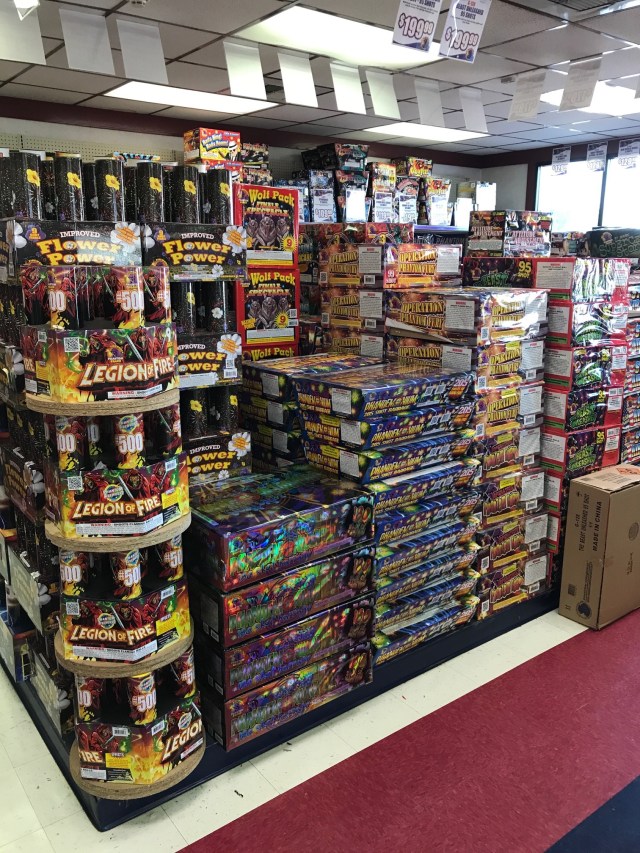
We had escaped the dark clutches of Satan to spend a nice weekend among the pleasant people of Kentucky. Tomorrow we’re hosting a 4th of July party after a visit to Phantom Fireworks in Indianapolis. If Satan and the rainy gates of hell come anywhere close again, we’ll fight fire with fireworks, all the while yelling, “What the hell!”
We’ve been riding the roads east of Louisville, Kentucky for a couple days now. This has been a treat in terms of terrain. The hills are both beautiful and challenging.
But the stunning aspect of cycling the roads here is the manner in which we’re treated by motorists. Without fail, every driver here has treated us with incredible deference and respect. They wait behind our small group when we’re climbing. Even when I broke off on my own, the cars held back until the road ahead was entirely visible and clear.
This has been a strange experience. Back in Illinois, the drivers are much more impatient. We hear gunning engines when they pass, often too close. Some are noticeably aggressive.
There is none of that here. Even when the hill requires a couple minutes to climb, the cars wait patiently behind.
What’s the cause of all this kind deference? Is Kentucky just the most hospitable place on earth?
The kindness was evident among people from the moment we arrived. It was pouring rain when we pulled in. Yet a neighbor living in the condo next to our AirB&B rental came out to tell us how to use the keypad and let ourselves in. Then he kept up the conversation after the rain stopped, inviting us over for beers if the weather cleared.
So it has been a pleasure traveling around meeting people. Even downtown Louisville seemed positive. There was a literal pole vault competition taking place on 4th Street. There was an elevated runway and a full vault pit set up on the city street. We watched vaulters scale heights over 16 feet as we dined at Guy Fieri’s restaurant.
The one exception to the cool groove of Louisville was a moment that took place on the concourse between restaurants. As we sat there dining, a man started running away from the crowd. Suddenly a strong-looking dude burst from the crowd and tackled the runaway, who fell to the ground as one other person grasped his hands and extricated something from his grip. The tackler shoved the man’s shoulder’s into the ground for a moment, gave him a stern shake, and then got up and left. He was noticeably limping for having conducted such a rough recovery of whatever was stolen.
The strange thing about that moment is that no one else seemed to pay much attention. “Did anyone else see that?” I asked. But everyone was busy eating.
So it felt like a dream. That can happen with things both good and bad in this world. Because this morning while heading back on my own on the bike, I was climbing a long, steep hill when my brain shifted into that weird zone where it feels like it is on the outside looking in. As I glanced at the top bar of my bike, a large drop of sweat fell from my forehead. When it struck the black matte surface of the bike, it made the sharp little shape of a skull. Talk about an obtuse encounter with mortality.
I’d already made multiple decisions over the last two days to keep things under mortal control. Having once been tumbled into a grassy ditch by the horrid phenomenon called Bike Wobble, I trust no road over 40 mph. The fastest I’ve ever ridden is 55 mph in a similarly hilly section of southwest Pennsylvania. In fact, the two regions are so similar in appearance and smell and roads they are nearly inseparable. But in Pennsylvania, the cars and trucks were so aggressive and rude, it put the fright of God into you just riding around normally.
It is experiences like these that make me so appreciate the nature of a place like Kentucky, where people “get it” for whatever reason.
That extended even to the parking lot of a Methodist church where we left our cars while out riding. The parking lot is known to triathletes because the church members welcome people into their stone building to use the bathroom. And this morning the woman walking into the church with an instrument under her arm invited us to come back after the ride to attend a picnic later on.
That is true Christian hospitality. But like all good faiths, there was another element of commitment on display during our ride on Saturday. As we passed through a small Kentucky town, there was a line of people outside another small church. They all held up signs criticizing the acts and demeanor of Donald Trump. They were calling out rhymes in protest.
I shouted as we rode past. “Thank you! I agree!” And then we disappeared own the next hill. And climbed another and another. And vehicles waited for us on every turn and up every hill. It was all proof that civility is still alive, either by tradition or by sensibility, and it’s not confined to one margin of the country or another.
Perhaps at a local eatery where angry locals gather to complain about liberals in America, there is a side to Kentucky that we did not see. But even at the gas station where I stopped to buy a small Coke in the wrong sized cup, the wizened little gray-haired lady with her locks in tight braids chirped when she saw me. “My cousins do the Ironman,” she said enthusiastically. “But aren’t you supposed to be drinking water, not coke?”
She got me on the guilt trip there. And perhaps they’re so used to seeing triathletes on the Ironman loop this was all a perversion of reality, an out-of-mind-and-body experience under the Kentucky sun.
Then I rolled past the two giant correctional facilities built on top of a Kentucky hill. One was for adults, and one for juveniles. And I thought about the fact that privatized prisons are a profit-maker designed to twist the law into money for the discompassionate.
Then I thought of that guy tackling the thief in the 4th street mall, and how they both walked away after a cruel little encounter. Evil seemed so close and yet so far at the same time. But civility bridges the gap.
We’re headed to Louisville today for a training weekend with some triathlon friends. Three out of four of us are doing the Ironman there in October. I’m not one of them.
But my first tri of the summer is coming up at Lake Zurich in mid-July. So the big training days will be great for the legs and lungs.
So we’ll get in some wicked good riding in the hills of Kentucky. I’ve not spent any time in that state other than perhaps driving through a section of it long ago. I expect it to be humid, probably hot, and a bit rainy given the weather prediction.
Which is much like the weather where I grew up in southeast Pennsylvania.
Zippity Do Dah
Last weekend my legs had real zip in them for all 65 miles of the Swedish Days ride. So I plan to carry that confidence along even though I’ll be the lone road bike among three other tri-bikes, all of whom are naturally strong riders and somewhat scary fit. I hope I can Do Dah with them.
Of coruse, fear doesn’t help you stay on the wheel. Determination does. And if there’s a gap I’ve gotten used to riding some miles along among bands of triathletes. There’s no real glue holding them together in a group ride. It’s a very conservative sport that way. Every athlete for themselves. Responsible for your own pace.
Which is as it has to be. The rules in most triathlon races say ‘no drafting’. It’s not like teams could ever expect to emerge out of the water at the same time and race in a pack anyway. So it’s a solo world that every triathlete occupies.
Crit-ical
Ironically, the road bike criterium nationals are taking place in Louisville this weekend as well. I might find my way to witness some of that. Depends on the weather I suppose.
Crits are almost the opposite of everything about triathlons. It’s the rare rider that can tear off the front of a crit and chew on it long enough to stay away from the group. Instead it is a rider’s best bet to stay tucked into the group using little energy as possible for most of the race. Ride the draft. Cover the surges. Jump back on when the group rejoins and wait for the big break to occur with a few laps to go. See if you’ve got any zip left in hour legs so you can Do Dah Sprint
That’s the typical pattern anyway. There are exceptions to every rule. That’s why we all ride, to find out how exceptional we feel on any given day.
Yesterday during a 1500 meter session in the pool, not all at once, mind you, but in a series of intervals of 100 and 200 meters, I decided that what I need to make myself a faster, stronger swimmer is a really cool nickname.
With my closely cropped gray hair and propensity for having fun with bubbles, the term Silver Bullet came to mind. But that would imply that I’m already fast. So that’s not an option.
So I tried out Señor Speedo, hoping to pick up on some Latin pizzazz on the way from wall to wall. But that was too close to Senior Speedo. No one wants to see that.
While staring at the bottom of the pool, I imagined myself as a dolphin or porpoise swimming through tropical seas. The Determined Dolphin? Nah. My pink skin doesn’t make work. I look a lot more like a dildo in the water than a dolphin.
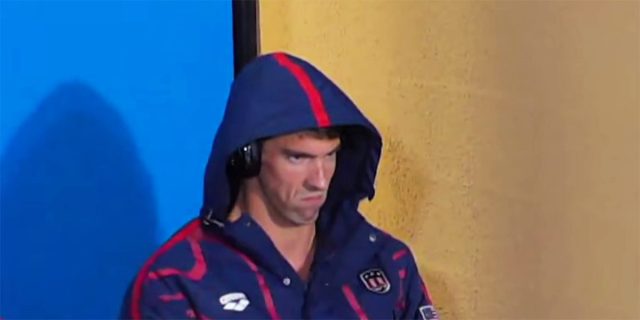
So I struggled to make the whole swimmer nickname thing work. Lacking a good nickname, I pretended to be Michael Phelps, but all I could think about when that came into my head was his expression under that hoodie in the waiting room during the Olympics. He doesn’t seem to like the look of that big pink dildo above his head.
So I’ll just stick with being me in the water. Or maybe with capital letters.
Me In The Water. Or Me, In The Water. Maybe…Me In, The Water.
You get the picture. The nickname isn’t going to do it. Only me in the water will make me faster and stronger. But being chased by a dolphin carrying a big pink dildo might not hurt either.
Yesterday while waiting for my wife to get in on the 5:55 train, I sat outside Graham’s 318 Coffeehouse on a quiet street in Geneva, Illinois. The air temps were pleasant and the sun was perched behind some trees to the west. So I sat. And I wrote.
I’m working on a book called Sustainable Faith. It takes an unconventional look at the true nature of faith and how to sustain it in the face of all that seems to contradict what a literal interpretation of the bible says. Here’s an excerpt that examines that issue in the context of the earliest chapters of Genesis when the serpent uses God’s own words to trick Adam and Eve into disobedience to God:
The serpent is successful in tempting Adam and Eve by employing what is now the oldest trick in the book: promising people a shortcut to success. It seems the serpent actually invented this age-old temptation and it is quite significant that the serpent uses the literal words of God to introduce evil into the world. This is the source of original sin, not the fact that two weak-willed human beings gave into the deception.
This is not the conventional interpretation of scripture, but it is accurate. The Judeo-Christian tradition has long held that it was the collapse of Adam and Eve into sin that holds the greatest significance in the earliest phases of scriptural history. Without the blame placed on Adam and Eve for original sin, what is there for God to forgive? And absent that sin, for what atonement did Jesus Christ die?
Those are difficult questions because they belie 2000 years of Judeo-Christian tradition. Many Christians base their entire faith on the sacrificial act of Jesus on the cross. But what if Christianity in all its literal adherence to scriptural tradition has it all wrong? What if the real lesson of Genesis is found not in the loss of innocence by Adam and Eve, but in recognizing how to avoid the type of temptation offered up by the serpent?
These are challenging notions to people whose faith is based on hardline, conservative concepts of sin and atonement. But we must recall that it was a Catholic priest named Martin Luther who dragged the faith back toward a realization of its core tenets. When Luther contended that we are saved by grace, not by how much money we give or how righteous we claim to be, the church was challenged to change its ways.
In the face of an evangelical tradition that has clearly lost its way and even lost its mind in lust for political power, it is time to call the whole thing to account. That’s what I’m writing about, to challenge the curmudgeons who through fear and greed have turned over the religious authority of God to political purposes and corruption.
And as I sat there working on the text, I noticed a man who was slightly older than me sitting in a table across the patio. At first, I was not going to engage with him, absorbed as I was in writing the book. But he was dressed in a sharp cycling kit without team names or some inane beer logo on the back, and I admired that. So I asked: “Where you riding today?”
He replied that he was headed up to a steep hill that has a name I don’t recall. But I’ve ridden that hill many times, and it is steep. So this was a man who loves his work. So I smiled, and said “Excellent. I know that hill.” Then he briefly told me that he’s training for a multi-day ride in California. “And it’s hilly,” he informed me. Enough said. I get that.
Curmudgeonly options
He was joined by a friend and I overheard their conversation. “I’m not really into rides longer than two or three hours,” he admitted. “Of course, the first day out in California is ninety miles. And I’ll do that. But it’s not what I prefer.”
This was a man with both determination and common sense. His manner was a bit brusque in some sense. He seemed self-assured almost to a fault. But he stopped just short of being a curmudgeon.
Experience has a way of bringing a person to a point where they do not gladly suffer either fools or miles without a purpose. That is a sustainable way to live, for it vexes neither the body or the soul. In that mode, life fits together like a hand in a cycling glove with just enough padding for the job. But not too much.
Then came John the Baptist
There are not that many souls in history that have arrived at such sustainability in their existence. In the introduction to my book, I examine the life of a man called John the Baptist. If taken literally, his tale reads like a cartoon character in some ways. But John was an example for all of us to follow. Whis is what I write about him.
John was a colorful character who wore clothes of camel’s hair tied at the waist with a leather belt. He dined organic on fare such as insects, wild honey and other undomesticated edibles. That’s because John lived out in the wilderness far from the restrictions of traditional culture.
But John was no country bumpkin. He took shrewd note of the happenings back in town. In particular, he called out the calculating ways of the religious authorities of his day, openly criticizing their penchant for creating rules out of scripture that were designed to manipulate and control the populace. More specifically, John accused them of extorting money from believers by demanding paid sacrifices and other practices.
As you can imagine, these criticisms won him no friends. But John did not relent. He hammered home his points by calling the priests and scribes a “brood of vipers” and “hypocrites” for their self-righteous ways. Those weren’t his only enemies. When John was brought before a sectarian king, he called the man to account for his lustful, covetous ways. That accusation ultimately cost him his head. John was certainly no coward. Nor did he lack convictions. He was a liberal with guts, who knew the truth and the price one pays for telling it.
John stopped just short of being a curmudgeon. He advocated a sustainable form of faith that required only repentance to enroll. There is much to be said for people with that kind of perspective and skill. They know how to climb the hills of life at a pace that can be sustained.
The 4th of July used to be such a depressing landmark in the schoolboy days of summer. After the liberation June and relief from school obligations during elementary or middle or high school or college, it was a shock to realize what July 4th actually meant. Summer was more than half over.
For athletes, summer seemed to shrink the further one got along in a career. Cross country practice might start up the second week of August. Granted it was fun to rejoin teammates for long runs on August mornings. We’d be all tanned and blonde-haired from the summer sun. Tales of summer romance and drunken nights and parental fights.
Hot precursor to fall
But that meant August was commodified. It became something other than summer. More like a hot precursor to fall. Gone were the swimming pools and girls and sights of summer skin showing goose bumps from the cool water on bare skin. I’ve always loved goose bumps on girls and erect nipples under thin swimsuits. Smuggling raisins, we called it.
There is actually more room for all that now that life is not confined to a school year. August doesn’t have to be eclipsed. Instead, there are actual races to do. Racing in the summer heat is a perverse treat. You’re so loose and yet so soaked with sweat the body feels like it has been turned inside. But goddamnit, you’re alive.
Late to summer
A few summers ago, before I was swimming for triathlon purposes and spent time in pools and lakes, I neglected to visit the Quarry pool before it was almost too late in the season. In fact, I arrived late in the day on the final afternoon the pool was open.Everything from the sand to the beach toys looked tired. The tanned lifeguards looked worn out. Yet they would soon be departing for college with those perfect tan lines ready to reveal on that first autumn hookup. Or if chaste, those tans would just fade on their own time. But that seems a waste. It really does.
Perverse fascination
Schoolboy summers from the earliest age held a bit of perverse fascination like that. Summer does strange and fun things to your body. That white skin next to dark skin is such a tantalizing taboo. The moles on my skin would turn dark as chocolate. There were no words of fear or knowledge of cancer back then. You tanned and you faded with the season. Skin peeled after a sun burn, or got wryly wrinkled from long days in the chlorine and wetness.
Surely all those miles I ran in tiny shorts during the late 70s have had their cost on the skin of my legs and arms. Aging is the process of sagging, as if the world has been holding us together all along, and is just now relaxing its grip. I used to play a game with my children where I’d put my arms around their bodies and then slowly release them from a bear hug. If they giggled at any point along the way, I’d hug them tight all over again. Fits of laughter ensued. That is life itself, it seems. It is full of laughs in that middle zone where the happy tension lies. It is only when we’re either too tense or too free that life seems unhinged. Thus the secret to loving life until the end is learning to hug the world back as you laugh at the notion of letting go too soon.
Sweet arms of summer
I’m looking for the sweet arms of summer to hug me now, and embrace these summer miles that somehow suddenly feel so good. The running is smoother. The cycling is strong. Even my swimming is coming around. Pulling it all together for a race in mid-July. Because summer doesn’t end on the 4th of July. In fact, it’s just beginning.
The Tour de France will be broadcast with all its strange and glorious conflict and controversy. I’ve come to believe those boys are no different than high-schoolers playing with drugs under the summer sun. Who’s to say that it’s not normal to pump yourself up with substances while riding 2,000 miles in the heat and mountains? They’re defying death just like the rest of us.
Now you’ll excuse me while I go looking for a few goose bumps to admire. I love them on the skin of my wife, and the look of her in that sleek swimsuit, and her beautiful curly hair when it dries, and her flashing eyes. I want to steal her into a tent and make love on an air mattress in that light where the sun through the tent canvas looks so romantic it makes you want to cry. This is no longer some schoolboy summer. This is life. And I love it. And her. And the whole goddamned world, faults and all.

 It happened again this weekend. After months of running without my knee acting weird, the “knob” came back. It happens when I hit a section of downhill ground at the wrong angle. The knee buckles a little and a knob of bone or ligament… or something yet unidentified… pops out just below the inside left kneecap.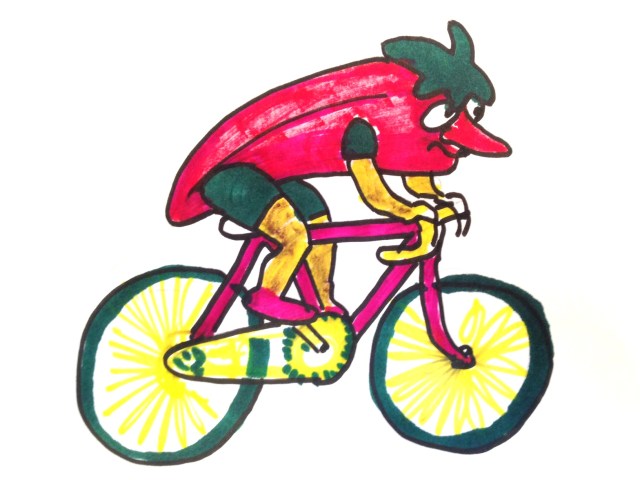
 The Tour de France broadcast has become a creature entirely devoted to advertising and commercials. Consider the various definitions of the word ‘commercial’ and see if you agree: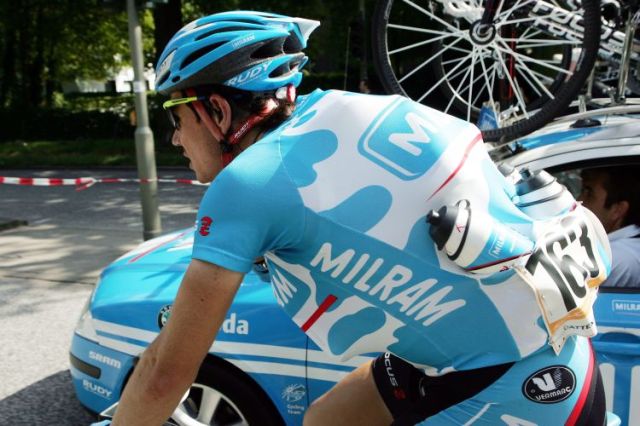
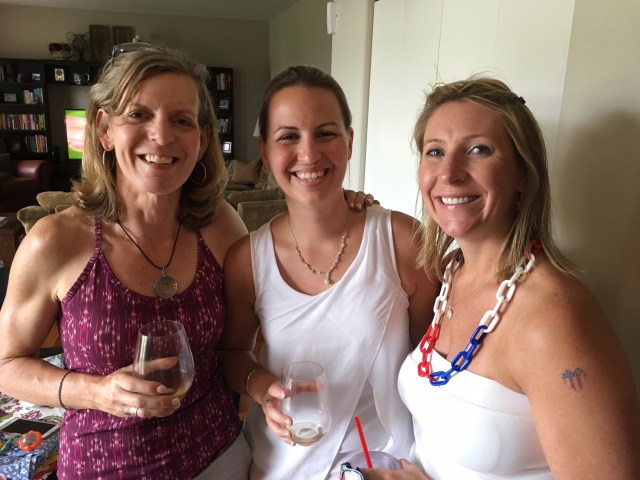 We had a bang-up 4th of July party with 20+ guests in our backyard and kitchen. We all know that’s where most of the socializing tends to occur. It’s a law of nature.
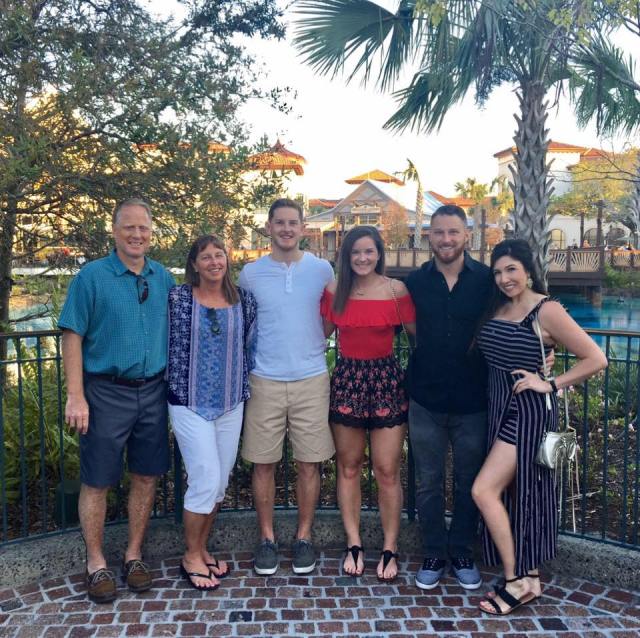 In fact the entire Kuehn family is composed of athletes. Her son Scottie played Division 1 football for Illinois State University. Her husband John played for a national championship Division III basketball program at North Park University, which was North Park College back then.
 So we turned onto the Interstate as she cheered me on to drive faster. “Go! Go!” she laughed. For fifteen minutes we seemed to have outrun the front edge of the storm. Then all hell broke loose as the bending storm caught us out in the fields of northern Indiana. “Oh boy,” she intoned. It was pouring.
 By the time we came out the storm had relented. It was still raining but not in such a downpour. The hours that had just passed seemed like minutes because when you’re concentrating that hard on anything, there is no time to get bored or distracted.
 We finally reached Louisville and it looked like we were going to beat the storm completely. But that was hoping for too much. The southern edge of the 200-mile long storm front had picked up its pace and was coming fast from the west. As we made our exit into Louisville the clouds poured over top of our vehicle. Lightning flashed and the winds swirled. Everything was dark and furious. The rain started in again, coming down in sheets, driven by a low breeze. Illuminated by our headlights, the rain appeared to be engaged in some sort of mad, weather-driven Shakespearean play about the tempest versus the vespers.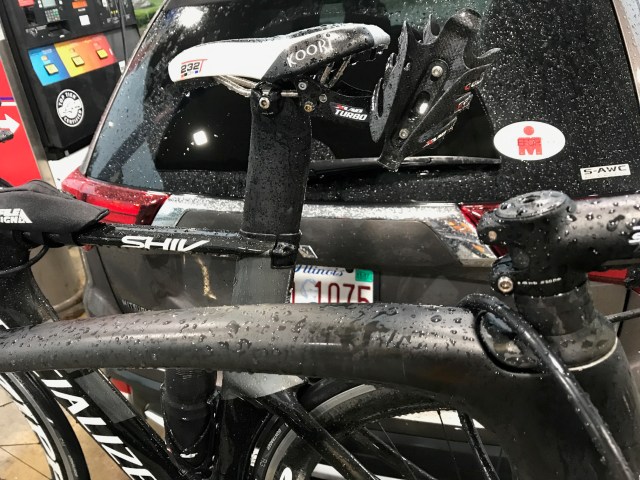


 We’re headed to Louisville today for a training weekend with some triathlon friends. Three out of four of us are doing the Ironman there in October. I’m not one of them.
 With my closely cropped gray hair and propensity for having fun with bubbles, the term Silver Bullet came to mind. But that would imply that I’m already fast. So that’s not an option.

 Yesterday while waiting for my wife to get in on the 5:55 train, I sat outside Graham’s 318 Coffeehouse on a quiet street in Geneva, Illinois. The air temps were pleasant and the sun was perched behind some trees to the west. So I sat. And I wrote.
 The 4th of July used to be such a depressing landmark in the schoolboy days of summer. After the liberation June and relief from school obligations during elementary or middle or high school or college, it was a shock to realize what July 4th actually meant. Summer was more than half over.


 We Run and Ride