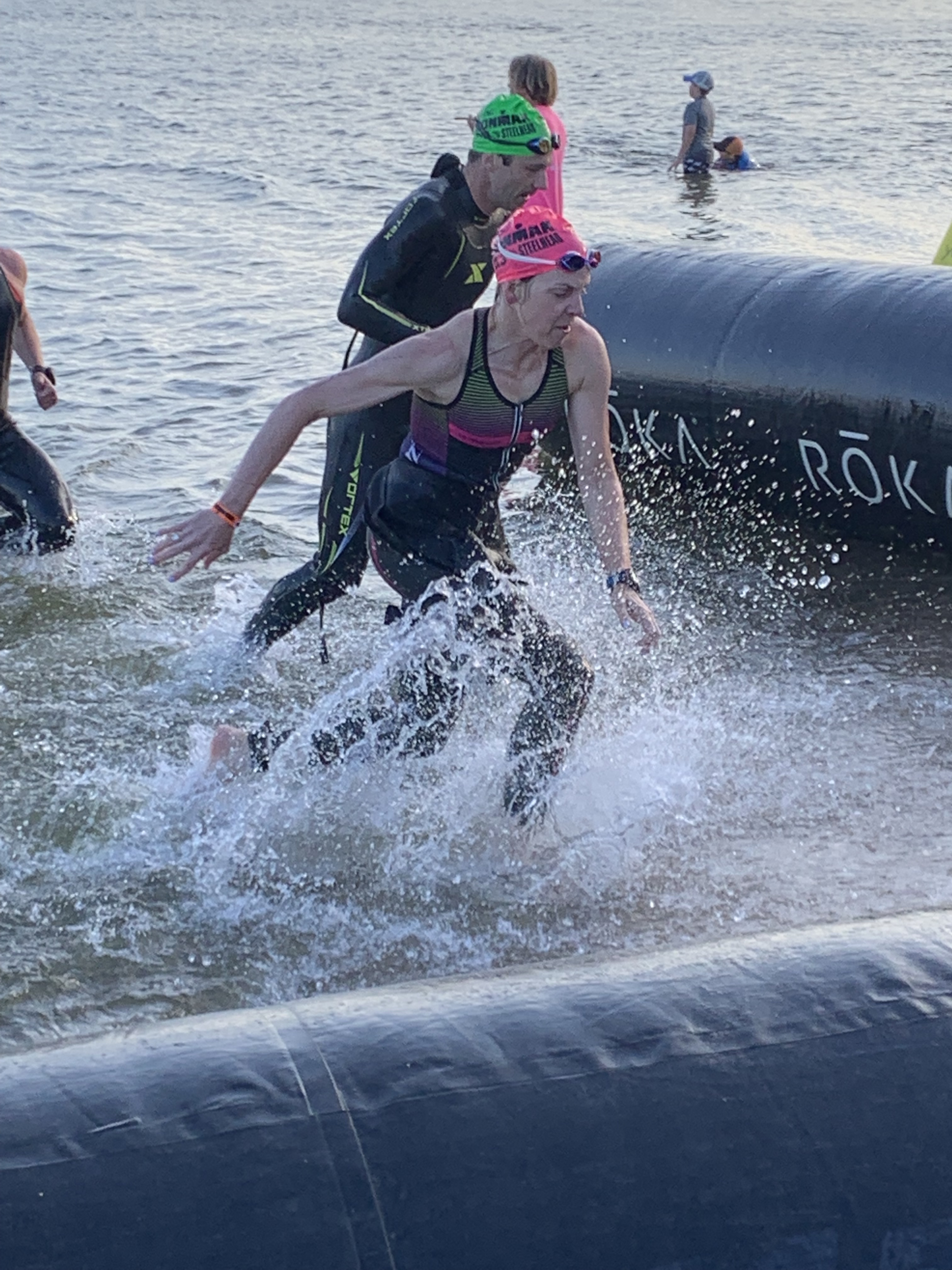
Coming out of the water determined and ready to tackle the bike and the run.
There is nothing at once so tantalizing and tortuous as unfulfilled potential. That is particularly true in the sport of triathlon where athletes hope to excel in three sports in a single day.
Things can go wrong, and often do. There are physical problems to counter. Logistics to manage. Even the best preparation can get waylaid by a bad weather day.
That means determination may be the most important aspect of doing triathlons. Determination is what bridges the gap between unfulfilled potential and success.
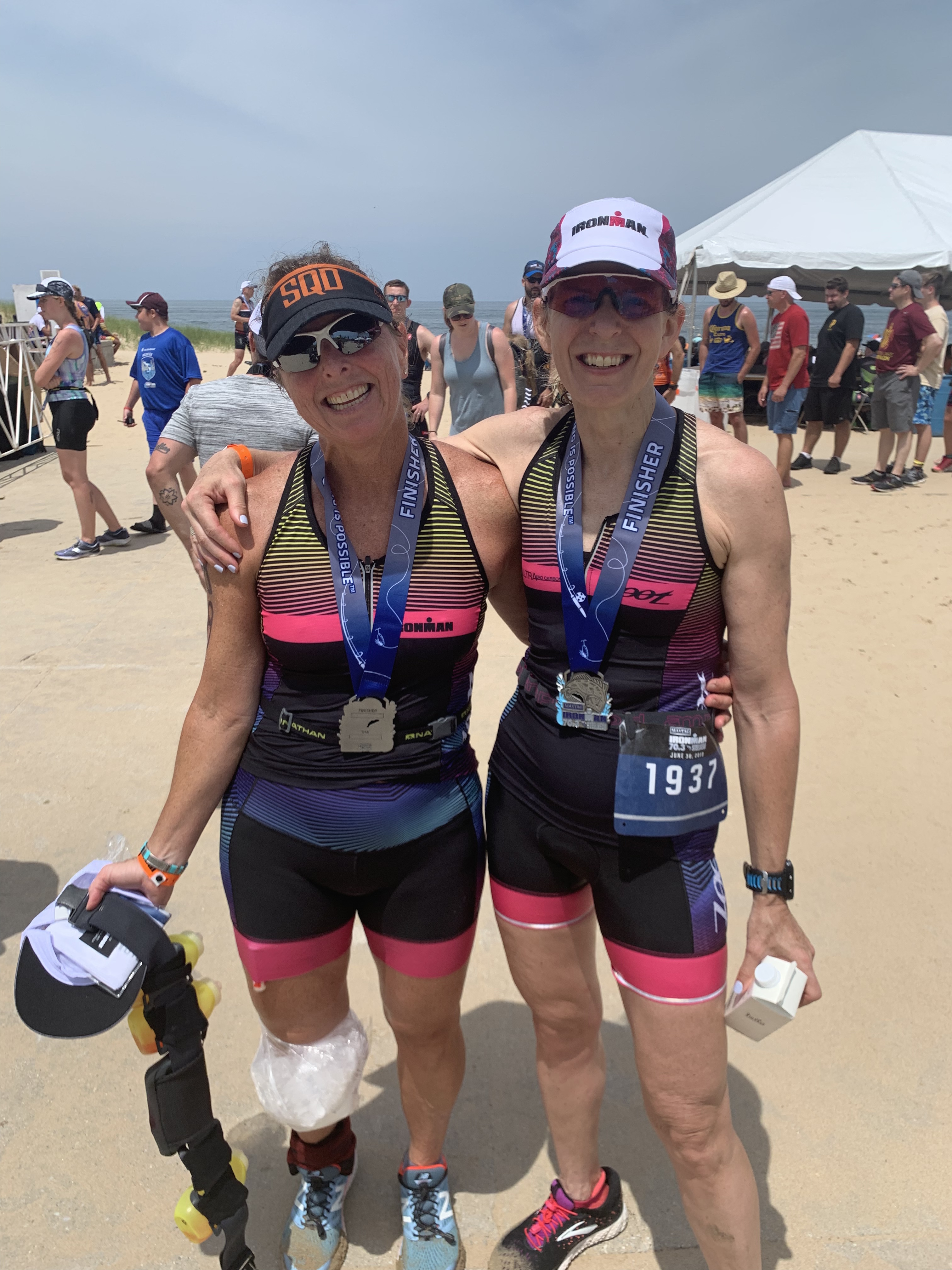
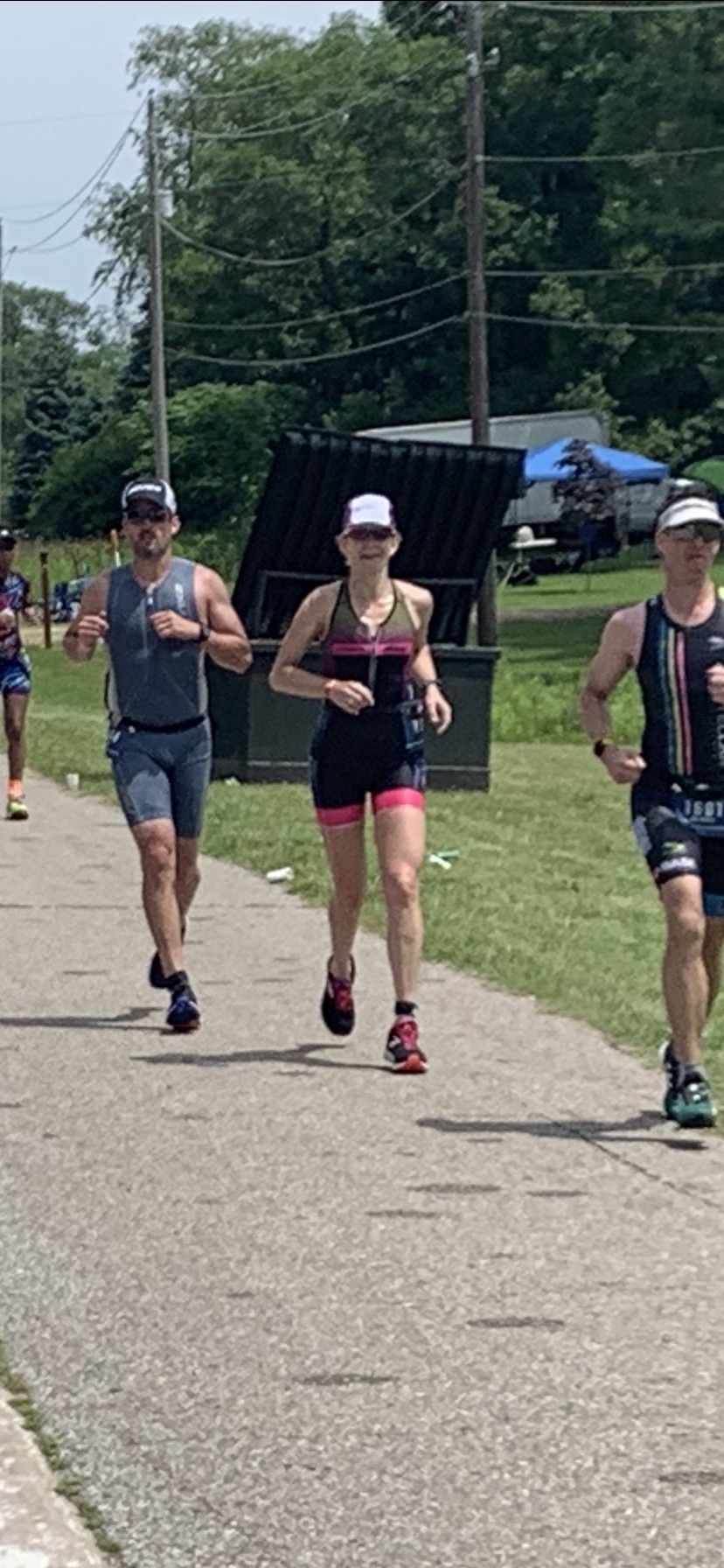
Her good friend Lida Bond Keuhm serendipitously wore the same kit and had a great race too.
That’s why I’m really proud of what my wife did in the Steelhead Triathlon this past weekend. We traveled there last year for the race and the winds were so strong the lake rhetorically chopped up swimmers right and left. She finished the swim and bike, but by then was cooked. The deep red bruise on her face from getting kicked in the water was symbolic of the day.
The experience was bitter for her because he training had been going so well up to that point. In fact she’d had a run of tough luck on several races. But in between, she kept up the training. Rising at 5:00 a.m. for swim, bike and run workouts. She has been disciplined and determined through it all.
Sue is one of thousands of age group competitors who pour across the finish line after the pros.
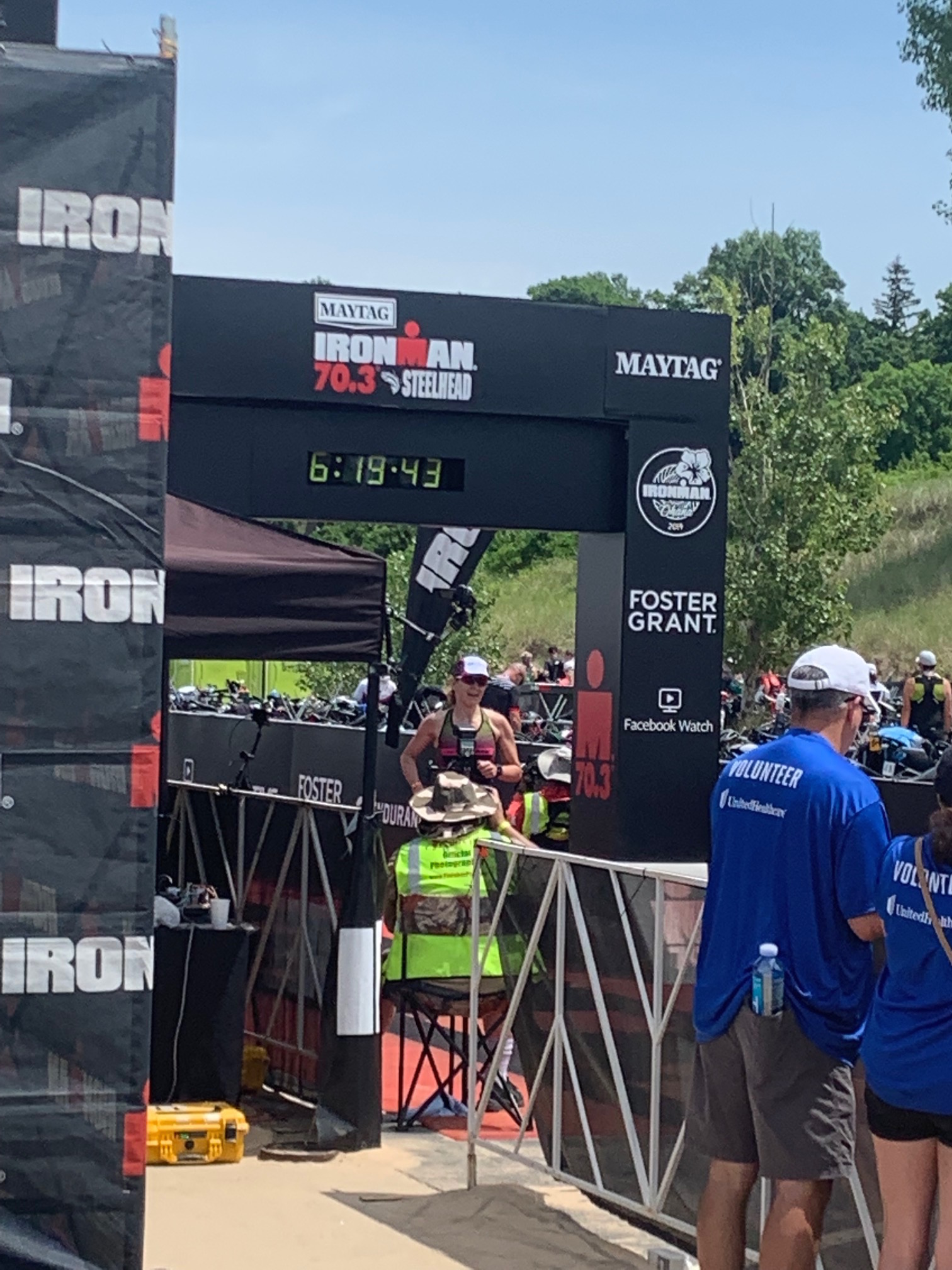
Thus when she crossed the finish line and set a PR (all 5s!) it felt like a major vindication for all the work she’s put in. Her coach Steve Brandes has been a wise and patient guide. Saturday morning he sent her a .gif with a funny image of some robot-like character running and running and running. She got the hint. Keep it rolling when you get to the run phase.
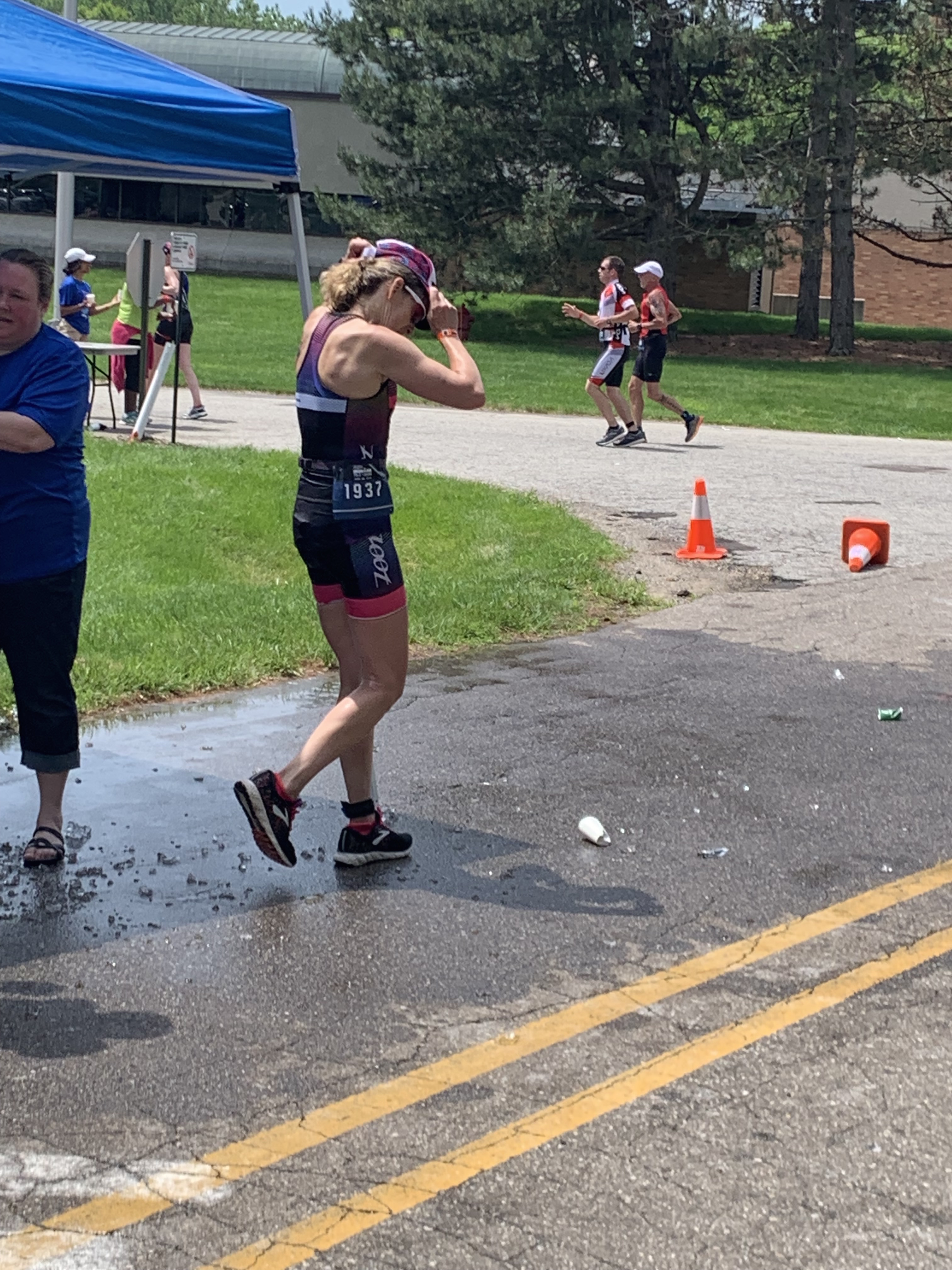
Getting through the heat was a logistical challenge. Ice helped.
And she did. Even on a day that grew hot with a sun beating down on the competitors, she kept her cool and got it done. A determined girl whose finish placed her in the top 25% of her age group. I’m so proud of her for the determination she’s shown.
She kept it rolling all thirteen miles of the concluding half-marathon. Determination helps.
There is nothing like the feeling of competing up to your potential. On the way home she was formulating new goals and feeling the surge of achievement rise within her. The bike short tan she picked up along the way was a small price to pay for the stamp of determination she placed upon her own heart.
And that is the tale of one determined girl and the triathlon.
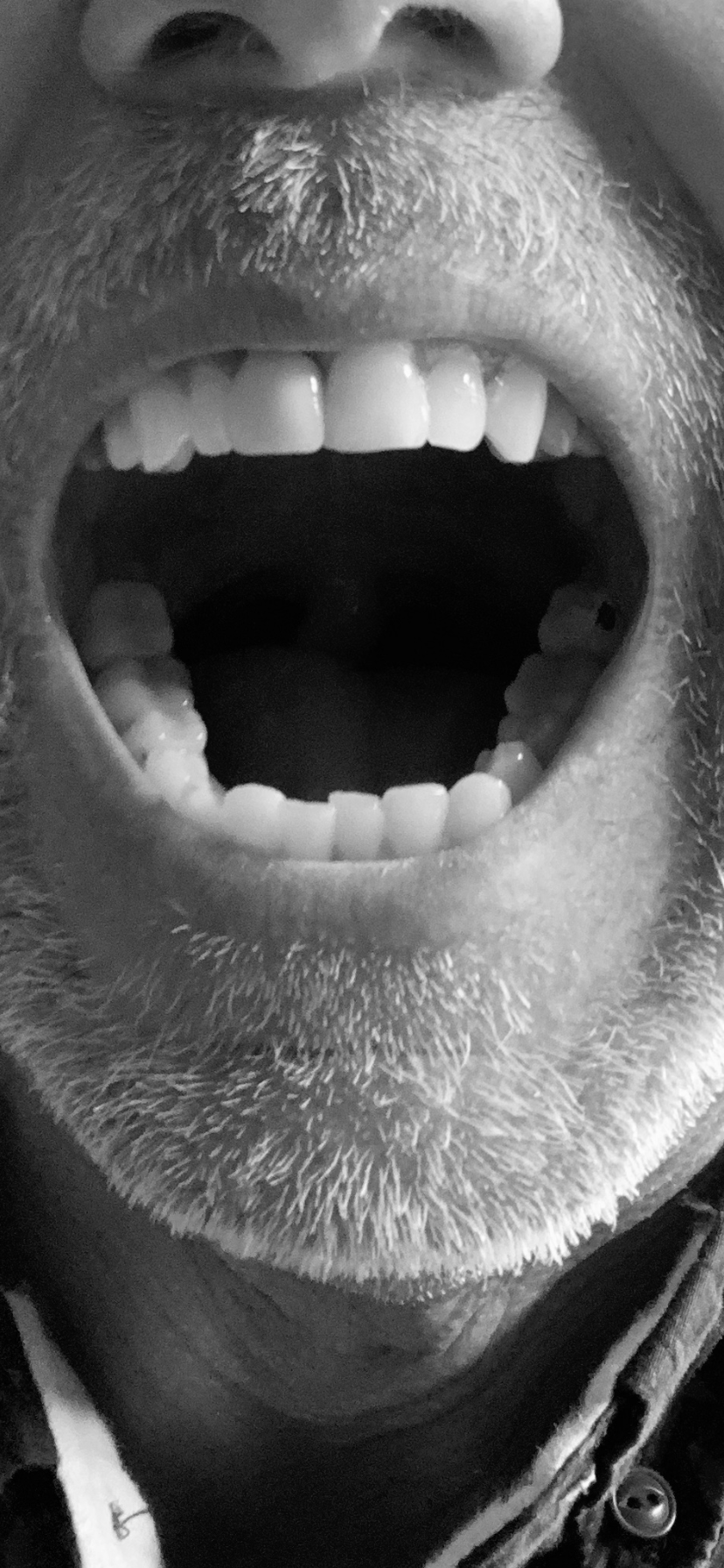
Last weekend I began to notice a sore area around my #18 molar. That’s the tooth on the far back left side of the mouth. It would flare up and recede in relation to cold or sweets and I knew, this is not good.
By Tuesday it was genuinely sore and getting worse. That afternoon it was on the verge of constant pain and I called my dentist. They said I could come in the next morning for a look-see.
At that point going out to run or ride was the last thing on my mind. But I did get in the pool for a 1200 yard workout and it actually felt good. The flow of water across my relaxed me, and by proxy the tooth seemed to hurt less.
But by Wednesday morning all I wanted was to get relief. I knew something was wrong deeply with the tooth because I’d actually gotten a second (preview) opinion with my wife’s dentist Tuesday afternoon. She loves his work and he agreed to see me. Of course he wanted to know as much as he could about my mouth and I was as forthright as I could be.
Corn looks quite a bit like teeth. Yet we don’t want our teeth to look like corn.
In so many ways our dental history is a record of who we are as a person. Archaeologists and paleontologists can tell quite a bit about the lifestyle of people by examining their teeth. I well recall hearing about the problems experienced by the Anasazi Native Americans who ground their corn on stone bowls and wore down their teeth as a result of grinding both stone and grain as they ate their meals.
My teeth have been through a gauntlet of treatments. They came in crooked as hell as a pre-teen. The two front teeth pointed in at each other. That led to a prescription for braces.
But the summer before I was supposed to get braces installed on my wayward toofers I was practicing at third during baseball practice when twilight fell and got I struck in the mouth by a line drive that was supposed to be a grounder. The baseball hit me straight in the mouth and knocked out my right front tooth. I didnt know it at the time, but the tooth was hanging there by the nerve like the shaking corpse of a condemned and dying man.
My father drove me to the dentist stat. He anchored the tooth back in with a metal stake and it held. But then the tooth died, turned gray and lasted well into my late twenties before having it replaced with a fake tooth that I also had replaced at some point along the line.
Self Image. A Drawing by Christopher Cudworth, circa 1972
So some of this dental history was not my own fault. And those braces that I ultimately did get? They straightened by teeth but required the wildest combination of metal and rubber bands you’ve ever seen. The orthodontist even glued a black dot of adhesive to an incisor and strapped three rubber bands across my choppers to yank the right side of my mouth into place.
I was a strange combination of persistently withering personal esteem and determined self-awareness at that stage of life. Thus I told my orthodontist when he asked me how I felt when getting braces, “I’ll just have to change my self-image.”
The day that my braces finally came off was a relief and a joy. I recall that I girl I like told me how nice I looked. In the end, that’s what it’s all about to a kid in his teens.
Beyond those early years when my teeth seemed indestructible and cavities were rare, visits to the dentist were largely positive affairs. But the ins and outs of life in my twenties left me with a raft of problems that turned into decay. Ultimately those led to the breakdown of a tooth or two including one that fractured on a chomp of ice and required emergency repair.
There are aspects of my dental care that I certainly wish had gone differently in life. During those years when my late wife was so sick, all our money and attention went into helping her get well. The resources we had were focused on that. I brushed and flossed (most days) but the regimen was not idea. Gingivitis caught up with me, and pain at times too.
Somehow I came into possession of a handheld dental mirror and used to look around inside my mouth. But you can’t much tell what’s going on in there if you’re not trained in dentistry. Our teeth are hard, multilayered structures with sensitive roots down the middle, the exoskeletons of our inner existence.
And when infection sets into a tooth, it can affect your entire health pattern. I’ve experienced that. When a sore tooth was repaired my longtime dentist years back said, “You’re going to feel better after this is fixed.”
The tarsnake of infection is that what heals you can also wind up killing you.
I’ve experienced other types of infections that took over my life temporarily. One was the result of a sliver that pushed some nasty bug into the middle of my left middle finger. The other was the result of our cat nipped me on the hand that led to cellulitis. Both are proof that infections are just opportunists waiting to attack the human body for their own propagation. That’s the strange balance of health and evolution in action. We need bacteria to balance our guts and yet, during that cat nip episode, the antibiotics I took to treat the cellulitis in my had killed off my good gut bacteria. I contracted c.Diff and it was beyond awful. These are the tarsnakes of life. What heals you can also kill you.
There is no real excuse for not taking care of our teeth. Nor is this a complaint that life has somehow treated me unfairly. Just like training on a running track, we sometimes travel the same circles hoping for a different result. Do we brush our teeth well enough? Are we flossing out the food that sits there and creates bacteria pockets and eats away the enamel. Dentists preach and preach but there we go with the same old half-assed habits that lead to decay and destruction of our teeth. And in some ways, our whole health.
Like so many things about myself, my teeth are neither perfect, nor perfectly healthy. With age the orthodontic treatments from years ago have given in to the shifting forces of time. Like the advent of crepey skin and facial wrinkles, there are some things that are inevitable in this world. I’ve held off some of those as long as I can, but it’s also why I’m keeping this photo of my smooth and fit legs forever.
From six years ago. Smooth legs. Life keeps throwing changes at us.
But I’m grateful that yesterday a real pro got hold of my mouth and fixed the rotten root issues in my aging mouth. He was confident and competent and did not mess around. “I do three thousands of these a year,” the amazing endodontist told me as he numbed me up and cleaned out the offending roots, thereby saving the tooth for the foreseeable future.
When reality bites, it pays to call in the experts. At the least they’ll introduce you to the facts about your situation. And at best they’ll cure what ails you. We really can’t ask for much more than that.
People have long been fond of movies that hint at a reality that exists, yet we just don’t recognize.
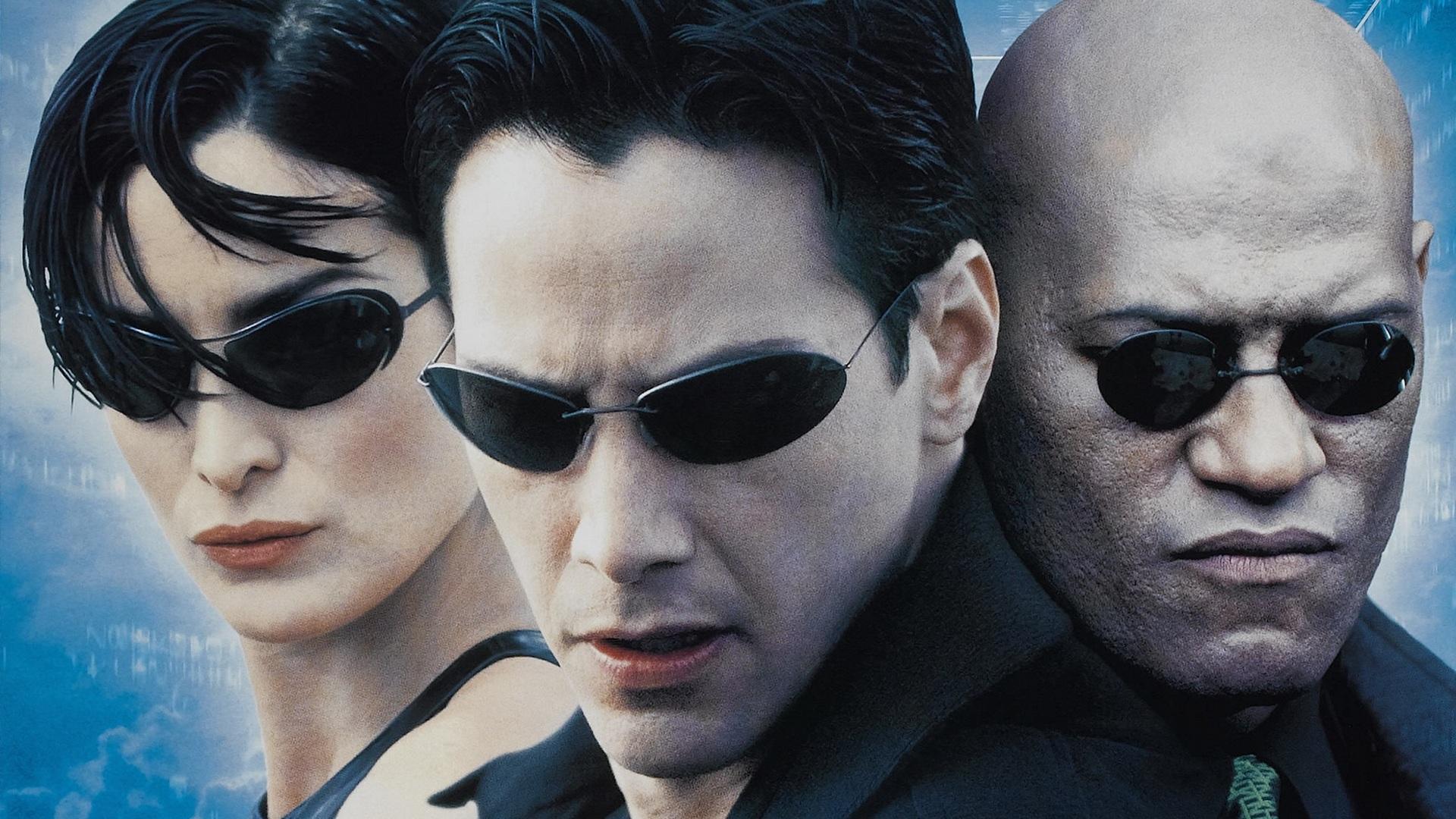
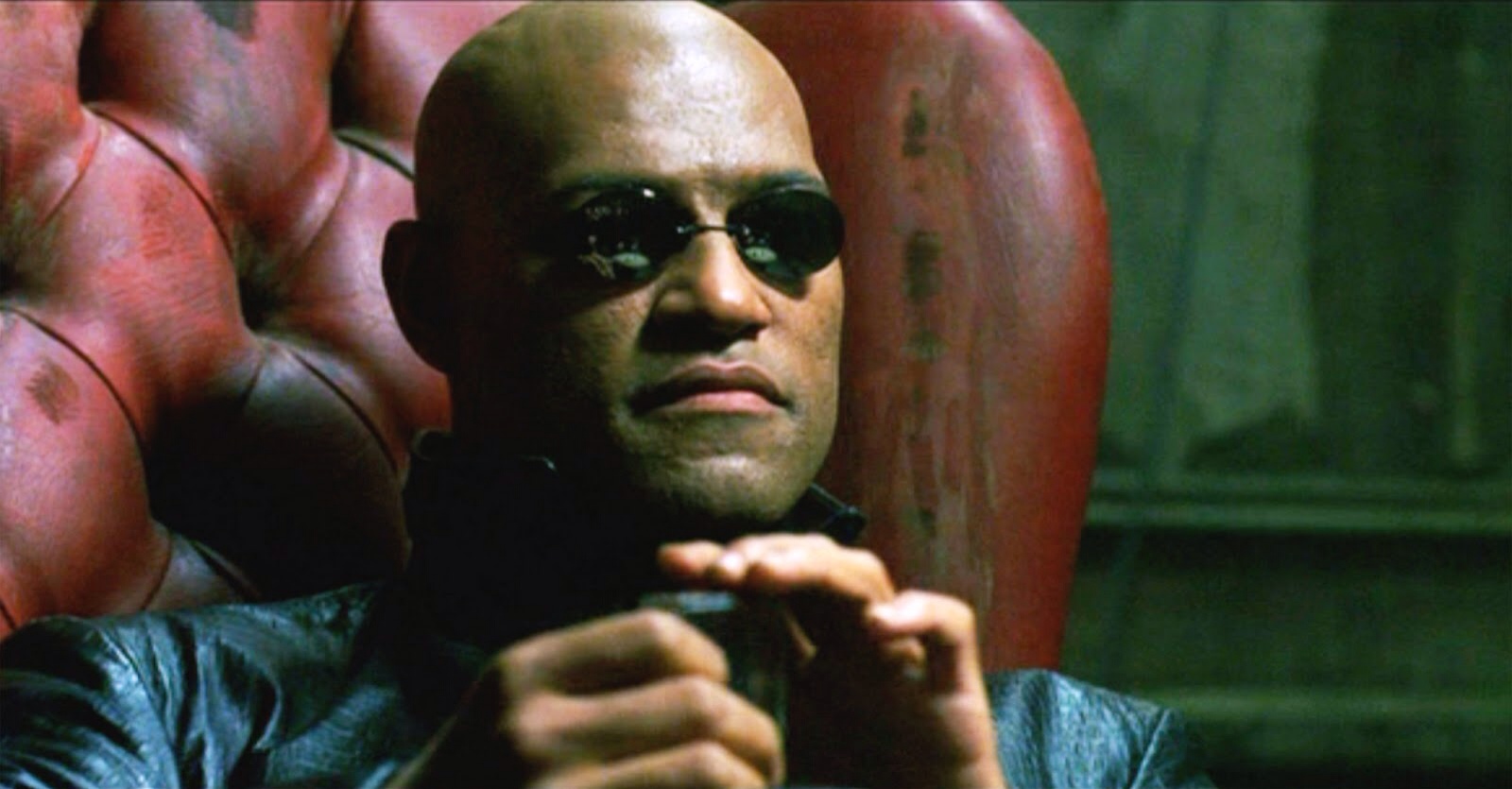
The Matrix series starring Keanu Reaves was one such enterprise. Its premise centered around the idea that life was a digital illusion and that mere humans were subject to that dynamic. In other words, we weren’t truly free.
The character Neo somewhat stumbles or is guided into a penetration of The Matrix. That leads him into a world where a group of visionaries is determined to break free from machines that draw energy from human beings.
Science fiction tends to imitate life in spite of itself. Which is why The Matrix is intriguing in an organic way. All of life on earth is actually subject to a matrix of sorts. But it isn’t digital and there aren’t any “agents” assigned to enforce the will of machines. It is an organic matrix built on billions of years of material change and the influence of gravity, the invisible will of the universe.
The Matrix we all depend upon in reality is a series of self-evident patterns once you stop to study them. The first level is the order of the universe itself, with gravity and matter interacting in massively complex ways. Gravity isn’t perfectly understood, but we can see how it works. The universe and our galaxies and solar systems are effectively a colorized map of gravity at work.
As we dial in closer to our own solar system, we know the rates of orbit and can see the moons around Jupiter and Saturn. These relate to our own lonely moon. So we know the matrix of gravity also applies to us.
By the time we reach all the way down to the level of earth’s atmosphere, we can feel and see the effects of gravity every day. It affects everything we do from driving our cars to going out for exercise. There is no escaping it.
And yet the human race has learned to exceed the relative pull of gravity and even utilize the control of these forces, sending spaceships to the moon and putting satellites into orbit. We bounce digital information off these satellites even down to the granular level of geo-positioning to track every run, ride or swim that we do. Even if you do not use these apps knowingly, all of us willingly participate in the data-driven Matrix in our everyday lives.
Are you starting to feel The Matrix yet? Well, it’s even more interesting and unnerving than that.
Because while our planet revolves around the sun, it also rotates on its own access, an effect that results in night and day. The angle of the earth in relation to the sun also drives the seasons, winter, spring, summer and fall. The sun’s rays and the relative composition of the atmosphere determine climate along every measurable line of latitude from north to south and from east to west.
The climatological matrix is real. But human beings have been messing with the formula for climate by introducing heavy levels of carbon dioxide into the atmosphere, an element of the atmosphere that helps govern how much heat is retained around the globe. In the past, volcanic eruptions and asteroid strikes have caused global climate change. But this time, it is taking place in a cumulative way, only spread over one hundred or so years.
That’s nothing in terms of geological time. Because while the earth has been traveling around the sun and spinning on its own axis, inside the earth there are massive cycles of heat exchange going on within its molten core. It occasionally bursts through the surface in what we might now label the “Neo Effect.” That is, volcanism punctures the matrix of the earth’s surface, otherwise known as “reality” to the rest of us. But what does it reveal?
Over the last fifty years we’ve discovered that the heated core of our planet and the energy it generates helps to drive the formation and reformation of the earth’s crust. Out in the deep ocean trenches around the world, magma rises up in long ridges and the sea floor splits in the middle and “spreads” east and west. The ridges of new material give off magnetic signatures by which we can detect how fast and for how long these processes have been taking place.
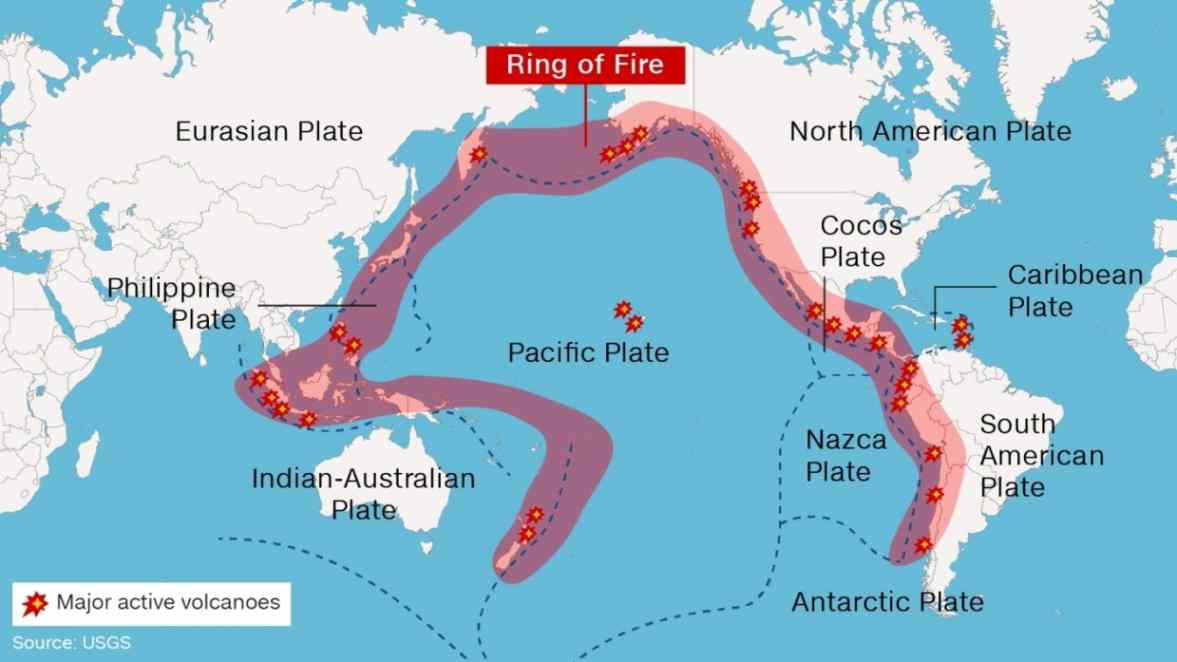
And out on the rim of the Pacific Ocean, there is a corresponding “ring of fire” in which volcanoes and earthquakes drive tectonic forces where continental crust scrapes and lodges until it releases either in the fury of an eruption or the deep tremors of an earthquake.
These are forces that have been taking place for billions of years. They have literally moved the continents across the face of the earth and constructed the shapes of “map” we see today. The edges of these continents match up not as a sign of some sort of magic, but as a direct reflection of the cause and effects of plate tectonics.
Because these forces have been acting on the surface of the earth for so long, the world’s climate is also directly effected and produced by the position of the continents around the earth. Each is a contributing factor to the atmosphere of the earth as well. The steamy forests found along the equator are important sources of oxygen and equally important as tools for carbon exchange as billions of plants conduct photosynthesis that literally produces the oxygen life on earth requires to survive.
But human beings have been chopping down and burning equatorial forests for centuries now. In that same time period, industrialization has contributed billions of tons of fossil fuel carbons into the atmosphere and processes like these are altering the earth’s climatological systems. These are the forces that produce climate change and are resulting in an overall trend of global warming.
Such is the functional relationship of The Matrix so far. But we have not yet explored all of the elements of this highly complex system. Because life itself is pasted like a Matrix unto its own across the surface of the earth and even deep into the oceans. Every living thing is like a digital imprint of the environment it needs to survive. Nothing in this world exists without relationship to some niche in the climate that produces a type of ecosystem.
Deep in the swamps there are species of fish, birds, insects and plants that could not possibly survive at high altitudes on the face of a mountain. Every single atom of nature is evolved to perform a particular function in a highly specific set of environmental conditions. This is the immutable fact of evolution. Nothing evolves without a purpose. No purpose even exists without evolution.
These principles apply even to the human race. Granted, people may choose to believe differently about their origins, but The Matrix of gravity and climate and evolution all function so perfectly together the ideological complaint against this organic matrix is just that, a desire to escape from its grip because the reality and responsibility of our function on earth is too grand for some people to accept.
This is the problem with the approach of religious believers seeking to dismiss the factual evidence for the organic Matrix in favor of a magical explanation for all of reality. Some abide in a belief system called ‘creationism’ that relies entirely on a literal interpretation of the Book of Genesis to describe all of reality. The metaphor of scripture functions must better, for it describes the order of the universe without turning those words into rigidly conflicted claims of religious authority.
Because when you think about it, that approach actually enforces the naive outlook sense by Neo before he discovered how The Matrix actually worked. Once he got a look behind the scenes, he never wanted to go back. In fact, there was no going back.
It is just as important to realize that Neo found new meaning behind the curtain of naivete that was The Matrix. That greater meaning was more demanding of course. It required new levels of commitment to principles of concern for humanity. Not ironically, it was The Agents assigned to enforce the naivete of The Matrix that were the true enemy.
Thus as we go about our lives carrying our phones with us everywhere we go, and swipe and delete, create and comment our way through this digital reality, it is important to realize that true meaning ultimately comes through the organic forces to which we are all subject, and that is creation itself that drives that understanding, not some pale and literalistic imitation designed to control the minds of the masses and feed the machine, which is tradition.
I kind of take training as it becomes available. For example, that’s me doing some heavy lifting with a local tree. All part of the natural regimen I keep.
But seriously…
We got to the pool this morning at 6:00 a.m. Usually the lanes are filled then, but swimmers pile out of there like crazy after that.
Lane three was open toward the shallow end. I tossed my pool float and flippers next to the water and stretched my shoulders a bit.
Another fellow showed up at the same time. He looked a bit distracted and I told him, “You’re welcome to share my lane. I’ll stay to the right.”
He was a decent swimmer, but the kind that makes big waves. Which is actually good practice to get tossed around by waves from another swimmer. We’re coming up on open water season and now’s the time to get ready.
Plus we finally found my wetsuit in our house. It had been hanging on my wife’s side of the closet the last few months and I’ve been digging through every corner of our home looking for it. She walked down holding it up, and asked, “Is this what you’re looking for?”
Now that the lost wetsuit is found, I can turn my attention in earnest to building swim fitness. I missed some swim time due to a hand injury from a bike accident and then tripped on a root and smacked my chest on the ground a couple weeks ago. The bone under my right tit still hurts.
That said, it felt good to get into the water and have at it. I averaged 1:47 per 100 which is good for me. Granted, some of that was swum with a pool buoy between the leg. But I reason that’s just like swimming in a wetsuit.
Which I’ll also do next week to see where I really stand. My plan is to do a Sprint distance Tri or two and a couple Olympics this summer. We may also do one crazy race at an odd distance up in Wisconsin.
I’ll admit that I don’t plan too heavy or too far ahead. It’s a product of the life I lead that things need to remain flexible. My goal is to always be in good enough shape to race when I feel like it. Then dial it up the best I can, and have fun.
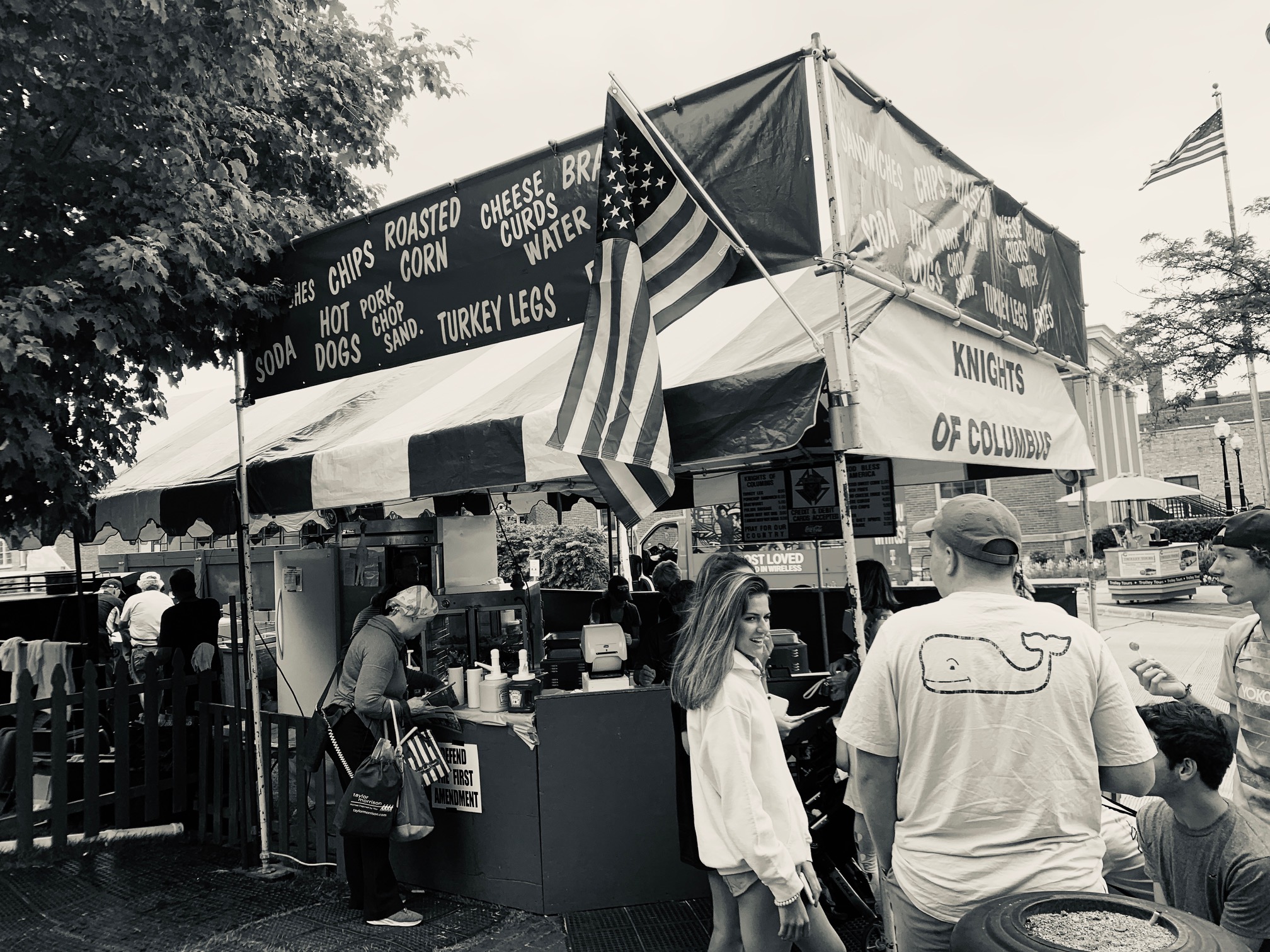
The day was overcast as it often seems to be in mid-June. Summer has not quite arrived. The calendar teases us with the equinox turning and yet the days automatically start shortening. The yin and yang of yearly destiny. That is when the official season of sun and carnivals arrives.
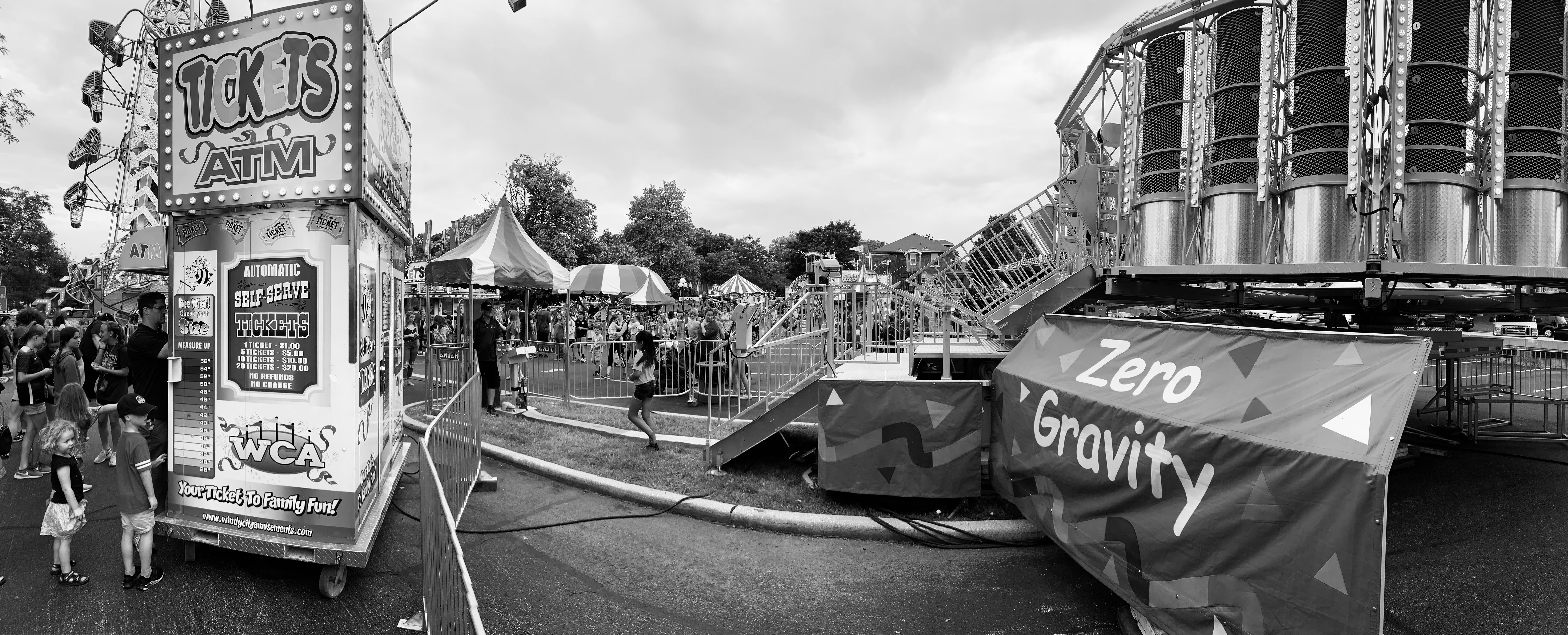
I wander through the Tuesday atmosphere of our local festival. The mothers are pushing kids in strollers and fathers walk with kids in tow. A few families perch on the ground to listen to a lone guy playing electric guitar to a sparse crowd on the lawn of the courthouse. I’ve been here so many times. So many scenes like this. So many years. So very American.
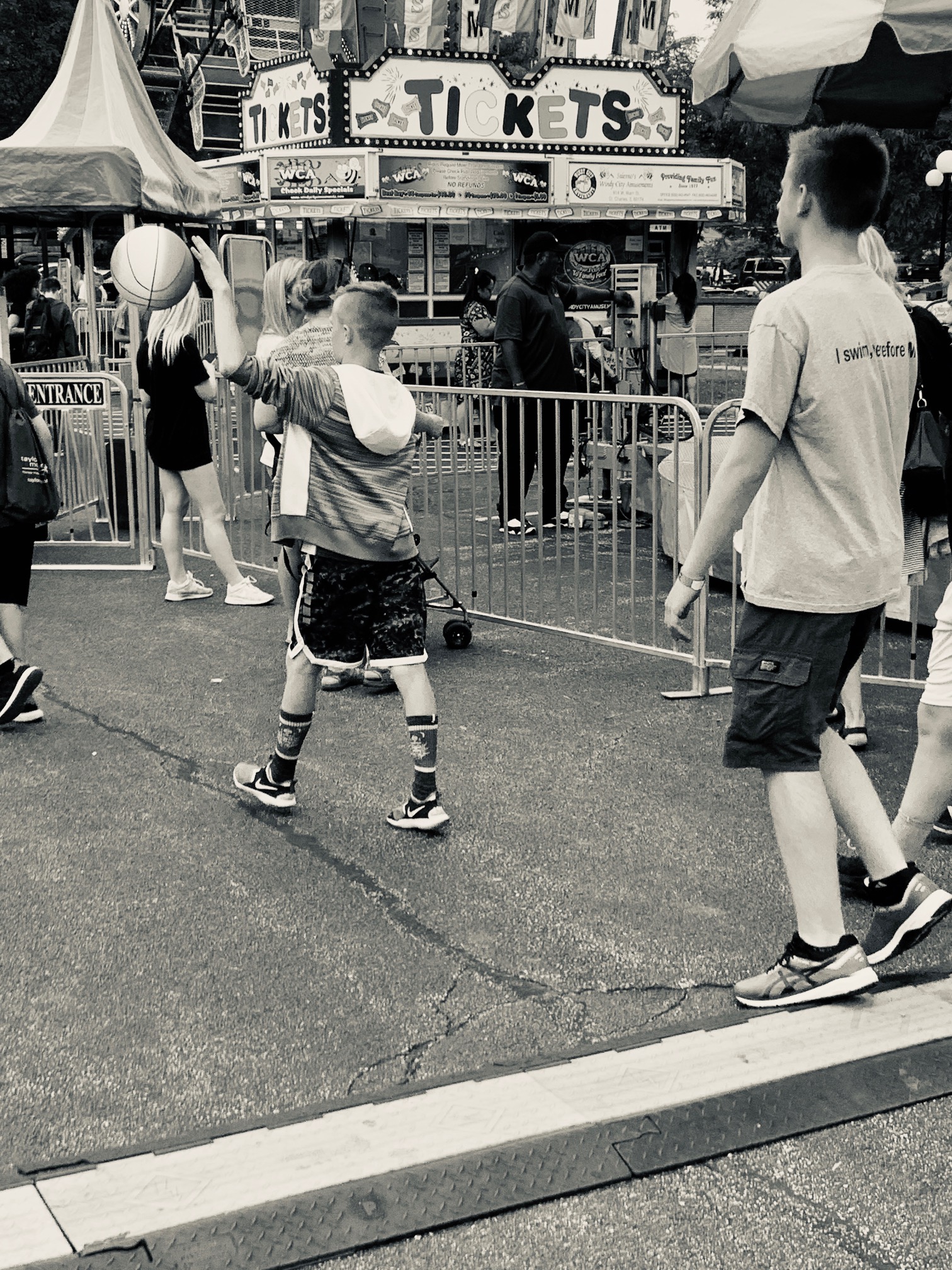
I’ve pushed my own kids in strollers around this town. Rolled them up the street to the parking lot where the rides and games are stationed. “Give us your money,” they all cry. But the Carnies are silent these days. No barking or temptations allowed. Just walls of repetitive junk to lure the suckers.
Once in a while, someone actually wins. That is the American Way. Just enough winning to keep the disenchanted from popping all the balloons of the otherwise cheerfully wealthy. It works for casinos. It works for the lottery. It works for the government. And it works for the carnival. It’s worked that way for years. All it takes is for us to see some random kid walking away with a bouncing ball to continue believing in the carnival of dreams. So very American.
I was that kid a few times. With an arm that would not quit and deadly accuracy from years of life as a baseball pitcher, I could hit the stack of pins exactly where they needed to be struck in order to knock them all down and win a prize. Desperate to impress and urged on by girls who wanted free prizes, I handed out cheap and brightly colored snakes to the girls that begged me to win them one and when that ran out, I handed them to all the girls I could find. Their eyes would flash with a quick thanks. Then they’d turn and look for more dangerous boys to bring the thrill of the carnival alive. And then the Carnie banned me from playing the game any more. And that is America too.
Those girls all turned into mothers or aimed some other direction that life presented. All have their histories now. But it used to be such a mystery to me. Life. What girls wanted. Without sisters to study I had to learn about women by wandering about in the wild world. Now it’s all there in black and white. I see how it works. We’re all part of a repeating cycle. The merry-go-round is whatever makes you happy. Or sad. That’s all that anyone really has.
It is also true that sooner or later, life catches up to everyone. It happens to some faster than others. But after enough time goes by, the past is a blur, the present is the horse you’ve chosen to ride and the future will chop off your arm if you’re not careful. I once sat at the top of a Ferris wheel at the County Fair with my son. We waited while others got on the ride, and then our car lurched and feel three inches on one side. Those things are put together again and again by people who must cease to care after a while. It’s just another town. Another carnival. And if lives are at stake, well that’s America too.
The carnival is a sideshow of people. I see the folks that have taken care of themselves and others, not so much. People watching can be a rush. And then reality strikes. A panicked grandfather bursts out of the Midway calling the name of a child that he’s lost somewhere. We all stand there watching the drama unfold. I ask the man if he wants me to call 9-1-1. His eyes are wide with fear. Then he runs off again calling the child’s name. HIs arms are raised. His body taut. The entire carnival comes to a standstill. Then he finds the child and admonishes the frightened looking kid who had simply gotten into the wrong line for a ride. It was thumbs up by Grandpa though. Tragedy averted. Everyone goes back to their amusements. The American Way all over again.
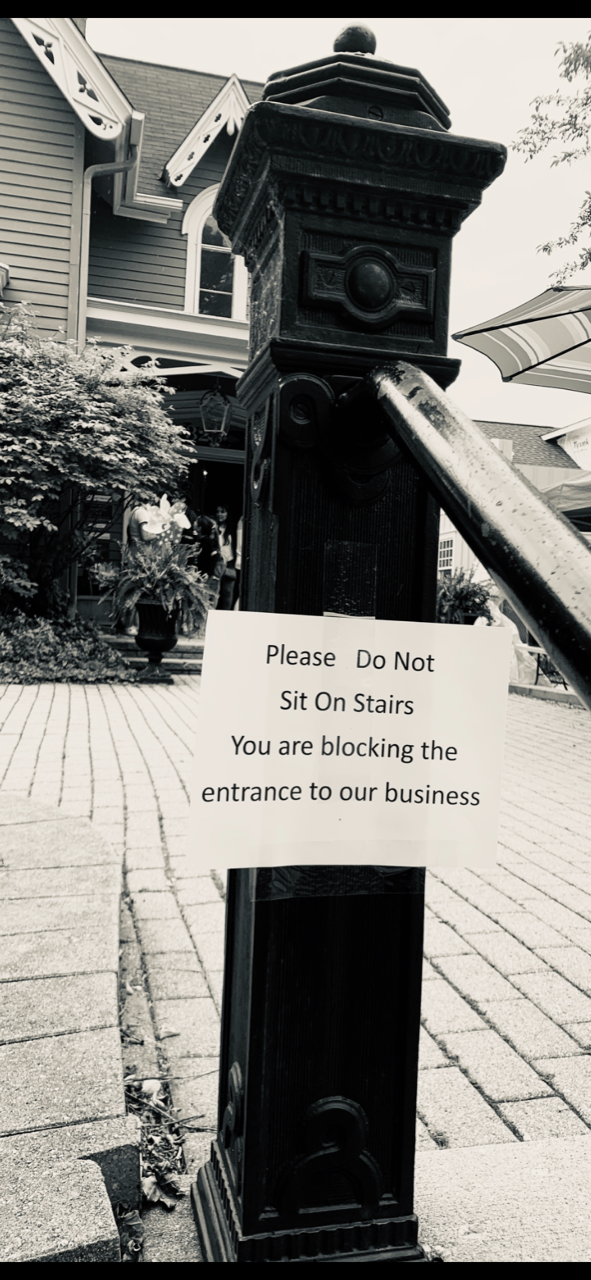
I left the carnival after that. Walked toward the street where the shops line up hopefully. Supposedly this is what summer carnivals are all about. Combine fun and commerce. Sometimes the two don’t mix that well.
America is like that. Playful hopes and selfish interests collide at every intersection. the people in charge of town zoning and the organizers of carnivals know that you can’t please everyone. The best you can do is attract the masses and hope for the best. Cash flows in. Cash flows out.
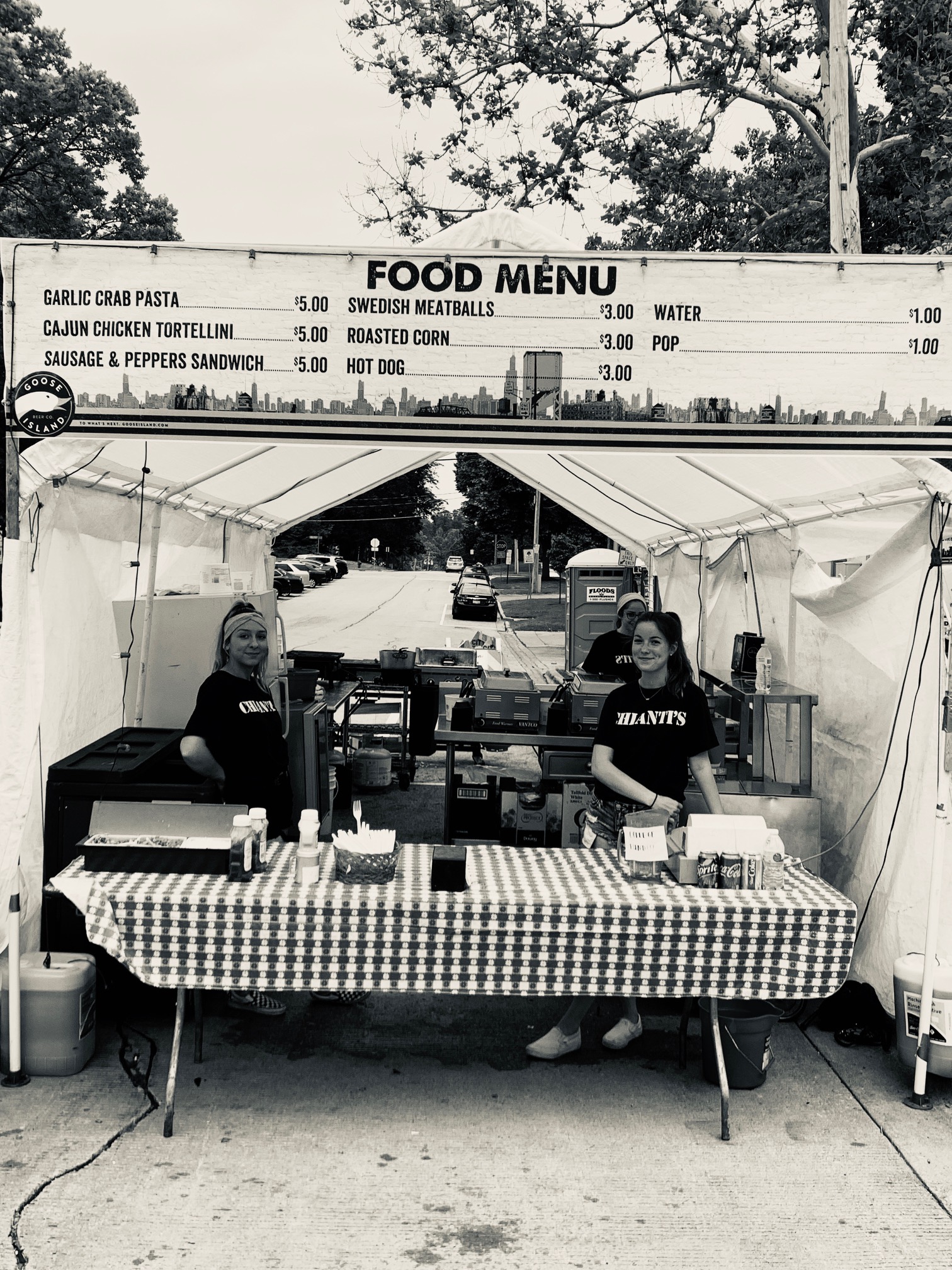
I’ve run on all these streets when the carnival is gone and the food booths are gone as well. I rise early and trot through the early morning fog when no one else is around. The carnival of years is a manic ghost that comes and goes. The streets are empty again. The equinox has turned. Summer has begun in earnest. And the next carnival awaits.
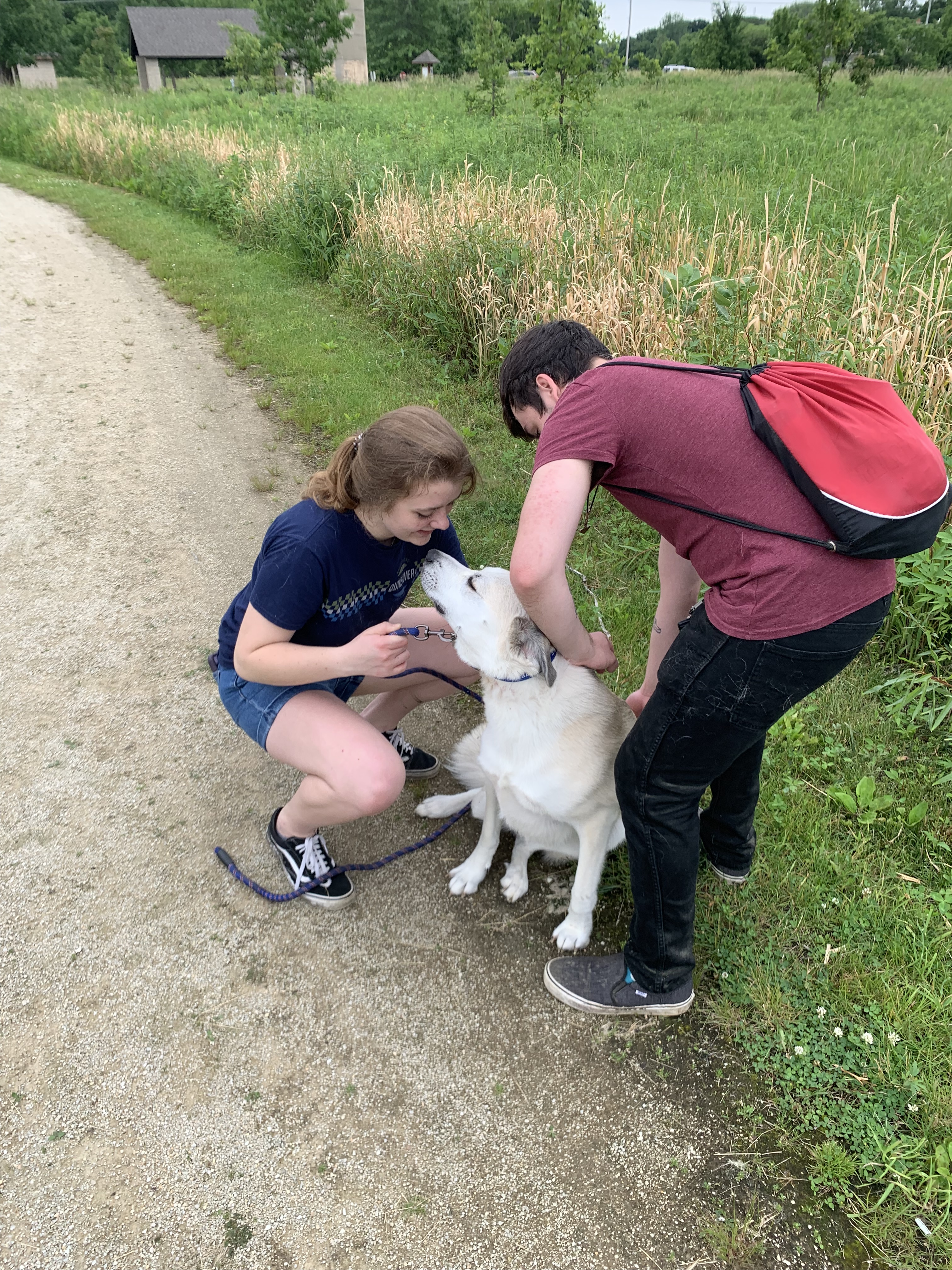
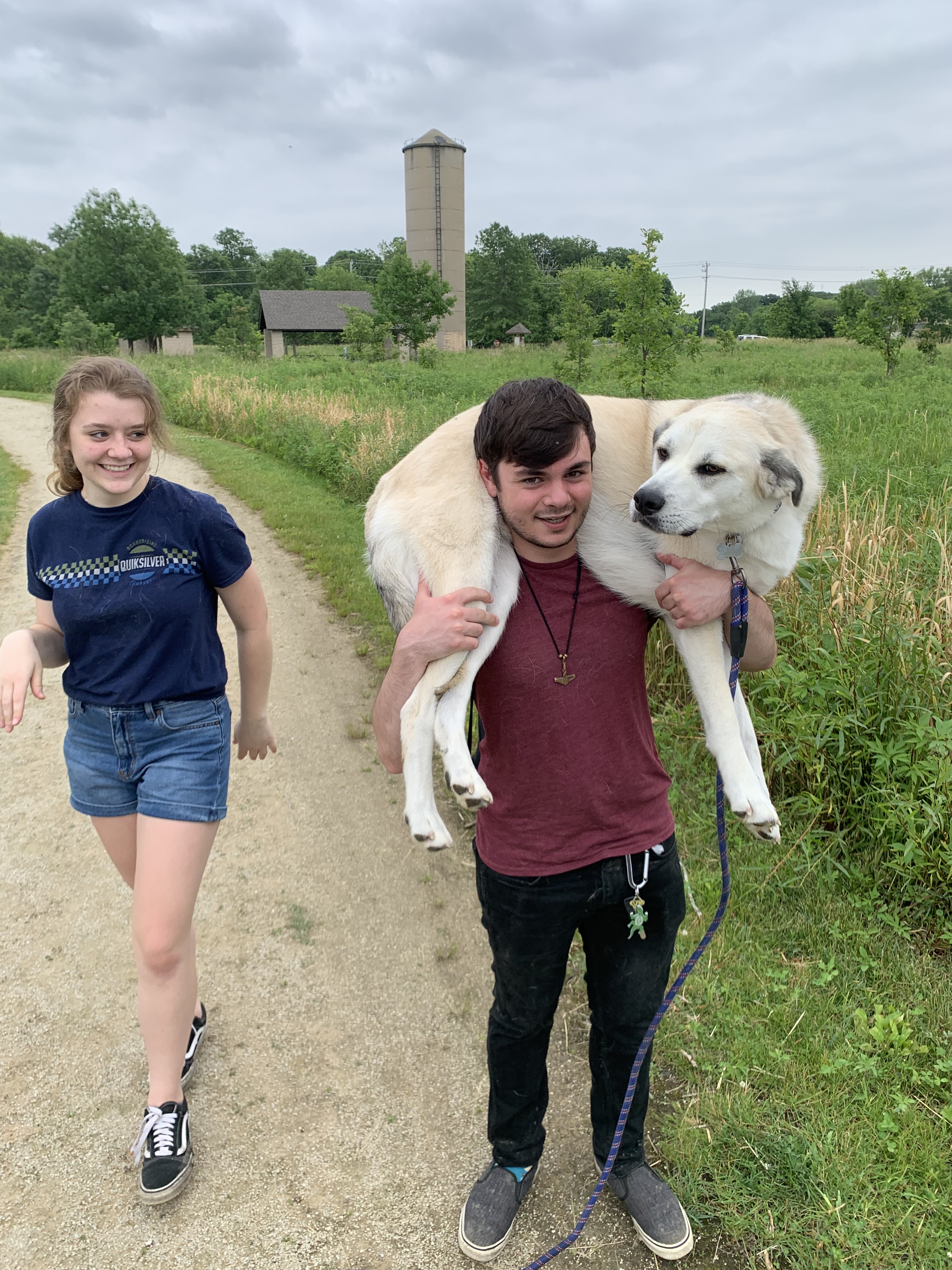
Toward the end of my run through the woods and prairie at Dick Young Forest Preserve, I turned east on the last stretch of trail toward the parking lot and beheld a strange sight up ahead. At first I thought it was someone carrying an injured deer on their shoulders. But as I got closer the it became apparent there was a young man carrying his rather large dog.
Max holding his dog Augie on his shoulders
At first I assumed the dog had grown tired or was aged and needed to be carried during the last part of his walk. But the young couple smiled and his Doggie Mama Megan told me, “No, he just doesn’t want to come home. He likes it out here so much he just lies down or tries to crawl into the weeds when we turn around.”
Augie had the sweetest face in the world. I bent down to nuzzle his nose and he gave me a lick. He did not seem like a stubborn soul at all. Then Max and Megan said, “Maybe he’ll walk the rest of the way if you walk with us.”
Max and Megan pause for a photo but Augie looks suspicious.
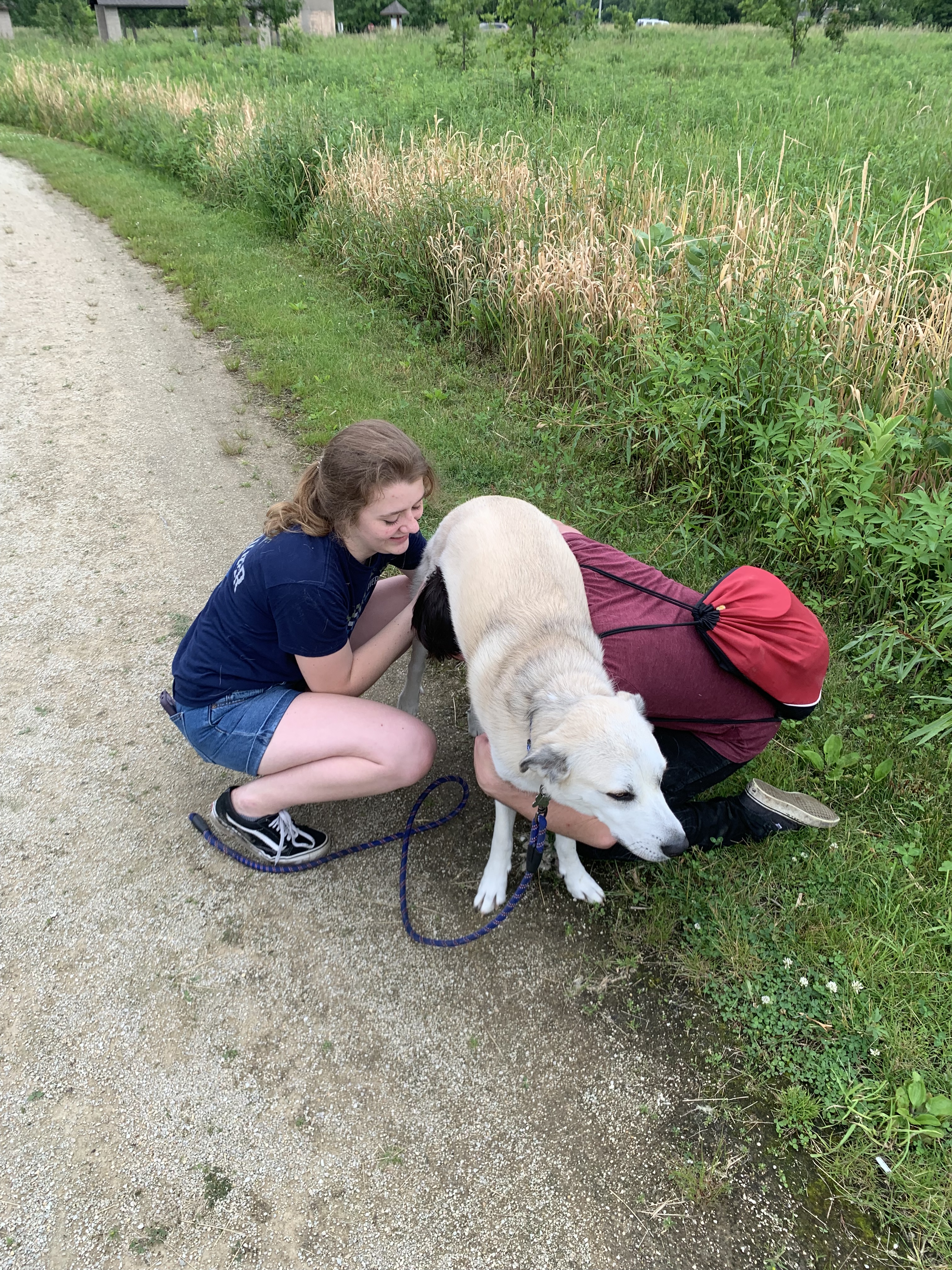
So we started walking toward the parking lot. But Augie was having none of that. He wasn’t falling for such shallow tricks. Instead he plopped his butt down and would not move. He even attempted to pull on the leash for a dive into the weeds.
I thought to myself: “This is a dog that knows what he likes and there is little anyone can do to change his mind.”
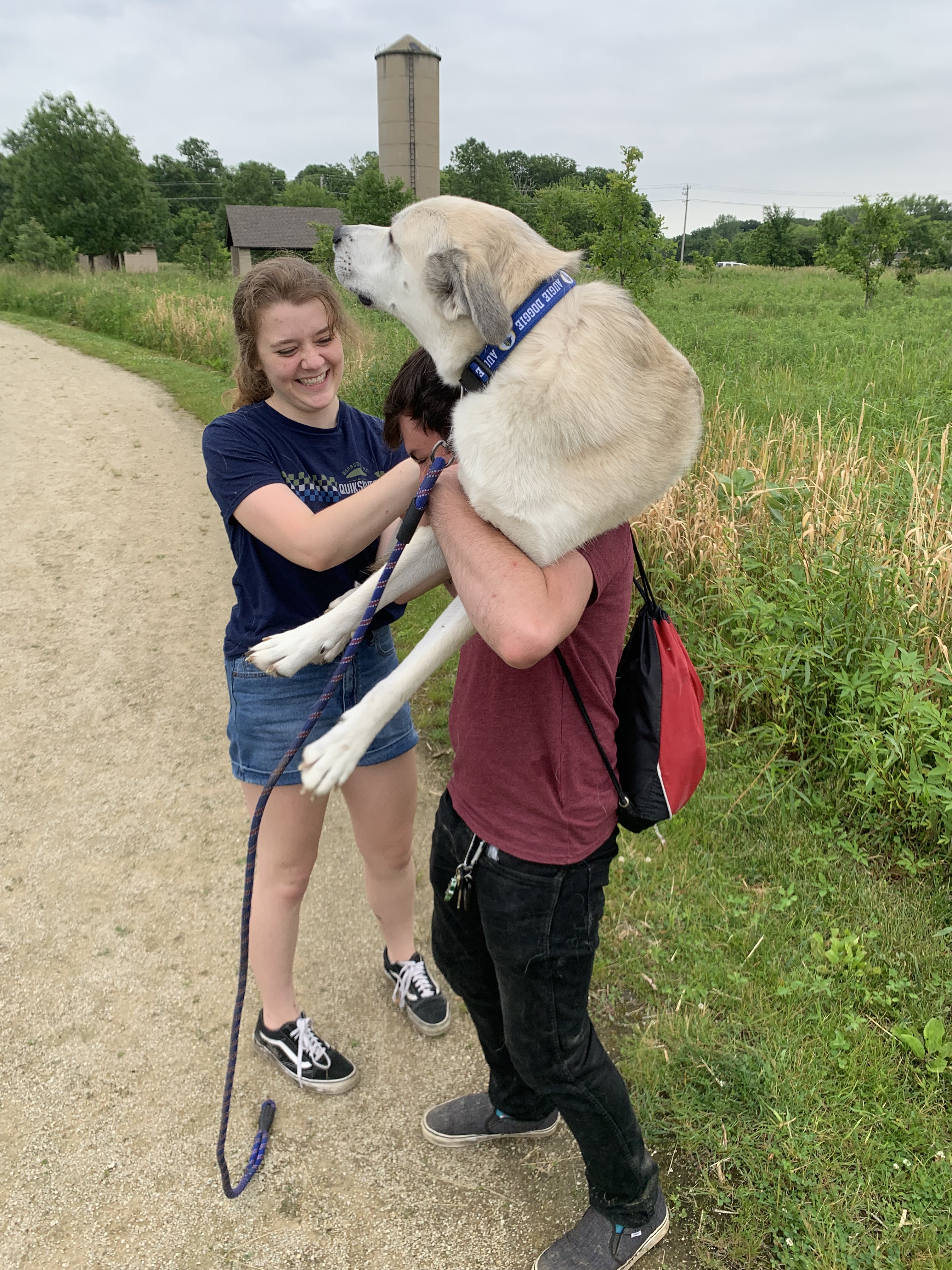
Augie’s reticence to go back home meant that Max needed to get Augie back on his shoulders for the last one hundred yards to the parking lot. Megan helps position the pup…
Then Max gets his head under the belly of the dog.
Finally he can stand up with Augie on his shoulders.
Then it’s time to portage Augie to the parking lot. He’s calm once he’s up there. Doesn’t put up a fuss.
Something about this meetup just made my day. Such a sweet young couple who loves their dog. Perhaps the dog trainers out there will deem this behavior unacceptable on the part of Augie and his owners. But I prefer to think of this as a happily symbiotic relationship that will evolve over time.
At any rate, thank you Max and Megan and Augie for one of the nicest little conversations yesterday. And Augie, I suggest that you don’t start making them carry you out into the field as well. That’s what the leash is for, good buddy.
When they’re above the ground, it’s easy to forget that clouds are made up of water vapor.
There was no rain predicted in our area yesterday, which was Father’s Day. No green blobs on the radar. No threat of being bombarded on an early Sunday morning.
But the weather forecast was not entirely accurate. It wasn’t raining out, but it was wet. It was exactly like the thick mist of a cloud had descended on our county and was not going to evacuate the area anytime soon.
We rode through sheets and sheets of the stuff. To some that might have represented misery. To me, it was the perfect way to spend a Father’s Day.
I felt so alive. As we climbed a hill through a maple forest the air went silent except for the sound of rain on millions of leaves. It felt like some ethereally digital experiment in which every sound was magnified, but only to the level that it was pleasant.
We turned west and tore along Beith Road toward Maple Park at 22 mph into a crosswind. In aero position the rain flipped up from my front tire and off the back wheel of my wife’s Shiv when I got too close.
At the Casey’s we stopped for a bathroom break and took in some nutrition. Then it was time to cut back through the wind on our twenty-mile journey home.
This morning my schedule called for a bird census trip to a restored prairie at a local forest preserve. It was windy out today. I’m not a fan of birding in the open when a strong breeze is blowing because the birds tend to stay low and out of sight. Plus I can’t hear their calls as well.
But sometimes it’s best to carry on with a plan rather than hope you’ll find time to fit a scheduled activity into the calendar later on. So I drove out to the preserve and hiked out to the first GPS post and started the count.
During the first stop I looked up to find a meadowlark circling overhead. As it fanned its tail and circled I snapped photos of the bird. I could tell in the viewfinder that the images would turn out interesting.
A meadowlark soars over a restored prairie.
I’m always looking to salvage some kind of value from every experience I do. Sometimes on a long ride or run in the wind it’s all I can do to get through it. The sound of the wind while you’re riding can be so exhausting and the feeling of the wind rushing across your ears and pressing on your body is tiring as well.
Yet we ride on or keeping running because once you’re out there, what other choice do you have? Somewhere along the way there always seems to be a little break when the wind lets up and things get quiet enough to think. I do recall a ride many years back when the wind was so strong I stopped the bike and yelled an obscenity into the wind.
In fact I did the same thing this morning during the bird census. “Fuck the wind!” I yelled out. Then I turned around to see that a man was walking his dog on the trail that cuts through the prairie. He stopped, clipped his dog back on its leash and turned around. Apparently he thought I was yelling at him.
But actually, all I was trying to do was let off some anxious energy on a morning when I wished it was quiet enough to hear the grasshopper sparrows singing their insect-like songs in the low vegetation.
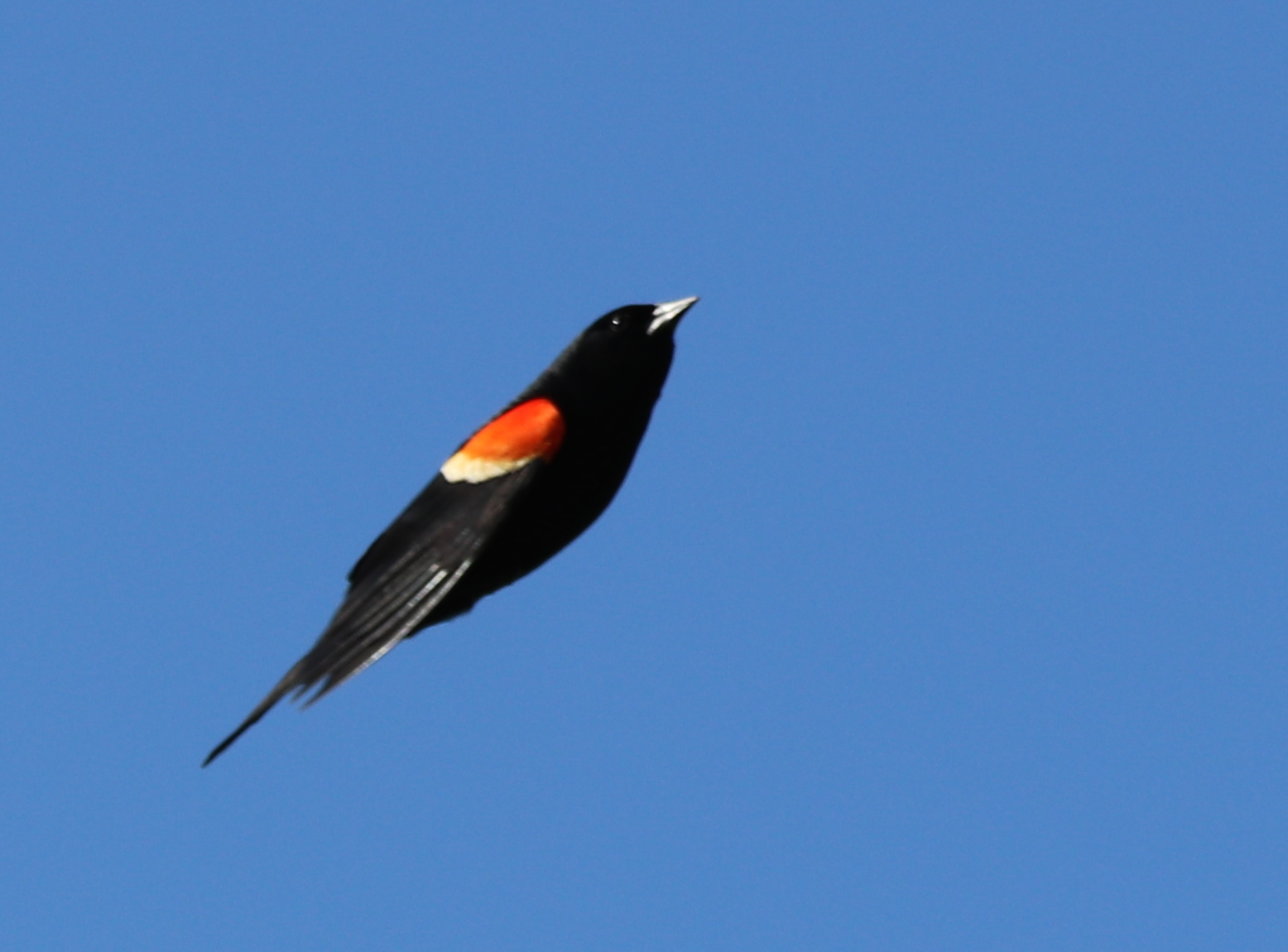
Instead all I saw and heard were the obvious birds. The loudmouths and aggressive species like red-winged blackbirds that dive-bomb if you don’t stay alert and wave them off.
A red-winged blackbird soars up to prepare for a dive.
By the time I’d finished up the count this morning I was tired and ready to plop into the car and relax a few minutes. I’m no scientist by trade, but this much I can tell you. It takes patience and persistence to gather information about the rhythms of the wild.
That’s especially true when you’re performing your citizen science duties against the wind, or through the rain. It’s a test of commitment and belief in what you’re doing when you’re waist deep in grass and worried about ticks up your pant legs. But the two constants in my life have been endurance sports and getting out in nature. Sometimes the two mix and at other times, they are necessarily separate.
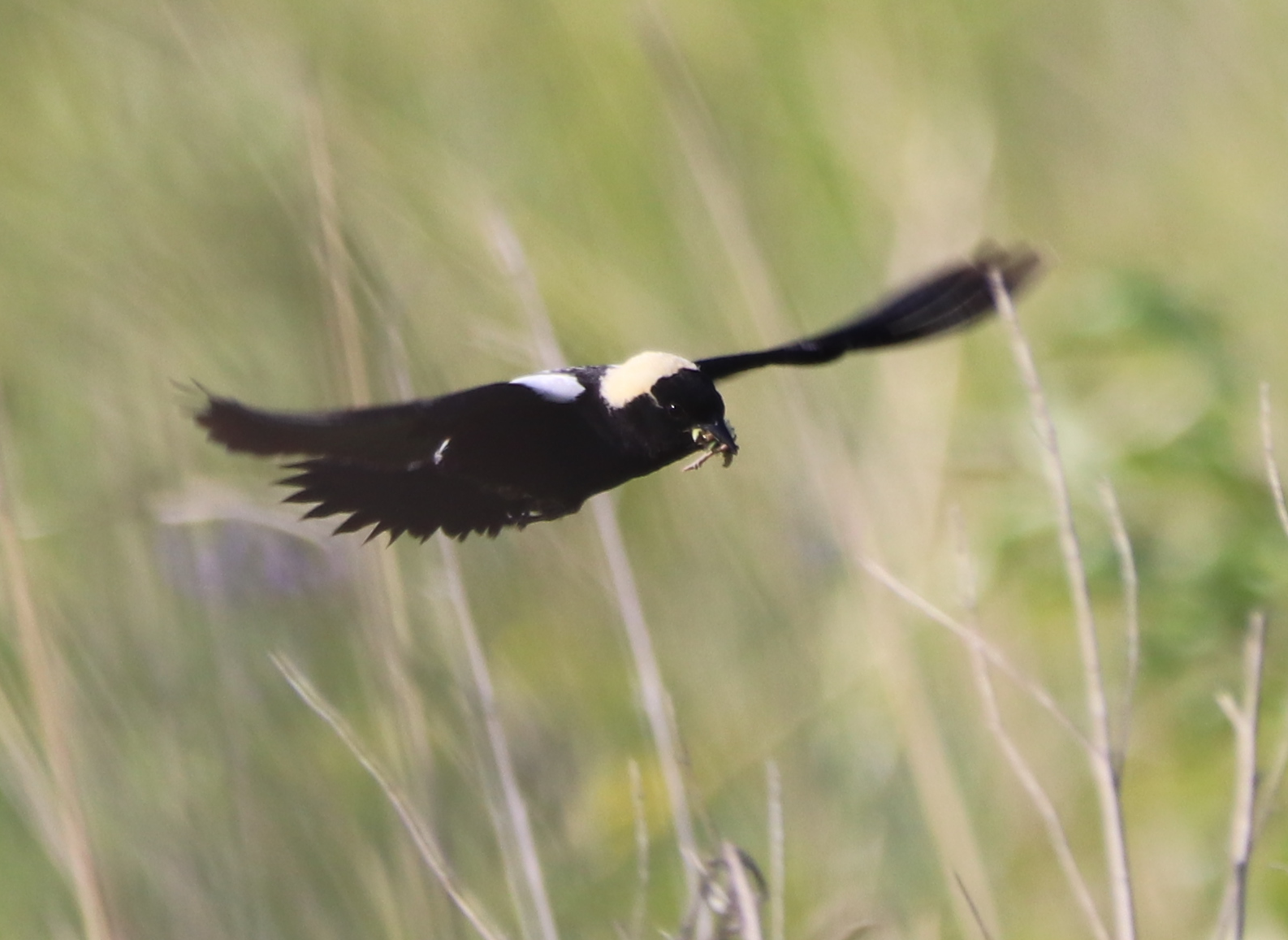
A bobolink brings food back to its young in the next.
But the hope common to both activities is that I’ll experience something out there that just blows me away. I’s always in pursuit of that sensation, those peak experiences where you feel a sense of wonder. Sometimes they come by in a flash, which means that in everything you do it always pays to be as alert and alive as you can.
At the corner of Beith Road and Route 47 north of Elburn, Illinois. One wonders what the test plot will tell the Kane County Corn Growers this year?
Twelve miles into my forty mile ride this morning I stopped in the little town of Kaneville to visit the Purple Store, a local hotspot where they grill out every Tuesday and Thursday and residents can socialize and talk about life in farm country.
This morning a gathering of three or four elders was seated in chairs facing the counter where the manager on duty was soaking up friendly teasing from the group of old boys trading quips. I recognized one of the visitors from my days as a Kaneland student, the regional high school four miles up the road. We exchanged greetings and then I joined the conversation in progress by repeating a question I’d just heard.
“Is anyone planting corn this year?”
The entire Midwest is an evaluation plot this year.
But here it is June 11th, 2019. Normally there would be corn sprouts casting a green haze across Kane County fields. This year there is nothing but a few bean fields planted. The remaining farmers are rushing to get seed into the ground before the next expected rain storm tomorrow. During my ride I saw farm implements coursing across fields and hustling down country roads to reach their next destination.
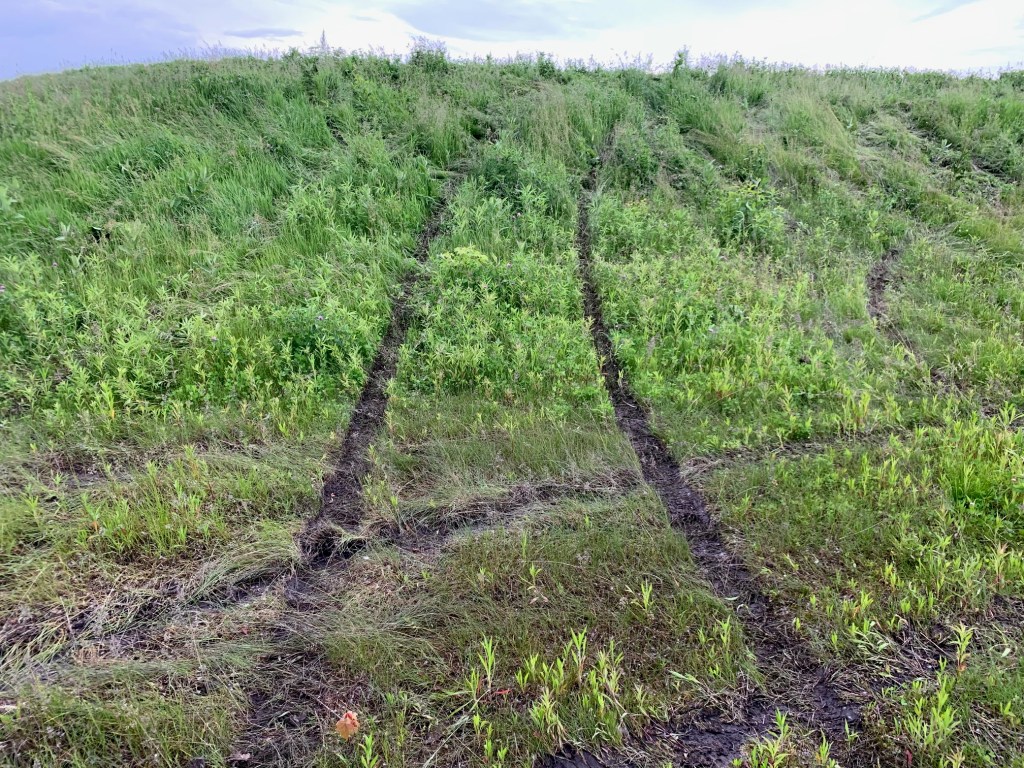
Too late to plant corn
“It’s too late to plant corn,” one of the elders observed quietly from his seat inside the Purple Store. He’s seen a few planting seasons in his time. Clearly this year’s situation is different than anything he’s seen in recent times. What’s a farmer to do when the weather flat-out refuses to cooperate?
Some might try to write off this year’s rainy season as a climatic aberration. But if the same thing happens next year, and the next, whats the story then? And what if the tables turn and drought takes over as it did long ago in the Dust Bowl when too much native soil was turned over and the rains refused to follow the plow?Let’s admit it agriculture will need to make big adjustments if climate change keeps messing with the systems to which we’re accustomed.
Tariffs and ripoffs
Already the ag industry has seen waves of losses brought on by Donald Trump’s trade snits toward China. To make up for the gaffe of blowing up the seed markets, Trump shunted billions to the agriculture industry to make up for the losses caused by sinking prices and piles of grain spilling out of stuffed silos across the Midwest.
Whoops.
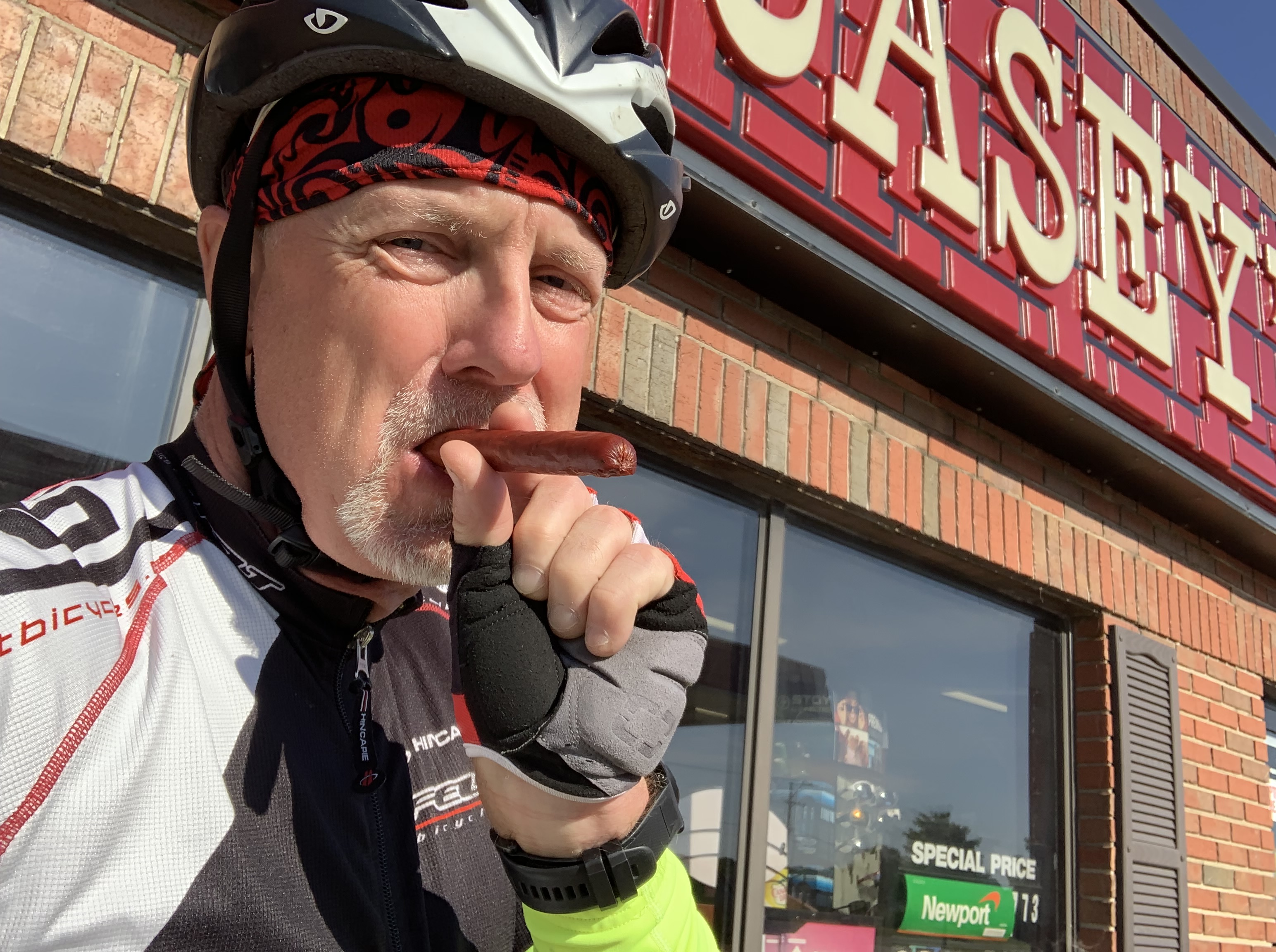
Imbibing a meat cigar at the Casey’s General Store in Maple Park, Illinois. The heart of corn country.
There’s no such thing as perfect economic policy, that’s for sure. International trade policy is at best a set of standards against which countries seek to measure their output and intake. These measures are designed to protect a healthy economy for everyone involved. But trade wars act like a cancer eating away at economic systems from the inside out. Just like a cancer patient whose chemo doctor brings them close to death in order to save their lives, there is a tipping point at which the treatments become worse than the disease itself.
As an illustration of this point, world-class cyclist and Lance Armstrong once turned to his oncologist and said, and I paraphrase, “Give me all you got, Doc. You can’t kill me.”
To which his doctor replied, “Oh, yes I can.”
Those who consider themselves too strong to fail or refuse to accept the reality of their actions when they do can turn out to be the death of us all. And if our climate reaches a point where it is stressed beyond its capacity to recover from the impact of manmade climate change, we can expect there will be politicians and religious zealots still claiming there is nothing human beings can do to affect the world that much.
That is ignorance. That is arrogance. That is cognitive dissonance. And no amount of farm subsidies is going to fix stupid.
Cycling in corn country in June usually offers a cast of new green corn shoots. This year: bare ground.
Just ask the farmers who couldn’t get their corn into the ground this spring, or whose properties are buried under floodwaters from the Missouri or Mississippi Rivers. Might there just be something going on that’s bigger than “local weather?” The voices of those farmers might just be the canary in the coal mine that gets the attention of climate change deniers and their religious ilk so eager to deny the science that points to manmade impacts on our global atmosphere.
I know one thing: I just rode forty miles through mostly blank fields today. And having lived in farm country for all sixty-plus years of my life, I know an odd sign when I see one. There’s nothing corny about this situation we’re in. And I know from studying nature for those sixty years that one can never tell which seed of hope or piece of genetic drift is vital to sustaining this world for future generations.
I wonder if some people really get that. But it’s easy to see the people who really don’t. They’re the ones still claiming that nothing’s wrong with this picture.
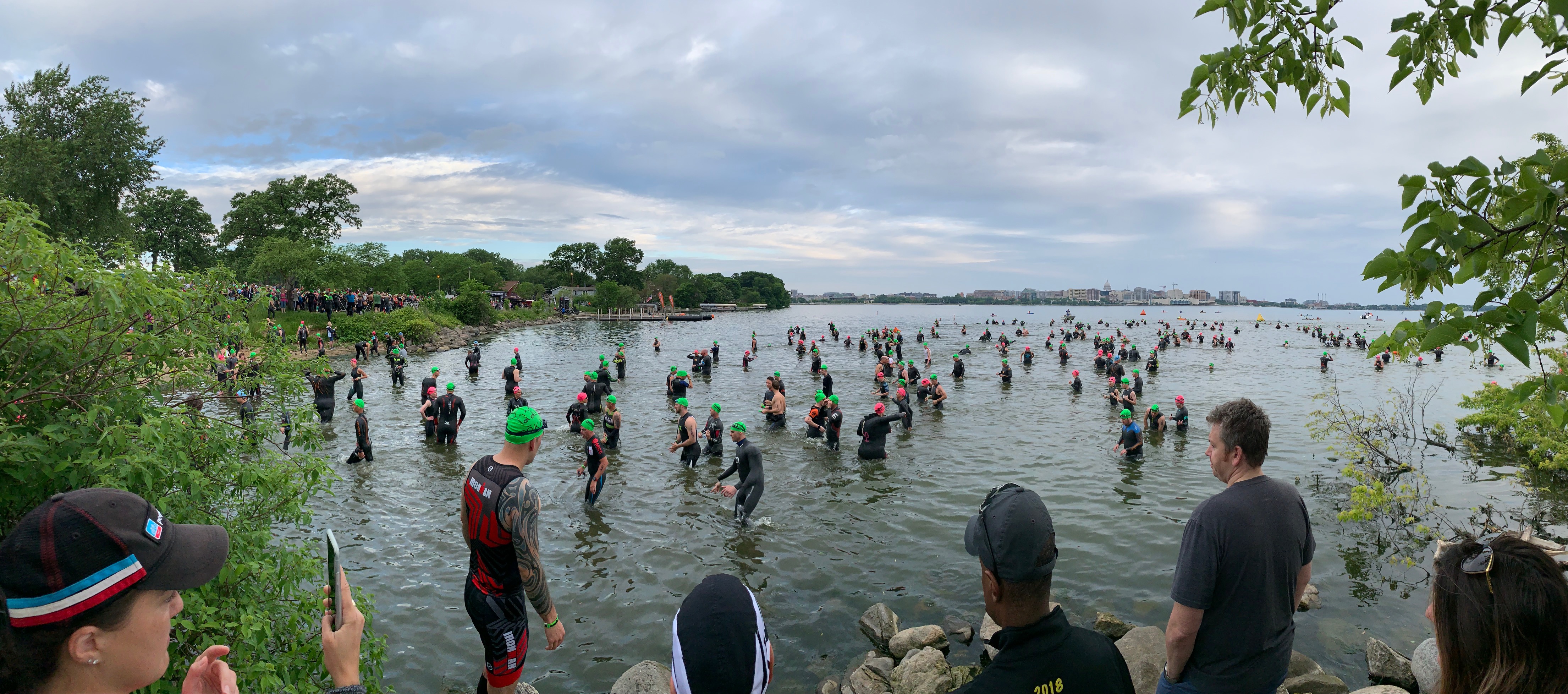
This weekend my wife completed the Half Ironman in Madison, Wisconsin. That’s no mean feat given a course that is hilly beyond belief. At several points the grade reaches 10% and a long steep stretch up a country road called Observatory Hill makes you want to stop and look at what you’re doing.
I know this because we rode the course together a few weeks back in anticipation of the race, When it comes to her training for the longer races, I’m her Right Hand Man. I may not do every mile with her but we cover large chunks of training together.
We’re fairly equal as athletes so it works pretty well. She’s the faster swimmer. I’m the faster runner. We’re about the same on the bike depending on the day and terrain.
Right Hand Oops
View of the swim warmup with City of Madison in the background.
As she was racing yesterday in Wisconsin, I got out for a 10K run along the Lake Loop that skirts downtown Madison. My running has been picking up in terms of pace and volume, so I was feeling peppy after a warmup and turned around ready to bring the last three miles home at 8:00 pace.
The asphalt trail is heavily traveled by cyclists and runners. One has to remain alert for other foot and bike traffic. But I like to run on the thin dirt path next to the actual trail. It is the product of the footprints of thousands of other runners.
As I rounded a slight left turn on the path that skirts a tree, my toe caught a root that sticks up out of the dirt. The thump of shoe rubber was followed closely by the awkward thud of my face literally hitting the ground. My right side also took a beating, especially my right hand. It was dirty and bloody and sweaty all at once.
Back at it
The outside right of my hand where I once busted a bone years ago playing soccer goalie.
After lying there cursing for a couple seconds, then looking around to see who’d witnessed my incredible fall from grace, I gathered myself into a vertical posture and brushed off the worst of the brown dirt covering me from knee to shoulder.
It’s been a long time since I hit my head on the actual ground. Growing up as a competitive kid, that happened quite a bit. But as an adult one tries to avoid that kind of casual trauma at pretty much any cost.
So I shook my head a little to gain my wits as I started back running. There was grit from the ground stuck in my eye and my vision initially seemed a little off. Within ten strides however, I was back on pace, a little shaken and worse for wear, but running at the original rate.
I looked down at my hand and lamented, “That’s gonna sting in the shower.” The whole hand ached.
Right hand redux
That worried me because my right hand is already messed up from another incident a couple weeks ago. I was cycling up a busy country road and approaching a vehicle parked by the side of the road. It was a tall white SUV and I was hustling along on the bike at about 20 mph while checking for traffic behind me when a man stepped out from behind the SUV and I had no time to stop. My front wheel nailed him in the left buttock and I flew off the bike in a heap on the road.
I was glad there was no traffic coming from close behind or I might have been run over. The guy that got struck with the wheel was cursing me right and left. It turned out his classic GTO was parked right in front of his SUV and he’d been looking under the chassis before stepping out into the road. He’d probably looked for traffic and seeing none, thought it safe to poke his butt out into the traffic lane.
Later the local police called me to follow up on the report. ‘Why was he standing in the traffic lane?” the officer asked. I gave my observations but honestly, it happened so fast that nobody had a chance to react.
I’d taken photos after the incident. There was no room for error and lots of potential for happenstance collision. My right hand took a beating when my bike struck the fellow. At this moment I’m not sure there is not a broken bone in that spot before my index finger there. I’ll find out Wednesday at a doctor’s appointment. It is still sore.
The right perspective
Some of this calamity stuff is the inevitable product of trying to go fast under all sorts of circumstances. That’s one of the tarsnakes of triathlon training and racing. It does come with some degree of risk. I’ve had enough incidents on the bike in particular to realize that short of riding like a tortoise, things are going to happen now and then.
Yet falling down while running was surely a surprise. But when I returned to the race tents at the Ironman after a shower and getting cleaned up, I learned that two people had succumbed during the swim portion of the event that morning. The cause was unknown, but one person unresponsive when the volunteer kayakers reached him and the other was taken to the hospital in critical condition. And as we later learned, another athlete had also died.
Several weeks ago following my collision with the guy tending to his car, one of my cycling buddies told me, “You should be glad. Things like that can go sideways in a hurry.”
It all makes me genuinely glad that things turned out alright, even if the right side of my body is a little sore.















 We Run and Ride