
Pretty soon, the year’s summaries on Strava and Garmin will arrive, and with that assessment comes a bit of introspection about “doing more” in the coming year. I wasn’t a heavy-duty trainer this past year. I did do an Olympic-distance triathlon, but suffered on the run for two reasons. First, I hadn’t run enough miles to support a competitive 10K coming off the bike. And second, I forgot my nutrition at home and had to use a makeshift routine and lost two of the bottles in the first miles of the bike!
I know, that’s just stupidity, not laziness. But it’s also lazy in a way. Normally, I make a list of all the things I need for a race to check off on race eve, but I neglected to do that. I did make the bottles the night before, yet forgot them in the garage refrigerator, where I put them, so that I would not forget them. So it goes, with a mind run by ADHD.
Active laziness
But these are ancillary problems. The real problem I faced in 2025 was active laziness. I ran and rode and swam some, because those are the ‘easy’ things to do when you’re a triathlete. They’re the dopamine fixes we all get from “training.”
But I didn’t do any strength work last year.
That neglect has both a cause and an effect. The cause is that strength training is hard. It takes time to get to the gym and lifting weights takes patience and focus. I lack that sometimes. Or, it takes dedication to go downstairs, set up in our home gym, and do it.
Part of my reticence stems from insecurity about type of weight work helps. I know some quad and knee exercises that have good benefits, but got out of the habit of doing them, and then it feels like a ‘long way back’ to get going again. We develop mental gaps that are hard to bridge.
However, my left knee started hurting two months ago. That’s related to the torn meniscus repair a few years ago. The orthopedic surgeon nipped off an offending bit that protruded from the inside of my knee. That freaked me out. It felt like the knee was breaking down. We chopped it out.
Chiro gyro
That reduction has a cost. There’s aless cushion between my knee bones, and that specific area feels sore in the morning. I saw an ad for a local chiropractic clinic called Bodywerks Medical Center that was advertising help for knee pain offering a $39 special for x-rays and consultation. I took them up on the offer.
I’ve visited chiropractors before, and it always seems like they’re more interested in finding ways to maximize your payments and getting a long-term commitment out of you rather than curing whatever immediate problems you might have. They seemed different and caring over the phone, and the front desk people seemed authentic in their interactions.
But after the x-rays came back and they “talked about me in the morning meeting,” the company sat me down to review x-rays. They began by pointing out my straightened neck (car accident thirty years ago) upper back (some mild scoliosis) and lower back (one suspect vertebrae and mild lack of curvature.) After that list of bodily flaws they finally get around to discussing my left knee. You might recall that was the reason I scheduled the appointment in the first place. They put an x-ray up on the big TV screen and the chiropractic physician, who seemed a bit in the hurry to it all over with, told me, “It looks good. There’s still space between the bones, see?”
Bye and buy
The head chiropractor leading the consultation then left the room. I was left sitting there like someone who’d just heard a timeshare presentation, and it was time for the close. The office assistant shared some printouts documenting my long list of bodily problems next to the costs, insurance coverage, and a treatment schedule extending well into the year 2026. The total out-of-pocket expense I’d be expected to pay after insurance was nearly $6000. Down at the bottom of the page, I found a few bits about the knee treatment. It seemed like that last priority on the list.
I asked what the treatment options were, and they offered, “We can make some adjustments, give you exercises, and possibly an injection.”
“Do you have any questions?” she asked.
“I only came here for the knee treatment,” I responded. “This is a whole lot more than I was planning.”
“Well, we did figure out the costs for just the knee,” she told me, and slid a single piece of paper across the table. It showed a $1007 out-of-pocket expense for me. “That’s after insurance?” I inquired.
“Yes,” she told me. At that point, I was beginning to feel like they didn’t really want me as a client. Perhaps they don’t make as much money as they’d like when dealing with a Medicare client. Or, my insurance doesn’t really cover chiropractic treatments. In either case, it was way too expensive. Before leaving, I asked if I could have the estimate papers and she replied, “No, we can’t let these out of the office, but you can take photos of them with your phone if you like.”
I did that, but I probably deleted them since by accident. I take so many photos its my habit to touch and delete bunches of them at once. Such is the digital life.
Orthopedic sensibilities

Yesterday, I visited our regular ortho doctor, who moved my knee around first, then looked at the x-rays, and he told me, “It looks good. I thought it was going to be worse than it is. You’ve taken good care of your knees, it looks like. It’s likely we can help with the physical therapy and maybe an injection. Some people use a steroid injection if they’re in pain. Those are some options.”
I chose physical therapy, and in a week or so, an injection of collagens, or something like that to cushion the knee joint. But that’s just the start.
In Seb Coe’s footsteps

And thus I’ll use this ‘problem’ with my knee to begin what I’d already planned to do this winter. Get busy with some strength work and prioritize that over sometimes meaningless runs of 25-30 minutes. Some of the greatest runners in human history used the winter months for that purpose. The former 800, 1500, and mile world record holder Sebastian Coe did plyometrics and strength work all winter to prepare for spring training. He could leg press 700 lbs. That’s a fine example of not being actively lazy.
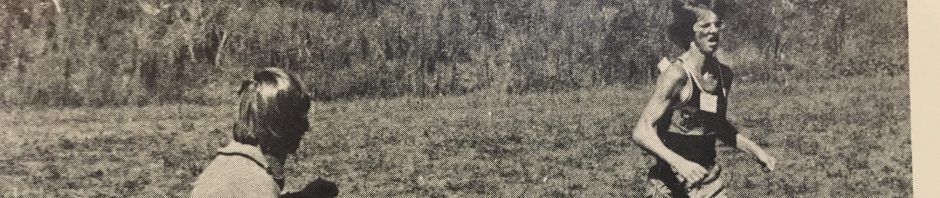
Look at Seb’s foot position in this photo. It is highly “supinated,” with the instep raised and the outside of the foot the first point to make ground contact.
Yet even Coe had flaws. I met him in 1983, the year before the ’84 Summer Olympics in Los Angeles. He consulted with Dr. John Durkin, a podiatrist I knew through my high school coach Trent Richards. Durkin became known as one of the nation’s foremost podiatric specialists for athletes at the time, treating runners such as Craig Virgin, Jim Spivey, and many others.
But Sebastian Coe had a problem. He had flat feet and kept having calf injuries due to the twisting effects of his flat feet radiating up his body. As strong as he was, Seb Coe had weaknesses that needed fixing with external devices. These included orthotics.
Thus, you and I have to consider our respective weaknesses when making plans for today and the future. We cannot afford to be actively lazy. It’s our job to find ways to strengthen our own efforts, correct and compensate for any flaws, and use that journey for motivation rather than ignoring reality in favor of the “easy route” that’s too easy to choose.
It’s fine to run, ride, and swim. But we all need to build strength for those pursuits, and other interests.


 We Run and Ride