On the run from golf carts and people

I’ve written about the fact that as a child growing up in Lancaster, Pennsylvania, and before that, Upstate Seneca Falls, New York, I spent quite around golf courses. Some of my earliest memories are crawling around on the putting green grabbing golf balls as my dad practice his putting. When we were old enough, dad took us all golfing at times.

Our home in Lancaster sat next to a golf club called Meadia Heights. That course was a wonderland for a kid, as we roamed around on foot and poked about the streams and woods for fun. But we also knew the rules of conduct when setting foot on the golf course. Stay off the fairways when possible and never, ever spend time on the greens.
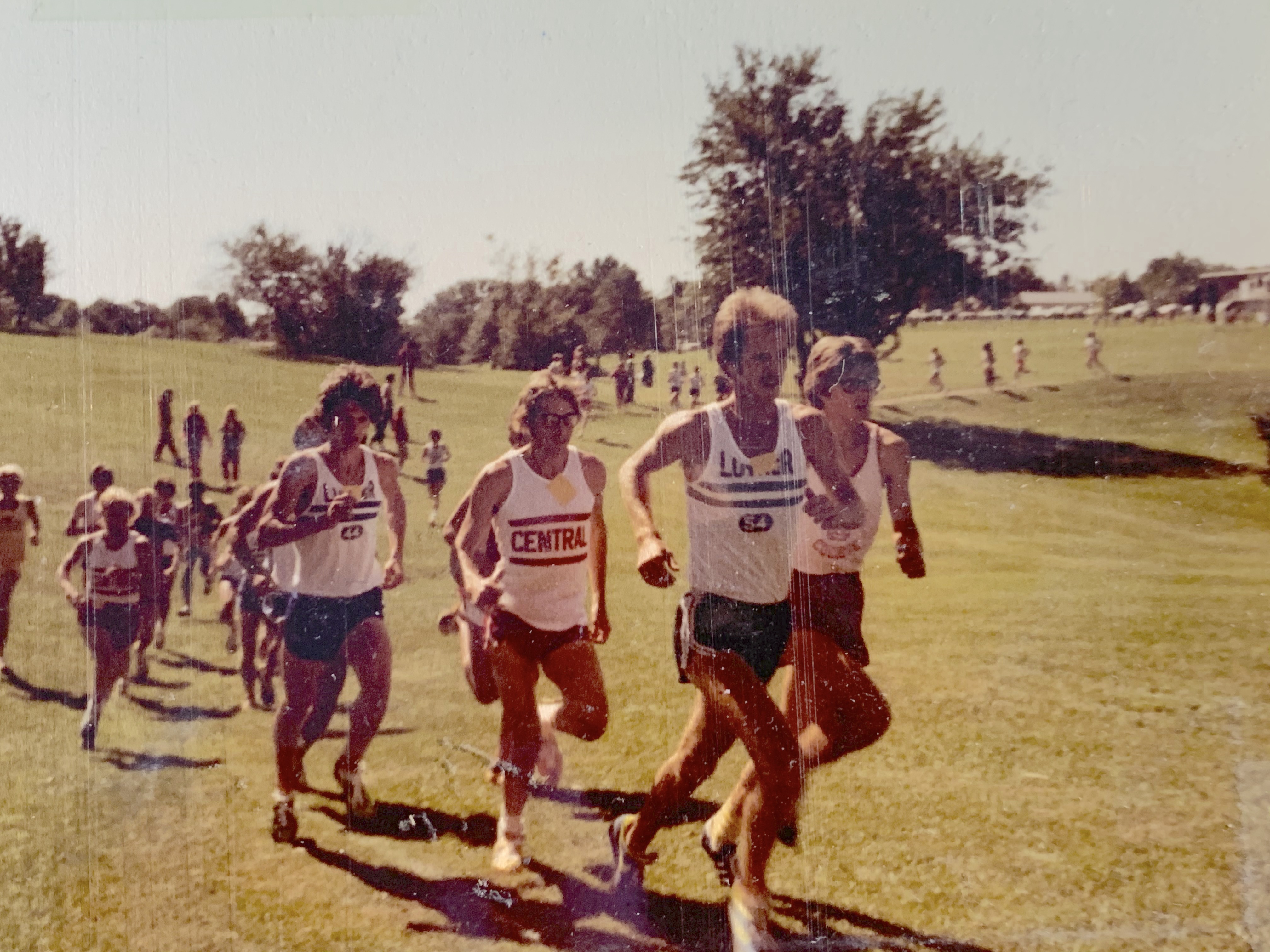
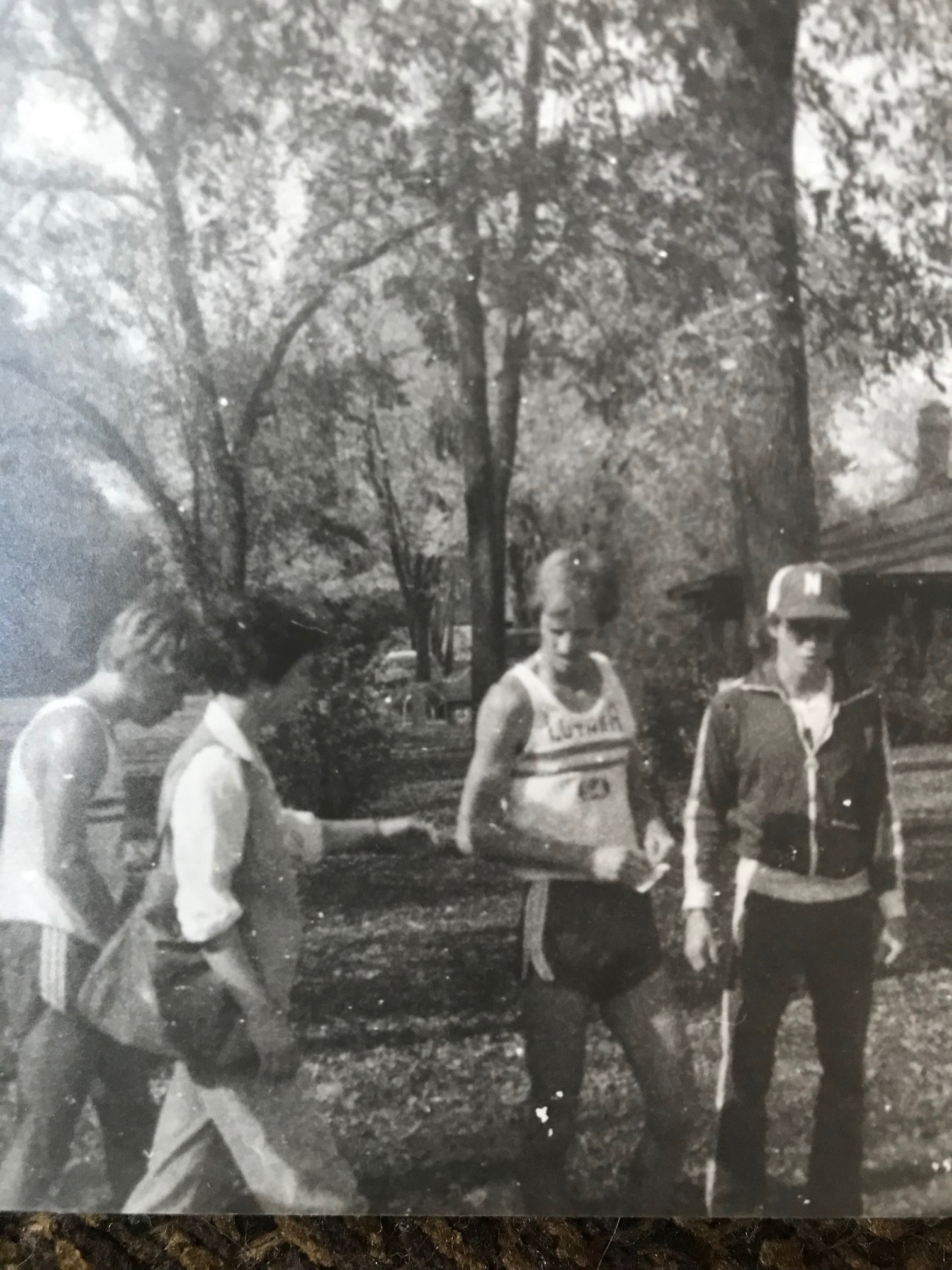
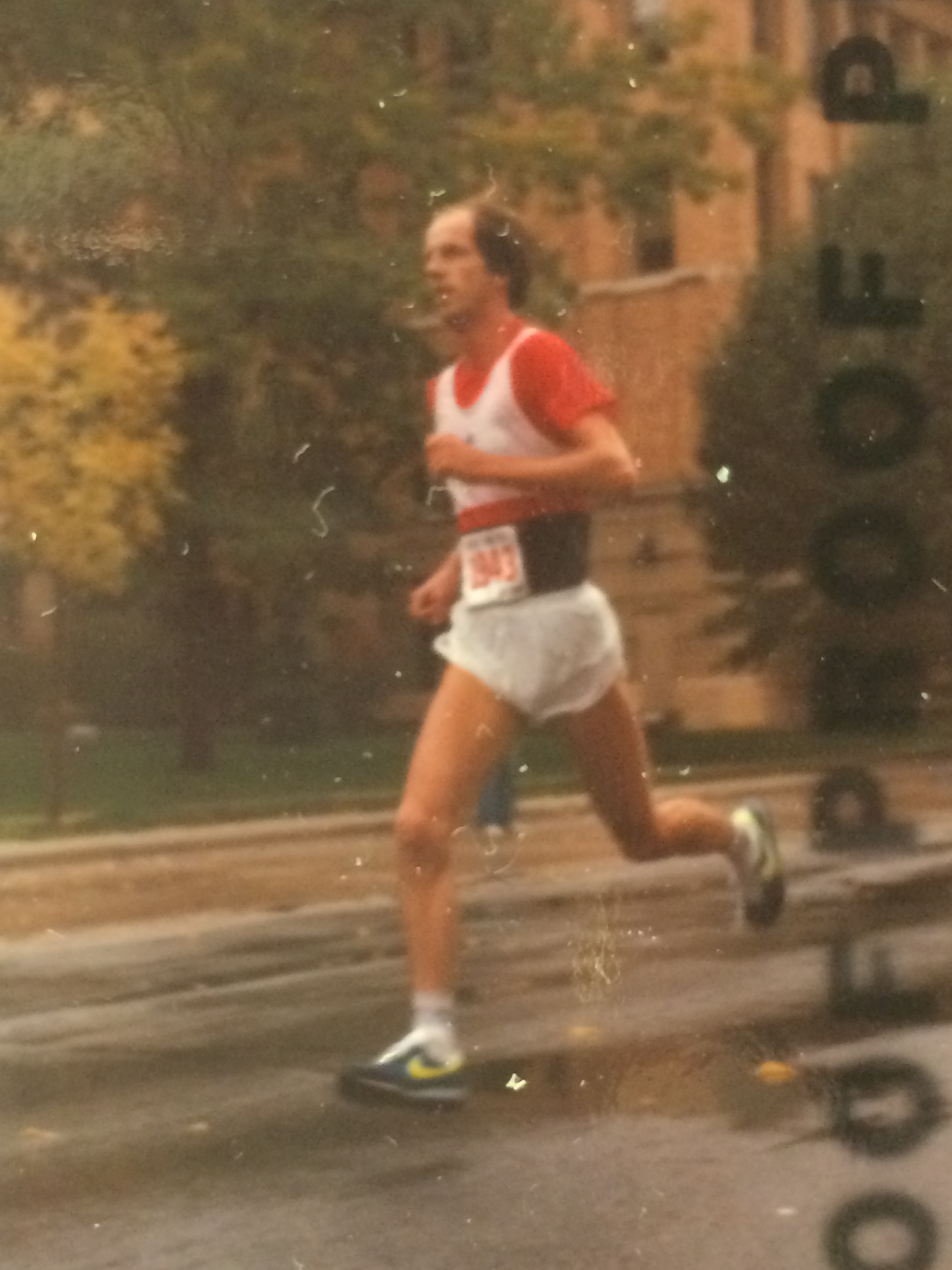
Racing on the Grinnell, Iowa golf course.

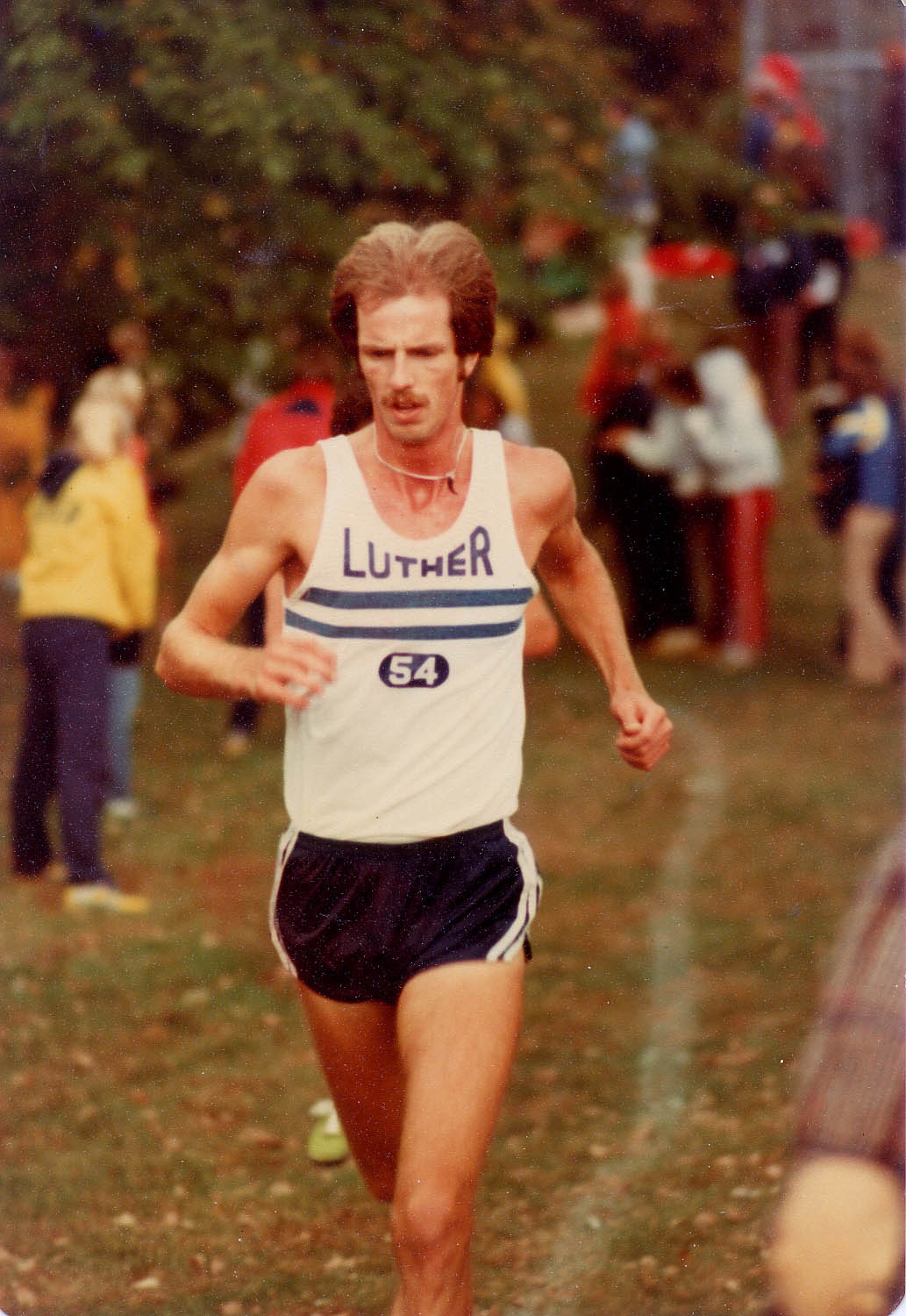
Years later as a high school and college cross country runner, I raced many times on golf courses throughout the Midwest. For four years in college we raced at a golf club in Grinnell, Iowa. That rolling landscape made for challenging racing. We ran down the fairways in our cleats and Nike waffles, and I get the greenskeeper was not too thrilled at some of the marks we left behind.

Of course, those footprints were no worse than divots left behind by golfers. The etiquette on any course is to replace a divot either with the chunk of turf you tore up or a dose of seeded sand so that grass can grow back again where your golf club removed it.

No carts allowed

Getting ready to play a round of golf and preparing to race your guts out on a five-mile cross country course are two massively different things. The amount of effort to play golf is minimal, especially when using a cart to get around the course. That’s why professional players aren’t allowed to use golf carts in tournament play. Caddies carry their bags and the players must walk.

A pro-level player named Casey Martin once sued the PGA to be allowed to ride a cart during tournament play. That lawsuit failed. A 2013 story in USA Today detailed the fact that even when Martin became a golf coach, he was not allowed to ride a cart on the golf course.

Casey Martin never thought his use of a golf cart would be an issue again.

“Martin, born with a debilitating birth defect in his right leg that makes walking difficult, sued the PGA Tour in 2001 for the right to ride when he played in Tour events, citing the Americans with Disabilities Act. He won. Twelve years later, he’s the golf coach at the University of Oregon, and the issue has resurfaced.

Martin arrived Monday at a U.S. Junior Amateur qualifier in Oceanside, Calif., expecting to ride in a cart as he followed a couple of prospective recruits around the course.

He said he cleared his plan beforehand with tournament chairman Matt Pawlak. But after five or six holes, Martin says he was stopped and told the U.S. Golf Association had found out about the cart and it was not allowed. Because Martin was officially a spectator, USGA rules did not permit him to use a cart. The controversy was first reported by GolfWeek.”

Rules matter

That’s how the game of golf approaches its principles. Rules matter. Etiquette matters. And while I’ve had opportunity to sort of “breach” those rules in my lifetime, I still respect the fact that rules exist for a reason. That is why it disturbs me to see people who flaunt those rules for no other reason than the fact that they can.

A year into the Trump presidency, video emerged that showed Donald Trump driving his golf cart on the greens at a course that he owns. Some pundits rushed to justify his actions with the claim, “Well, he owns the course! He can do what he wants!”

But there’s more than arrogance at work. Apparently Trump doesn’t like to walk on the golf course because he believe it wears him out. His belief is that people are given a certain amount of battery life and using it to walk around golf course could in fact shorten his life.

So why golf at all? Doesn’t swinging a club use a certain amount of energy too?

Hypocrisy afoot

The fact of the matter is that in everything he does in life, Trump behaves like a selfish hypocrite. He complained for years about the amount of time President Obama spent playing golf, then massively exceeeded those totals when he became President.

During the early phases of the now-defunct Trump presidency, a Sports Illustrated golf writer named Rick Reilly reported that he known Trump for thirty years and noted that Donald Trump cheats to win. He even wrote a book about it titled Commander In Cheat: How Golf Explains Donald Trump.

A Guardian article about the book contained this passage: “Donald Trump is the worst cheat ever and he doesn’t care who knows,” Rick Reilly says as he describes a man he has known for 30 years. “I always say golf is like bicycle shorts. It reveals a lot about a man. And golf reveals a lot of ugliness in this president.”

Ugly behavior

Could this guy hack running even one lap around a golf course? Not likely.

Now all that ugliness and hypocrisy is playing out in all-new ways as results point to a Trump loss and a Biden win in the presidential election. Those results are real, and the rules that govern elections do matter. Trump’s attempts to cheat the system by gutting the United States Post Office delivery system in an attempt to delay mail-in ballots still failed. He also resorted to claiming in advance that mail-in votes were fraudulent. Now he’s suing states all across the nation in whining attempts to delay certification of Biden as President. All these actions signify a failure in character and of conscience. Despite all his cheating and lying to steal the election, Donald Trump is the loser.

His despicable nature leaves zero reason to offer the outgoing Commander In Cheat any sympathy or respect. He should get the same treatment as any law-breaking, money-grubbing, tax-evading cheater, and be prosecuted accordingly.

At the very least, he should be made to pay for the crime of driving on the golf greens. A suitable punishment for this abuse of power and attempts to cheat the system would be to make Trump run laps around his own golf course. Treat him as any tough 7th-grade gym teacher would. Run his ass into the ground to teach this bully and brute a lesson. Make him spews his McDonald’s hamburgers all over the green grass. Teach him a lesson that he’ll never forget. And if he dies in the process, then we can all agree that his life battery just sucked. Perhaps if he was not such a lazy bastard and did some actual exercise to recharge his battery once in a while, it wouldn’t be so weak.

As for the near-term, it’s Tough luck, Tough boy. Your cheating luck just ran out.
Posted in competition, cross country, running | Tagged , , , , , , | Leave a comment

A good deal underfoot

The first set of running orthotics that I purchased in the early 1990s were fitted and designed by Dr. John Durkin, who served as a podiatrist to world-class runners such as Sebastian Coe, Craig Virgin and Jim Spivey. The inserts he created helped me overcome a persistent case of chondromalacia, a wearing down of the cartilage under the patella due to misalignment of the kneecap due to musculoskeletal imbalance.

I wore those inserts for years in both my running and regular shoes. They got quite stinky. I once blanched in embarrassment while working in a close office situation realizing it was my feet that smelled so bad.

In 1993 I ordered another pair of orthotics through my insurance plan and badgered the hapless podiatrist to adjust them repeatedly to my liking. My knee still hurt while wearing them and I blamed him for the incorrect orthotic prescription. Actually it was weakness of my hamstrings and quadriceps that likely caused the problem. At the same time, I begged my family physician to let me see a physical therapist during that period but he insisted that such treatments were “just fluff,” and refused to give me a referral to see the PT. Such is life under the thumb of an HMO plan when your regular doctor has a set of fixed beliefs about something.

Only years later when that same doctor tore a ligament and had to do physical therapy himself for recovery did he admit that PT had value. Too bad his revelation came to fruition after I’d just torn my ACL playing soccer.

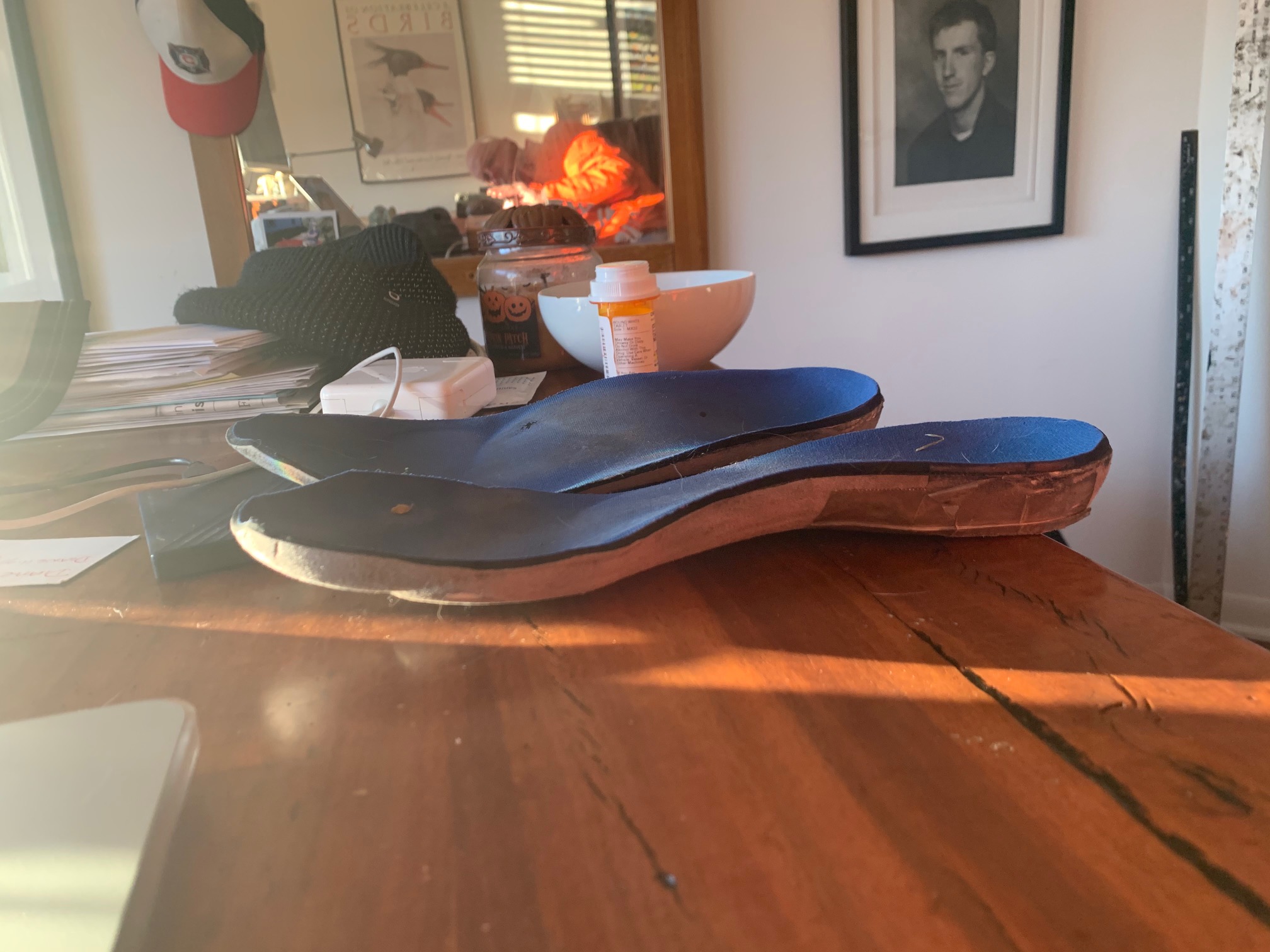
That said, I persisted wearing the same set of weak-ass orthotics all the way through 2009 when a podiatrist I met at a running trail almost barfed upon looking at them. She prescribed another set of true running orthotics that worked quite well for many years. There was just one problem with those orthotics: they were thick and heavy. I grew to hate them for that reason.

The thick orthotics.

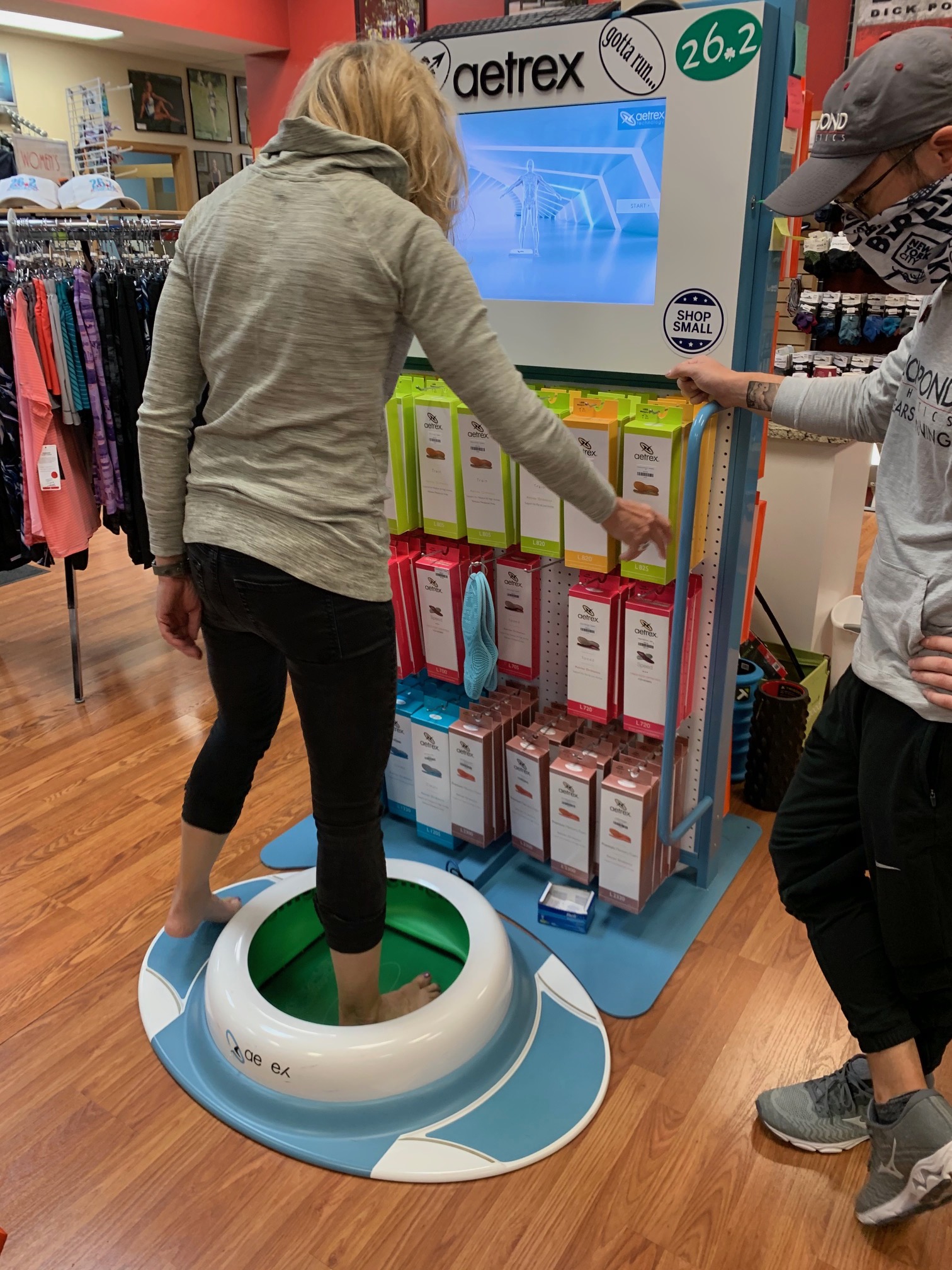
That is why I’m writing this blog today. Just over a year ago, I visited my favorite local running store, Dick Pond Athletics, to check out an alternative set of orthotics. I’d seen a machine in the store that measures your biomechanical needs and prescribes a set of pre-made or 3D printed orthotics. The concept of those 3D inserts fascinated me.

I reasoned the same principles were at work and technology is making all sorts of advances in this world. These days when you visit the dentist there are 3D cameras that create instant images of your gums and teeth. An optometrist that I’ve visited uses a a reactive focusing mechanism to determine your prescription. Why shouldn’t technology solve the orthotics question of foot pressure and balance as well?

The staff at Dick Pond ran me through the paces of standing in places where the biometrics could be taken and stored. They gave me a set of orthotics to try out, two pairs actually, and I was instantly impressed. They provided just the right amount of support and were about 1/4 the weight of my previous set of orthotics. A set costs between $60-$70 and it is recommended by the store that runners get perhaps two sets a year. That’s still far less expensive than the cost of a podiatry visit and orthotics that run between $400 and $1000. I’m telling you, the aetrex inserts work as well or better than the big-ass orthotics I’d been wearing.

That’s no slam on podiatrists or pedorthists. For many people, their services will likely still be needed, just as physical therapy is needed. All I’m saying is that I am running as far and fast (and often faster) with this new solution as all previous inserts. Results count in my book. I wear my original set in my regular shoes. If they get funky after a few weeks, I spray them with Febreze. But largely, they don’t stink unless they get soaked from dew or some other maltreatment on my part. I stick them in hiking boots for walks in the woods, wear them discreetly in dress shoes to keep my feet and knees from hurting, and like that they aren’t clunky, hard or uncomfortable like some orthotics.

My wife Sue steps into the machine one foot at a time at first, then both feet.

This past month my wife Sue tried out the process and received a set of orthotics to replace her much bulkier inserts as well. At the same time, she found a sweet pair of Nike Pegasus on sale in her size, and now runs with a much lighter stride as a result.

The company that we both favor for shoe inserts is aetrex. They have a 30-day comfort guarantee. You’re not obligated if it doesn’t work for you. I ran all year alternating a set of Brooks Adrenalines and NB 880s with the aetrex inserts. I just bought a new set of inserts last month.

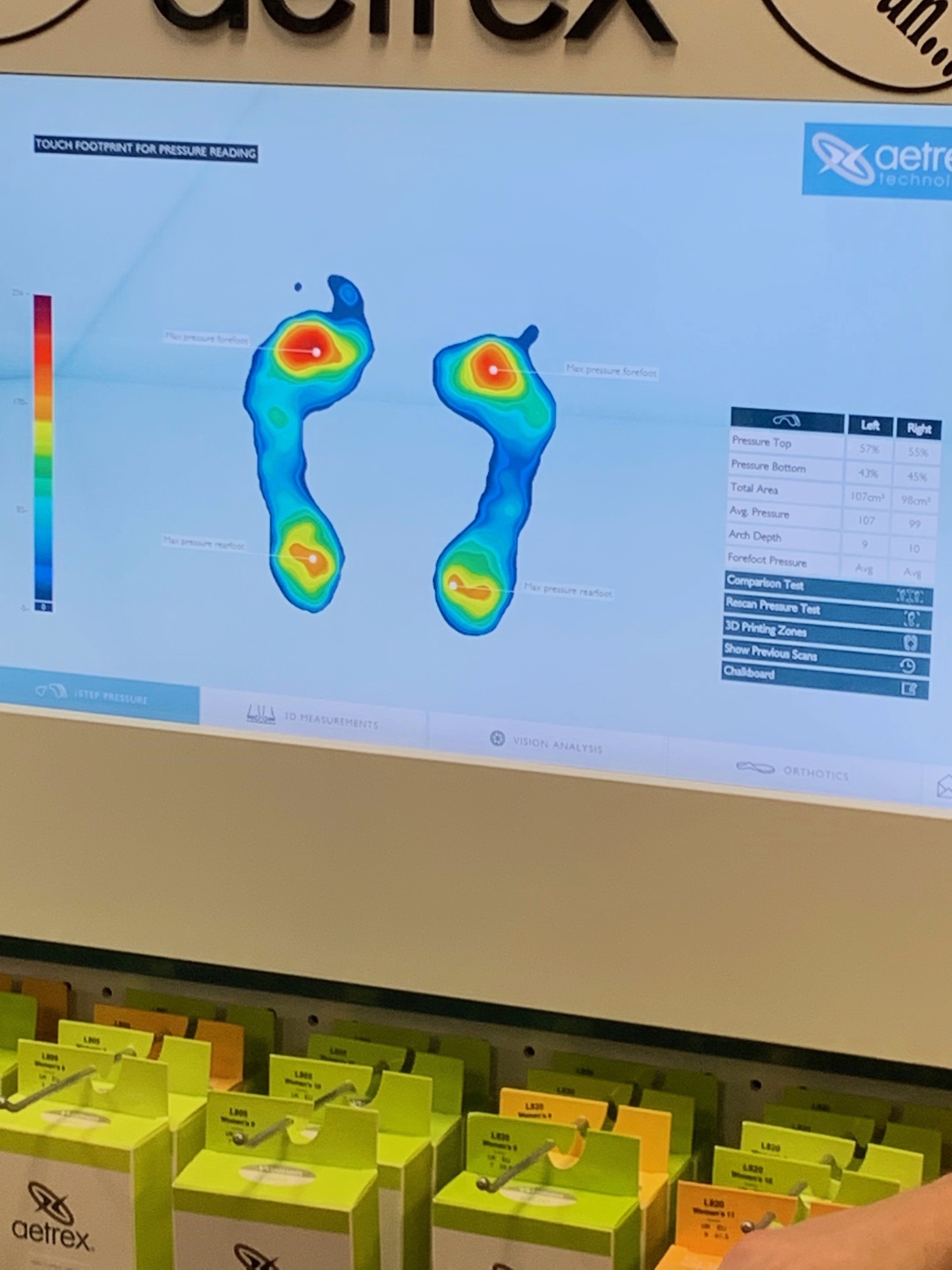
aetrex readouts show where the pressure points are. Customers get an emailed readout.

If you’re struggling with foot, ankle, knee or hip pain, I highly recommend checking out the aetrex system. You can find a store that uses it through the aetrex website Store Locator. It proved a winner for me. My mileage is up, as is my average pace. I competed in several races this year, including a Half Ironman wearing these gadgets and love that my feet don’t feel like anvils at the bottom of my legs. After your fitting, you receive a complete printout of data on your foot prescription. All I can say is that technology is really great when it works. And it does.

Posted in running | Tagged , , , , | Leave a comment

Living with unfinished business

As a coach I worked with boys and girls teams for more than ten years. I wish I’d played more as an adult while coaching. It would have made me a better resource. But we did have some fun.

After ten years of coaching soccer with my two children, I was invited to join a men’s team playing indoor at several arenas. The first few games were an absolute shock, as my body was not accustomed to the full-out sprinting and stops and starts of soccer. My heart rate rose quickly and I was often thankful to come off the field after a few minutes.

That was not like me. In all the years I’d played sports my strength was always speed and endurance. After a season of indoor soccer, I did improve in anaerobic conditioning. At one point while playing in an evening pickup match one of the guys in the box turned to me and asked, “How old are you again?”

I told him, “Forty-five.” He replied, “You don’t look like it. You still have speed.”

Unfortunately, that speed turned into a liability in the early 2000s when I came running after a loose ball, leapt over a fallen player, planted my left foot in soccer cleats and went to turn. My knee collapsed and I came tumbling down. I’d torn an ACL.

Turn of misfortune

That was an injury I’d never considered possible in my life. Growing up as an athlete, I played so many games of ballistic sports in basketball, soccer, football, baseball, tennis that I never dreamed the knee would come apart. I once heard a former Chicago Bear and football analyst Tom Thayer say, “ACL tears are often a fatigue problem. When the muscles wear out, the support isn’t there.” As one ages, it is also a strength versus torque issue. Joints and connective tissue lose flexibility as the years pile up. That’s what happened to me.

I did rehab my ACL tear and return to playing soccer. The orthopedic surgeon used a cadaver part that I named Jake. Sadly, I also tore Jake playing soccer two years after the surgery. It probably would have happened one way or another.

My daughter played soccer as well. One of my favorite aspects of watching her play was seeing her run down opponents in the open field. Should could fly when she wanted to.

So I live with fun memories of playing soccer as an adult, but those days are definitely over. I loved those evening games. The excitement of the contest. The opportunity to contribute. It was a blast.

I wasn’t the star of the team or the principle goal-scorer by any measure. My contributions were more valuable on the defensive side, where I typically guarded the top scorer on the opposite team. I took pride in trying to shut down the best players.

From that position, my job was to move the ball upfield and deliver it to one of our forwards. One of my favorite moments during all my years of playing involved a stolen pass in the backfield… that I turned upfield and sent into a curving pass that rolled right to the foot of our left forward. It only took him one step to strike the ball for a goal. It happened so smoothly that the feeling was satisfaction beyond measure.

That’s the part of soccer I loved most. The rhythm. The flow. The creativity.

I did have play forward outdoors, but only for half a season, because that’s when I tore the ACL the second time. It was a muddy Sunday morning after a dry spell. The soccer field was close-cut grass, level and greasy in consistency. We only had eight guys for the match and I was getting really tired playing center forward because no one else on the team could keep running. My distance running fitness did come in handy now and then.

We were losing 6-0 by halftime and I was frustrated and desperately eager to score because the other team was acting like assholes. The Mink in me emerged, and I took off from a rare stolen pass on our side and received the ball from a teammate at the top of the box. I planted my left leg, turned to shoot and was struck from the side by a clumsily sliding opponent. That was an asshole move too. I felt the knee go “Snick!” and that was that. The cadaver ACL was gone.

Transcendent moment

I prefer to dwell on a moment that was far more transcendent. We were playing a team composed of English guys and they were superior in skill. Somehow we stuck with them the whole match. The game was tied 3-3 with just a minute or two to go. A ball popped loose to me in the backfield and I looked up the side of the pitch. It was all green. There was no one to stop me if I moved fast. At full tilt I took off dribbling down the field with a defender trying to catch up as I moved just past the opponents goal box at the far right side of the field. Without looking up, I swept my right foot through the ball and it disappeared like magic into the near upper corner of the goal box. GOAL!!!

Our team erupted in cheers. At that moment the opposing coach, a crusty old English gentleman with a gray mustache, came running up to me with both fists clenched, then he extended a robust handshake. “Nice strike on the ball!” He exlaimed. “You won’t be sleepin’ tonight!”

He was so right. As I arrived home it was past ten o’clock p.m. I stripped down, shaking the black rubber filings from the soccer field out of my shorts and ass crack. I stood in the warm water and took a shower. That goal kept racing through my mind. I was still so excited as I lay down in bed that the feeling of that strike kept playing on repeat. Over and over again. My heart rate was high from all the late-evening exertion. So I just rested there with that Englishman’s words running through my head. “Nice strike on the ball!” I can still see that shot to this day. And I can still hear his words.

That’s the best kind of unfinished business of all.

Posted in aging, running | Tagged , , , , , , , , , , | Leave a comment

Hard effort feels the same at every age

When you get the bright idea to “go hard” on a given day, go for it once in a while!

Our Sunday morning run yesterday consisted of seven miles from North Aurora up to Batavia and back. Sue had a modest tempo run planned after the previous day’s 40m time trial and 10K brick run on Saturday. I rode 32 miles at 17.5 and was happy with that. It was windy as heck on the way out and a fun joyride on the way back.

At the turnaround point during our run on Sunday, we met up with a fellow triathlete and chatted for a quarter mile. Then I decided it would be good for me to put in some hard effort on the way back.

Unchained melody

If taking off on a whim like that seems a bit haphazard in terms of an overall plan, it’s because I train mostly by feel these days. Senior athletes like me need the flexibility to run hard on days that we feel good and take it easier based on the messages we’re getting back from our bodies day to day.

The days of mapping out 70-mile running weeks and hitting those numbers come thick-or-thin are gone. That’s fine by me. I don’t really miss the obligatory aspects of training. I’m not sure my testosterone levels sustain it these days.

All that horndog sexual and physical energy in my teens and twenties, combined with the need to prove myself on a daily/weekly/monthly/yearly basis has shifted to a more appreciative mode of training. Now I run hard when I feel like it.

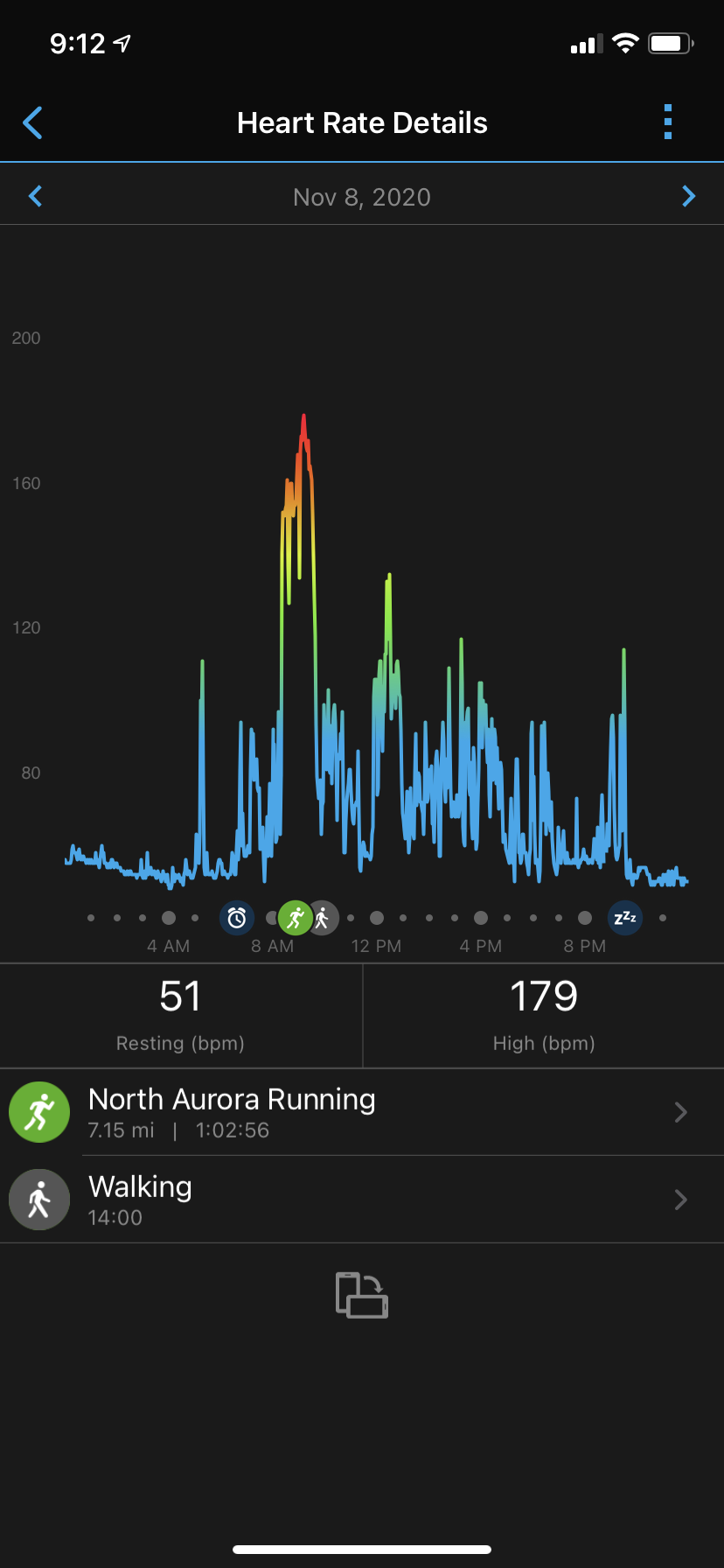
Yesterday that meant three consecutive sub-8:00 miles. I ran 7:48, 7:57 and 7:47, but didn’t have that much more speed at hand, to be honest. Earlier this summer I ran a 22:00 5K on a bike path and that’s as fast as I got this year.

Hard effort and Red Zone games

That’s seven minutes slower than my all-time best, but here’s the funny thing. Even at these slower paces, the sensation of a hard effort still feels the same. Yesterday while humming along I thought back to all the races I’ve run over the years and the feeling of running at the edge of my aerobic capacity has always felt the same. I was playing Red Zone games.

My heart rate reached 178 at its peak, somewhere in the middle of the second hard mile. That’s where the breathing got tough. We all know that sensation. To manage that Red Zone challenged, I shortened and smoothed out the stride, increased the breathing rate, took it deeper into my belly and regained the oxygen needed to keep up the pace. It worked. That’s associative compensation.

Racing along

As a person that has been doing this stuff for decades, I still find it fun (if no less uncomfortable) to run at the edge of my abilities. It’s also fun to actually race when the opportunity comes along.

That’s the main point of all this. Testing ourselves is what this endurance stuff is all about. No one says that has to be done on any sort of schedule to make it have value.

You should to that too. Take off on a bender once in a while when you’re feeling good. Make the effort hard, and embrace the moment. Don’t worry if you can’t go on forever. No one can. Hard effort feels the same at every age, and age itself disappears when you let it go. That’s true no matter how many years you do or don’t have under your belt.

Getting results

As for results, my casual approach to training works for me. This past summer I completed two Olympic triathlons and my first-ever Half Ironman 70.3. My Olympic was just over three hours and my Half Ironman in the 6:15-6:20 range. I was self-timing and had a water bottle cage fly off in the last ten miles of the bike, so there was some play in there in terms of time. My main goal was to finish.

Isn’t that fun?

Posted in 10K, 5K, aging, aging is not for the weak of heart, competition, cycling, cycling the midwest, triathlete, triathlon | Leave a comment

Mentoring other athletes and building community

Mentoring and collaborating with other athletes builds a sense of community and a support network.

This morning I finally made it back to the swimming pool after weeks away due to work commitments and post-triathlon season chillaxing.

I struck up a conversation with a young man that had just finishing swimming as well. He was quite good in the pool, and I noted as much. He told me that he’s not even in swim season right now, but finishing up an abbreviated cross country season with a meet down in Peoria this weekend.

“It’s not a state meet, they’re not having that,” he told me. “We’ll be running in flights, with the sixth and seventh guys in a race, then the fourth and fifth, the second and third and finally the top guys.”

I didn’t bother asking him where he fit in that scheme. It mattered more that he was excite about the race. His build wasn’t a traditional cross country guy build. He was a bit thicker than that, but who is to judge how fast a runner can go based on mere looks? I can’t.

Multisport future

We talked some more about his swimming. He related a funny story about how his coach threw him into the 500 because there were no other spots to fit him into the meet, and he won. “So the coach went, ‘Huh…” he laughed. “Now I swim a bunch of other events too. But I’m working on my sprints.”

We both agreed that the 200 is a tough event. I mentioned that I swim mostly for triathlons, and he told me, “I do those too. They’re good for scholarships.”

He’s a junior in high school now and just starting to look at colleges. I shared that having a solid swimming foundation is a real advantage in triathlon events of all distances. His running will also be a great gift for a multisport competitor. “Cycling is mostly just Time In The Saddle,” I advised. That’s pretty true. A guy that can swim and run as well as this young man can learn how to focus that power into the bike.

As we parted ways I shared that I know the coach at a local college where triathlon is now an intercollegiate sport. I gave him the name and shared that he should reach out. Last summer I trained with some college kids from that program and they were really athletes of fine character.

Out in the parking lot I saw him heading toward his car and called out, “What kind of running shoes do you like?”

“Saucony,” he replied.

“Good shoes,” I told him.

“Thanks for talking with me,” he added.

I smiled, waved and said, “Good luck this weekend!”

It’s a habit I have, talking to young athletes and old. It’s a great way to learn what motivates other and share a bit of encouragement. We should all mentor each other, when it comes down to it. That’s what the whole idea of community is all about.

Posted in college, cross country, cycling, running, swimming, tri-bikes, triathlete, triathlon, triathlons | Tagged , | 1 Comment

Glory Days: Does it matter what we’ve done in the past?

In case you’re not familiar with the term Glory Days, here’s a few lyrics from a Bruce Springsteen song of the same name:

I had a friend was a big baseball player
Back in high school
He could throw that speedball by you
Make you look like a fool boy
Saw him the other night at this roadside bar
I was walking in, he was walking out
We went back inside sat down had a few drinks
But all he kept talking about was

Glory days well they’ll pass you by
Glory days in the wink of a young girl’s eye
Glory days, glory days

All of us have personal histories, and there is a danger that comes with living in the past if we regard those experiences as better than the present. Voicing wistful regard for the Good Old Days is a form of emotional compensation, especially when life in the present isn’t exactly glorious. Lord knows not every moment of life is perfect.

We do not need to regard the past as either our ultimate level of achievement nor our enemy and something to be avoided. It is possible to learn important things about ourselves by taking a measured look at how things took place in days gone by––and learn from them.

Over the course of a lifetime

The days of yore, while competing at a hot national track meet in Michigan. I nearly died from what I originally thought was heat stroke. It turned out to be a case of food poisoning.

It is true that while we change as people over the course of a lifetime, an internal narrative forms within us. We believe certain things about ourselves depending on how we interpret events from the past.

For example, on an athletic level, I came to believe that I was not good at running in the heat following what seemed like a case of heat prostration in the wake of a steeplechase event during national meet held in high temperatures and humidity. Years later I ran on another hot day, I ran exceptionally well in a 10-mile road race. That led me to question the narrative I’d created in my head about that hot-weather race. Piecing together the events of the day, I suddenly recalled that we’d gone out to dinner at a Pizza Hut that night and had eaten an entire medium pizza on my own. Two hours later I got extremely sick and threw up twenty-seven times overnight. My roommate counted.

It was food poisoning, not heat that nearly killed me that night.

Dwelling on the past

An obsession with the Glory Days can happen with love and relationships as well. For a time after breaking up with a college girl that I really thought loved, I blamed myself for letting it happen. Then one day I was going through my running journal from that period and noticed a long series of comments over the period of a year and realized that in many respects, she’d been playing me against other men all along. It’s much too easy to vex and blame ourselves over the confusing world of love, family and friendships.

Well there’s a girl that lives up the block
Back in school she could turn all the boys’ heads
Sometimes on a Friday I’ll stop by
And have a few drinks after she put her kids to bed
Her and her husband Bobby well they split up
I guess it’s two years gone by now
We just sit around talking about the old times
She says when she feels like crying
She starts laughing thinking about

Glory days well they’ll pass you by

It matters what we’ve done in the past, because we really can learn from it. At the same time, I’ll admit that in this blog and others I mine quite a bit of material from the past, some of it from my so-called Glory Days. I believe that if you’re analytical rather than just wistful, the past reveals much valuable insight about who you really were, and who you are today.

Getting through it

In that spirit, I’ll share an anecdote that shows how much we can learn about ourselves from even the smallest incidents, good and bad.

During my junior year in college I competed well enough to land in the Top Five for most of the season. That meant I was a steady contributor to the team’s success. But when it came time for the conference meet, I experienced a first real bout with depression.

Earlier that summer, I’d worked in a job that was such a negative, physically and mentally unhealthy situation that it essentially caused a post-traumatic stress reaction. In combination with other events in life at the time, my brain and body were in a bad way. All that season I’d consistently run under 26:30 for five miles. Then I had a race where I ran 27:40 and was 14th man. I came back to run well again at 26:15 against a tough University of LaCrosse team, and was sixth man. But my moods were up and down. At conference, my nightmare of all races took place.

That late October afternoon proved dark and dismal. My mood was beyond dark as well. Nor did my body not want to cooperate in any way, shape or form. People that have never experienced a profound depressive episode might find it hard to understand how difficult it can be to perform in that state, but it’s as close to a living nightmare as I’ve ever experienced. You know those dreams where you’re trying to run faster and can’t? I lived that shit.

I ran 28:48, the worst race in my entire life. That put me in 25th place overall. I’d placed ninth in conference as a freshman and sophomore. I’d place ninth again as a senior.

Glory Days can follow difficult ones. The important thing to remember is that the past is not the sole definition of your present or future. We all are engaged in the continual process of becoming.

For many years, I allowed that single race to define my impression of that entire year of my life. What I’d forgotten along the way is that two weeks later at nationals I bounced back to race as our fifth man for a team that took eighth place in the country. The conditions were horrible, with on a course covered in 4″ of snow. Yet despite the horrid results of my depressive day at conference, I bounced back to help the team achieve something worthwhile. It set the stage for future success. That next year as a senior I ran second man for most of the year and helped lead the team to second place in the nation.

As I’ve aged and learned so much about life, and myself, it is those comebacks and periods of perseverance that mean more to me. Life is filled with more of those moments than most of us care to admit. We have to tune out the doubts, make up our minds to get through it, and find a way to make things right again. I encourage you to take a harder look at how you’ve defined yourself. Sometimes the hard truths produce more self-forgiveness than you might think.

That’s where the past can help us most. “I’ve done it before. I can do it again.”

Posted in aging, aging is not for the weak of heart, anxiety, Depression | Tagged , , , , | Leave a comment

The difficulties of life when your brain works differently

At an early age in life, I realized that somehow my brain worked differently than others. For one thing, I abhorred boredom. Still do. That’s why I write this blog and others on a daily basis. If I’m not doing something new or relatively creative every day, I get restless.

There are other facets to brain function that go along with a brain that works differently. In third grade, our teacher set up a reading contest in which our task was to plow through a catalog of SRA books that were color-coded by difficulty. The further you went along, the harder the reading got. I never had trouble reading, but again, I hated boring writing, especially if the subject didn’t interest me. It was anathema to me. When I didn’t like a story, there was no way I was about to suffer through it. So I stopped reading those damned SRA books.

Plus I didn’t like the colors.

The teacher measured our reading rate by having us make paper boats out of construction paper. These were fastened to the wall at a starting point above the blackboard. As the class read books, the boats moved around the room at whatever rate the kids completed the SRA sections.

Mine sat still. I would dutifully take those SRA books out of the box but sit at my desk doing nothing. Part of that resistance was emotional more than cognitive. My father had a practice of pushing and exasperating us at times with rounds of archly enforced demands and punishments. Being told that I had to read those SRA books was a demand that felt too close to my father’s driving words and criticism if I failed.

So I avoided the task at hand.

Teachers say what?

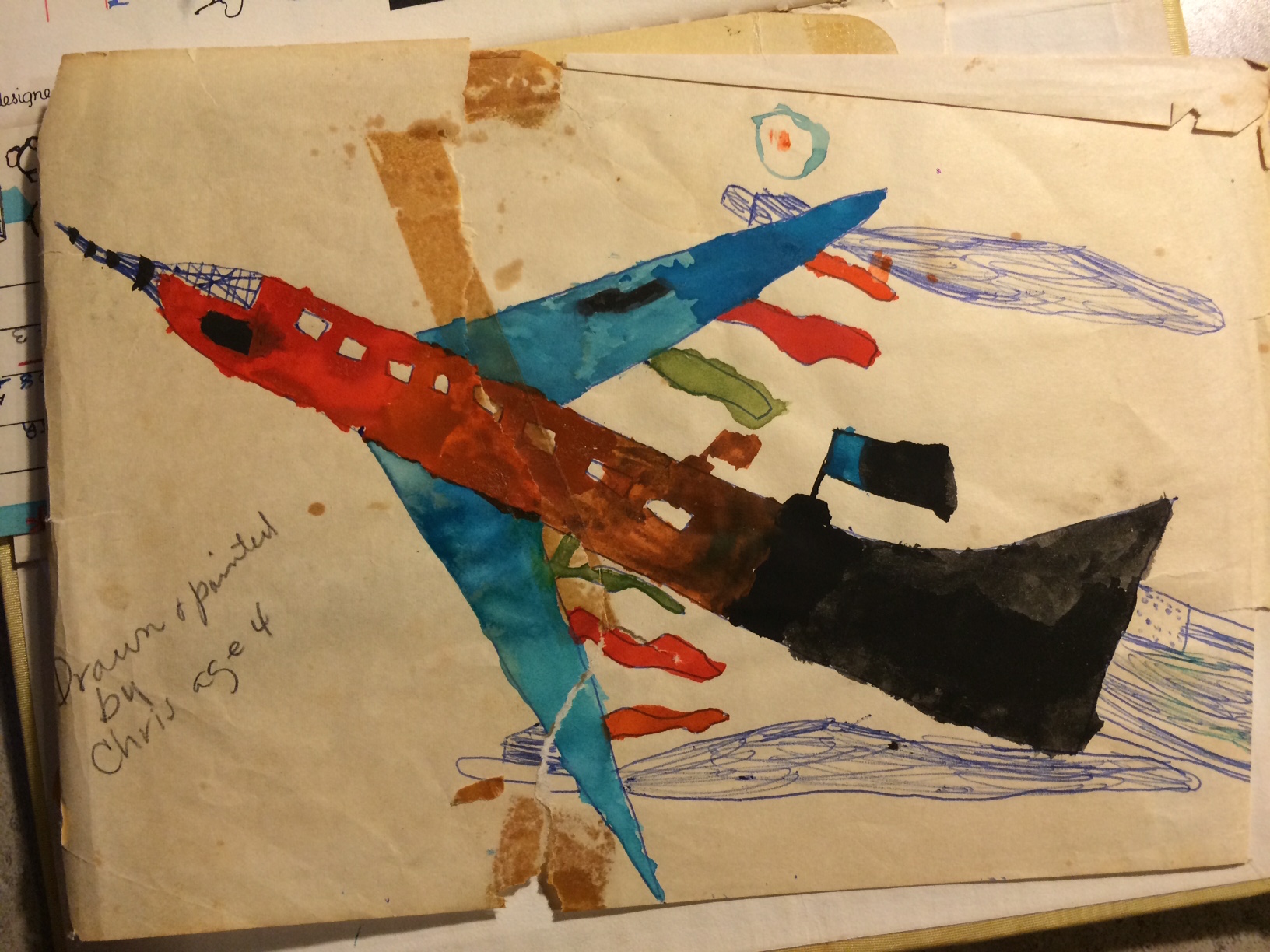
My first watercolor painting at age four.

One day I came back from recess to find my mother standing in the classroom with Mrs. Helm, my third-grade teacher, who’d also been my second-grade teacher. She liked our class so much she moved up a grade to have another year with her favorite students. I felt proud to be liked that way, but that didn’t mean there weren’t issues at hand.

Mrs. Helm thought she knew me well, and called my mother in for a conference to see what was going on with my reticence toward reading. When I walked into the room, Mrs. Helm directed me to address my mother. “Will you tell your mother why you don’t want to read?” she suggested.

I stood there a moment, took a glance around the room and gave my answer. “I’m waiting for the other boats to come around again,” I replied. “Then I’ll start reading.”

My mother suppressed a laugh, but Mrs. Helm was not amused. “You must catch up,” she told me. “Or you’ll get bad grades.”

I looked at my mother. She nodded somewhat seriously. But she was also an elementary school teacher, and knew that there was something more to the story than a kid that could not read. She took me to the library on a regular basis and I grabbed books off the shelves with an appetite for joy and knowledge. My mother just understood that I didn’t like drudgery, or being forced to do it.

Instead, she said the one thing that she knew could motivate me. “Chrissy, can you catch up?”

My mother knew me well. That was a challenge I could embrace. It called upon my competitive verve and a desire to succeed in the face of odds. That same instinct would later fuel my running career. I don’t think I’m alone in that respect. I’ve met many runners over the years driven by their own set of compensatory needs or outright demons. A runner is never truly alone with those in tow.

Playing ball

Age age fourteen, a baseball pitcher.

Later in the year with Mrs. Helm, she wanted the class to do a play based on some historical story we’d read about. Again, I found the subject boring and did not want to participate. She gave me an ultimatum: “Chris, I need you to stay in from recess to work on this play.”

Well, that requirement did not set well with me. I was keeping track of the number of home runs that I’d earned in our daily kickball games. A friend and I were leading the competition among all the kids who played. My goal was to tally one hundred homers, many of them by launching the playground ball over the swingset in center field. The feeling of catching that kickball in the sweet spot and watching it fly over the swingset was one of the best feelings in the entire world. I was not about to give that up to stay inside and do some stupid school play.

“No, I want to play kickball,” I told her.

“Okay, if that’s your choice. You don’t get to do either.” She made me sit inside the entire recess period with my head down on the desk. No looking up. That was my punishment. I could hear the sounds of others kids playing outside. I knew that I’d missed the chance to add to my home run lead. “That’s fine,” I resolved under my breath with my head down on my desk. “I’ll just kick more homers tomorrow.”

While most teachers in public schools struggled to motivate me, even my baseball coaches knew how to use motivational tactics during practice. At the age of ten, I was so much faster than the other kids on the team, and could run so much farther, that they’d make me do extra pushups (my weak spot) before being allowed to chase after the other ballplayers. I’d still catch them.

Looking back, I realize there were genuine attention disorders going on with some parts of my brain. Long before ADD or ADHD––or whatever you call it––was diagnosed with kids, I dealt with some sort of attention deficit disorder. I’ve taken to calling it Creative ADD. People of a creative nature need to learn in different ways because their minds work differently.

That’s why sports were so appealing to me. They offered a physical release of energy and a brand of mental stimulation that fueled better concentration. They also provided creative challenges and an opportunity to act in every second of play.”Depending on the sport, and I played nearly all of them in some form, baseball, basketball, soccer, football, wrestling, table tennis, court tennis, volleyball, the list goes on… there was also problem-solving involved; geometric calculations, math problems of time and distance, reading opponent body language and response and paying full attention in the moment and over the long term. Add in goal-setting, discipline and pain tolerance, and sports were and remain a constant source of affirmation, mental and physical stimulation.

And I still say I was right to want to go out to recess rather than stay inside and work on that foolish classroom play.

Outside-the-box thinker

As a perpetual “out-of-the-box” thinker that alternative capability has had its benefits and its costs. I recall several races where my inattention to course details actually cost me the victory. At the same time, the hyper-focus nature of creative ADD grants the ability to concentrate during intense interval workouts when pain is the preoccupying force at work in the body. If that seems counterintuitive, so be it.

I will not lie. My Creative ADD an outside-the-box thinking has cost me in some ways through my adult years. While many companies like to promote thinking “outside the box,” in practice it is seldom welcome or tolerated. When it comes to individual management of employees, especially those whose brains work differently, the instinct is to corral and control rather than encourage and reward alternative ideas and God Forbid, failing forward.

Granted, emotional intelligence enters the picture as well. People addicted to honesty and liberality are not always welcome in the workplace. Not with bosses insecure about their own management capabilities and shortcomings.

Compensation

That said, my early encounters with perceived injustice has motivated me to create opportunities for others. Drawing on those early experiences with the reading program in elementary school, I’ve always wanted to encourage other kids to read without turning it into a grind.

In the early 2000s, I conceived and developed a summer reading program that grew from 35 libraries and 50,000 kids in its first year to 175 libraries and 375,000 kids in communities all across Chicagoland. The program rewarded kids who read 10 books a Panera Bread free Kid’s Meal. At twenty books they earned a Culver’s ice cream cone. At thirty books every child completing the program received a coupon book containing free admissions to twenty seven cultural and entertainment opportunities. These included leading institutions such as the Shedd Aquarium, Brookfield Zoo, Art Institute of Chicago, several children’s museums, sports teams, a railroad museum and Wild West town, historical and nature parks, and more. The free admissions totaled $270 worth per child. At a completion rate of 75% (or 281,250 kids) that potential value equaled $75,937,500. That’s a whole lot better than handing out packs of pencils or a book mark.

One day, while meeting up with lines of people waiting to enter the Kane County Cougars ballpark on summer reading admission day, I saw a child sitting on a parking block reading a book. His mother looked at me and said, “I made him promise to finish his last book before we went in the gate.”

“Is that a good book?” I asked him. He looked up and smiled. “Yeah, I really like it.”

That made me smile. From early anguish good things can come.

Posted in anxiety, competition, running | Tagged , , , , , , , , | Leave a comment

Cold confessions on an autumn bike ride

Saddling up for a 3:30 ride on a late October day, I thought the gear I’d chosen would serve the purpose of keeping out the chill and the wind. It was fifty degrees outside, on the knot. During the ride, the temperature dropped. The wind picked up, then shifted directions so that I was riding back into a cold autumn breeze.

Moments like those bring out cold confessions, making you wonder why you’re out there at all. Glancing at my Garmin, the watch itself seemed to be frozen in time. I’d forgotten to start it up again at the first traffic light at 1.94 miles.

By that point, I’d already covered six miles. It wasn’t worth picking up a partial ride. I turned the whole thing off. Now I was riding for the sheer act of doing it. No Garmin reward when I got home. No pretty map of the route. No pace per mile average.

That said, my legs still felt good. The wind creeping up the jacket sleeves and turning my hands numb still wasn’t that bad. I’d worn cycling gloves but nothing over my bare fingers. No worries. I’d felt worse many times before.

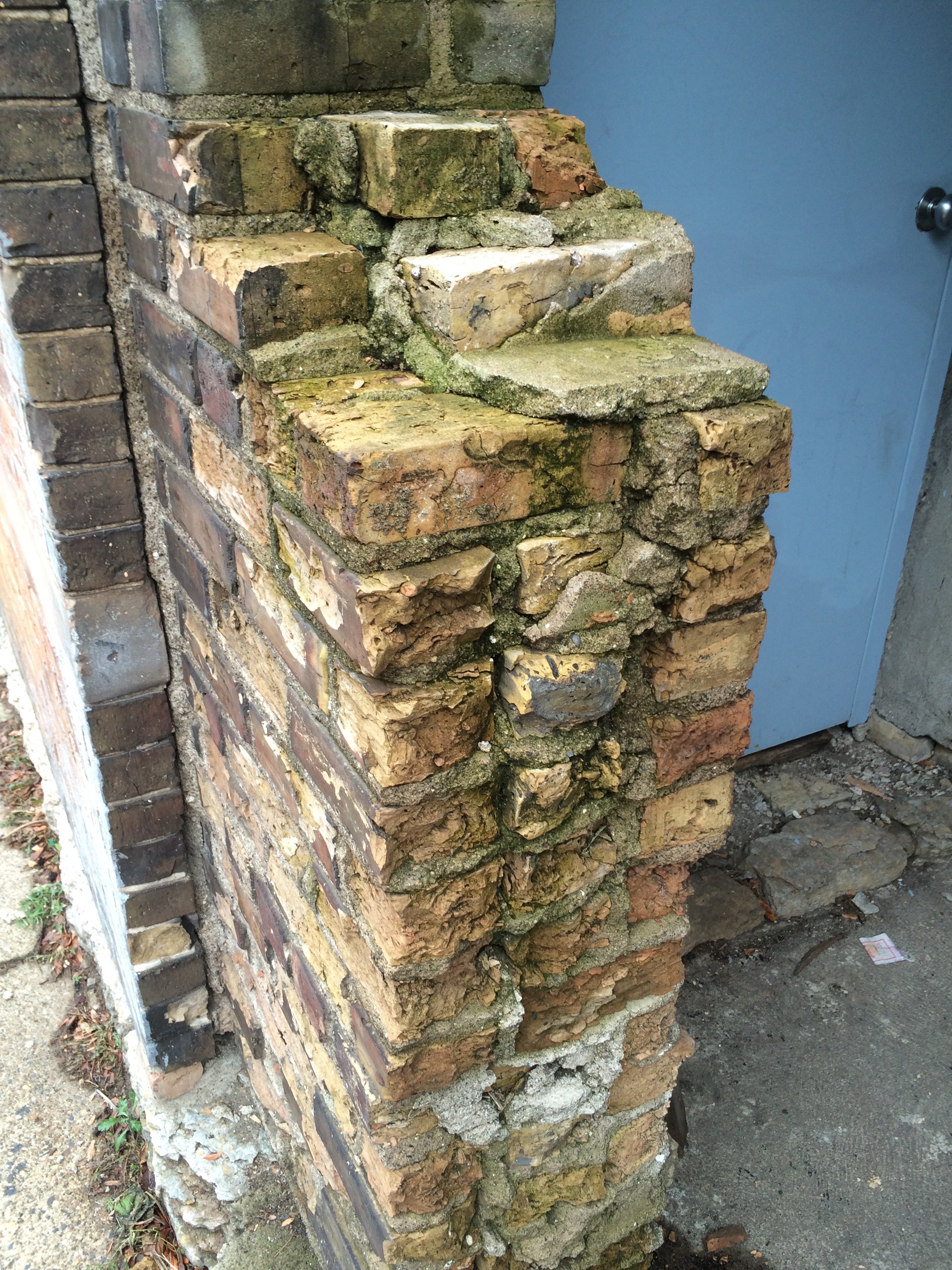
Not the same brick pillar. But you get the picture.

My ride took me past the little brick bungalow where I lived for ten years in Geneva. I saw that the brick pillars I’d repaired back in 1995 were still holding together. That was twenty-five years ago. We all try to do things that stand as a testament to our worth in this world. Some of them go unrecognized. That’s okay.

The same goes for the things that we attempt that don’t go so well. They stand as cold confessions in our past. Inside that same house are a number of projects that I patched together with much determination but little know-how. Most of them worked out in the end. Some are hidden. The wallboard compound used to rebuild a bathroom wall. The layer of pink paint on the dining room wall.

These are cold confessions. Unadorned and real. One feels the same way on a bike on a cold autumn day. It’s just you and whatever you’re wearing. If it’s not enough, so be it. One still needs to get home. We all need to get home.

Posted in cycling, cycling the midwest, Depression | Tagged , , , , | Leave a comment

Winning means different things to different people

On a chilly October day in October, 1983, I stood on the starting line of a race in downtown Oak Park, Illinois. It was fifty degrees outside. Rain had fallen the night before and the clouds still formed a low, gray ceiling above the city.

A few weeks before, I’d finished first in a 10K race called Run For the Money. It was sponsored by a bank of some sort. There was no cash prize. I considered that false advertising. After the race, one of the local runners that I’d beaten in the race introduced himself to me and explained that my finishing time of 31:42 was actually misleading. “The course is 200 meters long,” he explained. “We measured it ourselves.”

So that was more false advertising. Perhaps I’d just run a 31:10 10K? Or faster? One never knows in such circumstances.

A few weeks later at the starting line of the Frank Lloyd Wright 10K in Oak Park, my confidence was high and I was eager to run. The gun went off and once again, I led from start to finish and completed the race in 32:00, just twenty seconds behind the course record set by a guy named Tom Mountain.

I’d win the same event a year later after a year of competition in which I ran 24 races, setting personal records at every distance ranging from 5k (14:45) to 25K (1:24). My 10K PR finally did drop to 31:10, but I placed second in that race anyway.

That’s how tough it was to win back in those days. That’s why winning actually meant something. You had to earn it through hard training, race-day concentration and mental toughness.

That’s also why I’ve always held high standards about what it means to win. Because along the way to many wins, there’s also a fair share of so-called “losing” to do. If we’re smart, we learn from that.

Just as importantly, if you happen to win and then turn around and malign everyone else as losers, does that make you the ultimate winner? No, that makes you a miserable jerk.

If you also happen to be so fatally insecure that you feel like you’re winning only when criticizing or bullying others, that makes you an absolute asshole. And we all know who we’re talking about by now. Isn’t that indicative that there’s a problem afoot? That what some people call “so much winning” isn’t actually winning at all?

There’s also a pathological problem among people who feel like cheering on that type of “winning” makes them a winner too. Those are the actually the worst kind of losers in this world: the vicarious and vicious.

So in order to draw some clean lines around what it means to win, perhaps it helps to share a pair of cogent definitions of the word WIN. Perhaps that can help people understand what the word really means.

To win means: to reach by expenditure of effort.

To win means: to make friendly or favorable to oneself or to one’s cause 

So let us be clear: claiming a vicarious victory by supporting a person (or a team, or a party) that behaves like a total asshole and treats everyone like “losers” does not deserve support, much less respect.

For example, it is not “winning” as a supposed Commander In Chief to show derision toward military veterans, Gold Star familiies and prisoners of war, brand service men and women “losers” and “suckers,” and call generals and heads of our military forces “dopes and babies.”

He also insults and harasses women, supports racist tropes and groups and conspiracy theorists, as well as lies and downplayed the threat of a dangerous and deadly pandemic. He does it all because the only thing he claims to care about is “winning.”

In Trumpian terms, that is short for “he only cares about himself.”

That is the hallmark of a sociopathic loser. His supporters own that moniker as well. Everyone who supports Trump is behaving like the losers and suckers that he assumes that they are. It’s so simple to see. And so hard to avoid.

Posted in 10K, 13.1, 5K, competition, running | Tagged , , , , , , , , | Leave a comment

It’s just bodies, sex and all that

Some people seem to be born with knowledge of what sex is all about. During those formative years in which sex first entered the picture, so to speak, it seemed so tantalizing and out of reach that it vexed me terribly.

Perhaps the first sexual escapade of my life was up in a tall hemlock tree with a neighbor girl named Cathy. We climbed up there together one summer afternoon and showed each other our genitals. Even at the age of six years old, I got an instant erection. “Why does it do that?” she asked. “I guess it gets embarrassed,” I told her.

Fifteen years later, as a senior in college, I was dating a woman with whom I had fallen deeply in love. She bought me a pair of silky running shorts during cross country season. We went for a run and within a mile the state of excitement in my pants was apparent. We both stopped and laughed. That was the only time I ever got an erection while running.

Most of the time, the state of a man’s genitals during running is something entirely different than erect. The movie Juno describe the bouncing genitals in the shorts of distance running as “pork swords.”

It would have been helpful early in life to realize that girls/women knew all too well what was going on down there. But we all find out about sex and genitals at our own rate. Unfortunately for Bleeker and Juno, they played it a little fast and she wound up pregnant. This scene shows the nature of their true relationship, outside the sex that is, and it sustains them through their teenage challenges.

I wonderfully recall being a freshman cross country runner at little Kaneland High School out in the cornfields of Illinois. During a dance in the cafeteria, I somehow lucked into the arms of a cheerleader named Joanie whose rock hard body and thighs were mine for the night. She held me tight through many songs and when it was all over for the evening, I stood in dazed wonder at my physical and emotional good fortune. She kissed me quickly and vanished out the door. Thank God the lights were low because I discovered on the way home that I’d been excited enough through all that thigh-wrap dancing to spot the front of my gray jeans. If my friends had seen that, I might never have lived it down.

Despite that intense experience, I still did not understand much about the wonders of the female body. With no sisters to depend upon for advice, or to stumble upon in a half-dressed state, the female anatomy remained a cartoon cutout in my mind. Even tracing the pictures in my father’s Playboy magazines when I was eight or nine years old didn’t help me figure all that much about the female body. I was intensely curious, yet left with the mysterious.

Self portrait, 1973.

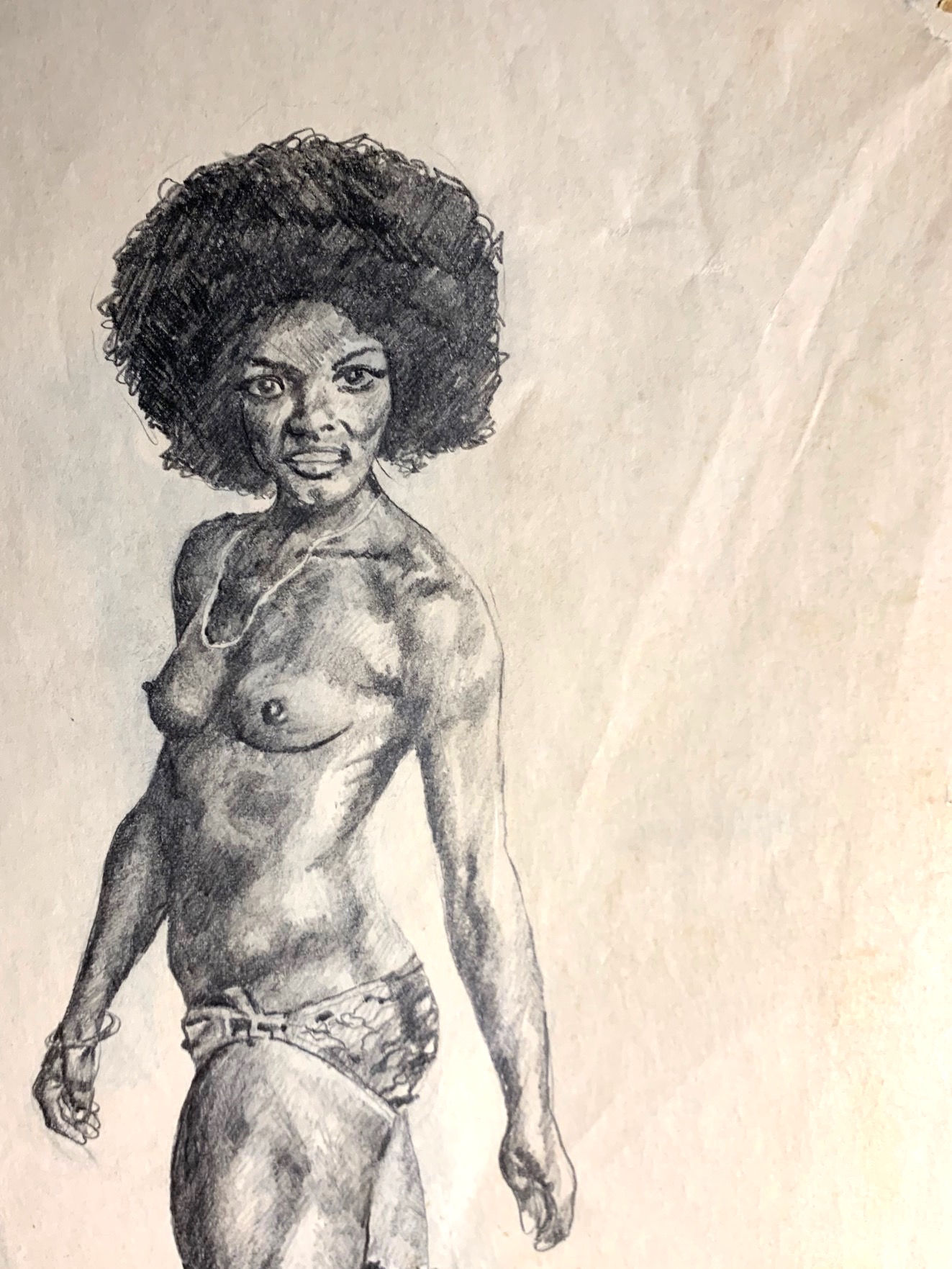
As my artistic talents grew along with my hormones, I began copying centerfolds with pencil drawings. Those took me hours to complete. The excitement during that process would build, and like all young teenaged boys, that always consummated with one thing. But at least I had the product of all that obsession to consider after it was through. Such is the give-and-take of the artistic process. It is often driven by desires of one sort or another. Creativity and sexuality are both sides of a coin in some cases.

Drawing circa 1972
Drawing circa 1973
Drawing circa 1974

And yet, there were times when it was necessary to get rid of all that sexual energy to get anything done at all. Even after a morning session in the shower, I’d be distracted beyond belief during classes in high school. The fashions worn by girls back then were as much a focus of male attention as they are today. Even back in seventh grade, the girls wore fishnet stockings and miniskirts. Some had already sprouted breasts. We’d play spin-the-bottle at kissing parties in dark little basements. Sex was always peering out from one corner or another.

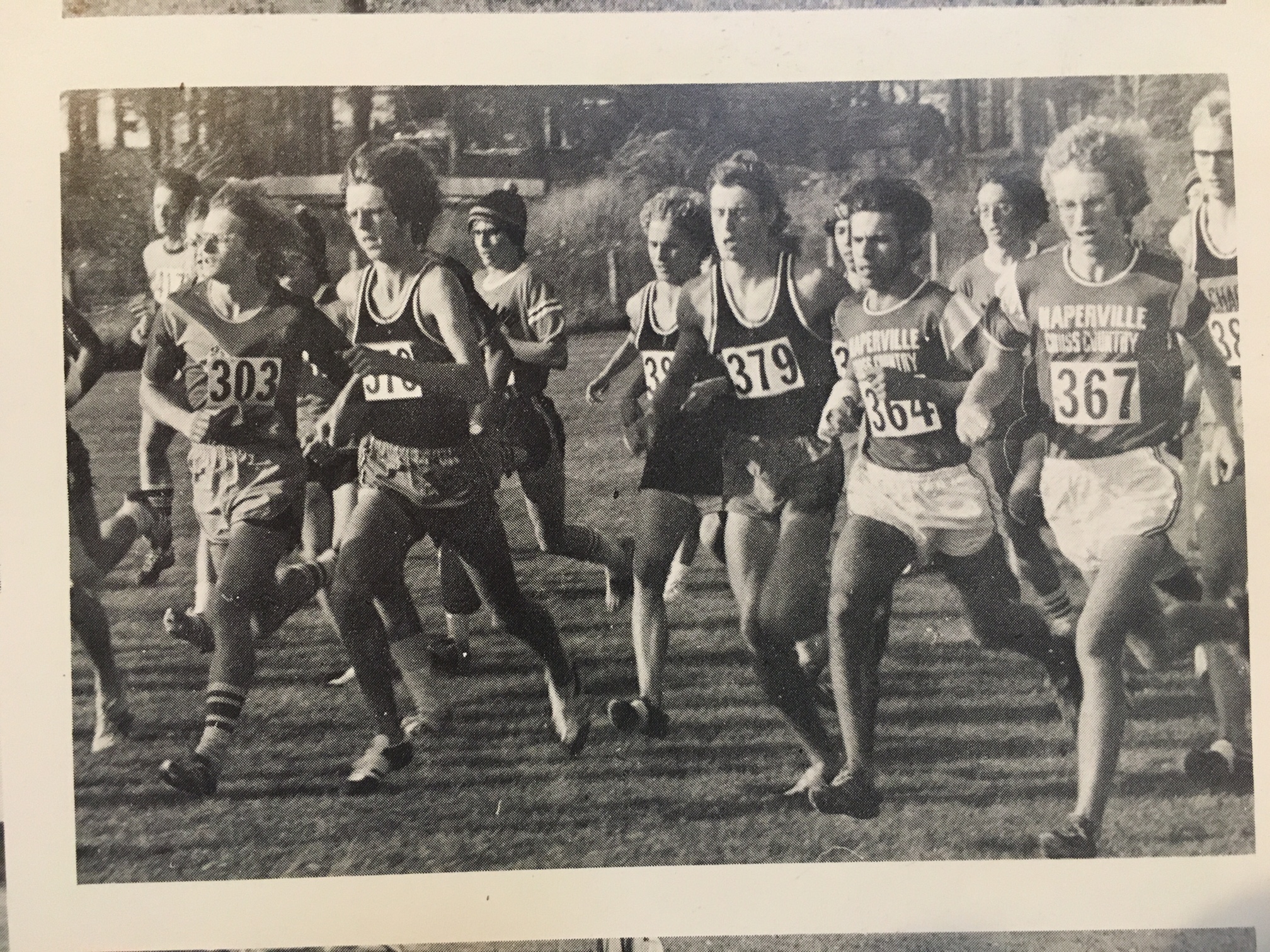
In hopes of proving myself to girls and gaining their attention, I competed hard (no pun intended) in every sport I played. Of course, cross country wasn’t the macho sport that football ever was. We were a gang of thin, pale souls with thick hair, sunken cheeks, and hollow eyes. But we were tough. When the cross country team went 9-1 and the football team went 0-9, we at least laid claim to success while the sweaty, zit-covered footballers retreated to the showers in defeat week after week. For whatever reason, the girls still clung to them like burrs on a flannel shirt. The football guys got laid. With a few exceptions those first couple years, the cross county guys jerked off into tube socks. That changed by the time we were juniors and seniors, but just barely in time to salvage some rite of passage.

Cross country 1974

All that time, the uneasy relationship between sexual feelings, guilt and self-image wrestled for my attention. A friend in wrestling once told me that he masturbated to lose weight. I was already rail-thin from miles of running. The thought that I was making myself even skinner didn’t help my self-esteem.

That confusion into college when as a freshman I officially lost virginity in a drunken outdoor session on some campus stone wall. It was an inauspicious way to “become a man,” but I didn’t care. I figured one has to get off the starting line one way or another.

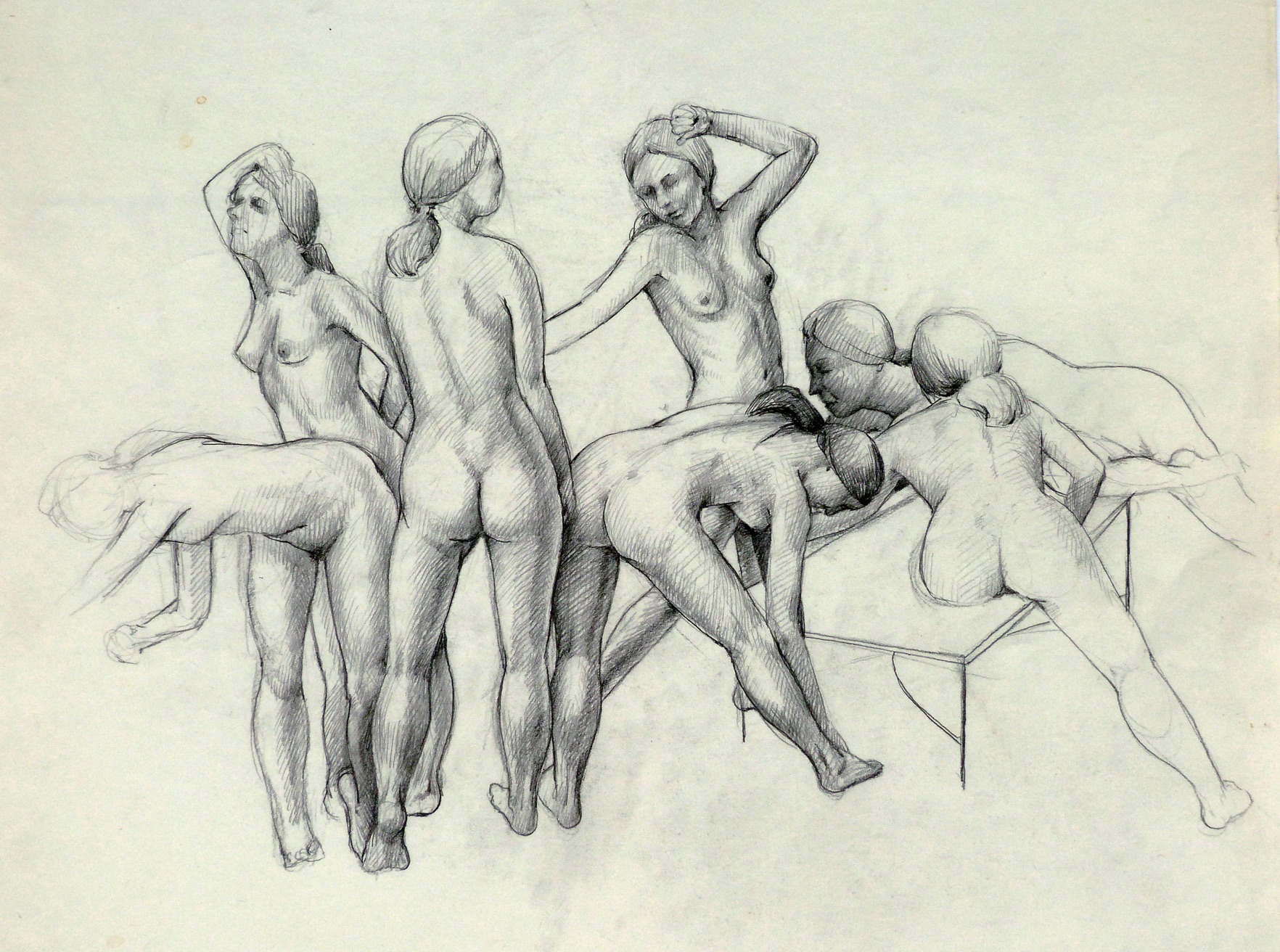
At the same time, I was enrolled in life drawing classes with nude models. Finally the curves and angles of the female body were revealed for what they were: just bodies. Coming back from classes with my armload of drawings each day, I’d be met at the dormroom door by a phalanx of floormates eager to gaze upon what I’d drawn.

Now I was getting somewhere, but where?

From Luther College Life Drawing Class 1975

That “somewhere” would soon enough take the form of sexual relationships much like the Bob Seger song “Night Moves.”

I was a little too tall
Could’ve used a few pounds
Tight pants points hardly reknown
She was a black haired beauty with big dark eyes
And points all her own sitting way up high
Way up firm and high

College came and went, so to speak. The adult world and forty years of life awaited. Now I’m sixty-plus years old and hormones don’t drive every thought that goes through my head. My focus is now the desire I feel for my wife. It is a fascinating thing to share all this running, riding and swimming with her. The intimacy of watching her strive through workouts and then sharing a marriage bed is unique in many ways. In her I see the desires of so many women seeking to keep themselves fit and healthy, to enjoy life in all its fulfillment and variations.

To be true, the world is much more free with body images these days. The female buttock is no longer taboo. Nor are nipples so carefully hidden. Even the Mons Venus owns the day. All this honesty would have helped my young mind free itself from the sexual trap of mystery and fear. It’s just bodies, and sex, and all that.

The way it should be.

Posted in sex | Tagged , , , , , , , , , , , , | 2 Comments