10 ways to test whether you could you survive being a runner in the 70s

Unknown-1For better or worse, the sport of distance running has changed quite a bit since the Running Boom first took off in the early 1970s.

That’s when Frank Shorter won the Olympic Marathon and the world of jogging got its start.

But there were quite a few of us that were already running our butts off before Shorter opened this whole can of worms and authors like Jim Fixx and Hal Higdon convinced Everyman and Everywoman there was something special about the activity of putting one foot in front of the other as fast (or slow) as you can.

It wasn’t all pretty back then. In fact one wonders if the relatively pampered runners of today would put up with much of what the sport was about back in the 70s. Here’s a list of 10 ways to test whether you could survive being a runner in the 1970s.

#10: Running shoes were rare, spare and hard to wear. 

The running shoes of the very early 1970s were better known as “flats.” These were minimalist black shoes with gum rubber soles about a quarter inch thick. There was very little heel lift. You had to buy them at local shoe merchants that stocked such fair. One salesperson once told me: “Don’t wear them around too much. They’ll stretch out your calves.” Then came adidas training flats and the SL72. These were snazzy looking shoes whose build still pretty much informs every running shoe on the market today. Solid insole. Heel cup and heel counter. Insignia on the sides. They were basic. And they were good enough. Finally NIKE and Tiger came along in the early to mid 70s and the shoe war was on. But you still had to really search to buy the best models. We purchased ours from Dick Pond, a local guy that sold running shoes out of his garage. His company is still alive today.

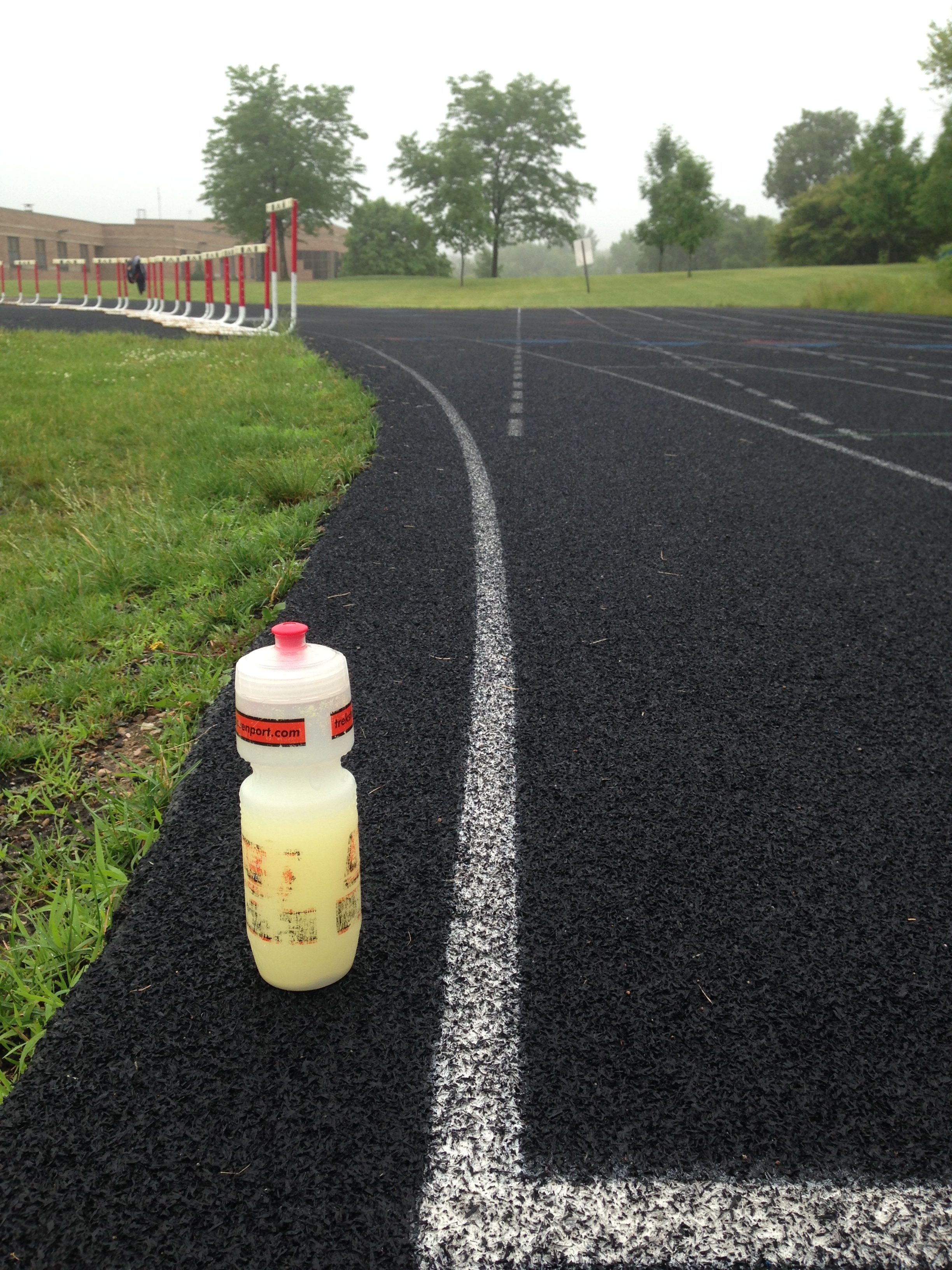
#9. We almost never drank water before, during or after running.

Some coaches even denied you you the right to drink water during practice. Most of us ran distances of six to fifteen miles without drinking anything at all. Once in a great while we’d creep on someone’s hose or the faucet on the side of an industrial building when we got really thirsty during a 20-miler. But other than that, you toughed it out.

#8. We raced three times a week. 

High school cross country runners typically had meets Tuesday, Thursday and Saturday. In between those meets we’d often do speed work. That made for fast runners, but some who burnt out as well. With 18+ meets to run during the season, you knew pretty well where you stood in terms of fitness by the time the District, Sectional and State meets rolled around. As a result the sport at the state level was largely faster then than it still is today. It was not uncommon for the Top 25 athletes to all run under 14:35 for three miles. That’s what it took to be All State.

#7. We ate and drank what we wanted, and smoked some pot too. 

While my freshman year coach counseled us on the better aspects of diet including instructions to avoid food such as carbonated beverages (sideaches) eggs (sulphur led to sideaches?) it was not uncommon for runners to ingest a daily diet of baloney sandwhich, Suzy Qs, Frito’s and a Coke. That was a pre-race meal. And we still broke 15:00 for three miles.

Beer was still pretty much PBR, Stroh’s and Old Style. There were no craft beers.

But there was a growing supply of pot. Frankly it destroyed some of my runner friends. Those of us that experimented with it and did not get sucked into a pot habit had some sense that it was not something a runner could sustain as a practical habit. There was all that smoke in the lungs, for starters. And it didn’t combine well with the drive to succeed. Ultimately it was our conservative instincts that balanced our taste for a liberal dose of fun. Such is the life of most runners. The 70s were one of the first real tests of those principles. The world could stand a dose of such equanimity.

#6. There was no such thing as tapering in mid-season. 

Most runners “trained through” even important meets. The idea was to maintain a constant “tired state” so that when you finally cut down mileage the last weeks of the season you’d enjoy such fresh legs you could set PRs for three weeks in a row. Sometimes it actually worked.

#5. We did speed work out the ass. All the time.

Legendary speed-based workouts were common even at the high school level in the 1970s. Middle distance and 400 meter runners used to do workouts of 30 X 300 meters at ungodly paces. This is how one of my former teammates was able to run a state record 1:49 880. He barfed a lot to get there. But that’s what it took to be good back in the 1970s. It’s pretty much still true today. Because how many 1:49 high school half-milers are there even today? A few. Here’s the list of 800 meter records from the last 40 years…

800-meter run

National — 1:46.45, Michael Granville, Bell Gardens, CA, 1996
IHSA — 1:49.71, Jason Van Swol, New Lenox (Lincoln-Way), 1998 (finals)
Class 1A — 1:51.22, Peter Callahan, Winnetka (North Shore Country Day), 2009 (finals)
Class 2A — 1:51.48, J.D. LaFayette, Normal (University), 2014 (finals)
Class 3A — 1:49.71, Jason Van Swol, New Lenox (Lincoln-Way), 1998 (finals)

So for all the improvements in shoes, equipment, track surfaces and training knowledge, it still comes down to running as fast as you can in what you’ve got.

#4. We did insanely long runs to experiment on ourselves. 

When some sophomore buddies and I decided to run the 30-mile DeKalb Walkathon we had no plan other than to head out and see if we could do it. Then it turned out that runners from DeKalb were there as well. So we raced the first six miles at six minute pace. then most runners quit and turned back to the NIU campus. But a few of us kept on. And on. One by one they dropped off. And there was one significant problem with this lack of strategy. The water stops were not even set up. BECAUSE IT WAS A WALKATHON! The organizers weren’t expected people to be out on the course running. Which left me all alone at the 20-mile mark with no other buddies to guide me along the way. So I kept on running. And running. Finally at 27 miles I begged a Coke in town because I was a little thirsty.

And we did shit like that more often than most of us would care to admit. Because it was the 70s. The frontier of the running movement. No one knew right from wrong. It was one grand experiment.

#3. We actually believed in our running heroes. 

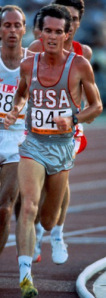
Perhaps there are still runners today that kids admire. But they don’t seem to inspire much…inspiration. By contrast we had our Frank Shorters, Bill Rodgerses and Steve Prefontaines to emulate. Then came the Africans like Henry Rono and others to stretch our imaginations even further. And we believed that running like them in practice and style could actually make us better. Women like Francie Larrieu Smith and Mary Decker Slaney, Joan Benoit and Grete Waitz were inspiring too. The 70s were a time for such naive beliefs.

#2. We sang our way to success. And failure. 

Without Walkmans or iPhones or any other gadgets to carry along during training in the early 1970s, we had to rely on our own voices to carry use along. That meant heartfelt choruses of The Who and The Doobie Brothers. The Eagles and Kansas. Those strange anthemic tunes were all we had sometimes to finish off a 20-miler with no water on a Sunday morning in the hills of Iowa. It was tough going, but a song sung with buddies can often get you through the worst of situations.

And when we failed, there were sad songs to help us drown our sorrows in cheap Olympia or Coor’s beer.

#1. We dreamed of a better world. 

There was a certain belief in the 1970s that being a runner was a secret way to becoming a better person. Coming back from a 15-miler, covered in sweat and walking through the football locker room to reach the cross country showers was a rite of passage of sorts. Our skinny bodies seemed nothing compared to the hulking, stinking, padded frames of those giant football players.

And yet I recall the moment when a runner from another team split off from the course tour before a cross country meet and tore through an actual football practice screaming KILL KILL KILL! at the top of his lungs. His name was Rich Flynn and he was a stupendously talented kid from Cary Grove high known to be a little crazy. It stunned us all that he had the guts to encroach on football practice like that.

Then he left us all in the dust during our three mile race. He seemed to run with such abandon and freedom that none of us dared to challenge him.

Yet thanks to all the torment that many of us had received at the hands of football players who believed they ruled the world in the 1970s, our competitor’s actions were symbolic in a way that drew our ultimate admiration. So what if he was crazy! He also had guts. Real guts to stand up in the face of insane repetition of thought processes that were clearly thick with authoritarian values.

And that was what many of us were about as runners in the 1970s. It was counter-culture to do what we did at so many levels. And despite all the corporatization of the sport over the last 40 years, there is still a streak within us all that hearkens to that independence.

Even my conservative running friends can feel it. There’s a certain liberality that comes from (and through) running. Even with its disciplines and rigorous requirements of dedication, there is an idealistic freedom that emanates from this sport we love.

One could argue that the 1970s started it all. It took a lot to survive that era with its pursuant hangover from the 1960s and its dark economic turns and shifts. It wasn’t perfect but it was real. Those of us that survived it sometimes stand back and wonder, “What was all that about?”

But the answer was simple. For better or worse, it was all about us, and who we wanted to become. On the run.

WeRunandRideLogo

Posted in Christopher Cudworth, running, We Run and Ride Every Day | Tagged , , , , , , , , , | 5 Comments

A little less fear of a cold winter and the blue moon

IMG_4930My record for running in the cold is twenty seven below zero. My eyes froze shut that day. Had to stop and thaw them out with warm hands pulled from thick mittens. That run only lasted two miles. it was relief from cabin fever however. Sometimes that’s all you can imagine.

It’s been cold but not that cold in Illinois the last few winters. Even at ten or twelve below you can pretty safely run without frostbite if you dress appropriately. Your lungs do not freeze.

I’ve even gotten six or seven cycling trips in this winter when temps have gotten over thirty degrees. My bike needs a really good wash as a result. There’s grit in bad places. I finally had to take the mountain bike over to the car wash and spray it down at the start of a ride. On a 20-miler the trip home required about four miles on a soaking wet limestone path. That bunk was stuck everywhere. It took a power sprayer to wash it out.

Now we have 14″ of snow and the streets are still a sloshy mess. No great rewards in riding in that slop. About 5 years ago I went out on such a day and wound up lying on my side while trying to cross a giant ice patch on ground where a mall once stood. As I slid to the ground my Motorola Razr phone flew out of my pocket. But I had not noticed. At home I checked for the phone and panicked. So I went back to the spot of the fall and found the phone lying in a puddle of water. I dialed out and connected. “Oh, it works!” I chortled. That was the last call that phone ever made. It died a few minutes later.

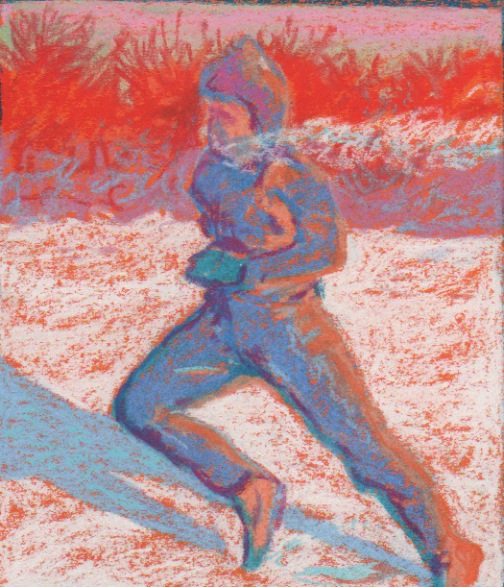
You have to relish the cold or it will keep you down. Illustration by Christopher Cudworth. Originally published in Runner's World Magazine.

You have to relish the cold or it will keep you down. Illustration by Christopher Cudworth. Originally published in Runner’s World Magazine.

So there are risks to getting out and about on the run and on the bike in winter. You must be prepared to cut short a workout if your equipment gives out or the weather turns on you. Sometimes it’s even hard to get out the door when the cold blue moon is shining its light on the snow outside. Nothing makes it look colder in winter than that unforgiving bleak light of the moon on a smooth layer of snow.

When you actually do head out the door, it’s never really as cold as your imagination makes it out to be. The benefits of running under a full moon are pretty great. You can see the road and the beautiful sight of your own breath in the frosty air. What’s not to love?

Living in Lincoln Park in Chicago during the early 1980s, I was running tw0-a-day workouts to prepare for the spring season. One February evening I carefully considered the benefits of heading out for an eight mile run from 1764 N. Clark Street up to Montrose and back. It was eight below zero. The wind was whipping from the north. It was damned cold.

On the return trip I was hugging the lakeshore and somewhere near Fullerton I think it was a giant wave crashed against the sea wall and flew twenty feet in the air. The cold lake water came sloshing down on my head, shoulders and back. It stopped me in my tracks, which was bad because there was a second half of the wave that caught me standing still.

At that moment you seriously wonder if you’re going to freeze in your tracks and die. Even my half Gore-tex top was soaked through. The rainproof pants did not keep the water off my socks and up my legs. “God. Damnit!” I yelled. Then I started up running again.

That was a long three miles from home. But it’s surprising how quickly your body heat helps you cope with the freezing temperatures and half-frozen water dripping down your ass crack. Actually I kept a brisk pace the rest of the run.

That shower back home felt really good. But the landlord was cheap and the temps inside our apartment were just under sixty degrees all the time. Sit around in that and you start to shiver.

So every time I think about running outside in cold weather, the memory of that really cold night and the violent wave that nearly took me out come to mind. I pull my gloves a little tighter and my balaclava up over my face and head out. I no longer live and run or ride near a lake. Just a sluggish cold river. And I tell myself, “It’s cold. But I have a little less fear of winter.”

Follow this blog and please share to your social media connections. Your readership is most appreciated.

Follow this blog and please share to your social media connections. Your readership is most appreciated.

Posted in Christopher Cudworth, cycling, running, We Run and Ride Every Day | Tagged , | 1 Comment

Craig Virgin exemplifies the best of American distance running

Just under a year ago I wrote this piece about Craig Virgin, one of America’s top distance runners. He was recently featured in a piece by the NCAA for his accomplishments as a runner and for his perseverance through congenital illness as a child and coming through adversity following his career. A writer is working on his biography and is seeking photos of Craig Virgin from the late 1970s through the 1980s. If you have any such content, contact Randy Sharer at rsharer@aol.com.

Christopher Cudworth's avatarWe Run and Ride

By Christopher Cudworth

0219_craig-virgin2-624x413During the Sochi Winter Olympics, three-time Olympian American distance runner Craig Virgin was interviewed on NPR for his perspectives about the 1980 boycott of the Soviet Olympics by the United States. Virgin’s lucid, compelling observations about the futility of that boycott in terms of world politics has been validated by the political situation in Ukraine following the Winter Olympics. Russia’s move into Crimea has driven futile protests in the West. It was clear back in 1980 that the Olympics were a poor tool for nationalistic policies, and they remain so today.

Craig_VirginVirgin’s lost opportunity to represent the United States at the peak of his athletic career had personal costs that continue to resonate today. The lost opportunity to earn an Olympic medal damages an athlete’s value as a personal brand on the marketing front. There were hundreds of other athletes who similarly lost that opportunity in the…

View original post 2,165 more words

Posted in Uncategorized | 1 Comment

Oh that’s Super. Just Super.

_80719483_perry2_getty

The Super Bowl felt like a giant convergence of social memes last night. While it’s fun to watch the game, it also captures the contradictory force of nature America has become. 

The headline of today’s blog has a bit of a cynical feel, doesn’t it? When someone tells you that something is “Super. Just Super,” they are typically not being complimentary. They’re using hyperbole to shoot you an insult.

Those of us that have learned to be cynical about supposedly super things like pro football now have plenty of confirmation that at its highest level football has become a strickeningly corrupt and abusive sport.

Heads up

The concussion controversy continues in the background of the football world. There are those who think that ultimately something in that category will have to reckoned with. Kids get banged up and lives get altered from concussions, especially on repetition. Without youth football, you ultimately would not have pro football. It’s a serious problem for the game America claims to love.

Maybe we’re dumb. Maybe just happy. 

_80719547_perry5_gettyYet a fascinatingly large percentage of Americans seem happy to ignore such threatening trends and facts. As long as things like football as entertainment make us happy, we are content to ignore the risks.

It’s become the symbol for the entire lifestyle, the American Way we employ to aggressively ignore anything that threatens our way of life.

That’s the exact reason why we have so many people are still denying the very real dangers of climate change. The American fixation on the costs of change and sacrifice take precedence over global preservation and safety because some brand of popular and powerful opinion holds sway in society. Maybe we’re dumb. Maybe just happy. Just like pro football.

An ethos and religion

That’s because football acts like a religion in this country. People adore the Friday Night Lights tradition because it provides ritual as a foundation for life. The following definitions help describe this phenomenon.

RELIGION:

a particular system of faith and worship. plural noun: religions “the world’s great religions”

a pursuit or interest to which someone ascribes supreme importance“consumerism is the new religion”

Sacrifice

There are even people who get sacrificed to this religion. That includes players who give their lives and their minds to the sport.  But it also includes the many spouses living in constant threat from domestic abuse by husband/players that cannot turn off the violent tendencies necessary to thrive in pro football.

That level of intensity may exist naturally in the human race. But the more insidious aspect of those situations is that abused wives fear that speaking out will jeopardize their husband’s lucrative, often short careers in pro football. It’s an ironic twist that the NFL considers itself a “family.” A family that does not reveal its dark, coarse secrets.

It’s an inevitable product: If you are going to train up young men to hit and be hit, to dominate without question and to ignore pain in yourself and in others, there will emerge a brand of psychopathy in some people. Not all. But enough that society should take a hard look at what it wants from its sporting religions.

Pagan traditions

Like most religions (Christianity for example) football draws on pagan traditions as a foundation for mass appeal. That is exactly why half-naked cheerleaders crowd the sidelines. It’s literally their job to jump around, shake their boobs and titillate the fans. Interestingly, this year’s Super Bowl television coverage fairly ignored the grossly underpaid, scantily clad “cheerleaders” as sideline candy. But then we had the Victoria’s Secret commercial to make up the difference.

It’s a rather interesting intersection at which we’ve arrived. Female fans seem to enjoy these commercialized enticements of comely women as much as men. That’s not a bad thing necessarily if the appreciation is subjective on the order of choices made and some sort of equity.We’re apparently all in on some super joke that under it all, we’re all alike.

Perhaps paganism remains the one true religion of the world after all. It’s all about the battle, spoils and plunder. A rehearsal perhaps for the apocalpyse so many Americans seem eager to believe in.

The Apocalypse, you see is the Big Payback against all those who lack virtue. It’s all part of God’s Playbook for humanity. That’s when Coach Jesus returns with the player’s roster on which the names of all those who worship the Coach are drafted into salvation and eternal life in heaven. Seats on the 50 yard line. Or perhaps a Skybox? Yes indeed, the Super Bowl and its accompanying religious fervor seem like the tribulation come to life.

Human chattle

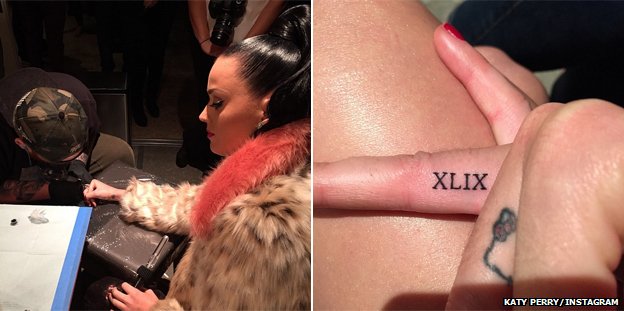
_80719717_perry_tattoo_instagramBut as we’ve pointed out, there’s are many problems with the scenario of pro football as a religion and the Super Bowl as the High Mass.

There’s this whole Roman Empire thing going on around the Super Bowl, which has become known (among many vices) as the annual focus for the sex trade and human trafficking. And it gets worse. Like online gambling and other recently legalized vices, the sex trade is likely just a step away from becoming one of those partnered revenue sources that feeds the sin-tax principles of politicians seeking new revenue. Prostitution is already legalized where? All that money changing hands for sex slaves is going to be too tempting for politicians to ignore forever. Just you wait and see.

Because the NFL, so far as one can see and hear, is about ownership of human chattle. There are draft days, and players bought and sold. The compensation can be great for those involved. Yet the costs can be just as great. Investing your entire life for a shot at NFL glory sounds good. But it’s not that much different from the sex trade.

Legitimizing abuse

With politicians mouthing phrases such as “legitimate rape” while defunding real attempts to prevent unplanned pregnancies, one sees that the self-absorbed patriarchs who live among us still view women as sexual property, and little else. In that regard there is a very real anti-Christ living among us.

Up to the old tricks

What Satan really seems to enjoy the most in life is confusing the innocent with coy phrasing and tests of character that lead us, as in the Book of Genesis, into temptation. Here’s a little scripture sampling to show how the supposed doer-of-all-evil actually works.

Now the serpent was more crafty than any of the wild animals the Lord God had made. He said to the woman, “Did God really say, ‘You must not eat from any tree in the garden’?”

The woman said to the serpent, “We may eat fruit from the trees in the garden, but God did say, ‘You must not eat fruit from the tree that is in the middle of the garden, and you must not touch it, or you will die.’”

“You will not certainly die,” the serpent said to the woman. “For God knows that when you eat from it your eyes will be opened, and you will be like God, knowing good and evil.”

Rush creepy looking

Noted pro football fan Rush Limbaugh perfectly captures the corrupt nature of abuse of power.

We’ve all heard what politicians and pimps are prone to say, and for real. “No means yes if you know how to spot it.”

Or, “Why would you accuse your husband of abuse if he provides for you?”

And, “You made the choice to play football. Isn’t it your responsibility to deal with the consequences?”

Dressed in fire. Defying the gods.

In case you did not notice it, the halftime show with Katy Perry served up a mocking festival of grandiosity. Her playfulness as a performer uses sugar-coated humor, like this video California Girls … to comment on how weird the world of objectification really is.

_80719543_perry_624getty (1)So we all knew that we’d be getting a rigid looking Katy Perry (she can’t really dance) riding out to midfield on a giant faux-golden pussy cat. What else could it have been? Then Lenny Kravitz played guitar (we think…) like a saint sent from Beezelbub. Finally, Missy Elliott turned the event into a hard-rapping dance orgy. It really all fit nicely with the theme of the day. “Oh that’s Super! Just Super!”

Big picture

The Super Bowl is simply political theater, writ large. Imagine how the sight of all that glitz and materialism must look to our sworn foes among the religious terrorists that so hate American aggression and consumerism. I mean, My God! The Super Bowl is like waving a red flag right in the face of a raging bull. Look at us! Look at us!

The evidence against us as a profligate nation is all there. The violence. The sex. The human trafficking. The abuse. The deflated footballs and overinflated egos.

All in good fun

It may be fun for all of us to watch the Super Bowl and pro football. There’s no denying its stimulating allure. The surprises and big plays. Even the colossal mistakes are Oh So American in nature. So we get some of what we deserve for loving football like the religion it has become.

_80719711_perry6_624reutersReligious organizations across the country, fearing for their own dissolution with falling membership and a society of DONEs, could learn a few things from the NFL. It’s the new Catholicism as it were. Dispensational confession to the sport that takes no prisoners. Yet we all fight on in vicarious fealty to the Patriots, the Seahawks, the Browns and Bears and Chiefs. It’s all very childish in an ADD sort of way. Football as a focus is in fact a distraction from our distracted way of thinking. We feed ourselves to the sharks, and then wonder aloud about how it all happened.

A super reaction 

In that sort of culture, how else could we react when those terrorist-drive planes (if the conspiracy theories aren’t true) crashed into the towers in NYC. We stared at our TV screens in wonder, and in awe, and with a trace of fear. But then a voice in the back of our cynical little American heads said the words that captured it all.

“Oh that’s Super. Just Super.”

Follow this blog and please share to your social media connections. Your readership is most appreciated.

Follow this blog and please share to your social media connections. Your readership is most appreciated.

Posted in Christopher Cudworth, We Run and Ride Every Day | Tagged , , , , , , , , , | 4 Comments

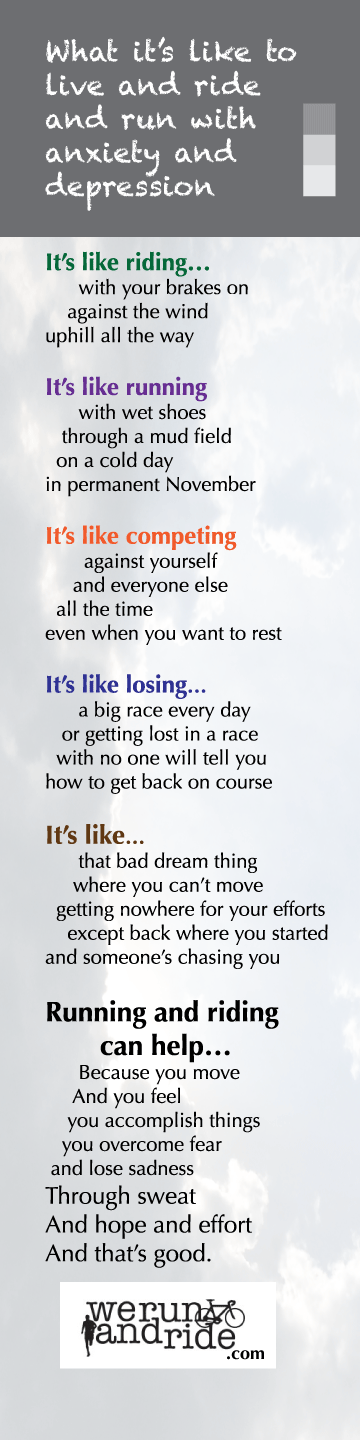
What it’s like to live with anxiety and depression. How running and riding can help.

AnxietyandDepression

Posted in Christopher Cudworth, cycling, duathlon, half marathon, marathon, running, triathlon, We Run and Ride Every Day | Tagged , , , , , , , | Leave a comment

Ooops I forgot about February

Weather Forecast

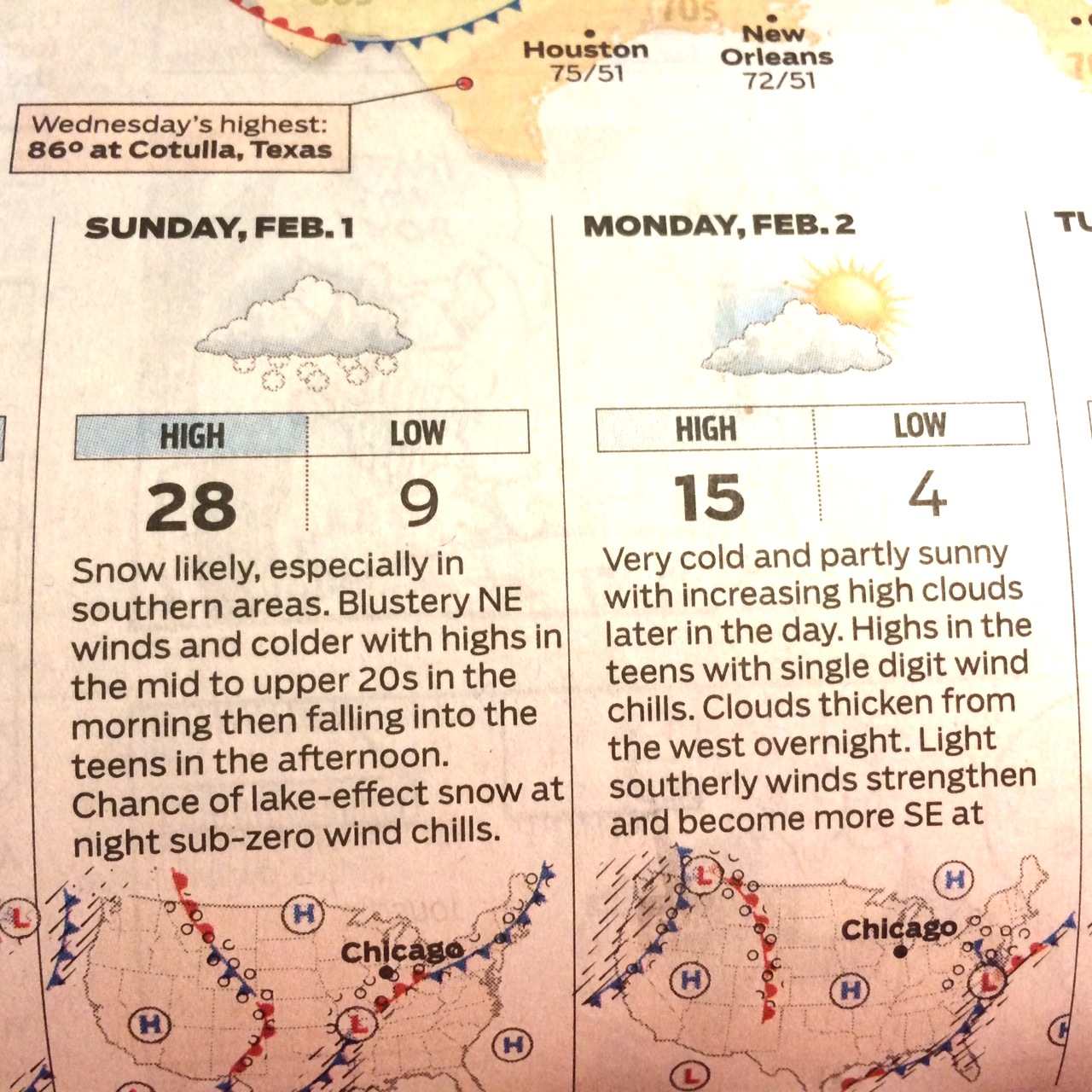
Yes. It’s still going to be cold in Illinois this February.

The weather forecast here in Illinois this week is not encouraging. Temps are predicted to drop to the low single digits. Winds will be ripping the makeup right off the faces of women commuting through the streets of Chicago.

That’s February for you. I almost forgot about it. Thoughts of spring were so nice when a warm front came through the last day or so it was possible to smell a faint whiff of water on the breeze. Tantalizing. And deceptive.

That sweet breeze! It blew from the east as I ran my square little three-mile run around the high school and back. My middle mile dipped below 8:00 with the wind blowing up my ass like a motivational fan.

How often we’ve deceived ourselves with a wind like that on a bike. Riding along at 22 miles per hour we’ve convinced of our status as talented cyclists. Then we turn around and head back into a wind that we conveniently forgot about and the suffering begins. 12 miles per hour becomes difficult. The interior dialogue goes from hero to goat. “You suck at cycling,” a little voice in your head keeps muttering. On the February breeze you think you hear the clinky sound of frozen laughter. Turns out it’s only ice on the trees.

In winter a wind like that can literally kill you. Work up a sweat going west and then find yourself coming back into a cold lake-driven wind 30 miles west of Chicago? That can put you into hypothermic distress. It’s best to carry an extra layer in the butt pocket of your Pearl Izumi jacket for just those conditions. Just in case.

Flat and cold. Like Illinois. 

God Forbid you should get a flat on your road bike tire when it’s 28 degrees outside and the winds are pretending that you’re a polar bear out for a hunt. It doesn’t take long to go from sweating to freezing. That can happen if you forget to respect the month of February.

As a kid I was a paperboy carrying the Chicago Tribune and a bunch of smaller newspapers. I rode my Huffy 3-speed bike all over the town of Elburn, Illinois from 5:30 in the morning till 6:30 every day. Some mornings the temps dipped below -15 degrees and it was best to keep moving. Keep crunching. Get the route done. Don’t think too much. It’s February and it’s cold.

Respect the month

At home I’d warm up by a heater as my mother made hot shredded wheat or eggs. All those mornings built character. I no longer feared the cold. But I did respect it. Yet we forget those lessons. Looking ahead to spring we forget there are 28 days of completely unpredictable weather to fight in the month of February.

Inside thoughts

Fortunately there are warm gyms in which to lift weights and run on treadmills or ellipticals. Yet I still prefer to go out and ride over dealing with the whole Computrainer thing. Part of that is that my bike fit still sucks despite $800 of adjustments a couple years ago. Proof that money fools a fool, I guess. But we’re dealing with that whole bike fit thing while February is still playing with our hopes here at the Cudworth Clinic. Starting from scratch on the bike fit. There’s riding to do.

Journal hopes

My running journal is filling up with consistent efforts again. Honestly it will be March before the rides add up to anything much. I’m still reeling in consciousness from a tricky day 10 years ago when I rode my road bike into sixty degree temps and fog only to see it dramatically drop to 45 degrees with a wet mist that had me shivering at the last stop light before town. I stood there shaking so hard and praying that my body would not fail me before getting home to a warm shower.

I could only think to myself, “Oooops, I forgot about February.” Respect it. Or it might kill you.

Follow this blog and please share to your social media connections. Your readership is most appreciated.

Follow this blog and please share to your social media connections. Your readership is most appreciated.

Posted in Christopher Cudworth, We Run and Ride Every Day | Tagged , | 1 Comment

What it means to really LOVE our running and riding

Starting lineMore than one person I know has made this similar observation about their love of running or cycling. “I don’t know what I’d do without it.”

Of course (and unfortunately) we all typically do get to experience life without our favorite activities. Injury can stop you cold. So can circumstances such as work changes or family needs. Then we muddle through life without running and riding.

In those periods it feels like a dark cloak is covering our energies. In some ways it also acts like an invisibility cloak. We tend to pull back from our social connections such as run clubs and group rides whenever injury, illness or circumstance stops us from running and riding. We long to recover our full selves.

SkiesThat’s because running and riding are very much mental as well as physical activities. They form our personalities and our character as surely as our other avocations do.

Those of us that have been at this running and riding thing a long time go through phases in our running and riding careers.

There’s the DISCOVERY phase when everything is new and difficult and exciting.

Next comes the DEVELOPMENT stage when the miles add up to better proficiency as a running or cyclist.

With those two growth patterns under our belts, we engage in the PERFORMANCE mode of the running and cycling worlds. Some of us race or do challenging events to celebrate our involvement in the sport.

IMG_1165Then along comes the MATURITY stage where you weigh your values and your goals. You begin to answer questions about what it really means to do these sports. This phase can last a long time and still incorporates elements of development and performance.

Maturity blends into ACTUALIZATION in which your running and riding are truly woven into your being. You process life through the lens of effort and training and discipline. The things you learn about your self are well-applied to other pursuits. Sometimes you pick up a third sport like swimming or weightlifting along the way. The transfer of experience and discipline to these other events is part of the actualization process.

When you’re fully into this game you reach the GRATITUDE zone. That’s where you truly pick up on the pleasures and challenges that make running and riding special. Being grateful for the ability to enjoy your favorite sports is a glorious journey. It wakens your senses to both thrills and absorption of the moment.

TrackIf you are so lucky and skilled to move through each of these stages early in your running and riding career, the entire arc of your active life can be truly blessed. That’s when you can turn to your friends and even your rivals to proclaim, “I really LOVE this!”

And that is how you enter the world of ENLIGHTENMENT in your running and riding. That’s when you know how to work with fatigue and pain and movement and motivation all at once. It may be no easier to stick to the wheel of the rider ahead of you, or to hold on through the middle miles of a marathon. But in your enlightened state you know how to draw on every muscle and every reserve.

When you’ve done your best in the enlightened state, you really know for sure. Of course some people move into a world where they know every movement and moment is their absolute best. If you know one of those people, do not envy their state of mind. Emulate it. Learn from it. Grow and go through all the phases if necessary to get where yo want to be.

And then love it. Because that’s what it’s all about. Loving it.

Follow this blog and please share to your social media connections. Your readership is most appreciated.

Follow this blog and please share to your social media connections. Your readership is most appreciated.

Posted in Christopher Cudworth, cycling, duathlon, half marathon, marathon, running, triathlon, We Run and Ride Every Day | Tagged , , , , , | 1 Comment

YOU’VE AGED. NO KIDDING.

IMG_3668This past weekend was hectic. Saturday morning saw an hour run on the river trail in Naperville. Thanks to all the weight work the last two weeks the left knee injury I sustained by hurdling an orange cone during a race on a snow-covered road has finally begun to heal.

One of the odd byproducts of injuries is that the rest of your system has to work extra hard to bear the brunt of the interior trauma. Getting rid of swelling in your body makes your body work overtime. Healing takes extra blood flow. That leave you achey. Every run feels like you’re 80 years old, stiff and sore.

So by Sunday morning my legs were a little stiff from the previous day’s run. But I got up and met my longtime friend and former track / cross country / baseball coach Trent Richards to do an interview about him and his protege Ruthie Rosencranz.

“What’s the workout?” I asked. “We’re doing four 800s,” he told me. “You can run with her if you like. She’s doing 6:00 pace. So 3:00 for the half.”

Squaring up

IMG_8590Looking at the track at the Falcon Park Recreation Center in Palatine, I got that old familiar twinge of doubt. It was square, for starters. There were joggers and people going all sorts of paces on the track. And I had forgotten about running with Ruthie and downed a bowl of granola with milk at 7:15. It was now 8:30 a.m. Not enough time to digest.

So I warmed up and watched Ruthie do her first 800 in 3:00 flat. It didn’t look too fast. But we all know that when it comes to running, looks can be deceiving. Standing on the side of the track watching someone else run is much easier than actually doing it yourself.

After watching me warm up, Coach Trent had an observation about my running form. “You’ve aged,” he said in his inimitable style. He’s never been one to couch honesty in sugar. “You think?” I laughed. “You’ve only known me 40+ years.”

He first coached me in baseball when I was 13 years old. We shared many an intense moment in that sport. At one point during selection for the regional All Star team I overhead Trent sticking up for me with the band of coaches doing the choosing. “That’s Cudworth,” he pointed to me. “He’s skinny but he can throw hard and he’s a competitor.”

I wound up coming into the All Star game when the big lefty they started got knocked all shelled in the first inning. I finished the game, losing only 4-3 on a passed ball pitch in the final inning.

Seeing potential

Trent saw the potential in many people over the years. But he also recognized the limitations, and wasn’t afraid to share the truth. When some newspaper labelled me a “junior sensation” for having won a few early season races, Trent corrected him. “Cudworth’s a good runner, but not a sensational one,” the newspaper quoted him.

He was absolutely right about that. Because just down the road from where I lived there was a sensational runner named Tom Burridge who ran for Batavia High School. Burridge ran to an All State finish and later competed for the University of Kentucky where he ran 13:45 for 5000 meters. Knowing Tom as I do, perhaps even he would not call himself a sensational runner. But he was damn good. I was merely good enough to lead our team.

All in context

Not that any of that was a shame. These things I share for context. Because Richards is right when he says I’ve aged. My stride was long and fluid then. It’s much shorter and perhaps more efficient now. “You still carry your arms too wide,” he observed. Always have. Probably always will. Better than some. Worse than others. We all fit in the spectrum somewhere.

That’s true about age as well. Whether we like it or not, time is a sliding scale in our lives. We start at one end and move to the other. At a certain point it is no longer physically possible to perform at the levels we did from the ages of 16-28, our peak physical years. But if you can still run nearly as fast at 55 as you could at 40 years old, you’re doing okay.

No kidding. 50 really is the new 40 thanks to this fitness boom that has changed the way many Americans approach aging. We keep sliding back the scale as much as we can.

And by the way. I did run that half in 3:00 flat.  Followed in Ruthie’s steps the whole way. After three laps it started to hurt. But with all those years of experience and reserve, I almost know how to step outside my body to finish a run. Even with a bowl of cereal threatening to come back up.

Run for the ages

Still have a 6:00 mile in my legs. Not bad for a guy my age. Stringing six of them together might be tough. But it’s worth trying if for no other reason than to make your former coach smile, laugh and admit, “You’ve still got it.” Or something like that. No kidding.

WeRunandRideLogo

Posted in Christopher Cudworth, We Run and Ride Every Day | Tagged , , , , , , , , , , | Leave a comment

Trent Richards is a coach for life

Trent Richards, Ruthie and Karen Rosenkranz

Trent Richards, Ruthie and Karen Rosenkranz

At Kaneland High School in Maple Park, Il., and as a track standout at Illinois State University, Trent Richards was known for exceeding the apparent limits of his stature. At only 5’7″ he jumped 6’7″ in college high jump, twelve full inches over his own head.

That’s motivation in a nutshell. Richards went on to coach the sports of baseball, track and cross country in the region around St. Charles, Illinois. In the early 1970s he helped create the St. Charles Track Club. The summer program attracted the region’s top athletes in both boys and girls track. Many won state and a few even went on to win national AAU championships.

Running maven

Richards was ahead of his time in development of progressive coaching techniques. He earned his Master’s Degree in Physical Educatiobn and Sports Medicine from Illinois State. And long before it has became popularized by physical therapy and sports training experts, many of his athletes trained using plyometrics for base strength and injury prevention. His coaching days in St. Charles produced numerous All State athletes in cross country and track.

In the early 1980s Richards was at the forefront of another movement sweeping the health care field. He formed a company called One On One Fitness to coach and counsel employees, corporate executives and athletes. These included CEOs of Fortune 500 companies and advertising agencies in Chicago. His collaboration with a leading sports podiatrist led to the growing field injury diagnosis through bio-mechanical analysis.

Branching out

With an active mind and entrepreneurial spirit, Richards expanded his interests into the fields of marketing where he provided innovative counsel to golf courses and other companies in the Chicago market. His contributions to the FunBrain website helped grow and define the online market for interactive education.

In the last few years, the Roselle, IL.  resident has become certified in coaching energy modalities.  These include Cranial Sacral Therapy and Watsu (warm water therapy) as alternative health strategies for adults to reduce stress and pain. That insight is helping Richards in his own life as well, having learned this year that he has a form of cancer that requires chemotherapy. He is meeting the challenge in his typically concentrated way, working through the exhaustion after chemo to get back to the things he loves. Many of his former athletes have joined an informal support group to meet up with Richards and encourage him in his cancer journey. It’s rather like the support he’s given out all those years is coming back in his time of need.

Always coaching

Yet it’s also true that Richards continues coaching prep athletes. One of these is a distance running prospect named Ruthie Rosenkranz from Lake Zurich (IL) high school. On weekends they meet at an indoor track in Palatine. Richards prescribes workouts and guides her through a year-round program designed to build strength and speed.

The day’s workout is mapped for four 800 meter repeats at 6:00 mile pace. Ruthie nails the splits on every lap within a second or two. Her stride is smart and efficient. Richards gets her to pump her arms more in the final laps and to keep them in line during the earlier pace work.

Making plans

When the workout is through and Ruthie is cooling down, her mother observes that her daughter has a work ethic that she applies to everything she undertakes. “She’s studying to become a nurse,” Karen Rosenkranz notes. “She’s looking at Illinois State University because they have a really great program there.”

Of course ISU happens to be the alma mater of her coach Trent Richards. Their meeting happened by chance last year and it has worked out well for Ruthie to have such solid guidance going into her senior year in track. “Lake Zurich has a lot of girls out for track,” she enthuses. “So it helps to train to compete for spots on the team.”

Her mother loves the commitment shown by her daughter. But it’s really not about pressure in athletics so much as preparation for life. “She works really hard on her studies at night, during the week.”

With track starting just a few days after the January workout, Ruthie feels confident of a good start to the season. But first, there’s one more thing she wants to do. “Coach, can I do another half? I want to learn to run when I’m tired.”

And off she goes, hitting the splits yet again. Finally in the last lap the fatigue starts to show a little. Her knees drop a touch. Yet she’s picked up the pace.

“She’s great, isn’t she?” enthuses her coach. It’s always been his pleasure to help athletes improve. Through all the changes and challenges faced in his life, that’s the constant that Trent Richards values most. Seeing kids improve.

WeRunandRideLogo

Posted in Christopher Cudworth, running, We Run and Ride Every Day | Tagged , , , , , , , , | 8 Comments

50 Shades of Grey in Cycling

50 Shades of Grey in Cycling

There’s a lot going on in cycling. But it’s not all black and white.

Posted in Christopher Cudworth, cycling, Tarsnakes | Tagged , , , , , , | Leave a comment