 This weekend there were massive storms across the Midwestern United States. The winds were fierce and persistent. Our run club on Saturday morning did an out and back course with the return trip flush into the stiff northern breeze. It was hard work getting back.
Then the rain started at noon and continued all the way through Sunday evening. At times the rain was horizontal. When the wind let up by Sunday noon, a steady drizzle kept coming. The birds at our backyard feeder pecked at wet seed but it was all they could do just to feed. The band of seven male ducks that uses our feeder stood out in the rain and wind looking nonplussed about the conditions.
Human equations
But everyone on the human side of the equation altered their daily activities, it seems. At the grocery store, attendance was light compared to a typical Saturday or Sunday. The Garden Center at Home Depot was nearly deserted. I visited just to buy some extensions for the downspouts.
That got me thinking about my former house and how it used to flood in the basement when big rains came. Over the years I worked with the waterproofing company until they finally installed some high-powered sump pumps that could jet water out of the sump wells with frightening speed. “Yeah, this mother is going to do the trick,” the waterproofing dude assured me.
That gave me some peace of mind when the rains came. But more than once over the years, I’d scuttled around that basement like a crayfish in the Gulf shallows trying to usher water around my little domain.
Persistent H20
Water is persistent. It goes the path of least resistance. Downhill in whatever direction it can find until it settles or pours through the low spots. But water is fickle: It can also rise up when confined by banks that cannot hold its volume. That’s when rivers overflow and wetlands become so important. The so-called “backwaters” of the Mississippi and other great rivers accepts floodwaters. Rivers that overflow their banks often enrich the soil. That’s how the Nile served Egypt, and how many great rivers still perform valuable fertilization rites to this day.
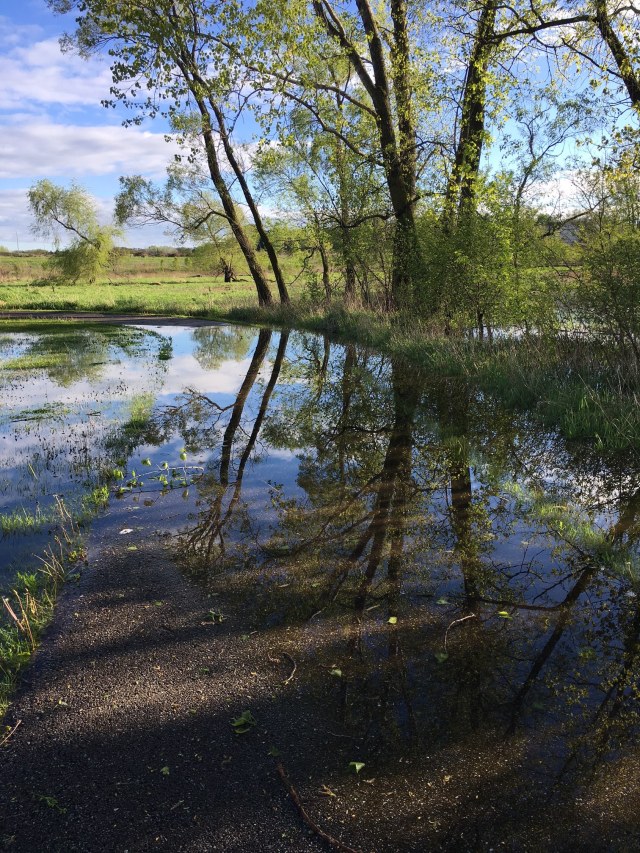
To some small extent, that’s the case right now in our backyard, where a wetland bumps up against civilization. The spring rains filled it past its typical boundaries. Now the bike and running path that rims the wetland is covered over by a giant puddle. The huge poplar trees and scrubby willows along the edges of the wetland are reflected in the pure, clear water that has overflowed the banks. I stood over those waters in a moment of zen. The calm I feel at such moments goes beyond thought.
Songs of the day
I walked down to the edge of the extravagantly overflowing pool this morning to listen to newly arrived migrant birds. There was a yellow warbler singing, and a yellowthroat as well. These two beautiful birds are small in size (5-6″) but have a big aural presence during the 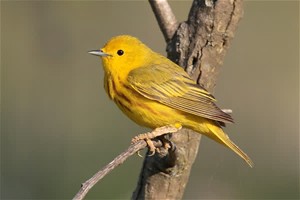 spring and summer months. They are both common birds across the Midwest, and their respective songs are part of the background music of life here. Both often sing throughout the day as well.
The yellow warbler has a bright yellow plumage with rich red stripes on its breast. It’s insistent but thin song goes sweet-sweet-sweet sweetchieuuuuu. The yellowthroat wears a black mask through its eye. It tosses back its head and sings a throaty witchity–witchity–whitchity whichhh!
These birds I know from years of summer association. While running and riding in the country, their songs are indicators of slightly wild and often wet places. And while 90% of the human populace likely ignores their songs, they keep singing it. Perhaps they know something that we don’t. That we’re not so important as we might like to think.
Knowing they’ll be my company so close to home is a joy indeed. They love the wet places and right now things are really wet within thirty yards of my house. Indeed, people who walk and jog or bike that path will have to choose whether they want to go straight through the extended wetlands or choose a soggy shortcut across the park district lawn to connect with the paved path further down.
Nature’s own course
Nature determines the course of things on its own terms, at times. I wish more people understood the importance of these seemingly simple dynamics. Wetlands are important. They play a critical role in holding water and filtering it down into the earth where some of it reaches the aquifers. Wetlands need space but people like to confine them and try to limit their reach. It’s hard for human beings who covet property over purpose to leave wetlands alone rather than dig them up or channelize them until they serve no purpose other than storing turgid water with no purpose other than reflecting the sky.
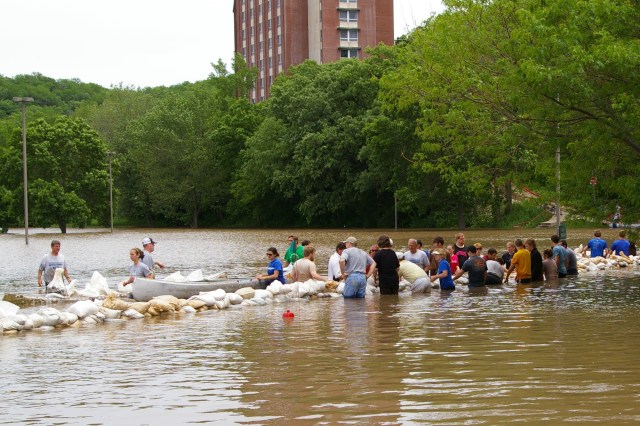
During college, I lived in the dorm in the background of this photo. That’s a parking lot.
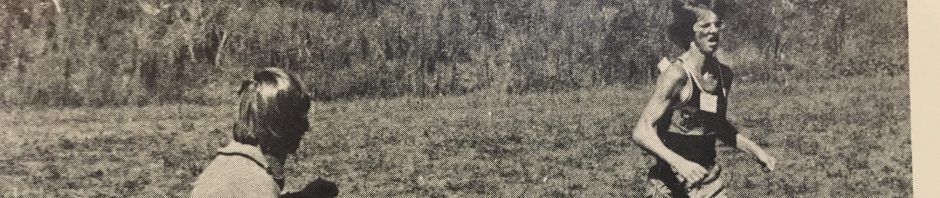
I admit to loving the chaos of water when it disobeys manmade structures. The rush of a flooding river is compelling to watch. But even that love of chaos has its limits. Because up in Decorah, Iowa where I attended college, the levees do their best to hold back the Upper Iowa river, but the topography defies such efforts, and over the last decade the river has caused havoc year after year. It floods the entire lower campus, including the cross country course that runs along the lowlands by the river. The floodwaters even threaten bridges at times. And be advised: There is no more frail feeling in this world than running or riding over a bridge where the raging waters course just feet below.
Occasionally people try to ignore the power of such water and try driving through floodwaters. Their cars inevitably get scooped up by the waters and thrashed against bridge abutments or destroyed some other way. Apparently, some people believe they have immunity against the forces of nature. But when it is unleashed, water is the most unforgiving substance on earth. It listens to no one. It is wet and wild.
The rains were surely fierce this weekend. They dashed against the side of our house making noise like a rushing train. But this morning the waters the rains left behind are calm and broad behind our home. There’s an allegory there. A lesson that our patience must be tested before such calm can be earned. Think about that before your next hard run or ride or swim.
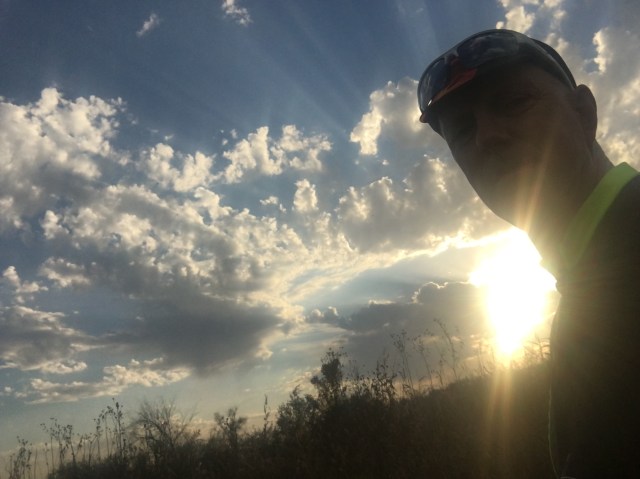 The idea of tracking a run or a ride by satellite on some days just seems intrusive. Who really, truly needs to know what you’re doing? Perhaps even you don’t need or want to know what you’re doing.
 But here’s a hint about making the most of time on your own. Plan some unplanned stops. Pause on that path through the forest preserve. Actually stop, and breathe. Look around you. Take it all in before you make another step.
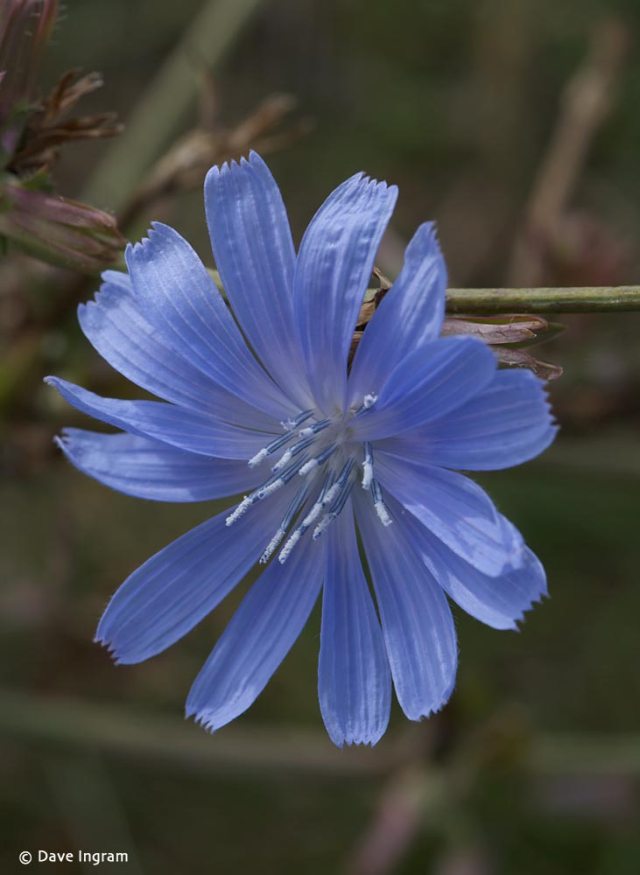 Yet there are wild coneflowers that grow in the ditches during summer, and long strands of chicory, bluer than the sky, perched along every road bed.
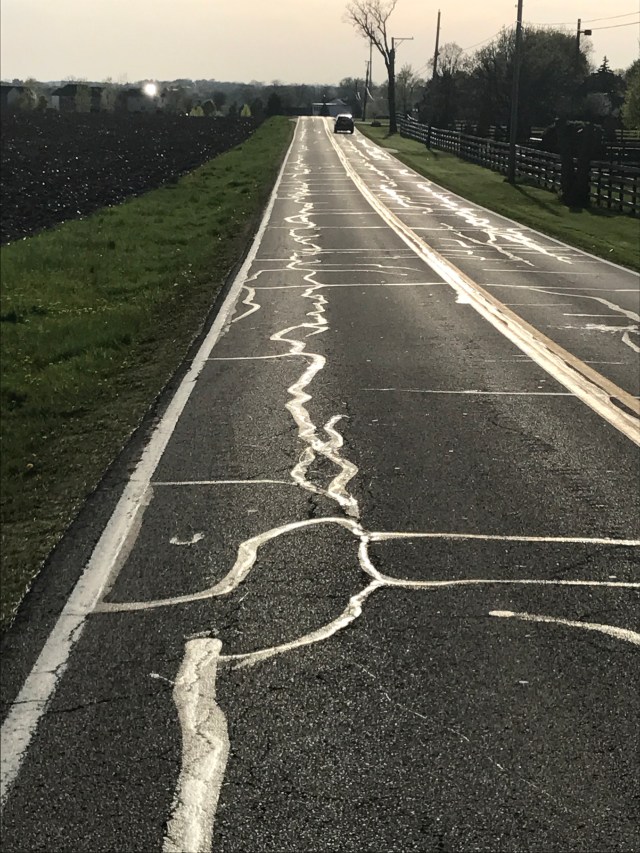 On the heels of a longer bike ride on Sunday, the opportunity to ride on Monday seemed like an extravagance. But the weather was near perfect: 70 degrees and sunny.
 We rode familiar roads this weekend. The exact same route back as out. One could call that boring or engaging. It’s all about the company.





 On Saturday we rode with a group of triathletes from the City of Naperville out to Yorkville and back. The first few miles are classic white bread suburbia. Boulevards and subdivisions. Ride in a bunch and watch out for minivans.
 Yesterday I wore a pair of Cordogan shoes to work. They complemented the peach Oxford shirt and olive pants I’d paired up from the closet. Sue said, “You look nice.”
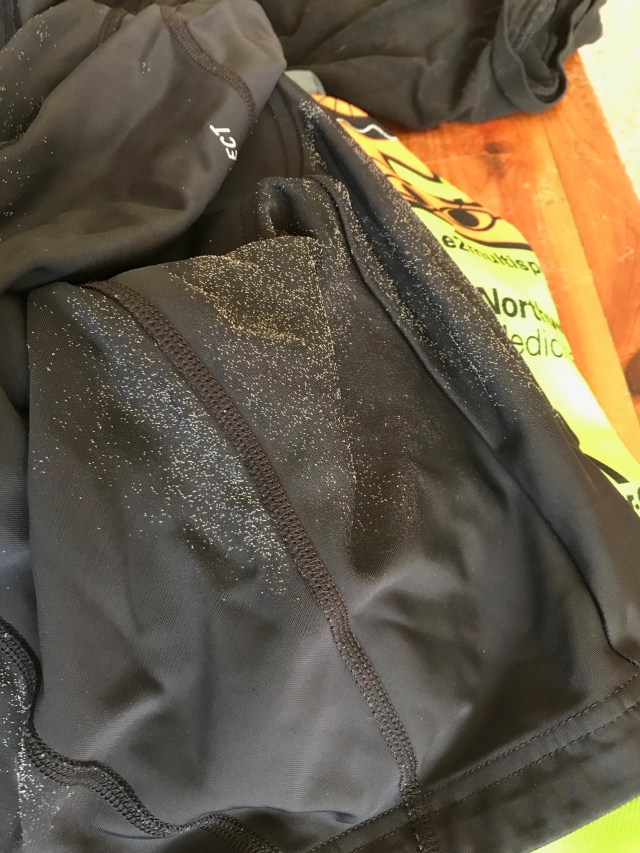 I tried hard to recall when I had purchased those shorts. My thoughts turned to last year, when we took a trip out west for training. It sure seemed like I bought those shorts just before that April trip. But could a set of cycling shorts wear out in just a year?
 It’s a fact. Endurance athletes can lose weight by not stepping on the scale. The pounds just fly off when you ignore reality. Avoid the numbers. Kick the digital reality to the curb.
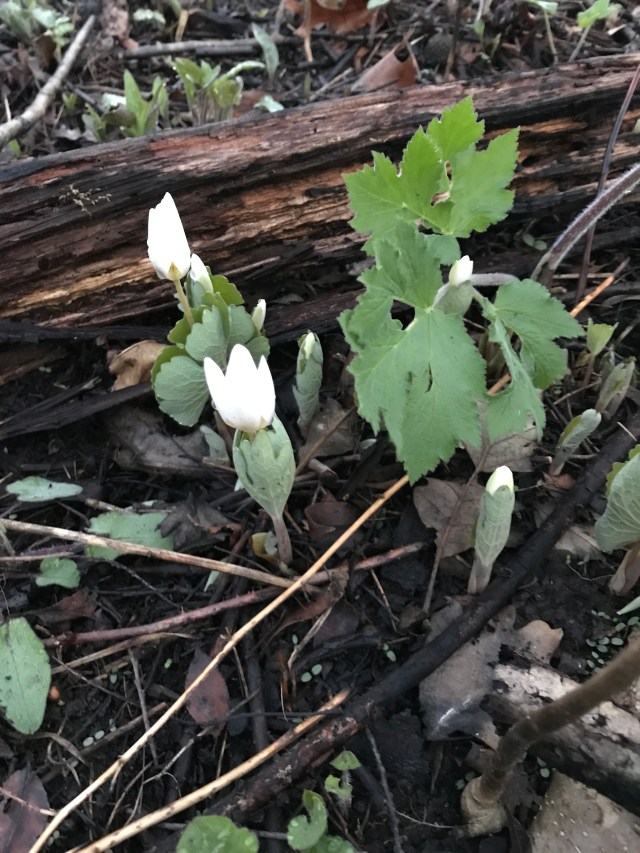 Some might consider the things I consider sacred a bit silly. One of these is the bloom of bloodroot in the spring woods. It flowers in April. The petals do not last more than a few precious days. Its leaves look like a tender version of a grape leaf. Its stems run blood red if you pluck the plant from its muddy place in the earth.
 It is true that we are all as frail as the blossom of bloodroot in the spring. Pale as moonglow under the pall of death. It occurred to me as I posted this photo that somewhere on the prairie behind me in this photo are the ashes of a wife that I scattered with my children the week after Easter four years ago. But those are gone as well. The earth gives forth and the earth reclaims.
 As Sue leaned over to give me a kiss before leaving for Master’s Swim this morning, she whispered, “Don’t go running. There are big storms coming.” I checked the Weather Channel app after she left and the entire face of the screen was covered with green and orange storm clouds. “Well,” she’s right about that I chuckled.
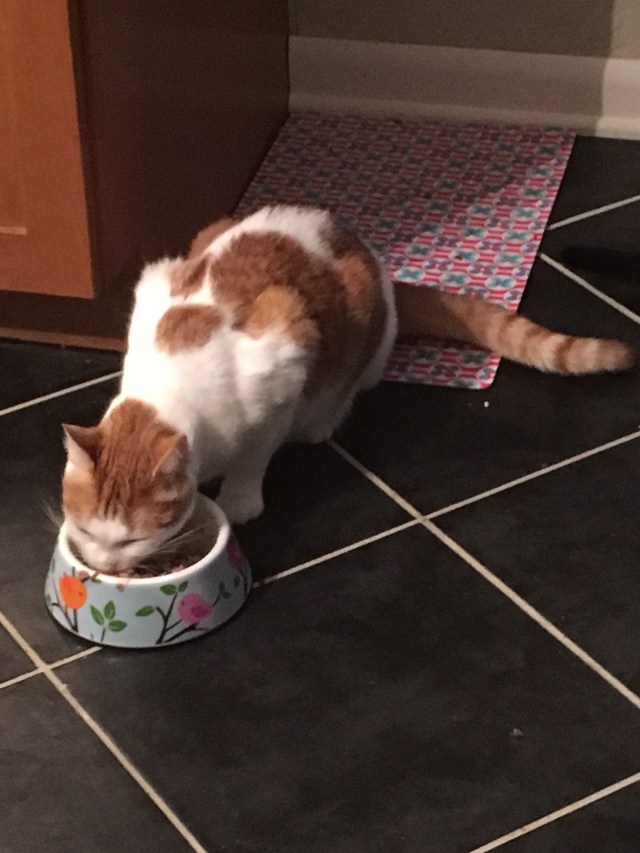
 Because I was one hungry cat. Those other hungry cats had made me think about ingesting food before I was ready to think about food. And I was getting hungrier by the minute. Then I walked through Woodman’s and spied a type of food that should not be a food and it got me thinking about how much food I eat that I should not be eating because it is full of sugar and other bad stuff and my stomach growled in response.
 Religion is supposed to have progressed, yet the effects of arrogance, entitlements and selfish pride never disappear from society. So while it may seem silly to connect the hunger of our household cats or the hunger one feels after missing a meal due to a workout with the hunger of people in our communities and around the world, there is a cognitive connection. You can ask yourself: What would it feel like to be hungry all the time, or to have no access to food? How would that make me feel?


