Cold comfort

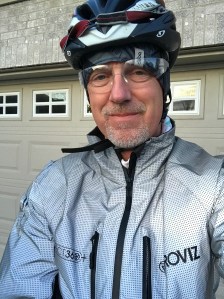
IMG_2553Starting a ride at 5:00 pm on a March evening when the temperature is just 48 degrees is a guarantee of one thing. It will get colder as you go. And sure enough, by the time I finished my ride in 1:45, the air had chilled to just 42 degrees and the wind had shifted slightly to the north.

That wasn’t cold enough to generate any real threat to well-being. I had dressed well for the weather with my relatively windproof Proviz360 jacket underpinned by a long sleeve base later and a cycling jersey over that. But toward the end, my arms got cold and my toes too. Fortunately by then I was a mere three miles from home.

Cold comfort and direction

It was sunny and clear throughout the ride. But as the sun sank lower in the sky I was headed directly west on a straight road, and that bright sun became a problem. Vehicles approaching from behind could probably not see me very well on the bike. Even my rear blinking light was little assurance of warning to drivers.

Sure enough, one of them buzzed within inches of me as it blew past. The disturbing thing about that incident is that I was already six inches OFF the actual road riding outside the white line. The driver still nearly struck me. Whoever it was, broke the law.

Three near strikes

That’s the third time this year in fact. Each time I’ve wondered if it was something I’d done to put myself at risk. The lighting conditions were bad yesterday. Yet even in good light one day, a lone driver on a massively open semi-gravel nearly mowed me down.

I do think these close calls were accidental. If they were intentional they are evidence of a truly savage mind behind the wheel. That’s possible of course, but I’m going with the benefit of the doubt that in these instances the drivers just cannot see me.

that means I’ve got to ramp up my visibility game. Or else die.

Mr. Silhouette

The Proviz360 jacket works in any condition other than being silhouetted by the sun. Even the merest glimmer of light makes the jacket light up. But when the sun turns me into a silhouette on the road, I’m at complete risk.

So I can’t ask for sympathy if I’m not doing enough to protect myself. That would be cold comfort indeed, defined as: “quite limited sympathy, consolation, or encouragement.”

No sympathy, and that’s cold comfort

We already know there are many drivers that have very little sympathy for any types of bikes on the road. Some seem ignorant that cycling is not only legal, but there are laws requiring vehicles to give cyclists three feet of clearance in all conditions while passing. Of course, that sometimes means cars would have to slow down and separate hazards while trying to pass with oncoming traffic involved. Some people don’t like to do that. They actually speed up and just try to blow past as quick as possible. Which doubles the danger to all involved.

“The laws don’t apply to me”

It is also clear that many people hate the idea they have to accommodate the laws protecting cyclists. The attitude seems to be that those laws don’t really apply to them. Either they’re in a big hurry to get somewhere or they view the road as their personal property. Thus a cyclist is essentially a ‘trespasser’ on their road.

This seems to hold true across every spectrum of road. From urban streets where cyclists attempt to navigate through a maze of trucks, buses, cars and taxis to suburban thoroughfares and boulevards where everyone is either late or afraid they’re going to be late, cyclists are seen as an infraction against the car culture.

Animated road kill
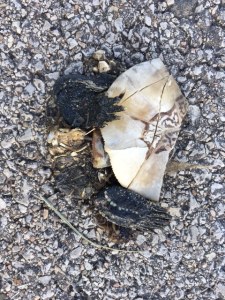
TurtleOut on country roads, cyclists are regarded with disdain by many drivers, who seem to look at cyclists as an animated form of road kill, one of those necessary evils of driving on public roads. The attitude of road ownership is even more pronounced in semi-rural areas where the farming community faces its share of discrimination as suburban housing reaches into the fields. It all becomes a competitive battle for use of the roads.

It’s never funny when cultural consideration gets flattened by selfish expectations. But then, America is a country that once thought it was fine to keep slaves. it wasn’t that long ago in our nation’s history that was true. Do we really expect that one or two generations is really going to fix that brand of prejudicial ignorance? Or that it doesn’t somehow get pushed into other areas like toothpaste out of a tube?

We’re daily witnesses to the political wishes of those who consider their own aims and fears far more important than the general welfare of the populace. The real Concealed Carry in this country is selfishness. It is the most dangerous weapon in the universe.

Outcomes

So I got home last night with two realizations.

One, I have to light my bike up like a Christmas tree if I really want to be safe. One simply can’t assume that between bad lighting, busy roads, people texting while driving and the general distractions of life that any single driver gives a rats ass about you.

I accept that. It’s cold comfort when you’ve nearly been struck several times. But you can either work to manage that problem, which I plan to do, or die without trying.

Cold comfort realities

It is also true what my buddy told me yesterday about exercising in the cold. He’s a track coach and has produced many state champions. He shared that he keeps in touch with Division 1 track coaches across the country. And one of them told him something that is immensely interesting.

See, track times among athletes in the south and west are generally faster than athletes in the northern states. That’s especially true with sprinters, but it really applies to tracksters of many types. The cold spring weather reduces the ability to produce fast times because athletes can’t perform as well in the cold as they can in warmer temps.

Recruiters of track athletes actually keep tables that adjust the times of runners up north to compare with those who compete in warmer, more southern climes.

Wait till June

Which is cold comfort when you get home after a ride in cold spring temps because you’re pedaling like mad and just not going as fast as you would in June or August.

But there’s a reason for it. The statistics of big time athletes bear it out. And it’s always nice to have excuses for not killing it out there. But it’s even better to have a plan to not get killed out there.

That’s called convergent evolution. It’s life in real time.

Posted in cycling, cycling the midwest, cycling threats | Tagged , , , , , | Leave a comment

Looking forward to a peak experience in the hills of North Carolina

Last Climb Horribly Hilly.jpg

In late May this year, my spouse and I are participating in a triathlon training camp in the hills (mountains?) of North Carolina. It involves a ton of riding over the three or four days of the camp. There will be running and swimming sessions too. What a great way to kick off the season!

There’s only one problem. There aren’t a ton of hills here in Illinois on which to prepare for the trip. Our only real hill-training option is a rise in the Kane County landscape called Campton. That hill is composed of a mound of glacially deposited gravel covered with trees and homes. Cyclists love the fact that a pair of roads peak near the top. Total elevation might be an additional 300 feet, but it’s the best thing we’ve got.

The approach from the east is long and gradual. It starts slow and grows acute toward the end.

The approach from the west is long and steady with a steeper section in the middle. 

The approach from the north is like a condensed version of the east climb. The incline starts slowly and then vanishes where the pavement disappears into the trees. 

The approach from the south is the most difficult. The climb is abrupt from the get-go, with perhaps an 11% grade that levels out to 8% for another 150 yards.

Each of these is a Strava segment, so the efforts can be compared week to week and even year to year.

For variety, the climb from the south can be made longer by swinging down to Route 38 where another long and gradual hill adds a half mile to that approach. This is also a good place to practice tearing downhill at a fast pace. There’s a Strava segment for that section too.

Years ago with a friend, we started the season by doing a couple workouts on the east and south hills doing repetitions. That set the tone for a much better year of riding. I expect to do the same thing this year in advance of the North Carolina trip.

We may also swing up to the Madison, Wisconsin area for a few longer rides in real hills. The Madison Ironman loop is quite hilly and well-known to us. There is a section called Barlow that has 18% grades on it. Try that on a tri-bike and you might wind up walking the whole thing. Bike geometry matters on the steeper climbs.

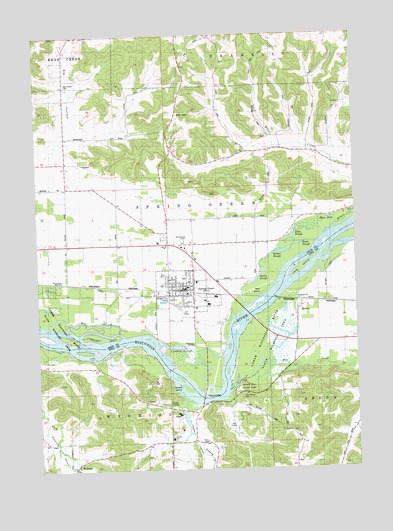
Spring Green Topo map.jpegHealthy hills

The region out by Mt. Horeb,  Dodgeville and Spring Green also has some healthy hills. We’ve ridden the Horribly Hilly ride that starts and finishes in Mt. Horeb. But the ride uses a lottery to gain admission that is too frustrating to abide year after year. It always seems that one or the other of us gets rejected. Then we have to work through the cycling network to find someone who either chickens out each year or can’t ride for other reasons. Then we buy their entry. But it’s hard to plan around that.

In the past, the race has also kept the $10 lottery fee just for applying. Talk about a slap in your cycling face.

Admittedly the ride is fun precisely because it is hard. The finish climbs the southslope of Blue Mound State Park, a glacial rise in the landscape similar to the hill back home in Campton. Only Blue Mound is a lot bigger. The final section comes in stages that take you upwards more than 2000 feet from bottom to top. I made it up that hill without stopping or climbing off the bike. That’s not a huge feat because plenty of people do it. But we take our victories where we can find them. Had the Olympics been hosted in Chicago there was a plan to hold the cycling road race west of Madison, and Blue Mound likely would have figured in that race.

The only trepidation I feel toward the hills of Wisconsin stems from the bike wobble incident of 2012. That’s when I crashed at 40 mph, busted a collarbone and was lucky nothing worse happened.

So for me, the training camp in North Carolina promises to be a challenge and a peak experience. I’ll be riding the Specialized Venge Expert, a more stable and trustworthy steed on the downhills. That could prove to be pretty important. So I’m looking forward to it, but also respect the fact that there could be moments that make Blue Mound feel like a walk in the park.

That’s what peak experiences are all about.

Posted in climbing, cycling | Tagged , , , , | Leave a comment

Emptying the full magazine

IMG_2169There is hardly a day on this earth when I don’t feel like expressing myself in some way. Whether through writing or art, photography or conversation, that’s the thing I live for.

But once in a while, it feels like all the ammunition’s gone. I have an empty magazine.

Those who know this blog will no doubt find my use of a gun reference to describe a state of mind quite ironic. But in this case, an empty magazine is both a good and a bad thing.

More than one time in my life I’ve also found myself shooting blanks. That’s not a sexual reference. Sperm potency was never a problem and I’m thankful for that. I have two grown children to show for that.

Yet as an endurance athlete, I’ve faced many situations in which I’ve “pulled the trigger” and nothing happened. Pumped the accelerator. Nothing. Sometimes our training and racing takes us to a point of emptiness. Hit the wall. Gave up the ghost. Shot the wad. And that was a sexual reference.

When I get tired, the preservation instinct that comes over me is one of ambivalence. I cease caring about the things I usually love. That can include the creative endeavors through which I feel truly alive.

And I hit a point of that stale consciousness this afternoon. The computer screen felt like a wall with scribbles on it. Even the dopamine normally pumped into action by social media just laid there.

Some of this comes from having just completed a project on which I’ve been working for more than a year. Pouring yourself into the writing of a book takes concentration bordering on obsession. But when you’re finished and send it off for review by willing readers, it’s normal to have a bit of a regressive phase.

It’s the opposite of grief, in a way. But just as exhausting in its way. It reminds me of the times when I’ve pushed through an entire competitive season of running. Training to a peak is quite a rush. There are risks involved, and that is true in writing too. Sometimes you get to a point where you realize there are thoughts to be rearranged. So you cut and move things around. Then it sings, and you almost sigh in relief.

That’s how it is with training too. You can map out a plan any way you like, but there are always periods where you have to break with the plan. Catch your breath. Change it up.

And for some reason, I was drawn this afternoon to a place where I used to spend much more time. Our public library is a big place, and the New Books shelf used to be a favorite haunt.

So did the magazine shelf. So I walked back there and perused the covers of magazines to which I once subscribed. Their covers were still familiar. The designs were still much the same.

It made me think of all the revelatory moments had while reading the words inside those magazines. Harper’s. Utne Reader. Even National Wildlife. They shaped me. Challenged me. There was Runner’s World on the shelf too. All that advice. What did I learn?

Today wasn’t the day I wanted to dig back into the magazines. My internal magazine was empty, you see. I was weaponless. Harmless. Content that I’d emptied my magazine for what I consider a very good cause. Which is nothing short of changing the world.

Some people choose to do that with a gun, emptying their magazines in a school, a church, a concert or a campus. That is their manifesto. But it is an uneducated guess fueled by the anger and complicity of all those who secretly share their fears, their prejudices or their sheer love of weaponry. To me, they’re all the same. The line between sanity and madness is as thin as the curved surface of a trigger. All it takes to breach the line is an appetite for self-expression and a touch of disenfranchisement. The result is carnage, intentional or not.

That’s why I’m happy to admit that my magazine is empty. My anger with this world has a healthy outlet. I may hurt people sometimes. That I will admit. But I also know that I’ve healed as well. Encouraged. Even inspired.

And that’s a magazine worth refilling. IMG_2169.JPG


Posted in Uncategorized | Leave a comment

Light thoughts on a dark morning


B Oil and Water Bright.png

Oil and Water, acrylic by Christopher Cudworth

Gosh, it was dark out this morning at 5:40 when I stepped out the door to run. It was hard getting out of bed knowing it was cold and windy outside. But I gathered up the gear to run outside and tucked the zipper tabs of my Proviz360 jacket into the pockets so they wouldn’t whap-whap-whap on my chest during a three-mile run.


I’ve been doing this running thing so long I almost feel like a hologram out on the road. My conscious thoughts seem to emanate from a hollow space in the brain evolved just to generate light thoughts on a dark morning.

It is often the dark thoughts that rattle around the front of my brain at first. Those are the thoughts that weigh your head down. Force it back on the pillow. It might be hard to describe why they make your mind feel so heavyif you’re not a person who experiences dark thoughts much. But they do.

Typically it takes a half mile to shake free from dark thoughts rattling around the forehead. Whether financial or relational, work-based or political, those dark thoughts cling to the inside of the mind like thought velcro. They make a dull ripping sound when they finally break loose.

Then creativity can enter the front of the brain again. It hangs around outside the front of the brain like someone waiting for a persistent lodger using single-hole potty in a public building. There is brief eye contact when the dark thought emerges. A polite smile perhaps. Then the Dark Thought mutters, “Sorry, I had to deal with some real shit in there.”

And then it goes on its way.

Running with all this going on in the brain might seem a bit distracting. It’s easy to lose sight of the pace in those moments, or feel that it’s important to run at all.

But I know my way around my own brain. So I took a deep breath and let out a low growl while running up the hill on Hickory Lane. The asphalt is black on that road and the sky above was still dark as sin. So I let out another growl to let the world know I was going to move along even if the morning refused to get light anytime soon.


B Oil and Water Dark.png

Oil and Water 2, acrylic by Christopher Cudworth

If this all sounds dramatic, it’s really not. It’s just part of the process for someone that has done this sort of thing so long it seems as familiar as the opening credits of a movie. Dark thoughts move into the distance like the words in a Star Wars introduction. Light thoughts enter in, and May the Force Be With You.


And then, as if on cue, the eastern sky began to lighten on my return trip. Another day alive on this earth. I’d already begun to imagine new ventures to build around my series of book projects. Meanwhile, my feet kept up their tap-tap-tap on the dark asphalt and I actually felt quite fine inside.

Light thoughts on a dark morning. There aren’t many better reasons to do what we do.


Posted in Christopher Cudworth, running | Tagged , , | Leave a comment

The unnatural dilemma that faces us all

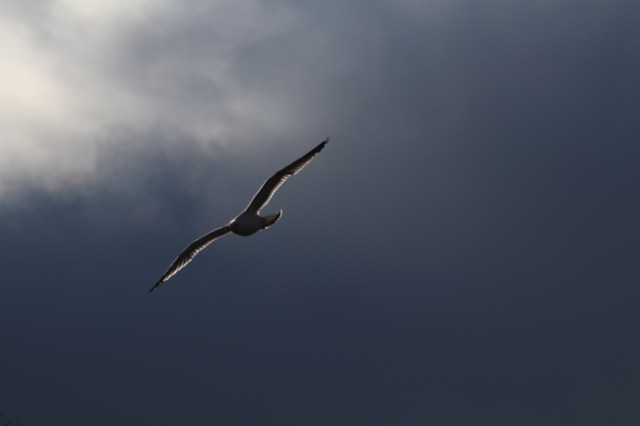
Gull Against Dark Sky.jpgI’m going to admit something to you. I’ve been on what amounts to a forty-year guilt trip. It all started when I was about fourteen years old. That’s when I seriously took up running in track and field and cross country. Much of the training for those sports takes place early in the morning or in the evening. Those also happen to be the best times for birding.
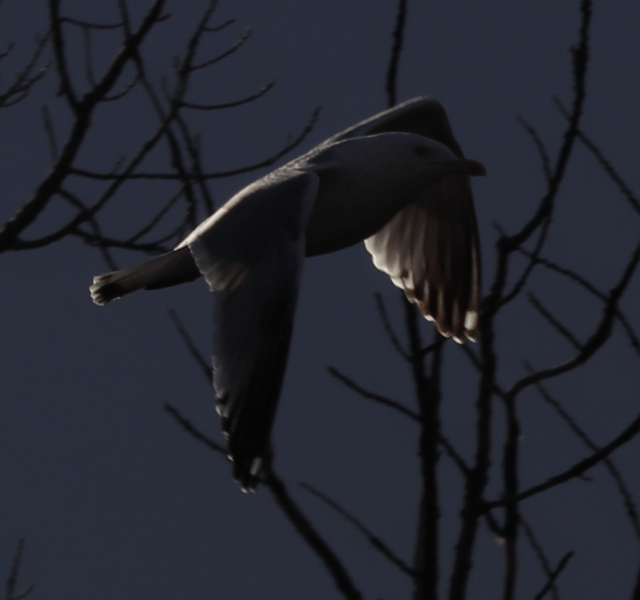
It didn’t get any better when cycling entered the picture, or swimming. Those activities also often require early departures or getting out of the house for pool time.

Gull Darkness.pngBut when spring comes around each year and birds migrate through our area, I feel guilty if I let the spring go by without finding some interesting species somewhere along the way. That means getting out the door by 6:00 am to get on site in time for the dawn chorus, or the departure of ducks from the wetlands.

Yet something’s changed in the last year that is making my unnatural dilemma less conflicting. We moved to a house that backs up to a wetland. There are birds that come to that wetland that I once traveled miles to see. Notable among them are sandhill cranes. These formerly uncommon birds were once an annual treat during their March migration. I recall the first time my brother and I watched a flight of 400 Sandhills heading straight north over our house in St. Charles, Illinois. We heard them first. That’s often the case with sandhill cranes. Their voices carry long distances.

We stood there in awe as the giant silver birds passed over in a long see formation. Then we danced around in street because it was such a treat back in 1973 to see even a couple of these birds. A very few bred in highly protected spots here in Illinois. They were considered rare enough that their nesting sites were closely guarded secrets.

These days, thanks to environmental laws that have improved habitat availability and reduced poisons that harm wildlife species, sandhill cranes have made a successful comeback. They are quite common now even in Illinois.

Which is why two different pairs of the birds have been seen in our backyard. They have even walked up to our bird feeders for breakfast or lunch, depending on their mood.

So my guilt over not seeing any cool spring birds is partly assuaged by the fact that they now come to me. The same holds true with the formerly endangered wood duck, a classy-looking waterfowl that I’d see once or twice a year along the Fox River. Their numbers were quite low forty years ago. Installation of wood duck nesting boxes has helped the species grow in population.

Last year we had fourteen wood ducks marching from the wetland up to our bird feeders to munch on corn. They were wary birds but for some reason felt better about walking to our feeders than flying.

We also have hawks of several species and great horned owls that will sing throughout the night during winter or breeding season. On top of that there are sparrows and even warblers that can be heard singing in our backyard.

On top of our daily wildlife sightings that include coyotes and rabbits and squirrels, I regularly get out for nature hike. This past weekend the walk too me through Nelson Lake Marsh, an Illinois Nature Preserve about a mile from my home. And again, a trip to that property used to require a drive of 6-8 miles. Now I can actually run there, course through the preserve for four to five miles, and run home again. This is my scouting method, and I can often count 20-30 species of birds simply by hearing them and cover all sorts of habitats from wetland to woods to restored prairie. So the diversity is thrilling.

Come late spring the bobolinks return to the fields along with meadowlarks, kingbirds and sedge wrens. From the wetlands come the sewing-machine voices of marsh wrens, and from the woods the plaintive calls of wood pewee, one of several flycatcher species that call the preserve home. 

I’ll trot through and survey the various habitats, then come back out with binoculars on a day when I take a break from running. That doesn’t mean I don’t still feel torn by running on days when the birding would clearly be fantastic.

Out on the bike it’s a different story. Covering so much ground in typically open country, there’s no real time to pause and look at a kestrel on the wire above. The landscape is a fauvism. One’s concentration is often focused on the pavement directly ahead.

Sandhill callingBut as I type this, the calls of forty cranes have come down from the sky above. They are moving on a brisk spring day, headed to whatever breeding grounds they favor, likely to the far north. Their voices are built on 60M years of evolutionary change and development. But perchance they do not sound much different now than they did 10M or 30M years ago.
So all the while this guilt trip over whether I should run or ride or swim or bird is really rather silly. Being able to access the things we love and enjoy in this very brief life we human beings have on earth is really the name of the game. Everything else and all the guilt-fed considerations are really an unnatural dilemma. We’re given this gift of life somehow, and those who treasure it get the most from their experiences. Those who can only snipe at others and blame the world for not giving them what they want will receive exactly the life they deserve. Fat of mind and stupified by their own narrow vision, they will hide in the self-proclaimed glory of their personal worth and never see that the world has much more to offer than what they are so determined to steal from it.

And that is the unnatural dilemma that faces us all.

Posted in Christopher Cudworth, Uncategorized | Leave a comment

Time in the Saddle Alone (TITSA)

IMG_3008Last night I parked the car at the train station so that my wife could drive it home after her commute. That gave me the chance to ride 20+ miles during the hour and a half of good light still available.

Riding north from Geneva, I climbed up to 834 feet above sea level. The view from up there used to be quite dramatic forty years ago. But between urban development and the growth of trees, the City of Chicago 35 miles away is no longer visible.

I rode up those hills steady and smart. Full pedal strokes. No mashing. Used the full pull of the shoe on the cleat.

Up on the flats, the wind was stiff out of the north as I rode west. It pushed me and relented as I went along. There was no need to fight it. My goal was time in the saddle. Trust the legs will gain strength with the hours. Settle yourself on the bike. Ride in a good position.

This is the sane way to get into cycling condition. To find good form, you have to practice it. Time in the saddle is how you get there.

So is time alone in the saddle. It’s far too easy in the early season to get caught up with a group that turns you into mashed potatoes halfway through the ride. There’s time for all that once you have 10-15 rides in you. Then it makes sense to get pulled along, and do some pulls yourself.

Extremes

Before that, the body doesn’t know what to make of the extremes. No pro goes out and does a four-hour ride at max effort to start the season! Why do amateur riders tend to do that to each other? It makes no sense.

Though I’ve ridden now for 15 years, I still know more about running than about cycling. But I know that it never paid off to run at maximum effort all the time. It paid instead to train slow for the bulk of the early season and build a base. Then progressively add intensity over a period of weeks. That’s how you get in shape.

But cyclists often pride themselves on pushing to extremes and not asking any questions. It seems to be part of the unspoken psychology of the sport that one should never inquire about the suspected pace, or worse yet, dare to question or complain whatever goes on with a group. It’s considered better form for some insane reason to hang on until the legs give out and eventually get dropped than to ask, “Hey, what’s the planned pace today?” That’s like a confession of weakness.

I have to say that triathletes can be even worse about this dynamic than traditional cyclists. Once a tri-guy or gal gets down in aero, they might as well be encased in a space suit. They tend enter their own world, and riding in the draft is a foreign concept to many. That’s not true for all of them, but I think you all know what I mean.

Fortunately, there are exceptions.

Sue In AeroBecause that’s not the case with my wife Sue, as we’ve worked out a system of riding together no matter what bike she’s on. I tend to ride in her draft on longer rides because I don’t ride with aero bars and she’s not interested in riding in my draft as a matter of training principles. So we share some of the pulls, but not too much. Many days she’s frankly stronger than me, but there are days when I end up guiding us home as well. Last summer we did rides of three and four and even five hours together. Not every second was perfect, but we also split off sometimes to get some riding in alone. Good partners know how to compromise. I think we do that well.
It’s too bad when cyclists fall into the trap of riding whatever pace their insane buddies choose to hit on any given day. That’s why time in the saddle alone (TITSA) can also be so important to your own fitness and sanity. There’s an honesty and patience that comes with making your own way through the spring winds, over that first season of hills and home on the flats with the wind behind your back. It’s all liberating. And finding your pace and space in the world without the initial pressures of riding with others is a good thing.

So the ride last night was a nice little base-builder that provided a chance to think ahead to when the weather gets warmer and the legs have more juice than they do now. TITSA is the way to go.


Posted in tri-bikes, triathlete, triathlon, triathlons, Uncategorized | Tagged , , , , , | 1 Comment

Bringing Just Do It to life

IMG_2770I don’t recall if the Nike brand slogan Just Do It coincided exactly with the peak of my competitive running career, but I know that I lived it just the same. The very early 80s were a heady time in the road running scene, with tons of elite and sub-elite runners duking it out at distances from 5K to Half marathon. In 1984 I raced 24 times and won about half those races.
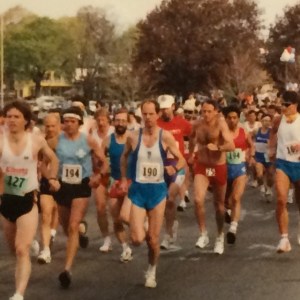
A year after that tremendous investment of energy, I’d effectively completed the course of the competitive surge that had began after college and lasted into my mid-twenties. By fall of ’85 I’d decided to back off the training and start looking at other things in life. But not before getting married and giving all my groomsmen a set of Nike Air Pegasus running shoes. They were silver with grey swooshes and matched our tuxedos with flair.

Those shoes were purchased through the Running Unlimited store that had sponsored a racing team on which I competed for two years. The top tier of guys on that team included Olympic Trials qualifiers in the marathon and one guy who just missed by 20 seconds. Several had 10K times under 30:00, so I fell somewhere in the middle of the group overall.

Runner’s Edge

That was the second Nike-based racing team of which I was a member. In 1982 I’d signed up to race for a team out of Paoli, Pennsylvania sponsored by the Runner’s Edge running store. That team also had Olympic quality runners from whom I learned more about running in six months than perhaps all the racing and training I’d done before.

Mostly that meant slowing the hell down on longer runs and finishing with a flourish to test the legs when tired. That ran counter to the methods we used in college in which we ran 6:00 pace all the time. Practices essentially consisted of race-quality efforts every day, including twenty-mile runs done in two hours. With no water.

I’m not sure how that made us faster in races of 5 miles. But that’s how we did it. So the training knowledge gained over the years from high school through my early 20s was a mix of good and bad.

Market changes

In 1982, the job I held in marketing for Van Kampen Merritt required moving to Philadelphia in a consolidation of resources. Eight months later the whole marketing department was given the heave-ho because the VP of Marketing wasn’t giving the sales team what it needed to succeed. I was given $7K severance and a pat on the back.

The sudden change stung a bit. Armed with that bit of anger and the harsh realization of finding new work in a relatively down economy, I moved back to Chicago to live with a close friend in the city. Arriving in Chi-town in the months of May1983, I dialed in and started running for all I was worth. I mean that both literally and figuratively.

You talk about your Just Do It moments in life? This was it. I figured there wasn’t much to lose at that point. Deep down I knew that I’d never be world class or make it anywhere close to the Olympics. But I did want to try to be the best I could be at running. This was my one chance at it. There simply isn’t a second go-round in life. Just Do It.

Ready for action

Nike RunningAfter a summer training on the trails of Lincoln Park, by fall I was ready for some real racing. Right out of the box I took a win at the Run for the Money in Arlington Heights. I ran 31:53 on a course that a fellow competitor had personally measured and shared that it was more than 200 meters long. So I knew I was fit. After a couple more wins in smaller races,  I won the Frank Lloyd Wright Run in Oak Park in 32:00 flat on a winding course. I didn’t break the race record set by Tom Mountain, a better run than me, but in terms of concentration and control of circumstances, beating 3000 other runners was a significant point of triumph. I enjoyed every step of that victory, which happened to deliver a real silver cup as the top award.

By that point, I really was Just Doing It. There weren’t many other immediate obligations in life. Those results produced an offer to join the Running Unlimited racing team. The sponsorship included free Nike running gear and a couple pairs of Nike shoes along with steep discounts on anything else needed to train and race. The contract called for competing a minimum of twelve times in 1984. Just Do It.

Competition

That turned out to be a sweet year. It was defined by a shared love of competition with the other guys on the team. In several races, we gobbled up the top ten positions on the day. I’m not sure how that exactly helped the reputation of the shop, because it shut out other runners from the podium and age group placings. But it sure was wild competing with eight or nine other guys wearing the same spare white and blue running uniforms.

For races on the track that season, I chose a of Nike Air Zoom spikes. They were white with a sky-blue swoosh. Light. Airy. And fast. I ran my PR for 5K on the track in those shoes. The race was held at midnight at North Central College. Only the purists in the running community were still there running that late at night, but there were plenty of us. Some twenty-five runners lined up and I can still recall the sensation of cool air flowing over my bare shoulders in the featherlight Nike kit. We knew how to dress to run then. The less, the better. Flying along at 4:40 per mile pace on an early May evening. The experience of running does not get any better than that in this world.

Just Do It

In a world where so much else is the product of relativism, group approvals and decisions made by committee, the choice to Just Do It your own way and live with the outcomes is a pure one indeed. There is no room for compromise when it’s just you and your feet on the ground. At one point after the big surge of running was over, I observed in the presence of my mother that perhaps I’d been a bit self-indulgent. She corrected me: “No. I liked your intensity,” she told me.

There’s a lesson in that.So it’s no apologies and no regrets when it comes to how it all turned out during my phase of Just Do It. That brand of drive still lives within me. I just finished writing a book about the effects of hypocrisy in religion. It’s called Sustainable Faith. It has taken a year-and-a-half to write, plus thirty years of study in matters of theology. Much of the book was formulated and even written in my head while out running or riding. Sometimes I’d have to stop and blurt an idea into my phone so that it would not be forgotten.

The writing process for a book is much the same as it is for training and racing in running. You put in the bulk effort to build up a base. Refine the base with some reorganization and editing. Throw in a few bursts of creativity to shake things up. Find the voice that’s trying to emerge. Re-write and re-edit. Then fine tune with some speed reading to see how it all holds together.

And suddenly, you’ve just done it. Now I’m sending the book out into the world for some feedback. You have to have as much courage to Just Say It as it takes to Just Do It. Sometimes you win. Sometimes you lose. But the process is always worth it. Always.

Christopher Cudworth, 2018

##

Here’s an excerpt from my new book titled Sustainable Faith. It opens with a glimpse of what John the Baptist brought to the world of faith…

Sparks of rebellion

While John’s approach to preaching and prophecy was remote by nature, it certainly didn’t cease its influence outside the city limits. Like all good prophets, he made sure his voice resounded within the temple walls. He railed against the hypocrisy of their country club lifestyle while people suffered in the streets. He branded the religious authorities a “brood of vipers” for lashing out like a den of snakes when questioned about their legalistic ways. Thus John used what we might call ‘guerrilla tactics’ to “make straight the way for the Lord.”   

Of course, his accusations earned anger and scorn from the religious authorities he targeted. His criticisms were taken as a threat to their reputation and job security. Some likely feared that a full-blown rebellion could spring from John’s wilderness movement. Yet all that was part of the plan. John’s assigned task was to make the self-righteous and entitled feel anxious over the falsehood of their authority. It worked because there is nothing more daunting to the self-acclaimed elite than a truth-telling prophet with seemingly nothing to lose.

Then along came Jesus.

If you’d like a chance to preview this book and give feedback, write me with your email address at cudworthfix@gmail.com


Posted in Uncategorized | Leave a comment

Have you ever been poisoned?

Jimmy Johns.jpgThe weird tale coming out of Great Britain is that a former Russian spy Sergei Skripal, 66, and his 33-year-old daughter, Yulia remain hospitalized Tuesday and in critical condition after being subjected to some kind of nerve gas. That was obviously an attempted murder over some perceived transgression. Possibly it was the work of Russia. But that country denies any involvement. Surprising, huh?
Back here in the states, people are getting poisoned every day. But it’s not by the Russian government, at least as far as we know. It’s from fast-food joints and restaurants.

Take a visit to the website Iwaspoisoned.com if you want incentive not to play Russian Roulette with fast food or anything like it this week.

Here’s a few samples of what you’ll find.

Location: Chicken Rico, Merritt Boulevard, Dundalk, MD, USA

Report Type: Food Poisoning

Symptoms: Diarrhea Fever Nausea Vomiting

Details: The staff from A local high school visited Chicken rico in March 13th around 3pm. We ordered a variety of foods from the menu with the coming thread in each meal being chicken. All 6 customers were ill the next morning from diarrhea, nausea and fever. 2 employees missed work the next day due to illness.

And this:


Brush with death

The reason these are fascinating to me is that I have had food poisoning on a few occasions. None was worse than the incident in which I dined at a Pizza Hut following a national track meet at Calvin College in Michigan. I ran a steeplechase race that afternoon, and it was hot outside. But after the race, I felt no real effects from running in the heat.

But in the middle of the night, I awoke with vicious stomach pains and began to violently throw up. That lasted for hours. My teammate counted the number of times I went to barf: 27.

By morning I was lightheaded and weak. I’d lost 7 pounds off a 140 lb frame at 6’1″. My coach came in and was not too concerned. But I told him, “Take me to the hospital or I’m going to die.”

The hospital staff treated me with fluids for severe dehydration. The experience was frightening, and I literally could have died.

For years I thought it had been heat stroke that made me sick. Then one day it dawned on me: I’d eaten an entire medium pizza that night at Pizza Hut.

Papaya don’t preach

People get sick like that every day from spoiled food. It doesn’t have to be fast food either.


Sour milk see

It is likely that our bodies ingest some level of bad food every day. There’s an hilarious new commercial for McDonalds where two guys succumb just from sniffing the bad milk from their fridge. I find it enormously funny. Some people hate the commercial, but they probably haven’t lived with single guys who never clean out their refrigerator. I can be accused of the same in my not-so-recent past.

I will confess to the occasional Egg McMuffin or Wendy’s Single in my diet. Neither is particularly good for you. But at least I haven’t been poisoned so far.

Perhaps Iwaspoisoned.com is the Internet’s answer to a worldwide Russian plot to poison all of us.

Freaky sick

So we’ll close with this one, a real dandy from Jimmy Johns, whose owner wants to make be barf because he loves jetting around the world trophy hunting for sport. If only his own food would attack him for once, the world would exact some revenge on the real assholes of this universe.

Posted in Christopher Cudworth, track and field, we run and ride, We Run and Ride Every Day, werunandride | Tagged , , , , | Leave a comment

There is a God if you want one

IMG_6536.jpgJust past the peak of my obsession with running, somewhere in my mid-20s, I’d made the decision that enough was enough. I’d taken a couple years to work part-time at most and dedicate my time to see how good I could really get at running. It was time for a change. 

The answers to my questions about how good I could get were satisfying to me, if not entirely conclusive. Perhaps a couple years of training might have gotten me down to 30:30 10K that I’d hoped to achieve. I still think that time would have been possible,  under the right conditions. But things are never perfect.

Plus at 26 years old, there were other obligations of life starting to call me. I’d get married in 1985, have our first child in 1986 and dig into my first real professional position in 1987. I kept running, but not with the same competitive obsession. 

With maturity came the dedication to family that should kick in about that age. And as we got into the rhythm of being parents, the routine of going to church became a consistent part of our lives.

Looking for God

That was how it was when I was growing up as well. My dad and mom dressed us up in cute little suits and took us to church at a Presbyterian church in downtown Lancaster, Pennsylvania. I loved Sunday school for the different set of friends I’d find there. And a boy named Tommy Golden always made me laugh. So it was fun learning bible stories and hanging out with God.

I used to stare up at the arched ceiling of that big church and wonder if God was floating around in the vapors. But a sign never came, so I had to be content with the beauty of the hymns we sang. The reward for my dedication came later at People’s Drugs where my dad would take us after church for a ‘sticky bun’ and a Pepsi.

Confirmation

Something from those days must have stuck in my brain because even after our family moved to the Midwest from Pennsylvania, I decided on my own initiative to sign up for confirmation class at a little church in downtown Elburn. Our class was filled with all kinds of people and it was like we’d formed our own little community.

Plus I lived next door to the pastor of the church. He once came over to play ping pong with me in our spacious attic on the table my father made for us. Somewhere during the match he realized he was going to lose, and I heard him mutter the word “shit” when he missed one of my slams. That’s the moment when I realized pastors were human.

Campus Life

During high school, I joined the group Campus Life, an evangelical youth ministry run by students and advisors from Wheaton College. Their goal was to create a safe environment for kids to explore Christianity. My goal was to get the cute girls from other towns to go out with me.

While I accomplished that goal, my adopted mission was to challenge the often formulaic presentation of Gospel as fact. At one point a counselor pulled me aside and said, “You’ll never be a Christian if you keep asking so many questions.” That didn’t stop me. 

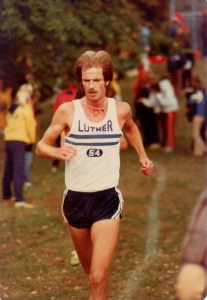
Then I eased off into Luther College, an institution named for the man who launched the Reformation by challenging the Catholic Church and its indulgent habits. The faith I took away from the college experience aligned with my earlier instincts that the “unexamined faith is not worth having.”

Running for my life

I also ran thousands of miles during four years of competition in track and field and cross country. During the middle of a bleak junior year when the weather felt it came out a cold version of hell, I had my first real fight with depression. This coincided, but was not caused, by enrollment in a class titled “Existentialism.” We read books by those dire philosophers Sartre and Camus. Then we sat in class with a professor who would squinch the skin of his forehead together in passionate consideration of the words we were reading. He was one intense dude. Some of my answers to his questions were not well-received. That is how college should be. Get your ass kicked a little. 

But I’ve always thought that guy was a little bit like God. What other visage do we have to go by? We’re told by scripture to refer to God as the Father, and his son Jesus is an assistant coach of sorts, but also one with God. Then the Holy Spirit is floating around too. That makes up the Trinity. The God Squad. 

Spectrum

Too much of that ontological theology stuff is garbage. My relationship with God is much more honest than a pile of terms. I admit that I’m a flawed human being and ask for insight. I confess that I’m a dick sometimes, and possibly a bit arrogant. But I also ask for help in finding and helping those in need. And try to respect all people. That’s the spectrum of faith. 

Some of that, the more angry, dismissive part, squares pretty well with being a competitive runner. Being a dick and being arrogant to some extent helps you when you’re standing on the starting line amongst people who trying to beat you to the finish line. When you’re in stellar shape and know you have the ability to win, that is no time to be conciliatory. You go do what you’re trained to do. 

During the opening mile of a five-mile race, a competitor once turned to me and asked, “How fast are you running today?” I think he meant to collaborate on the pace. But I turned to him and barked, “Faster than you.” Then I took off at sub-5:00-mile pace and won the race going away at 24:45. It was not my calling to help him in that moment. 

Credit where due

When I finished, there was no call to point a finger at the sky and thank God for the victory. That would be truly arrogant. To assume that somehow God favored me over the other competitors that day is as absurd as claiming one could run to the moon. For one thing that’s a very long way. And for two, there’s no oxygen or traction.

Some things we clearly do on our own, and the thing for which we can thank God about that is simply being alive. We’re all composed of the same carbon and juice. Our blood saline is similar to saltwater. We go from dust to dust, trading genetic material and DNA for all we’re worth. Then the worms and germs come to eat us up and transfer that energy to some other life form. And unless you donate your body’s organs to help others or let science carve them up for research, that’s as close as we come to reincarnation.

Beating hearts

Inside that shell is the beating heart that drives it all. Mine cannot meet the pace that it once did back in my 20s. The body naturally slows as we age.

And what of the mind? During all these years of a beating heart and the movement of feet in shoes and on pedals, how has the mind fared? What can it tell us about the nature of being? And is there really a God?

I think I know the answers to all those questions. I really do. And it’s this: There is a God if you want one.

That is not to say we create God ourselves, or that God does or does not exist. Those are questions designed to defeat the purpose or meaning of our existence, which is to commune with creation.

Interesting exercise

How we do that is a personal choice. And having spent 60 years of my life attending church in one form or another, it was an interesting exercise to sit down and make a list of all the things I did in those roles. That’s what I did in church this past Sunday. 

It all added up to years of this and that. Taught Sunday School to middle schoolers for 10 or 15 years. Did the same with High School Youth Group at church. Sang in the choir for 15 years. Played in the Praise Band and even led the damned thing for a while. Served on church boards through building projects and pastoral transitions. Endured countless conservative sermons at the former church we attended where condemnations of evolution, homosexuals and the liberal social agenda were a regular thing.

But in the meantime, I was challenging the kids of the people who sat in those pews to realy think about life. About God. And where the two intersect. I followed no books or guidelines. Just opened the door and welcomed those young minds into the space where God could indeed enter in.

Why did you stay? 

You might ask, “Why did you stay?” And my answer would be, from a sense of duty and commitment to principals that mattered, such as family, and friends, and keeping one voice alive in that space of dogma.

But even my late wife tired of the constant harangue pouring out from the church denomination in which she’d been baptized and confirmed. So we said our cordial goodbyes and then refused the political invitation by some members of the church elders to say bad things about our former pastor.

One of the things that I’ve learned from all these years of religion is that the church can be a wonderful thing, but it can also be the height of evil. In times of joy or crisis, the body of Christ can be quite sustaining. It’s those patches in between where drama is lacking and people get bored and bickering that can produce the heights of evil and the depressing antithesis of God.

What prayer can do

I’ve been through the death of a spouse, and I know what prayer can and cannot do. I’ve had prayers directly answered, and I’ve learned that some forms of prayer need to be reconsidered. Asking for miracles is not a good habit to abide. Accepting the miracles that can occur if you keep an open heart and mind is a very good practice.

That is why I say there is a God if you want one. My atheist friends are content to ignore that invitation, and I don’t judge them. But I do think everyone has a god of some sort. A thing they trust either in the universe or themselves. That is what I was trying to find as a child looking up at the ceiling of the church in Pennsylvania.

And that is what I have been communing with during all these years. God is a very mobile dude (like the Big Lebowski) if you keep an ear open. I once lay on a pole vault pit after work, so angry at some transgression by a co-worker that I could not even stay at home with my wife and kids. And somewhere out of the gray sky above me, a voice spoke and said, “Forgiveness.”

I went to work the next day and forgave that guy every wrong thing he was trying to do. And two weeks later, he was fired from his position. Sometimes giving in is the most powerful thing you can do in this world. Just ask Jesus.

There is a God if you want one

So like I say, there is a God if you want one. At times in life, I’ve made other things my God. For a while, running was one of them. I gave it my all, and more. And having experienced that level of zealotry and the self-indulgence it can ring from your soul, I quickly recognize it in others. As John Irving once wrote through a character in his book Hotel New Hampshire, “You’ve got to get obsessed and stay obsessed.”

All that means is that with focus, we can achieve many of the things we set out to do. Having a God isn’t like that. It’s a combination of pursuing truth and letting it come to you. That is the race we set out to run from birth. Learning our limits and at the same time, pushing them.

That is the God of existence.

Posted in competition, cross country, running, Uncategorized | Tagged , , | 2 Comments

Age 60 going on 200

UsainBolt100MeterDash.jpgThis morning’s track workout consisted of 8 X 200 all out with a 100 meter walk-jog between. It was an experiment to see how much torque the internal engine could take. The test went well enough, but also revealed a few insights that were eye-opening.

The fifteen-minute warmup was a cranky one thanks to the lingering effects of a mild cold. As colds go this was not a bad one at all. It started Monday and is winding up today. My body aches a little as bodies do when fighting the common cold. But it wasn’t the hacking, coughing, phlegmy kind of cold that I used to get when training so hard my body teetered on illness every other week.

Leaning tower.jpegLeaning into gravity

Once the warmup was through, I did the requisite bathroom visit to make sure the workout would not be interrupted. When you’re going to test something, it is important to eliminate as many distractions or interruptions as possible. If Galileo had dropped his spheres of different mass from the Leaning Tower of Pisa, and one of them had hit a clothesline on the way down, we might not have the theory of gravity as we know it today.

Alright, that’s an exaggeration. Some discoveries are inevitable. Learning the effects of gravity and how to measure them falls into that category. But we’re all good at deceiving ourselves, which is why the battle for sobriety is often an all-or-nothing proposition, and why making dates with porn stars when you’re already married is never really a good idea. Taking unnecessary risks only promises to increase the gravity of your situation.

Flying in the face of probability

There are indeed absolutes in this world, yet most of them hide behind the specter of how we view them. But the fact that Usain Bolt has run the 100 meters in 9.58 seconds is an absolute marvel. It seems superhuman. But in our own way, we can all be superhuman. We just have to try.

Which is why I went to the track to test how fast I can actually run 200 meter repeats at the age of sixty years old. The running track is an absolute. It is precisely measured, so we don’t go about fooling ourselves. Except for a couple elderly gents walking the inside lane, I  had the entire facility to myself. A clear track means an honest test.

So I ran the 8 x 200 workout and this is what I learned. While I’m not as fast as I used to be, I’m still able to run reasonably fast compared to most of the running world. The best I could manage this morning for 200 meters was 41 seconds. That’s four to six seconds over the 37.5 pace I was hoping to hit on at least one of them. That means I need to gain 3.5 seconds of speed at 200 meters to run the equivalent of 5:00 mile pace. At sixty years old that is not that bad.

The world record for the mile among men at the age of 60 is 4:51.85. Age 65 is 4:56 and age 70 is 5:21. But here’s the shocker. The dropoff from age 55 to 60 is tremendous, because the mile world record for a 55-year old is 4:35. Age 50 goes down to 4:25. And the age 40 mile world record is 3:57 by Bernard Lagat.

As for my personal record mile, it will sit at 4:19 forever, because that’s what I ran in college, which is 64-65 seconds per lap, or 32-33 seconds per 200 meters. I’m not even going to pretend I’m able to run that quickly at my age.

I’m currently going through 100 meters at 20-22 seconds. To run 5:00 pace will require 18 seconds per 100, or about twice as slow as Usain Bolt! But for me, that’s not a huge gap between where I am and where I want to be. With some practice I think I can get there.

Just breathe…

Part of the challenge of keeping the pace for 200 meters is the oxygen uptake factor of running the full 200 meters at 100% effort. It’s not as easy as it sounds. The last 100 of each interval was 1-2 seconds slower on my four fastest 200s, which were 41-42 seconds each. Then I slowed down overall for the last three, running times closer to 44 seconds. Admittedly, the last one was at 46. But that’s still just 23 seconds per 100. So it wasn’t a total collapse. Perhaps I should rest more than 100 meters between intervals.

I could really feel it in the lungs. They aren’t used to working at maximum effort like that. I’ve been running interval 400s at 6:30-7:20 pace depending on the week. That is coming through the 200 at closer to 50 seconds. That’s the other objective of these faster 200s, to make my training pace of 6:30 per mile feel easier.

Not quite a miler

cudrunI was never all-out speedy.

My all-time record at the 200 meters, as far as I can recall, is a not-so-blazing 26.7. And my best ever 400 was 55.5. For a skinny middle distance runner, that’s not terrible speedy.

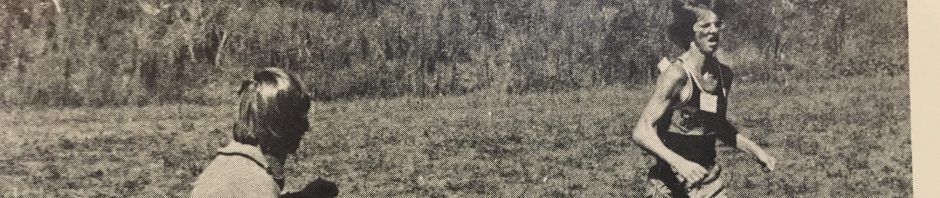
But that helps explain why I never got faster than I actually did at the mile. I didn’t have a miler’s raw speed, so technically my PR is 4:19. But that was run in college, and I got  faster at every distance after I graduated. My PR at 5000 meters in college was 15:01. I ran near 14:45 for the distance three years later. So I honestly think a 4:16 mile was within my reach given the workouts I was doing with repeat 400s at 60-63 seconds.

Too bad, so sad, I never tested that fitness in an all-out mile. I did win a mile race in a Friday night race that summer of maximum fitness in an easy cruise at 4:22. I was saving myself for a Sunday morning 15K that I nearly won before succumbing to a competitor with a sub-30:00 10K and sub 2:20 marathon to his credit. So I was supremely fit at the time. Part of me wishes I’d gone all out in that mile to see what I could really have run.

Days gone by

These days it is hard to imagine being able to run that fast. My body just can’t do it. The body that I now have is some 40 pounds heavier, for one thing. I weighed 140 at racing weight during those peak years. I weigh 185 these days, with hopes of getting down to 175 this summer during training. Can’t lie about it. I’m thicker now but with no regrets. For on thing, I also don’t get as many colds, or look like a stiff wind could snap me in two.

If I’m lucky (or something like that) I’ve got perhaps another 30 years on this earth. Maybe I’ll keep running till I’m 80. There was a guy with an Air Force jacket at the track doing little run drills on one end of the track. He told me he just turned 79 years old.

If I live to the age of 90, I’ll reach 2047. And if I reach one hundred (which I doubt) the year will be 2057. If I were to go all biblical or Green Mile on you and live to be 200 years old, the year would be 2157. Wouldn’t that be a trip. I’d have to be Benjamin Button.

It’s good to think about mortality, because without awareness of the preciousness of life, days go by and we take them for granted. So for now, I’m experimenting with going as fast as I can so I can stay in one place.

Every endurance athlete knows the battle with gravity is eternal, until it’s not.


Posted in healthy aging, healthy senior, marathon, running, track and field, training | Tagged , , , , , | Leave a comment