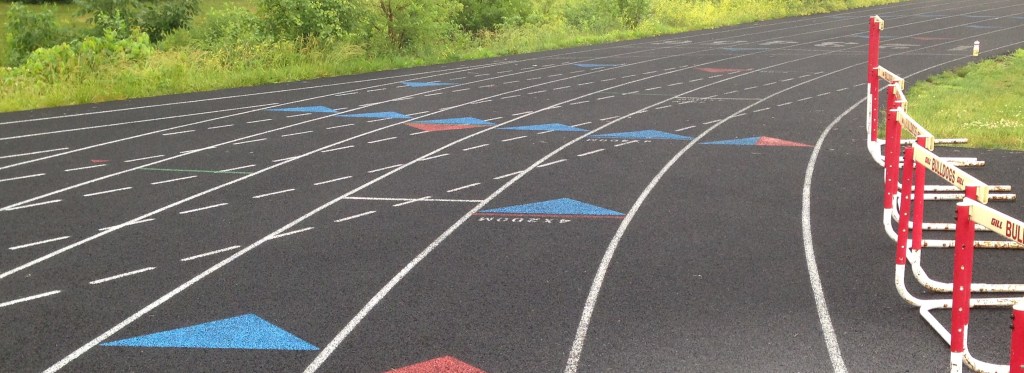
By the time we arrived at the Geneva Middle School track, the sun was barely a hand’s width above the horizon as I took measure of the light. We’d have forty minutes or so to complete a workout of 10 X 400 meters.
I’d been in that circumstance many times before. As October progresses each year, the light seems to fall into the void of autumn. Many times over the years I’ve run with teammates and training partners in late afternoon and finished as the sun vanished behind the trees. The night comes on and the air cools quickly. It’s all evidence of how tenuous our earthly existence really is.
But while the light lasts and the afternoon wind ceases to blow, conditions are perfect for running. Even the light breeze on the homestretch felt good around us.
Both of us were wearing new running shoes. The feel of new treads on a black rubber track is profoundly joyful. We warmed up with a mile jog and she did her strides while I engaged in some stretching.
Her planned workout was to run at 8:30 pace or below. We finished the first 400 under 2:00, and she made note of it. “That’s a little fast.”
We did another, again at sub-2:00 pace. Then another. She wasn’t struggling. Instead she was thriving. I tossed out my plan to do the second set of five at my own pace because it was such fun running with her lap after lap.
By the time we hit eight 400s with only two to go, her confidence was high. We didn’t go nuts but kept to the pace she’d been hitting all along. I was more than happy to get in a clean and steady workout at my current racing pace for 10K and more.
The sun was completely set as we cooled down with a couple laps of jogging. A cool waft of corn-swept breeze came our way. We climbed into the car to pick up supper after the workout and she summed up the evening by saying, “Well, that was good.”
Indeed it was. Just my wife and I and ten four hundreds. Cannot think of a better way to spend an October evening.
I’m sharing a video today that is compelling in its sadness, and yet inspiring. A Colombian rider at the UCI World Championships is left stranded on the roadside after getting a flat. There is supposed to be a neutral service car to help riders in this circumstance, but it seems that even that vehicle passed this rider by.
This young man rode thousands of miles to prepare for this competition, and then this happened. We’ve all experienced disappointment in sports, but as the commentators point out, few of us earn the chance to represent our country at this level. The pressure that comes with that is hard enough to bear. To have your chance to prove yourself stolen by a flat tire and no help in sight is a crusher.
I recall racing the 5000M in the Prairie State Games, an Olympic-style statewide competition held for the first time in the mid-1980s. The race started in 80-degree temps with 80% humidity. I passed through two miles under 9:30 in third place behind Ty Wolf of the University of Illinois and a University of Chicago runner whose name was Paul Snyder, if I recall correctly. At that point a side stitch from hell started coming on. I ran for another lap but it was too painful. Bent over from pain, I lurched off the track and the medical crew pushed my sad body into a wheelbarrow full of ice. I’m not sure if heat was the exact problem, but it was disappointing to have lost my place in the race.
Perhaps you’ve had an experience like that where your expectations were high and they suddenly burst in front of you. If so, this rider from Colombia expresses the tears and frustration that sometimes come with competition. We learn from it. But damn it hurts in the moment.
Like a ton of little kids sucked into the idea that the Boy Scouts of America knew what was good for us, I signed up for Cub Scouts and was assigned to a neighborhood den.
Dutifully, to the best of my ability, I followed instructions in the Cub Scout manual to earn badges. There was a sense of accomplishment in doing so. That much I’ll admit.
Then one summer afternoon our den was out playing kickball in an open field near the Den Mother’s house. I was a wicked good kickball player as a rule, and I didn’t like to lose. Which is why, as I was about to roll the ball from the pitcher’s position to the opposing, I saw from the corner of my eye that the runner on first base took off running the moment the ball left my hand.
The rules had been clearly laid out before the game. No stealing. No leadoffs. No leaving base until someone kicked the ball.
The player at home plate completely missed the ball. But there on second base stood the runner that had left the bag at first when I pitched the ball. “You need to go back to first!” I told him, pointing at the bag.
“Nuh uhhh,” the player on second replied. The other players froze, not knowing what to do with someone so brazenly willing to lie about the game and its rules.
“You go back to first or I’ll make you!” I told him.
At that moment one of the players from the opposing team ran across the street to get the Den Mother. I was arguing with the player at second when she arrived on the field.
“What’s this about you trying to start a fight?” she scolded me.
“He cheated,” I said sternly. “He stole second when I pitched the ball.”
“That doesn’t give you an excuse to start a fight,” she warned, grabbing me by the shirt.
I tugged away and glared at the player on second. He made a face.
“I quit then,” I replied, turning defiantly to the Den Mother. “If you like cheaters, then I quit.”
Then I walked off the field and trudged all the way home on my own. I knew my way around the neighborhood. That was no great risk.
When the Cub Scout Den Meeting arrived the next week, my mother called up the stairs, “C’mon Chrissy,” she called me that. “It’s time for Cub Scouts!”
“I’m not going. They cheat,” I told her.
My mother came upstairs to hear the whole story. I clearly explained the disagreement over the rules. My mother understood. She could have made me go back and apologize for threatening the other player I suppose. But my mother knew that I had a strong sense of justice earned from repeated interactions with my brothers. We simply never cheated or got punished if we did. Granted, I could throw occasional fits of wicked anger and tears, but at least I was trying to sort right from wrong.
So I never went back went back to the Cub Scouts as a kid.
Professional Boy Scout
My painting Flag Waiver.
Years later I was recruited by friends to work for the Boy Scouts of America as a district executive. Perhaps it was a closeted attempt to reconcile my earlier misgivings in life. But history repeated itself.
I worked there for three months before discovering that several of the other DE’s were cheating on their enrollment numbers. They filled out membership forms for youth in their districts, paid their annual fees and sent the paperwork to the national office. They cheated.
That was just like leaving from first base before the pitch was made. It was stealing second when it wasn’t allowed.
And just like earlier in life, when I met to discuss the problem with the executives running the Council, they accused me, not the other DEs, of dishonesty and trying to cause the Council harm. They even convinced a volunteer adult leader to participate in a scam to discredit me and insinuate that I’d stolen money from a Camporall when I’d gotten home late on a Sunday night from the event and decided to deposit the money early the next morning.
Having watched up close how corruption soiled the organization, it was no surprise to me that the Boy Scouts of America became embroiled in a massive lawsuit for obscuring child sexual abuse by adult volunteers and even professionals. It taught me that the more some people present themselves as good the righteous, the less they can be trusted.
Race cheats
Occasionally I’ve even see people cheating in races in which I was a competitor. Some of that cheating was on purpose and some of it was mistaken. I was in second at a 10K race with a mile to go in the Sycamore Pumpkinfest 10K when the runner ahead of me cut through a park rather than following the path around it. That shaved about 200 yards off the course distance and I was faced with the choice of whether to follow the leader or stick to the course. I stuck to the course. He beat me by 200 yards.
I know life isn’t fair. I know that justice isn’t always served. In many ways and on many days, justice doesn’t even sniff the fresh air of truth.
That’s what I learned from those early experiences in the Cub Scouts and in many later encounters with cheaters in life. They love to get away with it. They relish it in fact. And when they get accustomed to cheating, they grow to admire those who do it best. That’s how we got where we are today. The proof of admiration for cheaters and crooks is all around us. They gaslight and mock and smirk at those of us who refuse to cheat as if we’re the suckers, losers and fools.
Cheaters don’t always prosper
I’ve also seen enough in life to know that cheaters don’t always prosper. The Boy Scouts of America and the Catholic Church and a host of other self-righteous organizations claiming purity and goodness while hiding the sting of evil behind their institutional prowess. Our government here in the United States is in the grip of a phalanx of cheaters, hypocrite and power-hungry religious zealots. We’re all witnesses to another corrupt chapter in American history playing out before our eyes. Once again, there’s a guy standing on second base smirking at us all. He thinks he’s getting away with cheating. He’ll steal bases as long as we let him, and his teammates are all too happy to cheer him along.
The question is, what are we going to do about it? I say we challenge the cheaters with everything we’ve got in these circumstances. Speak up and speak out. Vote.
Don’t be gaslighted. The truth is eventually revealed when you do. That’s the other thing I’ve learned. There comes a day when we win because perseverance overcomes the deep inner weakness of the cheaters no matter how strong they claim to be. The bullies ultimately do fall. The stealers of second base get caught. The Den Mother realizes how badly she failed in a test of conscience because she stood up for the wrong kid all along.
I’m going to tell you two quick stories and then explain why they’re pertinent at this precise moment in time.
During college cross country in a season where we’d go on to place second in the NCAA cross country championships, the top five guys all came down with sore Achilles tendons after an ill-advised speed workout on a cambered road. All of us were limping the next day, and I was deeply concerned about losing all that hard work so I went to the campus doctor for a checkup.
Bad Doc
He prescribed some pills and I filled the prescription that day and started taking them. Within hours I was lost in a daze. I got lost on my way to class. Couldn’t concentrate. I kept running and didn’t feel much pain. Of any kind. That lasted a couple days.
Everyone else was sore and weirded out by the injuries. Finally, our coach drove us to the Mayo Clinic in Rochester, Minnesota for a team checkup with a physician that graduated from our college. He took one look at the bottle of pills I’d brought along and said, “How long have you been taking this?”
“A few days,” I explained.
“Stop immediately,” he warned me. “This is a strong steroid called butazolidin. But this amount the campus doctor prescribed? This is how much they give horses.”
That was my first experience with a world on steroids.
Brain drain
Further on in life, my late wife had been going through cancer treatments for eight years before we found out that it had migrated to her brain. It wasn’t supposed to be able to do that, but it did.
She had surgery and radiation to reduce the tumor and was prescribed a powerful steroid called dexamethasone.
It completely changed her personality. She started spending money we did not have. I half-assumed that she’d been given some cash by her parents, which happened occasionally throughout our marriage.
Then she stayed up half the night researching the car she wanted us to buy. I was out of work taking care of her at the time, so I didn’t think it was the best time to be buying major purchase items. But she was adamant, so we drove to the Subaru dealer and signed the papers for a new Outback. Fortunately, my credit rating was over 800 at the time, so they didn’t ask any questions.
Not long after that, her alternating manic and sleepy behavior forced her boss at the preschool where she taught to call me. “She’s not herself,” I heard her say.
That was putting it lightly. The forceful energy and loss of inhibitions was hard to handle. The steroids had taken over her brain.
Trump on steroids
The reason I share these two harrowing, first-hand incidents is that I just read a disturbing report that President Trump received steroid treatments with dexamethasone. Then he forced people to jump into a car and drive around the streets surrounding Walter Reed hospital.
That action put everyone in his immediate environs in dire danger of contracting Covid-19. He’s needlessly (except for ego’s sake) endangering professionals whose job it is to protect him.
It’s not just the steroids that make Trump so irrepressibly irresponsible. He’s always been that way. But the idea that his sociopathic need for approval and fearful approach to losing election credibility is being exacerbated by mind-altering drugs is beyond disturbing. The fact that the White House is busy covering up the truth about Trump’s condition is not unexpected, but it is corrupt.
In other words, business as usual in the Trump era. He hid the truth about Coronavirus from the public (a fact openly admitted to journalist Bob Woodward) then politicized it by mocking those seeking to follow medical recommendations such as wearing masks and social distancing.
All Trump cared about was looking good for his date with legal security and a chance to keep the presidency and avoid being prosecuted for crimes already committed.
Now he’s on steroids. He’ll soon be acting out like the manic character George “Baby Face” Nelson in the movie Brother, Where Art Thou.
I could see Donald Trump whooping and hollering like this as they haul him off to jail after he rightly loses this election. It will probably be his dear supporters marching him through the streets once they realize how badly they’ve been hoodwinked by the Scammer In Chief.
As a child growing up in Lancaster, Pennsylvania, I spent tons of time riding around neighborhood roads next to the Meadia Heights Country Club. The black asphalt road surface of those streets was bordered by fine gravel in which chunks of pyrite or Fool’s Gold could be found.
If there were larger pieces of pyrite I’d often stop to collect them. Apparently the source of gravel for road projects was rich in the stuff. Sometimes it would be stuck in the gooey black tar holding the road edge together. One of our our favorite activities was stopping to burst tar bubbles on hot summer days. You could press your finger into the raised black head of a tar bubble and get a satisfying POP as the gas inside was released.
I read an article once in Harper’s Magazine that described how some kids would pick up that tar and chew on it like gum. We were never that stupid.
Nor were we dumb enough to think that Fool’s Gold was anything but that. It looked pretty and gave the impression of being valuable according to some preconceived notion that gold and shiny things were worth more than others. I just liked the cubic shape of the crystals. The minerals were unique in shape and configuration.
Apparently some people place much greater value on the power of pyrite. Some crystal lovers credit pyrite with the power to bring about wealth.
It’s interesting to read the comments below the video. They remind me of that book The Secret that someone recommended years ago, in which the supposed powers of the universe come to you if you believe enough to become an attraction of sorts. The same goes for believers in the power of rocks and crystals. One person had this to say:
“It’s real pirite works fast 💨 even helps with your back pain wow instantly stops and blocks the pain it helps me go forward in things I don’t want too face it blocks evil danger.”
Another person writes:
Pyrite or fools gold has been my favorite since I was a child! Mom got us kids rings or bracelets with our birthstones on it. But mine is Diamond so no tennis bracelet for this 5 year old boy lmao. But since I was born on April 1st “April fools day” mom brilliantly substituted Pyrite fools gold as only for boys born on April 1st! I currently still have a piece from back then and it’s a wondering stone. It disappears and reappears pretty regularly. It always comes back. I’m going to give it a job now that I’m learning all it can do. Thank you!
The gal pitching all the powers of pyrite is attracting wealth alright. The people that buy into her schtick on YouTube count as visitors to her video, which has 127,000 views. So she’s not exactly lying about the power of pyrite to bring attraction and wealth her way.
Among all the rocks and crystals credited with healing powers, energy boosts and wealth delivery, perhaps Fool’s Gold is the best named of them all. People desperate for inspiration and hope will gravitate to anything that promises those qualities.
Rock worship
But this worship of rocks has a deadly history. One Roman emperor made the fatal mistake of trying to replace the prevailing religion of the day with the worship of a black rock.
As described on the website ancient.eu:
Upon his arrival in Rome and despite his youth, Elagabalus was officially recognized by the Senate as emperor – they had hoped for economic and political stability after the chaotic reigns of Caracalla and Macrinus. Controversy, however, would soon rear its ugly head; something that would not only anger the Senate but also shock much of the populace, especially the Christians and Jews. As a high priest Elagabalus made plans to replace the old, traditional religion of Rome with that of his own – the worship of Elagabal. This Syrian god was even to replace the supreme god of Roman mythology – Jupiter.
To cement his intentions Elagabalus had a large, black conical-shaped stone (possibly a meteorite) brought from Syria – a cult symbol of his religion – and installed on the Palatine Hill. A new temple, the Elagabalium, was built to honor Elagabal. In his Roman History Cassius Dio, who called the emperor the “False Antoninus,” wrote,
The offense consisted, not in his introducing a foreign god into Rome or in his exalting in very strange ways, but in his placing him even before Jupiter himself and causing himself to be voted his priest…. Furthermore, he was frequently seen even in public clad in the barbaric dress which the Syrian priests use, and this had as much to do as anything with his receiving the nickname of ‘The Assyrian.’
In similar fashion the Israelites living in the wilderness got bored and desperate for a new God and boiled down all their precious metal to build a Golden Calf.
All of this history illustrates that people are too often desperate for secret pathways to success and fortune. It’s true that many of us are susceptible to the promise of shortcuts and get-rich-quick schemes. The people who prey on that populace include those promoting networking marketing and pyramid schemes. Yet the wealthy are just as likely to get tricked by inveterate scammers. The Bernie Madoff scandal proved that.
Diversity is wealth
Despite my skepticism of the miracle powers of pyrite I keep some on my desk because I like the look of it. On a trip to Colorado many years back I was parked high in the mountains at the end of the Durango-to-Silverton railroad line. A young kid was selling rocks and minerals and walked up to me with the largest chunk of pyrite I’d ever seen. I spent $5.00 on it because I liked its heft.
It didn’t bring me wealth, but it does offer a form of satisfaction. I like the idea that the earth offers such diversity. Fossils are another aspect of the earth’s history that makes me stop in wonder. The farm on the hill of a Catskill mountain in Upstate New York where my mother grew up was rich with fossil-bearing slate. The intricate patterns of those dark fossils felt like they held deep knowledge.
Imagine the still-undiscovered wonders that the world holds. In a contrary sense, the truth of the world is not found in what rocks can do for us, but what we can do to better understand the rocks, soil, the water upon which all living things depend on for survival. That is the nature of our dominion.
Appreciating the complexity of a single igneous, metamorphic or sedimentary stone is an invitation to consider how it was formed, it’s age, and what it means when it comes to answering questions about why we are all here. Without these rocks and minerals, the foundation of all being, none of what we see around us would be possible. They are the foundation for all material reality.
Carbon reality
Every human being you encounter in the world is composed elements that are distributed throughout the universe.
“Almost 99% of the mass of the human body is made up of six elements: oxygen, carbon, hydrogen, nitrogen, calcium, and phosphorus. Only about 0.85% is composed of another five elements: potassium, sulfur, sodium, chlorine, and magnesium. All 11 are necessary for life. The remaining elements are trace elements, of which more than a dozen are thought on the basis of good evidence to be necessary for life.[1] All of the mass of the trace elements put together (less than 10 grams for a human body) do not add up to the body mass of magnesium, the least common of the 11 non-trace elements.” –Wikipedia
Elements come to life
From the combination of all these elements we somehow come to life. That is the force people are trying to discover and enervate through the power of crystals and the worship of supposedly beneficial and mysterious forces within them.
But if you really want to discover the force of life in this universe, all you have to do is run, ride, or swim. That is how you put those elements and trace elements to use within you. Press that chemistry into action. There is some admitted foolishness to these endeavors, but the feel of moving your elements through this world is what brings the mind alive as well.
Every urge to compete. Every will to win. Every test of self and perseverance comes down to our elemental selves. Knowing that is the secret to life.
That is worth more than all the gold in the world.
Taking the steed out for a ride. I just don’t horse around with the mechanics.
I was always a crap bike mechanic, but as a kid, I couldn’t resist trying to convert my big frame bike into a Sting Ray. Somehow I came into possession of a set of handlebars and put them on my bike.
Then I wheeled the bike up the bank at the end of our yard and rode hard to jump off the hill and “get some air.” Tragically, I had not tightened the handlebars enough. They went spinning down in front as I flew forward upon impact and wracked my nuts on the top bar. There I lay, collapsed in a heap in the yard, crying my head off.
No one came to help me. I lay there blubbering for a while. Soon enough the pain subsided. Looking around, I saw that no one had seen me and in my child’s mind it therefore never really happened. I would tell no one about the crash.
You might think I’d learned my lesson from that incident. But a couple days later I paid fifty cents to a friend to buy a smaller front wheel to put on my bike.
Excited now that my bike was starting to look like a real Sting Ray bicycle, I backed up into our neighbor’s yard and pedaled like a madman toward the bank to catch some more air.
One problem. I didn’t tighten the new front wheel well enough. It came flying off and I crashed all over again with the front fork digging into the dirt. That pitched me forward and I hit my nuts again. This time it hurt even worse. I lay there moaning for several minutes.
Yet again, no one had seen me. So I tightened the front wheel and cranked on the handlebar with a wrench to the best of my ability. This time, I tested the bike by steering it around the driveway first to test things out.
It goes to show that some lessons in life are best learned twice. After all these years of cycling, I still rather suck at changing the tubes in my tires. I once took a course in bike repair and maintenance and still don’t know remember how to adjust the brakes or tweak the derailleur. Recently I put a bike back together that I’d like to ride again, but don’t trust my wrenching on the thing. I’ll have a friend who excels at bike wrenching give it the once-over.
Let’s face it: people like me will never be good bike mechanics. We don’t all have the aptitude. The way I look at it, you can’t be good at everything. Local bike shops need the work. I’d rather trust them than wrack my nuts all over again.
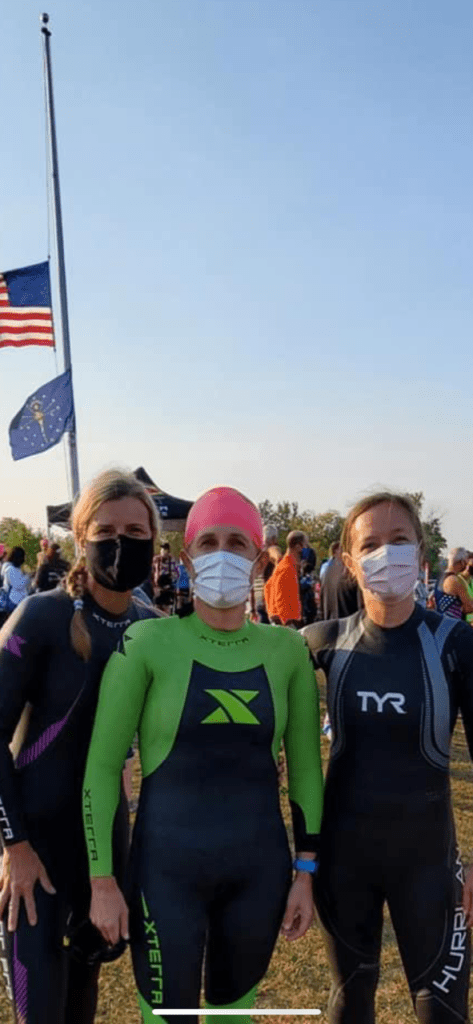
The folks at 3Disciplines deserve thanks for putting on a well-organized, safe and interesting triathlon event in the Muncie, Indiana area. Communications in advance of the race were clear and helpful. Event registration was simple and quick, even with the temperature checks. Race instructions were informative rather than a self-aggrandizing announcer listening to himself talk. Everything came off really well.
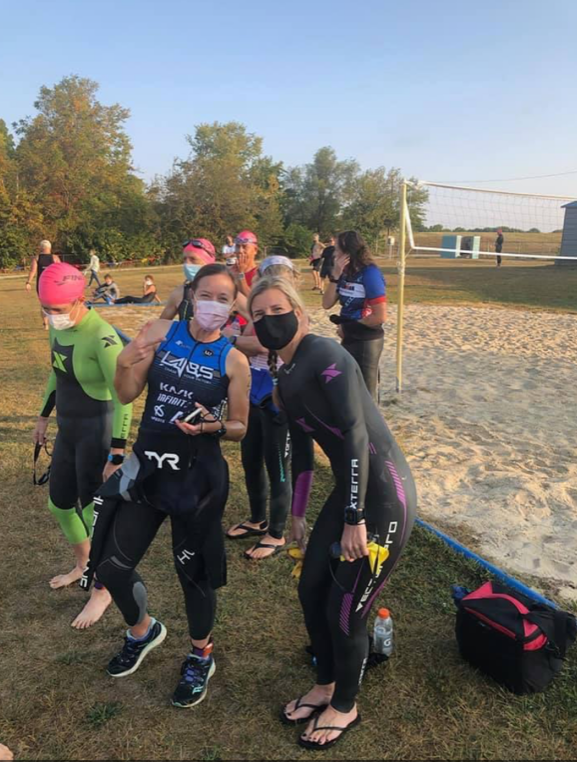
It wasn’t the world’s largest event, but that was rather the point. It was quite simple to social distance the entire day. The venue of the park lent itself to a good overall vibe. While the lines for the indoor toilets got a bit hinchy, participants kept their masks on and kept their distance.
Into the water
The reservoir in Muncie is large enough to attract bald eagles and osprey. I saw both species of raptors soaring over the water as the athletes gathered to start the swim. I share that information to afford some perspective on the scope and scale of such an event.
The Half Ironman distance came first, then the Olympic. The Sprint followed later.
That’s a ton of organizing to accomplish, especially in the era of Covid-19. Despite the major hurdles overcome to put on the event, some apparently ungrateful jerk accosted one of the race organizers and said, “Well, you can tell this isn’t Ironman…”
What kind of idiot says things like that? In a year when the pandemic cancelled everything in sight, the Muncie crew collaborated with the Mayor and police and medical teams to set up the swim, protect the roads, and staff aid stations safely. Who cares how the Ironman people do it? It’s completely irrelevant.
I watched all this organization with admiration as we shuffled down the hill toward the water to hear race instructions and behin. It was a warm enough morning that we weren’t freezing and the reservoir water temperatures were 68 degrees at the start. Near perfect conditions.
There was a stiff breeze already blowing by the 9:30 start for the Olympic triathlon, the event I’d chosen to do. My wife was already out swimming the first leg of the Half. Our friends Kerry and Mike Behr were doing the Half and Olympic as well. She greeted me at the end of the line and we headed toward the first buoys with a bit of trepidation at the growing chop.
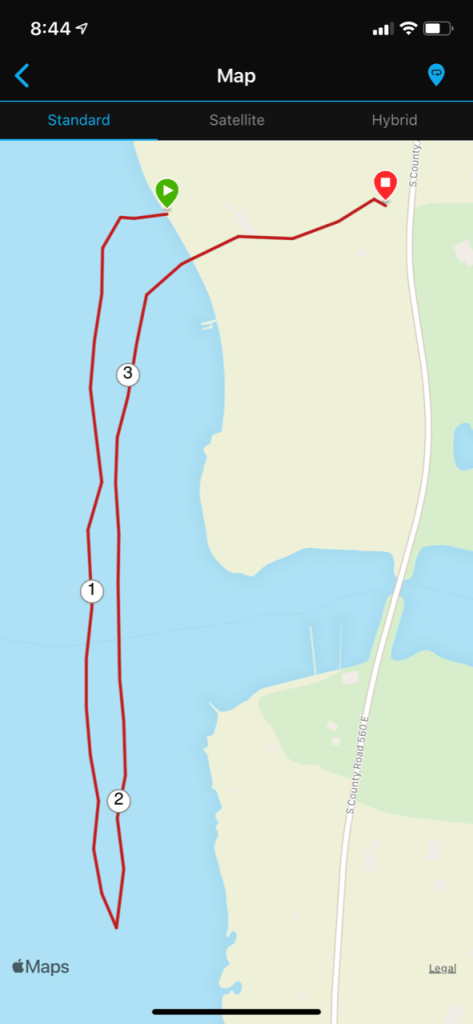
The law of the lake was to keep buoys to the left. I breathe to the right, so the trip toward the turnaround I faced the waves and took in a few accidental gulps of water. A year or so ago that would have freaked me out. these days I’ve learned to feel for the movement of the water and read the timing of the waves I swam fairly straight and hit the turnaround at 19:58.
That’s about what I expected. Despite the lack of swim practice this summer, I wasn’t tired. On the trip back I picked up the pace and returned in 16:00. The only thing difficult about the swim was keeping the mask on the whole time. I didn’t catch Covid, but there were a few dead minnows trapped in the elastic ties.
Crawling out of the water, I thought I hit the transition button yet learned upon getting on the bike that I’d actually missed. So my watch kept running as I trotted slowly uphill. Looking at the GPS track of my swim, I’ll take major credit for the relative direction and sighting. Damn, I’m pretty good! The trip out was tracking against the wind and waves. The way back was much more direct. Goddamn, I’m really good!
T1 travails
During transition a man at the rack behind me lay on the ground clutching his calf. He was clearly in pain, a situation made more uncomfortable by the fact that his wetsuit remained wrapped around his ankles. Asking the obvious, I called out: “Cramp?”
“Yes!” he replied. “I never get cramps.”
Most of us have been in a situation like that at one time or another. It’s easy \to get leg cramps during the swim. Sometimes they don’t show up until transition. After getting my own wetsuit removed by taking off the fat little timing chip band to roll the last bits around my ankles and feet, I stepped over to help the athlete curled up on the ground.
It took thirty seconds to finish getting his wetsuit off. His hands were gripped around his calf the entire time as I pulled firmly on the stubborn neoprene clinging to his calves. Finally the suit popped off his feet, but a grimace still covered his face. “Damn, this hurts…” he muttered.
Nothing I was doing in the race was important enough to ignore the needs of that guy curled up on the ground. I’d body-marked his arms and legs that morning. We’re all in this together in one way or another.
Bikeville
Walking my bike out of transition, I noticed that the watch still read Swim. “Dangit!” I thought to myself. Fortunately I’d peeked at the watch to know the real swim time, and that gave me confidence that I was on the way to a half-decent performance. Still, I needed to get out of transition mode. I hit the button and hit it again. Time to bike.
I have this problem with triathlon racing. A bad habit of sitting too far forward on the saddle in cycling. I don’t ride a true tri-bike yet. My Felt 4C road bike is outfitted with aero bars. But even when I raced my Specialized Venge road bike in Sprint events, that ugly cramping sensation happened during every race. It hampers me on the run quite a bit.
While it sounds like a simple problem to solve, it’s a subtle issue of bike position versus power. Add in windy conditions or bad roads, and the eagerness to keep up the pedal pressure gets away from me. Two weeks ago in Madison during the Half Ironman I paid particular attention to the propensity and kept shifting my weight backwards. For sure, the fit probably isn’t perfect on a road bike for tri-biking. But we make do during our transitions through the sport.
The biking was no horrible, but not that great. All I wanted to do was get through without cramping my ass so tight I could not run.
Novice to expert
Essentially I’m still a novice in this sport myself. This summer I did my first-ever Olympic distance triathlons and my first-ever Half Ironman. That first Olympic in Springfield was a slow and painful effort after the bike. My hamstrings cramped in the ninety degree heat and the 10K took forever. This race in Muncie was a much-improved 3:06, a time that placed me third in the 60+ Age Group behind a speedster named Christopher Niquette who raced a 2:31 Olympic to finish 8th overall behind the winner Brad Radowski in 2:15. In many ways the sport of triathlon is an ageless endeavor.
I finished third in my age group, 53 seconds behind the guy in second. Perhaps if I hadn’t stopped to help the guy with cramps I’d have finished second. But what would that have mattered? Isn’t it better knowing that the universe is an incrementally better place because you helped get a wetsuit off so a guy with cramp could get back to business? I think so. How about you?
A community on the go
We all start somewhere in this sport, usually by taking up one of the three disciplines, then adding others as we go along. After my race, I chatted with a middle-aged woman that had introduced her long-term fiance (they are going on nine years of engagement–– it works for them, she told me…) to running. He moved quickly from doing 5Ks to running 26.2 marathons, then added on the cycling and swimming. Now he’s a multiple-time Ironman.
That made me think about my own incremental entry into the sport. First I did duathlons because swimming was not yet in my repertoire. Going back to 2003, I took swim lessons expecting to start doing triathlons, then tore my ACL playing indoor soccer. It would be ten years before I’d get back to the idea of doing multisport events.
After a year of duathlons, I managed a couple Sprint triathlons. In those early days, swimming the 400-600 meter open water distance was a real test of courage. We all have our own share of starting blocks and stumbling blocks. Increasingly, I talk to people who no longer like to cycle on public roads for fear of being killed. This year, people struggled to find places to swim given the Coronavirus restrictions on health clubs and public beaches. Even training on running paths had a cringe factor as people struggled to understand the risks of airborne disease particles. This has been a strange year. But even in this odd atmosphere, we still need to find ways to improve.
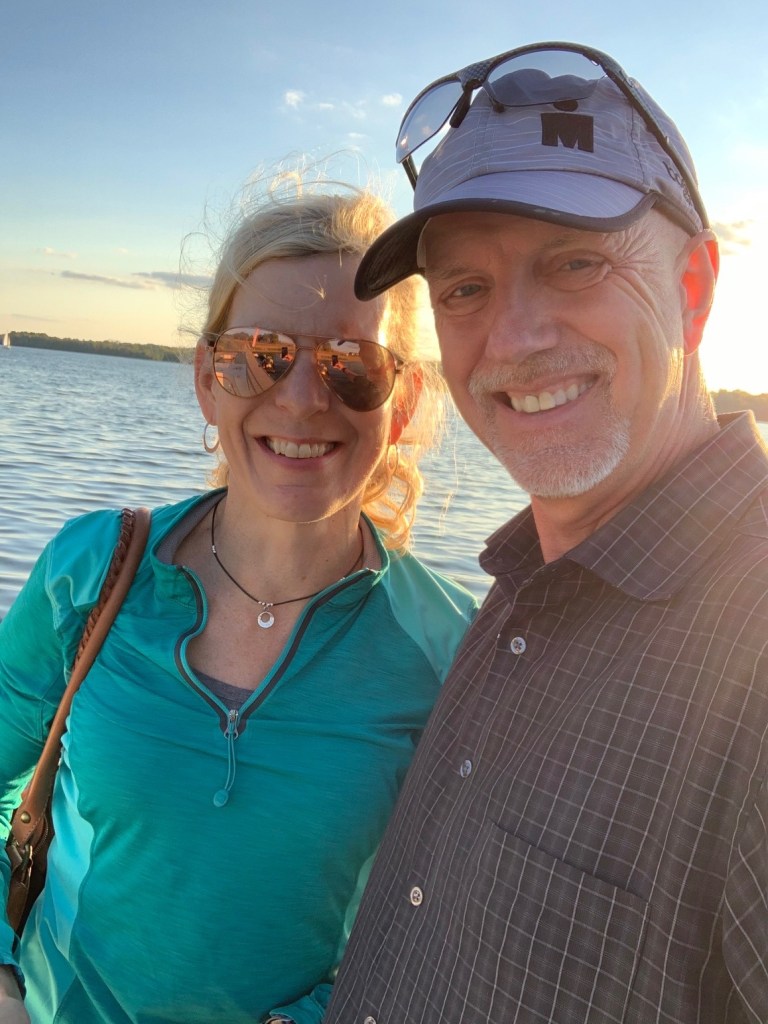
Somehow over the past year I’ve improved my swim times immensely, can always manage on the bike, but it’s the running that I still (and always will) truly enjoy. That, and doing these events with the woman that I love. We’ve shared a ton in the eight years we’ve been together. Time flies when you’re having fun.
The run course
The last six months I’ve been running negative splits on most of my runs. That delivers a sense of freedom, which means that I had a sense of confidence trotting out onto the run segment.
I was pleased to find out that the run course involved a ton of trail running. The surface was a mixed path of compacted dirt and rough gravel. After an opening 8:30 mile with a bit of a side stitch from trying hydrating well into the bike, I smoothed into a solid stride and started to roll. I was free and feeling good. Honestly I was in Runner Heaven, like I was back in high school and college cross country. So I started passing people.
The course wound through the woods and emerged on the road to a distance turnaround at 3.5 miles. At that moment I was like “Whoa, how’s this going to work?”
Was the course straighter on the way back? It wasn’t. My Garmin showed a total distance of 6.5 mile for the finish of the run course. Some folks were disappointed by that, but I didn’t care. I was honestly cooked at the 6.2 mile point but hung in there till the end. It was a blast. I’ll break 3:00 next year for sure. This course was tough, especially with the windy conditions. The hills were challenging too, but they made the whole race interesting rather than some merciless slog through some God-forsaken industrial complex or burnt out public park.
Not everyone was a fan, including my wife. She was sore as heck coming off the run course, but still won her age group for the Half-Ironman. Her swim was solid and so was her bike. The gravel trail was not her favorite part of the race.
For me, the really tough part was wearing a mask during the swim. (Okay, I’m kidding about that part.) Thanks to 3Disciplines we all got a chance to play outside. For that, I was grateful as heck.
Yesterday I ran an easy seven miles through a forest preserve and back. It was warm out again, so I didn’t run hard.
When I got back home and saved the workout on my Garmin Fenix, the data was shared over to my phone and spit back as a report. I was surprised to see that the Garmin app characterized my run as UNPRODUCTIVE.
I’ve teased and joked about my UNPRODUCTIVE training with my wife. It seems no matter how fast or slow I go, the Garmin shoots back that warning that I’m doing something wrong.
After that last run it said something like: “This is slower than your recent efforts. It may indicate that you are tired from training.” That is ironic, because it often says my runs are UNPRODUCTIVE…because I’ve run faster than usual.
Dangers of overtraining
Way back when I was training 60-80 miles per week in my early 20s, it was common for me to put in too many hard efforts close together. That led to injuries, colds and other breakdowns. One day during the start of a thirteen-mile run with a South African physician named Sol Epstein, I described the fact that I had frequent sore throats and was fatigued. He listened patiently for a mile or so to my naive complaining, then turned to me with a suddenly loud voice and said, “You’re fucking overtraining!”
He was right. But I was a product of that era. The philosophy back then, at least among the runners with whom I trained through college, was to go hard all the time. We typically ran our twenty-milers at between 6:00-7:00 per mile. The next day we’d do speedwork. We might have a race on Tuesday, do more speed work on Thursday, then race on Saturday. Sometimes on race day, we’d warm up four miles the morning of the race, jog a mile before competing in the five-mile race, then cool down a mile. Back home after the meet we’d run four more miles. The next day we’d do another 15-20 miler.
Out of my fucking mind
So it was shocking to be told by my runner partner Sol that I was out of my fucking mind trying to train so hard all the time. He was part of the racing team from the Runner’s Edge shop outside Philadelphia. Most of those guys in that group were far better runners than I, possessed of 10K times in the 30:00 range, or below.
I learned from training with them to do long runs much slower for 15-17 miles, but finish fast. Our speed workouts on the Villanova University track were quick, yet restrained efforts at a prescribed pace. That experience of training with them changed much of what I knew about distance running.
Data-driven lifestyle
These days, it is empiric data produced by devices that rules the world of endurance athletes. Yet that data is valuable only to the point that you can effectively interpret it relative to conditions. Some of those factors are definitively subjective, such as windy conditions, that don’t show up in pace-per-mile results. It’s true on the bike, too. That means assessment of a specific effort remains under the power of your judgment.
So there are days when my supposedly UNPRODUCTIVE training brings a smile to my face. The slower pace I ran yesterday was not the product of undue fatigue. I kept the pace modest for the precise reasons that my Garmin typically tells me that I’m going too fast. It’s all about managing your collective effort. I knew from years of training that my body wanted a run at 9:30-10:00 pace. Only the last mile or two were faster, down around 9:00. All good.
Likewise, on days when I feel good and rip through an 8-miler with negative splits down below 8:00 pace, Mr. Garmin may report that I was UNPRODUCTIVE and all I can say to my watch is two simple words.
Fuck. You.
That said, I do love knowing what the exact pace of my run, ride or swim turned out to be. I also love looking at the maps because they are a gratifying visual record of a workout, no matter how good or bad it went. It also helps knowing my pulse rate, elevation changes and relative cadence. But I’m not so tied to data that I can’t deal with not knowing these things. I’m not a total convert to a data-driven life on the road.
My wife wants me to get a power meter for cycling. But I think back to a year that I rode without any devices at all. No cyclometer. No watch. No nuthin’. Just rode. I needed that year to rediscover the love of riding. A part of me loves the notion of freedom too much to tie myself to a power meter or a heart rate monitor. People swear by them, I know. But I prefer to swear at my supposedly UNPRODUCTIVE training and laugh it off if Mr. Garmin doesn’t like what I’m doing.
This morning I visited the dermatologist for an annual skin check. My father had skin cancer and it’s nothing to mess around with. The sight of his bald head ground down to red patches is enough reminder to get my own skin inspected by a professional.
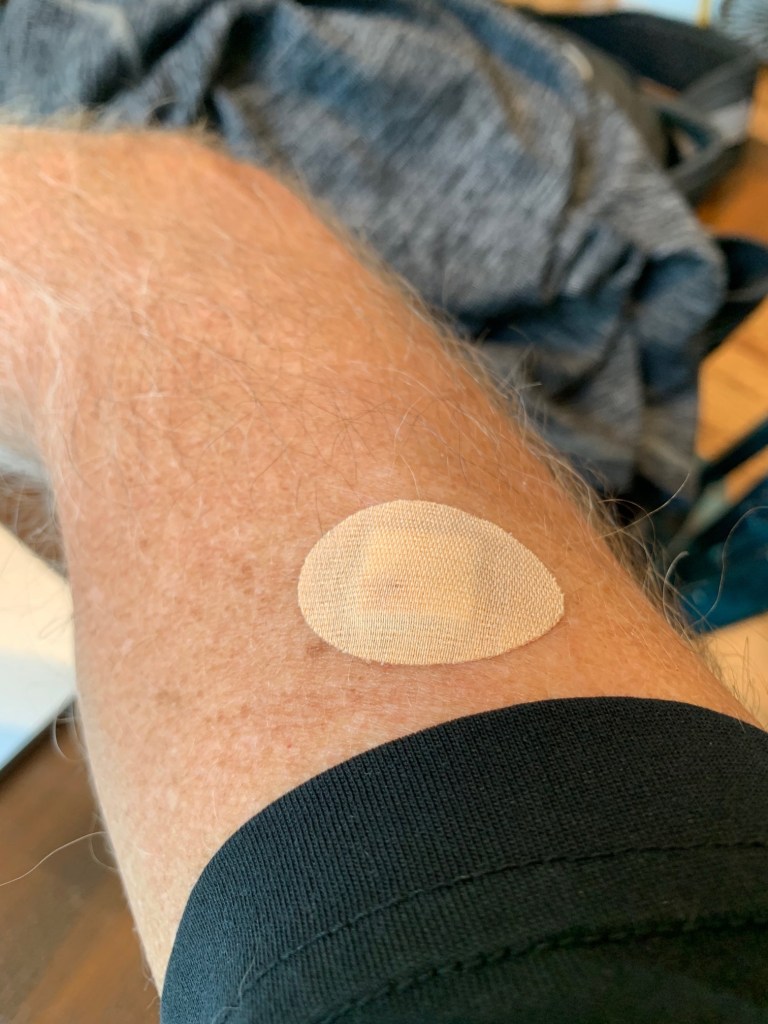
I have one small bump on the upper side of my right arm that they shot with novocaine and took a sample. Rather than engage in speculation and self-diagnosis, it seems much wiser to have a doctor do the work of determining risk.
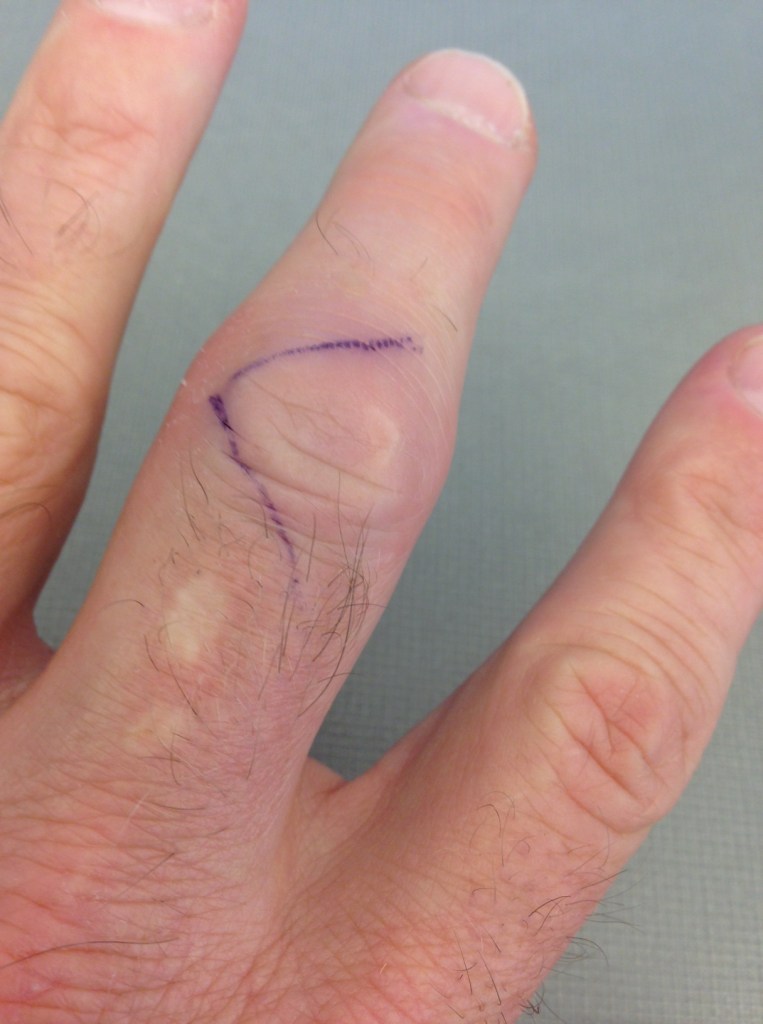
There have been enough health scares over the last eight years to convince me that it’s never a bad idea to go to the doctor when things look the least bit hinchy. Back in 2013 I had a sliver that caused an infection that could have cost me a middle digit on my left hand.
V marks the spot where the surgeon opened up the top of my finger. Notice the scars from flame-driven wart removal as a kid. I guess my left hand is jinxed.
That was followed a couple years later by a case of cellulitis when our family feline gave me a nip for petting her the wrong way. I’d never heard of cellulitis and did not know how serious it could be until it showed up on my right hand. That led to antibiotics that killed my good gut bacteria and led to c.diff., a potentially life-threatening disease.
So I don’t mess around with even the smallest signs that things are out of line. Last year an infected tooth almost killed me too. You could rightly say that infections are my weakness, my Kryptonite.
As for the current threat of infection in this world, the Big C threatening us all is Covid-19. I listened to a radio discussion with Dr. Sanjay Gupta on CNN this morning. He was discussing the recent vacillation on information distributed by the Center for Disease Control (CDC). The website posted a notice that Coronavirus is now known to float in the air “like smoke” said Gupta. Then the CDC took it down again. That raised concerns on many fronts. Was it a political move to force the CDC to comply with the Trump Administration’s directives to quell information about the pandemic?
I cite this incident because, as I’ve just shared, it is far better to be cautious than ignore the threat posed by infections in the human body. Dr. Gupta also shared that many Covid-19 victims experience serious holdover effects and symptoms that include compromised conditions of the heart, lungs and other organs. “You do not want this infection,” Gupta intoned.
Long haulers
There’s a word now for Covid-19 victims whose health is long affected by the infection. They are called ‘long-haulers.’ Nothing about that terminology is a joke, or meant to be so. Like many infections of the human body, the initial symptoms and response are not the gravest threat to long-term health.
For example, the aggressive treatment of my cellulitis resulted in a complete disruption of my gut function. I truly could have died from that.
200,000 people have died from Covid-19 in the United States. Seven million have thus far been infected. That’s during the good weather part of the year.
Back in early 2020, the United States Postal System was scheduled to send out sets of five face masks to every American. While the science of face masks was as yet undetermined at that point, taking precautionary measures is never a bad idea. That’s why people get vaccinated against potentially deadly or physically devastating disease. Vaccinations for smallpox, polio, measles and other infectious diseases have protected millions of lives.
Conspiracy theories about vaccinations still abound. For a while, there was serious traction around the idea that vaccinations cause autism. Famous personalities such as Jenny McCarthy preached against vaccinations. The term anti-vaxxers applies to millions of people who still claim that vaccinations, not the diseases they prevent, are more dangerous to human health.
“Cancer is a group of diseases defined by abnormal cell growth and caused by genetic defects. Most of us know that these genetic defects can be inherited, caused by environmental factors such as smoking, drinking, obesity and a lack of physical activity, as well as exposure to radiation and pollution. It is not commonly known, however, that many infectious agents, including some viruses (oncoviruses), bacterial infections, and parasites, can increase one’s probability of developing cancer.”
None of us lives a perfect life when it comes to the things we ingest or absorb in our lives. The world is now filled with chemicals that infiltrate our food, the air we breathe and water we drink. These toxins accumulate in our bodies over time. Even people who attempt to eliminate these threats from their existence are still prone to cancer. The late Linda McCartney (wife of Paul) was a known proponent of good eating. Yet tragically, she succumbed to cancer.
My late wife ate well and exercised regularly. So did the late wife of my former roommate and teammate Keith Ellingson. Both women passed away from ovarian cancer.
But had I not chased my wife to get a checkup with her gynecologist during a stage in life when her menstrual cycle was disrupted and profound, that cancer might never have been discovered. She might well have died within a year. Instead, supported by physicians and nurses who guided us through medical advice and treatments, she lived eight good years, long enough to see her son and daughter attend college.
Private and public empathy
Knowing the effects of that experience on our lives, it stuns me that some people are so selfish with their personal beliefs they refuse to wear a mask while out in public. I challenge all those who avoid basic self-regulation for health protection to consider the lives of those threatened by this pandemic. While the very young seem safer than most, the disease is not all that selective in who it ultimately impacts. Those who contract it warn that it is devastating on many fronts.
All it takes is a bit of empathy and concern for others to realize that infectious diseases are preventable if the truth is know about them. What people don’t understand is that the truth when it comes to medical advice is often is an evolving process. What is known needs to be shared, then revised as more or better information is discovered. This does not defeat the value of medical advice. Not does it excuse hiding the known truth about diseases like Covid-19 in the early stages of its spread. That is what was done by President Donald Trump. He lied to all of us. That’s not a CNN or MSNBC hit job as some like to claim whenever bad news emerges about Trump. The President willingly confessed the fact of his dishonesty to Bob Woodward. He was not coerced or misquoted. He was exposed for what he is: an inveterate scoundrel and liar.
This revelation is proof that the nation is under threat from an infection far more serious than any disease known to the human race. That disease is the propensity to lie for selfish reasons and greedy ambitions.
The Bible is rife with verses covering the pains caused by greed. Here is one notably specific verse that applies to what we’re seeing from our President today:
And in their greed they will exploit you with false words. Their condemnation from long ago is not idle, and their destruction is not asleep.
Silence of the shams
It is remarkable how silent the so-called Evangelicals are on the topic of Trump’s greed. They avoid the pain caused by his lies with claims of so-called moral equivalency by stating that “all politicians lie,” as if that were a defense of a prodigious slanderer, liar and brute. Even when his lies are directly quoted back to him, the President either denies that he ever said them or was somehow misunderstood. He is a sociopath whose deceptions are a massive contributor to the fact that 200,000 people have died on his watch. All through support and silence from the sham religious faction that calls itself evangelicals.
Self-care and beware
We’re all trying to take care of ourselves the best we can. With all the running and riding I’ve done under the sun, even the swimming too, I visited the dermatologist today to get my skin checked. Fortunately there seems to be no major issues. No bleeding sores or blackening formations on my skin. But one cannot be too careful in this world. It’s all about engaging in self-care and beware.
That is why I’ll be voting for Joe Biden and Kamala Harris this November. I believe in the protections of pre-existing conditions in the Affordable Care Act. I believe all people should have access to medical care despite their financial condition or their relative insurability. I believe that a significant portion of our current health care insurance system is a corporatized sham of profit-making that leaves millions of people completely out of the loop. I don’t think Donald Trump gives a damn. Neither does the Republican Party. They only thing they care about is holding power, enriching those that can keep them there, and claiming it’s all about ‘personal responsibility.’ Which is another way of saying, “We don’t care if you die.”
If the Republicans win, the cancer of Trumpism will expand. If they lose, it is still rife within our nation. It will take the chemotherapy of truth to root out the infectious parts of our nation; those that embrace racism, vigilante justice, denial of science, hatred for intellectualism and rationality, and religious bigotry as a worldview. These are the deplorable factions about which Hillary Clinton rightly spoke during her 2016 campaign. She was absolutely correct about all of them. The reign of Trump has proven her perfectly right, and even upped the ante. The nation’s worsts instincts have migrated from deplorable to despicable in the blink of an eye.
It will take strong medicine to quell the disease of Trumpism. Let us pray that the body politic of democracy can survive the necessary treatment.
I guess I’m Old School in more ways than one. Not only do I train with relatively little hydration, preferring to stop for sips rather than haul water around with me, I also avoid wearing earbuds while out running or riding.
Never have I grown used to turning my head into a music receptacle during longer runs. I recall the onset of music headphones with the Sony Walkman. Experimented with it. Didn’t like it. Didn’t do it. Left it to the joggers to own that experience.
Along came Apple products including all sorts of iPods. Generations of them came and went. Some of them are still lurking around as drawer detritus in various parts of our house. Tried them too. Left them home. Love the open air instead.
Even corded iPhone earbuds are fading away now. Runners seem to prefer the uncorded solution, and who can blame them? No one likes that flapping cord.
These days, people are quite keen on tuning out the world. For that purpose, nothing better than having music pouring through earbuds to block out the sounds of nature, traffic or conversation.
Fruitless hellos
That is why it is largely fruitless to say hello to runners on the trail these days. It seems that 50% of the people you meet or pass are tuned in or tuned out. I can’t help myself. I still say hello.
I can tell that my wife is sick of me trying to greet these bud-driven runners. I think it exasperates her to hear me talking to people that don’t hear what I’m saying. It probably reminds her how long I’ve been around the running scene (forever) and can’t seem to change my ways. I’m the Old Guy that still says hello to people while out running.
It will take a while to break the habit of saying hello. In my earlier, competitive days I was typically too focused to care about saying hey to anyone. But not entirely. While training on the Chicago lakefront and through Lincoln Park I met many nice people by starting up conversations. I even scored a few dates that way.
Times have changed. Now that social distancing is a “thing” even on the trails, people don’t want to be bothered by anything outside their carefully chosen bubbles of concentration.
So I’ll have to choke down my hellos or be deemed an Old School Interruptor. Life outside the earbuds still goes on, but some people don’t want to recognize it.