- Follow We Run and Ride on WordPress.com
-
Join 782 other subscribers
-
Recent Posts
Archives
- September 2026
- August 2026
- June 2026
- December 2025
- November 2025
- October 2025
- September 2025
- August 2024
- July 2024
- June 2024
- March 2024
- January 2024
- October 2023
- September 2023
- August 2023
- July 2023
- June 2023
- May 2023
- April 2023
- March 2023
- February 2023
- January 2023
- December 2022
- November 2022
- October 2022
- September 2022
- August 2022
- July 2022
- June 2022
- May 2022
- April 2022
- March 2022
- February 2022
- January 2022
- December 2021
- November 2021
- October 2021
- September 2021
- August 2021
- July 2021
- June 2021
- May 2021
- April 2021
- March 2021
- February 2021
- January 2021
- December 2020
- November 2020
- October 2020
- September 2020
- August 2020
- July 2020
- June 2020
- May 2020
- April 2020
- March 2020
- February 2020
- January 2020
- December 2019
- November 2019
- October 2019
- September 2019
- August 2019
- July 2019
- June 2019
- May 2019
- April 2019
- March 2019
- February 2019
- January 2019
- December 2018
- November 2018
- October 2018
- September 2018
- August 2018
- July 2018
- June 2018
- May 2018
- April 2018
- March 2018
- February 2018
- January 2018
- December 2017
- November 2017
- October 2017
- September 2017
- August 2017
- July 2017
- June 2017
- May 2017
- April 2017
- March 2017
- February 2017
- January 2017
- December 2016
- November 2016
- October 2016
- September 2016
- August 2016
- July 2016
- June 2016
- May 2016
- April 2016
- March 2016
- February 2016
- January 2016
- December 2015
- November 2015
- October 2015
- September 2015
- August 2015
- July 2015
- June 2015
- May 2015
- April 2015
- March 2015
- February 2015
- January 2015
- December 2014
- November 2014
- October 2014
- September 2014
- August 2014
- July 2014
- June 2014
- May 2014
- April 2014
- March 2014
- February 2014
- January 2014
- December 2013
- November 2013
- October 2013
- September 2013
- August 2013
- July 2013
- June 2013
- May 2013
- April 2013
- March 2013
- February 2013
- January 2013
- December 2012
- November 2012
- October 2012
- September 2012
- August 2012
Categories
- 10K
- 13.1
- 400 meter intervals
- 400 workouts
- 5K
- addiction
- adhd
- aging
- aging is not for the weak of heart
- alcohol
- anxiety
- bike accidents
- bike crash
- bike wobble
- blood on the highway
- boxing
- category
- Christopher Cudworth
- climbing
- coaching
- college
- competition
- coronavirus
- covid-19
- cross country
- cycling
- cycling the midwest
- cycling threats
- death
- Depression
- diet
- doing pulls in cycling
- duathlon
- evangelical Christianity
- fear
- foregiveness
- friendship
- game of chicken
- gay marriage
- God
- half marathon
- hating cyclists
- healthy aging
- healthy senior
- I hate cyclists
- injury
- internet trolls
- IRONMAN
- it never gets easier you just go faster
- life and death
- love
- marathon
- marathon santa
- marathon training
- Mechanical Genius
- mental health
- mental illness
- mountain biking
- nature
- Open Carry
- PEAK EXPERIENCES
- race pace
- racing peak
- religious liberty
- riding
- road kill lovers
- running
- running shoes
- same sex adults
- sex
- Share the Road
- steeplechase
- swimming
- Tarsnakes
- the rules velominati
- tour de france
- track and field
- trail running
- training
- training for a marathon
- TRAINING PEAKS
- tri-bikes
- triathlete
- triathlon
- triathlons
- trolls
- Uncategorized
- we run and ride
- We Run and Ride Every Day
- werunandride
- When the other man is an Ironman
- women
Follow me on Twitter
My TweetsLeave a comment!

Sunnier times and ra… on Tarsnakes Brett on Singing praises for Coach… Jim Nielsen on Singing praises for Coach… Jim Nielsen on Marty Supreme and Me Warren on Marty Supreme and Me
Seeing your way to better training and racing
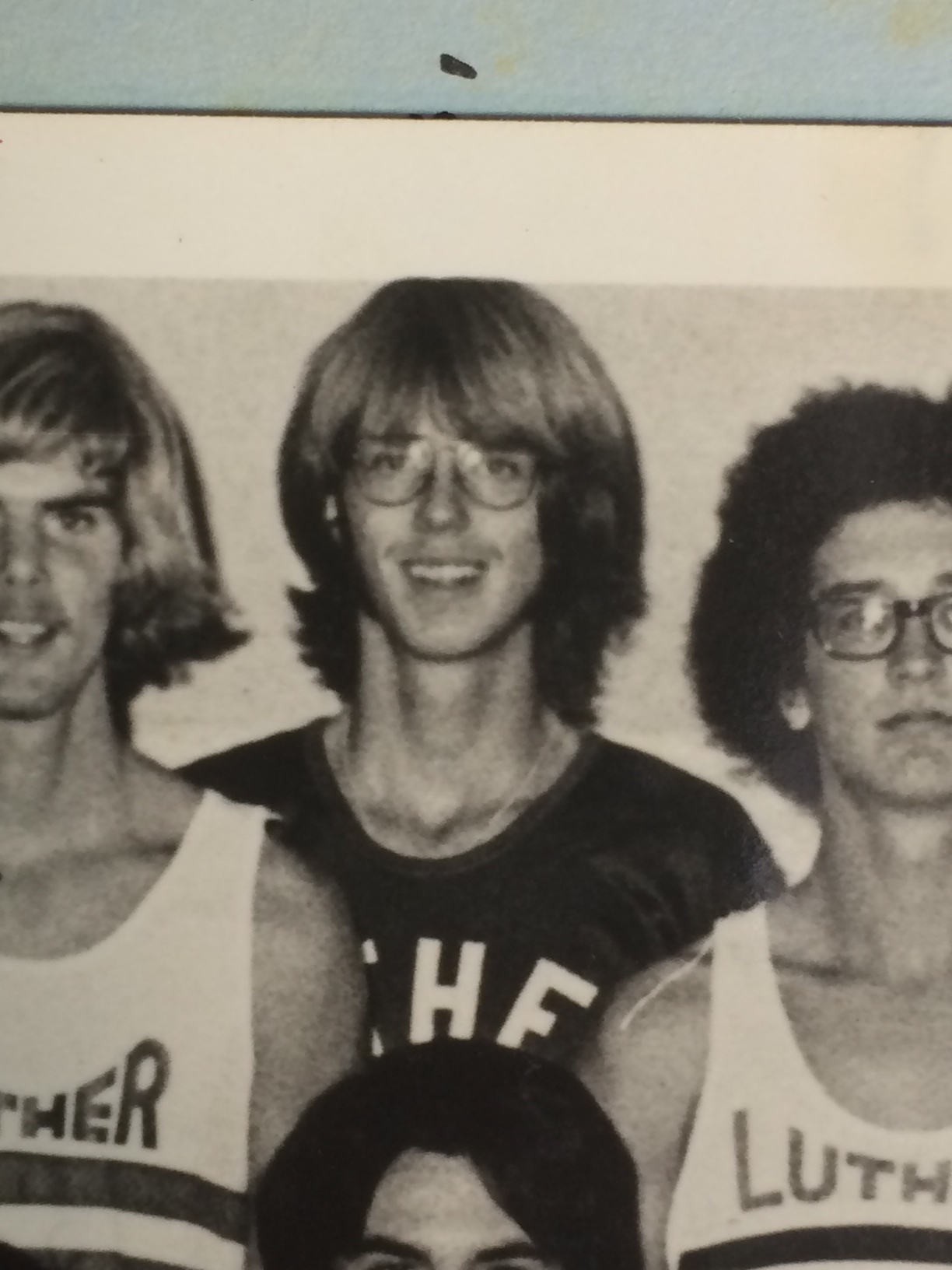
Between my junior year and senior year in college, I shaved an ugly 70s-version beard, cropped my hair from shoulder length to something more human than Sasquatch and got contact lenses to replace a pair of Coke-bottle glasses that weighed about 13 pounds.
That change in appearances was in large part responsible for an advance from 7th man on the cross country team to a consistent 2nd man for much of the season. Other circumstances including injuries to some valued teammates also had something to do with that. Yet the ability to step up when needed was the product of an enhanced self confidence.
It’s a fact. Athletes need to feel good about themselves to compete well. For me, emerging from behind that beard and a hood of hair so thick no hats were needed on winter days was good for my ego. Getting contact lenses put the capper on the makeover. Getting rid of those thick glasses provided both an emotional and physical boost. I was no longer pushing those large specs up my nose, for one thing. Who knows what sort of facial tension might have led to shoulder tightness, poor arm carriage and inefficiency.
Could big glasses really have that much impact on the human body? For certain. In my case it led to keeping my head up more. Even peripheral vision helps when racing, especially on the track, and most notably in my chosen event, the steeplechase. In close quarters going over hurdles with four or five competitors the last thing you need to worry about is a set of thick glasses clonking up and down on your face.
We all wore glasses bands back then. Those tended to pull your frames so tight on your face that your entire forehead would crease up. Not a good physical or mental scenario either.
So the freedom of running with contact lenses was liberating. It also helped that a pretty girl also was attracted to my newfound persona. We fell in love and that might not have happened if I was still doing my Napoleon Dynamite imitation.
The interesting thing about that change was returning to college in August and attending a fraternity party in the dorm. No one recognized me. That’s how profound the change really was.
There’s no doubt that the summer I got those contacts was an epiphany. Running for the first time since freshman year in high school without glasses stuck on my face was a sense of freedom too long missed. Of course there were lessons to learn about wearing hard contact lenses. The very first day I ran in them I wiped sweat from my left eye and did not notice for about 10 more strides that a contact lens had popped out. Tracing my steps back to where I thought I’d wiped my eye, I looked down at the ground and there it was. Just gleaming in the sun. Talk about luck.
First timer’s luck. There would be lost contacts in the future, of course. We all suffer that fate. My best friend lost his contact during a college cross country training trip in Wyoming. His eyes were really terrible. How he ran all those miles on mountain trails with just one eye is amazing.
I’m still wearing gas permeable hard contact lenses. They’re better than the plain hard contacts because they let the eye breathe a little. Not as slick and supple as soft lenses, of course. A long line of optometrists and opthalmology specialists have recommended that I stick (so to speak) with gas perm hard lenses because they supposedly keep the shape of my eye in place. With astigmatism the eye sort of goes oblong on you. So hard contacts are like orthotics for the eyeball.
Or so they tell me. One summer I lost a contact lens and all the eye doctor had in stock for temporary lenses was a set of soft contact lenses. That meant I had to learn how to put them in and take them out. It wasn’t that hard (ba dommm teeessssh) compared to hard lenses.

Even with contact lenses I need to remember to look where I’m going. Last summer’s collision with a tree was the result of riding with my head down. Even contacts can’t help you then.
And what a difference in feel! Where my hard lenses consistently feel dry or contact-y, the soft lenses were like having a naked eye that could see. There was just one problem. While cycling a slight downhill at 30 miles an hour one of the lenses started to lift up from my eye due to the backdraft around my sunglasses. I could see that lens flapping and trying to pull free. So I slowed the bike and stopped to flip the floppy lens back in place.
Yes, there are ways to avoid all this hassle with lenses of any sort. Lasik surgery works and my friends have gotten it. Some love it. Some are a bit disappointed. They all still require reading glasses.
As I flirt with events such as swimming in the triathlon the whole Lasik thing starts to make a ton more sense. After all, the contact lens that I lost that led to getting the soft lenses that summer was the result of a swim lesson. I don’t recall if I had not worn goggles or what. But no one is about to find a blue contact lens on the bottom of a pool. Much less the bottom of a lake, or an ocean.
So I reside in a world in which my contact lenses have indeed made my vision and training and racing so much better. But contacts do have their limits. They are one of the tarsnakes of modern human existence. A blessing and a curse.
It’s a strange thing to consider that this thin layer of glass or plastic is what enables me to see better and do the sports I love. Oh that my parents would have agreed to get me contact lenses for basketball in high school. So many pairs of bent and shattered glasses. And how those glasses confined my peripheral vision.
But times were different then. Only after I got out of college did I learn the glories of playing hoops without glasses. And my game continued to improve.
About two weeks ago I went to sleep without removing my contacts before bed. That was the first time I’d ever done that in 40 years of wearing contact lenses. I woke to a fuzzy world because my eyes were caking over with proteins. Yet I could still see. It dawned on me what I’d done. Fortunately there was no pain resulting from the mistake.
Before that the only other incident resulted from a long day spent with my college girlfriend that did not wind up until 1:00. I was at her house and could not stay the night, but my contact lenses were painfully dry and sore. Driving home like that was almost unthinkable, so I plucked the contacts out to try seeing without them. My eyes could see perfectly even without the contacts. The lenses had constricted my eyes so long they were sort of “stuck in place” and there was no need for glasses or contacts.
That’s sort of the principle of Lasik. They go in there and pinch up your eye a bit and you can see better. I got home safely that night. But by the time I’d slept through the night my vision had returned to normal. Which was bad.
It goes to prove that all of life is something of an illusion. Seeing or not seeing well is not just a need. It’s also a choice. I admired my blind friend that could run with his dog years ago. His blindness did not keep him home. It did not define who he was.
We tend to take our visual abilities for granted, those of us who run and ride and swim. But perhaps today you should open your eyes to the fact that seeing is also believing. We love to run and ride and swim because, in the end, we all love to see things. To experience things. To move and to see and feel that movement is to be alive.
And I hope you can see that.
Why entering a race sometimes just doesn’t register
The Horribly Hilly is an immensely popular ride in southern Wisconsin. Event demand is so strong organizers hold a lottery each year to determine who gets in. A few years back it cost $10 just to enter this lottery. Back then if you did not get into the race, that money was not refunded.
If 2000 people submitted $10 entry fees and were not admitted to the race that generated a quick $20K for the event. Talk about no obligation fund-raising! Most events would just call it a day at that. Thanks for the money, folks. See you next year.
They’ve changed their policies now. The Horrible Hilly still has a lottery, but they no longer charge for it. And it’s a great event by all accounts.
But hey, if a lottery works, there are probably a bunch of other ways to conduct race registration that are just as creative. Here are a few suggestions:
ONLINE SLOT MACHINES
People love to play games online! Instead of a lottery you can set up an web and mobile app in which entrants pull a digital lever and watch the slots whirr and ding. If it comes up three bikes for a cycling event or three running shoes for a marathon, you’re in!
CONTESTANT BEAUTY CONTESTS
Who says life or entry registration has to be fair? Races that only desire to have beautiful people enrolled should have web-based beauty contests. The model for voting already exists on sites such as Reddit/r/gonewild. Why not turn our races and rides into things of real beauty?
AMERICAN IDLE
Rent out a big stadium. Invite tons of people from an area to get tickets and stand around for hours or even days waiting for their chance at fame. The people who give up and leave are the losers. Those willing to stand idle for that long deserve to get into the event. That’s how American Idol works, isn’t it?
THE “NOT REALLY AN EVENT” REGISTRATION SCAM
If you set up a really nifty website for a race that does not really exist, with all the perks, bells and whistles athletes love such as free performance tees and amazing goody bags, it’s not hard to get people to pay $150 just for the right to run 5K with a bunch of other fools. So you take all their registration fees and send them an “I’m sorry this event has been cancelled” and make it really hard to get their money back. Actually, there are people out there that really do this. And they suck.
Well, that sums up our creative look at ways to conduct event registration with something other than a faceless lottery. We hope you found these tips useful and fun. Except for the last one. That really does suck.
Omigod there’s a body in there!
Well the Christian blogger lady got her day in the sun. She stood up for purity of mind in her fashion. Refusing to wear yoga pants without something to cover up her butt is noble indeed.
She’s got a right to worry that her husband might look at other women and be moved to lustful thoughts. That other men might look at her own derriere with sex on their minds.
She’s got a right. But she may have it all wrong.
There’s a whole world out there she and her ilk want to ignore. It’s a world moving beyond the idea that yoga pants are even an issue.
See, there’s this thing called sports. Additionally there are these things called cycling and running and swimming and triathlons. There are a whole lot of women wearing a lot less than yoga pants doing these sports. They’ve learned to appreciate their own bodies not just for what they look like, but what they can do.
It’s a rather “in your face” moment for any man when he realizes that the gal in the bikini bottoms just dusted his ass during the run portion of a triathlon. Or a 10k. Or a local criterium for that matter.
At that moment a guy can certainly admire the shape of a woman and have lustful thoughts. But he must also reckon with the fact that he is not the one who controls how that woman views herself.
That’s true for other women as well. The very competitive world of female appearance has a lot of variations. There are skinny models and plus size models competing for ownership of female body image. There are movie stars like Jamie Lee Curtis going honest about the ruse of being a sex symbol.
Recently a friend of mine posted an image of a Dancing With the Stars model on Facebook. She classily encouraged him in his appreciation at meeting her. See, he’s long been facing a life-threatening disease. His male friends and some female friends picked up on the lighthearted thrill of an encounter with a beautiful dancer. But a few jumped in to defend his wife from any perceived jealousy at the idea of her husband ogling the comely dancer. She wore a sexy dress. And omigod there’s a body in there!
In truth the world is finally coming to grips with the fact that having a body and even showing it off is not a sin. While the world of pornography is not exactly a happy place in some quarters due to human trafficking and abusive behaviors, there’s also a whole world of people out there snapping pictures of themselves naked because its fun. It teaches us something about ourselves and body image.
In many respects this widespread exhibitionism is performing an important role for society. In Europe where nude beaches are both legal and practical, public nudity is no big deal. In that context of body honesty, yoga pants are not anything prurient at all. It’s the taboo perception that they are revealing that is the real problem here.
Which is why women wearing running bras in public is no longer a problem at all. The taboo with such apparel has been removed by the practical necessity. It’s rather like society is saying, “So women have boobs. So what?”
We all have parts. Some people consider them naughty. That’s their weird little problem. Just go to a triathlon transition zone and watch whether people are concerned about their genitals. Quite the opposite. And while women may behave a bit more discreetly in such situations, while men still tend to be naked like pigs, those are issues that have their own rules and decorum. It’s not about the nakedness, but how you carry it.
Hang around enough female athletes and you’ll find a patent honesty in their regard for the bodies of other women. You’ll hear things like, “I wish I had her ass.” Or, “She’s got nice boobage.” To the credit of so many women, they realize that appreciation is not always sexualization. Soon enough, that model (no pun intended) becomes adopted by men as well. Pretty soon men and women are working out together wearing whatever they want and sex is not at the forefront of their minds.
Sure, there are always hormones flying around. Women aren’t immune either. Far from it. Where else did the term Man Meat come from?
By the time any one of us views enough selfies in all their forms, we come to realize that there are far more banal similarities between us than prurient definitions. Even the celebrity Fappening in which the iCloud accounts of stars like Jennifer Lawrence and Reese Witherspoon (to name a couple) were hacked, it all pointed out that even these famous people aren’t all that creative or compelling in their body explorations.
That’s the real message here. That making yoga pants into some symbol for lust is not some great insight. What’s the alternative, dressing women in burkas? There was a time when just the sight of an ankle sent men’s heart’s racing. But an ankle truly is no different than a breast if you build enough maturity into your viewpoint. It’s one of the tarsnakes of existence that we have these bodies and have to figure out what to do with them. We work to make them better and what, go into hiding?
So rather than take this naively childish approach to biblical interpretation in which we’re supposed to tear our eyes out rather than consider the shape of another human being, let’s stop and think for a moment. Could “pluck out your eye” just as easily mean remove the source of lust at its root? Perhaps, God Forbid, it’s really intended to convey that pleasuring yourself may be an acceptable way to pluck lust out of your eye and out of your heart.
I once had a doctor tell me that frequent sex was good for my prostate. “Great,” I responded. “Want to write me a prescription for that?”
He laughed, but he was also serious. “Take care of yourself if you have to,” he admonished.
This whole repression thing never really works out the way it is supposed to anyway. All those preachers and self-righteous politicians decrying sex while secretly engaging in all sorts of shenanigans prove the point over and over again. Dealing with sexual outlooks in a healthy way is far better than trying to keep it all in, only to succumb in some massive way.
The great Coming Out of the human body both male and female needs to continue. It’s time to stop with the immature approach with regard to what’s underneath our clothes.
“Omigod there’s a body in there!” How many billions of times do we have to say that before it’s no longer a surprise? That’s insane.
Athletes are truly leading the way in this regard. Building a healthy image also helps you regard others in a similar way. So strip down, work out and stop worrying about what’s underneath the yoga pants. It’s a body. Get over it.
10 ways to test whether you could you survive being a runner in the 70s
For better or worse, the sport of distance running has changed quite a bit since the Running Boom first took off in the early 1970s.
That’s when Frank Shorter won the Olympic Marathon and the world of jogging got its start.
But there were quite a few of us that were already running our butts off before Shorter opened this whole can of worms and authors like Jim Fixx and Hal Higdon convinced Everyman and Everywoman there was something special about the activity of putting one foot in front of the other as fast (or slow) as you can.
It wasn’t all pretty back then. In fact one wonders if the relatively pampered runners of today would put up with much of what the sport was about back in the 70s. Here’s a list of 10 ways to test whether you could survive being a runner in the 1970s.
#10: Running shoes were rare, spare and hard to wear.
The running shoes of the very early 1970s were better known as “flats.” These were minimalist black shoes with gum rubber soles about a quarter inch thick. There was very little heel lift. You had to buy them at local shoe merchants that stocked such fair. One salesperson once told me: “Don’t wear them around too much. They’ll stretch out your calves.” Then came adidas training flats and the SL72. These were snazzy looking shoes whose build still pretty much informs every running shoe on the market today. Solid insole. Heel cup and heel counter. Insignia on the sides. They were basic. And they were good enough. Finally NIKE and Tiger came along in the early to mid 70s and the shoe war was on. But you still had to really search to buy the best models. We purchased ours from Dick Pond, a local guy that sold running shoes out of his garage. His company is still alive today.
#9. We almost never drank water before, during or after running.
Some coaches even denied you you the right to drink water during practice. Most of us ran distances of six to fifteen miles without drinking anything at all. Once in a great while we’d creep on someone’s hose or the faucet on the side of an industrial building when we got really thirsty during a 20-miler. But other than that, you toughed it out.
#8. We raced three times a week.
High school cross country runners typically had meets Tuesday, Thursday and Saturday. In between those meets we’d often do speed work. That made for fast runners, but some who burnt out as well. With 18+ meets to run during the season, you knew pretty well where you stood in terms of fitness by the time the District, Sectional and State meets rolled around. As a result the sport at the state level was largely faster then than it still is today. It was not uncommon for the Top 25 athletes to all run under 14:35 for three miles. That’s what it took to be All State.
#7. We ate and drank what we wanted, and smoked some pot too.
While my freshman year coach counseled us on the better aspects of diet including instructions to avoid food such as carbonated beverages (sideaches) eggs (sulphur led to sideaches?) it was not uncommon for runners to ingest a daily diet of baloney sandwhich, Suzy Qs, Frito’s and a Coke. That was a pre-race meal. And we still broke 15:00 for three miles.
Beer was still pretty much PBR, Stroh’s and Old Style. There were no craft beers.
But there was a growing supply of pot. Frankly it destroyed some of my runner friends. Those of us that experimented with it and did not get sucked into a pot habit had some sense that it was not something a runner could sustain as a practical habit. There was all that smoke in the lungs, for starters. And it didn’t combine well with the drive to succeed. Ultimately it was our conservative instincts that balanced our taste for a liberal dose of fun. Such is the life of most runners. The 70s were one of the first real tests of those principles. The world could stand a dose of such equanimity.
#6. There was no such thing as tapering in mid-season.
Most runners “trained through” even important meets. The idea was to maintain a constant “tired state” so that when you finally cut down mileage the last weeks of the season you’d enjoy such fresh legs you could set PRs for three weeks in a row. Sometimes it actually worked.
#5. We did speed work out the ass. All the time.
Legendary speed-based workouts were common even at the high school level in the 1970s. Middle distance and 400 meter runners used to do workouts of 30 X 300 meters at ungodly paces. This is how one of my former teammates was able to run a state record 1:49 880. He barfed a lot to get there. But that’s what it took to be good back in the 1970s. It’s pretty much still true today. Because how many 1:49 high school half-milers are there even today? A few. Here’s the list of 800 meter records from the last 40 years…
800-meter run
National — 1:46.45, Michael Granville, Bell Gardens, CA, 1996
IHSA — 1:49.71, Jason Van Swol, New Lenox (Lincoln-Way), 1998 (finals)
Class 1A — 1:51.22, Peter Callahan, Winnetka (North Shore Country Day), 2009 (finals)
Class 2A — 1:51.48, J.D. LaFayette, Normal (University), 2014 (finals)
Class 3A — 1:49.71, Jason Van Swol, New Lenox (Lincoln-Way), 1998 (finals)
So for all the improvements in shoes, equipment, track surfaces and training knowledge, it still comes down to running as fast as you can in what you’ve got.
#4. We did insanely long runs to experiment on ourselves.
When some sophomore buddies and I decided to run the 30-mile DeKalb Walkathon we had no plan other than to head out and see if we could do it. Then it turned out that runners from DeKalb were there as well. So we raced the first six miles at six minute pace. then most runners quit and turned back to the NIU campus. But a few of us kept on. And on. One by one they dropped off. And there was one significant problem with this lack of strategy. The water stops were not even set up. BECAUSE IT WAS A WALKATHON! The organizers weren’t expected people to be out on the course running. Which left me all alone at the 20-mile mark with no other buddies to guide me along the way. So I kept on running. And running. Finally at 27 miles I begged a Coke in town because I was a little thirsty.
And we did shit like that more often than most of us would care to admit. Because it was the 70s. The frontier of the running movement. No one knew right from wrong. It was one grand experiment.
#3. We actually believed in our running heroes.
Perhaps there are still runners today that kids admire. But they don’t seem to inspire much…inspiration. By contrast we had our Frank Shorters, Bill Rodgerses and Steve Prefontaines to emulate. Then came the Africans like Henry Rono and others to stretch our imaginations even further. And we believed that running like them in practice and style could actually make us better. Women like Francie Larrieu Smith and Mary Decker Slaney, Joan Benoit and Grete Waitz were inspiring too. The 70s were a time for such naive beliefs.
#2. We sang our way to success. And failure.
Without Walkmans or iPhones or any other gadgets to carry along during training in the early 1970s, we had to rely on our own voices to carry use along. That meant heartfelt choruses of The Who and The Doobie Brothers. The Eagles and Kansas. Those strange anthemic tunes were all we had sometimes to finish off a 20-miler with no water on a Sunday morning in the hills of Iowa. It was tough going, but a song sung with buddies can often get you through the worst of situations.
And when we failed, there were sad songs to help us drown our sorrows in cheap Olympia or Coor’s beer.
#1. We dreamed of a better world.
There was a certain belief in the 1970s that being a runner was a secret way to becoming a better person. Coming back from a 15-miler, covered in sweat and walking through the football locker room to reach the cross country showers was a rite of passage of sorts. Our skinny bodies seemed nothing compared to the hulking, stinking, padded frames of those giant football players.
And yet I recall the moment when a runner from another team split off from the course tour before a cross country meet and tore through an actual football practice screaming KILL KILL KILL! at the top of his lungs. His name was Rich Flynn and he was a stupendously talented kid from Cary Grove high known to be a little crazy. It stunned us all that he had the guts to encroach on football practice like that.
Then he left us all in the dust during our three mile race. He seemed to run with such abandon and freedom that none of us dared to challenge him.
Yet thanks to all the torment that many of us had received at the hands of football players who believed they ruled the world in the 1970s, our competitor’s actions were symbolic in a way that drew our ultimate admiration. So what if he was crazy! He also had guts. Real guts to stand up in the face of insane repetition of thought processes that were clearly thick with authoritarian values.
And that was what many of us were about as runners in the 1970s. It was counter-culture to do what we did at so many levels. And despite all the corporatization of the sport over the last 40 years, there is still a streak within us all that hearkens to that independence.
Even my conservative running friends can feel it. There’s a certain liberality that comes from (and through) running. Even with its disciplines and rigorous requirements of dedication, there is an idealistic freedom that emanates from this sport we love.
One could argue that the 1970s started it all. It took a lot to survive that era with its pursuant hangover from the 1960s and its dark economic turns and shifts. It wasn’t perfect but it was real. Those of us that survived it sometimes stand back and wonder, “What was all that about?”
But the answer was simple. For better or worse, it was all about us, and who we wanted to become. On the run.
A little less fear of a cold winter and the blue moon
My record for running in the cold is twenty seven below zero. My eyes froze shut that day. Had to stop and thaw them out with warm hands pulled from thick mittens. That run only lasted two miles. it was relief from cabin fever however. Sometimes that’s all you can imagine.
It’s been cold but not that cold in Illinois the last few winters. Even at ten or twelve below you can pretty safely run without frostbite if you dress appropriately. Your lungs do not freeze.
I’ve even gotten six or seven cycling trips in this winter when temps have gotten over thirty degrees. My bike needs a really good wash as a result. There’s grit in bad places. I finally had to take the mountain bike over to the car wash and spray it down at the start of a ride. On a 20-miler the trip home required about four miles on a soaking wet limestone path. That bunk was stuck everywhere. It took a power sprayer to wash it out.
Now we have 14″ of snow and the streets are still a sloshy mess. No great rewards in riding in that slop. About 5 years ago I went out on such a day and wound up lying on my side while trying to cross a giant ice patch on ground where a mall once stood. As I slid to the ground my Motorola Razr phone flew out of my pocket. But I had not noticed. At home I checked for the phone and panicked. So I went back to the spot of the fall and found the phone lying in a puddle of water. I dialed out and connected. “Oh, it works!” I chortled. That was the last call that phone ever made. It died a few minutes later.

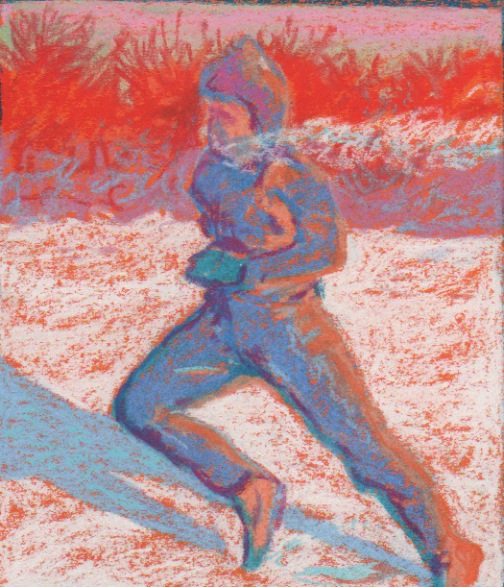
You have to relish the cold or it will keep you down. Illustration by Christopher Cudworth. Originally published in Runner’s World Magazine.
So there are risks to getting out and about on the run and on the bike in winter. You must be prepared to cut short a workout if your equipment gives out or the weather turns on you. Sometimes it’s even hard to get out the door when the cold blue moon is shining its light on the snow outside. Nothing makes it look colder in winter than that unforgiving bleak light of the moon on a smooth layer of snow.
When you actually do head out the door, it’s never really as cold as your imagination makes it out to be. The benefits of running under a full moon are pretty great. You can see the road and the beautiful sight of your own breath in the frosty air. What’s not to love?
Living in Lincoln Park in Chicago during the early 1980s, I was running tw0-a-day workouts to prepare for the spring season. One February evening I carefully considered the benefits of heading out for an eight mile run from 1764 N. Clark Street up to Montrose and back. It was eight below zero. The wind was whipping from the north. It was damned cold.
On the return trip I was hugging the lakeshore and somewhere near Fullerton I think it was a giant wave crashed against the sea wall and flew twenty feet in the air. The cold lake water came sloshing down on my head, shoulders and back. It stopped me in my tracks, which was bad because there was a second half of the wave that caught me standing still.
At that moment you seriously wonder if you’re going to freeze in your tracks and die. Even my half Gore-tex top was soaked through. The rainproof pants did not keep the water off my socks and up my legs. “God. Damnit!” I yelled. Then I started up running again.
That was a long three miles from home. But it’s surprising how quickly your body heat helps you cope with the freezing temperatures and half-frozen water dripping down your ass crack. Actually I kept a brisk pace the rest of the run.
That shower back home felt really good. But the landlord was cheap and the temps inside our apartment were just under sixty degrees all the time. Sit around in that and you start to shiver.
So every time I think about running outside in cold weather, the memory of that really cold night and the violent wave that nearly took me out come to mind. I pull my gloves a little tighter and my balaclava up over my face and head out. I no longer live and run or ride near a lake. Just a sluggish cold river. And I tell myself, “It’s cold. But I have a little less fear of winter.”
Posted in Christopher Cudworth, cycling, running, We Run and Ride Every Day
Tagged cold weather cycling, cold weather running
1 Comment
Craig Virgin exemplifies the best of American distance running
Just under a year ago I wrote this piece about Craig Virgin, one of America’s top distance runners. He was recently featured in a piece by the NCAA for his accomplishments as a runner and for his perseverance through congenital illness as a child and coming through adversity following his career. A writer is working on his biography and is seeking photos of Craig Virgin from the late 1970s through the 1980s. If you have any such content, contact Randy Sharer at rsharer@aol.com.
By Christopher Cudworth
During the Sochi Winter Olympics, three-time Olympian American distance runner Craig Virgin was interviewed on NPR for his perspectives about the 1980 boycott of the Soviet Olympics by the United States. Virgin’s lucid, compelling observations about the futility of that boycott in terms of world politics has been validated by the political situation in Ukraine following the Winter Olympics. Russia’s move into Crimea has driven futile protests in the West. It was clear back in 1980 that the Olympics were a poor tool for nationalistic policies, and they remain so today.
Virgin’s lost opportunity to represent the United States at the peak of his athletic career had personal costs that continue to resonate today. The lost opportunity to earn an Olympic medal damages an athlete’s value as a personal brand on the marketing front. There were hundreds of other athletes who similarly lost that opportunity in the…
View original post 2,165 more words
Posted in Uncategorized
1 Comment
Oh that’s Super. Just Super.
The Super Bowl felt like a giant convergence of social memes last night. While it’s fun to watch the game, it also captures the contradictory force of nature America has become.
The headline of today’s blog has a bit of a cynical feel, doesn’t it? When someone tells you that something is “Super. Just Super,” they are typically not being complimentary. They’re using hyperbole to shoot you an insult.
Those of us that have learned to be cynical about supposedly super things like pro football now have plenty of confirmation that at its highest level football has become a strickeningly corrupt and abusive sport.
Heads up
The concussion controversy continues in the background of the football world. There are those who think that ultimately something in that category will have to reckoned with. Kids get banged up and lives get altered from concussions, especially on repetition. Without youth football, you ultimately would not have pro football. It’s a serious problem for the game America claims to love.
Maybe we’re dumb. Maybe just happy.

Yet a fascinatingly large percentage of Americans seem happy to ignore such threatening trends and facts. As long as things like football as entertainment make us happy, we are content to ignore the risks.
It’s become the symbol for the entire lifestyle, the American Way we employ to aggressively ignore anything that threatens our way of life.
That’s the exact reason why we have so many people are still denying the very real dangers of climate change. The American fixation on the costs of change and sacrifice take precedence over global preservation and safety because some brand of popular and powerful opinion holds sway in society. Maybe we’re dumb. Maybe just happy. Just like pro football.
An ethos and religion
That’s because football acts like a religion in this country. People adore the Friday Night Lights tradition because it provides ritual as a foundation for life. The following definitions help describe this phenomenon.
RELIGION:
a particular system of faith and worship. plural noun: religions “the world’s great religions”
a pursuit or interest to which someone ascribes supreme importance. “consumerism is the new religion”
Sacrifice
There are even people who get sacrificed to this religion. That includes players who give their lives and their minds to the sport. But it also includes the many spouses living in constant threat from domestic abuse by husband/players that cannot turn off the violent tendencies necessary to thrive in pro football.
That level of intensity may exist naturally in the human race. But the more insidious aspect of those situations is that abused wives fear that speaking out will jeopardize their husband’s lucrative, often short careers in pro football. It’s an ironic twist that the NFL considers itself a “family.” A family that does not reveal its dark, coarse secrets.
It’s an inevitable product: If you are going to train up young men to hit and be hit, to dominate without question and to ignore pain in yourself and in others, there will emerge a brand of psychopathy in some people. Not all. But enough that society should take a hard look at what it wants from its sporting religions.
Pagan traditions
Like most religions (Christianity for example) football draws on pagan traditions as a foundation for mass appeal. That is exactly why half-naked cheerleaders crowd the sidelines. It’s literally their job to jump around, shake their boobs and titillate the fans. Interestingly, this year’s Super Bowl television coverage fairly ignored the grossly underpaid, scantily clad “cheerleaders” as sideline candy. But then we had the Victoria’s Secret commercial to make up the difference.
It’s a rather interesting intersection at which we’ve arrived. Female fans seem to enjoy these commercialized enticements of comely women as much as men. That’s not a bad thing necessarily if the appreciation is subjective on the order of choices made and some sort of equity.We’re apparently all in on some super joke that under it all, we’re all alike.
Perhaps paganism remains the one true religion of the world after all. It’s all about the battle, spoils and plunder. A rehearsal perhaps for the apocalpyse so many Americans seem eager to believe in.
The Apocalypse, you see is the Big Payback against all those who lack virtue. It’s all part of God’s Playbook for humanity. That’s when Coach Jesus returns with the player’s roster on which the names of all those who worship the Coach are drafted into salvation and eternal life in heaven. Seats on the 50 yard line. Or perhaps a Skybox? Yes indeed, the Super Bowl and its accompanying religious fervor seem like the tribulation come to life.
Human chattle

But as we’ve pointed out, there’s are many problems with the scenario of pro football as a religion and the Super Bowl as the High Mass.
There’s this whole Roman Empire thing going on around the Super Bowl, which has become known (among many vices) as the annual focus for the sex trade and human trafficking. And it gets worse. Like online gambling and other recently legalized vices, the sex trade is likely just a step away from becoming one of those partnered revenue sources that feeds the sin-tax principles of politicians seeking new revenue. Prostitution is already legalized where? All that money changing hands for sex slaves is going to be too tempting for politicians to ignore forever. Just you wait and see.
Because the NFL, so far as one can see and hear, is about ownership of human chattle. There are draft days, and players bought and sold. The compensation can be great for those involved. Yet the costs can be just as great. Investing your entire life for a shot at NFL glory sounds good. But it’s not that much different from the sex trade.
Legitimizing abuse
With politicians mouthing phrases such as “legitimate rape” while defunding real attempts to prevent unplanned pregnancies, one sees that the self-absorbed patriarchs who live among us still view women as sexual property, and little else. In that regard there is a very real anti-Christ living among us.
Up to the old tricks
What Satan really seems to enjoy the most in life is confusing the innocent with coy phrasing and tests of character that lead us, as in the Book of Genesis, into temptation. Here’s a little scripture sampling to show how the supposed doer-of-all-evil actually works.
3 Now the serpent was more crafty than any of the wild animals the Lord God had made. He said to the woman, “Did God really say, ‘You must not eat from any tree in the garden’?”
2 The woman said to the serpent, “We may eat fruit from the trees in the garden, 3 but God did say, ‘You must not eat fruit from the tree that is in the middle of the garden, and you must not touch it, or you will die.’”
4 “You will not certainly die,” the serpent said to the woman. 5 “For God knows that when you eat from it your eyes will be opened, and you will be like God, knowing good and evil.”

We’ve all heard what politicians and pimps are prone to say, and for real. “No means yes if you know how to spot it.”
Or, “Why would you accuse your husband of abuse if he provides for you?”
And, “You made the choice to play football. Isn’t it your responsibility to deal with the consequences?”
Dressed in fire. Defying the gods.
In case you did not notice it, the halftime show with Katy Perry served up a mocking festival of grandiosity. Her playfulness as a performer uses sugar-coated humor, like this video California Girls … to comment on how weird the world of objectification really is.

So we all knew that we’d be getting a rigid looking Katy Perry (she can’t really dance) riding out to midfield on a giant faux-golden pussy cat. What else could it have been? Then Lenny Kravitz played guitar (we think…) like a saint sent from Beezelbub. Finally, Missy Elliott turned the event into a hard-rapping dance orgy. It really all fit nicely with the theme of the day. “Oh that’s Super! Just Super!”
Big picture
The Super Bowl is simply political theater, writ large. Imagine how the sight of all that glitz and materialism must look to our sworn foes among the religious terrorists that so hate American aggression and consumerism. I mean, My God! The Super Bowl is like waving a red flag right in the face of a raging bull. Look at us! Look at us!
The evidence against us as a profligate nation is all there. The violence. The sex. The human trafficking. The abuse. The deflated footballs and overinflated egos.
All in good fun
It may be fun for all of us to watch the Super Bowl and pro football. There’s no denying its stimulating allure. The surprises and big plays. Even the colossal mistakes are Oh So American in nature. So we get some of what we deserve for loving football like the religion it has become.

Religious organizations across the country, fearing for their own dissolution with falling membership and a society of DONEs, could learn a few things from the NFL. It’s the new Catholicism as it were. Dispensational confession to the sport that takes no prisoners. Yet we all fight on in vicarious fealty to the Patriots, the Seahawks, the Browns and Bears and Chiefs. It’s all very childish in an ADD sort of way. Football as a focus is in fact a distraction from our distracted way of thinking. We feed ourselves to the sharks, and then wonder aloud about how it all happened.
A super reaction
In that sort of culture, how else could we react when those terrorist-drive planes (if the conspiracy theories aren’t true) crashed into the towers in NYC. We stared at our TV screens in wonder, and in awe, and with a trace of fear. But then a voice in the back of our cynical little American heads said the words that captured it all.
“Oh that’s Super. Just Super.”

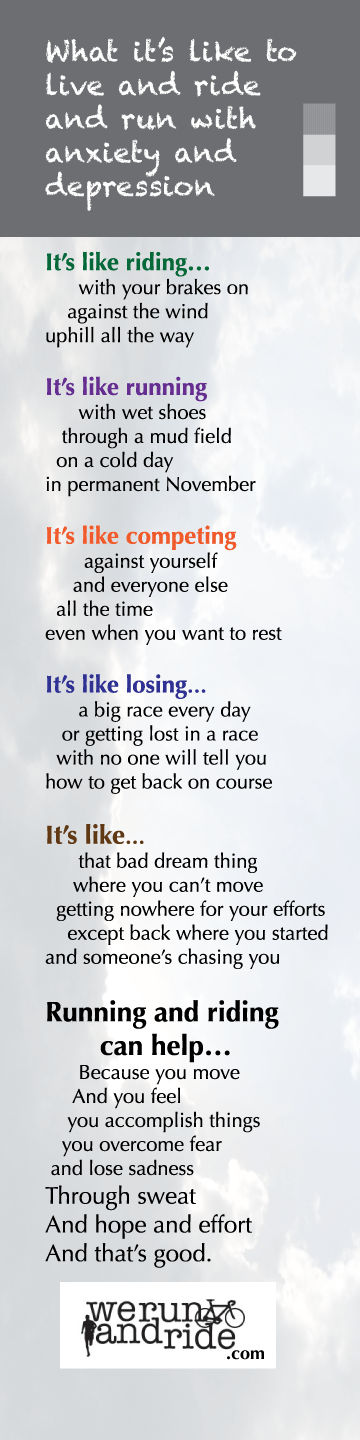
What it’s like to live with anxiety and depression. How running and riding can help.
Posted in Christopher Cudworth, cycling, duathlon, half marathon, marathon, running, triathlon, We Run and Ride Every Day
Tagged anxiety, depression cures, living with anxiety, living with depression, running and riding, running to cure depression, running to relieve stress, stress relief
Leave a comment
Ooops I forgot about February
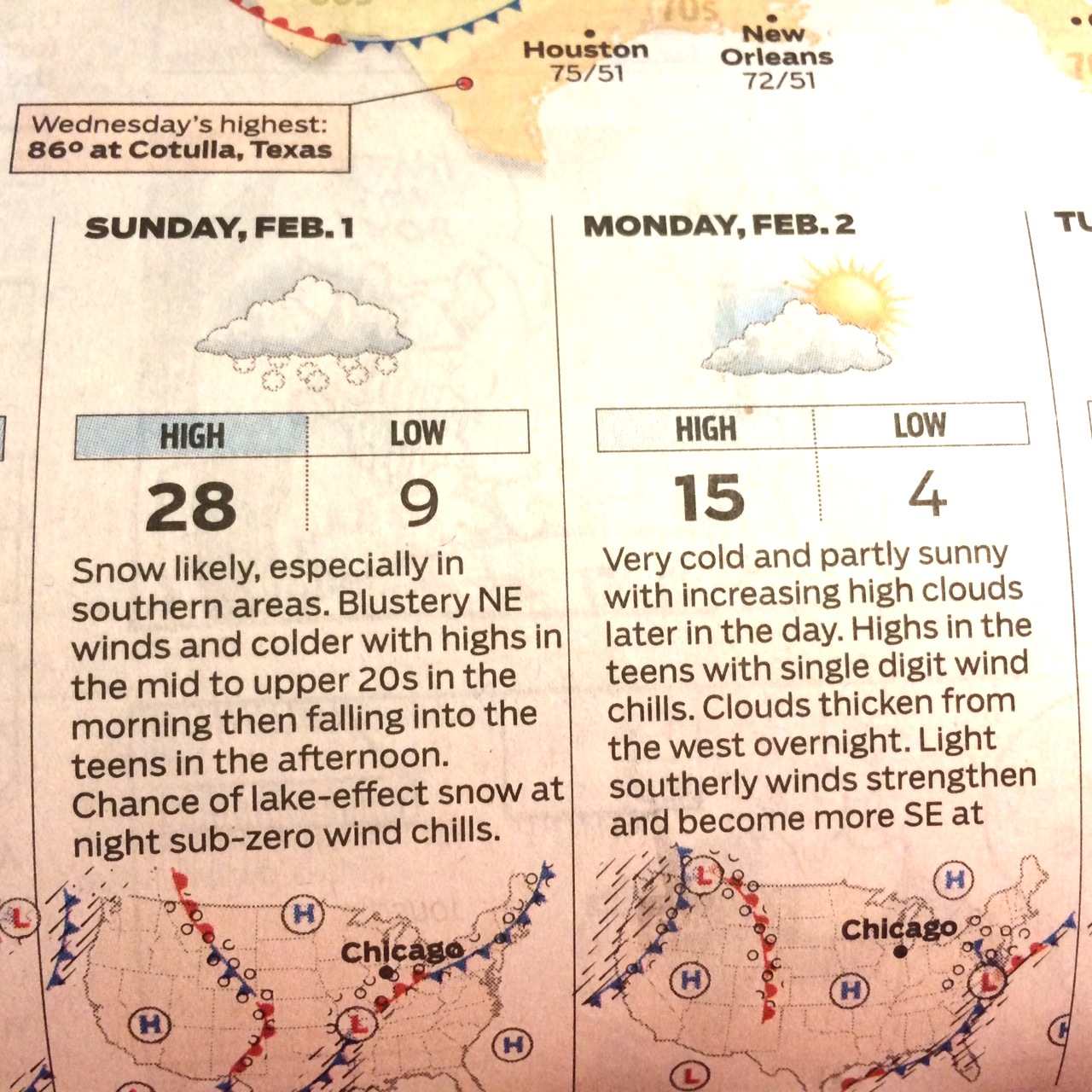
The weather forecast here in Illinois this week is not encouraging. Temps are predicted to drop to the low single digits. Winds will be ripping the makeup right off the faces of women commuting through the streets of Chicago.
That’s February for you. I almost forgot about it. Thoughts of spring were so nice when a warm front came through the last day or so it was possible to smell a faint whiff of water on the breeze. Tantalizing. And deceptive.
That sweet breeze! It blew from the east as I ran my square little three-mile run around the high school and back. My middle mile dipped below 8:00 with the wind blowing up my ass like a motivational fan.
How often we’ve deceived ourselves with a wind like that on a bike. Riding along at 22 miles per hour we’ve convinced of our status as talented cyclists. Then we turn around and head back into a wind that we conveniently forgot about and the suffering begins. 12 miles per hour becomes difficult. The interior dialogue goes from hero to goat. “You suck at cycling,” a little voice in your head keeps muttering. On the February breeze you think you hear the clinky sound of frozen laughter. Turns out it’s only ice on the trees.
In winter a wind like that can literally kill you. Work up a sweat going west and then find yourself coming back into a cold lake-driven wind 30 miles west of Chicago? That can put you into hypothermic distress. It’s best to carry an extra layer in the butt pocket of your Pearl Izumi jacket for just those conditions. Just in case.
Flat and cold. Like Illinois.
God Forbid you should get a flat on your road bike tire when it’s 28 degrees outside and the winds are pretending that you’re a polar bear out for a hunt. It doesn’t take long to go from sweating to freezing. That can happen if you forget to respect the month of February.
As a kid I was a paperboy carrying the Chicago Tribune and a bunch of smaller newspapers. I rode my Huffy 3-speed bike all over the town of Elburn, Illinois from 5:30 in the morning till 6:30 every day. Some mornings the temps dipped below -15 degrees and it was best to keep moving. Keep crunching. Get the route done. Don’t think too much. It’s February and it’s cold.
Respect the month
At home I’d warm up by a heater as my mother made hot shredded wheat or eggs. All those mornings built character. I no longer feared the cold. But I did respect it. Yet we forget those lessons. Looking ahead to spring we forget there are 28 days of completely unpredictable weather to fight in the month of February.
Inside thoughts
Fortunately there are warm gyms in which to lift weights and run on treadmills or ellipticals. Yet I still prefer to go out and ride over dealing with the whole Computrainer thing. Part of that is that my bike fit still sucks despite $800 of adjustments a couple years ago. Proof that money fools a fool, I guess. But we’re dealing with that whole bike fit thing while February is still playing with our hopes here at the Cudworth Clinic. Starting from scratch on the bike fit. There’s riding to do.
Journal hopes
My running journal is filling up with consistent efforts again. Honestly it will be March before the rides add up to anything much. I’m still reeling in consciousness from a tricky day 10 years ago when I rode my road bike into sixty degree temps and fog only to see it dramatically drop to 45 degrees with a wet mist that had me shivering at the last stop light before town. I stood there shaking so hard and praying that my body would not fail me before getting home to a warm shower.
I could only think to myself, “Oooops, I forgot about February.” Respect it. Or it might kill you.