Back in the 80s, when everything was everything

At the wake of my late coach Trent Richards, whose funeral will be this morning, I was walking through the photo displays and noticed a race brochure with a familiar logo on it. I burst out laughing, which is not the appropriate thing to do at most funerals, and bent over to take a photo of the race brochure. Here’s what it looks like.

Race Logo.jpgNow there’s a lot of things wrong with this logo. It’s busy as hell for one thing. And it’s rather sexist to boot. But in 1981, this is the kind of thing that was used to market races.

I have to laugh at the beer can holding the gun, a little tipsy to boot. And the beer cans in general. What a hoot. And decent hooters, let’s admit that much. It was 1981. The Hooters restaurants would come into being only two years later in Clearwater, Florida. So I was leveraging the mood of the times.

My friend Trent Richards was race director that day. Hence the contract to design the race brochure and logo. I can tell you that this was done entirely by hand. The drawing was sketched out in pencil and inked in by pen. Then I used a graphic material called PressType to lay in all the words. By hand. Letter by letter.

This was tedious work, and lots of things could go wrong. It was pretty easy to run out of certain letters when using PressType. When that happened, one had to improvise and create letters out of less common letters on the sheet. More than once during my graphics career from 1980 through 1984, I’d be up late at night doing logos or brochures and be forced to create a new “e” from a “c” and an “h.” This involved tight and dedicated pressure with a tool that looked like a cross between a plastic fork and a vibrator. It came to a point that could be used to press type into place. Hence the name.

You’ll have to pardon me for the flag the comely young gal is holding. “I went all the way!” is most definitely 80s-style humor. One must recall that shows like Three’s Company made jokes like that all the time. I was instructed to do the same. “Come up with something sexy,” was the instruction given by the race committee.

Okay, maybe it’s not that sexy. But you know, I did know how to draw a hot chick in my day. That hair. That kitty cat face. Pure 80s kitsch.

As for the race itself, it featured plenty of beer just like it says. And some dope decided that it would be a smart thing to drink a bunch of that beer before the race even got started. We found him on his back in a soggy ditch. His tongue was thick and clogging his throat. The combination of a hot day and all that beer in his system had caused him to faint. We later learned he may have experienced liver failure of some sort. Thankfully, he did not die.

But that was the last year they held the race. Probably the organizers realized that a promotion that combines so much beer and running in the early summer heat was a bad idea. Which makes me think strange thoughts every time I read about these races where people drink beer and run. it sounds fun, but it’s a really, really bad idea.

Still, the innocence of those days when everything was everything brings back some nostalgia. Everything was over the top if you could do it. And everything was fair game if you could promote it. Remember Reagan was President and a wave of conservatism was sweeping the country. Young people attended wearing polo shirts with popped up collars. It was suddenly hip to be square. In another few years Huey Lewis and the News would sing the song celebrating, perhaps tongue-in-cheek, but perhaps not. The lyrics went like this:

I used to be a renegade, I used to fool around
But I couldn’t take the punishment and had to settle down
Now I’m playing it real straight, and yes, I cut my hair
You might think I’m crazy, but I don’t even care
Because I can tell what’s going on

It’s hip to be square

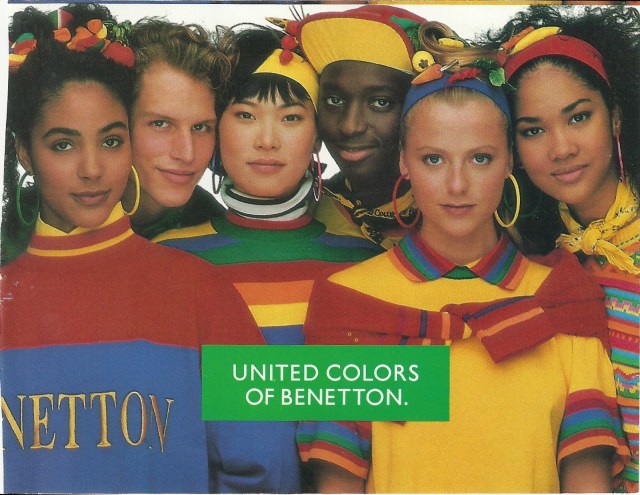
Colors by Benetton.JPGI never bought that line about being calculatedly square even in jest. Who needed that kind of approval to succeed in this world? Perhaps some vain or shallow types. But that whole repressive/regressive/hip conservative schtick was contrived.

Okay, I’ll admit to wearing a popped collar or two. And sporting Colors By Benetton sweaters and Colours By Julian ties, pants and shirts in the early 80s. That was the fashion of the day. And look at those ads by United Colors of Benetton. There are some to this day who would call them controversial. Too colorful in terms of skin and diversity. Proving that some members of society have not advanced much since the 80s. or the 70s. or the 60s. Or the 50s. Or the 40s. Or the 30s. Or the Civil War. Color and diversity is just threatening to some people.

God Forbid, we also wore running shorts that did not cover our male thighs. And we wore singlets and shorts that were lighter than silk. Some today might still brand these 80s fashion trends less that masculine.

It was such an everything was everything period of time, the early 80s. In some ways kind of geeky bad. But in others, way ahead of its time.

Posted in Uncategorized | Tagged , , | 2 Comments

The perils and pleasures of being frightfully naive

IMG_5467.jpgToday there is a wake for my late coach Trent Richards. As shared in this blog last week, I met the man when I was only thirteen years old. I recall the world back then as a bluntly mysterious place. I was too trusting of many people, and seemed to know so little about the world at times that I could not help being victimized by my own naivete.

Times were different, of course. These days the Internet is a veritable Pandora’s Box of what you might want to know about everything from world politics to female and male anatomy. But back then, one gleaned knowledge in parsed bits from what you encountered on your own.

Yet there was great pleasure to be found in really finding something out on your own. That was why my brothers and I enjoyed our birding adventures so much. The first time you find a species of bird in the wild, one that you have never seen before, is a great sense of discovery about the world.

The same was true with the sports in which we participated. Our games were full of self-discovery. It all came down to real experiences with how hard you could throw, how many baskets you could make in a pickup game against your friends, and how fast you could run.

That last bit was a revelatory experience on its own. I’d always done my fair share of running all the way through middle school. When a gym teacher assigned me to run as punishment during class because I did not want to play badminton, I took to the task with singular verve. I’d run the whole hour, and the more it hurt, the better I felt about myself.

This was contradictory for sure. That dichotomy of self turned out to be a bit confusing. What was it within me that sought pain over pleasure or saw them as the same in the end?

As the pursuit of running as a sport began to require sacrifice as well, especially in terms of time and other pleasures such as giving up soda during the season, I felt the thin veneers of naivete begin to peel away. I was learning what it meant to work, and work hard. To see results from that effort. Also to learn what my talents were, and that perhaps they had limits. These were the pleasures and perils of being frightfully naive.

Testing your limits

img_5483Because when you run up against your physical limits, and try to push behind, there are moments of truth involved in that quest for self-knowledge. Can you go harder or faster, or do you quit?

I recall well the first race in high school where I pulled a DNF. As a freshman I’d been running for the varsity team. All those new miles and competitions added up to some genuine fatigue. The course was a hilly one out in Oregon, Illinois, on a golf course where we were often out of sight from the coaches. I tried my best to keep going but there was literally nothing left in the tank. I slowed as teammates went past, and it was surprising for them to see me give up. Then I stopped. My chest was heaving and my legs felt like aching twigs, because I was so goddamned skinny.

The assistant coach was a man named Larry Edman. He found me standing there near tears on the side of a hill. He put an arm around me and starting walking me back toward the finish line. “It’s okay,” he advised. “Your body can only take so much running when you’re starting out. You’ve been running varsity and you’re onl a freshman. You’re doing great.”

Those words meant a lot to me, because there was never much quit in me at that age. Wracked by changes in my life and driven by fears that a fourteen-year-old mind could barely conceive, about family stability, and tectonic relationships with friends, it was all I could do to grasp what I needed to do to get along.

The head coach Rich Born was similarly encouraging. He knew I loved to compete and had given my all, even on a day when I did not finish the race. As the season bore on I rebounded plenty well, and we won the sophomore conference meet that year, setting us up to win the varsity conference meet the next.

Transfer of excellence

What one learns from such experience is transferable to so much else in life. Yesterday I went to my art studio to produce some work for an upcoming show at Water Street Studios. On Sunday afternoon it can be difficult to ratchet up the creative juices after an entire week of writing and other ventures. Yet I sat there painting some 6″ x 6″ canvasses and let the brush do the work. In two hours I produced two paintings in a relaxed and impressionistic style. Not too tight or bothersome. Simple observations of nature at both an intimate and broad scale.

And then I started a third. But the juices were no longer there. Significantly, the palette was also almost dry. That parallel gave reason to pause and set down the brush. I thought about the process of reloading all that paint on the palette, and let it go. There would be another day I knew. Another chance to paint.

Building on experience

img_5507So life does build on our running and riding and swimming experiences. We learn discipline but also forgiveness. Sometimes we make mistakes and push too far. We get hurt or sick or burnt out. We can feel our naivete scraped right to the bone in those circumstances.

Likely I’ll never understand why I was more naive about life than many of my friends. Or so it seemed. They knew how to flirt with girls, “hustling,” they called it. Some were so bold I was aghast at their methods. One day in the swimming pool I witnessed one of my sports teammates dropping below the water surface to poke a girl in the mons pubis with his finger. She protested at that moment, yet later in life they got married. They are now divorced.

Facing reality

What one learns from all these trysts and tests is that your personal experience is all your own. You can’t, and should not, attempt to be that person who does outrageous things if that is not your style. At the same time, I refuse to shut up on issues that matter to me. All the way back in the 1980s, when I was just 21 years old, I sensed the selfish nature of neoconservative politics. I resisted the daft, dismissive policies of Ronald Reagan with his “trickle-down economics.” I took to the newspapers and landed a gig writing weekly columns on the environment in response to the insane illogic of men like James Watt, then Secretary of the Interior, who by religious means saw fit to treat nature like a commodity to be disposed of by will of human activities.

Later, while working full-time at a newspaper, all the employees were given a personality test that proved revelatory for me. It was highly accurate on both my strengths and flaws. One of those instructions was to learn more about business to improve my acumen. So I started reading everything I could, starting with the Business section of the Chicago Tribune which I’d long ignored. And Crain’s. And Advertising Age. Forbes. You name it. I read it.

That was the second phase of my formal education, basically. I’d already studied biology, art and English at Luther College. That was my liberal foundation, the values portion of my personality that I have never relinquished. I use these things to face reality.

Spiritual journey

img_8071Then came a spiritual and religious journey as well. Because conservatism was so popular in America, and religious leaders such as Jerry Falwell and other TV preachers were leading public dialogue, I wanted to know why and how they thought. Plus I attended a very conservative Missouri Synod Lutheran Church because that was the church in which my wife was raised. And once the wise pastor that married us retired, I sat through inane sermons from arch-conservative pastors who hated on evolution, gays and liberals.

This was absurd, I thought. I was no longer so naive by that time in life. I’d worked for years and watched stiff-necked decisions made that turned out tragic in business and in the church. I watched people bragging about their righteousness and conservatism cheat and lie and manipulate others. And I wanted to know the reasons why.

So I dug into the foundations of literalism and originalism in terms of religion and politics. I read the Bible front to back several times, and while doing that I read tons more literature on faith and conscience.

That led to a seven-year process in writing a book titled The Genesis Fix: A Repair Manual for Faith in the Modern Age. It dealt with the effects of biblical literalism on politics, culture and the environment. Its conclusions were that conservatism essentially has the Christian faith backwards. It all came back to a  focus on legalism that led to ostracizing gays or women or blacks based on biblically literal interpretations of scripture. But those interpretations are naive. They are the real and brutal naivete that are vexing our world. It’s true in both Christianity and in Islam. The most righteous, zealous believers are often the most naive. Pope Francis is now in the process of confronting this naivete on a worldwide scale. But conservatives don’t like to hear it. They know they are being called out for their angry prejudice and fearful belief system.

Jesus and the faith

Pope Francis is merely bringing out the true teachings of Christ, who castigated his disciples for being “dull” or “without understanding” when they could not grasp the metaphors in his parables. Jesus also ripped the Chief Priests of his day, and all those using religion as weapon for control and politics in this world. In fact, that is one of the chief messages in all of scripture. Repeatedly throughout the Old Testament, God warns his people that they should not need kings if they follow the Holy Word. But the people insist on grounds of temporal concern. This earned them the ugly foibles of worldly leaders instead.

There’s a great lesson in all this that applies to our present time. The naivete shown when Christian evangelicals rally around Donald Trump over an opportunity for political power is classically biblical. It is simply a repeat of the horrific tendency in human beings to follow personality over principle. Plus, many religious people are so focused on the “end times” that they misunderstand the obligation to propagate the kingdom of God in real time. End Times theology is vindictive and distracts from the real purpose of faith, which is to love one another.

img_5474But let us be clear about something. The act of loving another does not mean forgiving their trangressions without admonition or resistance. Jesus did not recoil from calling religious leaders “hypocrites” or a “brood of vipers” when they needed to hear that their methods were not in keeping with God’s promises. Neither did the fiery John the Baptist back off from using the exact same words when religious curiosity (indeed, naivete) brought the chief priests out to the Jordan to witness what John was doing to save souls. “Go away!” the Baptist essentially said. “And only come back if you’re willing to have a change of heart.”

But they weren’t. And ultimately, John’s own obstinence got his head chopped off. That’s how religious authorities and vain kinds behave when their authority is questioned. They know that their naivete is a patent flaw, the clay feet in the statue of pride and hubris.

One for the ages

img_5583I’m no longer naive the way I once was as a child. As a person ages, one does well to recall the words of 1 Corinthians 13, “When I was a child, I talked like a child, I thought like a child, I reasoned like a child. When I became a man, I put the ways of childhood behind me.”

That does not mean we should all lose our sense of wonder, or cease pursuing childish things in our lives. There is a random healthiness in play, and in pushing ourselves into situations beyond our understanding. But when the Bible admonishes us to ‘put the ways of childhood behind me,’ it is talking about keeping a willing naivete as the foundation of our belief.

We must be cautious not to be deceived through use of faith to excuse our hopes of personal gain.

This is a subtle subject, and many Christians find this distinction difficult to understand, much less sustain. But it is a real and personal distinction one must achieve in order to grow in maturity of worldview, and in faith. It is the tarsnake of faith to find its contradictions as well as its securities.

And if one is not a religious believer in God, the process is essentially still the same, except one substitutes the word “God” with “life” in the following passage to produce a humanistic version of this message from Galatians:

“Do not be deceived: God cannot be mocked. A man reaps what he sows.”

A man (or woman) indeed reaps what they sow. Call it karma if you will. Or just rewards. Whatever you want to brand it. Religious or not, the perils and pleasures of naivete are instructive in this life.

That means you can actually learn much from what you do out there on the road, on the bike, or in the pool. Your personal character is revealed. Your life and its contributions are determined by what you learn in the process.

In some ways, I miss that deep and painful sense of wonder I once owned as a child. My naivete about life produced a feeling bordering on holiness at times.

I recall standing on the bluffs above the Upper Iowa River near my alma mater in Decorah, Iowa. I’d already run thirteen miles in the hills that morning, but felt the need to get out in nature on calmer terms. So I borrowed a friend’s bike and pedaled out to the wilderness beyond town and stood on that rocky ledge above the river. I wondered aloud what it was all meant. The answer is still coming back to me. And I am listening.

Posted in Uncategorized | Tagged , , , | Leave a comment

Earthbound

Last night during a 30-minute run I took a turn in our new neighborhood and came to the end of a cul-de-sac. I knew what lay just beyond. A cornfield. Yet there’s something in me that is earthbound, and I stepped over the weeds and fallen sticks to find perfect darkness beneath my feet.

That is, the earth had been plowed. Turned up for the winter months. Black and rich. Deep and rutted. The weather has not yet frozen the ground surface and we had rain in the last week. So the soil was wet. But I did not want to turn back. So I stepped out into this rubbled void, took a few steps and started running.

I knew where I’d come out. The homes on the street where I was aiming from the cul-de-sac were visible 400 meters away. Something in me was enjoying the challenge of running on soft earth after dark. To the south was a sky illuminated by the lights of car dealerships. To the north was the patent illumination of the shopping districts along Randall Road. Yet above me the sky was cloudy, the color of my painting palette if I rubbed all the colors together.

The earth on which I ran was turned in solid chunks the size of soccer balls. In between there were ruts from the tractor tires. If you’ve ever watched a farmer disc a field, it is a fascinating thing to see. The soil in our part of the country is 20-24″ deep, formed from prairie plants that were last extant here 180 years ago. So the soil has gotten quite a workout over the years. The only prairie plants left are those restored in preserves, where tall shoots of pale big bluestem and the tall rotting corpses of prairie dock and sunflower stand brown and morbid. But beneath the surface lurks the root systems. This is what rebuilds the soil.

Those root systems are what built up the soil over a long period of 10,000 years. This followed the glacial period when ice covered the land a mile deep, scouring away all but the Driftless region in the Midwest. The entire transformation took place over thousands of years.

When it was over, grasses and forbs began covering the land. Their roots shot deep into the blowing sand or loess from crushed gravel left by the glaciers. Winds blew off the retreating glaciers at a fierce pace, and the slow race to cover the oceanic limestone beneath all that had begun. It was a marathon, not a sprint.

Dirty Shoes.jpgThe remains of that soil is what I ran on last night. So much of it has reputedly blown away over the years, for prairie soils were once feet thick, not just inches. Agriculturalists have only recently taken steps to recognize this loss, and have begun to protect this enormous wealth of nutrients. For too many decades the soil was allowed to blow away or wash away down the rivers, dumped eventually in the Gulf of Mexico or along the banks of the Mississippi.  This is the type of tragedy that goes unspoken in our country. So preoccupied are we with our status as homo sapiens that we fail to see the world falling away from us.

And as I considered that sense of numb wonder at human hubris, I actually fell to the earth during my run.

It was a gentle tumble as things go. But one could not deny the fact of the matter: I’d fallen onto the rugged ground and lay there at the sky above. It was a welcoming feeling actually. How many other people in this world will get the chance (today) to lie on the wet earth for a few moments? Encased in our cars we zoom by cornfields and ignore the wet ground without a thought for its history or its significance in our lives.

So I lay there and laughed, then rolled over and looked down at my muddied shoes as well. They are relatively new, and now they bore dirt spots from my lark in the field. No matter. It’s dirt that keeps us alive. Dirt that lurks beneath our streets and holds our lakes and rivers. Dirt that harbors the microbes and worms and secretive creatures who come out only at night. These are the living things that actually run this world. When the human race is either burnt to a crisp or earthbound through its own greed, the ground will inherit us all. It will be a largely silent process. There will be no cheering or claims of victory such as, “We won! Get over it!” But the earth will win. You can bet on it.

Such arrogance of spirit in the human mind always begets a payback. The earth is waiting for ourmore gentle response. One with respect for its deep history, and not the ugly pride tied to how we’ve scraped and scratched at that trust with barely any respect.

We’ve even spread pollutants over the land, and rewarded giant companies with profits for poisoning the very soil and water on which we depend for life. We’ve pumped carbon from deep within the earth and spewed it into the atmosphere so thick that hit literally threatens to choke us off at times. The earth tries hard to act like a sink for all this, and sometimes is capable of healing these wounds. Yet the coughing fits of human activity continue. We trust this future to orange-haired clowns or hand it over to people stuck inside churches expecting God to fix it all or come through with an all new creation. Someday.

The earth begs for balance at times, or exacts it with floods or snows or healing winds that tear away that which offends. Those of us that run or ride tend to avoid these harshest of days on the roads. Yet sometimes we find ourselves “out in it,” and gain some measure of humility in the process. Or, we commence our activities in the aftermath of a storm, wondering at the sparkle of new snow, or recoiling at the spread of worms across the pavement.

And along the way, we might just notice the sheen of wetness on the face of a large chunk of newly turned earth. It beckons.

We are earthbound, all of us. Too many forget that. We run point to point on our Strava journeys without recollecting the fact of the ground we cover. But it waits. Ashes to ashes, dust to dust. The earth beckons, and we all return there. It is the movement between those ends we enjoy, along with the occasional swim, because water and earth simply go together.

Earthbound. Think about it.

And enjoy the process.

Posted in bike wobble, running, triathlete, triathlon, triathlons, Uncategorized | Tagged , , , , , , , , | Leave a comment

And it was good.


chris-in-pre-race-planning

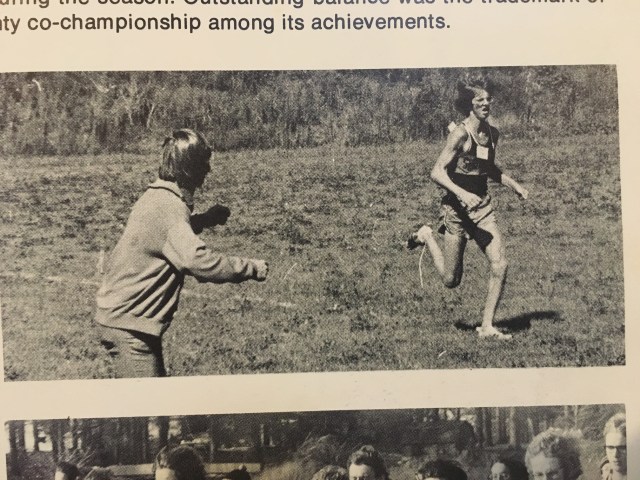
Coach Trent Richards, shown here counseling his runners before a district cross country meet in 1974, passed away on November 30, 2016.

At the age of 12, having moved with my family from Lancaster, Pennsylvania to the small town of Elburn, Illinois, the world felt like it was upside down, or inside out. Even the soil in Illinois looked different from the ground back east. The earth was dark instead of clay red. It was hard to understand why that was the case. The place did not initially set well in my head.


So I clung to things familiar, and one of them was baseball. That was a game that did not seem to change from place to place. And I loved it. I was a pitcher, and a strong one at that. But at 12 years old I was far too advanced as a player to remain in the league for 8-12 year-olds in the little town of Elburn, where I threw a perfect game the first time out. Not a kid on the other team even touched the ball with a bat.

That made me an anomaly. For some inexplicable reason, there was no team for kids between 13-16 years old. So the town’s baseball coaches made me an offer. “Do you want to try out for the American Legion team?”

I had no fear of older kids, per se. My brothers were older and threw me batting practice that was hard to hit. And I’d pitched against them too. So I tried out for the Legion team and wound up pitching several games before the season was over.

By the next summer, as happens in small towns, a new coach had taken over the team. He was a fiery young man of perhaps 22 years old. His name was Trent Richards. And as my friends would characterize him later in life, he was a force of nature.

Trent coached our baseball team the next few summers. We had a rollicking good year when I was fifteen, traveling from town to town on summer afternoons to play ball in small towns like Huntley, Sugar Grove, Hampshire, and Cary. We’d pile into a group of cars and drive through the Illinois countryside with the windows down, eager to go swing the bat and try to win. And we did that a lot. And it was good.

That was life in the summers of the early 1970s.

But the high school I attended did not have a baseball program. The athletic director Bruce Peterson was also the track coach. At a school of 750 kids, he did not want to dilute the pool of prospects for his precious track team, so baseball was not on the sports agenda. That  meant we all went out for track. And that track program was really, really good.

There was also no soccer team in the fall. That was the sport that my brothers both played back east. And had our family stayed back in Lancaster, I’d likely never have become a full-time runner. But without a soccer program, my father shoved me into cross country because he did not like the sport of football, which he considered a death-knell for knees.

He was likely right in my case, for I weighed all of 128 pounds. Plus that first day of cross country sunk into my veins like a drug. Plain and simple: I loved running. It changed my brain chemistry for the better. As a freshman, I helped lead our team to a sophomore conference championship. Then as a sophomore, I helped lead our team to its first-ever varsity cross country championship.

Then my father moved our family again. The reasons for the move were always vague, but I believe it had to do with money, since we downsized houses and rented, for one thing.


chris-at-plainfield

Coach Trent Richards urging me on to an invitational victory. Photo by Kurt Mutchler, who went on to become a National Geographic staff photographer.

Yet that move brought me back under the tutelage of my former baseball coach Trent Richards, who coached both track and cross country at St. Charles High School, twelve miles to the east of Kaneland, the little school out in the cornfields.

There was a mild hint of scandal to my move, and small rumors that Trent had recruited me to run for the school where he coached. Nothing like that occurred. He never talked to me or my father. Yet the team that I joined that fall for cross country was primed for success in St. Charles. Under Trent’s coaching leadership, we went 9-1 in dual meets and won a district championship.

Trent Richards was an avant-garde coach in many ways. His summer track club was far ahead of its time in encouraging women to participate in competitive running. The summer club attracted kids from all over the Kane County region, so that athletes from different schools got to compete on the same team and benefitted from open rather than scholastic competition. It was an egalitarian environment.

Then I ran yet another season for Trent with some individual success, but Trent characterized my running ability correctly the prior season when a sportswriter called me a “junior sensation.” Richards corrected him in print: “Cudworth’s a good runner, but not a sensational one,” he said.

And that was deadly accurate. One thing you could always count on Trent Richards to be was honest. He did not mince words with anyone. He was also a bit of a provocateur, a trait that ultimately served him well in business, where his big ideas (and he brimmed with them) at times turned into real successes. The website funbrain.com on which he labored for years was just one of his many projects and concepts that came to fruition. He had turned his teaching degree into a tool for engaging the world.

It was this trait to push the envelope that both attracted and at times repelled his closest friends and associates. If he had an idea he wanted to try, he could be persistent beyond belief in communicating its potential. And in his coaching days, he was not afraid to scorch an athlete who was not trying hard enough, or is someone was not reaching their potential in his estimation.

Yet he also could be so kind and introspective that it made you sad to have disappointed him in some way. This balance made him a great coach and friend. As he aged, he turned his coaching skills to individual athletes whose lives he tried to better not only in sports, but in other areas as well.


chris-among-teammates

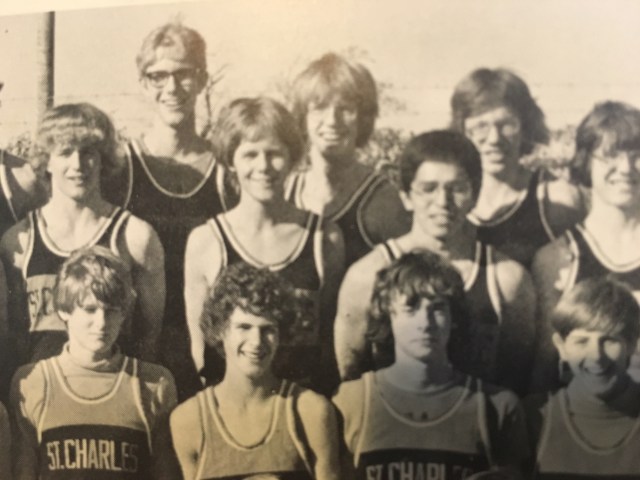
The team dynamic was always important to Coach Richards, who led hundreds of athletes through high school track and cross country, producing state level competitors.

The man always tried to spare you unnecessary trouble if he saw it headed your way. During the first week of basketball practice my senior year in high school, he wandered through the gym to find me off in the corner doing drills with a fellow senior teammate. Neither of us had attended summer basketball camp, and Trent knew that spelled doom for our prospects of making the team, much less playing during the season. “You’re not going to play this year, you know that, right?” he advised us both. The reality sank in at that moment and we both left practice.

That’s how it is in life, if you think about it. At least half our dreams or casual perceptions turn out fruitless, or even damaging if someone does not intervene. It is the mark of a true friend and mentor to at least point out the options, perhaps make the situation clear.

This doesn’t mean that everyone is accepting of such advice. Or that there were not times in life when my coach and mentor could not have used some of his own advice. That’s the nature of all our existence. I believe that role became mine to play in his life as our paths continued to cross and his sensibilities continued to broaden. Trent was always interested in seeing and understanding as much of the world as he can. Once while sitting on the deck of a friend’s cabin out in Dixon, Illinois, surrounded by leafy trees and bird song, he turned to me and said, “You know a lot about nature, don’t you?”

“Maybe not a lot,” I offered. “But some.” Then I directed his attention to the calls of a Great Crested Flycatcher chirping and making its “Whrrriiiuuup!” noise in the trees above our heads. There were many other birds as well. We sipped our beers and soaked it all in, not in a hurry for once, or competing at anything. We shared those moments and many others in life. And it was good.

Trent Richards passed away on November 30, 2016 after two years of cancer treatment. Our association dates back to 1970. 

Posted in competition, cross country, running, track and field, Uncategorized | 7 Comments

Swimming in the Jingle Bells pool

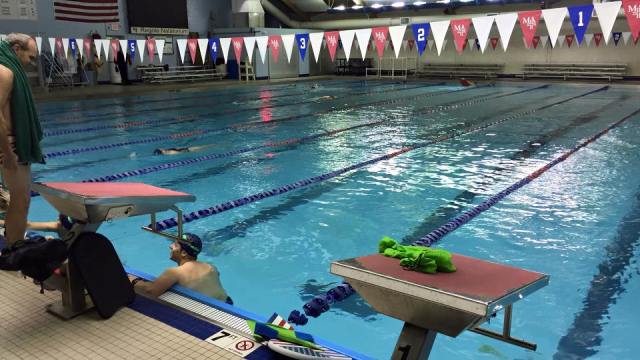
Master's SwimThis morning I had a great swim at the Vaughn Center pool where we’ve signed up for membership. The facility is just three miles from our house. The pool is ten lanes and has high skylight windows that bring in the sun during an early morning workout.

I was doing a workout consisting of 10 X 100m after a 500M warmup consisting of kicks with flippers, shoulder warmups with a float between the legs and some 50 meter sprints.

Between the warmup and the 100s, I paused to set my watch and heard the familiar strains of Christmas music playing over the pool sound system. “Silver bells, silver bells…It’s Christmas time in the city…”

And so it went the entire workout. I’d catch a breather for 30 seconds between 100s and hear some more Christmas music. For some reason, it seemed strange to be swimming in that nice pool with Christmas tunes playing. It gave me the sensation of living in Florida or some other Sunshine State where the weather is warm during the Christmas season.

Perhaps it was apropos, because my interval times without straining to swim faster were 10 full seconds faster than I’ve ever swum. Granted, I’m still not that fast a swimmer, but each 100-yard interval was under 2:00.

I even tried to consciously slow down the first 50 meters in order to swim under control. And still, I finished with better times. This was a gift I did not expect. It felt a lot like Christmas to me in that respect.

There is still a lot of work today toward those days next summer when I want to compete over the mile courses in Olympic triathlons. But my confidence and assurance in the water is growing. Swim stroke efficiency will be key to that.

One of my triathlon associates, Daryl Tyndorf, Ph.D, who runs E2 (Endurance Evolution) Multisport, had joined Sue and I at the pool after their work this morning with some of their coached triathletes. Daryl was a competitive swimmer in college, a sprinter mostly, and a gymnast as well. Now he’s a strong triathlete that has begun a company aimed at helping athletes improve the quality of their training and competition.

So it made me feel relieved, quite frankly, that he took a look at my swim stroke on his own volition and said it looks pretty good. That’s two weeks in a row that an experienced swim coach has told me I’m on the right track, so to speak.

And so it went that I swam all 10 of my 100 intervals feeling a lot more like a swimmer than even six months ago. It has taken two solid years of effort to get to this point, so let’s not get carried away. I won’t be leaving anyone in the dust when I’m in the water. But my kick’s a lot stronger and I’ll be working on stroke rate next.

Well, if Santa wants to deliver a set of clear goggles in my stocking, I’m not going to argue. The mirrored dark lenses I’ve been wearing in the pool make it hard to read my watch. We all know how important it is to actually see that chronometer read 1:58 rather than 2:00. We’re so vain and so protective of our little bits of progress.

Now I’m only hoping that some sort of injury Grinch or sneaky Christmas illness doesn’t creep up behind and steal my little stockingful of joy at being able to swim just a bit better. For now, I’ll just enjoy swimming in the Jingle Bells pool. And an early Merry Christmas or Happy Holidays or Have a Helluva December to all of you.


Posted in swimming, Uncategorized | Tagged , , , , , | 2 Comments

Running before the sun is up

sun-up-waterPerhaps you’re an early riser by nature. Or maybe you have to be an early riser because of your schedule. Or best of all, you just like running in the dark. In every case, it is a unique experience every time you head out the door for a pre-dawn run.

Just last week I met a runner who spoke enthusiastically about her nighttime and early running. “I love it. You feel so…wrapped up in the darkness.”

That’s how I feel about it. I’ve always like running in the dark. On summer nights between scholastic and college track and cross country seasons, those late night runs were full of dreams about upcoming competitions.

As time goes by, our dreams change and our focus too. Now when I go out before dawn, the mind wanders even as the feet seek out the safest path. It can be tough at times to find that footing. When you’re running against traffic, the car lights blind you. Yet a hand placed in front of the eyes cuts the contrast and the ground below becomes more visible.

sun-up-chris-faceOne grows practiced at this mode of running over the years. Running in the dark is both a science and an art. One must learn to trust instinct as well as perception. Of course, it helps to have reasonably strong ankles and knees to handle potential uneven patches in the surface. A bit of balance always helps. All those years of playing basketball and running the steeplechase, playing soccer and football and playground sports come in handy the older you get. But it’s still a dicey proposition sometimes.

For the first half mile of the run this morning, the stars were bright and visible in the sky this morning. The constellation Orion was visible low in the Western sky. The Big Dipper was its opposite. Occasionally the lights of an airplane rose from the east out of O’Hare Airport thirty miles away.

Even before dark, the Canada Geese were piping on the ponds as I ran past. Lately, there has been a pair of great horned owls calling from the trees near our new house. In four weeks+ the owls will set up shop with a nest in the nearby woods. They’ll take turns keeping the eggs warm through the cold blasts of late January and February. The rhythms of nature don’t stop. Next time you’re cold on a run, think about those owls hunched down on the nest as the winds blast away at them. Warm feathers or not, those are tough birds.

Running before the sun is up a bit like listening in on the secrets of the day. A junco lets out a twitter as I run past the willows next to a wetland. Then a robin scoots and flutters ahead in the darkness. The rains last night have likely brought worms to the surface of the ground. As the saying goes, the early bird gets the worm. I just saw the early bird.

My run takes me into a nearby forest preserve. At its southern edge, a restored prairie has matured after years of restoration work. The strong south wind whispers through tall grasses. I listen to that sound and wonder what other territories those winds have crossed on their way here. And what years those bits of oxygen and carbon dioxide have seen. Does the air we breather disappear or does it simply get recycled back and forth between CO2 and oxygen? I’m going to look that up. The question seems to matter more than ever. How ancient is our atmosphere, after all? We depend on it to breathe. To keep us safe from radiation. To capture heat and to release it as well. Are we killing the air we breathe, and which we depend on for life?

sun-up-movingAs I run, it strikes me that the morning air is not that cold even though it is late November in Illinois. I recall other warm years, including one in which I visited this same preserve on December 5. Temperatures hovered above 70 degrees for the entire day.That evening more than 20 species of ducks was parked on the main body of Nelson Lake. I crept out from the main hiking path to crouch on a fallen willow tree next to the water. The air was still, and the voices of all those ducks floated across the water as the sun set. It would soon be dark and the air started to grow chill. Yet even as darkness fell and the water shifted from pink to purple to black, I clung to that log and listened to the peeps and piping calls of the ducks until the lake grew largely silent. I was present for the secret turn of phrase that constitutes wildness.

By the next morning, temps had fallen thanks to a rushing night wind. The lake froze over and the ducks were all pushed southward. I was so thankful I’d stayed late to witness that last window of fall. And felt ready for the winter ahead as a result.

That paradigm, of active waiting for the seasons to change, or for the day to break, is what makes running in darkness so delightful. Because as I circled toward home the sky began to lighten in the east. A mile later the path ahead shone with reflected light. Water gathered in puddles spilled across the running path and it made a pleasant splash that cleaned off the soles that were surely muddy from traipsing through the mucky length of the forest preserve.

I know those paths so well next to the woods that I can run them by instinct. Even the shoulders next to the road home are familiar. I’ve ridden the bike many times down the same stretch of road. One learns by timing where the holes are, and the cracks. And how the shoulder falls away at certain points. Instinct.

Then the welcoming lawn behind our house appears. A flock of geese rises up noisily to head to the fields to feed. Yesterday there were twelve sandhill cranes calling like a complaining band of runners as they made their way through the harsh autumn winds.

We share the wind, the cranes and us. Soon the great flocks from up north will pass through on their way to Jasper-Pulaski park in Indiana. These are rhythms to which one should pay attention. They measure our days, and our lives.

But it’s the stars that give a true sense of shared humanity and humility in the early morning hours. They remind us of the timeless nature of our existence, and how precious every dot of life or light can be. We are moving and temporal beings. But sometimes it pays to stop during a run before the sun is and just behold the night sky. Because in the end, it is all we have, and all we will ever be.


Posted in track and field, trail running, triathlon, Uncategorized | Tagged , , , | 6 Comments

Riding outside the White Line

TarsnakesThere is little reason to not share the road with cyclists or runners other than raw selfishness. Even a large crowd of cyclists taking up a lane of country road on a Saturday morning can be passed eventually.

Yet there is evidence that a great impatience exists in this world among those who feel they should never have to share the road with people on bikes. Or on foot. Or on motorcycles. Even other cars.

Time concerns

The reasons for these road-hog mindsets are manifold. Some people are just plain “in a hurry” and get upset when they find cyclists or any other obstacle in the way.

But let’s be real about something: If you’re late to an appointment, it is no one’s fault but your own. And if you’re not late, but your fears of being late are making you angry or upset at a band of cyclists, then you simply did not allow enough time in your schedule to anticipate delays that happen almost every day.

Because it’s not just cyclists that cause delays. Far more time is spent by the average vehicle on the road by sitting at traffic lights than trying to ease around the occasional cycling group. This fact is demonstrated on a regular basis by cars that zoom around cyclists on the open road only to find that the cyclists catch up to them at the next traffic light. The culprit in making someone late, in that case, isn’t the cyclist. It’s the traffic light. So that claim is thoroughly debunked.

Selfish aims

Beyond time constraints, there appear to be a fair number of people who simply don’t like the supposed inconvenience of having to navigate around a cyclist on any sort of road. But there’s an art to driving, as well as a science.

Anticipating delays and getting around other traffic on the roads actually has a name. It is taught in driving school, and is called “separating hazards.” That means you try to avoid encountering two vehicles in the same space of the road. When an oncoming vehicle is approaching and there is not enough time to pass the car or bike ahead of you on the road, the appropriate (and legal) thing to do is to “separate” those hazards by adjusting your speed. Typically this is done by slowing down for a short period, then safely passing the slower traffic by using the other lane to get around. In farm country, this happens when you come up behind a tractor going slowly on the highway. In urban or suburban areas, the more typical scenario is a vehicle driving slowly on a tw0-lane side street or highway. The right thing to do to get around is to separate hazards and pass safely.

However, some motorists are too selfish for that. They refuse to wait for the opportunity to pass anyone safely. Instead, they choose to squeeze past cyclists by cutting closer to them within the lane. This is illegal in many states because laws dictate that a three-foot width must be kept between a vehicle and a cyclist.

Those who flaunt this rule often do so with demonstrative flair, gunning their engines as they roar past. The point here seems to be that expressing their frustration is some sort of divine right. As in, “This road is mine and you are slowing me down.” The patented engine roar is a threat intended to strike fear in the minds and hearts of those riding their bikes. It often works.

The greater threat to cyclists may come from the fact that millions of equally selfish drivers are daily distracted by texting. So the rude combination of aggressive, selfish drivers and those paying no attention to the road is more deadly than ever.

The roar that kills

There are thousands of collisions between vehicles and bikes each year. Some people even lose their lives.

Many drivers complain that the Rules of the Road are not being followed by cyclists either. Let’s be honest: that is true in many instances. As a cyclist for more than a decade, I can testify that it can be difficult to control or guide the behavior of the more ignorant or selfish cyclists among us. But we’re working on it. Who is doing the same among selfish drivers?

That is the pressing question, but one that is likely going to be ignored in an era when personal rights have become a turnstyle of selfish aims. It is no longer what President Kennedy said, “Ask now what your country can do for you, ask what you can do for you country.” The cultural meme has, in essence been reversed to satisfy those with selfish concerns about how white people deserve special treatment over minorities in this country, or Christians. Yes, the two most prodigiously favored cultural groups in America over the last 200 years are so, so persecuted these days.

As for the genuinely mistreated Middle Class and blue collar workers put of work by the flow of capital to cheaper labor overseas, somehow those people saw fit to vote against their own interests by believing lies about those jobs “coming back home.”

It is a truly strange world when a selfish vote turns into a vote against one’s own self-interests. Because unless someone also brings back the unions that protected worker rights, negotiated fair pay, invented the American weekend and established the right to overtime (which Trump has just avowed will disappear once he’s in power) then the entire premise of voting for self-interest in Donald Trump is based on hollow promises.

Because it was not men such as Donald Trump that delivered fair working conditions to textile workers in the Southeast, or protected coal miners and oil workers and other laborers from dangerous environmental conditions. That was all the work of liberals, who also worked to pass public laws to rid the country of dangerous air pollution as well as chemical and heavy metals in lakes and rivers. Anyone concerned about general human health and making America great should be concerned about these things, and yet Donald Trump has promised to roll back all these regulations, including perhaps the accords that address global climate change.

His voice indeed may be the Roar That Kills.

The anger behind support of Donald Trump may well be the same rage that drives people who do selfish stupid, dangerous things around cyclists because they hate the notion of sharing the road with cyclists just as they hate the notion of sharing the nation with immigrants, Muslims or anyone else they define as The Other. This the nation we now live in. Trump supporters love to deny this selfishness, but it is there in the signs of everything their Seig Heil leader says. He’s the ultimate selfish asshole who even claims there is no potential conflict of interest between his global business interests and his role as President of the United States. He made the spurious claim that the right to judge these conflicts for himself were included in his victory. But of course, that remains to be seen.

Political games

But let’s exhibit some temperance of our own right here. All it takes is one incident to color the image of one side or the other when it comes to use of the roads. A similarly political game is playing out in other arenas as well. This tirade that a Trump voter conducted inside a Starbucks illustrates the selfish perspective some people can develop when they think they’ve somehow earned the right of ownership in any cultural sphere. But let’s face it: selfishness abounds on many fronts. It is not confined to any single political or cultural group.

However, there is a difference in the degree to which selfishness is expressed, and how dangerous it is to society. When a motorist driving a 2000 lb. vehicle feels justified in expressing their selfish anger by running cyclists off the road, or even striking them, that is a threat to human life. By contrast, what threat can a cyclist actually deliver to a person driving a car or truck? Is slowing someone down for a 30-second period truly an act of selfishness or a simple product of the freedoms guaranteed by law in this country? These are the political questions that may soon come to a head in America.

Farm Country  

Wisconsin SunsetTwo seasons ago our group of cyclists was far out in the country southwest of Chicago. It was farm country and we were queuing up to make a left turn when a farmer in his truck came tearing up behind us, crossed into the opposite lane and made a veering turn to cut us off. He stopped his vehicle and raged that he paid taxes for those roads, and that cyclists interfered with his rights to drive them. A few words were also tossed in about maintaining his livelihood and such. Which left us staring out at the bland black fields where corn stalks tipped up by an October plowing session made clear the harvest was long over.

So the issue was really about a sense of ownership. And that farmer very likely had a strong sense of ownership for the roads that cut through his fields. Add in the pressures of taxes paid for that farm property, and how many developments were now threatening to consume fields to the east, driving up property values and assessments as they go, and the league of threats vexing the mind of that farmer all seem quite really, and present.

I’ll admit that I stopped and discussed the situation with that farmer. Told him that we all pay road taxes like the rest of the world. “We all drive,” I pointed out. See, he was pissed at the idea that people riding bikes and using the roads were not paying taxes for that right. Which is absurb. But the argument is used over and again by those who consider themselves an Emperor of the Highway.

Institutional causes

There is also institutional frustration with cyclists over the idea that the roads are public property. Up in Southwest Wisconsin in the Driftless Region, thousands of cyclists travel to enjoy the the freedom to ride in a landscape rife with hills and valleys. Yet there have been moves by local communities and counties to prevent organized rides in that territory.

People who believe that local governments should have the authority to make those decisions may be happy for that fact. “Go ahead, ban those cyclists from taking over your roads!”

But one wonders, given the expressed belief by those taking over the reigns of the upcoming administration, whether local control could someday also get out of hand. The incoming Secretary of Education under the President Elect has, for example, stated that her department will support local control of schools. That could directly lead to school districts teaching whatever they want in terms of curriculum. If that happens to include replacing science with religious education and creationism, so be it. In America, it is believed by those on the Right, it is more important what parents want taught to their children than what some government agency might want them to learn.

And so it might go with the roads across this land. If local governments think cyclists are a hazard to the interests and a safety of local residents, why not ban cyclists from using the roads altogether?

Except for those in the way
riding-gouldsThis would no doubt please those whose selfish view of the roads would exclude cyclists. And it would be no coincidence if that those voters who elected the Selfish One as their Leader to Make America Great Again might be the first to use their local control to vote against cyclists using roads where Real Americans like to drive trucks, tow farm vehicles, race muscle cars and hunt deer from the roadside using headlamps to blind them, if that’s what you feel like doing. Because this is America. Land of the Free. Except for those who get in the way of what you want. Including cyclists.

Because we’re being steered toward an America that claims it wants to be a lot whiter, a lot less diverse, less liberal, less gay, less alien, less Muslim, more Christian, less soccer, more FOOTBALL, less women’s rights, less abortion, less arts and letters, more Holy Scripture, less Democrats and Greens, more coal and oil, less politically correct, more Open Carry, less worry about misogyny, less taxes on the rich, less national forest and parks, more Open Range Clive Bundy free use of public land, less Living Constitution, more Originalism, less tolerance for blacks and Mexicans and Indians and most of all more rights for whites who founded this place, including the roads. Which were never intended for use by cyclists, right?

This may give all new meaning to riding outside the White Line.

That’s where the country may be headed, in which it is fair game to force cyclists off the road. So enjoy the roads while you can. Because when the Selfish take over the wheel, there is no safe place for anyone.


Posted in cycling, cycling the midwest, I hate cyclists, Open Carry, Uncategorized | Tagged , , , | Leave a comment

All is cool with the chef and the pool


Evan Sue Chris.jpg

Suzanne Astra, Evan Cudworth and Chris Cudworth at the Fox and Turkey 4 Mile

Yesterday morning we ran the local Fox and the Turkey Four Mile. The Batavia race attracted 2061 runners, 916 men and 1100 women. I placed 180th at just over 30 minutes. It was a fun run that went past my former home on Republic Road. And as coincidence would have it, I lined up with my own son about three blocks from that home. So we ran past it together feeling a bit strange that it was no longer the place to which we would return and have Thanksgiving dinner as we have the last few years.

Really cooking now

Instead, Sue and I worked to make Thanksgiving work for everyone at our new place. This year I actually prepared the sweet potato casserole on my own, with little help except finding the ingredients in the litany of cabinets where they are stored.

It might seem like a simple enough task to follow a recipe. And yet when attempting the same sweet potato feat a few years back, I mixed up the toppings ingredients with those used for baking the potatoes and had to start all over again.

It could be said that cooking is basic science. I recall chemistry experiments in high school that involved mixing liquids together, and if you combined them in the wrong order, the entire experiment would turn out a bust. There is no substitute for good instructions, and following them.

It’s the same thing with training, you know? It’s the same as having a recipe and having a winning recipe. I’ve done that many times in life.

But it’s a little different these days. I now have enough experience as a “cook” in endurance sports to throw a few ingredients together things generally come out okay. I do not perform at the level of a chef anymore. More like a mildly talented short order cook. Yet despite the fact that I have not been training like a maniac, I still finished 180th or so out of 2000+ runners in 30:03, a bit above 7:00 per mile.

Which isn’t too bad on a cool November morning in the 55-59 age group, where I finished twelfth among my peers, the best of whom ran in the 26:00 range, just over 6:00 pace.

And I could train my ass off and possibly do that again. But seriously, what would that prove at this point in my life? Besides, it seems much more fun to keep an eye out for life’s little absurdities and take what comes with the training I do do. And yes, that’s a joke.

Juggling Gumby Spatulahead

gumbyBecause during the first mile of the race I found myself in company with a runner who registers and dresses in character as Juggling Gumby Spatulahead. He wears a giant green Gumby costume and juggles green tennis balls during the entire race. He also spouts insane dialogue toward the runners around him and spectators as well. This turns his sphere of operation into a comic enterprise.

Yes, even Juggling Gumby Spatulahead beat me by a minute yesterday morning. At one point in my life, that fact would have offended me greatly. During my competitive career, I could not stand getting beat by anyone with a less than respectable stride, much less some joker in a Gumby costume.

But one learns to adapt to circumstance and choose your battles rather than try to beat every Juggling Gumby Spatulahead who comes along with another attention-getting scheme. That’s a game no one with self-respect and a conscience actually wants to win. Because you can wind up like every evangelical preacher conducting fake healings on TV, where credulity too quickly fills the void where credibility vacates the premises.

So characters such as Juggling Gumby Spatulahead symbolize joy and mock seriousness at the same time. People who can’t make real contributions in this world often invent ways to gain and keep attention. That’s how TV preachers make so much money. They create a show around miracles that never really happen. The same thing happens quite frequently in politics. The phonies often gain the most attention because people are so eager to be entertained and fooled they can’t separate real performance from carefully manufactured fiction. And that’s how men like Donald Trump win elections.

grinchYet it’s a subtle dynamic. Because we all enjoy people dressing up to celebrate an occasion and have some fun. Nothing at all wrong with that. There were hundreds of people dressed as turkeys at the race yesterday, and I loved the costume and makeup of this Grinch that was racing too. He not only looked the part, but carried an audio speaker with him that played “You’re a Mean One, Mr. Grinch.” But talk about an earworm…

Uber Reality

Granted, I always wanted to go out and win a running race while wearing a pair of Converse Jack Taylor basketball shoes. It seemed like that would be a cool thing to do as an expression of an Uber Reality, or consciousness. Retro and smart.

To be sure, I once witnessed a guy wearing cutoff blue jean shorts nearly win a competitive cycling criterium. Along with his cutoffs, he wore a torn up tee-shirt with his race number pinned to the side. In this getup, he rode with the top crit riders throughout the race, only losing in the bunch sprint by a few meters. It’s the closest thing I’ve seen in real life to the look of that classic cycling movie Breaking Away.

And I also watched a guy many years back win an 800-meter race while wearing blue jean cutoffs and borrowed track spikes. The college All-American runner from North Central showed up to watch an All-Comers meet and was talked into jumping in the race by his former teammates. He won the race with a blistering kick in 1:53. Without a warmup. He used the first lap to do that. Then killed the field.

In other words, he was truly talented and smart enough to harbor his resources for the circumstance of the race. That’s real talent and brains. No Juggling Gumby Spatulahead was he. He did not need to fake it to get attention.

Rise and shine

Along with talent, accomplishment requires a degree of hard work. So the morning after Thanksgiving, Sue and I drove to the Vaughn Center to do weights and swim. I focused on leg sets while Sue did an all-body workout that her coach assigned.

Then we moved to the pool and did our respective workouts there. I was invited to share a lane with a woman about my speed while Sue swam in a lane with a University of Northern Iowa college swimmer.

The gal in my lane turned out to be a swim coach by trade. When we stopped to talk near the end of our respective swim sessions, I told her the story of how Sue and I met, and how that relationship led to doing triathlons and swimming for me. She asked how long I have been swimming.

“It’s taken about two years to get where I am,” I replied.

“Well, I’ve been coaching for 40 years,” she told me. “And I can tell, you’re doing very well.”

“That means a lot to me,” I told her. “It’s been a hard thing to learn.”

“A slim person like you does not float easily,” she responded.

And I’ve heard that many times before. And it’s true. Yet there were moments this morning when I actually felt that flying sensation some people experience while swimming, like I was working with the water rather than it working against me.

At that moment I felt thankful for all the hard work put in over the last couple years, and that I hadn’t give up hope on those days went it felt worthless to try. I have followed the recipe doled out the swim coaches I know as well as advice from Sue as I went along.

So all is cool with the chef and the pool. And I’m certainly thankful for that.


Posted in running, swimming, triathlon | Leave a comment

If you’ve got it, flaunt it?

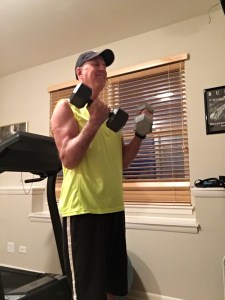
strength-workThis morning while lifting weights I set the camera up and snapped a photo of a curl set with 25 pounds. I’ve never been much of the flexing type. But I suppose the photo came out okay. I have a little more meat on my arms compared to thirty years ago when I weighed 140 lbs and raced 24 times a year.

I’d have to do strength work 24 hours a day to catch up with the physiques of some of the people found on Instagram. Their profiles are chock full of muscle shots and rock hard abs. Nothing but pictures of themselves. One after the other. Day in, day out. Me me me.

If you want followers on social media, that’s actually what you need to do. Pound away at the image and self-image of who you are. Make it appealing somehow to the masses. Be the One Trick Pony. And if you’re smart, you might wind up being a brand representative for health and fitness products.

girl-posesIt certainly seems to help if you have some physical attribute by which to market yourself.

twinmamahealthSo what can we learn from the Instagram accounts with the most Followers? Well, a nice butt never hurts whether you’re male or female. Strong legs too. A few thigh gaps seems to make a difference too. Then there are a fair number of female athletes who punch up the boobs shots as well. Whatever works.

More power to them. Like they say in the show The Producers, If You Got It, Flaunt It! Or perhaps, if you’re a fan of Donald Trump, you’ll prefer this Springtime for Hitler clip instead. Spooky how life imitates art sometimes. Even parody art.

Not sure that “flaunting it” will ever be MY business plan. What a typical senior guy has to offer in terms of flaunting it is not traditionally the fare that attracts thousands of Instagram followers. So I’ll stick with my drawings, paintings, a few running and riding shots. And plod along with my modest personal brand in tow.


Posted in Uncategorized | Tagged , , , | Leave a comment

What a first grader running around the playground knew when he heard about the assassination of JFK


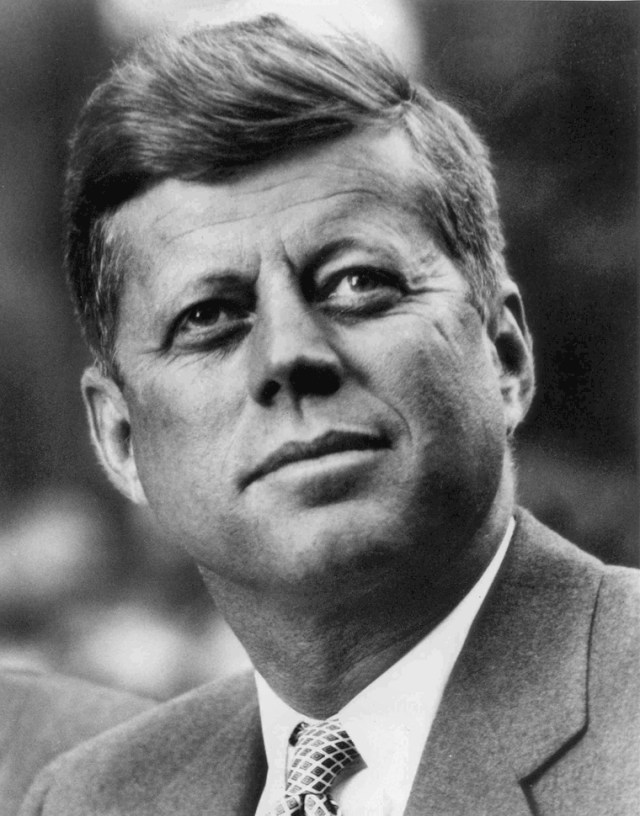
john_f-_kennedy_white_house_photo_portrait_looking_up

President John F. Kennedy: assassinated 53 years ago today.

I was a first-grader at Willow Street Elementary south of Lancaster, Pennsylvania in 1963 when President John F. Kennedy was assassinated. Like so many people alive in that era, I specifically recall the spot where I stood while hearing the news. We were out playing on the macadam playground because those were the playground rules in late November when the ground grew muddy from freezes and thaws in the ground surface. And I stood there, shocked and for a moment, quite fearful. What did it mean?


Our lives were fairly regimented in those days. We all knew the rules well because those were the foundations of our existence. We knew when recess started and finished. We’d stare at the clock on the classroom wall trying to will it to move its hands a little faster. We yearned for that precious time when we got to ditch the classroom and go outside to play. Recess was a form of salvation kids with so much energy and creative imaginations. That’s where people like me could find themselves in motion and freedom.

But suddenly it felt like all the rules had been broken. Someone had murdered the President.

Freedom rules

riding-sunsetRecess still exists in my mind. Nothing has really changed about the way I view that dynamic of motion and freedom. All these years of running and riding and swimming have their purpose. Every minute spent doing those activities is a reflection of that kid on the playground. I ran and ran and ran if I could. Early on, we played tag or some other game. Then we graduated to kickball and in springtime, wandered out on the flattened grass fields to play 500, a baseball game in which one player swung the bat and others kept track of the catches they made. 100 points for a fly ball. 50 points for a grounder.

Even freedom had its parameters. The rules defined the game. Otherwise, there was no game to play. We did not tolerate cheating. The game was self-governed by those who participated. On occasion, there would be fights over enforcement of the rules. But for the most part, everyone respected the rules of our playground games.

The heavy hand of authority

The hard part of being in school was putting up with the authoritarian rule of teachers with little patience or a wilting view toward the liberality of our precious playground time. We had to navigate the heavy hand of authority in order to get our chance to go out on the playground. I clearly recall a specific instance when my third-grade teacher gave me an evil choice:”You can stay inside and work on the classroom play or you can go out to recess. Which will it be?”

I knew that i needed my time outside. So I choose recess. “Okay,” she barked. “You don’t get to do either.” She made me sit at the desk and write fifty times: I’m sorry I did not want to be in the class play.
rulers

Ulterior motives

In other words, there never really was a choice. She had one outcome that was acceptable to her. But rather than take the time to explain the potential benefits of staying in to work on the play, she hung me out to dry. This is the method of blind authority. And it sucks.

I never forgot that lesson. It drove a new form of suspicion deep into my soul. I learned that so-called grownups were often trying to push me into things that they wanted me to do. When they didn’t get their way, they punished you.

And I thought to myself, at that tender age, “If this is how the world really works, I want nothing to do with it.”

From that point on, at the age of eight years old, I became a committed liberal. Either take the time to explain the rationality of your position and its implications, or I’ll suspect your ulterior motives.

Lessons learned

We all get that it is the supposed job of teachers and parents and Sunday School teachers and coaches and siblings to help us learn to make responsible, considerate choices. That’s how we grow. The narrative goes like this: the consequence of making poor decisions is punishment.

But even at six years old, as a first grader running around the playground at Willow Street Elementary, I understood the dichotomy between punishment for bad choices and the injustice that was perpetrated on John F. Kennedy. I stood there on the playground trying to process what I’d just heard. “What had our President done,” I wondered, “to deserve assassination?”

Somehow I knew what the word meant ‘assassination’ meant right away. It was clear enough from the manner in which someone said that word to me. Someone had actually killed the President of the United States. Shot him dead with a gun. Right through the head. But why?

The broader narrative

img_6438It struck me immediately that our President had not been given a chance in that situation. Someone according to their version of authority had made that decision on their own. This related deeply to the emotions I felt about the relatively unjust choices I was being offered on a daily basis by people in authority in my own life. I knew what it felt like to have my options canceled without question.

Years later as I read about the events surrounding the Kennedy assassination, two things became evident. 1) There was obviously far more to the broader narrative than a single gunman acting on his own and 2) the President was far from a perfect person, yet still an inspiration to many people.

Both of these were revelations the sort that require deeper investigation. So like many millions of Americans, I tried to learn more about the situation of JFKs assassination. It didn’t take long to discover that the “official” version of the assassination was a load of bunk. The Warren Commission was a hastily arranged opinion, if not an outright coverup.

From that point, the map opened wide. A broad range of conspiracy theorists dissected the Kennedy murder from (literally) every angle. These narratives involved various elements including the CIA, the FBI, the Mafia, Cuba, Soviets and you name it. Yet one thing was clear. All of them had a different vision of government than President Kennedy. And all of them operated in the shadows.

Public figures

Some authors investigated the personalities driving the conspiracies and produced convincing works about the motivations for some people to want Kennedy dead. Some accused Lyndon Baines Johnson (LBJ) in the plot to kill Kennedy and assume the Presidency for himself. LBJ was something of a surly bastard and he had a trail of ugly incidents and murders surrounding his legacy. He was a man desperate for the position of Vice President because it afforded him an opportunity to bury some of the skeletons he’d generated during his own drive for power.

Still others accused George H.W. Bush of running the CIA operation that killed the President. This much was clear: Kennedy had actually threatened to close down the CIA, or defund it, and that pissed some people off. JFK had plenty of other enemies as well, including FBI director J. Edgar Hoover. But the most intriguing piece of evidence about a CIA plot is a quite convincing photo of what appears to be a young George H. W. Bush on site in Dallas the day that Kennedy died.

Operations on the fly

Then there was the horrific theft and transport of President John F. Kennedy’s body from Dallas back to Washington. During the flight on Air Force One or Two, depending on who you believe, doctors obviously messed around with the wounds on Kennedy’s head. There was clear evidence that surgeons patched up a blast hole in the back of his skull. Talk about the ugly signs of a coverup…

OIl and WaterCoverBut that operation almost perfectly symbolizes a longheld American tradition in which the narrative acceptable to the populace is pieced together from a combination of bloody fragments and blown out narratives. But once the stitching is in place, people move on and don’t look back at the scars.

This is the very process by which millions of white Americans choose to ignore the genocide of Native Americans, which stands like a gaping wound in the settlement of the continent. Others choose to dismiss the horrific practice of slavery on black Americans. It’s as if the echo of that institution leaves no marks on the collective psyche. The result is a nation deeply conflicted by its interpretation American history.

Throw a bit of religion into the mix and what do you get? Even more confusion and anger over who is right and who is wrong.

Political stitchery and bloody truth


So let’s admit something about John F. Kennedy. He was an ardent womanizer. He hid medical conditions from the public to keep his candidacy alive. He was not a perfect human being. Neither was Dr. Martin Luther King, Jr. Or Robert F. Kennedy. All had flaws in personality and practice. Yet all stood for civil rights and social justice. And it cost them their lives. There is no getting around that simple fact. The leading civil rights and liberal political leaders of the 1960s were all shot dead. Murdered in cold blood. This is not some coincidence of history. This is the ugly, blown out fact on the back of America’s head. It has been covered up with decades of matted hair and political stitchery because the truth is just too ugly and real to reveal.

So we’re left to wonder what might have happened if Kennedy and his brother Bobby had survived those plots to erase them from history. The same goes for one of the leading black political and religious figures in American history, Dr. King.The political genius and moral vision of these people far surpassed the limited thinking of conservative American politics that produced McCarthyism, protected racism all across the American South and battled progress from science to medicine all across America. Conservatism stood for anachronism while the Kennedys and Dr. King stood for progress. This is the remaining battle for the soul of America, and it continues to this day. It is the battle of positive governance versus negative, light versus darkess, and enlightenment versus patent and dogmatic ignorance.

Positive versus negative

John F. Kennedy once said, “Ask not what your country can do for you, ask what you can do for your country…”

Compare Kennedy’s positivity to the likes of Ronald Reagan who made this famously negative statement, “Government is not the solution to our problem; government is the problem.”

Though he was considered by many conservatives to be a positive ray of light for the nation, and his ‘government is not the solution to our problem’ bears some resemblance to the inspiration words of Kennedy, Reagan assassinated the memory of JFK a second time with his negative statement about the role of government in America. Kennedy did not consider government an evil. It was a tool for good. His contention was that Americans needed to helped direct this tool for good. Reagan’s contention was that government should, in many cases, simply be abolished. That is the legacy conservatives have since embraced with fervor, and have held that belief to the head of America as if it were a loaded weapon about to go off.

Concealed Carry

chicago no guns signWe now know that the guns of conservatism were aimed back at Reagan himself, whose administration turned on him with the shadowy acts behind the Iran-Contra affair. Once unleashed the forces of darkness and negativism are too powerful to control by mere politics. The belief by zealots that they represent a higher power was quick to fill the void created by the negative space Reagan created with his criticisms of government.

It’s true:  very same forces within the CIA that conspired to undermine Kennedy took matters into its own hands with the Iran-Contra affair. As a result, Reaganism finished its term in office disgraced as one of the most corrupt administrations to have ever run the nation. Such is the power of negativism and self-fulfilling prophecy.

Smoldering coals

The reasons for the disgrace were simple. The secret form of government that evolved from the hot, smoldering coals of the Kennedy assassination fanned the flames of conservative zealotry during the Reagan years. These fires spilled across the globe under the guise of “American interests,” a loosely defined term that stands for imperialism.

It remained for the likes of Dick Cheney to come roaring in with his a conspiratorial version of Reaganism. Under Cheney’s watch, the American military was privatized into a mercenary operation accountable to no one but cash. War profiteering went wholesale. The Iraq War was an unbudgeted farce answerable only to the shadow government created by Dick Cheney.

Military wakeup call

The reality of this ugly truth took a while to sink in with those commissioned to serve the nation in our military. Soldiers participating in multiple tours of duty became disenfranchised by the lack of focus, and many eventually learned that the Iraqi people afflicted by America’s imperialistic aims were not, in fact, the enemy at all. America had been bilked into a war of choice, based on lies, and no exit strategy to boot.


This is what happens when secretive revolutions take place within a government. But even the public face of the government during the Bush years was an undeniable parade of one destabilizing event after another. First came the stolen election. Then 9/11. The war of choice in Iraq. The mess of Hurricane Katrina. And finally, the economic recession.

IMG_1019Yet conservatives refuse to admit or take responsibility for any of this. They prefer the patched up version in which liberalism is cut from the belly of America and slapped into bloody position over the wounds created by the assassination of American character that took place during the Bush years. The cognitive dissonance of governing by negativity as Reagan confusingly proposed was the undermining influence on American confidence.

To counteract this grandiose would in political will, conservatives threw fear in the faces of all who lived under the American flag. “Elect us or be killed by terrorists!” was the battle cry. And Americans, ever susceptible to the patched over tradition of American history, accepted fear as a replacement for courage.

Killing JFK again and again

This was proof of the pain and suffering produced by the Reagan Revolution. Those who don’t believe in government should never be given the reigns of power. And yet, millions of Americans have embraced a new candidate of negativity in the likes of Donald Trump. The man promises to murder the positive legacy of John F. Kennedy in all new ways. He has called the free press to his offices to chastise them for doing their job. He has threatened immigrants and women and gays and even children with his incurious, vicious and bombastic mode of communication.

To some, Trump must feel like the New Reagan. A supposed visionary. And yet, like Reagan, the hidden negativity of his message and communication style will also be his downfall. There can be no good outcome for an American president who simply does not understand or believe in the basic tenets of freedom and governance built into our Constitution. It is a very liberal document, originating the very freedoms of enterprise and thought that John F. Kennedy so aptly communicated when he said, “Ask what you can do for your country…”

Fighting blind authority

As a six-year old kid running around the playground, I already had encountered the ugly whims and force of blind authority. I understood what the price of freedoms were, and how rules and regulations guide that freedom, but are not the end answer to any of our problems. In other words, I understood at the age of six years old what liberalism was all about. I linked it to the lessons I was learning in Sunday School and how Jesus promised freedom to those who understood the rules but unlike Satan, did not use them to

gov-mike-pence

The newly installed Vice Bigot Mike Pence.

manipulate others. That’s how the serpent tricked Eve and Adam, by twisting God’s words to get them to do what he wanted. This, I understood, was the root of all evil.


I also understood that the forces that killed John F. Kennedy were similarly dark and negative. They had welled up from those places in the human soul where people confuse the will to win with the desire to cheat, to control and to gain control. Those forces are always heavy handed and hard at work in the world today.

And today, fifty-three years after the Kennedy Assassination, I remain determined not to let those ugly forces win the day. Because recess is worth it, and so is running around without people calling you inferior because you are black, or Mexican, female or gay. Liberalism is the heart of American virtue. That is lost on those who prefer the words and darkness of Satan (as Trump’s key advisor Steve Bannon has claimed) to those of the Constitution.

And please take note, before you cease following this blog because you disagree with these assessments, try to prove me wrong. Write a rational response in your own words, not just the sputterings of Alt-Right websites or talking heads like Limbaugh. This is important stuff. Freedom matters. I invite your discussion and will listen and respond to all rational attempts to describe why you think this current course is the right path for America. History speaks otherwise. But perhaps you’ve got greater insights. 
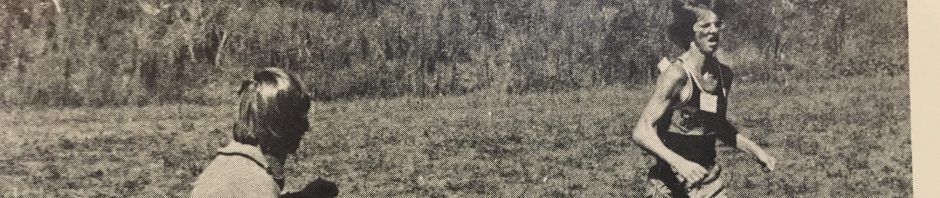


Posted in Uncategorized | Leave a comment