
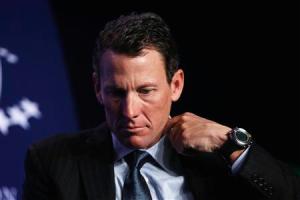
Armstrong at a Livestrong appearance.
Retired professional cyclist Tyler Hamilton’s book The Secret Race documents the doper’s decade of the 2000s when bike racers made a common practice of taking performance enhancing drugs and doing blood transfusion to increase hematocrit counts and raise oxygen carrying capacity. It was a turbocharged peloton for many years. In fact, without doping, the book contends, you were relegated to ride in the middle of the pack, or worse.
Lance at a glance
As the world’s premiere bike racer from around 1998 to 2005, Lance Armstrong was not only the fastest on his bike in races like the Tour de France, he was also best at blood doping. Evidence cited in Taylor Hamilton’s books suggests that Lance Armstrong did indeed turn up positive a couple times, but those tests were allegedly dismissed through payoffs or other arrangements with the UCI and other cycling organizations.
Driving force
The extent of Armstrong’s expertise at performance enhancement was not confined to his own bloodstream. He also required that his teammates also dope and do blood infusions. Yet it took a long time for these practices to become public knowledge because the Lance Machine was a big force in driving the sport as a whole, bringing in millions of dollars in team sponsorships and heightening the awareness of the Tour de France and cycling worldwide. To many people, Lance Armstrong was cycling. He was essentially the driving force of the peloton.
Lance the brand
In the public eye, Lance bore the burden pretty well. His carefully crafted image included humorous ads for Nike depicting Lance as a playful type who seemed to know more about the world than the rest of us. His Livestrong foundation paralleled that superhuman vision by leveraging Armstrong’s status as a cancer survivor to build a non-profit organization dedicated to cancer education and support for those suffering from the disease. The brand built around Lance Armstrong leveraged his manufactured good guy image into a worldwide, multi-million dollar phenomenon. The yellow Livestrong bracelet was everywhere. People got it: Lance was an athlete who cared.
Doubters and shouters
There were Lance doubters and haters all along, of course. Many in the French media thought he stole his Tour de France titles by doping. It wasn’t until Lance came back from retirement riding to a 3rd place in the Tour that he won a bit more French support because he seemed like an underdog fighting for a good cause. And in some ways, he was. That does not mean he was innocent of any wrongdoing even then, and his public feud with teammate Alberto Contador, who won the Tour that year, was for some people the first glimpse that perhaps Lance Armstrong was not the nice guy he pretended to be.
Crashing and burning
The next year with a different team, Lance Armstrong had gathered a group of riders that was dedicated to help him win yet another Tour de France. That dream ended with crashes and Lance Armstrong proceeded to finish his riding commitments that year and officially retired again.
Extensive hobbies
Armstrong jumped into the world of triathlons, where he hoped perhaps to use his remaining physical prowess to extend his brand and, perhaps, salve his considerable ego in a different sport where the scrutiny and rules were less onerous toward him.
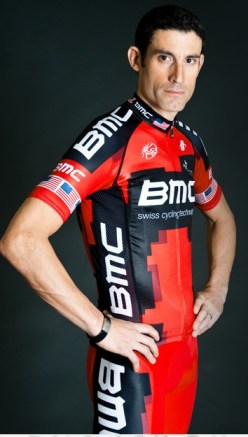
George Hincapie came clean.
By George
Then came a Federal grand jury investigation in which close friends and former teammates allegedly testified that Lance had been doping during all those years of Tour success. These were credible witnesses, people close to Lance Armstrong that had good reason to talk. Many were being implicated in other pending investigations and ultimately made public confessions of their doping histories. The most notable of these was cyclist George Hincapie, a stalwart teammate to Lance Armstrong and other Tour leaders who had a crystalline image in the world of cycling as the ultimate go-to guy for team support. Yet Big George turned out to be a doper too. That’s when cycling fans really sat up and took notice.
Yet the grand jury investigation suddenly ended for reasons that were not made clear. That meant the truth would not come out from testimonies made by cyclists close to Armstrong. Some sniffed corruption in the way the Feds gave up. But there was more to come…
USADA strikes
The United States Anti-Drug Assocation (USADA) went a few steps further, compiling its report and released it to the public. At that point, the Lance Armstrong Legacy started to crumble.
Armstrong tried to kick the accusation can down the road by saying that he would no longer fight the accusations, that they were ungrounded. It seemed like he was wishing the whole thing would blow over. Then he issued a statement (actually, a confession of sorts) that to discerning eyes showed the truth. Armstrong’s statement centered on the fact that he believed his efforts in the 7 Tour de France titles were justification enough for his victories. In so many words, but without saying it directly, Armstrong made the case that because so many people were doping, he had to dope himself in order to start with a level playing field.
Getting popped
And the fact is, Lance Armstrong was right. He was telling the truth about that. He may have been the best and one of the most prodigious dopers of all, but he was not alone. The peloton was a hopped up glory train of overpowered bike racers riding hellbent until they each got caught. And that happened. Tyler Hamilton called it “getting popped.”
Forgiveness and not forgetfulness
Knowing all that we do now based on the power of testimony from so many world class cyclists that they doped and did blood infusions, Lance Armstrong deserves some degree of forgiveness. Here’s why.
Tour winners, stage champions and team leaders such as Bjarne Riis, Christian Van deVelde, Tyler Hamilton, Floyd Landis and many more all were prodigious dopers. To a man, they all insisted they thought it was the right thing to do for their careers at the time. Cycling observers like Greg LeMond had at times publicly challenged the corruption of the sport, but the sport (and Lance Armstrong particularly) fought back the image that everyone was doping. No one should forget that. The sport tried to cover it all up. On that point Lance was not alone.
Ramifications
There are lawsuits against Armstrong for committing the crime of deception. That’s all going to be determined in a court of law, we must suppose. Additional layers of guilt or legal findings will not make the case against Armstrong any more damning than it already is.
Mea culpa lacking, must we make our own?
For perspective, perhaps we ought to consider the case of Lance Armstrong in comparison with other people we categorize as heroes. Some of them seem to have “cheated” in their professions as well.
John, Paul and the rest
Would the Beatles have been as creative without influence of illegal substances such as pot and LSD? Did they literally dope their way to writing the music for the Sgt. Pepper’s album, considered by some their best work? The Beatles also readily admitted “knicking” songs from other artists as foundations for their own music. Is that a form of cheating too? We also know that post-Beatles, John Lennon was no saint, and Paul McCartney got busted for pot. Yet we don’t judge those two geniuses based on their crimes, but on their work.
Bled dry
I’ve decided to look at the career of Lance Armstrong the same way. Like he said in his public statement: He put in the miles. Rode more than 2000 miles in each Tour. Suffered through heat and wind and near-fatal brushes with death in descents and untold pain on climbs. It doesn’t make sense to take that effort away from him. Yes, he doped well enough to win, but there were far more factors at work along the way that could have dumped his arse in the ditch along the way. His  comeback attempt was proof of that. The image of Lance Armstrong with a gash under his eye from a crash on the cobbles is enough proof that it was his hard work and racing that won those Tours, not the dope alone.
Was Lance Armstrong really a liar?
The answer to that question is yes, and no.
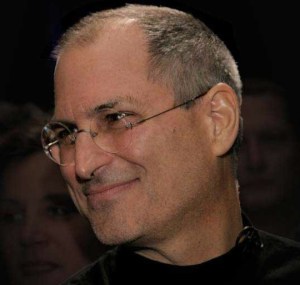
Was Steve Jobs essentially (by personality at least) the Lance Armstrong of the computer set?
We live in a world where people lie, cheat and steal to get ahead all the time. In business, when software or technology giants steal ideas from one another, they often go to court to battle it out. That’s what’s happening with Samsung and Apple right now. Is that any different than Armstrong versus Ullrich, each doping to maximize his chances for victory? Are there also mysterious “doctors” behind the scenes of those business battles just as there were in the cycling doping wars? Of course there are. Corporate espionage and business intelligence is every bit as competitive as life in the peloton. Perhaps moreso.
The Jobs and Lance parallel
We also know from his biography that Steve Jobs could be a difficult jerk at times. Yet some attribute Apple’s success as a company to that Jobs trait of demand for perfection. In other words, he was just like Lance. The parallels between Steve Jobs and Lance Armstrong seem almost stunning. Two of the world’s greatest brands, and what do we find behind them? Hard-nosed, driven men, both who battled cancer yet defined their life in ways that celebrated the bitter importance of making the most of every moment. Their examples may be flawed in some respect, but they are examples nonetheless. Just like King David in the Bible, who had so much blood on his hands that the Lord denied David the chance to build a temple in His honor. Yet David too was forgiven.
The good, the bad and the ugly. All forgiveable.
The story of Lance Armstrong all breaks down rather neatly through hindsight. The good (winning 7 Tours) the bad (the doping) and the ugly (being a jerk to wives, teammates and some who once helped him.) All of it is true. All of it is ultimately necessary to the story, and whether we forgive or forget Lance Armstrong.
Competitive realities
We have to ask ourselves: Are we intellectually capable of understanding the environment in which Lance Armstrong operated? We can also understand the need for that environment to change, and that appears to be happening. But one can’t permanently blame Lance Armstrong for his response to a competitive reality that many great men, not just Lance Armstrong, chose to engage through doping. As we shall see, going from whore to hero (and sometimes back to whore again) is something of prized tradition in American politics, economics and culture. Happens all the time. Ask Bill Clinton, who as President succumbed to pleasure, but who has gone on to become one of the worlds’ premiere statesman, with a wife who has ably served as United States Secretary of State. Now that’s the power of forgiveness in action.
The porn of the peloton?

Traci Lords shows off her cycling kit from the early part of her racy career.
Perhaps the entire era was a bit like the pornography of the peloton, an exaggeration of truth, and a bit sordid. But you know what they say: pornography drives technology. Pornography is a $14B industry and we’ve seen a few porn stars make the leap from hardcore to mainstream roles in society. Traci Lords. Sasha Grey. Ron Jeremy.
We have also seen what the hopped up boys on bikes dressed in tsexy suits can do when their sport is a lurid pantomime or regular bike racing. We’ve watched them effortlessly rolling up mountains when they are engorged with packets of their own blood. Cyclists during the doping era were like giant human erections. But it’s time the sport crossed back into the mainstream again.
No less thrilling roles
Sure, the doping era was thrilling in its way. But now it is up to the un-dopers to surpass those thrills under legal circumstances. The powers that be have passed judgment on Lance and the rest. They have been branded porn stars for their transgressions. But even porn stars can teach us a few things. And they have.
Cleaning up its act, to a degree
The peloton is reportedly cleaning up its act these days, and that will be a good thing if it is true. It’s just not necessary to write off the sports former stars in order to enjoy the stars of the future. That effort is futile, and we should not forget how well Lance Armstrong rode his bike, or Jan Ullrich, or Marco Pantani or Alexander Vinokourov, who by the way allegedly paid off another cyclist to let him win.
We treasure colorful personalities and even a touch of the unimaginable and absurd to allow sport to mimic the good, the bad and the ugly realities of the real world. Right down to the porn stars, whose largely denied role in society nevertheless drives $14B in business per year.
How to forgive, and not forget
We all like to believe we’re people who believe in the value of honesty and virtue. The morals of our religions strike those notes with clarity. Yet the fabled story of the prodigal son shows that it is right to forgive and welcome even the squanderous among us home when we’ve indulged in debauchery. We all deserve a second chance. Even the dopers and the driven, all should be forgiven.


 We Run and Ride
I can’t believe what I’ve just read. “We live in a world where people lie, cheat and steal to get ahead all the time.” So it’s OK for all the rest of us to do it too? To do the right thing in such circumstances requires strength of character, and Lance Armstrong has demonstrated a sad lack of that.
“Christopher Cudworth is a writer and artist with a penchant for discovering insights that lead to truth whenever possible.” So you lead people to the truth, then explain that it’s OK to “lie, cheat and steal” if other people do it? Is that what you teach your kids, Christopher?
I lived and worked in the USA at one stage, and met many wonderful people, and I know that not one of them would subscribe to the views esposed in this article.
Lindsay Graham
Canberra, Australia
While you raise legitimate points, I think you’ve missed the primary point of this essay. And that is, that forgiveness is still possible despite the flaws of human beings, even on a grandiose scale. It is not to say that what Armstrong did is right or admirable, or to teach our children that it is right to cheat. The point is to recognize that the world really is built upon such things as this. Only then can we comprehend both the magnitude and the scope of what we are dealing with. In fact my experience in dealing with dishonesty has produced much personal pain and disappointment. When you choose the honest route, you are often at great risk, and subject to much disappointment.
But there is a strange operative afoot in the way we are asked, by faith for example, to address these transgressions. We are called to forgive. That is the truth to which this article calls people. We honestly cannot learn without forgiving. It’s a tough lesson, and not one to easily swallow, but I’m willing to guarantee that many people do understand that concept. Imagine the potential effect on Lance Armstrong, for example, if someone were to approach him and say, “I don’t like what you did. But you are forgiven.” That approach is transformative.
By contrast, are we to respond vengefully forever toward Lance Armstrong? If so, what does that prove about us? To ostracize him might make us all feel superior to him, and his legacy. But what’s the real point in that. It seems that society has learned much more from people who grow to confess their sins. If Lance ultimately can’t do that, then you’re right, there’s probably no hope of reconciliation. But he hasn’t had room to do that to this point.
I think it takes courage to go against the grain and forgive rather than just jump on the bandwagon of condemnation. What do you think, when you hear it in those terms?
What a load of BS. Lance cheated, lied, intimidated and bribed his way to his victories. Others who chose to compete honestly had their careers stolen. Those who chose to speak out against him lost jobs and opportunites. Forgiveness requires repentance. Read the story of the prodigal son again. The son returns home humbled and ashamed of what he has done. He asked to be taken back not as a son, but as a servant. Lance, on the other hand, still professes his innocence and refuses to admit any wrongdoing. Punishment is merited. Forgiveness is not.
The essay does not disagree with anything you’ve said. In fact it directly documents the ways Lance acted to damage the careers of others. He should be held accountable for that.
But when it comes to getting the truth, and issuing forgiveness, it works both ways. They have proven that torture does not work in wresting the truth from possible informants. Good interrogators work with criminals and terrorists in many ways. The same extreme can be applied in this circumstance. That more truth and possible humility can come from LA if society approaches it that way. And yes, Lance must first show contrition. But perhaps it is important, given the great scandal running through the sport as a whole, that good can come of opening that door. I’m not saying I’m perfect on the issue, or absolutely right. I am suggesting that it is naive to write off the many other factors that go into winning races beyond the doping. More than one athlete has been intimidating and controlling in their time. The more I read of so-called heroes, the less I believe in idolizing anyone at all. That’s all been kind of washed clean. But you make good points. Excellent points in fact.
Pingback: Lance Armstrong: Forgivable hero or narcissistic bastard? « The Weekly Show