
 Early March is always a time of keen transition in our part of the world. The cliches about “in like a lion, out like a lamb” seldom hold true in black and white. Furthermore, as a distance runner for more than forty years, I’ve been coddled by lions and stomped by lambs.
Only one thing holds pure and true in the month of March. That is when the blackbirds return. The call of a red-winged blackbird from a fencepost or an overhead wire is a sure enough sign of spring that one can let down ever so slightly.
These are hardy birds, mind you. They frequently fly through snowstorms to get here in Illinois by early March. And what’s the rush? Well, the males want to be ready and on territory by the time the weather actually shifts, typically in late March or early April. Until then, it’s a back and forth process with blackbirds setting up shop on suitable breeding grounds only to flock back together when the weather turns bitter cold again.
Their survival instincts tell them when to turn on the hormones and when to shut them off. Birds in a flock depend on a collective wisdom assembled through millions of years of evolution. The birds we see today are the product of the survivors of experiments in feeding and breeding. Any fatal instinct or turn of bad luck weeds out individuals that don’t get to pass on their breeding stock from one generation to the next.
Weeding out the weak
It’s a whittling process, much like the manner in which the pace of a race weeds out the slower competitors until but a few remain. And as numerous as blackbirds can be in some areas, they still constitute the tip of a spear that goes back millions of years. This is what’s so insulting about the notion that all this nature we can witness is the result of some slapdash effort by God to toss it together in a few days. That worldview places human beings at the top of the order and dumps the rest into some weaker category of existence. But it’s not true. Every living thing we see on this earth is a massively refined product of time and yes, of tradition.
That’s why birds of feather flock together. It’s tradition that keeps birds and all living things alive. It may not be cognizant tradition in the manner of which we’re accustomed to thinking, but it is tradition just the same.
The other way around
If anything it is humans who imitate nature, not the other way around. Those running routes we established in college all had names. We branded them after landmarks found along the way. Thus one of our favorite running routes in college was named Wonder Left after the sign for the Wonder Cave billboard at the counter corner of Route 52 and Meadowlark Lane north of Decorah, Iowa.
We’d proceed from campus up the long hill out of the valley and typically face a north wind in the spring season. There was nothing blocking that wind for another 500 miles north. It was all low hills and cornfields from us to the Boundary Waters in northern Minnesota.
The wind would roar in our ears as we plied our way through it. Yet somewhere along the way, I’d hear the sound of a red-winged blackbird calling from a wire. And I’d think, “This is only temporary.”
April chill
Typically, it was. Yet some springs winter would hold on well into April. Which drove us to manic lengths trying to fix our hopes on some day to come where we could actually run outside in shorts, not baggy sweats. One chill April day that was marginal enough that we could actually run in shorts in the high forties or low fifties, some at the back of the pack started up a chant, “The weather sucks! We want spring!”
This went on for a mile or two before we arrived back on campus so sick of the damp air that someone stopped and yanked off their shorts and ran past the whole team. That pair of pale butt checks set off a springtime alarm of sorts. We all stripped naked and held our running stuff in our hands to gather at the door of the college union. Then on the count of three, we all spilled into the cafeteria stark naked and running in a furious clambering line. “The weather sucks! We want spring!”
He who hesitates is lost
But one guy hesitated back at the door. He was twenty yards behind when he finally decided to make a break for it and follow us naked through the cafeteria. Big mistake. Once the crowd inside the cafeteria was warned, a few football players or some other gathering of big guys was ready for the next wave if it was going to come. They leapt up and grabbed our teammate and tied him to a post with his own clothes. He was a shy dude by nature, you see, so that had to be agony.
Years later our little Luther College became known for a ritual called Naked Soccer . The whole notion makes me very proud of my alma mater. Granted, it was probably snuffed out, a sign that the administration feared the seemingly inevitable incident of raw sexual harassment or worse. But I still don’t believe that getting naked is, on its own, a true crime.
Butt cheeks on patrol
It was the right thing to do back when the weather simply wouldn’t cooperate, and our little band of blackbirds was sick of migrating through the chill of March. Now that butt cheeks are far more common in the public eye, the only thing scandalous about the notion is the exposure of a penis or two. And in the case of men, that generally turns out to be a shrunken proposition when the air is cool.
But we did have one teammate that simply couldn’t run naked due to the fact that he was simply too well-endowed. That made it even funnier to most of us when he had to stick with his jock when the rest of us were stark naked.
Such are the antics and traditions of men and blackbirds. Driven by hormones against the raging spring winds, some of us show our epaulettes while others have to keep them under cover. Nature is a patient teacher however, willing to wait out the vagaries of all this behavior to find out who really wants to survive, and why.
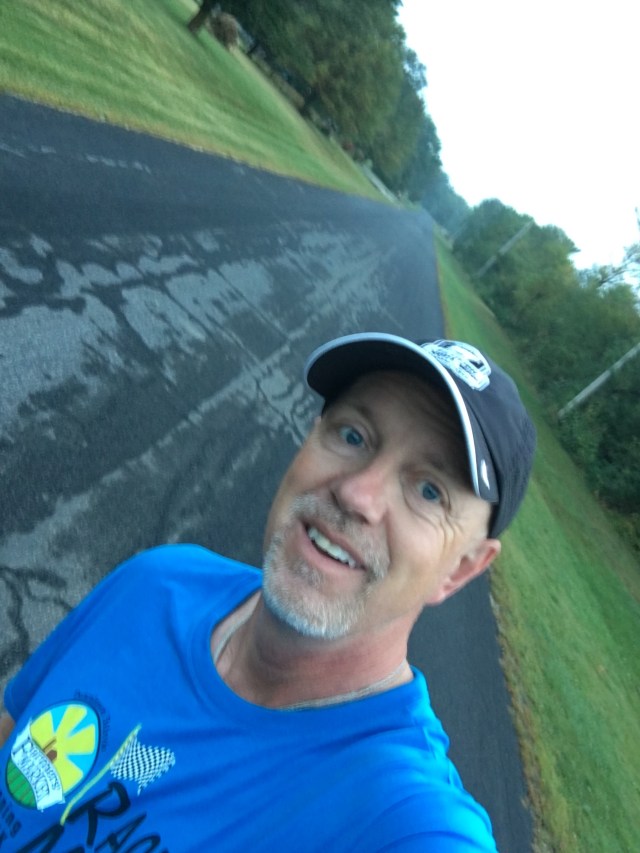 Turning fifteen years old tends to be a watershed moment in life. The freshman blues abate and the fear of junior year obligations is not yet upon you. Hormones rage but the looks to complement those desires are perhaps not all there.
 I was not immune to all that. Nor was I immune to the teasing of friends and enemies. It made me burn inside, and want to set fire to the world any way I could. My father dearly wanted his boys to avoid the likes of his own academic struggles, but he chose on many occasions to wear us down with exasperation rather than build us up through communication. So I sought consolation with other father figures in life. We all do that to some extent.
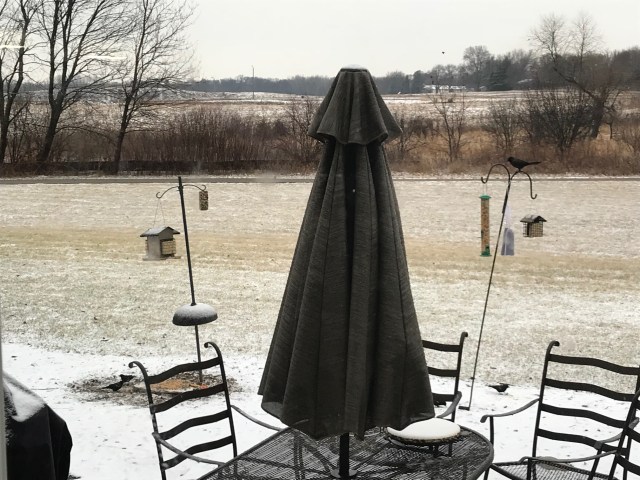 It snowed here in Illinois this morning. The birds gathered around our feeder were manic for the little bits of food that remained after the last refill. I drove down to Woodman’s grocery story and brought back bags of bird seed, some suet, a woodpecker block and a mesh bag of thistle.
 Some of them get eaten as a result. The feathers of a mourning dove lay strewn around the lawn twenty feet from the feeder this morning. Doves are fast food fare for Cooper’s hawks, who come winging around the house as if it powers then with centrifugal force. The birds at the feeder don’t stand much chance against a hawk flying at that rate.
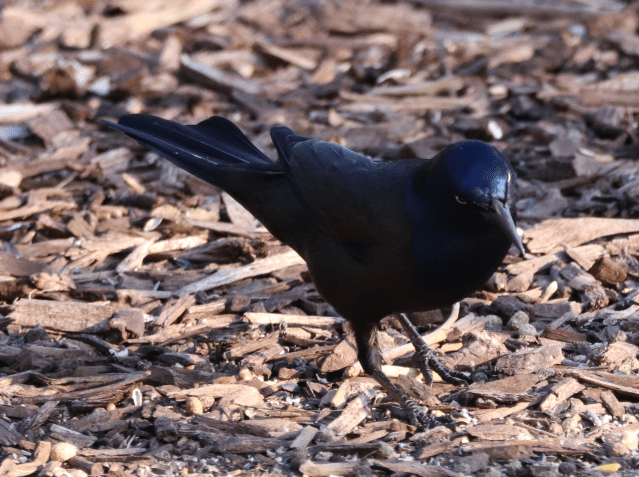 When it comes to seed and plant eaters, it seems even the birds don’t abide by the rules doled out to their kind. In fact, the opposite it often true. Creatures that we typically associate with eating seeds are not above taking meat into their diet. On many occasions I’ve seen birds called grackles gathered around a road kill. They’ll even eat their own kind.
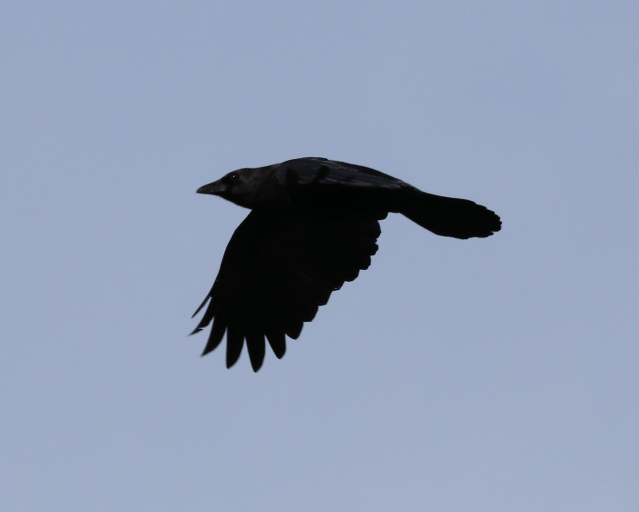 In some of the races in which I’ve competed over the years, I’ve been the predator tracking down the prey ahead of me on the course. There is little remorse on those occasions when we’re the dominant ones. We all seem to love it when we have the chance to vanquish our competition and eat them alive.
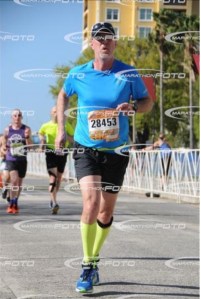 Standing at the starting line of the Gasparilla 8K in Tampa, I had cleared my mind of just about everything in preparation for the race. But that had taken some work. My wife’s race started at six in the morning, so there was a bit of waiting around to do. Chasing out onto the course to see her pass by was a tiring run of a couple miles. It was hot out, and the thought of using energy any other way than running my race seemed like a dumb idea.
 I seem to be checking my watch quite a bit. That means I was either trying to stay on pace or wishing the darn race would be over.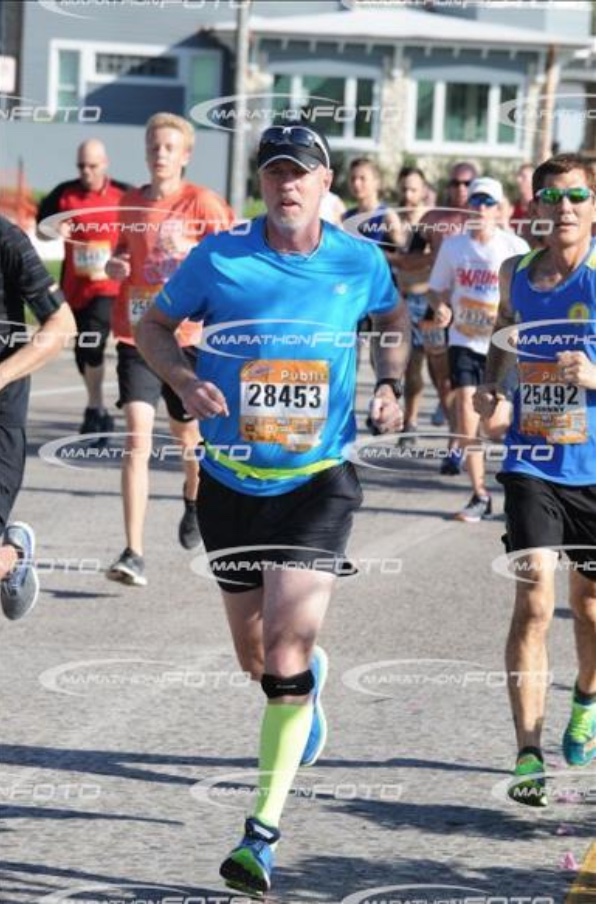
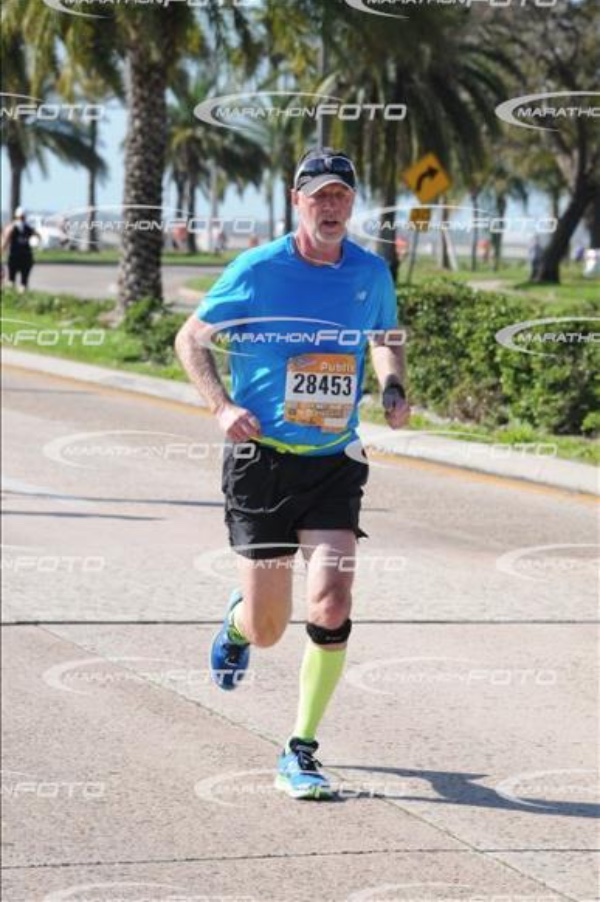
 Last night around 2:00 am I awoke thinking about yesterday’s blog and a passage to which I referred to the feeling of loss one can accumulate with age. This is what I wrote the feelings I had while lining up to race an 8K and realized that my time for winning the overall was long ago, and past:
 But the gun lobby successfully sold a new version of the Second Amendment on the false narrative that the proliferation of guns in the hands of private citizens is equal to liberty. That’s a lie, of course.
 Trump didn’t like John McCain either, for getting captured and tortured. Was that McCain’s fault, or are the circumstances of war (or school shootings for example) often out of the control of an individual.
 The starting pen at the Gasparilla 8K was low on competitors lined up in the 6:30-7:30 per mile pace. I’d started far at the back of the pack lined up for the race, which numbered more than 5,000. It was the last of the four scheduled races of the weekend. The 15K, the original and flagship race of the Gasparilla series, has been won by a local Floridian named Eric Montalvia in a flashy 46:09, a 4:57 per mile pace. The 5K that day was won by Tampa’s Taylor McDowell in a more pedestrian 15:58, a 5:08 per mile pace.
 The morning had started early on Gasparilla day. My wife Sue was running the half-marathon, and finished in just over 2:20 on a morning that heated up so fast it earned the Yellow warning flag from race officials. The Gulf breeze came from the South and made the Bayside stretched tolerable while headed in that direction. But when racers turned back north, there was nothing to wick off the heat.
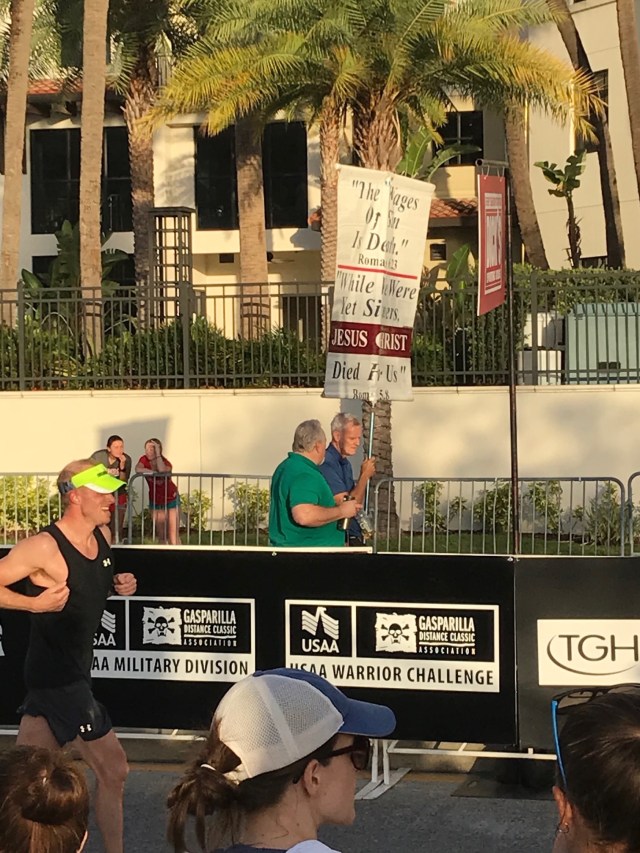 my legs and wanting to warm up enough to overcome the sore Achilles I’d created by wearing sandals on our vacation jaunts. Everything we do has a cost. At least that’s what the guy carrying the Jesus sign tried to tell us. “The wages of sin is death.” Did Jesus really have such bad grammar?
 Heading into my senior year in college, I was desperate for a summer job when my best friend’s father offered me summer work as a janitor at a building called International Towers. It sat at the junction of Cumberland Road and I-90 outside Chicago. From the roof of the building you could see downtown to the Hancock and Sears Tower. It looked like you could reach out your arm and drop a car right in the middle of it.
 I’d been told by someone (not Andy) to go pick up some boxes of fluorescent lights being discarded during a redesign of an office way up near the top of the building. They were long lights, probably 72″, and there were a dozen of them in each box. So I gathered them up on a cart and hauled them all down to the basement to get rid of them.
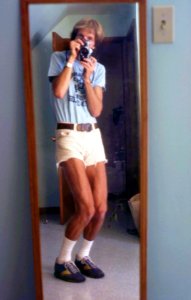 But when I think about that day spent hiding out after the explosion of the fluorescent bulbs in that compactor, it forces me to dwell on the fact that my naivete caused the problem. I wasn’t trying to cause an explosion. Probably there were kids my age smart and snarky enough to do that kind of thing on purpose. But I was never really one of those kids. Instead it was stupidity that let me blow things sky high.


 This morning at 4:45 my wife rose from bed to gather her gear and go swim. She is disciplined about her workouts. And frankly, she loves to swim. That goes back a ways, and she is good in the water. So it’s a joy of sorts for her to swing over to the natatorium before the sun is up and get in 2500 yards or so.
 Part of the latent guilt I feel right now has to do with the difficulty of going places in the winter months. It’s been a raw winter in some respects. And because it has been tough to run in some conditions, I barely stayed ahead of the fat tsunami this winter.
 I’m even guilty about how that “i” in the definition above somehow doesn’t link up with the rest of the word. It’s a glitch from having copied it over from dictionary.com to WordPress, that I can’t control. Yet I can’t help feeling guilty about it.


 We Run and Ride