
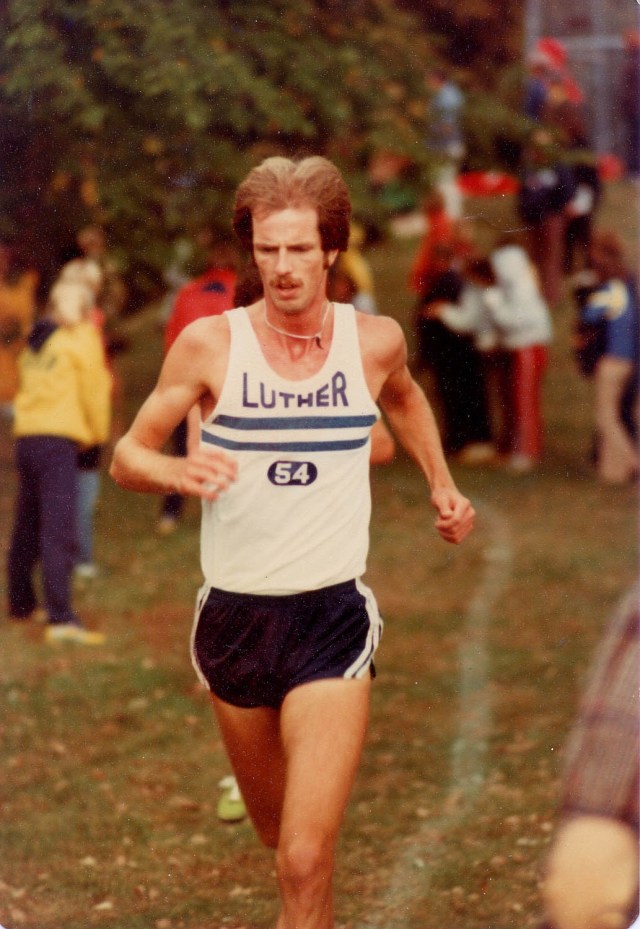
Summer jobs

cudrun.jpgBetween years of college there was always pressure to find good summer work and save up money for expenses come fall. As a sometimes oblivious member of the human race at that stage of life, I was not always thinking ahead. Which meant searching for a summer job any way you could get it.

I doubt the process has changed much. Young people still put off the inevitable when it comes to needs and obligations. It may well be worse these days for college and high school kids. The continually changing nature of the economy is hard enough on young people graduating from college in terms of finding decent-paying work, much less trying to find employment for three months to save up between school years.

Weird sensations

All I remember is the weird sensations and temporary feel of summer work. In some ways I played it smart, and in others, not so much. On top of working all day or at least some of the day, which was new to me, there was pressure to get in those precious training miles to prepare for cross country in the fall.

Perhaps scholarship athletes have some of that pressure taken away, but not really. Training can be a form of work when you have to perform at a level justifying the support offered by a college or university.

D3

I was a Division III college athlete, so there were no scholarships. The campus jobs I was required to work as part of the financial package I was offered paid $1.10 an hour. That rate was earned at a college that charged $3400 the first year I attended and finished at $4300 that last year. So the student work program was not a source of income. It was working off the debt one had already accrued through enrollment.

Yet on top of getting up to work at 5:30 a.m in the dishroom, there were 80-100 miles per week to cover. So one essentially had two jobs to work.

Young and stupid

Fortunately we were young. And generally stupid. And full of manic energy. So we got by. But then summer would roll around again. That meant finding and working a “real” job that often wasn’t real work in the sense that it contributed anything to society. Whether serving as part-time park district stuff or doing manual labor at a factory, those summer jobs were character-builders to say the least.

Coaching

Still, it started off simple enough. The summer before my freshman year, I worked as a coach for the St. Charles Track Club, a competitive organization that attracted more than 100 kids ages 5-16. The job paid $500 for the summer, which seemed like a lot of money to me then. This was supplemented by some sales of my artwork that year, but I think I went to college that fall with $250 in the bank to last the whole year.

That said, our track club produced state and national age-group AAU champions from sprints to jumps to distance races. So that wasn’t a bad summer actually. Despite being in the proximity of all those runners, and racing a few times over the summer months, I did not do all that much mileage before heading off to college.

Still, I made the Varsity cross country team that freshman year and finished 9th in the Conference meet. We went to nationals in Boston where the weather sucked and the course turned to muck. But those were lessons learned for the future.

U-Haul

The summer after my freshman year, I somehow I stumbled into a job working at a U-Haul distribution. I worked for a trio of guys who both sold and delivered trailer hitches, boxes and the assorted needs of U-Haul rental locations across the Chicago area. I mostly drove vans around the area stuffed with orders that I picked and placed in the truck.

I certainly learned how to navigate the suburbs using maps and learned the names of all the towns and places I visited. That knowledge would come in handy later in life when I became an admissions counselor covering the same territory. You can’t get me lost in Chicago to this day.

That doesn’t mean some things did not go badly on a few fronts. While driving a U-Haul van, I crunched the rear end of a brand new Buick in front of a dealer on Ogden Avenue in Downers Grove one morning. The car pulled out quickly and I was glancing at the map when the van nailed the rear tail light. The guys back at the shop shook their heads but they’d all had fender benders too. So I got off easy.

Which made the incident I never told them about a bit more dramatic. Because one day while driving a box truck filled with a heavy load of refrigerator cartons I hit the brakes while approaching a busy intersection. The roads were slick with summer rain and the oil of traffic turned them into a skating rink for trucks like mine. The back end spun around and I went through that intersection backwards. I held the wheel lightly, then slowly turned the truck as it went through its gravitational gyration. When the front end came back around, I kept right on driving. Down the road I had a ‘death shiver’ when I realized how bad that could have turned out.

There were other adventures along the way, and the crew definitely got a kick out of my raggy jeans attire that was worn, I’ll admit, not to look too much like I’d given in to “The Man.”

Not exactly “work-ready,” was I?  So the last day the crew determined to teach me a little lesson about control and humility. So they snuck out to my Buick Wildcat when I rolled into work and put a prank whistle on some part of my engine that made it sound like it would blow up when I started it again. They slapped the hood and told me, “No go back to school.”

And that was funny. But during that summer, after many long weeks of glancing admiration for the hot young girl working in the front office, I worked up the courage to ask her to go on a date to a Jackson Browne concert. Turned out she was the daughter of the Big Boss, but he approved. That made the whole summer seem worth it. Saved a little money too, and wound up flirting with the Top 5 that fall in cross country.

Olympic Stain

There is no small irony in my mind that the job I worked the summer after my sophomore year was a company called Olympic Stain. It turned out to be a stain on my soul. Working conditions at that plant were awful. The fumes of turpentine hung near the ceiling of the plant all day long. There were industrial accidents taking place all the time, with forklift drivers striking 50 gallon drums of paint three stories up and mean-spirited pranks taking place between workers. Nasty, stupid stuff going on all the time.

And having had no training in pipes management, I turned the wrong release valve one afternoon and liquid latex shot out of the pipes and coated me from head to toe. That meant a trip to the industrial shower where I was stripped naked and shoved under freezing cold water. That day I also had to endure the teasing of employees embittered by their own sad reasons for working there. It was a nightmare, and some deeper part of me was traumatized by the experience.

That fall in cross country I struggled with feelings of depression and lack of self-worth. Everyone who knew me categorized that as “Cud’s Weird Year” and it didn’t help that I was immersed in studies of existentialism and the irreversibility of time. To this day I blame that summer job for pushing too many emotional buttons. I finished out of the Top 15 in the Conference meet but recovered enough to help our team compete at nationals where we placed 8th, our best effort to that point.

That winter a roommate turned to me after I’d spent an entire run complaining about the pace and said, “Cud, you just need to shut up and run.” So that’s what I did. And things started to turn around from that point on.

International Towers

Coming off a successful track season my junior year in college, in which I set all my PRs from mile to 5000 meters, I was feeling better about myself and shaved off the shoulder-length long hair and beard I’d grown. That led to the idea of getting contact lenses and an entirely new self-image going into senior year. While running, it helped not to have those Napoleon Dynamite glasses perched on my nose.

That summer I found work through my best friend’s father who hired me to work as a janitor at the tall office building he managed off Cumberland and I-90 on the outskirts of Chicago. That commute was long, more than an hour, but the money was needed.  So I took what I could get, to quote Bachman Turner Overdrive.

The job was illuminating on many fronts, as I got to witness the background activity of an office environment that included a group of lusty middle-aged women who drank wine in the restroom during lunch breaks. I also got to witness labor disputes and union controls. And during lunch one day, my best friend’s father took me to a bar where the waitresses wore revealing negligees if they wore anything at all.

Making it happen

It was tough putting in running miles after such long days, but I sensed there were good things ahead for me. The job paid $5.00 an hour and I saved up quite a bit of money. That was a rather new experience against the other summer jobs I’d worked.

That fall, with an entirely new attitude brought on by not looking like a geek, I also fell in real love for the first time with a gal that I met at RA retreat. That helped.  And that fall on campus I also had a job doing promotional work for the campus recreation office. No more dish room labor at 5:30 in the morning. Thus I trained twice a day and my times over the 5-mile distance dropped down to near 25:00. For most of the season I ran second man to my roommate and was fifth man on a team that placed second at the National meet.

Lessons learned

What I learned is that there is a 1:1 relationship between work stress and overall performance in life. There is no doubt those summer jobs shaped me, some for better and some for worse. All tested character and taught lessons about self-discipline.

Ultimately those are tests we all have to pass. I could have been smarter searching for summer jobs, but I also had the courage to try something else. Coming off my senior year in college, I spent two glorious weeks doing exceptional watercolors from life. I’d scored some expensive watercolor paper for a very cheap price at a local office supply store that was selling it out, and I was on fire with creative energy.

But when I told my mom that I wanted to paint that summer and try to sell my work rather than work a traditional summer job, she freaked. My dad had been in and out of jobs during my college years, and she had a fear going on about money. So she wasn’t exactly encouraging.

Still, I persisted in my hopes of selling artwork and signed up to sell my paintings at a huge local art festival in Geneva, Illinois called Swedish Days. It was a good prospect actually. I had all my work matted and framed. And then it rained. And rained. And rained. The show was  literally a washout. I sold only one piece of artwork that weekend. My plan was foiled.

But all was not lost. Later that fall I held an art show at the college and every last piece of that artwork sold. Sure, it was too late to prevent the need to work that summer job. So I did work that janitor job in July and August. I was grateful for the work. But I wonder to this day what summer might have looked like (and life beyond) had I earned $2000 in one weekend as happened that December. That could have been one sweet summer.

Iconic

During my work in the field prior to my painting sessions, I’d found a dead red-tailed hawk that summer on the roadside. Now granted, it is highly illegal to pick up raptors or any other species of bird and keep them. But I did so because I wanted the bird for reference purposes, and felt a higher calling, legal or not. So I cut up the bird and saved a talon from the middle toe of the hawk to make a necklace.

That fall my new girlfriend (whom I would date for two full years) asked about the necklace, and I told her, “I’m going to be completely focused on my running this fall, so my love of nature and artwork will have to wait a little. But this talon reminds me that I’ll get back to it.”

That may sound hokey, but it worked in many respects. I’ve never stopped running and I’ve never stopped painting.

Now I believe that summer is meant to be lived with such purpose that every day feels like a vacation. Even if you’re working a full time job, there are noon walks to take, and early morning bike rides to enjoy.

It takes commitment to keep that level of relaxation in mind. But that’s another thing I’ve learned from running all these years. Sometimes the hardest efforts in life can feel the best, and that which does not kill us really does make us stronger.


Posted in Christopher Cudworth, competition, cross country, cycling, healthy aging, mental health, running, trail running, triathlon, we run and ride | Tagged , | Leave a comment

Livestrong still has a tale or two to tell

yellow livestrongRecently I saw a link to the Livestrong Foundation website and decided to visit and see what they’re doing these days. Despite all the bad press its original spokesperson Lance Armstrong generated through his admission to lying about use of performance-enhancing drugs, the Livestrong Foundation expanded and moved on from the controversy.

I certainly don’t blame them for keeping the mission alive. That mission is simply stated as “Helping you live Stronger, Healthier and Happier.”

In other words, you don’t have to be a cancer victim in order to benefit from the information and services provided by Livestrong. But those who do go through cancer in any form deserve all the inspiration they can get. So I tried to provide some. And it was published (see link below.)

The email that arrived in my inbox from a Digital Marketing Intern said the following:

I hope this email finds you well.

Thank you so much for taking the time to share your story with us! We have just published your blog, which you can find here: https://blog.livestrong.org/because-life-does-go-on-244240ff434f

If you ever need support, please feel free to reach out to us here at LIVESTRONG. We are happy to connect you with a cancer navigator.

That last bit is an interesting evolution and potentially valuable service from Livestrong. If someone is experiencing cancer themselves or acting as caregiver to someone going through treatment, it helps to know there are people willing to help you navigate through it. Just the health insurance maze alone can make you crazy.

As for our experience, I decided to tell our story again through Livestrong not only to share the experience of cancer survivorship and caregiving, but to encourage people that there is life beyond cancer even when the outcomes are not always what we desire. And from there, life does go on.

Jeff Long

Photo of Jeff Long from the Beacon News (link below)

Just this week I received news that an associate in the public relations business had passed away due to cancer. Jeff Long was a great person, family man and lover of the outdoors. He worked in PR for the Fox Valley Park District and despite occasional encounters with him through a regional PR association, I never knew he’d been through hundreds of rounds of cancer treatment over his years of survivorship.

His death made my heart sink a little. I mean that almost literally. I had this sinking feeling in my chest when I noticed people commenting about his death on Facebook. I asked someone who knew Jeff to private message me about the details as the news stories had not yet come out. Yet Jeff is featured today on the front cover of a Tribune publication, the Beacon News, and is featured as well in a story at the newspaper where I once worked, the Daily Herald.

Bracelet time

It all feels like a very long arc or even a big loop for me to go back and think about cancer survivorship. When immersed in treatment or caregiving, the cycles of treatment feel like a Mobius strip, never-ending and often hopeless.

That is why, for several years while Lance was winning big time and wearing those yellow Livestrong bracelets was a fashion trend, I wore my bracelet with what felt like a deeper connection to the optimism it seemed to provide. I’d read the Lance biography and absorbed the Lance legend by watching all those tours he won in France. That little yellow bracelet on my arm made me want to go out and ride, work off the stress and find a way back to the character needed to be a good caregiver.

But then, as Lance’s image was at first tarnished and then stomped upon by those who consider him nothing more than a cheater, my reaction was initial surprise and then resignation. Don’t get me wrong: I dislike cheaters more than anyone. The sports and political world is full of them, and my criticisms of those tendencies are never hidden. But because of my direct connection to the world of cancer, the action Lance took in that realm of his life still had significance. His “cheating” in the world of cycling had not diminished the triumph he’d achieved in overcoming cancer and then serving as an inspiration to many millions of people.

Mostly people were confused by the seeming contradiction of taking drugs after going through so many drug treatments to cure his testicular cancer. But I say that’s exactly why it was not such a stretch. If poison drugs (and that’s what chemotherapy is) can save your life, does it seem like such a sin to use them to celebrate life?

When Lance was being treated for cancer, he challenged the doctors by saying, “Give me all you got. You can’t kill me.”

But the doctor replied. “Oh yes we can.”

Maybe that changes a person in ways that some of us don’t understand.

Forgiveness

Lance was a jerk to some people in ways that deserve punishment. But my Christian upbringing and personal belief system encouraged me to look behind the Lance Armstrong persona well before he came out with his actual confession.

Here’s an excerpt: “Admirable in its forceful defense of his victories, Armstrong’s statement still stops short of saying he was truly innocent of doping. And that, in the context of all the evidence now emerging in full context of teammates confessing and accepting bans and possible other punishments for their sins, amounts to a confession by Armstrong as well.”

That is what I wrote then, and it still holds true. And I went on to say:

“He has done even more for the challenging plight of cancer patients worldwide through the Lance Armstrong Foundation and Livestrong, the highly active and effective education and assistance organization that delivers key resources and advice to cancer patients and their caregivers. So that is the balance in judgment many are being called to weigh. Which of his achievements is most important?”

I come down firmly on the side of that value. My contribution this week to Livestrong Voices piece is a tiny, tiny fragment of the overall purchase of that cause.

But it still matters. Every little bit matters. Because you never know who you might touch with your words or actions. And what it means to them is far more meaningful that most of us can understand.

Posted in Uncategorized | Tagged , , , , , | Leave a comment

Velociraptors revisited

IMG_3646.JPGThe city sidewalks that were just replaced in our little town were fresh concrete laid between wooden rails when a Canada goose walked across the fragile surface with its big flat feet. The tracks it left may or may not stay for long, but they look much like the fossilized tracks of dinosaurs found in granular rocks formed of sediment.
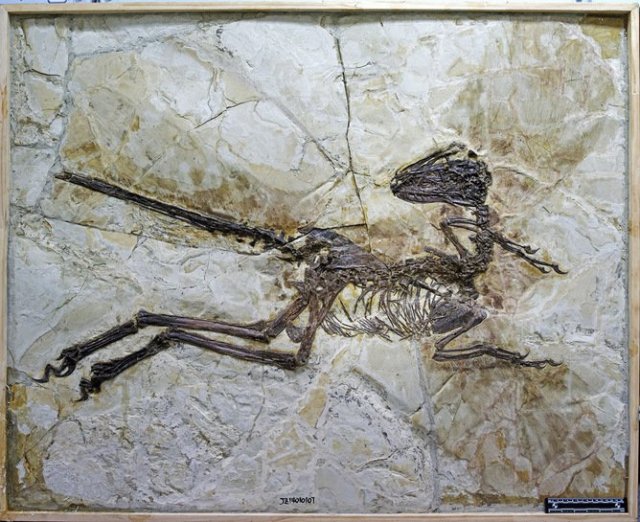

The fossil record at large in this world keeps growing by the year. Both private collectors, academics and museum researchers compete to find and claim the best fossils. The former do it for profit. The latter do it for knowledge. The net result is that human beings now know much more than we did one hundred years ago about the origins and development of life here on earth. Much, much more.

Human imprints

As my wife and I recently hiked into the mountains of North Carolina, our boots left deep impressions in the silty, sandy mud of the hiking trail. If by some act of nature a landslide covers those tracks and then suddenly solidifies through a heat wave, our tracks might be preserved as imprints that differ in constitution from the overburden. And if over millions of years that brittle overburden washed or wore away, the layer in which our footprints were laid might be exposed.

That’s just one of many ways a fossilized footprint or the bones and skin of a living thing might be preserved for millennia. When dinosaur fossils were first found the discoveries were cited as evidence of the existence of mythical creatures such as dragons or evidence of biblical creatures described only as “Leviathan” in scripture.

Such fantastical or general descriptions do little to enlighten the true nature and source of such fossils. But as scientists gathered fossils over the last two centuries, grand patterns began to emerge. These were undeniable clues of all that has gone on in the past. Clear relationships and lines of evolutionary succession were traceable from one geological era to the next. The fossil record reads like a Strava report on the rush of growth and absolute disappearance of thousands of types and species of living things.

Now we know that 99% of all the living things that once existed on the earth are now extinct. That still leaves millions of species in existence, but many of these are now threatened by the dominance and wastefulness of the human race as it consumes resources the way a Tyrannosaurus gloms up meat from the bone of its prey.

Velociraptor menace

In recent years the human fascination with dinosaurs has taken on a menacing flair thanks to the movie series known as Jurassic Park. Of the many dinosaurs depicted in these movies, one of the central figures of terror and tenacity has been the “character” known as velociraptor.

According to Hollywood paleoscience, those critters can run as fast as a horse, jump small buildings in a single bound, and distract a Tyrannosaurus rex if there are enough of them around to accomplish the task.

They also bit, with rows of fearsome teeth jutting from their grinning mouths. In fact, it is likely most human runners could set personal records over any distance with a velociraptor in pursuit.

Or maybe not. There is no more depressing scene in all the Jurassic series than the moment when a band of people is trying to escape a pod of ‘raptors chasing them through tall weeds. We see the human folk rushing through the grass followed by dark lines of ‘raptors slicing through the grass in close pursuit. Then the people start to disappear. It all makes the velociraptor menace seem real.

Feathers and all

But lately, science has begun to revise the projected appearance and supposed performance of creatures we call velociraptors. In a July 2015 article in Scientific American, writer Stephen Brusatte chronicles well-documented evidence that dinosaurs in the velociraptor family were actually covered in feathers, not scales.

These quotes and images from Scientific American explain:

“I study dinosaurs for a living and it didn’t bother me to see Velociraptors being used as hunting dogs for the sake of good cinema. What I didn’t like, however, was that the Velociraptors were depicted as big, drab-coloured, scaly brutes.

That’s because the real Velociraptor was a lapdog-sized predator covered in feathers. Palaeontologists have known this for a while. If you look at the arm bones of Velociraptor you can see a row of bumps, identical in size and shape to the quill knobs of living birds: the anchor points for big wing feathers.”

velociraptor.jpg

As published in Scientific American. A velociraptor species demonstrating traces of feathers.

“But we have a better idea now, thanks to the discovery of a spectacular new dinosaur from northeastern China that I studied with my colleague, Junchang Lü of the Chinese Academy of Geological Sciences.

Our new dinosaur, Zhenyuanlong, is one of the closest cousins of Velociraptor. Its gorgeous chocolate-coloured skeleton was found by a farmer in 125-million-year-old rocks that were laid down in a quiet lake buried by volcanic ash. It’s just the right environment for preserving the soft bits that usually decay before a fossil is formed.

Zhenyuanlong is covered in feathers. Simple hairy filaments coat much of the body, larger veined feathers stick out from the tail, and big quill-pen-feathers line the arms, layered over each other to form a wing. This is a dinosaur that looks just like a bird. If you could see it alive you would probably make no distinction between it and, say, a turkey or a vulture.”

Feathered Raptor.jpg

Illustration from Scientific American

Whether scaly or feathered, that critter shown in the illustration above could probably still find a way to hunt down a human being and eat them. That makes the contention by creationists that dinosaurs of this type lived among humans quite absurd. Still, that doesn’t keep the creationist community from leapfrogging right over clear geological and paleontological evidence to propose that the Bible trumps all other forms of knowledge. They still whine that the “earth is young” and claim that humans shared the ark with hundreds of species of dinosaurs. It’s bullshit. But it sells.

Comic sans

And quite comically, creationists randomly copy depictions of dinosaurs generated through real science in order to look credible in the eyes of people who want to think of creationism as true. But the manner in which they use these copies to lie to people stretches credulity to its maximum.

Creationists subtract the real science and can’t bear to acknowledge the bothersome wavy path of evolutionary science. They claim instead that science defies the presence of God and go to great lengths inventing faux science such as “intelligent design theory” to inject God back into the process. But that’s putting toothpaste back into an anachronistic tube.

It’s all bunk. Some people just want their worldview delivered in simple, straight and narrow fashion.  They would rather it be confined to simple facts whether it is true or not. So lie to them, the creationist logic goes. They prefer it that way.

Changing pictures

But there are interesting questions that await nevertheless. Now that the scientific consensus on many dinosaurs has been altered based on clear fossil evidence that species such as velociraptors had feathers, will creationists also modify their presentations in public displays such as the Creation Museum in Kentucky, where basic renditions of dinosaurs are shown in cases and cavorting with human beings?

And if they do change the look of those dinosaurs, how to explain the reason why to an audience so accustomed to circular logic that it can’t square with the truth? Millions of people, as many as 40% of all Americans as show in poll after poll, claim a biblically literal, creationist worldview.

Yet the virtual reality of creationism is clear: it classically steals from real science to show depictions of dinosaurs such as T.Rex and others romping around with human beings who look like us. The only thing missing are Closed Caption titles to explain what people are seeing.

The actual research behind the depiction of those dinosaurs is based on forensic and comparative science that helped thinking people piece together the appearance of creatures that evolved millions of years apart.

But the aching and most popular question of all might be. Will creationists now revisit velociraptors to get wise with the times?

More likely not

ryan-300x240-1445670001.jpgThe methods of creationism and their denial of reality resemble all those who persistently lie to make themselves seem credible to their intended audiences.

It’s common even in the world of running and endurance events. People lie about their personal records all the time.

But the real facts don’t lie. If someone walks up to you and says, “I ran a four-minute mile,” you reasonably expect that they mean they ran a mile that took them four-minutes to complete.

But people like to play loose with the facts because it suits their purposes in creating an air of credibility. Such was the case when Speaker of the House Paul Ryan claimed to have run a marathon “in under three hours.” Real runners checked the facts and found them sorely lacking. Ryan had not run a time anywhere near three hours. In fact, his best was likely just over four hours. Thus Paul Ryan is a liar. He creates his own truth and then attempts to sell it to advance his personal and political value. Do you know anyone else like that? I’m sure you do. Politics is full of them.

Rounding soundly down

But let’s get real when it comes to what Paul Ryan said about his marathon time because that’s not making a statement that’s a few minutes off his actual time. Rounding down his marathon time by an hour is a lot of rounding down.

So one might ask, whether we are talking about science or politics or personal records in running, why do such facts matter?

Well, it always matters whether we are being honest with ourselves and others. When creationists dismiss science as “made up” and then turn around and try to teach their version of reality in public schools, with zero scientifically examined facts to back it their claims that the earth is just 6000 years old, or that evolution hasn’t happened despite the massive consensus worldwide that it has, they are lying to impose their close-minded worldview on the public.

And when men such as Paul Ryan show a willingness to make up “facts” with such disrespect or comprehension of reality, it makes us wonder whether there are other issues that our politicians are lying about. Then it gets to the point where people can’t tell the difference between truth or lies, or invent their own set of “facts” (which is what creationists do) and suddenly every single speck of reason is up for grabs.

Feathering the truth

Gull.png

Photo by Christopher Cudworth

The truth of feathers on velociraptors and other dinosaurs has turned out to be a profound change in how we view not only ancient species of dinosaurs, but the species that remain with us today. That does not mean the creationists were right all along about human beings co-existing with dinosaurs such as T. Rex or velociraptors.

What it does mean is that our understanding of dinosaur evolution and the persistence of advantageous features such as feathers over eons provides an emphatic and undeniable link between the present and the past. No amount of biblical obfuscation can strip the feathers from those well-preserved fossils.

And what scientists are now realizing is that the birds with which we do co-exist are direct descendants of feathered dinosaurs to the point that we can consider them real dinosaurs living among us. That is not feathering the truth.

EmilyWithGoshawk.jpg

When liars rule

But when those who do feather the truth gain power…as men such as Paul Ryan often do,  because they lie and people want to believe them, there is great risk in letting remarks pass that are intended to make them look smarter or greater than they really are.

That inability to face and accept the truth is the biggest problem the world faces today. It is the biggest problem the world has always faced, and it will always be the biggest problem the world has to face in the future.

Having a future

Which is to say, we must face the truth if we expect to have a future. That’s why it is so important to revisit our notions and beliefs about velociraptors and every other field of human interest, science and religion. The things we learn by questioning our perception and considering new evidence are so profound they can turn the world on its head sometimes.

We can’t know whether our footprints will ever become fossilized evidence of our existence. Only time will tell that. But the more important evidence of our existence will be the sustainability of knowledge, belief and action that we hand on to future generations.

Because without that honesty, we might as well be extinct too..


Posted in Uncategorized | Tagged , , , , | Leave a comment

Why you can’t stop learning about yourself even if you try

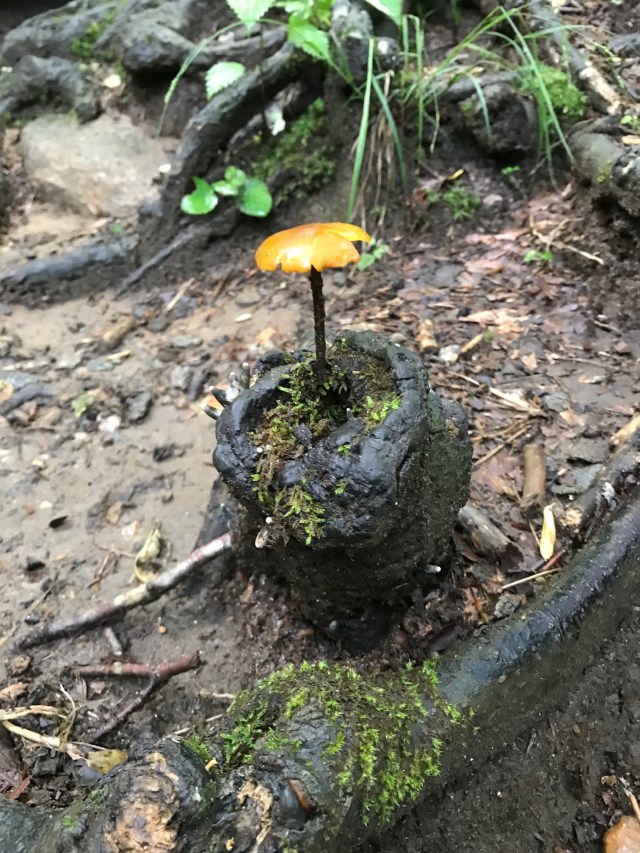
In the early goings of a hike in the North Carolina mountains, I looked down to find a mushroom sprouting from a root right in the middle of the path. I bent down to behold the shining surface of its little cap. And I thought: How precocious. How ancient. And how fitting.

Car Shroom.jpgWe walked further into the deep woods. The trail was rimmed with flora of many kinds. The songs of warblers and flycatchers tumbled out of the tree canopy. There were tall beech trees and poplars, soaring hemlocks and pines of other species. Then I looked to the side of the trail and found the black trunk of a tree rimmed with a stack of bright russet fungus.
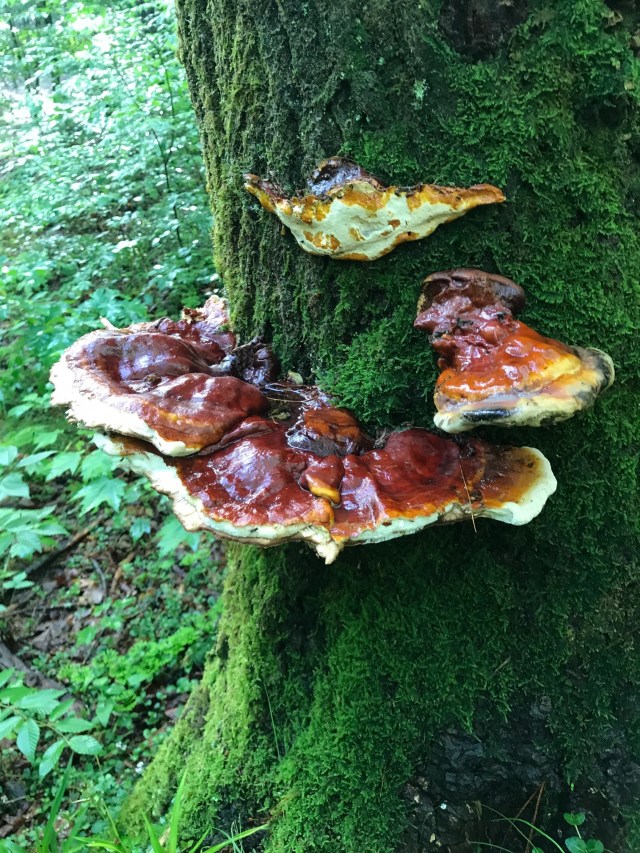
Car fungi.jpgI love the revelatory nature of the woods. It always finds ways to communicate its importance. My new book Sustainable Faith outlines the fact that much of scripture draws from the deep well of nature. Its language and symbolism depends on organic symbols large and small. Many of the parables of Christ have their foundation in natural images. The Mustard Seed. The Yeast in the Dough. The Vineyard.
Creation speaks to us. We should listen.

Ascents

We were walking in the woods because my wife and I both found need to do so. We’d both ridden long miles and climbed steep hills on our bikes the preceding three days. One of those climbs lasted more than eight miles up a Carolina mountainside. It was tough going when the pitch rose and the roads kept turning and rising, all the way to the top.

For three days we tested our bodies and our souls while perched on the bike saddle. I will admit the pressure of that need to perform affected me in ways that I did not expect. Anxiety washed over my mind in advance of the first two rides. I was not proud of that. Looking back, it seems odd that I even let it happen. But the anxious mind sometimes rides it own course.

To counter that fear, we should always recognize that the social pressures we face as human beings are real. They are not just imagined. The desire to keep up with the group is part of human nature. And this is also true: competition is part of life whether you want it or not.

When the competition is strong and there are expectations to be met including the realization that you may be holding up the entire group as last one up the mountain, social pressures can mount. And I let that get to me.

Descents

The strange truth is that the descents were in some cases not much more comfort. Holding your brakes as your bike soars down a slick road with the tires shuddering on the rough asphalt can be nerve-wracking as well. Having once gone down in a bike wobble incident that fractured my collarbone in three places, the memory of that crash gave me pause on some corners. Even with an entirely different bike under me, the prospect of tumbling off the road was still very much real.

Fortunately, by the third day on the roads, I truly was climbing and descending better. Plus the back muscle that had tightened up on a cold ride during the week before we left for North Carolina had finally loosened up enough that I did not feel like it might suddenly spasm during a climb. On the third day, my wife rode behind and let me lead our way up the hill. We met up with the group at a spot called Jump Off Rock where we took a group photo above a cloud-socked valley. And having conquered most of my subconscious fears, I did not feel the urge to jump off after all.

On the out and back, we cruised along in a pack of fifteen riders doing 20+ mph on a breezy, wet morning. The pack remained intact and one of our fellow riders, a curiously introspective triathlete named Tim, quietly noted upon the return, “It was nice to have everyone together.”

And I smiled at him.

Climbing legs

Tim’s observation was a nice way of saying that while competition can be unforgiving, collaboration can be beautiful. We had no trouble keeping up with the rest of the riders on the flats. I reveled in the flow of the pace line. It was “just” those long climbs on Illinois Flatlander legs that required a few days of adjustment. Give me another two weeks in those mountains and I do believe things would improve.

Yet after three days of mountainous indoctrination, my wife and I were ready for a change of pace. So we looked at the remaining day of vacation as a chance to recover a bit and take a hike through the verdant North Carolina mountains.

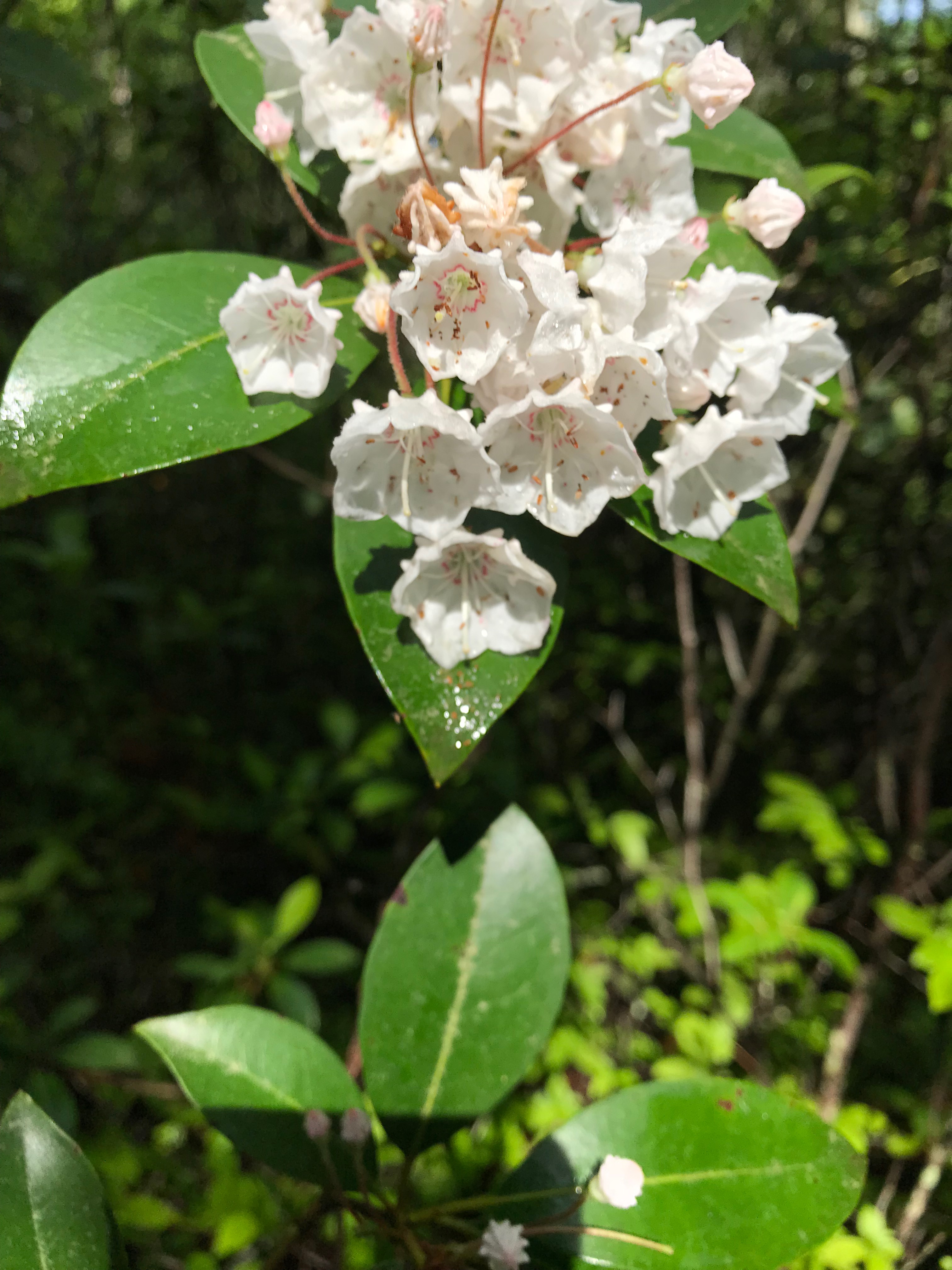
IMG_3389.JPGAs we climbed, the blooms of mountain laurel greeted us. In many places, the blossoms had fallen on the path in flowery constellations. Our shoes sunk in muck as well, and we crossed log bridges and walked through clear flowing streams.
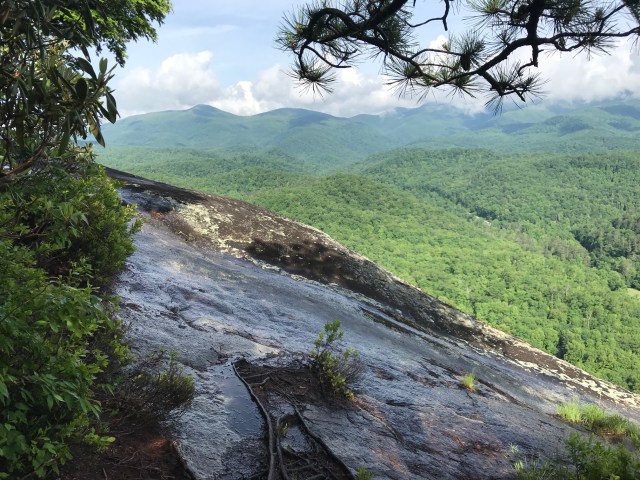
We used Eddie Bauer hiking sticks going up the slopes. They really helped. Then we reached the spot on the trail where a massive rock face juts out over the valley. The rock was covered with running water as the rains from the night before were gushing down all sides of the mountain. We stared at the abrupt edge of the world and considered our mutual fear of heights. “Let’s stop here,” she said while gripping my bicep in her trailing hand.

Car Slick

Open skies

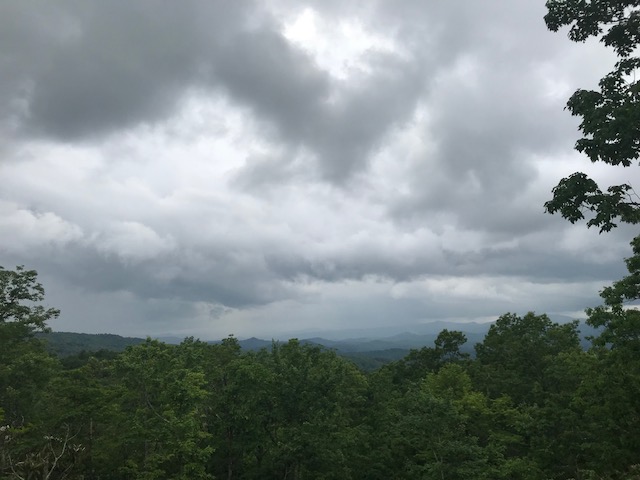
A few minutes later the croaking voice of a raven reached us as it flew with rowing wingbeats across the valley from peak to peak. We sat down a few minutes to take a drink and have a nibble of Larabar. Then hiked back down to our car so that we could drive up the mountain to meet riders who might need SAG support if the rains returned.

But the rains held off to the very end of their ride. The previous day we had all gotten soaked when a rain storm made it treacherous for those still descending the mountain. For my wife and I, the ride through the rain was almost joyous because we’d shortened the 90-mile scheduled ride knowing the skies were threatening. The rest of the crew that was still on the descent when the skies opened up were coaxed into the SUV when the roads were flowing fast with mountain rain.

Car Skies

Context

What we learned about ourselves through all this exploration was significant. As my wife and I were both the oldest and the slowest riders among a band of top-flight athletes on the four-day training camp, we judged ourselves too quickly against the mountains and our companions. In particular I blamed myself for not being fit enough to keep pace up the climbs. My guilt presaged my effort, and that only makes things worse.

But the real psychology of the group in context was telling. They only wanted us to have success at the level we could manage it. No one was truly judging us. Not in the least.

Of course that isn’t much comfort when you pedal up those last few meters and find everyone has departed or worse, they are literally waiting for you to finish so they can continue riding.

Too kind, I’d mutter to myself. 

Yet over the course of a few days, we appreciated that brand of kindness. Thus the satisfaction of riding together on that final day with the group was both joyous and instructive. You have to meet the road where it meets you. There is no fooling yourself here or in any other part of the world.

Fooling yourself

Except: there is an exception to that rule. Because you truly can fool yourself into believing you can’t improve or grow in new ways.

That’s why that precocious little mushroom growing out of that root caught my eye. While I’m sixty years old and not the same athlete that I once was at twenty-five years old, there is still room to improve each year. Try new things. And suffer a little for the sake of growth. To rot with the rest of the world if it does not appreciate us. Keep on growing.

I realized that while climbing those mountains. There were little surges of strength that kept telling me, “You’re not done yet. You can keep going.” And I did. There are times when you have to fool yourself into thinking you’re stronger than you think. Because you are.

It’s my goal as well to shed this layer of annoying fat that has fixed itself around my belly. Car Shroom That is laziness in diet personified. And then pick a few races and aim my energies at those constructively. One does not need to be obsessed in order to be a success.

It just takes controlled focus. When I forget that feeling, I’ll just think of that little mushroom, and keep on going, and growing.


Posted in bike accidents, bike crash, bike wobble, Christopher Cudworth, climbing, competition, cycling, cycling the midwest, doing pulls in cycling, healthy aging, healthy senior, injury, racing peak, training, tri-bikes, triathlete, triathlon, triathlons | Tagged , , , , , , , , | Leave a comment

A bright idea on a dark day

IMG_3306.jpgFor us Flatlanders, the day’s second ride in our North Carolina training camp proved just as difficult as the first. We rode a few miles on smooth, level roads and then the climb began up to the apex at NC 276 and the Blue Ridge Parkway.
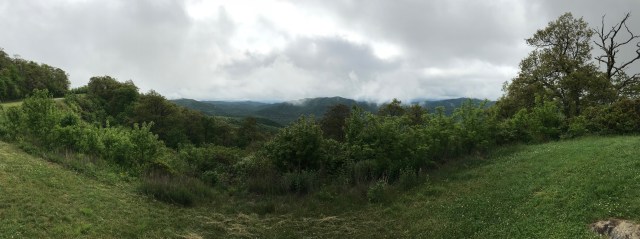
Sue led early on, and then I moved to the front. Not because I’m the faster climber this trip. She is. But I can always make it to the top, just not as strong as her. That’s the result of all her winter workouts turning those pedal on mornings when the sky was not even light yet. I admire her dedication and strength.

Blue Ridge.jpgThe rest of our crew was already a few minutes down the other side of the mountain when we arrived at the top. That backside descent was treacherous and twisty, a fact we only discovered by driving up to provide backup SAG support after we returned from our truncated ride. The full distance called for 90 miles today. The first climb was 9.7 miles in length, covered 2,254 ft in elevation gain and average 4.4%.

Familiar names

My pace for that climb ranks me 1240 on the All-Time list on Strava. I checked the Leaderboard to find a familiar name near the top. Matthew Busche was third in the KOM rankings. Matthew is a graduate of my alma mater Luther College and former pro Trek rider on the World Tour, including the Tour de France. He rode 38:24 for the same climb we rode today on January 31 of 2018. A fellow name Jimmy Schurman owns the 276 to Blue Ridge Parkway KOM title at 37.25. It took me 1:12:59.

RainInMountains.jpgIt’s clearly astounding to me that anyone can ride so fast up an ascent like that. But a few guys from our crew tore up that hill today and then climbed an even bigger mountain on a longer climb later in the ride. It’s humbling to be riding with people so strong and fit. Frankly, it’s even a bit demoralizing. But we rode our own pace and that’s all you can do.
Life is so much like rain and fog. What we see clearly in our present state, much like raindrops on a car window, distracts from the bigger picture of fog and clouds rolling across the mountain tops. But Sue and I tried to see both the near and distant concerns at the same time. So we rode back down the hill when conditions were safest. The real rain only caught us on the bottom flats. By then we were rolling along at 20 mph throwing up rooster tails with our back wheels. And it was fun.

No woulda coulda

I’m not sure that I’d have fared much better at riding much faster back when I was 25. I was lean as could be, and that surely would have helped in the climbing department. I was also obsessed with hard efforts, and had the low heart rate and fast running times to prove it. But cycling is its own game.

Plus these days I weigh nearly 40 pounds more than I did at peak fitness. I am also not so obsessed with proving myself. I was admittedly stressed out before today’s ride, but tuned out my own brain and fixed my focus on getting up the first climb. And that went well.

Big Rain

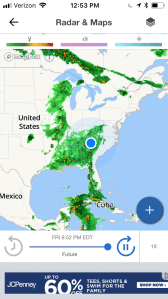
RainForecastDespite our luck in returning home safely, the weather was still threatening big rain with most of our riders still out on the course.

Thus Sue and I decided that we’d turn back because neither of us knew the true difficulty of the second climb that was still 30 miles away. If the weather struck or we were forced to hit the SAG wagon, it might not leave room for people who were going farther than we were likely to go. That was our bright idea for a dark day. If you can’t do the whole ride, make yourself available to others.

So in some sense, we took one for the team today, and the last five riders did indeed wind up in the SAG wagon because when the rain struck them on the twisting downhill after 70 miles it was not safe to continue.

Sue and I had driven back up the climb to offer additional SAG support if needed. All we found was a thick cloud bank at the junction of 276 and the Blue Ridge Parkway. That convinced us we’d made the right decision even though our ride was perhaps 20 miles shorter than we might have liked.

Our camp director asked me if the ride was “enjoyable.” There might be a hint of condescension there, but that’s okay. He’s a good guy and so are the others gathered here on this little mountaintop in North Carolina. I’m not the same caliber rider as them, and perhaps never could have been. But goddamnit, I did climb that mountain.


Posted in climbing, competition, cycling | Tagged , | Leave a comment

To the top of Ceasar’s Head and back

IMG_3282Day one of our training vacation in North Carolina saw us cross the eastern Continental Divide and ride back down to Brevard. The climb up Ceasar’s Head State Park consisted of five full miles of climbing  The entire ride saw 5000+ feet of elevation gain.

So it was tough going now and then. And yet the last 10 miles from the state park to the  town of Brevard were some of the most merciful miles I’ve ever ridden. The roads were smooth if a bit curvy at times. The drop in elevation was most welcome. And the dose of salt that had been shared with me atop the mountain coursed through my system with a welcome effect.

Salty dog

It was warm out there at points today. I hydrated well and ate as much as possible. Yet even the salty meat stick and dose of cheese did not hold me past the climb. Another rider had pulled over dizzy and ready for the SAG wagon. She held out a tube of salt and a lick of the finger made it wet enough to take a little circle of salt. For the road.

And darned if that didn’t seem to help immensely. I felt better on the flats than I had some 20 miles earlier. This is a lesson that has been learned several times over on long summer rides. It’s about time I bought my OWN salt and made it part of the recipe for my success.

The real deal

I’ve done some long climbs before. Riding west of Madison, Wisconsin there are several notable gnarly hills that can sap the life out of your legs. Climbing the road to Blue Mound State Park is probably the prior record, which involves some 2000 feet of climbing.

But that’s still nothing more than a lump in the driftless region. Here in North Carolina there are Appalachian mountains that seem to find their way in front of you with some frequency. I looked at the Strava stats and averaged between 4.6 and 6.2 mph up the sections of that climb. The actual Caesar’s head climb in total was 6.5 miles and it took me 1:22 to complete. There are thousands of ascents and the record is held at 25:59 by one Chris Butler. He rode an average of 14.3 mph.

The All-Time Women’s KOM time is 34:03. Her name is Mikaela Fudge. That’s 11.6 mph.

There are some strong riders in our group of 20 or so here in NC. One gal named just finished sixth in the Pro category overall at Chattanooga Half Ironman. She had plenty of company I guess going up the hill.

A League of Our Own


table-rock-sunrise-caesars-head-state-park-landscape-dave-allen (1)

The promontory at Caesar’s Head State Park, North Carolina

So Sue and I are trailing the pack somewhat. But we finished our sixty miles strong while a group of five wound up in the SAG wagon toward the end. I’m the oldest participant here by about eight years, and I think that’s Sue. There are some fit young athletes lolling around between rides, and I’ll admit to some stress and tension during the first thirty miles of the ride today. As a Middle Child, I felt guilty rolling up to meet the crew as they stopped to wait for us. That made me crazy for half the ride.


That response is the combination of wounded ego and an anxious mind. Who doesn’t want to feel like they want to keep up?

Yet it was interesting to hear that Pro triathlete lament that she’s feeling the effects of turning thirty years old. The “baby” of the riding crew is 25 years old, and she wound up dizzy and holding a stiff back at the top of Caesar’s Head.

Others at the table chewed on the problem of age a bit, and someone said “Wait until you hit forty.”

Then Sue jokingly said, “Waaaah waaahh waaahhh. Fifty is even tougher.”

Silence is golden

And I kept my mouth shut. Because it’s hard enough riding without admitting to everyone in the room that you’re a full sixty years old and going on sixty-one in two months. There’s enough drama in my head already. Perhaps my age will emerge eventually, but it doesn’t pay to make it an issue on its own.

I made it through sixty miles in the hilliest country I’ve ever ridden. We even slid down into South Carolina, the first time I’ve ever been to that state. So we stopped to pose for the photo at the south end of the North Carolina and the continental divide.

Tomorrow is another day in the saddle. Getting up these hills is all in the pedal stroke. One revolution begets another.

Posted in climbing, cycling, Uncategorized | Tagged , , , , | Leave a comment

Jumping through hoops to a sense of wonder

IMG_2896Yesterday a longtime friend showed up at a walk that I host in my hometown. Every Wednesday people from the community hike a three-mile loop on bike trails for health and fitness. His mom wanted to join the walk, so he decided it might be nice to accompany her and at the same time, catch up with me.
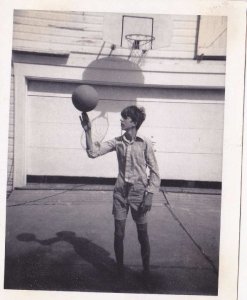
Crossing boundaries

Our association crosses several boundaries in life. We both worked at the same newspaper at different times. Both of us love the arts. We also both played lots of basketball a few decades back.

Like many longtime athletes, my friend had a few injuries over the years. But it’s now age (we agreed) that keeps us from the courts. “I can’t play at the level I want to play,” he lamented. “So I don’t do it any more.”

Open gym

He and I were both fond of open gym basketball. That’s where people show up, pick teams and play all day long if you can. When you lucked upon a good team, or were having a particularly good day on your own, the whole afternoon might be spent on the court until you lost.

Open gym was something of a lifestyle for my friend. We talked about how the different gyms ran their operations, but that wasn’t the depth of the conversation.

“I used to stay up thinking about how I played before I could get to sleep,” he told me. On that topic I could totally relate. Basketball is a game of feel as well as execution. There is an art to penetrating the lane and knowing how to dish off or take it all the way to the hoop. The rush of a good play could stick with you for hours.

My friend was a slashing type of player with great jumping ability. He was agile and lean, and quick enough to leave many a defender standing still. I can still see his aquiline face out there on the floor, sheened with sweat as the reddish hair on his head bore dark rims along the hairline. And his eyes focused like lasers as he interpreted the action on the floor.

Living the game

He was a good player, and he knew how to “live the game.” That means he appreciated the qualities in a good player and really reveled in a particularly good game of basketball. That often depended on the other players. I told him, “I could just about predict who was good and who wasn’t just by watching them walk out on the floor.”

“Oh yeah,” he grinned. “Absolutely.”

Perhaps we both loved the game too much?  Or let it absorb a little too much of our time. “But it helped me figure out who I am,” he observed. “When you come out the other end, you kind of figure out what’s important and what’s not. We all go through that stuff at different rates. That figuring yourself out stuff.”

Walking 

I shared a story about playing ball in a church gym one night. The quality of players was not that great, but there were a few decent shooters on the floor. At one point late in the game I dribbled toward the baseline and then cut toward the basket. There was no one under the hoop so I jumped from the line marking the foul lane and coasted under the basket. While in mid-air, I flicked the ball up toward the hoop and it kissed the glass and fell into the basket. Then I came down on the line at the other side of the lane.

“Walking!” someone called out after the play.

I stopped, and said, “What?”

“You walked,” the guy insisted. So I walked to the base of the lane and pointed to the line. “I jumped here,” I told him. Then I walked over to the other side of the lane. “And I landed about here. In between, I made the shot. That’s not walking.”

And then I ran down the floor and waited for play to begin again. Some of them stood there for a minute thinking that through. Then someone called out the score and we started playing again. The point was made. And the point counted.

Driving the lane

As my friend shared more insights about all those years of playing ball, we recalled another player who, like me, was both a basketball player and a runner. “He did too much of both for a while,” my friend said. “I told him you can’t train 100% in both sports. It’s okay to back off on one because you’re doing so much running already on the court.”

But I recall the look on that guy’s face when he showed up at a road race one time. He was supremely fit. It seemed as if running had consumed the other half of his brain from basketball. He was alive with the thrill of being an athlete in full throttle.

There’s only one phase of life when you can run and compete like that. The question we all have to ask ourselves is whether giving ourselves over to that obsession is healthy for us across the board. Should we instead have devoted more time to making money or getting into business? Not all of us are built that way. Not in the body. Not in the brain.

For some it truly is better, like a kid at recess, to burn off that energy because some part of your mind, both creative and athletic, needs the challenge of exercise to calm it at the core. Taking a basketball down the court and driving the lane to finish with an aggressive and artful flourish is the prescription.

So is bumping into other guys for an hour without apology. Sure, tempers eventually flare, a point my friend made with a bit of relish in his voice. “It’s gonna happen. Everyone has their limits in what they are willing to take.”

Sweeping the floor

Cud with Maravich skillsI’ve met a few people in life who held a could-woulda-shoulda attitude about their sports careers. Bruce Springsteen wrote a song called Glory Days that focuses on a guy recalling his youth playing sports.

I had a friend was a big baseball player
Back in high school
He could throw that speedball by you
Make you look like a fool boy
Saw him the other night at this roadside bar
I was walking in, he was walking out
We went back inside sat down had a few drinks
But all he kept talking about was
Glory days, well, they’ll pass you by
Glory days, in the wink of a young girl’s eye
Glory days, glory days


I always hated the third line because there’s no such thing as a “speedball” in pitching, but one must allow Bruce the creative license to construct the flow of lyrics. The overall point of the song was a lament about days gone by, not baseball terminology.

But “glory days” was not what my friend and I were talking about. Instead we were interpreting the intensity of having actually lived in the moment. To that end, he shared an interesting point about how so many people seem to miss the meaning of those moments in life.

Boss questions

“Think about the company CEO who says, ‘I may be the boss, but I still sweep the floor.’ But does he? Actually, he does it like a boss, not someone who has to do it or knows what it means to do it every day. That’s what’s wrong with this world,” my friend told me, and he gave me a shove with his hand on my shoulder for emphasis. It sent me stumbling into the grass, just like what happens in a basketball game when people are blocking each other out in the lane. I looked over at him and laughed. He was trying to share an insight on reality with me.

“There are so many people who think that because they know one thing well, they know all things well,” he told me. “And it’s just not true.”

God, I appreciated that honesty. I loved the fact that here was a guy who actually wanted to go below the surface of so much conversation in this world.

The depth of thought in our conversation was built around an appreciation for the sport of basketball, that when played properly, requires all sorts of skill and attention and yet, at the same time, can leave you dreaming and thinking about the world beyond at any moment, even in the moment.

Heights and peak experiences

Rose Breasted Grosbeak 1.pngWe finished our walk together. On the way we’d stopped with his mom and her friend because I’d pointed out birds that were close to the path. This week was the height of spring migration. There were rose-breasted grosbeaks singing within feet of the trail. I stopped and played back their songs through my Sibley’s birding app. My friend has taken an interest in birds over the years. He lives in the original “nice” subdivision outside the town where we both attended high school. It is a wooded area and sits across the road from one of the largest wooded tracts in the park district.
So we thrilled to the sight of Eastern bluebirds, house wrens, palm warblers, Baltimore orioles, Blue-gray gnatcatchers and many other species. His mom and her friend paused on many occasions to take it all in.

When all was complete, one of the gals said something on the order of, “This has been one the best days I’ve had in a long time.

And I could not agree more. It is possible to appreciate the past and still be present in the moment. In fact, prior experiences can enrich the mind and keep alive some of the instincts and peak moments in life that make you appreciate some of the people in your life who shared those things.

With that attention, a sense of wonder can indeed return.


Posted in Christopher Cudworth, competition, Uncategorized | Tagged , , , , , , | Leave a comment

When worlds collide on the roads, it’s best to roll with it

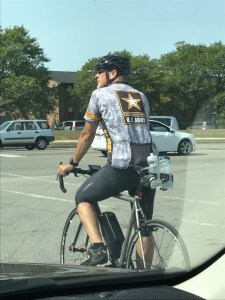
RiderLast night while discussing bike policies with some associates, the topic of cyclists rolling through stop signs came up. Our city sits on the edge of a transitional zone between the density of the Chicago suburbs and the agricultural fields and open roads to the west. Quite a few cyclists and entire cycling clubs many times make a practice of cutting through our town to reach those deliciously open roads.

Thus groups of 10 -30 cyclists will cut through Fermilab, the giant campus that was once home to the worlds largest particle accelerator. Now that honor, and all the science that goes with it are centered in Cern, near Geneva, Switzerland.

Supercolliding Superconductor

Back in 1988 or so, Fermi sought to build a much bigger accelerator beneath the surface of the ground. It was called the Superconducting Supercollider, a ring that would have been 50 miles around. The goal was to shoot tiny particles around the ring and smash apart the atoms to look for quarks and other traces of energy, the materials it affects and vice versa.

But local opposition and funding problems forced the SS project to grind to a halt. At that time, George H.W. Bush was President and the project was shipped off to Texas where it was run into the ground. Now it serves mostly as a tunnel for fire ants.

Fermi resurrection

Fermi physics.jpgThese days Fermilab is enjoying a resurrection of sorts. The new experiment driving science on the campus 30 miles west of Chicago involves shooting neutrinos through the earth to another facility built in South Dakota. Neutrinos are sort of like the Deadpool movie character in that they in the universe of dark matter:
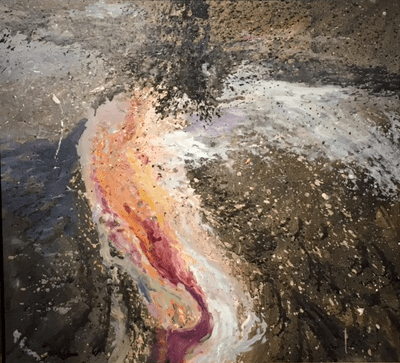
“A neutrino (denoted by the Greek letter ν) is a lepton, an elementary particle with half-integer spin, that interacts only via the weak subatomic force and gravity. The mass of the neutrino is tiny compared to other subatomic particles. Neutrinos are the only identified candidate for dark matter, specifically hot dark matter.”

One can almost hear Ryan Reynolds reading that description in Deadpool character. But seriously, the website http://www.ps.uci.edu/~superk/neutrino.html gives a bit more detail about neutrinos, which we need to know in order to complete the giant metaphor we’re about to construct about some tiny matters in this world:

Neutrinos are one of the fundamental particles which make up the universe. They are also one of the least understood. Neutrinos are similar to the more familiar electron, with one crucial difference: neutrinos do not carry electric charge. Because neutrinos are electrically neutral, they are not affected by the electromagnetic forces which act on electrons. Neutrinos are affected only by a “weak” sub-atomic force of much shorter range than electromagnetism, and are therefore able to pass through great distances in matter without being affected by it. If neutrinos have mass, they also interact gravitationally with other massive particles, but gravity is by far the weakest of the four known forces.

The substance of denial

B Oil and Water BrightSo Fermilab is sending neutrinos through to earth to see how many they can see when they come out the other end. Of course, I greatly simplify the nature of this science. These experiments are being run by people much smarter than I.
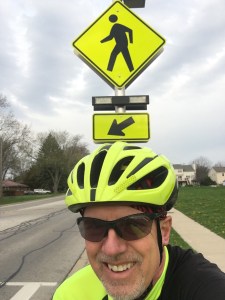
But rather than be insulted by the fact of their intelligence and commitment to deep science, it is thrilling to know there are human beings capable of deciphering the fabric of the universe. Science is a miracle of human curiosity.

Granted, some people find it hard to accept that this type of science (or any science for that matter) has value. Some folks are prone to deny science because it is too complex to comprehend or because it conflicts with the constructs of their political or religious worldview.

But it seems that lately, there are an increasing number of people who deny science on grounds that they simply refuse to change a single thing about the way they think. It’s either too much work or they don’t have the attention span to manage it. To compensate, they replace otherwise functional brain matter with a substance commonly known as denial.

Denial explained

There is a scientific explanation for this brand of patent denial. People who refuse to entertain a single competing thought due to the dogmatic composition of their brains suffer from a medical condition called Denial Syndrome. That’s when the human brain is entirely clogged with matter constituted entirely of pure, undiluted dogma, which are the building blocks of denial.

A brain in this state is capable of blocking all other forms of energy. The unfortunate side effect is that the mind in this reduced state is forced to operate in a single dimension.

The ramifications of Denial Syndrome are profound. Anyone that has ridden a cycling road bike on a public road has likely experienced the angry denial in the voices of in drivers who yell out the window. “Get off the road! There are bike paths you know!”

One dimensional thinking

Personal brandThis is Exhibit A in terms of one-dimensional thinking. The idea that bikes can only be ridden on bike paths is the single thought that can be squeezed out of the mind of a person whose brained is clogged by denial and dogma.

Never mind the fact that “road bikes” are designed specifically to ride on the roads. Every country in the world has laws allowing the use of bicycles on public roads with the exception perhaps of interstate highways.

None of that matters to the person exhibiting Denial Syndrome. In their one-dimensional thought mode, you are “in the way” because they are driving a car, on the road, and you (in keeping with  their denial of your humanity) are not a car. 

The material presence of a cyclist in their sphere of vision produces a ruminative cycle of electron panic better known as disgust. In brains of those with block neutrino passages, the phenomenon of disgust multiplies like the Richter Scale used to measure the severity and impact of earthquakes. Anger ensues. Then rage.

Energy + time multiplied by action = change 

But true science is patient, because it cares only about outcomes. Thus this giant scientific experiment we call society takes time to change. Thus the anger shown by motorists in Denial Mode toward cyclists who roll through stop signs will take time to change.

Sooner or later, when enough people are cycling, society will comprehend that it takes far longer for a typical cyclist to stop, unclip, restart, clip in again and proceed than it does for a cyclist approaching a stop sign to slow to a rolling stop, look around at all the cars and then pass through the intersection much quicker. That means everyone has to wait a lot less for the cyclist to engage in the process of stopping, unclipping, starting and clipping in again.

But be forewarned: A single cyclist is the just the CONTROL in this social experiment. The real test of cycling vs. societal norms comes when an entire group of cyclists approaches a stop sign. Then the process is multiplied ten or twentyfold. The stopping/unclipping/starting/clipping-in process must now be replicated many times over, and in close succession. When that doesn’t work, or cyclists get left behind. The entire process has to start all over again after the next car goes through. And that doesn’t save anyone time.

Recognizing advantages and realities

red-orange-green-traffic-lightsYou can see how the efficiency factor is enhanced when motorists actually recognize the advantage of allowing cyclists in a group to proceed through a stop sign outside the range of normal traffic etiquette. Cars will have to wait a lot less if the cyclists are allowed to roll through than if they are required to wait.
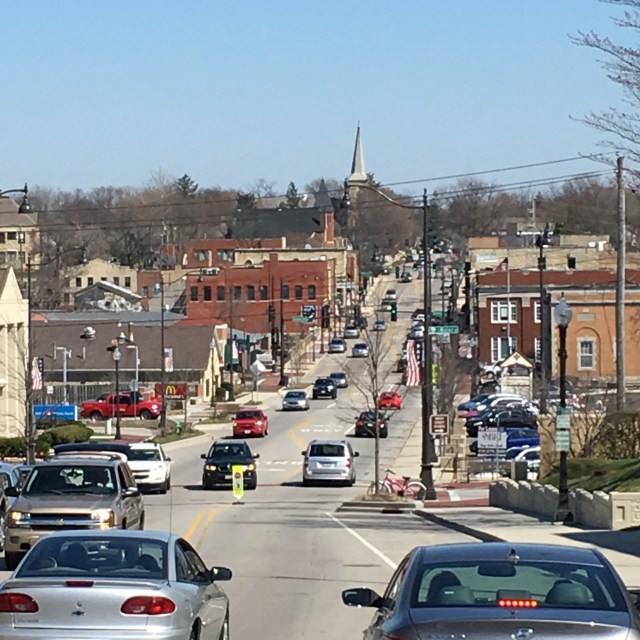
The laws of change do not, of course, apply at an actual stop light. That is where cyclists must recognize that the energy = time multipled by action = change formula does not apply. As any Fermilab physicist or CERN researcher can tell you, there are certain kinds of matter that cannot be forced through other forms of matter no matter how you intend to try. Sending a group of 20 cyclists across a busy street when other traffic has the green light is a recipe for a whole bunch of bloody quarks and greasy-stained corpses spread all over the road.

Perfect and imperfect timing

So that’s not what the Laws of Two-or-Three Dimensional thinking require. Cyclists are not out to break every law in the books, or breach the rules of science. They merely want to proceed in the most efficient, energy-and-time saving ways possible. This is sometimes misconstrued as arrogance by cyclists who roll up to a stop sign, do not stop completely and roll on through.

Granted, there are cyclists who stretch the bounds of energy = time multiplied by action = change efficiency factor. These are the groups of cyclists who don’t slow or stop at all.

That is unfortunately arrogant, impolite and a bit stupid. It does prove certain types of cyclists are prone to Denial Syndrome just like the regular population. Cyclists in Denial deny the risks they are creating by assuming they are a form of human neutrino or Dark Matter that gets a free pass to the universe as they apply their energy on the roads. Those single-minded cyclists have brains blocked by dogma as well.

The science of accommodation

IMG_2542.jpgYet it still makes sense for motorists, even those with brains clogged by one-dimensional thinking, to take cyclists into account. It truly can save time for everyone to give cyclists the right-of-way. All it takes is a slight reduction in dogmatic thinking about who “owns the roads” to accept the fact that people in cars have a lot easier time starting and stopping than do cyclists.
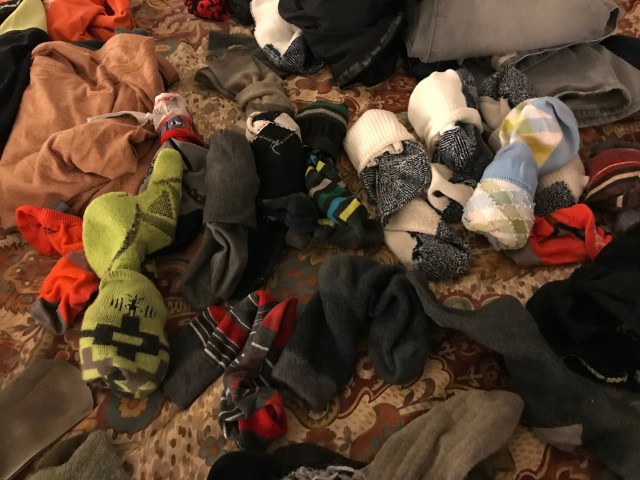
It doesn’t take a physicist to figure this stuff out, folks. But it may require some people to unclog their brains and take into account the fact that we’re all just chunks of carbon and oxygen passing through this world.


*Neutrinos are affected only by a “weak” sub-atomic force of much shorter range than electromagnetism, and are therefore able to pass through great distances in matter without being affected by it.


Posted in bike accidents, bike crash, blood on the highway, cycling, cycling the midwest, cycling threats | Tagged , , | Leave a comment

Sock drawer confessions

IMG_2786.JPGIt dawned on me this morning that I have no idea how most other people in the world arrange their socks. That seems like a fair topic in the age of “life hacks” that are supposed to make our existence more efficient and less frantic.

There is a part of me that has always appreciated the value of organizing a sock drawer. Way back in the early 1980s, when I was trying to impress a girlfriend with the idea that I had my life together, I organized my sock drawer before she came over to visit. While taking a tour of my apartment, I proudly showed opened the top drawer of my dresser to show here the rows of running socks I’d placed in position as if they were a work of art. Something about that display must have worked. We dated for almost a year.

But here’s the thing about sock drawers. It’s all well and good to organize them. But then it takes work to keep them organized. That’s where I often fall down on the job.

The Laundry Cycle

For one thing, socks are hard to track through the laundry cycle. And socks get lost. Jerry Seinfeld did a great comedic bit about how you can lose a sock while doing laundry and then check the washer or dryer. Often you’ll find the missing sock pressed against the back wall of the washer or dryer like a torture victim. It has this stressed look on its socky face as if to say, “I’m sorry! I didn’t try to get stuck here! The spin cycle made me do it!”

Sock on shirt.jpgSo it happens that some socks get lost. They are sneaky little buggers and fond of all sorts of tricks. Foremost, they are quite often found behind the washer or dryer. When grabbing laundry out of the dryer, the bulk of those clothes often forms a mass that is difficult to handle. That’s when socks fall off the back.

Somehow, certain socks always seem to disappear into the void. Either they conspire to join other socks in that linty zone behind the dryer or they cling to other clothes and wind up lost in the tee shirt drawer for weeks until you pull one out and go, “Oh, there you are.”

Behind the dryer

Socks behind dryer.jpgThat is still better than finding socks behind the dryer. Those connections and plugs seem to collect every form of household detritus and dust known to earthly existence. When you recover a sock from there, it usually requires another washing. Or else you have to shake and brush off dryer lint and maybe spider webs before putting the sock back into the wear cycle. In any case, it is gross.

Sock collection

I own perhaps twenty pairs of athletic socks in one form or another. Cycling socks are generally thinner and colorful. Running socks are either white, like my favorite Thor-Los, or some form of grey with patterns built in. I put all these socks on one side of the drawer where I keep them. Currently they’re in the bottom drawer. I don’t know why. Perhaps it’s because they’re down by my feet, but I don’t know for sure.  I actually haven’t thought about the reason until now. I used to keep them in the top drawer, and can’t remember when that changed.

But let’s get to some other important stuff, like how to properly fold a pair of socks.

Sock Folding.jpeg

Art stolen from SockDreams.com

Because it seems there are other issues that I should attend before considering what height drawer my socks should occupy. Take a look at this blog called Sockdreams.com, which focuses on techniques for folding and storing socks.

I have to admit that cutting up that cardboard to make little sock drawers within the bigger sock drawers is rather tempting. I’m no neat freak by nature, as you might have surmised. But why miss out on the pleasures of coming to your sock drawer and finding them all snuggled up like puppies in a dog bed?

Martha Stewart style

Even Martha Stewart (of course) offers a video on best techniques or sock folding and storage. But I bet Martha Stewart even tells you to fold a used condom before throwing it out. And I’m just not that into being neat. You have to draw the line somewhere.

The reason for all this concern about sock organization is simple. It’s a lot easier to get ready for work (or a workout) if you don’t have to hunt down your socks. There are enough other gear choices you have to make without having to shuffle through a sock drawer trying to match a pair of running or cycling socks. That can be so frustrating I have been known to say “screw it” and not work out at all. But usually I persevere.

Still, the choices are sometimes not easy. I have a penchant for wearing socks of the same general age as well as color. If there are six pairs of Thor-Los in my sock drawer, it matters to me if one is bright white (and new) while the other is thinned out and gray from years of washing. I feel unbalanced if two socks are the same, but not the same.

OCD for my ABCs

Is that OCD? Well, tough tooties. We’re all allowed to have our quirks. I’m pretty sure I’ve written about the period a few years back when I actually put letters such as A, B and C on my sock pairs. That earned me some criticism and laughter from others in the household. But the method never worked anyway. I’d wind up wearing an A with a C and go out feeling unbalanced anyway.

This is all complicated by the fact that my athletic wife also has many pairs of socks to sort. Thus when our laundry is dumped out on our bed for sorting, it means tossing her socks into one pile and my socks into another. Sometimes they’re so similar I have to stop and think, “Are these mine or hers?”

Sock it to me

Panties in a pileFortunately we do not wear similar underwear. But that is my favorite part of doing our joint laundry. Sorting her panties into small piles is quite enjoyable to me. It’s a nice little break from the boredom of sock sorting to pick up some little set of drawers with a pretty pattern and lace trim and drop!! them into the panty pile with that little thrill that goes through my head of her wearing them. I make no apologies for that. Not. At. All.
I don’t have a panty fetish because I have enough hobbies to keep me busy. But some people do have a foot fetish. It’s quite likely that socks play some sort of foreplay role in that desire. If you are one of those people, you might want to check out the website for TheSockDrawer.com. There are plenty of colorful games waiting to be played on that site.

Bob Ross socks.jpg

These Bob Ross artist dandies are enough to make anyone come in their socks

Intimate matters

All this thinking about socks and underwear makes me wonder which is the more intimate garment after all? Do socks or underwear claim the title of Most Intimate apparel?

I suppose the covering of genitals wins most of the privacy issues. But you know, toes are a pretty important body part to runners, cyclists and swimmers Thus we place a lot of trust in our socks to protect our feet, or otherwise, they’re fucked. So it sort of balances out.

Everything else is show

So in some odd respect the whole sock drawer organization thing is about prioritizing our needs and taking care of some things that really do matter.

And whether you take the Martha Stewart route or simply toss all your socks in a drawer the best way you can, it’s all about finding them when you need them. Everything else is just a show.


Posted in cycling, running, triathlete, triathlon, triathlons, Uncategorized | Tagged , , , , , , , , , , , , | Leave a comment

Is CPR alone essentially useless?

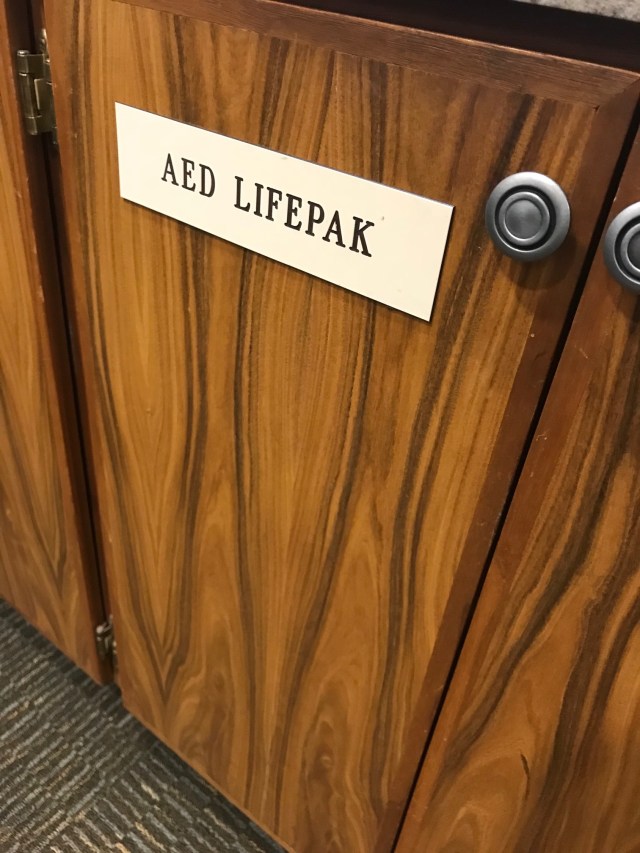
AED.jpgThis morning on the way to work there was a discussion on radio about how doctors view the art of dying in comparison to the general population. The most shocking part of the interview focused on the nearly useless practice of CPR (cardio-pulmonary resuscitation). The program revealed that actual survival rate from CPR is just 8%. And that’s the odds of surviving just for one month. Another 5% don’t get past that.

So the doctors were sharing a sobering fact that many of us likely do not realize:  just 3% of people treated with CPR live to see a relatively healthy life. The rest die.

All this despite hours of training and preparation engaged by thousands of people around the world. It needs to be stated clearly: CPR alone may not work.

AED packs

These days CPR training places more focus on the AED packs that contain shock paddles used to revive a heart that stops beating. Heart.org reports that: “Communities with comprehensive AED programs that include CPR and AED training for rescuers have achieved survival rates of nearly 40% for cardiac arrest victims. Making AEDs more available to lay responders who are trained in their use could save even more lives.”

A man that I met recently lost his father to a sudden heart attack while they were out birding on a remote island in the Aleutian chain of islands off Alaska. Losing his dad moved the man to learn what really works. He started a company that makes AEDs. Recently he sold that company after a decade of building it up. But it had competed in a market with the likes of Phillips and other companies charging $4000 per AED unit. His AEDs sold for $1500. Now there are 400,000 of them out there in airports and other key locations where heart attacks often happen in public. That’s a pretty admirable use of business acumen, if you ask me.

In training

A few months back my wife and I went through CPR training. We learned how to use an AED pack in the process. The trainer did not mention the fact that the CPR portion of the training has such a low success rate. Perhaps even she doesn’t know that.

The New York Times reports (please click through to read the article): “Research generally suggests that about 40 percent of patients who receive CPR after experiencing cardiac arrest in a hospital survive immediately after being resuscitated, and only 10 to 20 percent survive long enough to be discharged.

The same story shares that television programs showed a 75% survival rate from CPR alone. Those programs are lying to us. 

The American Heart Association takes a somewhat more optimistic view of CPR, but it still comes with some provisos: “Cardiac arrest – an electrical malfunction in the heart that causes an irregular heartbeat (arrhythmia) and disrupts the flow of blood to the brain, lungs and other organs – is a leading cause of death. Each year, more than 350,000 out-of-hospital cardiac arrests occur in the United States.

When a person has a cardiac arrest, survival depends on immediately getting CPR from someone nearby. Almost 90 percent of people who suffer out-of-hospital cardiac arrests die. CPR, especially if performed in the first few minutes of cardiac arrest, can double or triple a person’s chance of survival.”

Lucky guy

Last year I interviewed a young man that had saved his own father’s life using CPR. So there is real-time evidence that CPR can save lives. But as the AHA story suggests, much depends on the timing and circumstance of the attack.

So while there is conflicting information about the effectiveness of CPR, that means you should ask questions if you sign up to learn or re-certify for CPR. If the training does not include training with an AED pack, you are quite possibly wasting your time.

It’s all important to know because many of us participate in activities that can and do produce heart problems. There might not always be a doctor around when that happens. But pouncing on a person and administering CPR to the point where their ribs break during CPR may not be doing them a favor either.

It’s a tough subject, but the medical world is trying to send us honest messages that the illusion of successful CPR is exaggerated, if not an urban legend.

We all want to be responsible, but it sure makes sense to figure out what that really means.


Posted in healthy senior, Uncategorized | Tagged , , , | Leave a comment