Oil and water and chemical beings


OIl and WaterCover

Painting titled Oil and Water by Christopher Cudworth


This time of year, when sudden snows or rains come falling on otherwise dry pavement, oil from parked vehicles drops on the wet surface and turns into brilliant patterns. While running or cycling I’ll sometimes stop to take photos of particularly beautiful patterns. The image above this paragraph is a painting I made from one of these studies. It was featured in a solo show that I produced titled Urban Wilds. In that show, I explored the incursion of nature into urban environments.

There is a bit of wildness in the chemical separation of oil on top of water. The hidden world unleashed.

Certainly, it’s also a sign of pollution in some respect. Millions of gallons of gas and oil flow into our sewage systems and float toward local streams through runoff. The refined products made from petrochemicals spill from vehicle engines and trickle down from gas pumps. We take all this pollution for granted, but groundwater pollution is a real problem. Road salts, insecticides, herbicides, gas and oil all can penetrate important underwater aquifers. We all have a responsibility to limit this flow of chemicals into the world if possible. Never dump raw oil into the ground, or down a street drain.

But the popup nature of these artistic oil displays makes these road surface rainbows from oil an interesting conundrum in my mind. Oil is a natural product of the earth’s long processes. So is coal. Both were buried inside the earth’s crust and converted to the materials we consider “fuels”  when formerly living things underwent long chemical processes. What we’re witnessing in these oils slicks is actually the release of millions of years of time.


Oil 4.jpg

The methane and sap from a Christmas tree provided a beautiful surprise. 

Except, it can all occur instantaneously as well. This Christmas, when I pulled our tree out of the stand I looked down to find beautiful patterns on the water surface. These were created from a combination of methane and sap floating on the surface of the water. There are always such chemical reactions going on in this world. It happens inside our circulatory systems when our hearts send out blood in red oxygenated arteries and capillaries only to have it return in blue veins.


oil2Our circulatory system distributes vital oxygen and nutrients to our muscles and rids them of waste products as well.

Ideally, the nutrition we take in provides “fuel” for this process. We need lots of water to flush out waste products. Every morning when I step on the scale it provides feedback that my body is about 66.7% water in composition.

We also produce oils and other substances from our bodies. Healthy skin has a relatively moist glow, yet when too many oils emerge from our pores it can lead to all sorts of health and appearance problems. So we bath ourselves to wash off excess oils and other “pollutants” that can adversely affect our skin. Our bodies are just like the surface of a parking lot that needs to be washed clean of oil now and then.

The interesting aspect of all this oil and water confusion is the sensory component. When we find beauty in color, it stimulates regions of that brain help create mood. And when we oil1spread essential oils on our body, those aromas can generate chemical reactions. Some believe that stimulants such as these can be used to promote healthy physical responses.

To take the relationship between physical material and human physiology a step further, there are also many people who believe that rocks and crystals can generate beneficial effects within the body. These alternative healing methods are not necessarily borne out by science or medicine. But it does not stop people from trying to enhance their lives through these methods.

One of the ironies of modern medicine is found in how we treat diseases such as cancer. Having borne witness to the multiple toxic chemotherapy treatments experienced by my late wife, I have seen directly how poison can work within our bodies to combat disease. Yet intensely toxic treatment have their limitations. These include side effects that are in some ways worse than the effects of the disease itself in the short term.

Oil 3.jpgThus it’s an interesting world in which we live. It’s not all black and white as some would suppose. The oil and natural gas we extract from the earth do so many good things for the human condition. Yet the pollutants we create by using them can have deleterious effects on our health and the environment. It’s very difficult to live a lifestyle with a low carbon footprint. We cyclists and runners love to think of ourselves as environmentally-friendly. Yet the roads on which we run and ride are often made from highly toxic, ash-based asphalt. So is the rubber that fills the tarsnakes over which we run and ride.

And our swimming pools? Basically, these too are chemical immersion experiments. Rife with chlorine that in pure form would kill us in an instance, we swim through clear waters in blissful belief that we’re free from dangers.

This all goes through my mind when I stop to take a photo of the beautiful oil slicks found on parking lots. It’s like viewing the aura of the world in all its confusingly complex nature. We’re all chemical beings. Some of us just run faster than others.


Posted in running, Uncategorized | Tagged , , | Leave a comment

In pr(ouch)aise of massage

img_8636Yesterday I lay on the massage table with the front of head buried in that circular cowl where the snot builds up inside your nose until you finally have to sit up or risk drowning in your own personal version of a Mucinex commercial.

That’s if you don’t already have sinus issues or a cold. There’s something about lying with your nose slightly lower than your clavicles that seems to draws every available snot molecule from a three-county area into the front of your head.

Other than that, massage therapy typically feels great. Until, that is, the massage therapist decides to get serious.

Ouch

I think I’ve gotten a pass on serious massage therapy until yesterday. But when things feel tight in some area of your body, it’s as if some massage therapists to take it as a personal insult. Then they’re like an accountant looking at an unbalanced budget sheet. Never happy until those figures get smoothed out.

By way of compliment, my massage therapist Sarah Farsalas is an intuitive wonder who works on a number of athletes. She’s an Ironman triathlete herself who coaches and has served as a Liv cycling ambassador the last couple years. This April she is going down to The Woodlands, Texas for her Ironman. So she’s in the thick of training right now. “I’ve been soooo busy,” she admits.

Her massage technique is so intuitive I marvel sometimes how she know what hurts, and where. But this time around there seemed to be a different agenda afoot. She asked me how I’m doing. “I’ve been a little tight around the hips,” I told her in the pre-massage consultation. Well, that became the mission of the day. Somehow my thighs and hamstrings also fell in line with this Massage Therapy thing. Some people actually seem to think these body parts we have are all connected somehow. Sarah set out to prove it.

Cranking

While I was lying on my stomach she cranked on the hamstrings all the way from butt to knee. At one point, the pressure felt so intense behind my knee I thought something would pop. The aging muscle and fascia seemed to creak and groan like the rusted steel hull of a Lake Superior ship in November. The Wreck of the Edmund Fitzgerald. The cables behind my knee hummed under the pressure after she released them. I half expected to look down and see St. Elmo’s Fire quivering around my legs.

After half an hour she flipped me over and rode her elbow down the ridged range of my quadriceps. This hurt quite a bit, but I kept silent other than a couple inhalations. “Sorry,” she told me. “I know this is hard.” And it was. But I spoke up after a few minutes and said, “This is good. I can feel things loosening up.”

Scar tissue

Two years ago I needed a series of massage therapy treatments to break up a bundle of scar tissue that had formed in my back. It was necessary after a stupid bike incident in which I was looking down during a ride and slammed into a fallen tree. The accident messed my side up really badly. It took a lot of massage and finally some intense scraping by a chiropractor using a plastic tool to break down lumps and cords of coagulated blood and unnamed whatever. That really, really hurt. But it really, really worked.

Hands-on

So I’m a great believer in massage therapy and its benefits. The “hands-on” aspect of direct manipulation of muscle tissue cannot help but increase blood flow, loosen knotted fibers and squeeze out built-up toxins or lactic acid.

There’s a temporary cost to that. Most therapists recommend drinking plenty of fluids following a massage. This is advice is designed to encourage us to flush out any “baddies” that might have been lurking in some area of the body. And then there’s the soreness that comes with intense massage. This morning before my four-mile run to the gym, my thighs and hamstrings felt a bit tender. I thought, “That’s good. She really got in there and loosened things up.”

And then there’s the soreness that comes with intense massage. This morning before my four-mile run to the gym, my thighs and hamstrings felt a bit tender. I thought, “That’s good. She really got in there and loosened things up.”

Adhesions. Tight iliotibial bands. All these little tensions build up in our bodies and we try to get through it all without thinking about it. Bad idea sometimes.

But as I ran in early morning darkness down the wide shoulder of a very busy road, I could feel my legs swinging loosely below. The (ouch) was worth it.

Right now I only go once a month to check in with my massage therapist. She’s helped me through recent calf problems and untied some knots in my upper shoulders from swimming. I swear she can see some sort of aura around my body. It’s like she knows what hurts before I tell her.

This time around she put the hurt on me for good reason. So it’s a tradeoff. Or a collaboration. What matters is getting back out on the road in looser shape than before. That’s why I pr(ouch)aise massage.

WeRunandRideLogo


Posted in cycling, running, triathlete, triathlon | Tagged , | Leave a comment

How much is too much?

img_5507Recently I heard about a devoted ultra-runner who tore her Achilles tendon during a 300-mile race. She wasn’t running when it happened. She was reaching over to grab something out of a car.

People who know the woman speculated that her poor diet might have been responsible for the lack of nutritional support necessary to participate in such events. Apparently, her diet is some sort of restricted thing by choice due to some sort of eating disorder.

Situations like those remind me of that woman a few years back that was a chronic tanner. You might have seen the photos. Though Caucasian by race, she was tanned into some sort of awful brown color that looked like it was burnt into her skin. And it was.

I think I recall that she started having her child join her in the tanning booth and people started to protest. It’s one thing to destroy your own skin and risk cancer. It’s another to risk the life and health of your child.

tanning-addictionBut as an article on the website Everydayhealth.com notes, any activity that becomes stretched into a chronic need can be termed an addiction.

“It’s more about medicating the mood,” said Pagoto. “Some people do that by overeating, some people will smoke cigarettes, some people will do that by tanning.” She said much like drinking or smoking, tanning can start out as a social activity but then may turn into an addiction. And for many young women, the addiction is also driven by peer pressure, she said.

Dr. Dorlen agrees. “The culprit may very well be the endorphins that are activated when they are under the sun,” she said. “Research indicates that frequent tanning may be a type of substance abuse. Their brains are not very different than a person who gets a cigarette or UV rays.” she said.”

The same thing can happen with running, cycling and swimming. The trick to managing it all is keeping perspective on why we each participate in these sports. Setting and having goals is a healthy, even necessary life function. Hundreds of thousands of triathletes successfully integrate their training with their work and family lives.

possumBut when we hear about someone that is going over the edge in their training, alarm bells go off. That’s when it’s time to openly ask the question, “How much is too much?”

We all know the feeling. The warning signs. Injury, illness or a lack of motivation to do anything other than slog through training are all signs that it’s time to back off or even change perspectives on what is appropriate for each individual.

If we witness people that seem to be stuck in that cycle,  it is totally appropriate to ask how they’re doing. Let the conversation reveal what they’re truly thinking.

Often this turns into a brand of confessional in which many other elements of daily existence come into play. People under stress don’t always know when to back off, take stock and get a grip. They keep adding more activity to their workload because at least when they’re engaged, they don’t have to think about how and why their lives feel so manic or out of control. This is the same as self-medicating for emotional disturbances.

Obsession can itself can ultimately turn into an interminably long slog akin to that 300-mile journey that finally slowed our associate to a halt. This brand of immersion is truly a cry for help. The inability to back off is a sign that there might be mental health issues beneath the surface. Anxiety, depression and ADHD can each produce deep-seated pressures to exercise beyond a healthy perspective.

Here’s to hoping that you or your associates do not get to that point. Intervention truly is the moral thing to do. It can help if you reach out to someone in the company of a friend. Or, find a willing counseling source if there are issues such as family problems involved, or possible substance abuse.

I once knew a woman who due to depression ate so many carrots her fingernails turned orange. These challenges do not mean that someone is a bad person or even an addict. They may mean there are complex issues afoot that prevent that person from even understanding their full range of emotions.

The same drives that make us love endurance and multisport events can backfire in our lives if they become intertwined with stress and a desire to escape from the more mundane but still real pressures in life. With compassion and commitment to help, we can all be great coaches to our friends and associates in such situations.

WeRunandRideLogo

We invite you to follow this blog and please share to your social media connections. Your readership is most appreciated.


Posted in cycling, running, swimming, Uncategorized | 1 Comment

Life is always changing at Starbucks

Starbucks Changing.jpgAs an independent contractor for my clients, I work in a variety of settings. Sometimes it’s onsite with the client. Other times I’ll work from my studio space at Water Street Studios. Many times I’ll set up at Starbucks to write or conduct public relations.

Yes, the food and drinks at Starbucks are considered by some to be too expensive. But I don’t drink coffee of any sort. So I choose a chai tea or a black ice tea. Their breakfast Bacon and Gouda sandwich costs just under $4.00. So the total breakfast bill usually comes out to just under $8.00.

That’s not much different at McDonald’s. Most of their breakfast and lunch combos add up to $8.00 or so. But the ambiance at McDonald’s is not the same as sitting in any one of five local Starbucks within eight miles of my house.

That’s right, there are five of them within easy reach. Two in North Aurora, one on the east side and one on the west. Two in Geneva, and two in St. Charles. I’ve also visited Starbucks in Yorkville, Naperville and many other towns as well.

They are consistently friendly places. All of them. I admire that. Either they treat their employees well or they’re all fabulously brainwashed. I think it’s the former.

IMG_7618I’ve even visited a Starbucks in London. There was a store only one block from the place we stayed in the center of London. The food was ever so slightly different there. But not that much. My fiance got her coffee. I got my Mango Black Tea Lemonade. We were on our way.

Run Club

For a few years, we ran from a Starbucks in downtown Naperville on Saturday mornings. It’s always great to have a place to ‘do your business’ before hitting the running trail. Have a small bite to eat, jog around a little and empty the bowels. Life is always better on the other end of one of those.

When we’d get back from our runs, the bathrooms were sufficiently large to enable a quick change into dry clothes. This is where athletes really learn to appreciate the small things. Changing your wet clothes after a long run is one of life’s little luxuries. Then you can sit there in comfort, sip on your favorite beverage and talk about life’s changes or challenges with friends. What can possibly be better?

Dialing it in

This morning I planned out my run by parking at the Great Western trailhead beside Leroy Oakes Forest Preserve in St. Charles. The first three miles were a sluggish trip out west to Wasco. Then I turned back and picked up the pace. After an 8:30 mile I dialed it down to 7:00 pace and clocked a 6:55 fourth mile. Timed it on my Timex. It felt good.

Too bad that mile did not exactly sync up with the same mile market on my Strava, which only gave me credit for an 7:47 mile at some point during the run. Such is life. Some of our best efforts are known only by our own witness.

Regulars

Then I zipped out to Wasco again thinking there might be a Starbucks in that growing little town. I thought I’d seen one in the past, but it must have been some other green awning. Surely I could have dug around and found another coffee shop. I often visit Graham’s 318 in downtown Geneva where I’m technically, I suppose, one of the “regulars.” There’s the Christian Bible Study guy. The Guy Who Sits in the Same Big Chair in the Back Guy. The Engineer with his Big Maps guy. The Older Couple By the Door Wearing Stocking Caps duo. And there are lots of regulars who shoot in and out on their way to the train three blocks away.

I also see an artist friend there who suffers from bipolar disorder. I can tell by the way he walks up to the door whether he’s having a good day or bad. His work is featured all around town, and he can be immensely productive when his mind is working well. When it’s not, he gets by with a thousand-mile stare and a will to see another day. But it’s strained at times. And I get that.

Oops something’s missing

When I didn’t find my apparently imaginary Starbucks in Wasco, I drove back to a trusty shop in west St. Charles. There I changed into dry clothes in the bathroom and went to order a drink and some coffee. Only my wallet was missing.

Damn, I thought. And checked through both my computer bag and Tyr tri-bag. No luck. I must have left it at the Starbucks I visited earlier that morning to buy a water and check my email after dropping Sue at the train.

I called the store but they said it hadn’t shown up. So I went by the store to check for myself. And sure enough, after my call the manager found my little black wallet. It must have slid off the table when my bag hit it that morning.

Locker room talk

Relief. So I ordered a Grande Mango Black Tea Lemonade and downed a Bacon Gouda. I was dry inside my changed clothes and the Wi-Fi always works like a dream. In my occupation, fast, reliable Wi-Fi is as critical as a good pair of running shoes or a decent bike.

homeAnd granted, the Starbucks bathroom may be a long way from a posh locker room at a fitness club. But I don’t even use the posh one at the Vaughn Center where we swim and lift. The People’s locker room downstairs is plenty nice. I talk with other people and meeet some great folks. What more do you need in a locker room other than a seat and a place to hang your clothes?

But when you’re on the run, you need a consistent place to make that change. So changing at Starbucks is a part of my life. A recent report told me the company now has more stores than McDonald’s. Perhaps I’ll change in a few more before my days are through.

How about you? Do you have a fave coffee shop from which you run and ride? 


Posted in Uncategorized | Tagged , , , | 2 Comments

On wise women and very young men

Cudworth Running LCHMAt the tender age of 23, I stumbled into a relationship with a 33-year-old woman. We met in a bar and started hanging out together.

She smoked a lot of pot. A lot. She owned collection of Turkish pipes purchased on a trip to Turkey. They were painted pretty colors. That’s about all I recall about them.

In those days, I smoked pot with my friends on occasion. Nothing major. Just a parking lot high now and then before heading into one party or another. But this gal knew how to SMOKE. It was a learning experience, to say the least.

But that was only when I wasn’t running my brains out. 80-100 mile weeks. I weighed all of 140 lbs. Competed almost every other weekend. I was skinny even for a skinny guy. But I could run.

My 33-year-old girlfriend only took an amused interest in my running. One day she sat in the bleachers while a friend and I did quarter mile intervals at the high school track. She sat there the entire workout, just watching us. When it was through, she commented, “Your legs are almost in perfect sync together. It’s like you’re the same person.”

To some degree, that was true of that friend and I. He was with me the night I met my 33-year-old girlfriend. Later he’d hook up with her roommate. We all did things together that summer. Parties. Concerts. Dinners out.

And smoked some pot. The two of them got the two of us so high one late summer afternoon that those two young men could not even walk back to the house from the restaurant where we’d all had dinner together. We had to sit down and let the pot wear off some. “I can’t walk,” I laughed. I can see why the Beatles recorded Tomorrow Never Knows.

But listen to the colour of your dreams
It is not leaving, it is not leaving

So play the game “Existence” to the end
Of the beginning, of the beginning

A few nights later we were all out to dinner and when it was time to leave, we headed out the door toward the car. Only my friend saw a gal friend from high school and stopped to talk with her. And talk. The three of us, my girlfriend, her roommate and I sat in the car waiting. Then one of them said, “This is so rude. Let’s leave him here.”

I was aghast for a moment. “No!” I insisted. “He’s just like that. He’ll be right out.”

The two of them stared at me. Then her roommate shifted the gears of her classic BMW car and started to pull away. At that moment he walked out the door. I begged them to turn around. They gave him the silent treatment. He did not know why at first. But then he apologized. Lesson learned by a young man.

That moment led to a lecture from the both of them about respecting women. We were 23 years old, they told us. We didn’t yet know how to treat a women.

Sidewalks

Painting by Christopher Cudworth

Few men in their early 20s really do know how to treat the women in their lives. It is a rare and precious jewel of a man that has been raised right by his momma. Who seamlessly knows how to be a good companion to a woman.


As for my 33-year old girlfriend, she had some more teaching to do. One night I showed up for a date dressed in brown corduroys and a cowboy-style shirt that I’d just proudly purchased at some 80s jeans store. “You think I’m going out with you in that?” she asked. “Go home and put on some real clothes.”

Then she explained. “We need to take you to Marshall’s and get you some nice khakis,” she explained. “And some grown-up shirts.”

Understand that this was a woman who, despite (or because) of her love for pot, really had life figured out. She made about $90K working six months of the year doing rehab in apartments and condos in Chicago. The year I met her, she took off on a trip out west in a green VW bus that she owned. She drove around the back roads of the Great Plains and lit up into the mountains. Just cause she could.

She’d call now and then from some phone roadside booth. These weren’t the sappy sort of phone calls to which I’d grown accustomed with my previous girlfriend, with whom I’d fallen in love in college and wound up living in different towns.

Perhaps I might have married that girl if I’d not been 21 years old at the time. That was far too young to marry anyone, a lady friend from work once told me. So we parted ways. That girl married another man months after our relationship ended. They had four daughters, one of whom turned out to be best friends with my own goddaughter at a language camp in Minnesota. Life is strange sometimes.

That woman from college did teach me what good shoes were about. “A man needs to know what good shoes look like,” she’d told me. “Women notice a man’s shoes.” That’s advice I’ve never forgotten.

Yet let’s recall that the style in the 1980s was to throw on running shoes with jeans. That look never, ever really worked. Especially with stinky, broken-down running shoes that were veterans of so many miles. But we did it. Because we didn’t know any better. And wondered why women at bars were not interested in us. Perhaps it was the beat up running shoes. Or something more.

I don’t think I ever did go to Marshall’s with my 33-year-0ld girlfriend and get those khakis. That happened later in life. At the end of that summer together, the relationship began to unravel and that fall I met the woman that I would someday marry. Four years later of course. When I was grown and ready.

Perhaps it is significant there are no photographs of my 33-year-old girlfriend and I together. We weren’t that kind of couple. Not a stop and shoot a photo kind of pair. She never even saw me run a road race. Just that one training session with my friend.

Instead, she saw me objectively. So it felt a bit like there was two of me. Her young boyfriend, and me the runner. Which was I?

Perhaps, thanks to her deep interest in restoring classic furniture, she understood that young men like me actually need to be stripped of our cheesy varnish and refurbished, with painstaking care, into respectable men who know how to treat a woman, make love with giving focus, and encounter the world with self-awareness, not cowboy shirts and corduroys.

There was that one day in a 7-Eleven. We were picking out Cokes and something to eat when I absentmindedly spun around and struck her in the breast with my elbow. “Did you try that?” she whispered with a flash in her eyes. I apologized.

“No, I liked it,” she said.

After my older girlfriend and I parted ways,  I met a girl who was statuesque, blonde and 18 years old. We danced and went to concerts but that was about it. Out of respect for her youth, I did not think it my place to take it any further. We had fun together, that was it. I behaved, in other words, like an honorable man.

My fiance is fond of saying, now and then, “We all have a past.” I love when she says that. The point is simple: We exist together in the present, but there’s no point in pretending that we arrived at this point in time without the experiences each of us has had separately. We were both married before. Our circumstances are different, but that’s the point. We’re now converging in the love we share.

Sue and Chris

That’s Sue telling me not to turn into a statue on the brick.

Significantly, we run and ride and swim together too. This past Sunday morning I ran seven miles of her 10-miler with her. For long periods we said little but focused on the prescribed pace while the geese honked at us from the misty river. Our strides nearly match because her inseam is essentially the same as mine. I glance at her strong legs now and then while we’re running or cycling. I’m attracted to her in ways that I don’t even try to analyze. The day she showed up for our ride together in those little black cycling shorts I almost flipped.

Her influence is what got me back into doing triathlons. I’d tried in 2003 to move into the sport before tearing my ACL playing soccer. That put those plans on hold. Then 2005 brought my late wife’s cancer diagnosis. That led to eight years of chemotherapy and the devastating recurrences that came along the way. I took up cycling in 2007 and some of those long rides were important (yet difficult) therapy for the stress of trying to make get through life and make a living while taking care of her, sometimes full time. It was all a long journey through The Right Kind of Pride.

When it was done, I was determined to heal and look to the future. I figured the future was coming whether I was ready or not. So go out there and meet the world head-on. That comes from being an endurance athlete. Every new day is a challenge to be met. It’s in my nature.

I met Sue through FitnessSingles.com in 2013. We’ve dated nearly four years now. We got engaged last April, and are getting married May 6. Through this time together, both of us have been processing our recent past and working closely together on what it means to build a new life. It’s not always easy. We have families to meld, and some of that integration seemed pressured to our children when we made decisions about engagements, houses and moving. But it is working out. Day by day.

It’s her mind that draws me closer by the day. It’s rare that we aren’t discussing some issue of life. We share our hopes for our children and when necessary, concerns about issues like the life of our cats. We almost lost one this past week to a urinary infection. It cost a lot to save that little kitty’s life.

It’s all a swirling mix of events great and small. Sometimes it’s a hairball of financial commitments and other sticky problems that need to be coughed or cleaned up before moving on.

Yet there are so many wonderful moments. When she’s blow-drying her hair in her morning bathrobe, I’ll inch past her and reach down to grab her cute calves sticking out the bottom of her robe. It’s these small gestures sometimes that make up a relationship. You can see it in people who love each other, and you can often see when it’s not there as well. Some men never grow up, it seems. But those who do, often do so in the company of great women. Sometimes it lasts. Sometimes it doesn’t. We all have a past.

La-La-Land.jpgThat statement holds a pragmatism that amounts to a healthy dose of positivity. As in, “You can’t change the past, but you can make the best of it.”

In that light, we should all cherish the best of what we learned from past relationships. Both the good and the difficult relationships in life teach us something. Like anyone, I’ve made mistakes in how I treated people in relationships. I still sometimes do. In that regard, I do think about what that 33-year-old girlfriend once said about making up for messups. “If you make a mistake, it’s how you recover that matters,” she said. Good advice in business, relationships and life.

And quite sage advice for a young man of 23. Putting mistakes in the past can sometimes happen right there in the present.

We just saw the movie La La Land. Without spoiling a moment of that experience for you, I can say that it beautifully celebrates the joys and challenges of relationships. But I will say that in such circumstances, the present feels like the past is happening at the same time. Go see it. You’ll see what I mean.


Posted in Uncategorized | Tagged , , | Leave a comment

A liberal dose of Old School training wisdom

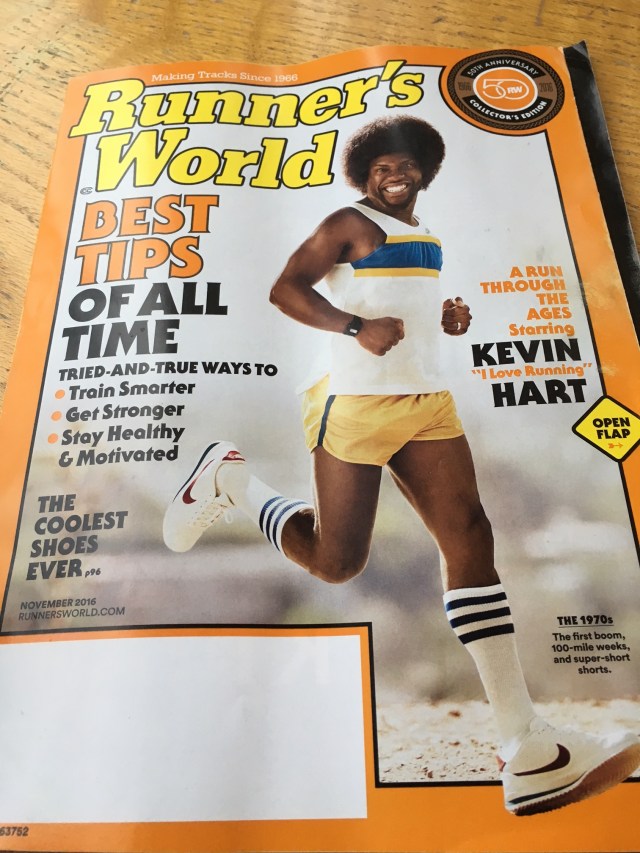
Runners World.jpgFlipping through the recent issue of Runner’s World magazine featuring Kevin Hart on the cover in full retro mode with short shorts and 70s afro, I was interested to see what the publication would have to say about training during the early years of the running revolution.

The author of an article titled “Go ahead, chuckle” started out talking about photos of shaggy-haired runners in short shorts, and that much was true. But when he got to the merits of Old School training, this observation struck me as the truly funny part: “Still, it’s impressive that so many athletes got it right when it came to training and racing in the “old days.”

The sidebar went on to speculate on what the “old days entailed.”

“THE OLD WAY Every plan featured long runs and simple interval sessions like mile repeats or “quarters” (before the metric system rendered quarter mile tracks nearly extinct.”

THE NEW WAY We add tempo runs, midrun pickups, hill repeats and fartleks to challenge our bodies in new ways each week.

This is a clear dose of revisionist claims about the past. It thus requires a liberal dose of correction.

Because here’s the truth: There is not a single runner from the so-called Old School era of the 1970s and 80s who did not do tempo runs, midrun pickups, hill repeats and fartlek training. We did all that and more. 

HOW WE TRAINED

A typical training week included all of these training types. It might look like this:

Sunday: 15-20 mile run, 6:30-7:30 pace

Monday: 4 miles am easy. 6 miles hill work, 600m hill repeats down and up 3oo m mile hill. Grass sprints 5 X 100 on football field.

Tuesday: 5 miles easy. If no race on schedule, 6 miles on track with ladder of speed work 200-400-600-800-Mile-Mile-800-600-400-200. 4:55 to 5:10 pace.

Wednesday: 6 miles am easy. 6 miles pm easy. Grass sprints barefoot.

Thursday: 4 miles easy am. 7 mile fartlek pm with 5:00 pace pickups from 400-600.

Friday: Rest am. 5 miles easy PM.

Saturday. 4 miles am warmup. 5 mile cross country race (25:30 to 26:30 depending on course difficulty. 4 mile jog back at home.

High mileage. High quality. 

That made for an 82-95 mile week depending on variance in training. Our objective was to maintain a consistent “tired state” in the legs and cardio system. We ran hard and we ran often.

We also raced frequently. During high school cross-country our schedule consisted of twice weekly (Tuesday-Thursday) racing along with a September through November series of weekend invitationals. That racing load was a bit much, but it certainly taught us how to run fast and compete well.

Programs these days tend to run fewer races. And that’s probably good.  There are many excellent high school cross country runners thanks to the wisdom and training methods passed along by Old School coaches now running programs throughout our state. They’ve reduced the racing schedule to protect the legs and minds of their runners. The results have thus come around again to late-70s and mid-80s levels. Here are this year’s top times in the Illinois state meet:

1Soren Knudsen, Minooka 14:02 2Danny Kilrea, LaGrange (Lyons)14:08 3Dylan Jacobs, Orland Park (Sandburg) 14:10 4Charlie Kern, Elmhurst (York) 14:125 Brian Griffith, Lake Zurich14:14 6Matt Pereira, Lake Zurich 14:247 Vince Zona, LaGrange (Lyons)14:28 8Jackson Jett, Naperville (Neuqua Valley)14:33 9Dylan Zangri, Oswego (East)14:36 10Sean MacGregor, Elmhurst (York) 14:36


In college, we raced only 2-3 of dual meets during the season and 8-10 invitationals between September and mid-November. Even this was a bit much. Some of us were running on fumes by season’s end.

Post-collegiate

After college, I personally built on these supposedly “Old School” training methods and learned that doing long runs slower was acceptable among elite runners. I also added strength training and during the winter months and stationary cycling to keep aerobic fitness high when really cold weather (below zero with wind chills) made training difficult.

Cudrun

Hard, fast training and short shorts went together in Old School racing.

I was especially keen on the value of tempo runs, especially a workout I branded “unlimited surges” that involved accelerating up to race pace and holding it for ‘unlimited’ periods, usually between 3-5:00 over an eight-mile run. This ‘race practice’ was crucial in learning how to relax during full-on racing.

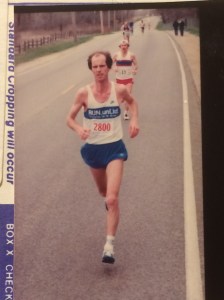
Using these “Old School” methods, in 1984 I raced 24 times in distances from 5K to 25K. No marathons. My times were 14:47 for the 5k, 19:49 4 miles, 24:47 for five miles, 31:10 for 10K, 53:30 10m, 1:10: 58 HM and 1:25:25 for 25K. The years of ’83 and ’85 were similar, but the peak of my competitive career outside school was 1984.

Yet here’s an interesting statistic. My target distance for racing that year was 10K. It was the ‘standard’ distance for which most runners aimed. And during that year’s training with dips in the schedule for recovery between hard racing, I averaged exactly 6.2 miles of training per day.

Significantly, many of us also raced on the track several times during the year. That meant testing your fitness in an indoor meet or two in January, jumping in an All-Comers meet in May, and finding a quick mile in which to compete in July. Usually August was a bit of a recovery and base training month. Not a lot of racing. Just long runs and lots of water.

More than volume

So it wasn’t volume alone that dictated pace and speed. The biggest weeks I’d done in college were just over 100 miles. But remember, we weren’t training for marathons. In those days, we thought marathons were for runners who either weren’t fast enough to compete on the road or track, or who loved the freak aspect of the event.

Yet when we did run the distance, the times were pretty fast. My teammates from the Running Unlimited sponsored team included Jukka Kallio, whose 10K was in the mid-31s but ran a 2:19 and change, just missing the Olympic Trials qualifying time by twenty seconds. There were also the Macnider brothers, Jim and John, both who ran in the low 30:00 range for 10K and ran marathon times in the range of 2:18 if I recall.

The road racing circuit in the 80s was nastily competitive. It was common to run 31:30 for 10k and place third or fourth in the race. The winning time for the hilly course at the Elgin 10M Fox Trot in 1984 as 49:00 or so. I took sixth or eighth in mid 53s.

So there was no coddling or recompense for those who did not train hard and fast. And that’s the primary difference between “Old School” and the supposed “New School” of distance running.  Granted, there are not many sub-elite runners that can maintain that level of training for long without getting injured or sick. So we took breaks either by choice or by force of illness or injury on occasion. Those were the risks you took.

Simple conclusions

The Runner’s World article comes to something near the same conclusion, saying this about THE BEST WAY. You’ll get fitter faster if you mix up your workouts which is important for racers, but it takes a toll. “High structured training is very effective, but it can also be physically and mentally hard to maintain,” says Mike Norman, cofounder of Chicago Endurance Sports.

The article concludes: “Runners overwhelmed by workouts should take a cue from old-timers: Sometimes it’s okay to just run. Spend a few weeks keeping it simple–a few runs each week at a comfortable pace–to recoup your motivation.”

running-past-houseYa think? That’s just common sense, and there’s nothing Old School about that at all. Just understand that we experimented like mad in the Old School era. During one college workout we did 28 X 400 at 80-second pace with 1:00 rest between.

Some of us also tried racing barefoot. By circumstance of advancing shoe technology, we served as guinea pigs for everything from the Nike Waffle Racer to some of the worst apparel ever known to humankind. But we didn’t feel “Old School” in any respects. We pushed the envelope all the time, doing insane workouts or long runs without drinking a damned thing the entire way. Sometimes we got burned. But when success came along you knew exactly where it came from: hard, fast running.

No substitute

There’s no substitute. The best runners in the world do the same thing these days. They may live more by the metrics of heart rate and blood work and technology, but those methods aren’t all that much better than knowing your resting pulse rate and backing off training that day if your heart rate is elevated by more than 10 beats in the morning.

We used chronometer watches and drank when we were thirsty. That’s about it. There aren’t many more “secrets” to running other than knowing your pace and how to push it. Some of us were too skinny for our own good. I’ll give you that.

But running comes down to a bit of internal liberality in terms of what you need to do to handle the rigors and pain of hard racing. Handle the pain. Our saying in college about pain was simple, “It’s only temporary.”

You can handle a lot of things in life with those three words.


Posted in running, Uncategorized | Tagged | Leave a comment

Today I’m pissed but not about what you might think

Perrier.jpgDrinking tons of water is a lot of work. Not the drinking part. That’s easy. It’s the pissing part that takes so much time.

The human body loves water. My new scale says every day that I’m something like 66.6% water. I’m not going to analyze the fact that there are three “sixes” in a row in that number. Water cannot be the sign of Satan. Beezelbug cannot swim. Everyone knows that. Otherwise, why would the River Styx be protecting the gates of hell? Satan is afraid of open water swimming.

Which puts you and me in good company if we overcome our fears and learn to swim across big bodies of water all on our own power. But then we have to consider why Jesus thought it was so important to walk on water. Was he afraid of open water swimming as well?

These are theological conundrums of the highest order. Right up there with how many angels can fit on the head of a pin. If both Jesus and Satan do not like open water swimming, that means the rest of us live in a weird sort of multisport purgatory in which we flounder around between heaven and hell.

And that pretty much describes swimming for me.

But you know, I also refuse to pee in the pool. Which means, to get back to the original direction of this post, that every time I have to pee during swim training, it means hauling my sorry ass out of the pool, walking over to the bathroom which is often located by a very cold section of the natatorium, flipping down the seat and sitting down to do my business.

Yes, when I’m at the pool I sit down to pee. When you get out of the cold water and have to pee, there is no guarantee how that male unit between your legs is going to appear. It might be in full George Costanza mode, rife with “shrinkage,” and therefore unable (or unwilling) to perform its duties with full-on enthusiasm.

Which means dribbling or worse, the dreaded “double-spray” penis that shoots whizz in two directions. Before you know it, there is pee all over both sides of the toilet seat and that means wiping the thing down with toilet paper as a bare minimum. But when your hands are already wet from swimming, and you grab a strand of that single-ply toilet paper that exists in virtually every public restroom known to the human race, it soaks throw and you’re left with a handful of uselessly dark paper and can’t wipe up a thing.

Thus it is much easier to sit your ass down, nudge your male crank into some sort of downward pissition, and let ‘er rip. Easy Peezy.

Still, you have to wipe the seat down after that because your ass and upper thighs are already dripping from the pool. By appearance, even clear asswater is no better than piss in the mind of the next person who crawls out of the pool and comes in to sit down.

Fortunately, your hands drip a little drier by the time you’ve whizzed. Then you can manage to wipe down the toilet seat without creating what looks like the Toilet Murder Scene from some seven-character crime show. They’re all the same, these shows. Blood and scattered toilet paper make great prime time visuals.

Even when I’m not swimming, drinking extra water means more trips to the bathroom than I’d perhaps like. While doing a painting the other day, I was drinking lots of water and the sudden urge to pee snuck up on me, and I really had to go. My hands were covered with acrylic paint and I had to somehow sideways get the zipper open to avoid getting paint on my pants. Yet when I went to fold my unit back into its place I had to laugh. There was a bright blue tip of paint on the end of my crank. That. Was. Funny.

Dropping weight

Interestingly, this campaign of increased water intake has had the curious effect of actually dropping my evening weight measurement. I’d lost two pounds of some sort after drinking six sixteen ounce bottles of water during the day. Thus far, I’ve been treating myself to the zero calories sort of waters such as San Pellegrino, Perrier and La Croix. But also some good old bottled waters too.

The next step is to hunt down a big-ass but still manageable-to-carry Personal Water Bottle. A fellow Board Member showed up at Batavia Main Street this morning with an elegant looking water bottle. It had nice designs on the side and a wooden top with a little rope sticking out so you can carry it anywhere. I had instant water bottle envy.

The goals are manifold. 1) : stop drinking other liquids rife with sugars and 2) stay more hydrated, which is healthier for me.

Mr. and Mrs. Hydration

So far, so good. And other than having to piss all the time, the results already feel good. It doesn’t mean I’m ready to become Mr. Hydration on the run. If I take a few sips before a 10K run or race, I’m plenty fine. My stomach hates ingesting liquids during hard efforts. Always has. But my fiance loves staying hydrated. She senses the difference in her running if she doesn’t carry water. And both of us hydrate plenty on the ride.

Admittedly, I’m a little Old School on the run and drink thing. If I’m going out for more than an hour run I’ll find a drinking fountain for a sip, but usually not more than that.  but Recently talked with Tom Burridge, the former US national record holder for the half-marathon, and asked him if he used to hydrate during his peak years. “Are you kidding?” he laughed. “None of us did that stuff.”

I think the truth about drinking water is somewhere in-between the Old School Suffering we used to abide and the New School Hydration Theory that says you should be absolutely sipping water while you’re peeing because, you know, you have to replace that percentage of liquid in your body as it flows out your urinary system.

Heroic kidneys

I guess peeing is a lot on my mind given the difficulties our cat Benny has had to sustain this past week. Watching him strain to dribble gave me new respect for the issue. Then I got a call from Craig Virgin, two-time world cross country champion, who from childhood had to battle congenital kidney problems.

His new biography will chronicle those issues and how along with the tough demands of growing up on a rural Illinois farm helped him develop the mental toughness necessary to excel in every phase of distance running from track and field to cross country to marathons. Even with congenital kidney disease to battle his entire life, Craig had the world’s best 10K time going into the 1980 Olympics, which were canceled for US athletes for political reasons. And wouldn’t that piss you off? All that work and risk of personal health and sacrifice. Then, denied a chance to participate and compete in the Olympics.

Piss off

In a bit of historic irony, that action by President Jimmy Carter was done in protest of the Soviet Union and Russian invading Afghanistan. Of course, the United States invaded that same country thirty years later, with no more success in taming its tribal nature. Now Russia has invaded our nation by hacking our democratic process. Yet those who question such intrusion are basically being told to “piss off.” Do people not see the irony in all this?

So I’m pissed, in the rhetorical sense, on behalf of all those people for whom opportunities have been denied. We’re already hearing about pompous plans for oppression of arts, culture and the environment. The National Endowment for the Arts will likely be cut and National Public Radio, privatized. Who knows what approach will be taken with our national Olympic teams, or any other federally supported sports programs. Will those go on the chopping block too?

Or will the jingoistic value of such endeavors fuel more funding? Athletics on the world stage often falsely feed that national pride for brief, marketable moments that Make America Great Again. Often this involves thrusting black athletes into positions of triumph even as respect for the personhood and rights of black citizens back home are denuded, neglected or oppressed by the very police charged with protecting communities all over America.

Not just me

So it’s not just me that’s pissed for some personal agenda or perceived need. This is not just “my opinion” about what’s going on in America. The facts about many of these issues of cultural and political discrimination are there. People just choose to deny them because it profits and protects their cozy worldview and the advantages it confers on them.

Last night we watched a  documentary on the life of musician Michael Jackson. It illustrated how his album Off the Wall served as a transitional force in the ultimate crossover of black music to the mainstream. Recall that when MTV first launched, black musicians were not welcome. This is only 1981 we’re talking about. Not that long ago.

The Grammy Awards the year that MJ issued his Off the Wall album handed out his award during a commercial break to avoid acknowledging a black artist in prime time. And long before that, it was black musicians who led the world of popular music. Despite massive layers of prejudice that persist to this day, black artists invented blues and soul music, Rock and Roll, Jazz and many other forms as well. But such genius was forced to hide behind a white wall of cultural fear and jealousy, theft of material and purpose.

Being a dick about race

These prejudicial truths are facts of recent history. And while strides have been made over the years in race relations among those enlightened enough to break down stereotypes, the seemingly “positive” stereotypes so many whites project on blacks have centered on things such as giant penis size and sexual performance. And wouldn’t you be pissed if that was one of the only compliments you heard about your culture over the years?

The point here is simple: All these biological challenges and needs are human problems. I joke about having to pee too much because I’m human. Flawed and clueless at times. Susceptible to the foibles of diet and water. Made of the same stuff as everyone else. We’re all human. Every race and nationality and religion on earth. Human. We all pee and we all poop because we have to. And when things go wrong, we can laugh about the humbling troubles we face in the process.

Addendum: Today in history

I make some bits of fun of myself in blogs such as this to make a point that while I do   point out the foibles in others at times, I’m also willing to admit the flaws so evident and obvious in myself. I’m human.

People who can’t or refuse to do that do indeed piss me off. And when the culture at large takes on his arrogant brand of shallowness, it is a sign that something has gone wrong in our culture.

I realize that a ton of people in America voted for Donald Trump because on a basic level, he refuses to apologize for who he is. That seems to empower others to feel the same. This approach tends to be paired with the idea that the nation got a raw deal somehow under President Barack Obama.

By any measure, this combination is stunningly shallow. Somehow the humble and difficult work of bringing the nation back from a bitterly painful economic recession was not enough for them. They wanted prosperity handed to them perhaps?

The problem seems to be that people expected President Obama to wave his hand and reverse decades of American corporate, industrial and international practices that have essentially gutted the middle class? Obama couldn’t do that. At one point he tried to encourage collaboration between government and business by pointing out the benefits of infrastructure. In addressing the need to invest in American roads, bridges and other infrastructure he told businesspeople, “You didn’t build that.”

But the message was twisted around by conservative media. Pundits insisted that Obama meant to tell people they did not build their own business. That’s how fucked up the messaging and meaning can get when people are so determined to disrespect someone.

But most of all, Obama’s political opponents seemed to blame him for being an intelligent black man who would not cow to their demands. That was his principal crime in the face of so many white Republican men in Congress.

And I see the legitimate parallels between how blacks have been treated over centuries in our country and how so much of our nation responded to the first black President of the United States. Many claim that it wasn’t about race, and that it was about “policies.” Even some black Americans complain that Obama did not do enough for “his own people.”

Cynically, some pundits jumped on opportunities such as that to blame President Obama for the racial divide in America. This political ploy was stolen directly from the playbooks of men like the Nazi propagandist Joseph Goebbels, who understood that the best method of combatting strength is to turn the strength of that person against them.

This was all done in a growing atmosphere of anti-intellectualism and distrust of academic as fomented by a conservative information machine the likes of which the world has actually never known. So we’ll leave this day’s blog with a quote from Joseph Goebbels, that illustrates how pervasive and effective it can be to overcome the intellect with unthinking ideology if need be. “Intellectual activity is a danger to the building of character” Joseph Goebbels

If you believe that intellectualism and science and liberalism are the real problems in America––and that is the heartbeat of neoconservatism as a rule and a practice––then consider yourself in interesting company. History knows what you’re thinking already.


Posted in Uncategorized | Leave a comment

Respect the toughest endurance sport of all: teaching.

As an endurance athlete since the age of 12, I’ve had the opportunity to do some difficult things. That three-hour run we did in the cold rain at forty-five degrees comes to mind. So does the Horribly Hill Ride, a cycling tour that concludes with a 2000-foot climb on the top of Blue Mounds State Park. And now that I’m in the pool, every day challenges my ability to physically and mentally exceed my capabilities.

For all those years of training and racing as a multisport athlete, there is still one activity that serves as a challenging comparison to all others. Teaching.

Classrooms of all sorts

Perhaps you’ve stood in front of a classroom of children or adults with everyone depending on you to provide a stimulating learning environment. And if so, you are to be congratulated. It takes personal assurance to teach any subject to others. One must be confident in the material, capable in its presentation and compelling in its delivery. Otherwise, you lose your audience.

As any standup comedian can tell you, losing your audience is one of the worst feelings known to the human race. A disinterested sea of faces is as deflating as a bad dream. And just like those dreams where you’re trying to run away but can’t move your legs, it is an enormous challenge to win back an audience.

Musicians know the pain of this distance between performers and audience as well. One story about rock balladeer Gordon Lightfoot says it best. The singer was onstage but having some challenges due to some substance abuse problems. And when he asked, “Does anyone have any requests?” an audience member shouted back. “Yeah! Try to remember the words!”

Harsh. There’s nothing like a heckler to gut your ego and confidence in some circumstances. Imagine if you were finishing the last leg of a triathlon and all the spectators along the course, rather than yelling encouraging words shouted out insults instead, such as, “You look like hell! Give up, this isn’t worth it. Why do you even try!”

That’s how wilting it can be to serve as a teacher and lose rapport with your audience.

Good teachers

Good teachers know how to hold the attention of any audience. In my own experience, I’ve been in hundreds of classrooms over the years. While I’m not a teacher by profession, I was married to a public school and preschool teacher for nearly thirty years. My mother was also a public school teacher for twenty years. My oldest brother retired from teaching English after thirty years at a private high school. His students still keep in touch and write him news of their challenges and success in life. He earned their trust because he invested himself fully in the process of teaching.

At his invitation, I once stood before his classroom of high school students to talk about art. The first session felt like it went pretty well. The kids seemed engaged and attentive. I unleashed a veritable barrage of information in that fifty minutes. Then the period ended and another wave of twenty-five students entered the room. “Oh no,” I realized. “I have to do it all over again.”

A teaching marathon

And that’s the challenge. Teaching is not a sprint, as they say, it is a marathon. You can’t sprint the first half mile and expect to finish the race. But given the situation, I plowed into my material. This time it didn’t feel so fresh or exciting. After ten minutes, I could feel a strange exhaustion rolling over me. My brother, who had been standing in the back of the room, calmly made his way up the side aisle and walked over next to me. From there, he slid into leading the classroom, and in doing so, started in with a question that drew the students into discussion and questions.

And that, my friends, is just one of the arts of teaching. There are many, many more. Preparing lesson plans is a key element of the profession. So is knowing how to direct and gauge the pace of learning. That’s all before you get into the realm of inspiring people to learn. In many respects, preparing to teach is like preparing for competition. It takes planning, preparation and implementation.

Teaching as a practice

It also takes practice. Just as becoming a faithful practitioner of yoga takes ‘practice,’ so does becoming a capable teacher. The process typically does not happen overnight.

It matters not so much what age students you are addressing as it does how you are trying to teach. There is far more to teaching than most people appreciate. We’ve all had teachers who are good and bad. Sometimes teachers are both, like the Bad Teacher in the Cameron Diaz movies.

Not everyone that goes into the profession is a gifted teacher. At least not at the start. Those who do excel at teaching, such as the lead character in the movie Mr. Holland’s Opus, are known to leave a lasting impression on the students they encounter.

One can, unfortunately, say the same thing about bad teachers as well.

Teachers as coaches

A few of the teachers I had in high school and college also served as coaches in track and field, basketball or cross country. It was always a unique experience to be coached in athletics and also tested in the classroom by the same person. Suffice to say I always wanted to impress my teacher/coaches even more with what I could do in the classroom. Because I didn’t want to be just a ‘dumb jock.’

Thus I can clearly recall with pride getting a paper back in the Earth Science classroom from my cross country coach Rich Born at Kaneland High School. The grade at the top of the paper said “A.” I’d answered all the questions correctly. That meant a ton, because while the results of a running race are quite empiric, being based on time, so are the results of taking a test where there are right and wrong answers. Learning what you can do is a great sense of satisfaction in either case.

Teacher pride

Imagine the pride a teacher feels when they see students achieving results that they did not think they could accomplish! As a person that has taught in many circumstances outside the true profession, I can profess equal joy and satisfaction knowing that something you’ve taught your students has been absorbed. The same holds true for coaching, which is why so many good teachers also make good coaches. Getting better at a sport often requires instruction and guidance.

The same holds true for coaching, which is why so many good teachers also make good coaches.I’ve coached the sports of baseball, basketball, track and field, soccer and cross country.Getting better at a sport often requires instruction and guidance. Coaches are the teachers who try to make that happen.

High achievers

This is particularly true in the “skill events” in track and field. No one takes up pole vault and goes fourteen feet the first day. It takes weeks and months of practice on technique and learning the art of turning running speed and strength into height. Our little school out in the cornfields near Maple Park, Illinois, happened to have a big tradition in pole vaulting. State champions emerged from that windy field with the cheesy landing pits.  all the sports I’ve witnessed, pole vaulting may be the discipline that required the most teaching. The pole vault coaches were teachers that knew how to see what kids needed to do, and then communicate it. There is perhaps no better illustration of how teachers help students achieve greater heights.

Of all the sports I’ve witnessed, pole vaulting may be the discipline that required the most teaching. Our pole vault coaches were teachers that knew how to see what kids needed to do, and then communicate it. There is perhaps no better illustration of how teachers help students achieve greater heights. And here is my public confession: I sucked at pole vaulting. I could high jump 6 feet and triple jump forty, but was always too skinny in the upper body to manage a good pole hang.

Parents and kids

Like teaching, coaching is never easy, and often unappreciated by those who stand to gain the most from the time and energy coaches put into that endeavor. When I was coaching, I met many very successful parents along the way. Wealthy, important people. Some appreciated the time I spent coaching their kids and would ask questions about how they were doing. Other parents just picked their kids up from practice and hardly said a word. In either case, I always felt it was an obligation to give them honest feedback about their child. Teach your children well, or let someone else do it?

Teaching relationships

 

Feather That Nest.jpg

The teaching props from my Feather That Nest storytelling program. 


Last night I spent a couple hours doing a storytelling session for a rolling group of fifty students and their parents. It was teaching in its most relaxed form. No curriculum to dispense other than a cute children’s story I wrote a few years back. The story involves a pair of robins who start building a nest, but the male keeps getting distracted and brings backs feathers to stick in the nest rather than the straw and twigs his robin wife asked him to gather. The story concludes when an owl, attracted by the sight of all those feathers waving in the breeze, makes a pass at the nest and snatches a feather away. That’s proof enough for the mother robin to call her husband to task.


The story is about learning how to focus as much as anything else. We all need that, and we’re all prone to distraction. But Mr. Robin gets into his gig of collecting feathers instead of grass for the nest because he thinks he’s doing something pretty cool for Mrs. Robin. Some of our intentions are plenty good. They just have unintended consequences sometimes.

During the storytelling process, the kids got to venture around the classroom playing the role of the father robin gathering feathers. I purchased the gaudiest colored feathers I could find at the craft store, and build a “nest” out of Sculpey clay that I painted as if it were the mud nest in the story. It all worked wonderfully as an interactive storytelling focus.

Drawing together

Owl Drawings.jpgThen I led the classes in a live drawing exercise where they copied what I drew on a piece of paper under the Elmo projector. I was frankly shocked how well these “students” including skeptical parents did when following along to draw an owl.

But by the end of those two hours, I was pretty cooked. It takes a lot of personal energy to keep things moving. I thought to myself, “My God, if I was an actual teacher, I’d still have four or five hours to go.”

And that’s the deal with teaching. It’s your job to win the day, every day, for days on end. That’s your mission and your calling.

It’s frequently exhausting work. Add in the fact that teachers often come in early and stay late, coach athletes after the school day or run bands or other extracurricular activities, and it’s no ‘nine to five’ profession. Far from it. =========

Teaching excellence

Two friends that taught in public schools for more than thirty years recently retired. During their careers, one earned an award for the top teacher in Illinois. The other won a similar award as the top teacher in their school district. They were inventive, creative teachers who also trained dozens of student teachers over the years. They have taught college courses on teaching, handing their experience to new generations of teachers.

It turned into a long haul for them in the last few years. That’s because school policies and national politics such as the federally mandated No Child Left Behind turned their profession into “teaching to the test.” This conservative effort to deliver accountability in early education may have been well-intentioned, but it was a failure in terms of enabling the talents of true teachers to direct and school students in real learning.

My friends are still teaching, however. Even in retirement, they continue in the belief that teaching is one of the most important things you can do in life. Whenever I read about or hear people criticizing teachers or complaining that they earn too much, have too much time off, or think they’re entitled to pensions, I think of all my teacher friends that have given so much of their lives and talents to people like you and me.

Anti-intellectualism

DonaldTrump.jpgPerhaps you don’t think education is that important? If so, I ask you: Is intellectualism, academica and higher education really the enemy?  These were some of the disciplines consistently maligned in the runup to the recent presidential election.

“I know people with Master’s Degrees that can’t hold a job,” one commenter barked on a Linkedin thread. The topic was Donald Trump, and why he constitutes the advent of a new era of frank talk and “common sense.”

But the comment criticizing someone with a Master’s Degree that can’t hold a job seems to make a number of assumptions about why that person had trouble staying employed. Why make the supposition that the degree equated directly to the inability to stay employed?

To turn the question around, could it be the sameheld prejudice against learning and the pursuant market value of that Master’s degree that has something to do with the reasons why that person was dismissed, or could not get hired because the degree raised their salary requirements? A Master’s Degree is not cheap, yet sometimes the companies who want that grade of experience are not willing to pay for it. That’s the real problem sometimes, along with ageism of many and all types.

There is another level of consideration here as well.  Could it be that in a world where being right seems so goddamned important to so many people… that a person who is actually able to point out errors of fact or fatal principles in corporate actions might be an unpopular personality? Instead, it may be the ignorant Yes Men and Yes Women who remain most employable in such a culture.

Just as importantly, in the realm of religion and politics, that’s how false dogma and fascism come to rule the day.

Teach your children well

Film Review Ted 2

In this image released by Universal Pictures, Mark Wahlberg , from left, the character Ted, voiced by Seth MacFarlane, and Amanda Seyfried appear in a scene from “Ted 2.” (Universal Pictures via AP)

We’re all teachers of one sort or another. As the Crosby, Stills, Nash and Young song says, it is our job to teach our children well. Sometimes we even have to teach our parents a thing or two. I know my children do.

But to malign all teachers (as some people seem wont to do) as lazy or lacking value in our culture is the worst mistake the world can make. Such rude assumptions betray the arrogance and ignorance underneath. That doesn’t mean people can’t become a success despite such attitudes. As Mark Twain once said, “All it takes is ignorance and confidence, and success is sure.”

Some people will never get that bit of insightful humor. They refuse to see themselves in the lesson Mark Twain conveys in that biting bit of humor. It’s a common problem, this persistent, arrogant lack of self-awareness.

We’ve all been present in the classroom when someone fails to “get the joke” about their woefully wrongheaded answer. Life can be cruel, and at times, so can teachers. If need be. There is an instructive value in that. There is only so much publicly professed ignorance a teacher is required to tolerate. 

Cold, hard truths 

I recall standing in my dorm room after a long run on a cold winter afternoon. Staring out the window toward the Oneota Valley in the distance, I remarked that the hills looked purple. A diffident athlete from another sport strolled over next to me and barked, “They’re not purple. They’re black.”

No amount of discussion or corroboration from other people in the room could convince this hulking guy that the hills were purple. So I asked, “Are you colorblind?”

He took that as an insult. “Fuck you!” he said, raising a fist as if ready to punch me.

Some people just refuse to consider that their own observations, worldview or viewpoint could be wrong. Even when a crowd of otherwise rational believers joins in, the stalwart and stiff-necked refuse to be convinced.

Those are the people that teachers have the most difficulty in reaching. It is also true that those types of people tend to be the crowd most willing to criticize teachers or other leaders as lazy or undeserving of the pay or benefits they work so hard and long to earn.

The Bible records what the Lord God thinks of such folks. “I have seen these people,” the LORD said to Moses, “and they are a stiff-necked people” (Exodus 32:9).

Stiff-necked people

rush-limbaugh-submittedYes, the Bible recognizes that dealing with stiff-necked people is the biggest challenge of all. Convincing a stiff-necked person, or people, that they might be wrong or need to repent is sometimes an impossible task.

Even as great a teacher as Jesus Christ had a tough time convincing people there was a better way to engage the world than to possess, covet, dictate or demand that everyone else go along with the legalistic ways of authoritarian religion and politics. Truth be told, Jesus wanted to set us all free from that. But stiff-necked people stood in his way. That segment of society persists in our culture to this day. Bloviators and accusers. Stiff-necked believers.

So the task of reaching (or teaching) stiff-necked people remains one of the world’s greatest challenges. We see it even in the top levels of sport, where “uncoachable athletes,” resist the call to discipline, whine and complain and make it difficult for everyone else around them to achieve.

Encouraging such arrogant people to repent is one of the longest and most difficult tasks in all of history. It can exhaust the spirit and tax the soul. It also cost the Lord Jesus Christ his life. He taught with all his heart and wisdom, but in the end, the stiff-necked believers and authoritarian zealots betrayed him and turned him over to even more brutal authoritarians who tortured and killed him. Meanwhile, Jesus’ detractors stood below and jeered him on a cross for daring to teach something other than what they told him to do.

Stumbling blocks 

It’s still quite difficult to get the stiff-necked world to recognize these traits among the ranks in the present day. So here’s a little list shared from the website Crosswalk.com in a post from Dr. Ray Pritchard. It cites the eight hallmarks of stiff-necked people. These are the traits that keep people like you and me from learning. They throw up stumbling blocks between great teachers and ourselves.

1. Certainty that you are right.
2. Refusal to listen to anyone else.
3. Defensive when criticized.
4. Making excuses for your shortcomings.
5. Lashing out at others.
6. No desire to examine your own life.
7. Repeated pattern of misbehavior.
8. Prayer without repentance.

Perhaps you’ve seen some of that on social media. And perhaps, like me, you’ve committed some or all of these errors in judgment. But if you ultimately repent and soften your heart, even after great conflict, you are not lost. You can still learn. You can still lead. You can still teach. You can still advocate for social justice, promote the merits of honesty, express hope for the future and show respect for great teachers.

You become, in other words, your own best teacher. This holds great value for you as a multisport and endurance athlete as well. Because with an open heart you also learn best from the experiences of others. I’ve written about that trait of openheartedness in the face of challenges in my book The Right Kind of Pride: Character, Caregiving and Community. 

A teacher-in-chief

Our outgoing President Obama tried to set an example of teaching and temperance. He also stood fast on issues of civil and racial justice, and against gun violence by and against police. He did all this while serving as a model of graceful fatherhood in the face of great responsibility. He was a great model and teacher for us all, especially black Americans so long maligned for a supposed lack of core values in family, faith and virtue.

Yet what has that earned him from the stalwarts of a stiff-necked nation? Largely, a patent ingratitude and forgetfulness in how far we’ve come from that period when the economy was in shambles and our nation was steeped in ideological, endless wars of choice. Add in a dose of racially-driven disrespect and discourteous accusations and hateful comments toward his wife Michelle, and somehow it seems the picture should be clear enough. If some people had their way, there would have been a public crucifixion of Barack Obama, the man whom many accused of being a ‘false Christian,’ or a ‘Muslim.’ As if the word itself constituted an insult. There are still martyrs of spirit among us today.

Triumph of the unteachable

slow-learnerWhat we’ll be gaining has yet to be revealed, but that list of stiff-necked traits above certainly has a set of checkmarks next to it when you consider the supposed “teacher” of such great intelligence that he claims no need of counsel from anyone else, especially America’s intelligence community. He was proven dumb wrong on that issue, and many others. But even when he’s wrong, he insults those who point it out and refuses to accept what he’s learned even when he’s already admitted it.

That would get you a failing grade in any Middle School classroom in America. There’s not a teacher on the planet who would put up with that kind of performance from a student. Yet as our nation’s often blind republic(an) would have it,  we’re now about to install that fellow as the head of our collective classroom.

Let Stupidity Reign!

So I’ve come to accept that it may take all the endurance this country can muster to make it through this stiff-necked reign of bluster, Tweeting and political terrorism passed off as normal politics. This will be a test for all of us as individuals. Even those who support Trump have been finding it difficult to account (e.g. Twitter?) for his nuclear threats, apparent collusion and love for Russia, and his continuing lack of consistency on any issue under the sun.

Because sooner or later, as citizens, and as a nation, we will find ourselves uniting under completely different banners in order to deal with the consequences of Middle School politics writ large. I predict that liberals and conservatives will find surprising new common ground on issues of education, environment and business on which to collaborate.

It’s true in every classroom: sometimes it takes a total idiot to bring to light the importance of the classroom environment, and how people actually enjoying learning together when necessity demands it.

Such was the case in American during World War II. And in some respects, the Civil War when class idiots insisted their racial superiority guaranteed them more rights than most. Such divisions ultimately drew the country back together. And before that it was the American Revolution when mutually liberal resistance to the conservative authority of Great Britain drew people together to form a more perfect union.

So in the meantime, let us say a prayer: God help us. Be our everlasting and enduring teacher. Amen to that.

Addendum: Godspeed, President Obama

What you read next, you may not fully agree, and you have that right. But in America today I think we’re losing a President who was in many ways a great teacher. Many stiff-necked people refused to listen to his example. They considered him too academic for their tastes, or criticized his demeanor as too officious, or arrogant. But that ignores the facts of his terms in office.

The man has shown great patience while facing one of the most raucous, divisive classrooms the world has ever known. For starters, he taught us perseverance in the face of a crushing economic recession brought on by a previous administration. Some disagreed with his methods, but the fact of the matter holds true: they worked. 

Then our President showed patience in the face of often unjust criticism. He demonstrated willingness and consideration for the ideas of others, but was slapped down and ridiculed by his political opponents, especially Mitch McConnell, who swore that he’d force Obama to fail. 

President Obama continued all this in his teaching style, and many people hated that. He was a law professor and Constitutional scholar before taking office. In this mode, he admittedly tested the limits of law with executive orders. But he knew what he was doing because he actually understood the law more than his peers or even more than his predecessors, who advocated the concept of the Unitary Executive. But truth be told, his executive actions were necessary given the complete and publicly stated opposition from his political opponents. And ask yourself an honest question. If you were in his position, what would you have done? 

Modeling vision and courage

Pushing forward with vision, Obama succeeded in proposing ways to confront our nation’s great challenges in healthcare. The Affordable Care Act, passed by Congress and verified constitutional by the Supreme Court, took the courageous stance of protecting millions of people from discrimination based on pre-existing conditions. The law also extended vital women’s health care provisions, among many other benefits.

And yet again, his political opponents refused to learn anything from these vital changes and protections for the American people. Instead, they engaged in stiff-necked obfuscation and resistance by  voting fifty times (or so) to repeal the Affordable Care Act. 

The job of Congress is to propose and build laws. And those who opposed the ACA and arranged 50 votes against it should instead have been working to build legislation as an alternative if the time ever came.  And at this moment in time, years after the issue was first debated, there is no such plan available. This is a massive failure of both public conscience and political responsibility. 

And so, the longheld and harsh criticism of our outgoing president seem to have no basis in fact or action. On every indicator from job growth to stock market performance, independence from foreign oil to basic gas prices, America is in far better shape now than it was eight years ago. 

Obama himself admits that his tenure was not perfect. That is the hallmark of a true leader. For that example alone, I am thankful to have seen this man and his wonderful family do the best they could while serving the country. You may disagree, or continue to hate the man for any number of reasons. But I ask you to as the hard questions as to whether those feelings are genuinely based on principle or through habit of mind and tribal allegiance. Because that is also what God, or you are not a believer, human conscience asks you to do. 



Posted in Uncategorized | Leave a comment

Kidney beings

Benny Cone of Shame.jpgPerhaps you’ve never given much consideration to the importance of your kidneys. But that’s why I’m here.

This weekend our youngest cat named Benny came down with a wicked blockage of his pee passages. His little body backed up and his kidneys took a whack. The vets performed some procedures and he’s making some signs of recovery. But nothing’s assured until we know his kidney function is restored.

It’s a strange thing to look inside your cat when the vet pulls the x-ray up on the screen. First, we studied the bone structure where the little guy had his hip broken as a stray when he climbed into a car engine and got singed and busted up when the car started up. Someone brought him to the vet’s office out of compassion for the creature. The vet put him up for adoption and my fiance Sue volunteered to bring him home. He’s been a sweet part of our family ever since.

He did get away for 10 days when I left the back door open one summer. How he survived out there and what he ate we don’t know. Finally, the twenty-somethings in our household saw him passing through our yard and caught him on a neighbor’s pool deck. He ate like a pig when we brought him back into the house.

I would have felt horrible had we never gotten him back. Sue rightly loves that little cat, so the recent kidney scare has us all a bit on edge. We watch our cats closely for the most part. Only a quick mistake allowed Benny out the door that summer.

So the girls here noticed this weekend that Benny wasn’t acting right. Finally, we found him Sunday morning huddled in a classic LLBean wooden sled tucked up in the crawlspace. We called and his little head popped up, glazed eyes and all.

Benny at Vet.jpgThe vets did a procedure to drain his bladder and stick a catheter in there. That’s familiar territory from my caregiving days with my father. The last 10 years of his life, it was a battle to keep his stroke-ridden body on cue in terms of urinary issues. My dad dealt with more catheters and bags than any person should have to endure. It’s no damned fun.
Back when a friend of mine had a urinary procedure, he called me following his operation to warn, “If anyone ever says these two words to you, “Foley Catheter…run like hell.”

“Don’t let anyone tell you that it doesn’t hurt,” he advised. “It does.”

See, all of us are finely calibrated delicate machines in the urinary department. If something clogs the system, the only way to fix it is to remove the obstruction, reduce the swelling, jam a catheter up or release the pee by otherwise routing it out.

Back in my thirties, I had some prostate gland enlargement issues. The problem turned out to be driven by an acute sensitivity to caffeine. So I quit drinking that, and the problem went away. But not before I had to deal with the onset of a prostate infection that was so painful and disturbing it made me want to die. It also blocked urine flow. When you feel that pressure hitting your kidneys, it can make you panic in a hurry.

So this gives us a bit of perspective, does it not? Sure, having to pee when you’re running or cycling of swimming is a pain sometimes. But not being able to pee, or losing urinary or kidney function, those are far more serious problems. We’re all kidney beings when it comes down to it. If our bodies cannot process or release urine, we can go septic and die.

Four years ago, my late father-in-law went through a heart attack that led to surgery. His kidneys did not stand up well to anesthesia and following that procedure, things got messed up. Ultimately he was forced to do kidney dialysis. And once that starts, there is apparently no going back. By the time he passed away, it was a blessing that he no longer had to suffer all that.

Benny.jpgThat’s why the poor kitty struggling to pee hits home with me. He’s a kidney being just like you and me. So do not take your kidneys or other urinary functions for granted. When things slow to a crawl down there, or you get a pain in your back or side, that might just be kidney stones. I had one small episode two years ago that taught me how weird that whole thing can be. As anyone that has passed a kidney stone can attest, those are no joking matter.

Which means that diet matters. Here’s a list of foods that have been linked to kidney stones. Then take a tip from our little cat Benny. Prevention is far better than having a catheter shoved up your kitty crotch, and donning the Cone of Shame. Those things can be hell to wear in a windstorm, especially on the bike.


Posted in Uncategorized | Tagged , , | Leave a comment

The tale of an overachieving Behr and an underachieving Bear

ted-2.jpgLast Saturday before run club for E2 Multisport, we gathered in the lobby of USA Gym to chitchat and take stock of who came to run. We were pleased to see a friend named Mike Behr show up. He’s a stellar distance runner and erstwhile multisport athlete. Recent champion of races such as the Naperville Half Marathon and former Iowa State University runner.

So Mike and I started out running at 9:00 pace, but dropped it to 8:15 the next mile. And stayed there the rest of the way. This was Easy Street for Mike, who just last week did a tempo run at 5:38 pace. He’s rounding into fitness for a 10-mile race on the Chicago lakefront in March.

We ran on paths make slick by a combination of freezing rain and a skiff of snow frozen into place. I kept rolling at 8:15 pace, a bit on the edge of my conversation pace, so Mike led the conversation most of the way. This included an observation that it was good practice running on an icy path. “It forces you to keep your body weight over your foot,” he observed.

Keeping his balance

Such is the intellect of an engineer. That’s what I recall Mike does for a living. He alternated semesters running at ISU and diving deep into his engineering studies. “You couldn’t do both,” he related last year when we first talked after the Sno Fun Run in Lake Geneva. “They were both too intense to do together.”

Yes, studying at the upper ranks of college engineering and running at the Division 1 level in track and cross country are not always compatible. To his credit, Mike knew how to balance the needs of being a high achiever.

Math Genius

Good will hunting.jpegThat makes me think of the main character in the Matt Damon movie Good Will Hunting. He played a kid gifted with an unbridled math genius brain. Yet a rough upbringing kept him from getting in sync with the world. Unrelenting abuse by an angry or alcoholic father can do that to a young man.

So the Damon character (named Will) rambled about as an underachiever working a job as a janitor at a university. He spent most nights slumming it with friends at Boston bars and driving around in beater cars.

But one day Will could not resist solving a complex math equation on a blackboard. Watch this clip and get chills down your spine.

That set in motion a chain of events that led to his meeting with a psychiatrist played by Robin Williams. Their lives merged because the Williams character was also considered an underachiever by his brilliant university friend who coveted the boy genius Will as a potential feather in his own cap.

Artful Underachievers

ted_21.jpgAll this achieving and underachieving is the hallmark of so much in life. Which brings me to another movie about another Boston underachiever played by Mark Wahlberg in the movie Ted and Ted2. He bears resemblance to the Good Will Hunting character played by Matt Damon.

My fiancee’s son Chris turned the movie on and left after a while, leaving Sue and I to absorb it’s schticky humor in couch-lounging style. She turned her head after a few minutes and said, “This exceeds my Stupid Threshold.”

I burst out laughing. That is exactly why I love the woman. She’s not big on drama nor is she likely to entertain stupidity. Perhaps that’s why we both are disgusted by the likes of Donald Trump, but that’s a topic I’ve covered aplenty.

Ted 2 Triumphs

ted-2-07.jpgWatching Ted 2 was light entertainment. What’s not funny about a stuffed teddy bear who swears like a sailor? The F bomb still rules.

Meanwhile,  the Wahlberg character is a dope-smoking semi-fool with a soft spot for Ted. But not too soft. In one scene, they can be seen in the background fighting over the last bottle of Bud Light in the refrigerator. They whack each other and wrestle and play tricks like cartoon characters until Ted shakes the beer bottle and gives it back to Wahlberg. The beer explodes in his face. Not highbrow humor, but still funny.

Immature forever

So I was laughing and Sue was rolling her eyes in disgust at these antics, and with good reason. In one scene the Wahlberg character pulls a rack of sperm samples over in a fertility clinic and gets soaked by exploding vials of jizz. Now that’s lowbrow High Art if there ever was such a thing.

Then they pair up with an elegant looking Amanda Seyfried who plays a lawyer representing Ted in his trial to gain status for personhood. The courtroom scenes actually offer some legitimate commentary about equality and tolerance. This dialogue is on the same level with the sentiment and insight of movies such as Miracle on 34th Street. So you can rip on immature movies all you want, they still often contain valuable social insights.

Bombing joggers

Which made the scene in which Ted and his human friends gather on the roof to throw fruit down at runners even funnier. The “jogger,” as they call him, stands there and yells up at the trio throwing apples down from three stories up. The apples strike the runner who tries to dodge them until a cyclist comes along and gets hit so hard by an apple the bike piles right into the runner. They both lay wounded on the ground as Ted yells out, “Serves you right for exercising!”

Ted-2-2015-Comedy-Movie-HD-Wallpaper.jpgAnd I have to say, that’s a pretty funny scene. The movie is lowbrow, yet let’s admit it: there are plenty of people in America who think and feel exactly like that.

Runners and cyclists and swimmers can be a pretty pretentious bunch. Our preening Facebook pages and running selfies are fucking obnoxious. So are the photos of our bikes. Carbon Fiber Porn. So we deserve a little humorous scorn for these memes and antics. None other than Hunter S. Thompson and his artist Ralph Steadman agreed. Here’s an illustration from the book, The Curse of Lono.

lono022.jpg

Head to bed

But that was the point in the movie at which both Sue and I decided it was time to head up for bed. As we walked through the front room, I was still laughing out loud about her branding the movie beyond her Stupid Threshold. “What’s so funny?” her daughter Stephanie inquired from her gaming perch on the couch.

“Your mom thinks the movie Ted 2 is a stupid move,” I chuckled.

“It is a stupid movie,” Stephanie agreed. But she smiled.

And that made me laugh even more.

The next morning, I decided to finish my poll of the women in the household by asking Sue’s daughter Sarah what she thinks of Ted 2. “It is stupid,” she admitted. “But it’s still funny.”

And that puts a capper on these observations about the value of overachieving, underachieving and hanging out with Behrs and Bears.

Posted in running, Uncategorized | Tagged , , , , , | Leave a comment