
For those of you who do triathlons, I’m sharing what it was like to do my first-ever 70.3, a Half Ironman race in Madison, Wisconsin. Those of you who don’t know the sport well are invited to find out what it’s like to prepare and do a race that takes hours to complete. Just don’t follow my examples. But you can learn from my mistakes
A short history of getting there
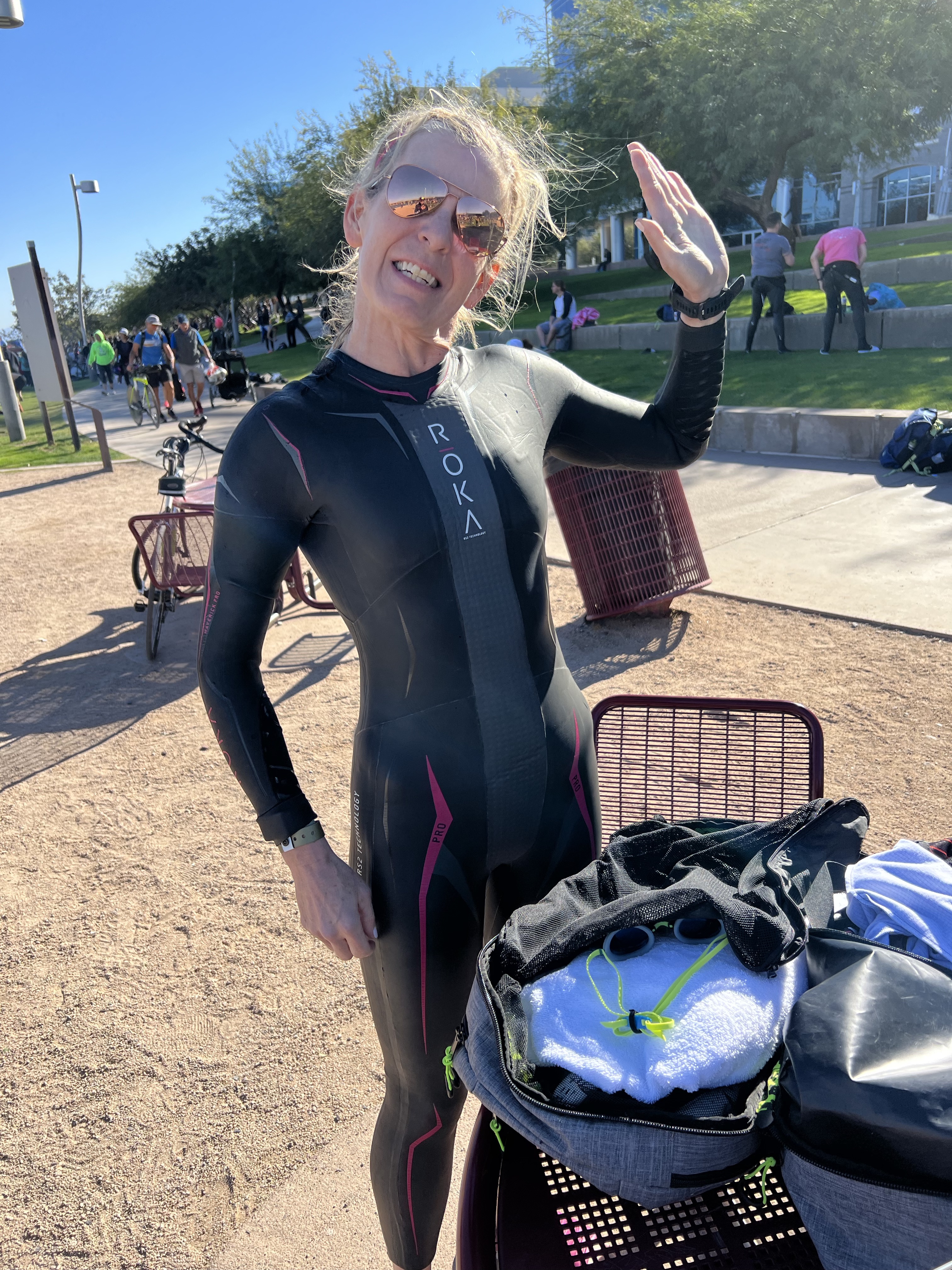
Ten years ago, I met my wife Sue on the dating app FitnessSingles.com. We’d been on a bike ride together and I quickly learned how fast she could ride in aero on her Scott tri-bike. I’d already been riding and racing road bikes for seven years by then, so I only struggled a bit keeping up with her. She was scheduled to do a half-Ironman in Racine that July, so I traveled up to watch her. At the time, I thought to myself, “I could never do this.” The open water swimming alone was daunting. I also wasn’t doing many runs longer than six miles due to some hip tightness and the like. At 56 years old, I was still pushing myself in some ways, and had explored the idea of getting into triathlons back in 2003, but tore my ACL playing soccer that year and it took time to rehab. Then my late wife got cancer in 2005 and adding anything to the caregiving menu and lifestyle at that time was out of the question.

Meeting Sue was like changing gears in mid-life. Soon enough I did my first duathlon, and coming off the run and the bike and into the second run, she saw the look on my face and chuckled, “Keep going honey!” That first time running after you’ve biked hard is quite the slog. Yet I was excited to be competing at something new.
Still, when I watched Sue and our triathlon friends do the MOWS (Madison Open Water Swim) I stood idly on the shore thinking, “I could never do that.” Something pulled at me though, because the epic nature of swimming in front of those lakefront buildings and Monona Terrace made me want to be part of that experience.
Swim Start

I started swimming at the XSport gym in 2014 and it was an awful struggle at first. I took some lessons and started joining Sue in early morning Master’s Swimming at the Marmion Academy natatorium. It took years of back and forth with form practice and longer workouts to get any good at swimming at all. The first race swim I did was at the Naperville Sprint Triathlon. I almost wore my new wetsuit but chose to wing it and it was rough. I passed a woman stuck in one place at the first buoy shouting “Goddamnit Goddamnit” and slapping water so hard it created a washing machine. But I kept going and it took me nine minutes to finish 375 yards.
The first time I swam actual open water in the wetsuit (750 yards) was at the Pleasant Prairie Sprint Triathlon in Wisconsin, and that experience was revelatory. Finally, I was feeling like a real triathlete. Then I moved up to the Olympic Distance and my swimming was no longer a game-ender. I swam 38 minutes for a mile and won my age group. From then on, I made the podium at several races. I’d actually improved at something entirely new to me! That was a good feeling.
Yet I was still prone to an occasional panic attack if I went out too hard in the swim. That happened earlier this year at Pleasant Prairie in fact. I started up front, swam too fast too soon, and wound up treading water to calm myself down. I’ve dealt with native anxiety all my life. Now I realize there’s a close relationship between ADHD and anxiety. Knowing there’s a reason and cause for certain emotional states is enormously helpful in building strategies for better mental health and performance. Yet despite that knowledge, sometimes things catch up with you. It took me 45 minutes to finish that mile swim in Pleasant Prairie, but I still made the podium in third place despite collapsing into a sweaty, slow run after two miles of the 10K What I learned from that is how important it is to get salt into my system before and during the race. Otherwise, I bonk.
Racing Madison 70.3

During Covid a few years back, my wife’s coach Steve Brandes hosted a practice race of 70.3 in Madison. I swam well enough and rode the 56 miles with enough reserve to finish the half marathon in two hours. That was my goal yesterday. I’d learned enough that it was possible to move up to the 70.3 distance. Perhaps I was just a chicken about it. I’ve met people who did the distance as their first race experience! Props to them.
For those of you who have never done a triathlon, it’s an early morning proposition. Typically we rise out of bed at 4:00 a.m. to get some breakfast and take care of bathroom needs, which at my age tend to require multiple visits before the race begins at any distance. But I’m not alone. The Porta Potties at triathlons are the busiest facilities of all.
Transition is the place where bikes and gear for the race are stored. Athletes set out their riding and running equipment on neat towels and pull on their wetsuits after applying reams of Body Glide because a wetsuit can cause nasty abrasions at the seams and neck.
As a person with attention deficit disorder, the process of packing up gear bags and making sure everything’s prepared is a challenge. It’s easy to misplace or forget bottles or goggles, nutrition, or any of the other stuff you need to do the race. I’d written out the list of items in a notebook and meant to bring that memorandum along to the race but left home without it. As it turned out, that spelled trouble.
I got to the race transition in the morning and realized I had no swim goggles. I’d definitely packed them the day before but must have dropped them in the hotel room while arranging the night before the race or kicked them under the bed. I rushed out to tell Sue and she was going to head back to the hotel a few blocks away to get some of her goggles. Then I thought again that her sister Julie was swimming a relay and might have an extra pair. That’s what I used, a pair of clear swim goggles borrowed from my sister-in-law. That wouldn’t be the last thing she did to rescue me yesterday.
Seed times

Standing at the swim start I seeded myself with the 40-43 minute group. The night before at dinner, Sue had corrected my math about the swim distance. I told her I was shooting for 38 minutes and she pulled out her phone and added up the yardage to illustrate the reality of 1.2 miles versus just one mile of swimming in the Olympic distance. “It’s about 2200 yards,” she showed me. “Oh,” I said.
Earlier that week we’d driven a half hour up to Crystal Lake to do an open water swim practice. I started slow and swam really straight and smooth the entire distance. That helped my swim confidence for the 70.3. I’d covered a mile in just over 37 minutes that day and felt ready to swim the 1.2 in Madison.
Waiting for the start I did a couple mental relaxation techniques and promised myself to swim to the outside of the main group as we dove in by foursomes. Punching my watch to start the day (I finally knew how to run the thing for transitions and all) but must have missed the button. Two or three minutes into the swim I looked at the watch and it had not started. I punched the button and kept on swimming.
Within minutes I found a rhythm. That’s everything in swimming. Rhythm and form, a shallow “catch” with arms bent and sighting to swim a straight path are all important. The water was a perfect temperature, just above 70 degrees and wetsuit legal. I’d have had a tough time swimming that distance in just my skinsuit, which has “floaty” properties but not nearly the same assurance that a full neoprene wetsuit provides. I likely would have panicked and pulled out of the race had that the water been too warm for wetsuit legal conditions. I was really grateful for that.
Turning back toward the finish I raised my head to look at the Madison skyline with the Monona Terrace and the Helix ahead and thought to myself, “You’re here. You’re doing this.” What seemed impossible a few years back was now a reality. I was proud of myself for getting there.
Time out of mind
Yet I still have these moments sometimes where I’m swimming or riding or running and it’s like time stops or folds back in on itself. It’s almost like I’m not really there at all and I suddenly realize “I’m out swimming in a lake.” Then I’m dialed back in. Do any of you feel that way?

Climbing out of the water, I was grinning with gratitude and kept at it while running up the spiral helix to the transition area. That’s the thing, right there. Back when I watched Sue do the full Ironman and watched her climb that helix I was envious. “That’s so cool!” Granted, the water was much colder that day and she had some asthma issues that eclipsed her breathing the first sixty miles of the 112-mile bike west of Madison. Before yesterday’s race, my brother-in-law Mike Czarnik told me multiple times, “There’s always something that goes wrong. Just be ready for that.”

Coming out of the swim I was smiling, present, and grateful to be safely out of the water and ready to ride. The weather outside the water was perfect for the day ahead. It was cool but not cold on the body as I biked out of transition. Yet while in transition, I discovered another problem. I had no socks. I thought I’d set them out that morning, but they were nowhere to be found when I went to put on my bike shoes. Sue has teased me about slow transitions due to putting on socks and such, but now I had to try the bike shoes without them. They felt fine. “I’ll deal with the sock issue when I get back.”
The first DQ risk
We rode the bike course a few weeks back and I knew that it wound around some bike trails heading out of town. But I didn’t know the rules about No Passing Zones. A few people passed me at first and I passed a few too, but we’d been on the roads until then. At some point along the road, one of my water bottles popped out of the cages behind my seat. I did not know that I was required to go back and get it. I’d already seen other bottles along the first mile of road. A guy yelled to me, “You just popped a water bottle.” Probably he was trying to save me from getting a penalty. I thought he was just trying to be nice.
Then I got on the bike trail with a bunch of red arrows pointing the way and zoomed around a woman going modestly. When I passed her she called out, “This is a No Passing Zone.” Had a referee been present, I would have probably been disqualified on the spot. That wasn’t a safe move.
So that’s reality. There are quite a few rules in the triathlon world, and they exist for good reasons. Sue specifically warned me not to stop and pee out in the open somewhere along the road because “they don’t like public urination.” In the Tour de France, they call that a “nature break,” but not in triathlon. I was prepared to abide by that rule and will get to that and its impact later on.
Having ridden the course previously I was surprised to find that some of the hills I’d forgotten were decently steep. But once I got through the first portion of the course I was encouraged when one of my five-mile checkpoints on the Garmin read 14:39. That meant I was averaging 20+ miles per hour on that stretch. I was hoping to put some speed in the bank to compensate for poor roads and rolling hills in the middle miles. My plan was to ride quickly without strain on the early smooth roads, focus on steady riding on the middle roads marked “Rough Roads Ahead.” After the one long hill at twenty miles, I knew another waited on Whalen Road at 45 miles. Then I planned to buzz it home on familiar roads. My goal was to complete the course in three hours, a realistic yet challenging time on a course with a couple thousand feet of elevation gain. And had I not stopped to pee at the Aid Station Porta Pottie, where the wait wound up being four minutes, I might well have hit that 3:00 goal on the nose. I averaged almost 18 mph. Not bad for me.
That tie of 3:00 flat without the Porta Pottie stop might have put me in the fifth place or a “podium” finish in my age group. But that is no excuse. I had plenty of opportunity to make up time in the run. But that wasn’t going to happen it turned out.
Sock it to ’em

Riding back into town I was again grateful to be making good progress and looked forward to the run. My legs felt great the entire ride and my nutrition plan seemed to be working. If anything, I felt stronger the last fifteen miles than I did during the middle miles when my kidneys started complaining from having to pee. I started to worry about that as my stomach started feeling wambly the more I had to pee. It was good to grab a banana at that aid station, and I followed that with a Picky Bar to get some solid food in my stomach. Things settled down after some food and some pee relief.
After climbing the Whalen Hill I let loose a little and might have hit 40 mph on a long downhill. I keep one hand on the right brake while the other arm is in aero, giving me plenty of control over the bike if need be. Two years ago during a ride on the Ironman Madison course a guy suddenly swerved in front of me on a downhill and I barely missed slamming into him on the bike. Back in 2012, I’d crashed due to bike wobble at 40 mph and I was happy to feel the solidity of my new Cervelo Ultegra under me during this race.
We purchased my first genuine triathlon bike earlier this summer and during the race, some woman called out to me, “Your bike is pretty!” It is. It was also the only bike we could find among the bike shops in the Chicago area! All were sold out on tri-bikes in my size, and as it was, this bike is a 56 cm frame versus the 58 cm Felt I’ve been riding since 2007. Even with aero bars installed on that bike, I’ve had real cramping in my upper hamstrings during races. It has stopped me from running several times during races.
It was fun flying in the last ten miles from Whalen. The roads are alternately smooth and rough but I know them well from years of training up there in Madison. Pulling into the helix I was grinning again.
The next DQ opportunity
I trotted through the garage where transition was set up at Monona Terrace and sat down to figure out whether I could run without socks or not in the Nike Vaporfly racing shoes. I’ve worn them for a few road races and a half marathon relay or two in triathlon. They’re great shoes but I had no idea whether my feet would blister in them sans socks. I trotted toward the Run Out and saw Sue and her sister Julie standing there taking pictures. “Hey,” I said to Sue. “I need your socks.”
Now, taking aid of any kind from spectators is strictly against the rules in Ironman races. But I was desperate in that moment, and if a referee were standing there and called me on it, I’d have claimed a disability. ADHD is a mental disability that blocks certain kinds of executive functions at times. I have ADHD, which is an adult realization along with the acceptance that is has cost me at many points in life. Thinking back to high school cross country races, I lost to a notable competitor on his home course because I did not absorb the fact that during the second loop on the course, we did not have to run around the track a second time. He went straight and I ran an extra two hundred yards and lost to him by only two seconds. The lead I’d built over three miles evaporated.
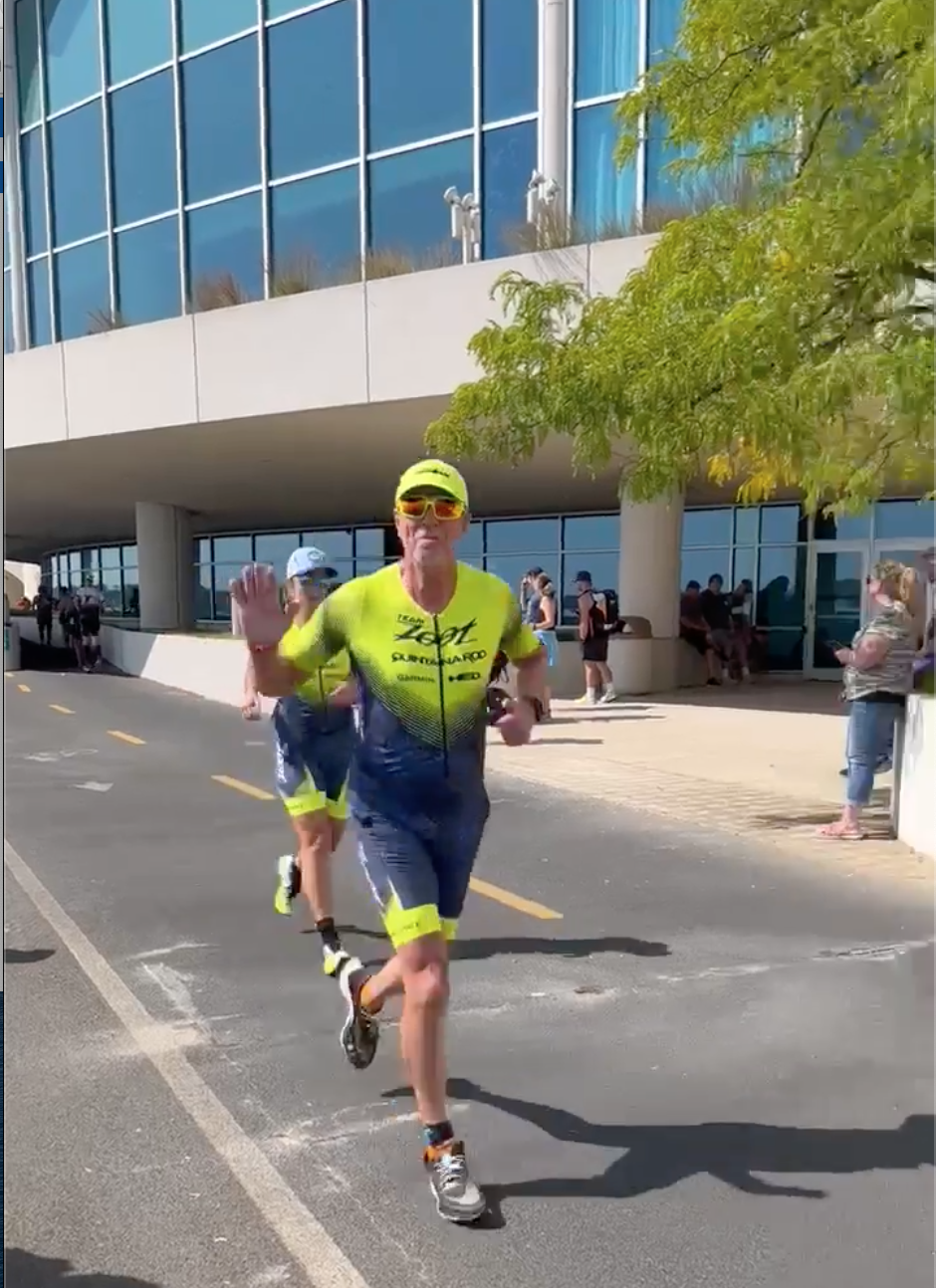
Sue’s sister Julie saved me again. “I have brand new socks in here!” she said, pulling out a pair of size 11 orange socks that turned out to be too big for her husband to wear that day. “They don’t match your kit, but you can keep them!” she laughed.
I sat my sorry ass down, pulled on the socks and shoes, and took off running. At the bottom of the helix, I realized I was still wearing my cycling gloves. I don’t like the feeling of that. I pulled them off and stuffed them in my back kit pocket. And kept on running. The first two miles went great at just under nine minutes per mile. On the way back around past the helix, I saw someone I knew and handed them the gloves. “Can you hold onto these?” I asked.
That’s actually another DQ if a referee sees me doing that. I was now up to three potential DQs for the day. So much for being a triathlon pro!
Heading into the run I’d downed a couple salt pills and few Clif Shot Blocks but by four miles I was starting to slow and realized I needed salt immediately. My pace dropped from 9:00 to 10:00 per mile, then 11. At the next aid station around six miles I popped two salt capsules that were given to me a few weeks ago during a cycling ride and I said out loud to myself, “you will get a Second Wind.”
The course wound around through neighborhoods and some sneaky little hills. Coming back toward downtown my pace picked up ats the salt kicked in. I felt bad at that point because my group of informants had said my pace early on was plenty fast to podium on the day. As the temps warmed and the sun caught up with me, I slowed too much to hold that position. It no longer mattered that I’d wasted five minutes at the Porta Pottie earlier. I was running to finish now.
Mistakes incorporated

So much of what you accomplish in life is based on eliminating mistakes. For some of us that’s a bit harder than others. Had I snagged that gear list from y home desk before leaving on Friday, those goggles and socks would not have been an issue. I have plenty of coping skills for ADHD, but rushing around before leaving town made me forget that. My son found that list in my office on Saturday and asked me last night if Id’ needed it. “Well, yes, I laughed.
He’s the one who has counseled me the last year on so much information about the effects and ramifications of ADHD. While I’ve accomplished much in life from writing books to conducting art exhibitions, leading successful literacy projects and building marketing programs, to being a caregiver to my mother, father, and wife for many years, I know now how important it is to slow down in the moment, check the list of things to do and do them as they are mapped out. I’m actually good at that. I just missed a moment going into this race that could have made things go differently.
As it went, my wife’s coach had a wry chuckle about all the potential DQs. You’ll notice that I’m missing a race belt and number in all the running photos. I put the race number on the belt the night before, and set the race belt out on my shoes that morning, but did not put the belt on in transition. So that was four potential DQs. I was so concerned about the socks that I forgot all about it. That’s why we do these races. To challenge ourselves and build on our experience. Yet I was careful not to draft or commit any genuine racing transgressions. None of my gaffes gave me any competitive advantage. In fact, I spent a total of 14 minutes in transition. I haven’t had time to compare that with my competitors, but I’ll bet those are smaller numbers.
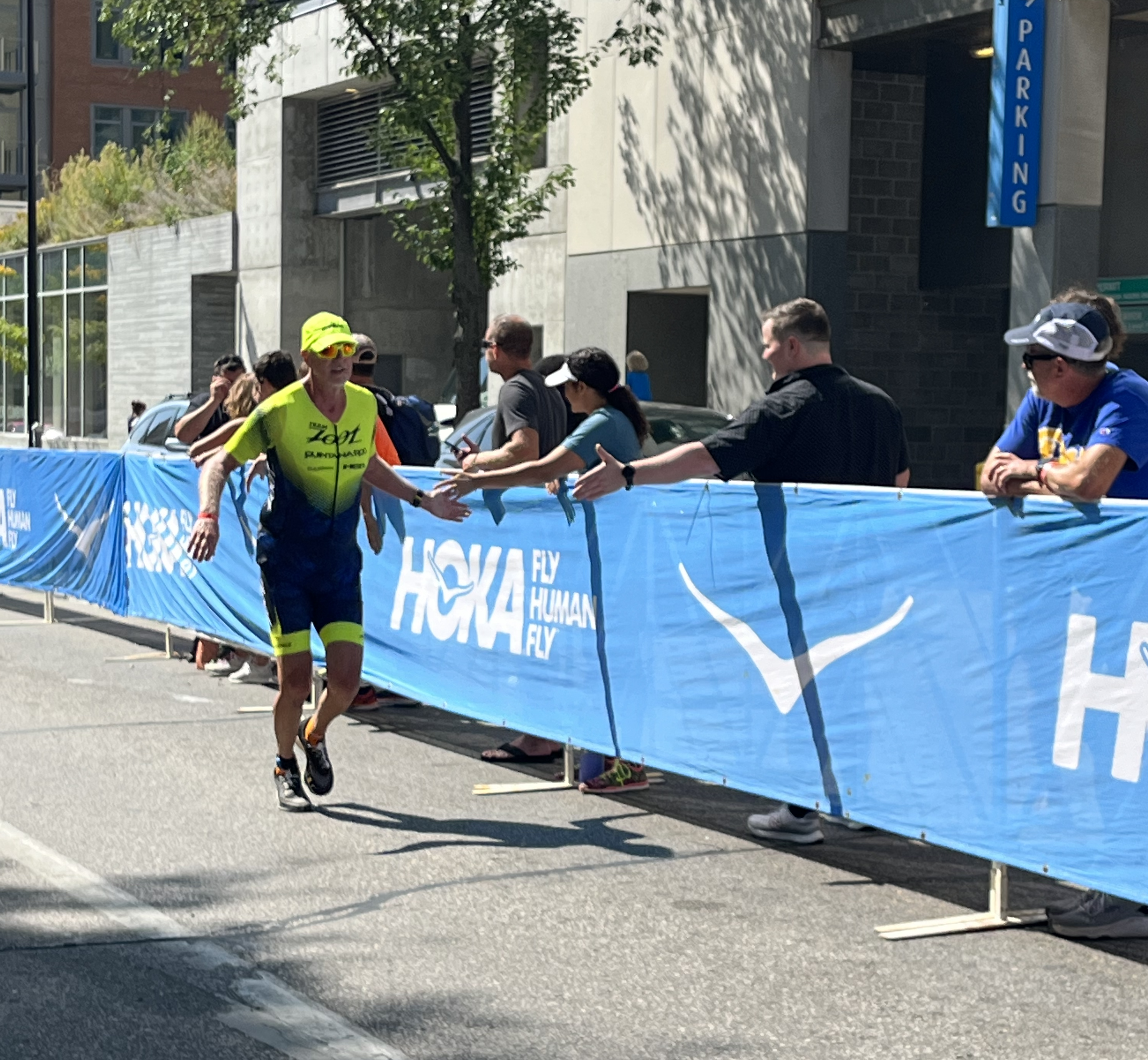
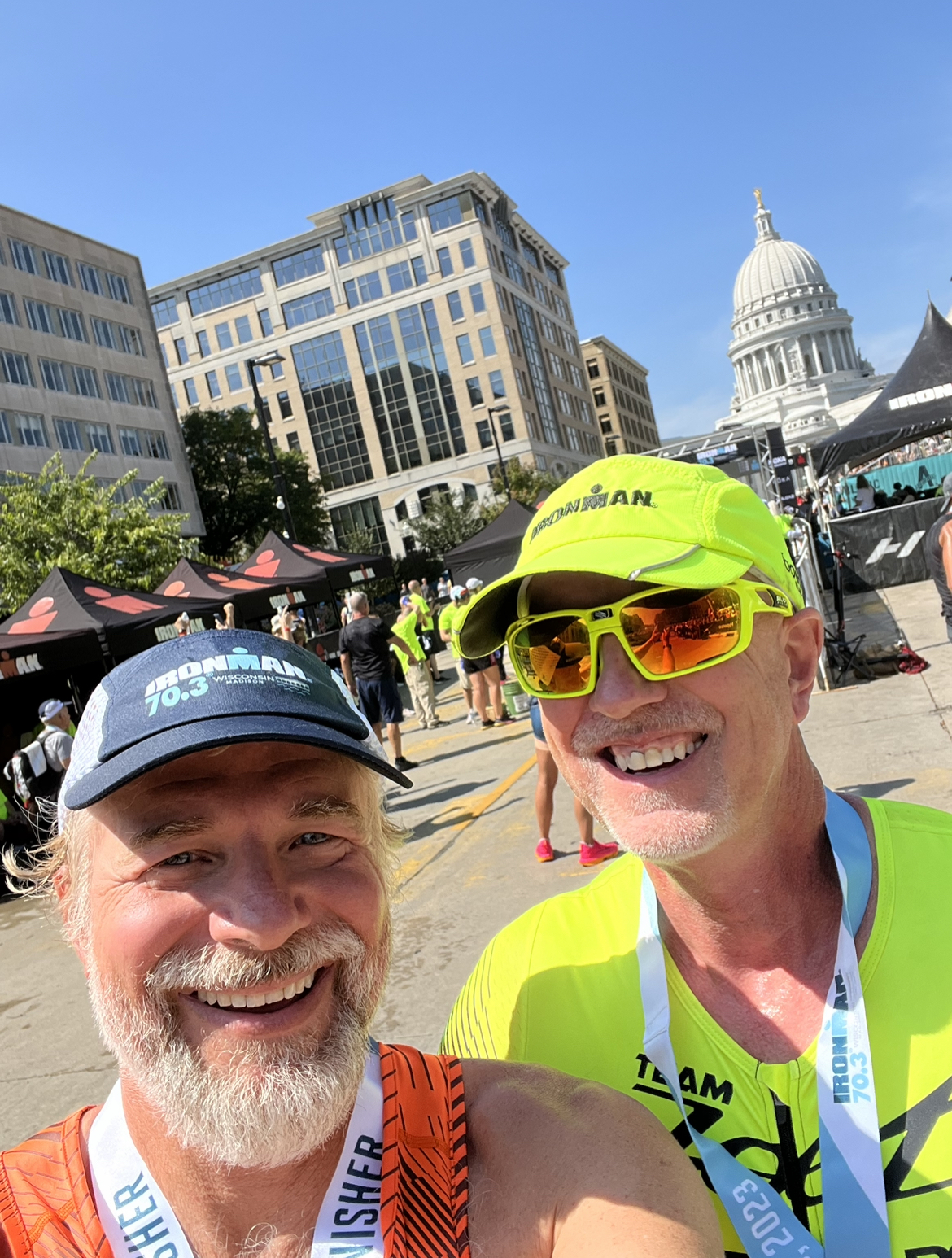
Coming into the finish line at Ironman Wisconsin 70.3, I made sure to slap a few hands along the crowd gathered outside the fencing. Perhaps that’s another DQ, but if it is I don’t give a damn. It was sweet to hear my name announced loud and clear as I trotted on the red carpet under the giant IM Finish ballon. “Christopher Cudworth, sixty-six years young from North Aurora, Illinois,” the announcer called out. ”
And that, my friends, is how you do a 70.3 Ironman. Minus the mistakes. Got that?
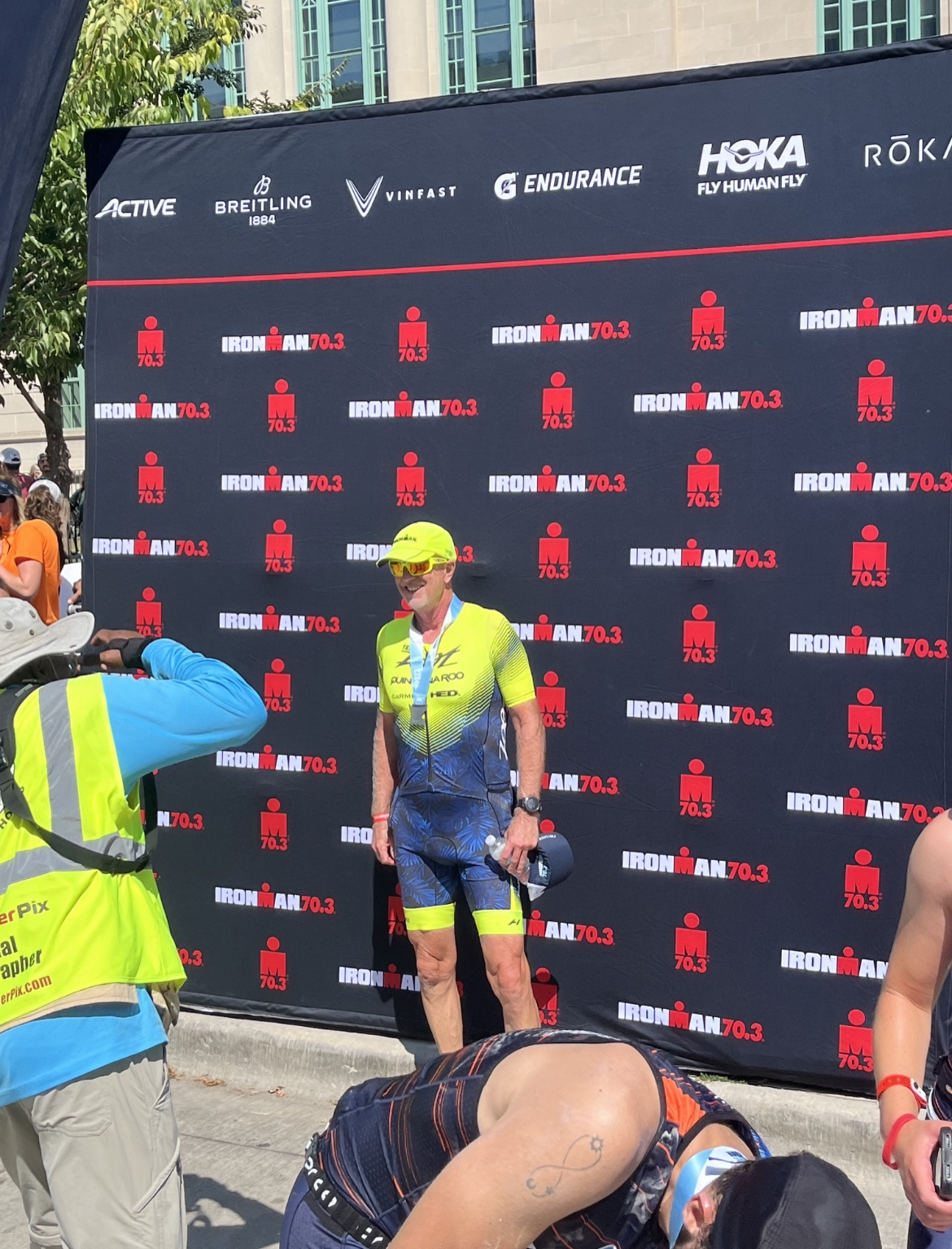
By the way: my socks were indeed in the transition bag, just buried out of sight in a hidden picket of the Zoot tri-bag. I just didn’t know where to dig them out that morning. It’s not just ADHD that catches up with you sometimes. It’s hard for anyone to think straight at 5:30 in the morning. The goggles I think fell off the bed and got kicked under the frame rather then making it into my bag.
If you have any IM tragic, fun or funny experiences to share, I’d love to hear and share them. Cudworthfix@gmail.com


 We Run and Ride