
By Christopher Cudworth

The classic Schwinn Varsity.
In 1968 the Schwinn Varsity was one of the “must haves” among bikes in North America. Heavy and durable, yet racy with drop handlebars and an actual 10-speed derailleur, the Schwinn Varsity knocked it out of the park as an object expression of cycling freshness and freedom.
Seeing the world on a Huffy 3-Speed
Confined to a Huffy 3-speed during my teen years, it was raw jealousy that haunted my heart when riding with my friends from wealthier families who actually owned a Schwinn Varsity. My buddy Eeker (a nickname) possessed a yellow Schwinn Varsity with those industrial-looking pedals and the tightly taped drop handlebars. On the rare occasions when I was allowed to ride his bike, the speeds were confusing because the most I knew about shifters was the little thumb tab on my Huffy 3-speed. The Schwinn had levers and if you didn’t know anything about derailleurs it was like a complex algorithm trying to figure out how to shift gears. Yet finally you’d grab one and pump your damned legs and the thing would really go. Sure, the Schwinn Varsity weighed about 40 lbs, give or take a dozen, but once you got rolling momentum would take you quite a ways.
Sports marketing mystique
Like a pair of Red Ball Jet sneakers, part of the mystique of Schwinn bikes was the perception of its brand. So we all learned an early lesson in sports equipment marketing, because everyone I knew wanted a Schwinn 10-speed bike. The lust for a piece of athletic equipment is sufficient at times to outstrip all rationality. Our yearning for play exceeds our capacity for self-control.
Many more sports marketing lessons would be learned in a life in athletics. Nike. Adidas. Reebok. Brooks. New Balance. Tiger/Asics. Tinley. Sporthill. Livestrong. On and on we go.
But the Schwinn Varsity was one of the first brand lusts of the modern era. We were innocent partners in an industry that would grow and grow over the last 40 years. Trek. LeMond. Scott. Felt. Orbea. Cervelo. You can almost feel the bikes changing underneath your butt as you ride them. Trickle down technology works from the ground up. But the Schwinn Varsity was something of a beginning.
Inheritance
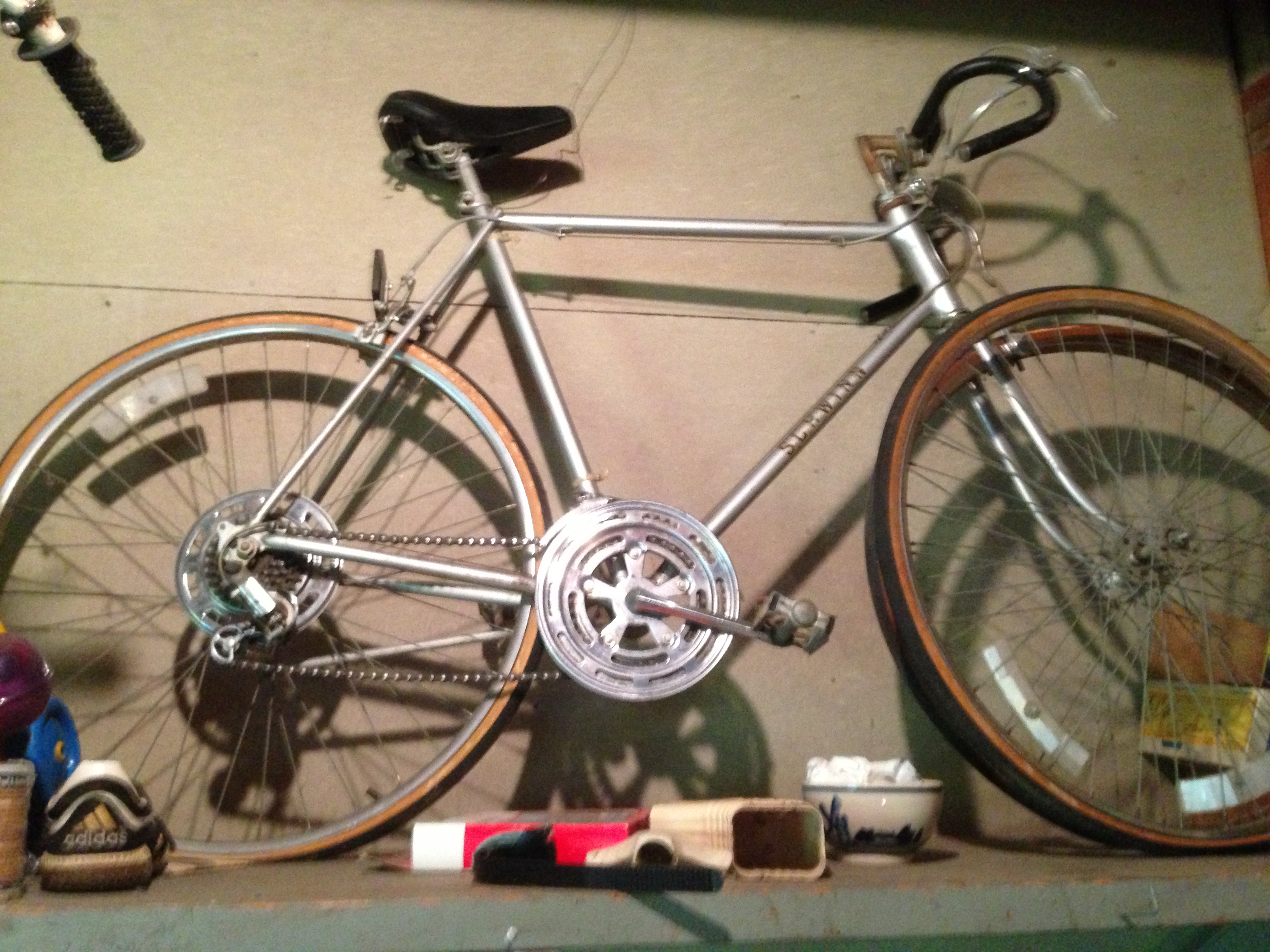
Hidden in the garage for nearly 30 years.
My late wife owned a Schwinn Varsity with a silver paint job. She told of riding that bike around the neighborhoods of Addison, Illinois, and sneaking away on the freedom it gave her in her teens. Really, it felt like a Schwinn Varsity could take you anywhere.
One day while riding up the narrow strip of asphalt called Woodale Road, a passing truck clipped her with its passenger side mirror. The mirror knocked her off her bike, tore off her shirt and caused a massive gash on her left shoulder. The truck stopped and the driver stood around sheepishly until she could be carted off bloody and scared to the hospital for treatment. The trucking company paid her bills in those days, but nothing more. In the late 1960s society was not so attuned to the idea of recompense for pain and suffering. At least not for her.
Damage done
The accident made it tough for her to ride a bike on the road the rest of her life. We kept that Schwinn Varsity all those years. It hung in various dusty, hot places in the garage as we moved a few times. Finally the Scwhinn came to rest high up on a set of wooden rafters in our home. The light reflecting off the garage floor would often illuminate that silver Schwinn Varsity, and occasionally I would take it down just to admire its finish, and its heft. It weighed a ton, but I’d ride it up and down the street with its dry-rotting tires just to see what it felt like to ride a Schwinn Varsity again.
Changing gears. Changing years.
It is funny how the objects of your early desires in life can come to feel like a burden once circumstance and technology enter in to change the world. Despite the fact that some people might feel the Schwinn Varsity was a perfectly good bike, my wife refused to ride it. The seat was uncomfortable. The bars were dropped too low. It was creaky and dangerous feeling.
To Linda, it was not the only weight and structure of the bike that made it untenable to ride, but the weight of the early experience she’d had getting knocked off that bike that made it so undesirable to ride again.
The simple truth is that the Schwinn mystique had grown heavy with time. So we bought her a clean new Trek Navigator 2.0. Twice as light. Nice full seat. Better ergonomics. Teh Schwinn Varsity was permanently relegated to the garage attic.
Repeating patterns
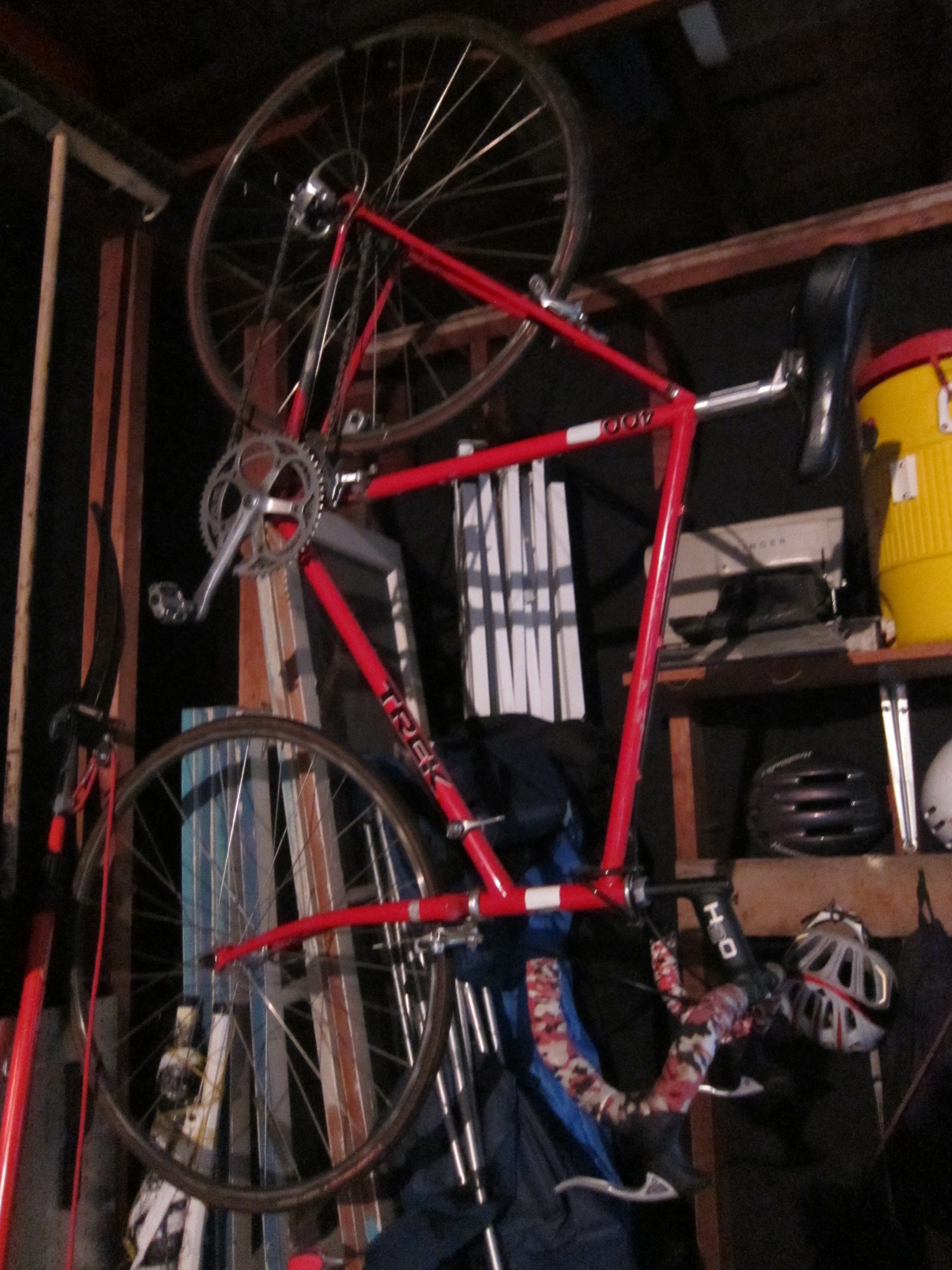
The red Trek 400 that launched two riders’ cycling habits.
The pattern of bicycle obsolescence repeated itself in the Trek 400 steel frame road bike my brother-in-law gave me to begin cycling. For two or three summers I rode that bike as hard as I could, trying like hell to build cycling muscles and keep up with the occasional group rides.
I clipped in with mountain bike shoes and SPD pedals, and could average up to 18 mph for 30 miles on the Trek that had similarly introduced my brother-in-law to cycling. He graduated from the Trek 400 to carbon fiber bikes and then purchased a sweet Waterford crit bike emblazoned with his team name and his own name in decals on the top tube. He raced CAT 3 and lived the sport fully until one day his fever ebbed and he stashed all his cycling stuff and jumped into the sport of skydiving.
Moving on
So we grow, and we graduate to new things and changed circumstances. The things we once prized become garage ornaments or mementos of the people we once were. But I could not bring myself to turn the Schwinn Varsity into a garden ornament. Giving it to Goodwill didn’t seem the right route to go either. I always wanted to find it a good home. Someone who really wanted and appreciated the Schwinn Varsity would be able to identify. That’s what I figured anyway.
At one point I put the Schwinn Varsity out on display during the lone Garage Sale I’ve ever conducted. A local bike expert who fixes up bikes and sells them on his front lawn came by to inspect the Schwinn. His careful eye noted a slight ding to the rear wheel, which was out of true. There was rust on the handlebars in dark brown pits. He didn’t buy the bike. “Too much work,” he told me.
Do It Yourself
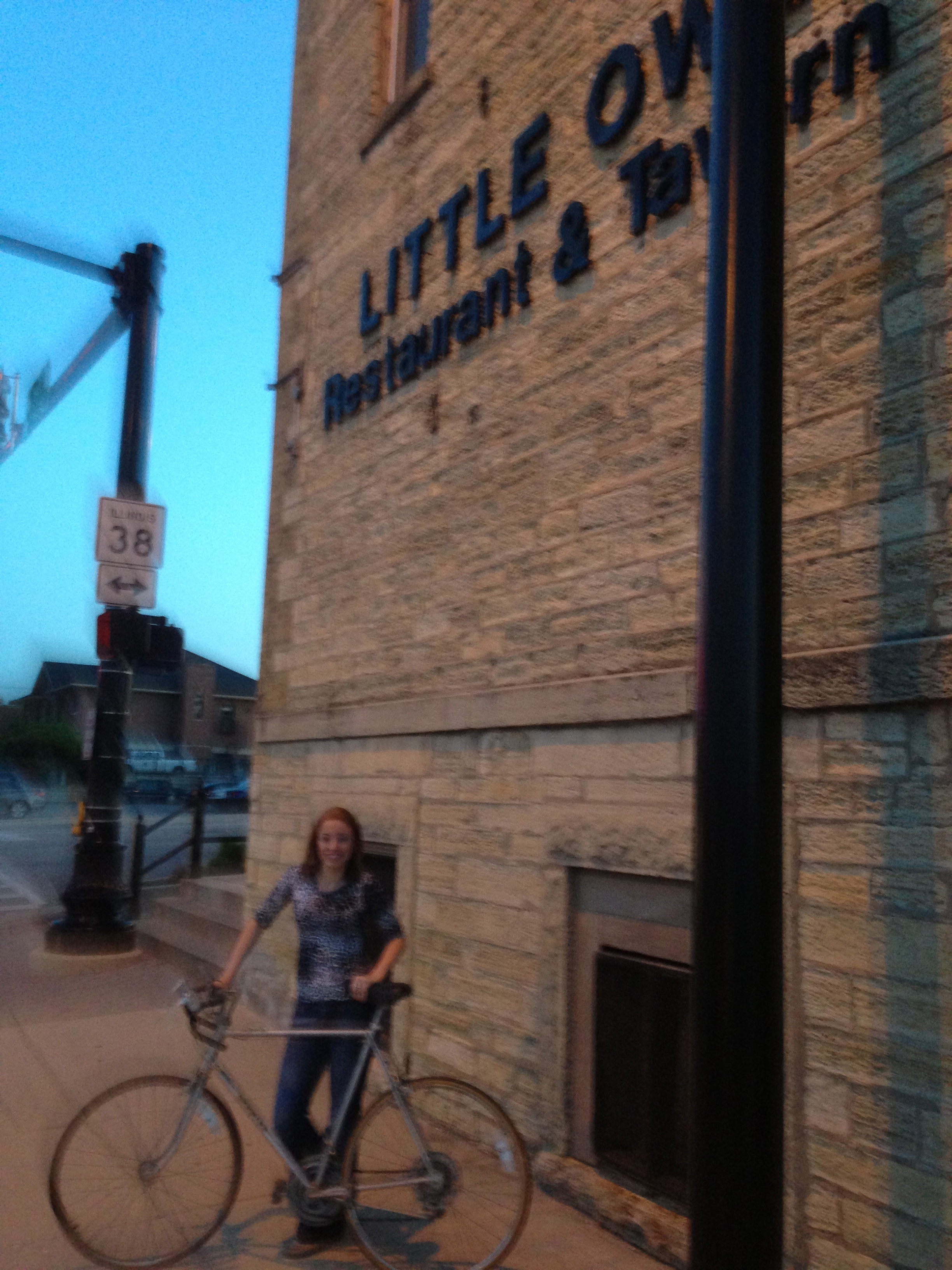
The new owner of a very old bike. And happy for it.
So I took the initiative this year to fix up the Schwinn, using WD-40 to clean the rust off everywhere. The bike shone. Even the wheels. Put new tires on both wheels. The shifters and brakes were still fine. Then I waited for the right cosmic moment and the right person on whom to bestow the Schwinn.
It happened one night at a bar in nearby Geneva, the Little Owl. While waiting for friends on a slow Friday night I struck up a conversation with the bartender, a young woman working her way through college. She took an interest in the fact that I was meeting up with cycling friends for a beer and said, “I like to ride. I just need to get a bike. But I want something cool and old I can knock around on.”
I told her I had just the bike. Just for her. Her eyes brightened, and a couple weeks later I returned to the Little Owl to give her the bike.
My daughter had joined me for drinks and we chatted with the bartender for a while and then went to get the Schwinn out of the back end of the Subaru. The bike wheeled its way happily through the night air, and when the young woman saw the bike, she declared it “perfect” and happily posed for a picture on the sidewalk outside the bar.
A new home for the Schwinn Varsity
The Schwinn Varsity now had a new owner, and a new rider, after more than 40 years. It’s the heaviest damn bike you’d ever want to feel, yet its weight is also its charm. It is far better off in the hands of someone who will love and cherish it than it was hanging like an odd ornament in the garage.
That’s how it is with all kinds of objects and dreams. Sometimes we mothball them for too long. It takes a little lubrication and a bit of elbow grease to get them back in shape. Then we take them out for a ride, and/or share the joy with someone we hardly even know. And the purity of the moment is made from the absence of time.


 We Run and Ride