
Have you ever wondered exactly how good you really are at something? Pick anything. It could be gardening. Your job. Relationships. Marriage. Divorce. We all face these pursuits in our own way. Yet it’s really hard to judge whether you’re genuinely good at something or not.
That’s why I took to running full bore at the age of twenty-two. I wanted to find out how good I really was. I’d been competing in running from the age of twelve when I ran a sub-12:00 minute two-mile in gym class. In middle school, I ran the half-mile in sub-2:30 and went on to set the freshman mile record at 4:57. By sophomore year I led the team in season points and we won the first-ever Little Seven Conference cross-country championship. That spring I ran a 4:42 mile. Then we moved to St. Charles and I led that team as well, winning nine dual meets and taking the District cross-country title. Track was just so-so as a junior, but my senior year in cross-country saw ten dual meet wins, an invitational title, and making the Sectional meet.
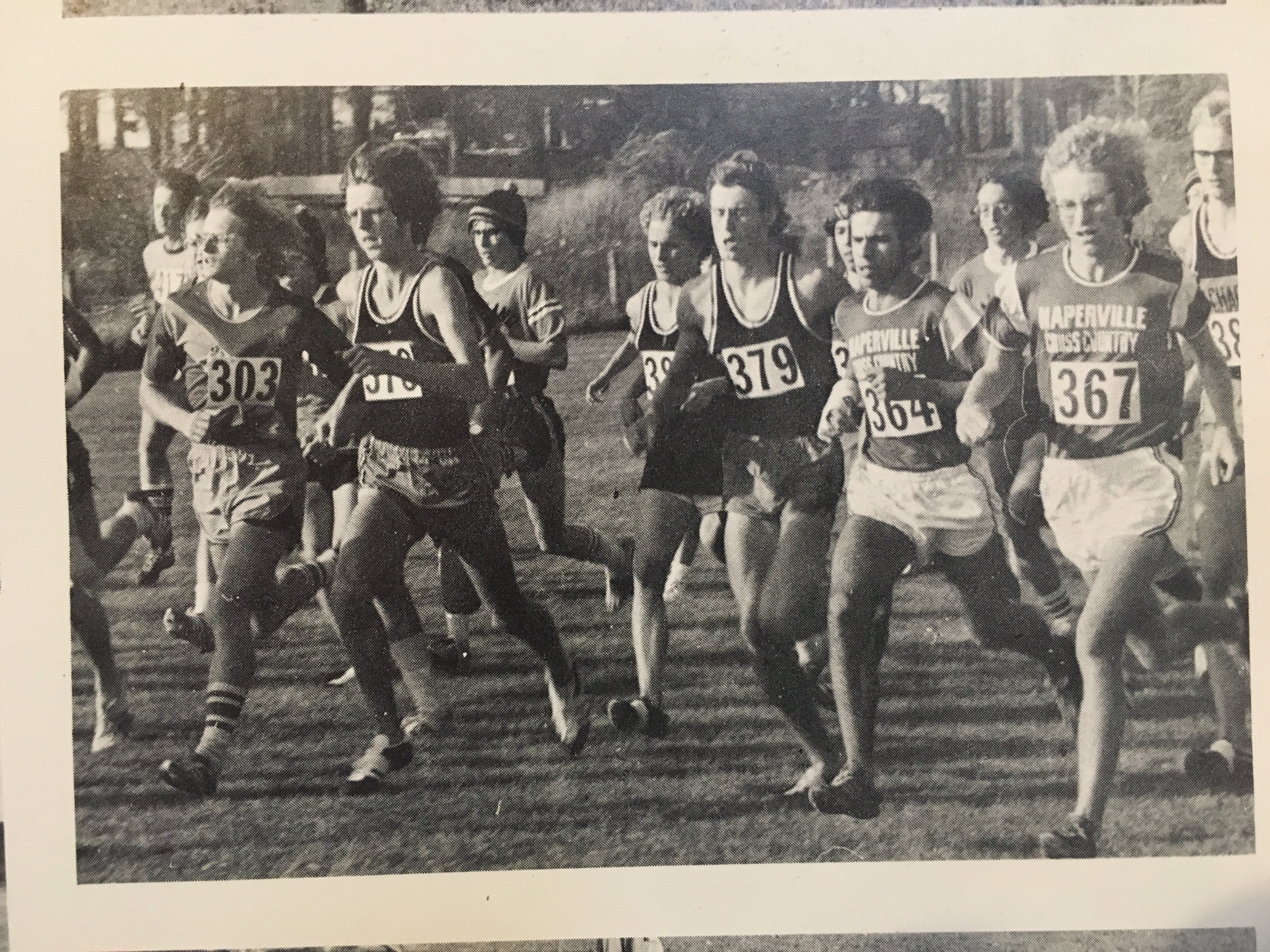
My coach during those latter years of high school running put it best. “Cudworth is a good runner, but not a sensational one,” he was quoted by the Beacon News after a sports writer used the term “junior sensation” to describe my season thus far. That next week I got my ass kicked by a truly sensational runner named Tom Burridge who would go on to run at the University of Kentucky, win multiple SEC championships, clock a 13:45 track 5K, and after that set the American record in the half-marathon with a time in the 1:04s.
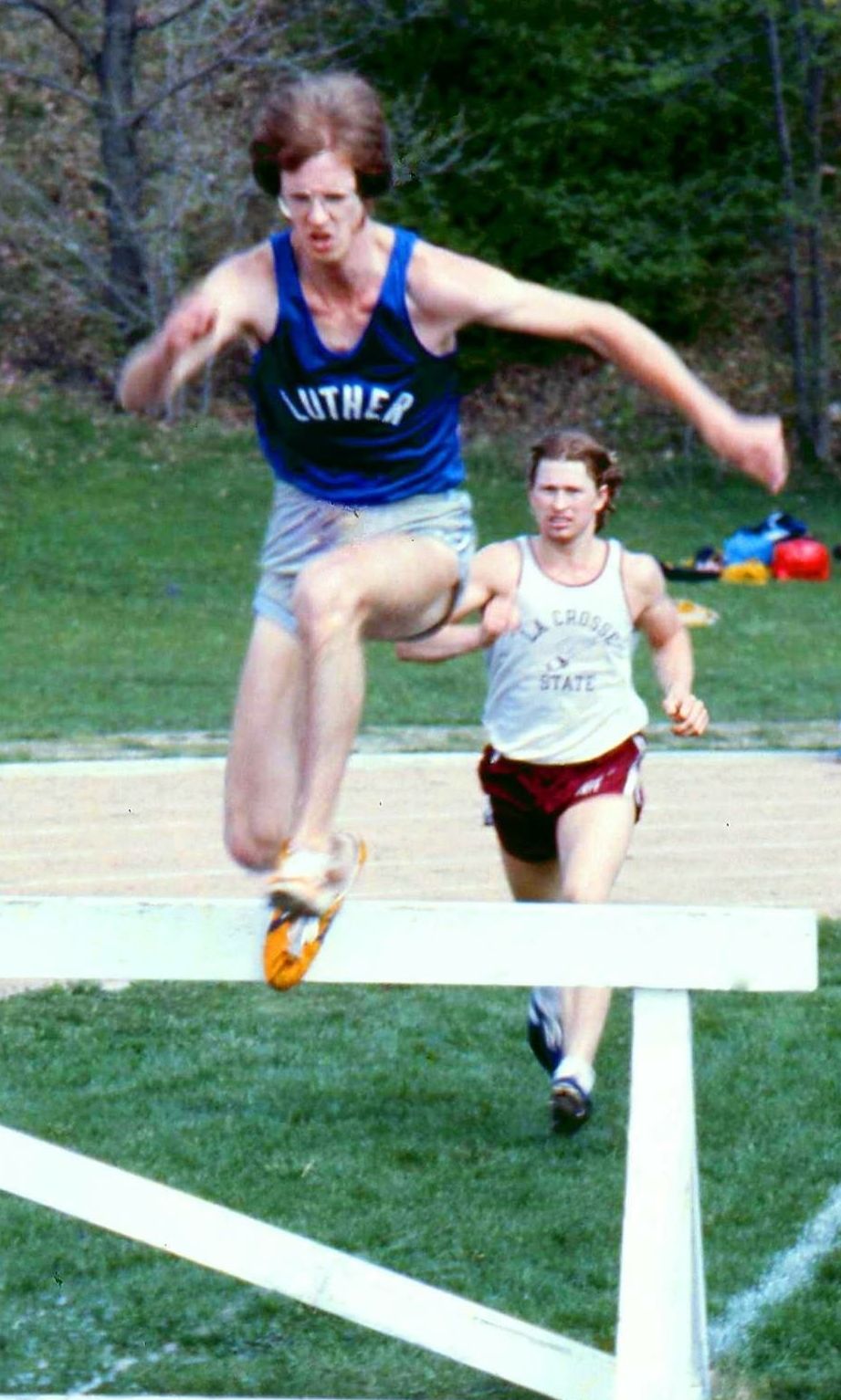
So I knew all along that I wasn’t a premiere runner. Yet I did help lead our Luther College cross-country team to a second-place finish in the Division III cross-country championships. I finished in 62nd place, seventeen seconds behind Steve Corson, our top runner that day. Most of the season I ran as our second and third man, truly enjoying all the work I’d put in over thousands of training miles.
That spring I ran a 9:20 steeplechase to win the conference track meet for the third year straight and qualified for nationals, but ran a laggard 9:30 in Cleveland after two weeks of basically hanging out on campus waiting for the competition.
So it felt like there was “unfinished business” when I got out of college. After a year of working in Admissions for Luther, which made it impossible to train due to 1500-mile travel weeks on the road throughout Illinois, I took a job back home in Illinois, broke up with my college girlfriend, and set a different course in life.
After a year of working at Van Kampen Merritt in Chicago and Naperville, I got sent to Philadelphia, Pennsylvania for work. I met the Crooke brothers and joined the Runner’s Edge racing team. Training with those guys was an entirely different level and style of running. We did our long runs slow and our track work smart. My 10K time dropped below 32:00 for the first time. Then the job ended and I moved back to Chicago.
Feeling adrift in the world after all that work upheaval, I moved downtown with one of my best friends, met a hot Polish girl runner and dated her on top of keeping up the relationship with the woman that would later become my wife. But I got caught on that cheat and dropped the ruse.
But while I lived in the City of Chicago the running got better and better. My 5K track time dropped to 14:45 from 15:10. My 10K time was suddenly 5:00 pace, running 31:10 on a warm summer day in July. I raced 19:49 for four miles, 24:45 for five miles, 53:20 for ten miles on a really hot day, ran a 1:10 half marathon and a 1:24 25K. I won the Geneva Community Classic in a time that stood for twenty years.
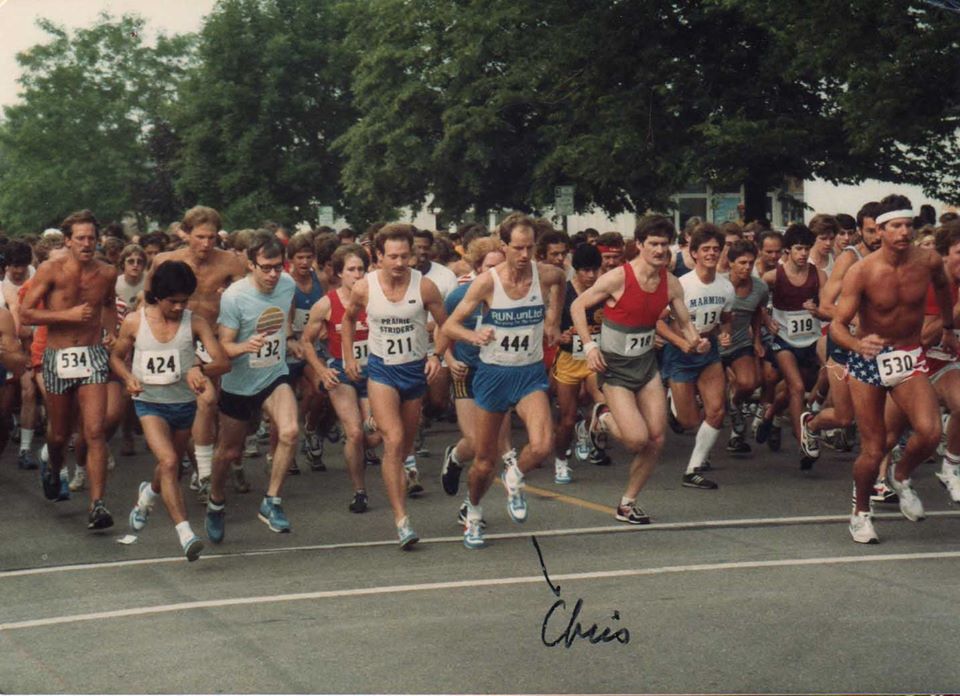
I worked in the Running Unlimited store that sponsored our racing team. I won ten out of twenty-four races that I competed in that year, so I fully earned that sponsorship. It was tough to make rent sometimes, and eventually the idea of living together as friends and roommates soured a bit as he’d finished his Master’s Degree work in kinesiology and was taking a job with a big company. Our two years of living in Bohemian Chicago style was over.
I don’t regret a damned moment of that experiment, especially when it comes to the running. I’d found out how good I was, and learned that I wasn’t more than a journeyman runner. The key point in that journey was entering a race where Alberto Salazar and other world-class runners lined up in front of me. I ran with them for three miles at 4:40 pace before blowing up and finishing the five-mile distance at 25:30.
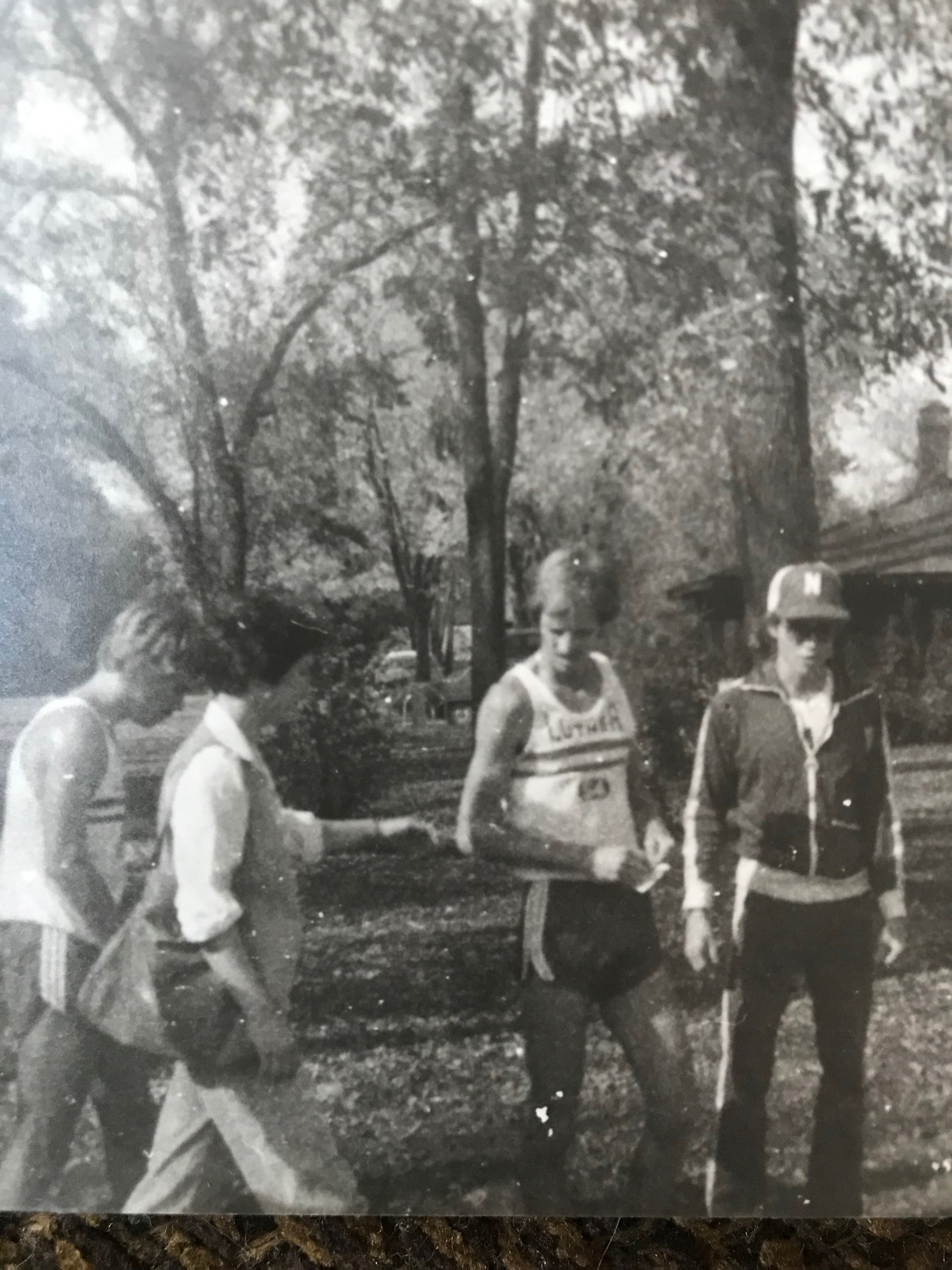
Yet I knew long before that I wasn’t a sensational runner, just a good one. But racing all those years helped erase that definite feeling of unsurety. There are few “woulda coulda shoulda” thoughts that ever follow me around. The only race that I didn’t run my hardest was that steeplechase win at the Iowa Conference track meet in spring of 1979. I ran 9:20 while relaxing the last two laps to save energy for a double back in the 5000, which didn’t produce anything. The top six spots all went to faster or rested runners. It might have been nice to find out that day how fast I could really run the steeple. The conditions and fitness were there.
This little summary is included here for context as I write about the difficulties that life presented in 2008. During that running career, the outcomes were always clear. You either ran well on a given day and accomplished a decent time or place, or you did not. Sure, we all second guess our efforts sometimes, but in the end there is an empiric outcome. That is undeniable.
By contrast, finding “wins” or success in the work world and simultaneously as a caregiver to both a wife with cancer and a stroke-ridden father was much harder. So was being a father. Part of me questioned whether I had the “guts” to do it all. On April 9, 2008, I wrote, “Here’s the God’s honest truth. I’m a success where there isn’t competition. Even that graphic facilitator gig last weekend was a muckup. Reading Rewards: A Failure. Daily Herald for 8 years: a ruse. Now I’m at Dukane where they don’t know marketing and the veil remains. Yet when I talk with people who are successful in marketing, my ideas resonate. Hard work and persistence. That’s what it takes. Now if I could just get that fan in my office fixed.”
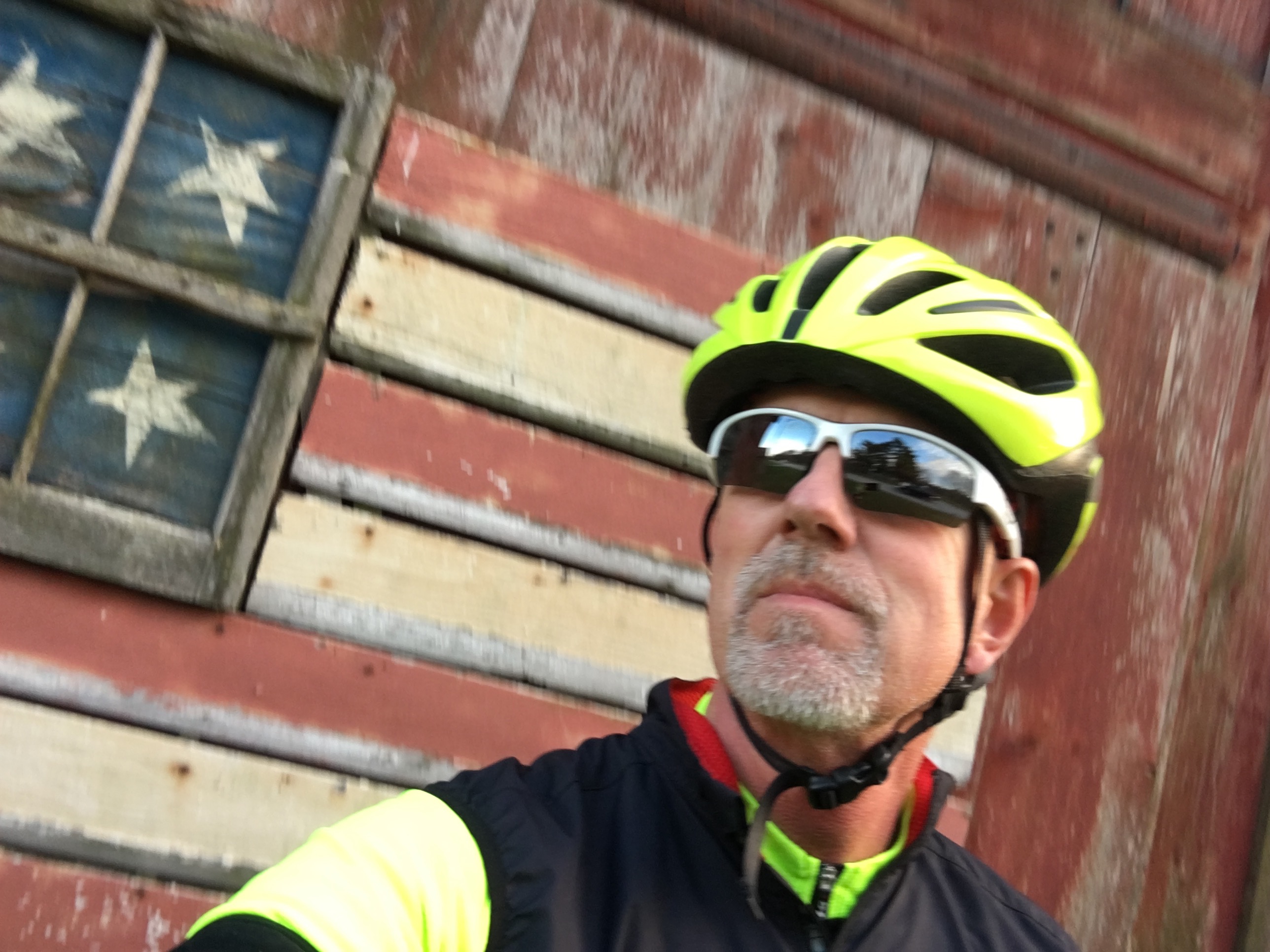
The next day I wrote: “Last night I was tired after work. Lay there on the bed wanking my hopes in the late afternoon sun. Exhausted. Mentally and physically because I woke up at 4:40 a.m. As again today. Wanted to bike but the hassle of tacking down gear (half an hour) and lateness of hour dimmed my wishes. Yet at 7:30, there goes Howard from down the street, rolling home. The true cyclist. I am just a hopeful pretender.”
Howard was a Category 3 criterium racer. I tried riding with him once and we hit a headwind and I got dropped. Life kept reminding me that I was “good” in some ways, but not great.
I kept writing on April 9. “I did manage something of a run. Traipsed over to the high school but there was a meet. Saw Doretta, whose son Talon is running. Then Clark Zetties, the doctor, who fought colon cancer. Then Dave Perkins walking their collie. So it was a social run. Which I needed because I feel alone in so many respects.”
“Routine is a deadly force in relationships,” I observed. “Its predictability is necessary for the functions of daily life, but that sameness can kill the spirit. And drown love. We wake to sleep. Then there’s work. The unstartling dirge of activity mixed with crises. What are we doing in life, with life? It is all strife and struggle.”

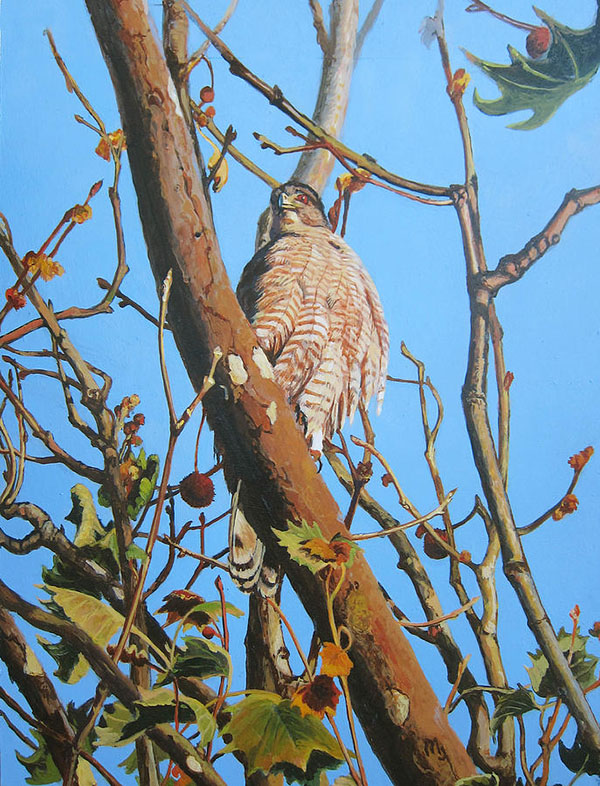
I noted in my journal: “Reading snippets about Roger Tory Peterson and his efforts to become a “real painter,” and artist as it were. Those paintings he did of an oriole, flicker etc. were popular and famous. But he was unsatisfied. Locked into a style he knew was practical and ultimately uninspired and differentiated. He longed to be Robert Bateman. So do I.”

My point in all that was that even world-class and famous artists or athletes go through the same struggles as the rest of us. They may operate at different levels or in different ways, but the pressures to succeed and the definite feeling of unsurety resides within them as well. That is life. There are no guarantees. You only know how good you are at anything by continuing to try, and grow.
Years after my full-on racing days were through, I observed to my mother that perhaps it was self-indulgent. “Oh, I don’t know about that,” she replied. “You burned brightly.”
The lesson in all self-doubts or “woulda coulda shoulda” retrospections is that we’re supposed to learn how to “live in the moment” and make the most of it whatever we’re doing. There aren’t any other realities waiting for us. This is everything we’ve got. Let’s live.


 We Run and Ride