
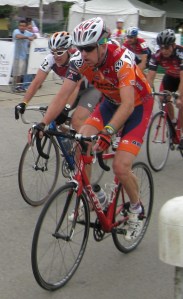
Flexibility is especially crucial to cyclists who race or ride really long distances.
Cycling is a multifaceted endurance sport that involves some contradictions, the first of which is that the lower part of your body is in almost perpetual motion while your upper body, if well-managed, should stay relatively still.
It’s almost as if a cyclist needs to split him or herself in half to be optimal on the bike.
Sure it takes a lot of energy to pedal. But a smart cyclist turns much of that effort into a cadence driven spin rather than pressing up and down on the pedals.
While lower body strength is obviously important to a cyclist—just look at the legs of world class riders if you doubt the need for strength, you can also make the case that core strength from the abdominals to the neck is vital to keep a good position on the bike to gain maximum outfit.
Flexible Flyer perspectives
Wherever your body is tight in terms of muscular and tendon connections, you are essentially pumping energy into resistance against those segments of your body and getting very little energy back in return. It’s like those tight spots are mini Black Holes in your body.
For example, if your Achilles or calf muscles are so tight that they limit ankle motion, that can cut down the range and power of your pedal stroke. Plus, if you’re tight in the knees on either side, that can pull your leg out of it’s most efficient rotation and put you at risk for an overuse or bio-mechanical injury.
When you consider how much movement your knees do during cycling, the amount of torque and wasted motion created by a tight or misaligned knee can be considerable. If every quarter pedal stroke carries your knee in a circumference 36” around, and you are riding at a cadence of 90 cpm (cycles per minute) each knee travels just over half a mile

every 60 seconds. Combined your knees cover a mile every minute. That’s 60 miles of knee rotation in an hour or 120 miles in two hours, all just to cover 30 miles. Perhaps you’ve been taking your knees for granted on the bike?
We’ve all ridden up behind a cyclist whose knees are pointing out at 30-degree angles as they pedal down the road. The added angular motion of the knees in that poor riding form is highly inefficient, using more energy because of the additional effort your legs must produce to cover the same rotational difference. It also increases your wind resistance profile, costing you perhaps 30% of your forward energy because you’re errant knees (or knee) is blocking that much more wind as you move forward.
The Flexible and Unflexible Platform
Often the reason cyclists stick their knees out is that their seat post is positioned too low. Dropping your center of gravity too low forces your knees outward to compensate for the additional leg length when the pedal comes up to the top position. If you are additionally tight in the hips, the knees, the ankles or the lower back, the “dropped seat” position may feel somewhat better because it helps you reach the pedals, but the net result is that it simply worsens an already problematic condition. Tightness becomes a self-fulfilling prophecy.
Your lower back is the most underestimated component of cycling efficiency. A tight lower back cuts power, but the balance for a tight lower back is strong abdominals. The cure for a weak or tight lower back starts on the front of your body where the stomach muscles “take up the slack” of an otherwise tilted pelvis, which puts your lower back into a curved or bowed position rather than straight. A strong core helps you perch on the bike rather than slap your ass on the seat and hang on with your shoulders and arms, and flailing away with you legs.
It all starts with your “platform,” that group of muscles strung like a basket around your hips, pelvis and pelvic floor. If those muscles are weak or tight, sooner or later your “platform” will tire from the added effort and you’ll find yourself weakening up hills or into the wind
Note: If your lower back and hamstrings are tight, they are essentially pulling against each other your entire ride. That means you’re doing work “within yourself” that can’t be pumped into the bike to make you go faster or longer.
If your core is weak your shoulders and arms will have to take up the slack. That can really knock you out on the bike. Bike fit has a lot to do with how your shoulders feel, but position on the bike also affects form and enjoyment. Most importantly, strength and conditioning of the core gives you the confidence and relaxation to ride your bike without fear of wearing out.
How to achieve a more flexible platform
Improving your flexibility through range of motion exercises like balance drills and toe raises increases ankle strength and develops balance, which you can use on the bike when you stand up to pedal.
Lunges
Use long, deep lunges to improve hamstring and lower back strength. As you progress add hand weights from 8 to 25 pounds and walk from one end of the room to the other. You’ll feel your body stretch out, your shoulders loosen up with time and your legs become steadier beneath you.
One Legged Squats
One-legged squats are an ideal exercise to enhance quad strength near the knees, hip flexor development and overall balance on the bike. This simple exercise requires no equipment and you can do it anywhere. It actually makes an ideal warmup exercise before a ride or a run. Just bend one knee at the joint to point the foot back at a 90 degree angle to the ground. Then lower your bent knee toward the ground so that your knee is about 8” or so above. Rise back up and repeat. Start with 10 repeats, alternating legs. You’ll feel it in your quads and butt, hips and Achilles are.
Planks
To do a plank, put your elbows together on the ground, rise up on your toes and hold that position for 60 seconds. This exercise very closely mimics your position on the bike and the tension your body feels holding itself up all day over the handlebars. Planks make your stomach stronger, and by proxy, your lower back.
One legged hamstring reach
Stand neck to a table for starters, and lift one leg straight out from your behind while reaching down to touch your other leg with the tip of your finger. Hold the position as if you were a ballet dancer at the barre. Usually 20 seconds is sufficient. This exercises causes your hamstrings to lengthen and is a great warmup before getting on the bike and being scrunched up all day.
Flat wall vertical arm swings
Standing with your back to the wall, put your arms flat against the wall and while keeping contact with the wall raise your hands up in matching arcs to touch above your head. This will strengthen and lengthen your shoulder muscles and even those touch muscles in the middle of your back where bands connect between your shoulder blade and spine.
Next, with your back to the wall, place your elbows against the wall and swing your hands from top to bottom, tapping the wall in both positions. This strengthens your shoulders as well, but gives your neck position a test that works well to prepare you for bike riding
Using these exercises to create a Flexible Flyer platform will help your efficiency, strength and comfort on you bike. No go out there and be flexible!


 We Run and Ride