

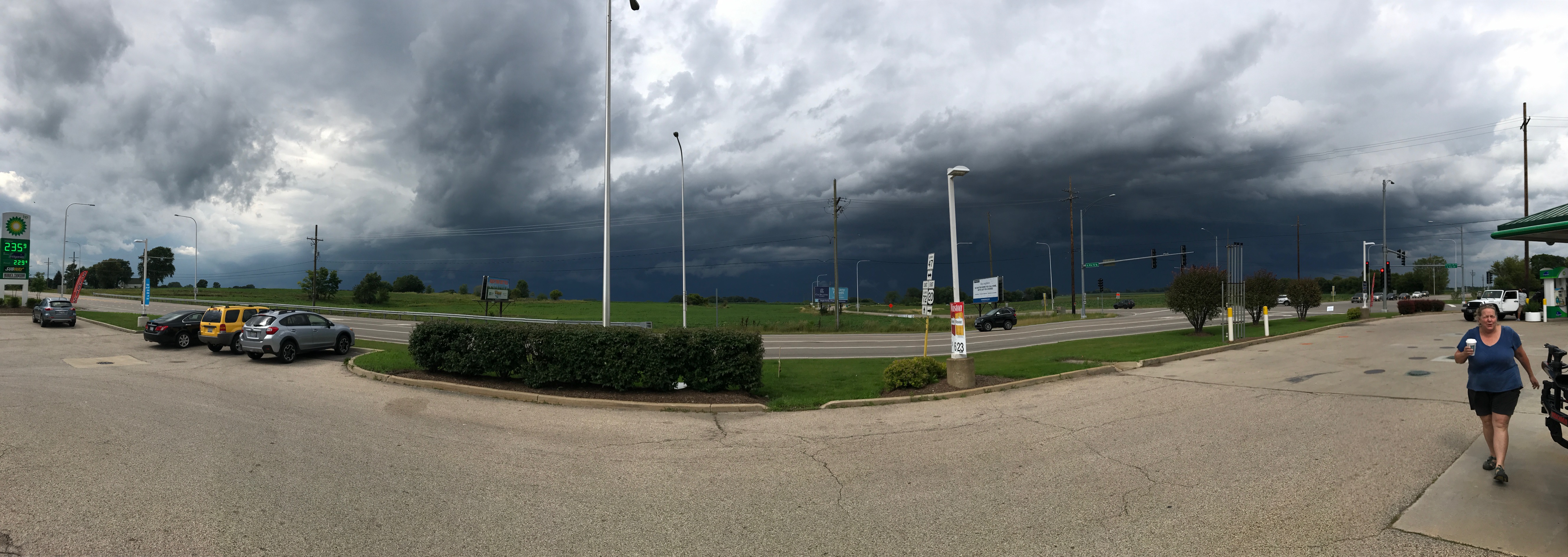
As our relationship grew the first few years, Sue and I began talking about marriage. We’d tested our compatibility in many ways: physical, emotional, and familial. Nothing’s ever perfect, yet we enjoyed each other’s company, found humor in many situations, and trained together almost daily. One of those afternoons we’d pedaled into Fermilab and made a big turn on the west end when a huge storm rose up and hit us flush from the side. The rain was coming at us horizontally, and wind buffeted us sideways on the bike. We rode headlong, getting soaked. When it was done the skies grew calm and we biked back through town to her rented home on Maves Street in Batavia. “Wow,” was all we could say. “That was intense.”
We got caught in the rain another day and parked under a tree as the skies unloaded. There was no lightning or thunder, but the roads were peppered with big drops and runoff streams, so it was safer to wait it out. After we pulled over, I looked at Sue whose eye makeup ran down her face in two long, black streaks. “Oh my God,” I laughed, “you look like Alice Cooper.”
These are the small moments that turn relationships into love. We laughed when I used the word “detritus” to describe the debris on roads after the storm. And on the day that Sue described her pet Wanda doing “cat physics” while considering a leap from one couch to another, I told her how much I appreciated her mind’s workings.
Her architectural training meant we shared artistic sensibilities. She also knew plenty of things I knew nothing about. She’d point out the assembly process as we passed a logistics building under construction. I’d written about precast concrete in my marketing work and we’d compare notes about the relative merits of building construction.
That brought us to discussing what to do with the house I’d owned since 1996. It was built in 1956 with a Wright-style extended roof that kept the house cool in summer and shed snow far from the walls in winter, it had no air conditioning except for the heavy wall units I’d been placing in the windows for over a decade. The old boiler in the basement fueled the radiant heating system, but it was original to the house, and impossible to tell if it would last another year or twenty years.
The biggest drawback in that home was the basement waterproofing system. A company called Everdry installed it before my late wife and I bought the home, but it was insufficient to keep the water at bay when big storms hit. Despite a system of drains installed along the home’s exterior walls, rainwater leaked across the basement floor on three sides of the house. The two sump pumps pushed water out of deep tanks at the north and south end of the west walls, but at times they could hardly keep up. Much of the problem was caused by the underground water table. Once while digging fenceposts on the back property line I discovered a layer of clay two feet down. The holes immediately filled with water once dug. Over time I realized the entire subdivision west of us was built on an underground stream flowing toward the Fox River from a wetland at Fabyan Parkway and Western Avenue. In the late 90s and early 2000s a period of immense flooding pushed the City of Batavia to address that hydrology, and sadly the result was a channelized drainage system where once a healthy farm wetland once existed.
Making matters worse at my home was a chimney crack that somehow allowed water to flow back through heat release piping next to the boiler. To deal with that annoying problem, I’d align loose gutter sections to direct the water pouring out of the galvanized pipe so that it would flow down into the sump tank.
All of this took place in “real-time” when the rains hit. Even our glass block window wells would fill up as the backyard became a lake. Mallard ducks would come perch in our yard when the water piled up. The stone block patio I built was tilted slightly toward the house and water gathered next to the sidewalk after the sand settled. I tried building a French Drain away from the house by wound up missing the mark by about half an inch so it didn’t drain completely.
I began to sense that the water we did push out of the sump pumps was just cycling back through the waterproofing system. That Sisyphean problem pushing me to the edge of tolerance. I’d contacted and met with the Everdry people and kept my $50 annual maintenance fee up to date. When sumps failed they installed a new one. That happened several times. The damned things ran 24 hours a day during the summer season. Even in winter the sound of the sumps going “whurrrrreeeyup” as they pushed water out into the yard was audible.
These problems drove a competitive urge in me to combat the home’s water issues. And once I began, it felt like the Water Spirits were having their day. A leak sprung in the roof over the garage and I got hit on the bald head with a cold spray of water once late spring day while I was taking out the garbage. “That’s it!” I hollered to myself. “I’m fixing this shit.”
Watery competition
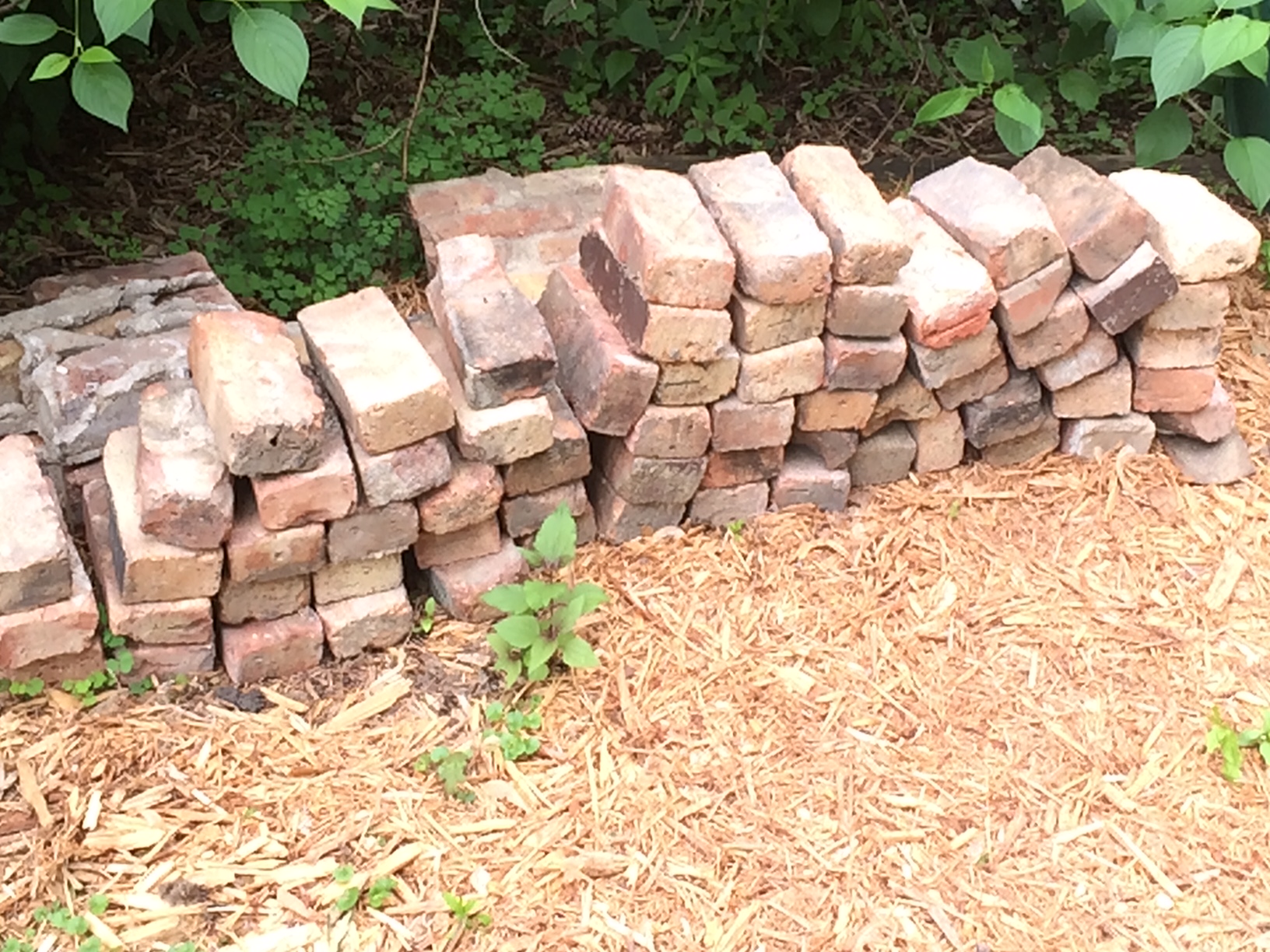
Eager to create a system where water wasn’t pressing against the house all the time, I dug waters features in two spots behind the house. The first received water from the sump at the Southwest corner. I lined it with bricks from the Old Chicago Stadium that I’d picked up from the guy who bought the whole place and sold it off. They had beautiful character and while I’m no sports sentimentalist, it was kind of cool knowing where they’d come from. Then I noticed a pile of old bricks outside an old building six blocks south of my home. I plotted to pick them up early one morning, but as I was loading them in my Subaru Outback, a man pulled up in a truck and asked, “Do you have permission to take those?”
“No,” I replied. “They looked abandoned.”
“Well, I own that building,” the man replied. “Those are my bricks.”
“Sorry,” I responded. “I’ll put them back.”
“No, at least you were honest with me,” he said. “You can go ahead and take what you have.”
I built a small platform with my brick collection and installed a pump that pushed water through a big clay pot with a hole in the side that I’d commandeered from my late wife’s gardening. It made me happy and the water was clear and clean and deep. The only time it proved dangerous is when a neighbor’s pug dog stumbled into the water and I had to pluck out the fat little pooch paddling around in the pool.
The other water feature was wider, flatter and rimmed with limestone rocks I’d brought back from a trip to Decorah, Iowa. That errand probably caused the rear bearings of the car to wear out before their time, but some risks are worth taking in time. I lined the two-foot-deep hold with flat stones but committed an error by cutting the AT&T internet cable during the excavation. They sent a tech out to fix my cable and sent me a $375 bill for the work, which was extensive, having to dig under the sidewalk and all, but I never paid it.
That water feature accepted the North sump pump’s flowage. And largely, that addition to my waterproofing system helped. My competitive urges to beat the water problems was mostly satisfied.

But then a blockage took place somewhere in the south system and the waterproofing guy came out to inspect it. He stuck some sort of backflush device into the piping system and gave it a big shot of pressure. To both our amazement, a geyser of water shot out of a pipe terminated in the front yard. Formerly the sump system pushed water out into the street, but that was banned a few decades ago, but the old infrastructure still existed. We had a good laugh out of that incident, as the sod blew out several feet from where the pipe ended.
Finally he put in a high-horsepower sump to deal with the South end water issues. I think that pump was 1.5 HP and it shot water out so fast it sounded like a fire hydrant hitting the back garden. Now the water was thirty feet away and to the south side of the house. Even it if didn’t cure the water problems, it felt good to punish whatever water dared enter my home.
All those issues contributed to my decision to ultimately sell the home rather than try to fix it up. The ancient boiler, the need for new roofing insulation, and aging old wallpaper all made it hard for Sue to love the place. We looked at taking some of my money to build a new entrance and fix all the rest, but the countervailing sensibility was that it was still the house where my late wife Linda and I lived for twenty years. My friends told me, “Usually a woman doesn’t want to live in the house of a former wife.”

And I got that. Some of the water problems flushed out any feelings of sentimentality. It was a tough decision to give up that home because I liked the general vibe with the pine three season room and the woodland garden between two maple trees that I’d built up with mulched leaves and soil, rich with ferns and transplanted redbud trees, but having moved many times before in life, I decided that it was a good thing to do.
My children were not big fans of the idea, I’ll admit. The memories tied to that home were strong. Their childhood and young adult years played big on their minds. But they weren’t thinking about the costs of fixing up the place. I was.
And time marches on.


 We Run and Ride