
By Christopher Cudworth

In some places the Cultural Shelf is a geological reality.
On the western edge of the sprawling Chicago Metropolis is an ancient ridge of gravel deposited by receding glaciers 10,000 years ago.
Most people who live in region seem to have no sense of this geological fact, or the history of this part of Illinois, and its subtle glory. But those of us who run and ride on it can literally feel the glacial ridge as we cross from east to west in Kane County.
The highest points in the region, after all, are glacial hills. They rise 150 to 200 feet above the otherwise low, rolling landscape. One such hill is called Johnson’s Mound. The steepest grade on the road up and over this prairie kame is 9%. Not much by mountain standards, but enough to challenge the legs and make the false flats feel like nothing when you ride back out onto the road.
The Cultural Shelf
Beyond topography, there is a geopolitical ridge in our region as well. One might call it the Cultural Shelf. Of course the giant city of Chicago dominates state politics for better or worse. But where the city ends, resistance to the urban, liberal, Democratic regime that runs it begins.
Illinois is technically a Blue State according to political analysts. But Illinois has also had its share of Republican governors. The last good governor was probably Jim Edgar, the only Republican or Democrat that, in recent years, has not gone to jail for corruption of some sort or another. Of course the most famous Republican of all was Abraham Lincoln, and Illinois is called the Land of Lincoln. But by today’s standards he would be a Democrat: Freeing the slaves and combatting the so-called government intrusion claimed by the Confederacy were all liberal ideals. The Cultural Shelf also shifts tectonically it seems.
Expectations high and low
So the Cultural Shelf in Illinois is not one of mere politics, but of highbrow and lowbrow expectations. If you know how to look, you can feel the Cultural Shelf just as surely as you can feel the glacial spine that splits our region in two.
The road divides
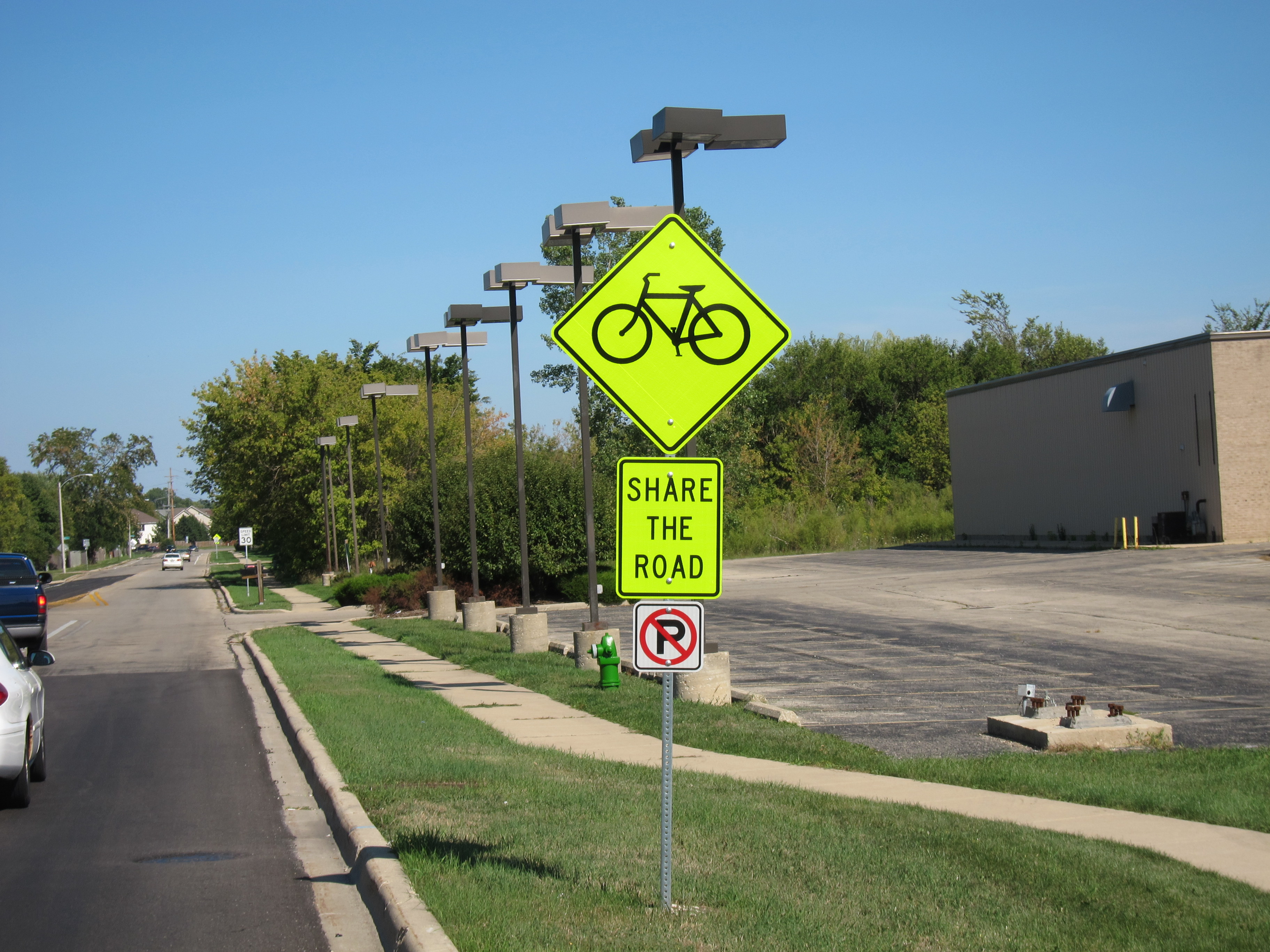
One can only hope drivers take the sign literally
Riding your bike on the roads west of the Tri-Cities of St. Charles, Geneva and Batavia is an experiment in tolerance and the supposedly highbrow practice of sharing the road. There are even signs stating SHARE THE ROAD on every major county highways.
Another road sign says CYCLISTS USE CAUTION, which is just brilliant, because the wording can apply to motorists as a warning to watch out for people on bikes and to cyclists as an instruction to use caution when riding.
The CYCLISTS USE CAUTION sign sits on one of the hilliest roads in the whole county. My Strava app lists the sequence of hills as the Burr Road Rollers, but what they really are is a product of some long ago glacier stalling out, leaving uneven piles of gravel in deep hills and pits. There are also little bowls of vernal wetlands here, and rare species of plants and frogs as a result. But it takes highbrow thinking, not lowbrow ignorance, to discover or appreciate these things. And it is symbolic in some way that the rollers sit precisely on the divide of the Cultural Shelf.
Backlash and backwaters
The county has for years now been buying up the most natural parts of our local landscape with $70M in funding handed to it through a tax referendum granted by the citizens of Kane County to preserve some of the better aspects of an otherwise egregiously abused landscape.
Once a prairie state, Illinois has but 1/10th of 1% of its natural prairie remaining. Some tiny shards of that pristine land are found in Kane County. Most of it cowers along railroad beds or other remote spots where native plants like bluestem, compass plant and prairie dock grow, and even rarer plants, if they’ve been lucky enough to hold on. They literally escaped the plow.
Restoration
The remaining prairie is in restored remnants, placed there by volunteers in painstaking efforts lasting more than 40 years. I personally planted a 15’ X 15’ plot of bluestem and Indian grass back in 1973, working with a fellow student on a hot summer day when it seemed like nothing we planted would ever amount to much. The seeds we planted that day had been carefully prepared for the moment, frozen and set into pots for propagation and that we later shoved into the ground. Those plants are now part of a four acre restored prairie at the trailhead of the Great Western Trail, a bike and running path that now extends from St. Charles all the way out to Sycamore, 17 miles away. The prairie now serves as a kickoff for hundreds of runners and riders who may have little knowledge that their first steps pass through a couple of acres of plants with a 10,000 year history in Illinois.
Reversion
The point here is that the Illinois landscape has been undergoing a tiny but persistent reverse transformation in some places. Some might call it a regression of sort, for it flies in the face of the supposed progress that brought civilization and prosperity to Illinois 180 years ago when the landscape was first settled. Farmers used steel plows to tear up the prairie and turn it into sod for crops. Then they placed drain tile in the soil to siphon off the giant marshes. It worked too well. Within 30 years the prairie was gone, and with it went prairie chickens, upland plovers and dozens of other species of birds and animals whose very existence depended on the prairie ecosystem.
Nowadays the county is breaking those drain tiles, restoring water to ancient swales and magically, the plants that once existed there come back, like dormant souls. But the tendency in some quarters is still to label such places a swamp and turn them into retention ponds, the ultimate insult to nature. But a recent series of floods has made it clear that natural water sinks are vital to real water management. Illinois is reclaiming its natural history in some respects.
But the notion of restoring the prairie is a highbrow but backhanded slap at the somewhat lowbrow (drain, plant and harvest) initiatives that killed off the prairie in the first place. Sure, it was hard work being a settler. But couldn’t we have saved at least some of the land that early explorers in Illinois called the most beautiful they’d ever seen? The highbrow succumbed to the lowbrow.
Debts and assets
And here’s where that kind of thinking starts to get real tricky.
The natural processes that built the rich farmland in Illinois are the same processes prairies restorations are trying to restore. The prairie built the soil inch by inch over 10,000 years, and farming cast away that rich soil by feet in some places in less than 100 years.
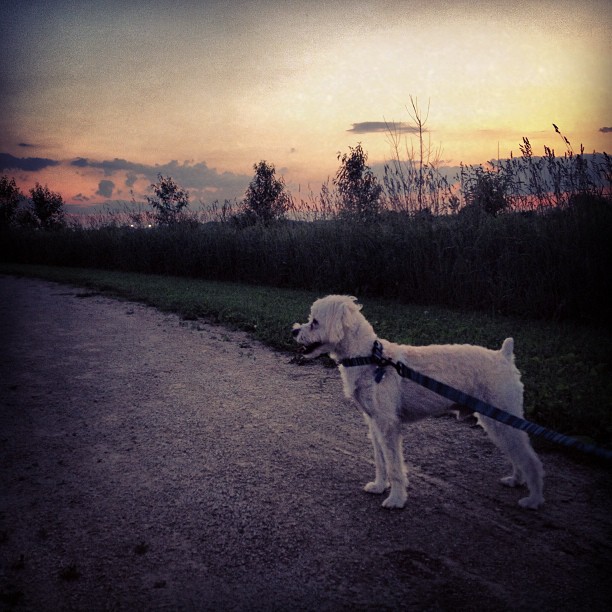 Walking through a restored prairie west of Batavia where I live, there is evidence of this soil loss along a fenceline. The posts stand on ground that is two feet higher than all the land around it. Until just 10 years ago, this property was farmed, and as a result, for 80 years the soil either sank, washed or blew away. You don’t see it happening as it is occurring, but it does.
It would have continued that way until we hit clay, one must suppose. That’s the dynamic in Illinois and all around the world. We’re feeding the people and starving the land of its richness at the same time. Industrialized farming has not cured the problem. But the fact may be that we can only fool ourselves for so long. The soil itself is not inexhaustible, we just like to believe it is during these times of seeming prosperity. Somehow the people who think most about the sinful nature of man do not seem able to connect that sinful nature to a propensity for destroying God’s creation. They simply don’t believe in it.
Why is that?
Dust Bowl lessons
We think back to the Dust Bowl on the Great Plains and how seemingly obvious it was that you can’t scratch up the grass holding the soil down and expect the resultant dry soil to stay put. The billions of tons of soil that blew around the plains for 10 years is evidence that human stupidity is damaging not only to the earth, but the people who live on it too. Dust Bowlers clung to their property (and their former prosperity) as it literally turned to dust, then more dust. People died by the thousands, choked to death by dust in their lungs. The land choked them to death.
It was lowbrow agriculture and greed that produced the Dust Bowl. IT was lowbrow thinking that drove the agricultural policies of the times, with false promises of riches, and slogans like Rain Follows the Plow that deceived people into planting the dry prairie.
Settle the Land was the goal. And how ironic. The middle of the nation ran up a big debt, in essence, to the land itself. And that debt, disguised as dust, even blew over the buildings of New York City at one point.
Cycles
One could argue we’re stuck in a similar cycle today, with nowhere to go but deeper into our own till. Our extraction and pollution policies never fully account for the damages wrought by industry or agriculture. We privatize the profits and socialize the losses. This is lowbrow thinking at its very worst. Then we tack on corporate welfare contributions giving incentives to companies to promote jobs, only to see those jobs shipped overseas. It’s like an economic Dust Bowl. Future for the Middle Class (like the middle of America, the Great Plains) turned to dust and blew away, on the wind.
Making things worse
 And where manufacturing was once 47% of the American GDP it now constitutes only 9%.
Sound familiar?
It’s just like the soil in America. We can see what was once there, and is now lost. Washed away from the Cultural Shelf, which sounds an awful lot like a Fiscal Cliff. Life imitates art.
Denial as a worldview leads to cliffs
Yet, we seem happier than ever to celebrate America’s lowbrow culture and policies.
Our politics, for example, are essentially divided over issues like guns (and denial that guns kill people) the Bible (a literal interpretation that results in a denial of science) and sex, marked mostly by a prurient obsession for controlling the sexual behavior of others.
As a nation we’re preoccupied with these issues yet 50% of the population seems bent on denying even a shred of common sense in defining them logically rather than emotionally, or religiously. That sort of ignorance is a straight path off the Cultural Shelf. A plunge toward idiocy.
It’s a country thing
Out past the Cultural Shelf the music on the radio changes to country music where laments over cheating wives and husbands, liquor and a strange brand of patriotism rules the airwaves. You can even haul your country music lowbrow worldview along with you thanks to satellite radio these days. That means the cultural shelf goes where you go.
Lowbrow drivers
More than one cyclist has encountered the citizens who live in lowbrow country, driving a red pickup with guns in the back and all too happy to buzz a cyclist…wearing lycra and riding inside the white line.
Fact is, when you ride out past the cultural shelf, you put your life in the hands of those who don’t give a shit whether you live or die. Because they think they own the road.
Yet the same guy who runs you off the road with his pickup tends to hate big government, which built the roads in the first place. So the whole worldview doesn’t make much sense. But that doesn’t matter to lowbrow thinkers beyond the heights of the Cultural Shelf. They’ll take simple thinking over highbrow reasoning and a skinny cyclist any day.
Lowbrow patriots

One of two bombs explodes during the Boston Marathon
Lowbrow thinking also tends to love the military over all else. Even God and country. Some people confuse the two readily, becoming terrorists for religion, or for nothing at all but their own aggrandizement and feelings of reconciliation. Others join racist militias, spouting conspiracy and exploding bombs in public places or clinging to guns as if they were representative of freedom itself. Those people, all of them, are lowbrow patriots.
Because the ugly fact about our militarized society is that more Americans have been killed on American soil by guns than all the soldiers in all our foreign wars combined. That’s a pretty lowbrow statistic, yet citizens who prefer living beyond the Cultural Shelf would say that’s the price of freedom. The 2nd Amendment is more important to them than human life. Selfish bastards don’t like looking up to anyone with standards. That’s the lowbrow way.
Even our movies celebrate lowbrow types with supposedly high ideals; gun runners, rum smugglers, dope dealers and vigilante cowboys new and old. It’s people who have fallen off the cultural shelf everywhere you look. The new American dream is a lowbrow worldview of “take what you can, any way you can get it.” It applies to Wall Street banksters as much as rural hucksters.
Not so smart
America is supposed to be better than this. But the proliferation of lowbrow thinking and the falloff in appreciation for considerate thought is on the upswing on every front. Even smartphones are apparently dumbing us down. Texting is gutting the English language and the Internet has cut attention spans, a phenomenon started by the supposedly smarter USA Today conversion of newspaper stories from long form to short tidbits. We saw it coming and we still didn’t do anything about it. And some political parties and certain partisan news channels really like low-information (lowbrow) voters who respond better to gut-level, visceral opinion than news or facts.
It’s like a game of chicken pitting a bike against a giant gravel truck. You know who’s going to win because stupid usually wins in such contests. Stupid has no conscience nor fear.
Mark Twain once said, “All it takes is ignorance and confidence, and success is sure.”
Unsustainably lowbrow
That doesn’t mean the type of success bred by ignorance is necessarily sustainable. The Dust Bowl is a classic illustration of that, but so was the pollution rampant in the 1970s. We recovered with a liberal dose of humility and changes to our habits. But now we’re facing global climate change, and the lowbrow, off the Cultural Shelf thinking that drives climate deniers is the same brute force stubborn thinking that makes people in country music songs do stupid things.
A new Dust Bowl?
Toward the end of May I drove home from my daughter’s graduation in Rock Island, Illinois. The same windstorm that kicked up that killer tornado down in Oklahoma was blowing like crazy in western Illinois. Farmers had just tilled their drying fields and the dust kicked up by the winds swirled dust-filled mini-tornados everywhere you looked. My daughter was in the car ahead and could hardly see the road ahead at times, the dust was so thick. She got a little freaked out, to be honest, and called me on her cell phone. “Can we pull over?”
So we did, and I ran up to her car and looked her in the eye and said, “We need to keep going or this is going to catch us for real.” She glanced back at the black wall of clouds now shrouding the western horizon. “Okay,” she said. “Let’s go.”

Actual photo of a New Dust Bowl taken in May 2013 in Illinois
We tarried on, keeping the speed around 50mph as wave after wave or dry brown dust blew so heavy and thick the taillights of the trucks in front of us looked like they were underwater. In the rearview mirror of the U-Haul truck I looked back at the giant black cloud and saw lighting flash red as blood in the clouds. It was a biblical-looking scene, like the rest of America west of the Mississippi River was being closed off for good. Do not pass Go. Do not collect $200. Maybe the Left Behind folks were right after all. America was f’cked.
Finally the dust cleared up a bit and I called my daughter on the cell phone and told her, “Hit it.” We jammed the accelerator and rose up to 75 and got the hell out of that storm.
Parallels on the open road

Some people hate the sight of a cyclist on the road. It bugs their lowbrow worldview.
It occurred to me at that moment that last summer I had ridden my bike from Dixon back to Batavia on country roads parallel to the road I was now driving. That day there was a tricky East wind that made the ride a lot tougher than it needed to be. But it was fun, and being out in the country on your bike is a feeling like no other. I had ridden back up the cultural shelf to my home on the ridge of the American divide. Surely the people who look out their car windows and think of cyclists or runners as nothing more than selfish, narcissistic nuts fail to appreciate the basic desire to both be in touch with the land and in touch with yourself.
50% lowbrow
One wonders, in a country where something like 50% of the population is chronically obese and another 50% believe in a dumbed down, literal interpretation of the Bible that even Jesus would not have liked, whether the cultural shelf has not already eroded right up to the banks of sanity itself.
Those of us who hear the shrill shriek of voices shouting at us to get the hell off the road, and who hear the gunning engines bearing down on us from behind know that truly selfish thoughts have more to do with aggression than intelligence or consideration. Surprise, surprise.
Cultural freedumbs
But we must draw our own conclusions and in turn, live our lives even in context of those who do not think like us, even those who appear not to think much at all, or at least want to. The freedoms guaranteed by the United States Constitution do not demand that people give much thought to how their supposed freedoms, like being a bully with their truck on the roads, can impact the lives of others. We’re as free to be dumb as we are free to be enlightened. The Cultural Shelf is proof of that.
We’re all just trying not to ride off the edge, or be driven off by others.


 We Run and Ride