
Everyone knows that getting injured sucks. No, it really sucks. More than sucks.
Being hurt grinds you down to the nub of who you are, not who you want to be.
In that circumstance, you had better be prepared to deal with who you are–as a whole person–if you want to get through an injury with self-respect and motivation intact.
So why mess around?
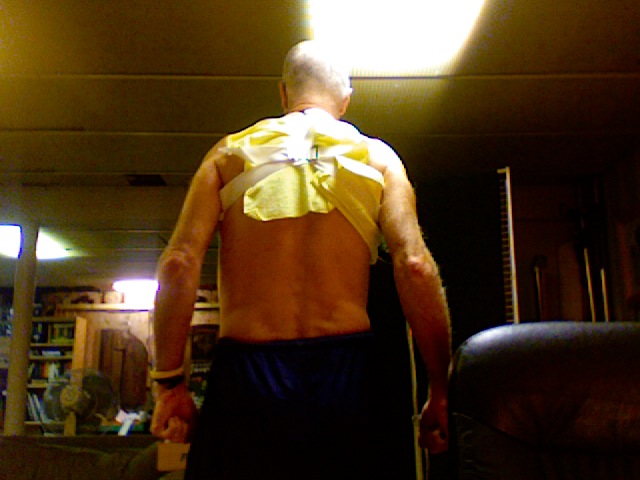
A wounded warrior wears a figure 8 brace for a broken collarbone.
Because whether you are one of those people who was born with a desire to participate in athletics, or discovered a love for sports like running and riding in your adult years, you know that a chunk of your self esteem is attached to that athletic core you’ve worked so hard to build.
Remove it for a day, a week, a month or a year, and a chunk of yourself goes away. Poof.
You’re left with the rest of yourself. The soft underbelly of Me. So how do you survive life without your tough, athletic exterior?
Taking the long view
If you’ve been an athlete most of your life you learn that you have to suck it up and wait it out. That’s right. You simply must take the long view (that might be days, or weeks or years, it’s all relative to your condition) or suffer the self-imposed indignity of feeling sorry for yourself every single, damn day. And that’s no way to go through life.
Wading through jealous payback
You also have to deal with the specifics of going back to work or other situations where you’ll no doubt face questions about your fitness routine from the very co-workers you’ve regaled for weeks or months or years with tales of training triumph or goals achieved in races. Suddenly you’re not talking about all that. And you know what? There might be a little payback to endure. People can be notably unsympathetic to former fitness braggarts, particularly if you’ve ever lauded your overall fitness in front of them in any way. We might not even know we’re doing that at times, such is the joy of running or riding. But secretly, some people might think you insufferable. And will not let you forget it.
Embrace the challenge
You need to embrace your injury or illness as a sign of trying your hardest and doing your best in something that ideally does transfer to better health, focus and work performance.
Then when someone digs at you a little for crashing and burning, you can reply in modest hope, “Well, injury and illness is part of the risk.” People have a harder time arguing with the idea of risk, because it is associated with courage and bravery, traits idealized in the corporate and social world. And if your protagonists still want to crush you for being a broken-down fitness nut, and say something like, “Well, this just proves what you’re doing is stupid,” you can humbly say, “Well, that’s your choice to believe what you want to believe. I’m sorry if I’ve ever offended you in any way. I just know what works for me.”
And leave it at that.
Unfortunately you’re still left with your banged up self, torn or half-sick condition, and athletic egos can be fragile, especially in the private space of planning your own schedule. That ‘workout hole’ where you used to run and ride can feel like a huge gap in your persona. So fill it with something constructive and uplifting. Nature walks. Volunteering at races. Get involved with your church or non-profit. Be around things that make you feel good. Then when you return to your training, you’ll have even more to think about. That’s a great cycle to develop.
Overall, the best approach to maintaining hope of better days is to place your fitness interruption in perspective. Take stock and you’ll realize that setbacks are just that. Like the pain you experience during a race, this too is only temporary. Pain is only temporary.
When change is permanent, expand organically
But sometimes it’s not. You’ve lost your ACL or turned an ankle for the 12th time and soccer just isn’t in your future. Not if you have any common sense. That means your athletic identity is about (or needs…) to change.
Be not afraid. Pick and choose from your training experiences to see where you can expand organically. A cyclist who is injured in a road crash can ride indoors on a trainer. A runner recovering from plantar problems can hit the bike trails and keep up a degree of fitness. The pool is always a good place to rehab. But please, don’t tell the swimmers. We never want them thinking their sport is superior to everything else. That would make them intolerable, and might resign too many of us to staring at a blue line on the bottom of a boring pool. A fate worse than drowning.
Owning your athletic identify
Your athletic identity is something you own and manage. No one can do it for you. If you’re hurt badly and it’s going to be a while before you run or ride, then start a walking program. Wear your running outfit and embrace the movement.
Or, do rehab and physical therapy exercises. Lift weights or go indoors with assisted weight machines and other ways to maintain muscle strength in key areas. Use the valuable time you’ve been given to balance out your overall musculoskeletal system of joints, support muscles, tendons and ligaments. Then when you return to action your risk of injury will truly be reduced. Physical therapy can eliminate chronic running problems such as iliotibial band syndrome, chrondromalacia and and “runner’s knee.” Cycling injuries to the shoulders can be eliminated through strength and core training as well.
Fortunately we live in an era where there are hundreds of opportunities to engage in active rehabilitation. There’s yoga. Pilates. Spin classes.
The art of knowing yourself
The fact of the matter is whether you like it or not, you can never be the athlete you were yesterday any more than a great artist like Picasso or Degas or Wyeth were the same artists they were the day before. Change occurs. Influences impact the framework of your belief system.
Being hurt or sick really does suck.
But refusing to accept the message each circumstance is trying to teach you about the need to moderate or change what you’re doing is of far greater risk to your long-term fitness plans than ploughing ahead doing the same things the same way. Exploiting your weaknesses is no way to improve. Diversifying your strengths to compensate for your weaknesses is a far better approach. Being sick or hurt is absolutely the best time to assess your weaknesses and strengths, and start along a new path to self discovery.
You can be an artist in managing your athletic identity. It just takes the ability to see the bigger picture in who you’ve been, who you are, and who you want to be.


 We Run and Ride